
Fahrenheit 451 is a 1953 dystopian novel by Ray Bradbury in which books are outlawed and firemen burn them, and 451 degrees Fahrenheit is the autoignition temperature of book paper. This Fahrenheit 451 study guide walks you through the whole thing in the order teachers and readers actually need it: the facts you get tested on, a spoiler-labeled plot summary of all three parts, character analysis, themes, symbols, language, and a bank of discussion and essay questions. Last updated October 2026.
If you are writing an analysis essay this week, start with the question bank near the end and work backwards. If you have not read the book yet, the at-a-glance box below takes about four minutes.
Table of Contents
- Fahrenheit 451 Study Guide at a Glance
- Ray Bradbury Fahrenheit 451 Study Guide: The Facts That Come Up in Tests
- What Is Fahrenheit 451 About?
- Ray Bradbury Fahrenheit 451 Study Guide: Plot Summary and Spoilers
- Part One: The Hearth and the Salamander
- Part Two: The Sieve and the Sand
- Part Three: Burning Bright
- Who Are the Main Characters in Fahrenheit 451?
- Why does Clarisse matter, and was she killed by Beatty?
- Why does Mildred try to commit suicide?
- What Are the Main Themes in Fahrenheit 451?
- Why Are Books Important in Fahrenheit 451?
- What Symbols and Details Matter in Fahrenheit 451?
- How Does Ray Bradbury Use Language and Imagery?
- Simile and metaphor for the mind and the world
- Contradiction between fire and water
- Imagery of birds, light, and sweetness
- How Is Fahrenheit 451 Structured?
- What Historical and Cultural Context Should Readers Know?
- How Do You Write a Fahrenheit 451 Analysis Essay?
- What Questions Should Students Ask About Fahrenheit 451?
- Comprehension
- Analysis and evidence
- Higher-order and essay
- Frequently Asked Questions
- What is the main message of Fahrenheit 451?
- Why is the temperature 451 important in Ray Bradbury’s novel?
- Does Fahrenheit 451 have a different ending in different editions?
- Why does Montag save books instead of simply reading them?
- What grade is Fahrenheit 451 appropriate for?
- Conclusion: How to Use This Study Guide
Fahrenheit 451 Study Guide at a Glance
Everything below comes up in essays, quizzes, and class discussion, so keep it in one place before you read a single chapter.
Ray Bradbury Fahrenheit 451 Study Guide: The Facts That Come Up in Tests
| Element | Detail |
|---|---|
| Author | Ray Bradbury (1918 to 2012), American novelist, short story writer, and playwright |
| First published | October 1953, Ballantine Books |
| Genre | Dystopian fiction, with crime, science fiction, and social satire elements |
| Length | About 156 pages in common paperback editions |
| Setting | An unnamed future American city, a rural riverbank, and a wooded valley outside it |
| Narration | Third-person limited, anchored in Guy Montag, with stream-of-consciousness passages |
| Parts | Part One, The Hearth and the Salamander; Part Two, The Sieve and the Sand; Part Three, Burning Bright |
| Central conflict | A fireman who begins to read books must decide whether his own curiosity, or the state, is the real enemy |
| Protagonist | Guy Montag, a fireman whose job is to burn books |
| Key characters | Clarisse McClellan, Mildred Montag, Captain Beatty, Professor Faber, Granger |
| Primary themes | Censorship and self-censorship, conformity, mass media, technology and dehumanization, memory, empathy |
| Most taught at | Grades 9 to 10, often tenth-grade English or AP Literature |
One term you will be asked to define: dystopia is a fictional society presented as oppressive or degraded, usually one readers can measure against their own world. Dystopian fiction is the genre built around that society.
What Is Fahrenheit 451 About?
Fahrenheit 451 follows Guy Montag, a fireman in a future society where all books are banned and unread books are burned. After meeting a curious seventeen-year-old neighbor, Clarisse McClellan, Montag starts hiding books and reading them, which turns him into a criminal hunted by his own department. The novel asks what happens to people, and to a whole culture, when nobody bothers to think independently.
The central conflict is Montag against the machinery of censorship. The secondary concern is larger and stranger: the people who enforce the ban are not monsters, they are bored television viewers who would rather not be disturbed by difficult ideas.
Two title details matter before you start. First, the firemen in this world are not firefighters who put out fires; they are firemen who start them, and the fire is usually a book. Second, 451 degrees Fahrenheit is the temperature at which book paper ignites on its own, which turns the title into a piece of real science rather than decoration.
Ray Bradbury Fahrenheit 451 Study Guide: Plot Summary and Spoilers
Spoiler-free orientation: the novel opens with the daily routine of a fireman, introduces a strange neighbor girl and a nagging question about his marriage, and then escalates as Montag starts hiding books at home.
Spoilers for everything below.
Part One: The Hearth and the Salamander
Montag lives with his wife Mildred, whose family he married into, in a house with a giant parlour wall that fills a room like a fireplace. He is delighted when the firemen are called to a house where an old woman has hidden books under the mattress.
The next day his new neighbor, Clarisse, walks past and asks a question that sits wrong: she wonders whether the firemen ever get lonely. Over the following weeks she asks more questions, mostly about nature and personal history, and Montag finds himself looking forward to them. In Faber’s words, she has put Montag in the minority of people who still think.
Montag confronts Mildred about her unwillingness to leave the parlour wall and notices she does not even remember the conversation. Then he reaches for a book he has never read, and one line of Clarisse’s about people reading nothing but cheap paperbacks makes him feel sick with shame.
Here is the pivot: Montag goes to a neighbor, Mrs. Bowles, who turns out to be hiding books. When he tries to pass them off to a woman at her house, the woman, Mrs. Phelps, asks why he wants a book. He hands it over, then remembers what he has done and runs. Mrs. Bowles phones his department anonymously, which is how Beatty arrives.
Part Two: The Sieve and the Sand
The opening line, “The salamander tolerated me, one of the few in the house,” marks the moment Montag seeks out Professor Faber, a man banned years earlier for owning books. Faber gives him a portable hollow of his own so he can travel with books, and recites lines from Matthew Arnold’s poem Dover Beach, especially the plea to be true to one another. Montag memorizes it.
Beatty comes to his house, seizes the stash, and delivers a long speech arguing that books were burned not by governments but by minorities, and that people chose to stop reading because reading is hard and television is easy. Montag sees that Beatty knows the arguments against his own position better than anyone.
That night Mildred takes an overdose of sleeping pills. Two firemen come in with the mechanical hound, and while they pump her stomach they casually discuss a case in which a woman was found dead in her own house, burnt, four days earlier. The conversation suggests a serial killer who has been burning women alive. Montag later realizes the body in that flat was Clarisse.
Then the hound arrives at the house and nearly kills him. He runs to Faber’s, and Faber gives him a wick or match, a small canvas satchel, and a direction: leave, survive, memorize books, and meet the people in the woods.
Montag goes to a bridge or overpass where people watch the road burn out, and hands books to strangers, to people who dropped out of high school, to people who were beaten for being different, and to a man who has never read a book and finds a book moving. When he turns to go, one person asks him to stay. He walks away, having become, briefly, someone who gives.
Part Three: Burning Bright
Faber, on the trail Montag left behind, tells a follower that the man who left is not running away but going toward something, which is the novel’s most quoted reversal. In the woods, a man named Granger shows Montag a group of thousands, walking, living off what they can memorize, waiting for society to fall apart so they can hand civilization over in better shape.
Montag says he was not afraid of the city, which surprises Granger. Montag joins them and begins with Ecclesiastes, learning it by heart because it is short and bitter in the way he now needs.
The atomic bombardment destroys the city. The book people watch from a distance, then start moving toward it to rebuild. The novel ends on the image of the river and the honeycomb, and on faith that people who remembered were worth keeping.
Who Are the Main Characters in Fahrenheit 451?
Montag is the only character who changes, so every other figure exists to press on him from a different direction.
| Character | Role | Key trait | Arc or function |
|---|---|---|---|
| Guy Montag | Fireman, then fugitive | Curious, quick to change, often scared | Moves from doing the burning to protecting books to memorising them |
| Clarisse McClellan | Seventeen-year-old neighbor | Restlessly curious | Her questions start his; her death confirms the danger of curiosity |
| Mildred Montag | His wife | Passive, numb, plugged into the wall | Tries to overdose, then betrays him and leaves |
| Captain Beatty | Montag’s fire chief | Well-read, cynical, tired | Antagonist who knows his own argument is weak |
| Professor Faber | Former professor and actor | Old, dignified, practical | Supplies the books, the motto, and the direction to run |
| Granger | Leader of the book people | Blunt, philosophical | Gives Montag a purpose and a long view of the future |
| Mrs. Bowles | Montag’s barren neighbor | Empty, delighted by fake sympathy | Hides books out of fear and reports him out of fear |
| Milton Montag | Montag’s grandfather | Surely the memory is real | Named as someone who once knew books |
Why does Clarisse matter, and was she killed by Beatty?
Clarisse does the novel’s questioning so readers do not have to. She asks about happiness, about empty churches, about whether firemen get lonely, and Montag cannot answer any of it. If you are asked why she was killed, give the official answer and the implied one: officially a speeding car killed her, but Bradbury strongly implies Beatty had her killed, because a teenager who asks real questions endangers the whole system. The firemen’s careless talk about a woman burnt four days ago is the clue.
Montag and Clarisse do kiss, once, in Part Two. It is brief and neither character names what it means.
Why does Mildred try to commit suicide?
Mildred is what the society produces: passive, soothed by the parlour wall, unable to hold a thought for more than a minute. Her overdose is part of a pattern, since the firemen report that seventeen people a year take sleeping pills in her city. She later shows her fear by reporting Montag’s stash and leaving him, which makes her a second, quieter antagonist.
What Are the Main Themes in Fahrenheit 451?
Bradbury wrote about seven intertwined ideas, and the strongest answer to what is the most important theme in Fahrenheit 451 is that censorship works only because people volunteer for it.
- Censorship and self-censorship. Beatty admits the ban was not imposed top-down; minorities raised objections and everyone else got bored, so they quit reading on their own. It pairs with Faber telling Montag that no one is needed to censor, that people do it themselves.
- Conformity and the desire for sameness. The Mechanical Hound looks like any other dog, which is the point. Nobody questions it, and Beatty’s logic that the crowd is always right keeps citizens unable to think independently.
- Mass media as an instrument of control. The parlour walls do not argue. They flood rooms until thinking becomes effort. Many readers argue this, rather than censorship, is the real threat in the novel.
- Technology and dehumanization. Screens, the hound, and the fast cars all do the human work of policing. The hound never pulls a trigger, which keeps it chilling.
- Anti-intellectualism. Books are called, accurately, a load of crap and a load of madman scribbles. Fahrenheit 451 is a temperature, not a complaint about literature’s quality.
- Memory versus distraction. The book people trade printing for memorization because paper can be burned. Ecclesiastes is chosen because it is short and bitter, exactly what Montag can carry.
- Empathy and human connection. Clarisse asks how people are happy and how they are unhappy. She is killed the moment she crosses the screen, which makes her death a death of empathy rather than only of a person.
Bradbury’s own interpretation shifted. He first wrote about book burning and the Second Red Scare, then in the 1979 Coda said the dangers were not government censorship but television, radio, and stupid audiences that gave up thinking. In a 1994 interview he pushed it further, describing his work as a warning against being pressured into political correctness. If your class asks why Bradbury changed his story, that is the answer.
Why Are Books Important in Fahrenheit 451?
Books matter in Fahrenheit 451 because they are the only technology in the novel that requires a person to be alone, slow, and thinking. Everything else in this society works faster than a thought. A book asks you to hold an idea in place, which is precisely the ability the state and the wall cannot tolerate.
Montag’s reading experience is built as a sequence, not a leap. He reads too much, then reads too fast, then cannot focus, then hates books, then reads slowly again. That middle stage, where he physically cannot sleep, is the most accurate thing Bradbury wrote about reading, and it is worth quoting in an essay.
Beyond symbolism, the books do practical work in the plot. They are contraband that proves a crime, a lesson that arouses suspicion in a child, a wedge between a man and his marriage, and finally a burden the survivors carry in their bodies. Faber’s hollow, the memorized books, and Granger’s plan are all attempts to put knowledge somewhere a fire cannot reach.
What Symbols and Details Matter in Fahrenheit 451?
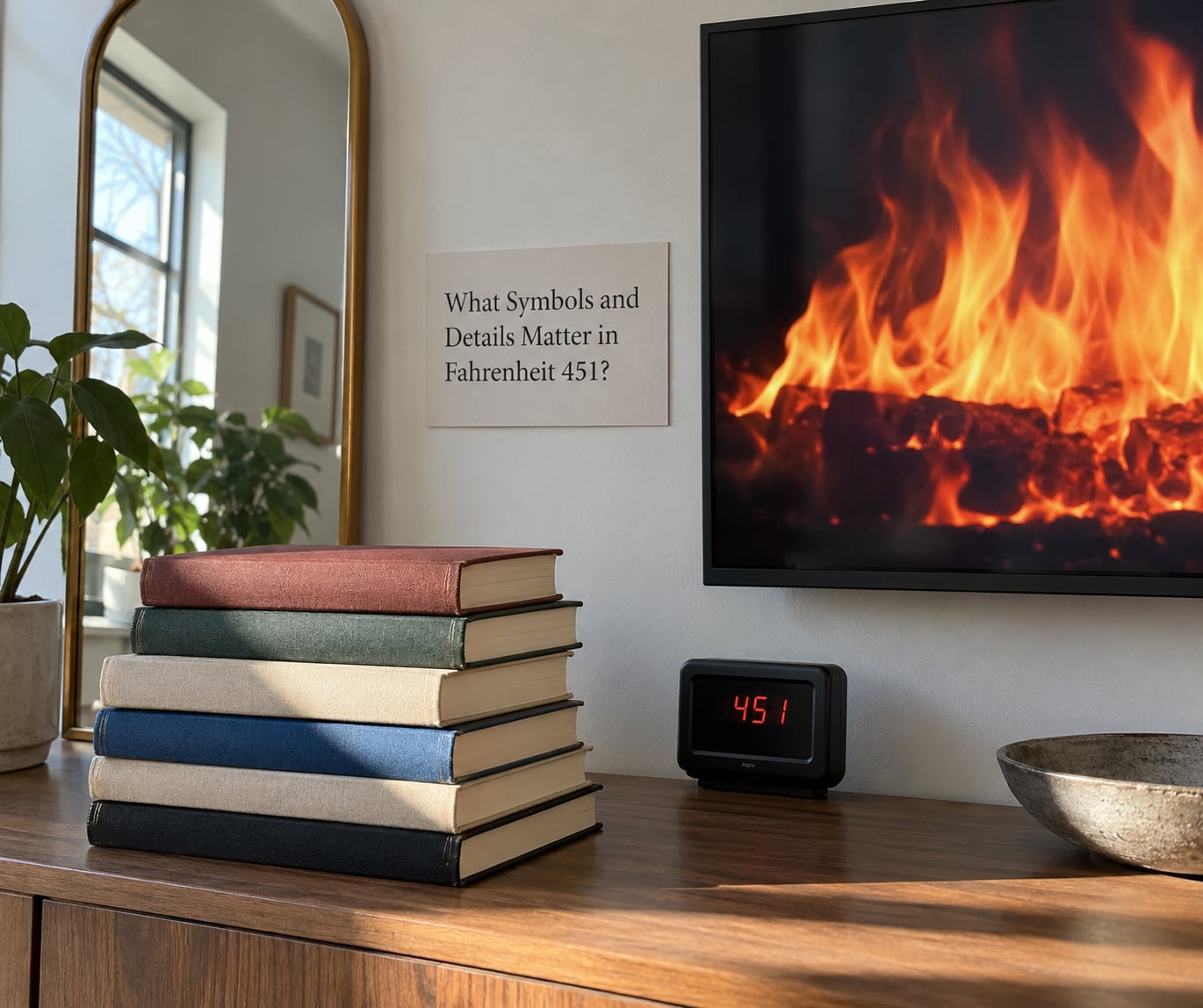
Symbols in Fahrenheit 451 work best as pairs: every warm symbol has a cold one facing it.
| Symbol | What it represents | Where it appears |
|---|---|---|
| 451 degrees Fahrenheit | Autoignition temperature of book paper, and the cold logic of the system | Title; fire scenes throughout |
| The salamander | The fire-resistant survivor, and Montag’s self-image | Part Two, Faber and Montag’s emblem |
| The phoenix | Rebirth and rising again from the ashes | Part Three, the book’s hope |
| The Mechanical Hound | Technology that enforces conformity without hatred | Part Two, the hound used in Mildred’s overdose |
| Parlour walls | Passive mass media that fills the space where thought would be | Montag’s home, throughout Part One |
| Seashell ear-thimbles | Emptiness disguised as culture, what is left once thought is gone | Mrs. Bowles, Part Two |
| Dover Beach | Honesty between people, and the need to be true to one another | Part Two, taught by Faber |
| Fire and water | Destruction and restoration | Fire scenes in town, the river in Part Three |
| The fog and the river | Escape, instinct, and the limit of what technology can control | Montag’s flight along the river |
The Mechanical Hound is worth extra study because it never speaks. It is a dog-sized machine with a metal eye that stirs at night, and it does not hate anyone; it simply follows a scent and a sound. Beatty works to convert it to friendly, so the threat comes from the machinery of the job rather than from any villain. Bradbury even gives it a system so human and so blind that it pities its own victims, which is the frightening part.
The mirrors and blinds are smaller details worth naming in class. Beatty’s office window is adjustable in twenty-three different ways because people come from twenty-three different places and he must tune his face and posture for each one, a small image of total corporate management of identity. Montag’s TV set has four-inch by six-inch speakers at a time, a satire of how attention is rationed by manufacturers.
How Does Ray Bradbury Use Language and Imagery?
Bradbury writes in short bursts of sensory detail, and the effect is a reader who is looking at a fire rather than reasoning about one. Close reading works best on the language.
Simile and metaphor for the mind and the world
The famous opening comparison of eyes as “two pale drops of milk completely surrounded by a darkness of skin” is not decoration; it converts sight into touch. Later, the city beneath them is “a dish of ashes,” and the river “poured quietly over the bridge, and whispered with a kind of musical insistence toward the sea.” Personification gives the natural world a voice, because human voices in the novel are thinned out by design.
Contradiction between fire and water
Water keeps appearing against heat, and the river is the one thing the Mechanical Hound cannot follow far. The novel’s moral and its image system agree: extinguishing is harder and slower than igniting, and living things endure. That also explains why the ending bombing feels enormous but not random; fire has always been the background condition of this world.
Imagery of birds, light, and sweetness
The mockingbird, the seashell, and Faber’s line about a honeycomb build the image of what books preserve, something vivid and inconvenient. Read those images together rather than separately, or you will reduce the novel to a symbol test. For essay support, look at motif, a recurring detail that accumulates meaning, versus a symbol, which stands for one idea.
How Is Fahrenheit 451 Structured?
Fahrenheit 451 is built in three named parts, and each one changes what the reader believes is possible.
| Part | Title | Key events | Main theme |
|---|---|---|---|
| Part One | The Hearth and the Salamander | Montag’s routine, Clarisse’s questions, the old woman’s books, the first reading and the first raid | Curiosity begins as an irritation |
| Part Two | The Sieve and the Sand | Faber, Beatty’s raid and speech, Mildred’s overdose, the hound, the flight, giving books away | Censorship against individual thought |
| Part Three | Burning Bright | Granger and the book people, the bombing, the decision to rebuild | Memory as survival and inheritance |
Part One is deliberately slow. Many readers report the first thirty pages as nearly suffocating, and they are right; the early flatness is the point, because it mirrors a society where nothing has happened yet. Part Two compresses several crises into a few pages, which is also a fair criticism, since Montag’s fear changes faster than his reasons for changing. Part Three shifts genre again, from thriller to parable.
The settings alternate on purpose: parlour walls, then the open road and river, then the woods and the walking group. Between the walls that lock you in and the open country that exposes you, the only private space in the novel is a mind that has read something.
What Historical and Cultural Context Should Readers Know?
Bradbury began Fahrenheit 451 as a series of short stories before turning it into a novel, so the historical roots are unusually traceable.
- Nazi book burnings, May 1933. Public burnings of banned books in Germany shocked him as a teenager, and the name Fahrenheit 451 was chosen partly for that tradition of destroying writing in public.
- The Second Red Scare, 1950 to 1954. The House Un-American Activities Committee investigated and blacklisted writers, artists, and teachers, and an early version of the book included scenes of people being hunted for their views.
- The Fireman, 1951. A novella about a fireman who is himself on the run from police, which Bradbury expanded after seeing how well the premise worked.
- Television’s Golden Age. By the early 1950s sets were moving into American living rooms, and Bradbury saw entertainment designed to be consumed rather than questioned.
- Publication in October 1953. Ballantine Books issued it the same year the House Un-American Activities Committee held its hearings.
Bradbury also said he was writing about the Hungary of 1956 when asked about his intentions, and he called himself a preventer of futures, not a predictor of them. The novel has been challenged or removed from school programs in South Africa, Panama City in 1987, Irvine in 1992, and Montgomery County in 2006, so a classroom question about whether a school may remove the book is not hypothetical.
Two edition notes protect your grades. In 1956 the Bal-Hi textbook edition was expurgated at the publisher’s insistence, which cut words, references to organized religion, and the most famous lines of the fire scene; Bradbury spent years restoring the text. Any quotation you find online may match a censored edition. A second note: the numbers on the wall of the Advanced Ceramics Shop in Faber’s apartment were a detail Bradbury often joked about, so if your teacher asks about it, there is no single answer.
How Do You Write a Fahrenheit 451 Analysis Essay?
Most marks are lost in the planning stage, not the writing stage, so work through these five steps before you type a sentence.
- Pick one idea, not the whole book. Themes that carry an essay are narrow. Try conformity through the Mechanical Hound instead of censorship in general.
- Write a thesis with a mechanism in it. Weak: society is bad. Stronger: Montag’s conversion works because the society removed all friction from disagreeing.
- Collect three pieces of evidence. One quotation, one detail that is not a quotation, and one scene you summarize. Details count as evidence.
- Connect the quotation to the claim. Use about one sentence to parse the words and one to explain what they do in the scene.
- Add context last, and only what serves the point. One sentence on McCarthyism or on Bradbury’s 1979 Coda is enough. Context that does not connect to your thesis is padding.
A model thesis: In Fahrenheit 451, Bradbury argues that censorship succeeds by making itself convenient, because Beatty’s speech and the wall screens remove the discomfort that disagreement requires.
A short outline: opening claim on convenience; paragraph two on Beatty’s raid speech and how he argues from his own reading; paragraph three on the parlour wall and Mildred, who reports Montag without being ordered to; short closing sentence on Faber’s line about people censoring themselves. If your Ray Bradbury Fahrenheit 451 study guide teacher wants a counterargument, add one sentence granting that Beatty is self-aware about it, then show why that awareness changes nothing.
What Questions Should Students Ask About Fahrenheit 451?
Use these in class or to test yourself. Answers to the first six are factual; the rest ask you to argue.
Comprehension
- What job does Montag have at the start of the novel, and why is fire reversed in his world?
- What is the one detail about Clarisse that Montag cannot stop thinking about?
- Why does Mildred try to commit suicide, and how do the firemen react while saving her?
- What does Faber give Montag before he flees, and what does he tell him to do?
- Why does Montag hand books to strangers on the bridge?
- What is the significance of the two women whose deaths are discussed in Part Two?
Analysis and evidence
- How does Beatty’s argument that minorities stopped reading support or undercut his own actions?
- Why is the Mechanical Hound more frightening than Captain Beatty?
- How does the parlour wall function symbolically in Montag’s marriage?
- What does Faber’s use of Dover Beach reveal about what he thinks Montag needs?
- Track how fire and water work against each other from Part One to Part Three.
- Why does Bradbury give the book people no technology at all?
Higher-order and essay
- Readers say Montag changes too quickly. Is the novel weaker for that, or is the speed the point?
- Bradbury later said television mattered more than censorship. Does the text support him?
- Compare the ending of Fahrenheit 451 with the ending of Nineteen Eighty-Four and with the ending of Brave New World, and rank them by hope.
- Which is more convincing to you: Faber’s caution or Granger’s certainty?
- A book about censorship was itself censored by its publisher. What does the Bal-Hi episode prove?
- Is ending a society with a bomb the only way to rebuild it? Write a paragraph defending or attacking that choice.
Frequently Asked Questions
What is the main message of Fahrenheit 451?
Bradbury’s message is that self-censorship, shallow mass media, and the quiet abandonment of reading damage a culture more than any government decree. Censorship in the novel works only because ordinary people stop arguing with it. Bradbury later said the real danger was passive audiences rather than censorship boards, which is why the parlour walls matter more than Beatty.
Why is the temperature 451 important in Ray Bradbury’s novel?
451 degrees Fahrenheit is the autoignition temperature of book paper, the point at which paper and ink catch fire without an outside flame. Bradbury used a real physical constant so the novel’s symbol reads as a fact rather than a metaphor. It also explains why the title keeps working: the number itself destroys, quietly and without anyone present.
Does Fahrenheit 451 have a different ending in different editions?
The famous Bal-Hi textbook edition of 1956 was expurgated at the publisher’s insistence, removing words, references to organized religion, and the strongest lines of the fire scene. Bradbury worked for years to restore the text, and current printings carry the restored version. So quotations and page numbers can differ depending on which edition your class is using.
Why does Montag save books instead of simply reading them?
Montag learns early that one reader can be stopped by hiding a book, which is how he loses his job and nearly his life. That is why he memorizes instead of keeping. Granger’s group treats memory as the only copy no fire can reach, and Montag starts with Ecclesiastes because it is short and bitter enough to carry.
What grade is Fahrenheit 451 appropriate for?
It is most often taught in grades 9 to 10, frequently as a tenth-grade English unit or in AP Literature. At about 156 pages it is short, but the prose is demanding and the content includes an overdose, a murder, and a mass bombing. Strong eighth-grade readers often manage it, while sensitive younger readers may find the suicide material hard.
Conclusion: How to Use This Study Guide
Read the assigned chapters first, then stop here and mark where this summary stops matching your memory. After that, choose one theme from the list, find two pieces of evidence for it in the text, and write the thesis before you write the essay. This Fahrenheit 451 study guide gives you the map, the notes, and the questions; the argument is yours to build. If you disagree with something here, including the criticism of Montag’s speed or the ending, say so in class with evidence. That kind of disagreement is exactly what Clarisse modeled.