Animal Farm is a 1945 political fable by George Orwell in which farm animals overthrow their human owner, Mr. Jones, only to end up governed by a new tyranny under the pig Napoleon. This George Orwell Animal Farm study guide covers the plot, the characters and their historical counterparts, the Seven Commandments, the major themes, the symbolism and the ending, with study questions and essay prompts for GCSE, A-level, IB and AP coursework.
There is no paywall here and no sign-up. Everything students actually search for, from chapter summaries to quote analysis, sits on one page you can print or save as a PDF from your browser.
Table of Contents
- George Orwell Animal Farm Study Guide: Quick Guide
- How to Use This George Orwell Animal Farm Study Guide
- What Is Animal Farm About?
- Plot Summary and Chapter-by-Chapter Overview
- Chapters 1 to 10 at a Glance
- Who Are the Main Characters in Animal Farm?
- What Do the Major Characters Represent?
- What Are the Major Themes in Animal Farm?
- How Does Orwell Use Symbolism and Allegory?
- What Is the Historical Context Behind Animal Farm?
- Why Does the Ending Matter?
- Animal Farm Study Questions and Essay Prompts
- Comprehension Questions
- Analytical and Theme Questions
- Symbolism and Comparison Questions
- Essay Prompts
- Quotes That Earn Marks
- A Framework for Structuring an Answer
- Frequently Asked Questions
- What grade level is George Orwell’s Animal Farm?
- What are the 7 rules of Animal Farm?
- What are some good study questions for Animal Farm?
- Is there a PDF study guide for Animal Farm with questions and answers?
- What is the message of Animal Farm?
- Where to Start If You Have a Deadline
George Orwell Animal Farm Study Guide: Quick Guide
Orwell wrote the book in 1944 during the Second World War and Faber and Faber published it in July 1945, a few weeks after the war in Europe ended. It runs to roughly 30,000 words across ten chapters, told by a third-person omniscient narrator who knows the animals’ thoughts and stays outside the story’s argument.
| Detail | Answer |
|---|---|
| Author | George Orwell (Eric Arthur Blair, 1903–1950) |
| Published | 1945, by Faber and Faber in London |
| Genre and form | Novella, fable, political allegory and satire |
| Setting | Manor Farm in England, in a period without modern technology |
| Narrator | Third-person omniscient, detached and ironic |
| Structure | Ten chapters, no subheadings, no character chapters |
| Length | About 30,000 words, roughly 100 pages |
| Typical grade level | GCSE years 10–11 in the UK, grades 8–10 in the US, also set at A-level, IB Diploma and AP English |
| Reading level | Around Lexile 1080, which is why it is often given to students in their mid-teens |
Orwell himself disliked the label fable, but the term works: a short tale with animals who talk, carrying a political lesson underneath. He told readers to draw their own conclusions, which is a warning that matters more than the plot summary ever does.
How to Use This George Orwell Animal Farm Study Guide
Teachers building a lesson plan can take the chapter recaps and the commandment table straight from the sections below. Students writing an essay should read the themes and symbolism sections first, then pick a question from the prompts and use the answer framework at the end.
If you only have ten minutes before a class discussion, the character table and the ending analysis carry most of the marks. If you have a whole lesson, the seven themes give you a running order.
What Is Animal Farm About?
Animal Farm is about a revolution that succeeds and is then stolen. The animals of Manor Farm drive out their owner, write Seven Commandments on the barn wall and build a society without exploitation. Over the following years the pigs, who are the cleverest animals on the farm, quietly turn that society into a prison staffed by pigs, and by Chapter 10 the animals cannot tell which of their oppressors are pigs and which are humans.
The surface story is a farmyard comedy with a genuinely tragic shape: a promise is made, the promise is broken in small ways, and by the end the breaking is total. The layer beneath is an allegory of the 1917 Russian Revolution, the rise of Joseph Stalin and Leon Trotsky, and the destruction of the Russian Revolution’s own promises under Stalinist rule.
Spoiler note for anyone reading a summary first: the windmill survives its destruction and is later turned into a private mill, Boxer is shot, and the novella closes with the pigs walking upright on two legs. Knowing where it ends changes almost every scene before it.
Plot Summary and Chapter-by-Chapter Overview
Old Major, an old boar, gathers the animals in the barn and describes his vision of a world where animals own the farm and no human exploits them. Three days after the meeting the animals revolt in the night, drive Mr. Jones away and take the farm. They write the Seven Commandments, set up a school and begin a new order. The utopia lasts until the pigs, led by Napoleon and Snowball, start competing for control and the human owners begin to come back.
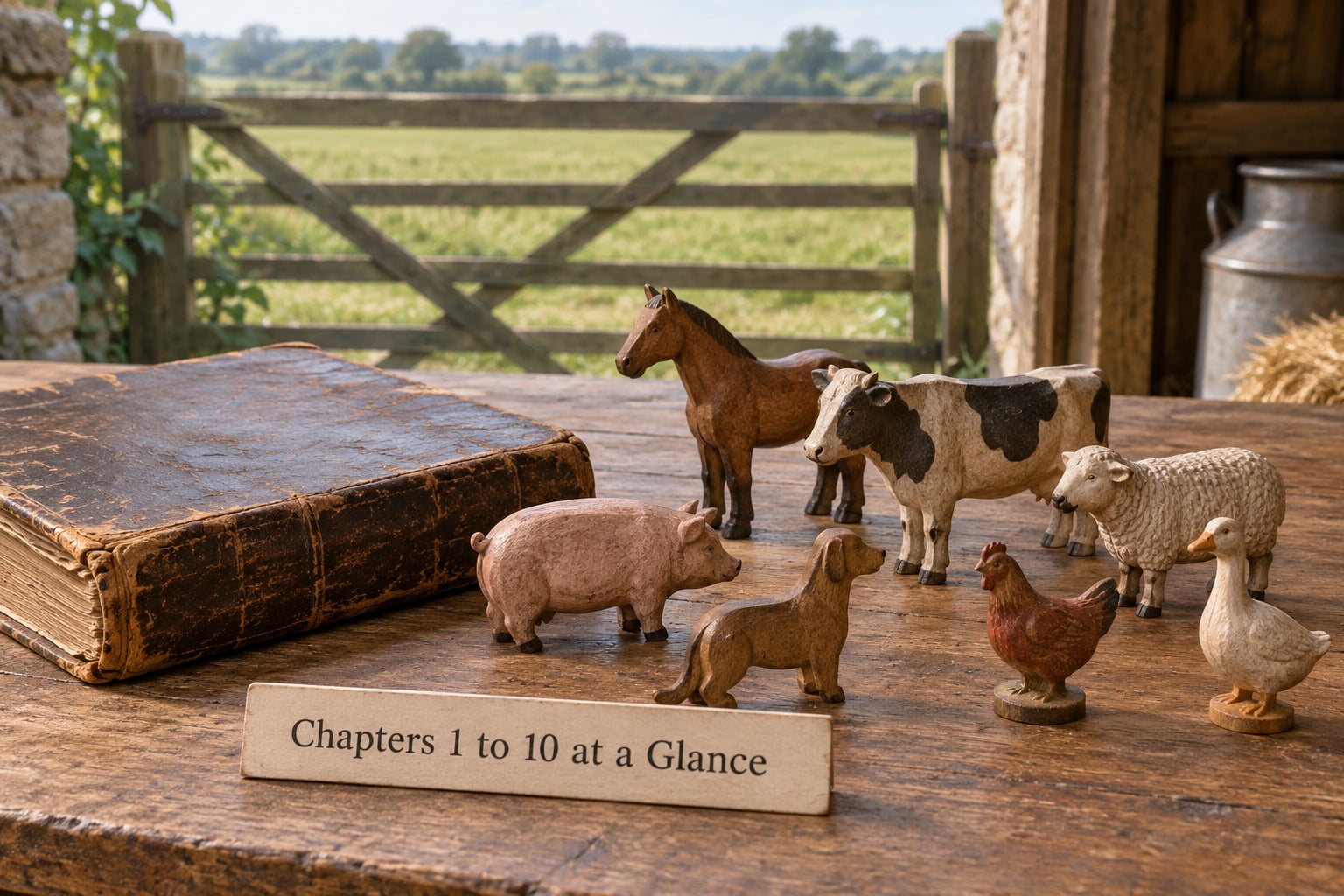
Chapters 1 to 10 at a Glance
- Chapter 1. The animals gather to hear Old Major. He names the three vices of humanity, sings Beasts of England and dies two days later, having set the meeting in motion.
- Chapter 2. The uprising happens in the night. The animals overpower the sleeping Jones family, capture the humans’ tools and the granary, and agree to never again use two-legged animals for anything.
- Chapter 3. The new order begins. Napoleon teaches the ABCs, the pigs learn to write, the commandments go up on the barn wall, and the animals set out to use the human technology they barely understand.
- Chapter 4. The Battle of the Cowshed. Jones returns with men and guns; the animals have no weapons, but Snowball’s discovery of the farmer’s gunpowder and the gun used by the geese turns the fight into a massacre. The humans are driven off for good.
- Chapter 5. The Battle of Windmill. Snowball proposes building a windmill for millers and for the happiness of the animals. Napoleon opposes it, mobilises the other animals against Snowball and wins the vote. The building work begins in winter.
- Chapter 6. The machinery fights back. The animals cannot manage the technology, the mill collapses and the windmill needs rebuilding. Napoleon quietly reallocates the animals’ food to feed the pigs while promising to manage it himself.
- Chapter 7. A conspiracy is set. Snowball is summoned back, accused of being a traitor, tried and expelled. Napoleon’s guard dogs are introduced, and the pigs begin editing history and rewriting the commandments.
- Chapter 8. War is declared against Frederick and the windmill is captured. Boxer, badly wounded, is treated with anthelmintic instead of the medicines available to the pigs, a detail the reader understands long before Boxer does.
- Chapter 9. The windmill is rebuilt at last, but Boxer is no longer able to work. He lies in the barn, and Squealer explains that the great tragedy is the state of the animal’s health. He is taken to the slaughterhouse to die.
- Chapter 10. Two years pass. The pigs walk on two legs, carry whips, wear finer clothes and become the new ruling class. Animals from the neighbouring farms come to observe, and the animals cannot tell whether their new masters are pigs or men.
Every stage of that arc moves the same conflict forward. The animals start with a shared enemy, and the novel’s real question is what happens to them when the enemy turns out to be one of them.
Who Are the Main Characters in Animal Farm?
Napoleon, the largest pig, is the novella’s antagonist. He is not clever, not well read and not even a natural public speaker, which is the point: his power comes from fear, from the dogs, and from his talent for presenting bad news as somebody else’s fault. He quietly takes the milk and the apples for the pigs and uses them for himself, and he arranges for any rival to disappear or be discredited.
Snowball is a young boar and Napoleon’s opposite: an ideas animal, a fluent speaker who plans the windmill and teaches the others to read and write. He is a more genuine socialist than anyone on the farm. He is also naive about his own popularity, and Napoleon turns that naivety against him at the critical moment of the Battle of Windmill.
Boxer, the cart-horse, provides the labour the new order depends on. He is loyal, patient, physically strong and incurably hopeful. His two slogans, Whatever horses do is right and I will work harder, make him the emblem of a working class that trusts its rulers absolutely. His death is the novella’s emotional proof that the animals’ labour built something that consumed them.
Squealer, a fat pig with a talent for the other pigs’ writing, handles propaganda. He paints a false picture of the farm after the Snowball affair, invents an enemy called Snowball’s collaborators, and holds up the modified commandments as proof of the regime’s generosity. He never appears to threaten anyone, and that is how he is dangerous.
Clover is a mare and the animals’ conscience. She understands what the pigs are doing long before the others do, and her quiet inability to act on that knowledge is what makes her so sad to read about.
Benjamin the donkey is the closest thing the novella has to a sceptical intellectual. He is old, he reads, and from the start he predicts exactly how the revolution will end: the animals are condemned to toil and die under human owners of their own. His remark about other animals being more equal than the pigs is one of the most damning lines in the book.
Moses the raven is a neighbour who says nothing about freedom and everything about a heaven after death, which he claims exists. He stands for religion as a promise that defers justice to another world, and he eventually leaves for a new farm. Mollie the mare, by contrast, is a comfortable, lazy animal who wants nothing from the revolution except that it not interfere with her food and her sleep.
Mr. Jones is the original owner, a drunk, cruel and idle man. He represents the old order that the animals overthrow. Mr. Frederick is a hard, violent neighbouring farmer who switches sides when he realizes a farm run by animals is more profitable to deal with; Mr. Pilkington is his counterpart, a dishonest landowner who lives off the animals’ products and then collaborates with the pigs. The names are not accidental: Frederick reads to readers who know their European history.
What Do the Major Characters Represent?
Grouped by political function, the cast divides cleanly. Old Major, Napoleon, Snowball, Squealer, Boxer, Clover, Benjamin, Moses, Mollie, Mr. Jones, Mr. Frederick, Mr. Pilkington and Mr. Whymper each map onto a force in the political story Orwell was describing.
| Character | Historical or political counterpart | Function in the allegory |
|---|---|---|
| Old Major | Karl Marx and Vladimir Lenin | The old revolutionary who names injustice and dies before the revolution he inspired |
| Napoleon | Joseph Stalin | Authoritarian power seized by force, purge and rewriting of history |
| Snowball | Leon Trotsky | The theoretician and reformer, expelled from the party he helped build |
| Squealer | The propaganda apparatus | Control of information as a substitute for consent |
| Boxer | The industrial proletariat | Labour that makes the state possible and receives no reward |
| Clover | Socialist conscience | Moral knowledge the movement cannot use |
| Benjamin | The sceptical intelligentsia | Clear-eyed pessimism, resigned to the outcome |
| Moses | Religion as the opium of the people | Promise of a better world deferred to death |
| Mollie | The petit bourgeoisie | Material comfort purchased by indifference to change |
| The sheep | The unquestioning masses | Support for any authority that promises easy answers |
| The dogs | A secret police | Violence used to close the space for argument |
| Mr. Jones | Tsar Nicholas II | The old regime, deposed by its own subjects |
| Mr. Frederick | Adolf Hitler | Brutal nationalism and the pact with a greater power |
| Mr. Pilkington | Anglo-American capitalism | The external partner who profits from the new order |
| Mr. Whymper | The accommodating middle class | Profit that decides loyalty, not principle |
| The hens | Those with nothing to lose | Resisters who show that obedience is not universal |
| Minimus | The compliant intellectual | A talent rewritten into obedience by patronage |
What Are the Major Themes in Animal Farm?
Power corrupts. The clearest theme, and the reason the novella survives in classrooms. The animals find their new rulers in Chapter 2 with no idea what those rulers will do with authority. The corruption is gradual enough to be invisible: a supplement here, a rewritten rule there, and by the end the pigs sleep in beds and wear clothes while the animals do the work.
The failure of intellect. Snowball has the best ideas and the least political instinct; Benjamin sees everything correctly and acts on nothing; Squealer has no ideas at all and controls the farm anyway. Orwell’s argument is that being right is not enough when the powerful own the vocabulary.
Language as an instrument of power. The novella’s most quoted line is also its most quoted theme: Napoleon is always right, and Squealer’s endless rewriting of the commandments shows what that means in practice. Who controls the words controls what counts as true, which is why the final erasure of the commandments matters so much.
Class stratification. The revolution produces a new class system rather than the abolition of one. Physical labourers become serfs, brainworkers become officials, and the smartest animals become the owners. Orwell treats this as the normal result of revolution, not a failure of the revolution’s principles.
Propaganda and the destruction of shared memory. Every account of the past in the novella is contested, and the version that wins is the one with the dogs behind it. Squealer’s invented history teaches the animals to distrust their own eyes, which is the mechanism by which a population becomes governable.
The betrayal of revolutionary ideals. Animalism begins as a moral rejection of exploitation. It ends as a set of rules flexible enough to legalise anything the pigs want. The novella is not against socialism; it is against what happens when a liberating idea becomes an orthodoxy enforced by force.
The exploitation of animals by animals. The most uncomfortable theme, because the farm was built on the premise that humans were the problem. The animals rebuild exactly the structure they overthrew, which suggests that cruelty is a habit of organisation, not a trait of one species.
How Does Orwell Use Symbolism and Allegory?
An allegory carries one layer of meaning through another. A literal farm story sits on top of an allegory of the Russian Revolution, which sits on top of an argument about how revolutions fail. Students often use the three terms interchangeably, so it is worth separating them: a fable is a short tale with a moral, an allegory maps characters and events onto another story, and satire holds a target up to ridicule.
The windmill is the central symbol. Snowball’s plan for it is about milling grain for the animals’ own use, while Napoleon wants it to grind grain for sale. The animals fund it, build it, lose it and rebuild it, and in Chapter 10 the pigs own it and profit from it. The windmill is the gap between the ideal and the reality, and the fact that it is rebuilt shows how easily people will rebuild the same dream if they are not allowed to ask what changed.
The hoof and horn is the emblem drawn by Snowball, a hoof at one end and a horn at the other. It ends up painted on the pigs’ flag and on their hooves, and later replaced by a hoof and a spur. A symbol of unity becomes the branding of the ruling class, which is a neat summary of how revolutions are appropriated.
The Battle of the Cowshed is the novella’s revolutionary moment, and it is won by animals using human weapons. Violence, not principle, decides it. That detail sets up everything after: the animals learn to fight, and then someone else learns to fight for them.
The dogs are more than enforcers. They appear only once Napoleon needs them, they are the only animals the pigs trust, and they kill a dissenter’s guard. Orwell uses them to show that control does not need widespread loyalty, only a small violent core.
Boxer’s sacrifice is the book’s moral verdict. He is loyal to the pigs because he believes they are his friends, and the regime treats his trust as a resource to be used and then discarded. The dying scene, where he says he will try harder still, is the most quoted passage in the novella for a reason.
The Seven Commandments are the symbols that move. Orwell lists all seven on the barn wall and then shows each being quietly amended, until the wall carries a single sentence that reverses the meaning of the seventh without changing a word of its first half.
| Original commandment | What it becomes | Where |
|---|---|---|
| 1. Whatever goes upon two legs is an enemy | Rewritten as four legs good, two legs bad, after the humans are defeated | Chapter 2 |
| 2. Whatever goes upon four legs, or has hooves, is a friend | Quietly dropped; the dogs that Napoleon owns are technically four-legged | Chapter 2 |
| 3. No animal shall kill another animal | Deleted; the dogs kill, and the pigs cover it up | Chapter 7 |
| 4. No animals shall eat or drink except upon productions of the earth | Deleted; the pigs take the milk and apples and eat anything they like | Chapter 7 |
| 5. No animal shall sleep in a bed | Deleted; the pigs sleep in beds | Chapter 7 |
| 6. No animal shall wear clothes | Deleted; the pigs wear finer clothes than the humans did | Chapter 7 |
| 7. All animals are equal | Altered to all animals are equal, but some animals are more equal than others | Chapter 10 |
The names are symbolic too. Boxer, Clover, Benjamin and Muriel come from the working farmyard; Napoleon, Frederick, Jones and Pilkington come from the world of European politics and economics. Orwell names the pigs after military dictators and the neighbouring farmers after ideologies, so the reader is given the map before the plot needs it.
What Is the Historical Context Behind Animal Farm?
Orwell wrote the novella after serving with the Republican forces in the Spanish Civil War, an experience he described in Homage to Catalonia and which left him disillusioned with both communism and fascism. He watched the Soviet Union suppress the Left Opposition and liquidate the old Bolsheviks in the late 1930s, and by 1943 he was writing privately that the story of the pigs would be the only honest account of socialism he could write.
The allegorical structure is fairly direct. Mr. Jones is Tsar Nicholas II, deposed in 1917. Old Major is Marx and Lenin, who died before the revolution they inspired. The pigs who learn to write and become the administrators represent the Bolshevik party. Snowball is Trotsky, brilliant, persuasive and expelled in a power struggle. Napoleon is Stalin, who eliminated Trotsky, broke the rules of collective ownership and imposed Stalinist rule. The Battle of Windmill with Frederick corresponds to Stalin’s alliance with Hitler and the Molotov-Ribbentrop Pact of 1939, an alliance that shocked Orwell and many others.
Two cautions keep the analogy honest. First, the novella is a satire with a purpose rather than a coded history lesson, and Orwell deliberately made the pigs dull rather than charismatic. Second, publishing in July 1945 meant a British audience that had just fought a war against fascism and was about to enter the Cold War, which shaped how readers took the ending.
Publication was not straightforward. Faber and Faber worried about the Soviet Union’s reaction in wartime and weakened the text, cutting references to Stalin and the Second Front in the American edition. Orwell’s review copy for the American edition carries a note about how much had been cut, and he never stopped pushing for the full text. The edition most students now read is closer to his original.
Why Does the Ending Matter?
The last scene is short and the prose goes flat on purpose. The pigs march past the farmhouse gate in a procession, walking upright, dressed in fine clothes, carrying whips. There is no animal left who can see the moment as an outrage, because the animals have spent years learning not to see.
That is the real horror of the ending. The pigs are not hiding what they are; they have simply become indistinguishable from the humans they overthrew. The command to stop consuming without producing has gone, the language has been rewritten, the memory has been edited, and the people who did all of that can now stand in the road without anyone objecting.
Students often argue about whether the ending is hopeless. I think the novella leaves the door open by a hair. The neighbouring farmers arrive to observe, and they are animals too; the song Beasts of England has been remembered even by the pigs’ own household. The pattern will repeat, but it is not the only future on offer.
For essays, the ending is also the point where the allegory becomes double-edged. The humans at the gate look at the pigs and cannot tell what they are, which is the same confusion the animals have had for chapters. Orwell puts both sides in the same sentence to suggest that tyranny is a habit that crosses every boundary once people stop asking questions about it.
Animal Farm Study Questions and Essay Prompts
Start with the comprehension questions if you have just read the novella, and move to the analytical ones when you are building an argument. The strongest answers in this novella come from a question about technique, not a question about what happens.
Comprehension Questions
- What does Old Major actually want, and why does he never see the revolution he starts?
- How did the animals defeat Jones without weapons in Chapter 2?
- What is Napoleon’s objection to the windmill, and what does Snowball argue for?
- Why is Boxer given the wrong medicine in Chapter 9, and what does he assume has happened to him?
- What changes on the barn wall between Chapter 2 and Chapter 10?
- How do the animals learn that the windmill has been privately owned by the pigs?
Analytical and Theme Questions
- How does Orwell use the windmill to symbolise the gap between revolutionary ideals and their reality?
- Why is Boxer’s fate the most important event in the novella rather than the revolution or the windmill?
- In what ways is Squealer more dangerous than Napoleon?
- How does the absence of named characters affect what Orwell can show about the animals’ obedience?
- Why does the ending change how you read every earlier chapter?
- Orwell said he wanted readers to draw their own conclusions. Does the novella push them too hard in one direction?
- The sheep support Napoleon before he has done anything. What does this suggest about how crowds make leaders?
- How does Mollie complicate the idea that all animals want the same thing?
Symbolism and Comparison Questions
- Why does the hoof and horn get replaced by a hoof and a spur?
- What does the song Beasts of England do that a speech about animalism could not?
- Compare the Battle of the Cowshed with the Battle of Windmill. Why is the first a victory and the second a division?
- How does the novella differ from Nineteen Eighty-Four in its ending and its tone?
Essay Prompts
- Orwell presents revolution as something that destroys the people who make it. To what extent does the novella support that view?
- Blind trust in leaders, not greed, destroys the farm. Argue for or against this reading.
- Is Animal Farm a tragedy or a comedy? Use at least two specific moments to justify your answer.
- Language, not violence, is the real instrument of control on Manor Farm. Argue this case.
- Compare how Orwell and the writer of your second text portray crowd obedience.
Quotes That Earn Marks
Learn six to eight well rather than a page of scraps. On r/GCSE, students repeatedly say the same thing about revision: quotes carry marks, but only when they are attached to an argument. Each of these does a specific job.
- All animals are equal, but some animals are more equal than others. The seventh commandment, rewritten in Chapter 10. Use it for hypocrisy, or for the way a small word change destroys a whole principle.
- Napoleon is always right. The motto the herd adopt and never question. Use it for propaganda and for manufactured consensus.
- Four legs good, two legs bad. The first commandment’s replacement, and the clearest example of language being rewritten to suit power.
- Beasts of England. The song invented by Old Major and later dropped as embarrassing. Use it for a shared culture being lost.
- I will work harder. Boxer’s response to everything. Use it for the working class’s faith in its rulers.
- Man is the only creature that consumes without producing. Old Major’s accusation, the moral charge behind the whole revolution.
- Whatever horses do is right. Boxer’s companion maxim. Pair it with the medicine in Chapter 9 for maximum effect.
- The creatures outside looked from pig to man, and man to pig, again and again. The closing line. Use it for the collapse of the line between oppressor and oppressed.
A Framework for Structuring an Answer
Whatever board you sit, the shape works: one sentence of context, one claim about the text, one short quotation, one sentence of analysis that explains a writer’s choice, and a link back to the theme or the historical point. This is the PEEL structure most English departments teach, and it also happens to be what the IB extended essay wants when students are unsure how to turn a political allegory into literary analysis.
Then connect outward. A sentence placing the novella beside the 1917 Revolution or beside Nineteen Eighty-Four is usually the difference between a descriptive answer and a top-band one, and it is where a lot of students stop early.
Frequently Asked Questions
What grade level is George Orwell’s Animal Farm?
Animal Farm is usually set at GCSE level in the UK, typically years 10 and 11 for students aged 14 to 16, and in grades 8 to 10 US English classes. It is also a set text at A-level, appears in the IB Diploma and works as a supplementary text in AP English literature. At about 30,000 words it can be read in three or four sittings, so teachers often set it early in the term.
What are the 7 rules of Animal Farm?
The Seven Commandments are: whatever goes upon two legs is an enemy; whatever goes upon four legs, or has hooves, is a friend; no animal shall kill another animal; no animal shall eat or drink except upon productions of the earth; no animal shall sleep in a bed; no animal shall wear clothes; and all animals are equal. They are written on the barn wall in Chapter 2 and amended one by one until only the last survives, altered.
What are some good study questions for Animal Farm?
Strong questions ask about technique rather than plot: why the windmill survives while the revolution does not, why Boxer’s death matters more than the Battle of the Cowshed, how Squealer is more dangerous than Napoleon, and what the final line about pigs and men does to the reader. Chapter-level comprehension questions work well for early revision; theme and symbolism questions work well once you can attach quotations.
Is there a PDF study guide for Animal Farm with questions and answers?
This page is a complete, free guide that prints or saves as a PDF straight from your browser. It carries chapter-by-chapter recaps, the character and historical-correspondence table, the Seven Commandments and their corruption, seven themes, an analysis of the ending, essay prompts and study questions with a PEEL answer framework. There is no sign-up, no download and no purchase.
What is the message of Animal Farm?
Orwell’s message is that a revolution can destroy its own ideals once the people who enforce them begin to enjoy the power. Language, memory and fear are the tools of that reversal, not overt cruelty. The novella also warns against treating the animals’ cause as a species matter: once the animals are in charge, they build the same system they were exploited by.
Where to Start If You Have a Deadline
Read Chapters 1, 4, 7 and 10 first, then memorise the seventh commandment as it appears in Chapter 2 and as it appears at the end. Take one character from the table, one theme and one quotation, and you can build a full answer in an evening.
Students who tell me the novella is too simple for an essay are usually writing about the pigs instead of about power. The farm is the easy part. The argument Orwell is making about how a liberation becomes a hierarchy is the part that earns the marks.