
Death of a Salesman is a 1949 play by Arthur Miller about a 63-year-old travelling salesman named Willy Loman whose finances, memory and family life collapse over two days in Brooklyn. This guide covers the plot act by act, every major character, the central themes, the symbols, the dramatic language, and the questions teachers actually set.
It is written for students meeting the play for the first time and for students revising it before an exam. Nothing here sits behind a sign-up wall.
Table of Contents
- Arthur Miller Death of a Salesman Study Guide: Quick Guide
- What is Death of a Salesman about?
- Who are the main characters in Death of a Salesman?
- What does Willy Loman struggle with?
- Is Willy Loman a tragic hero?
- Who is Linda Loman?
- Who is Biff Loman?
- Who is Happy Loman?
- Who are the supporting characters?
- Is Death of a Salesman an LGBTQ play?
- What is the plot of Death of a Salesman?
- Act 1: Friday evening and early Saturday
- Act 2: Saturday morning and afternoon
- The requiem
- The seven memories, and what each one reveals
- What historical context should students know about the play?
- What are the major themes in Death of a Salesman?
- The American Dream is a promise and a trap
- Reality versus illusion
- Willy’s struggle with how he is seen
- Fatherhood, love and the failure of guidance
- Being used up by a commercial system
- What symbols and motifs help explain the play?
- How does Arthur Miller use dramatic language?
- He builds speeches out of the same few words
- He puts two speeches in a row
- He uses stage directions as argument
- He uses silence and the sound of the city
- He writes Willy so he cannot be believed
- What is the significance of the ending?
- What should students know before writing an essay or taking a test?
- Discussion questions for class or a reading group
- How the play compares with Miller’s other work
- Frequently Asked Questions
- What is the main message of Death of a Salesman?
- Why is the American Dream so important in Death of a Salesman?
- What does Willy Loman’s suicide mean?
- What are the most important symbols in Death of a Salesman?
- How should I study Death of a Salesman for an exam?
- Conclusion
Arthur Miller Death of a Salesman Study Guide: Quick Guide
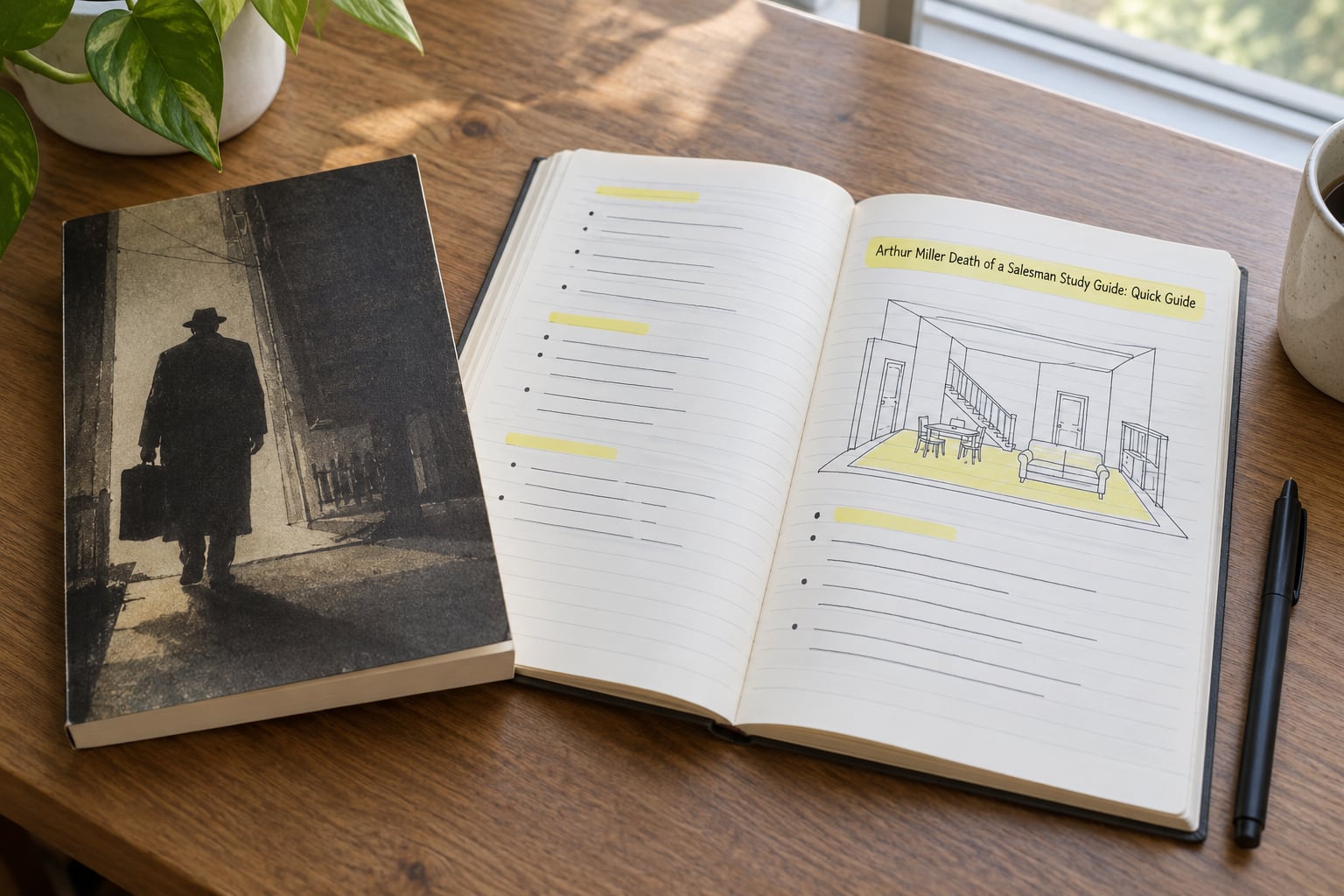
The play runs a little over two hours with no interval, and the whole of it happens almost in real time. Knowing the fast facts below fixes the frame before you get into argument and evidence.
| Author | Arthur Miller (1915-2005) |
|---|---|
| Full title | Certain Private Conversations in Two Acts and a Requiem |
| First performed | 26 February 1949, Morosco Theatre, New York; directed by Elia Kazan |
| Original cast | Lee J. Cobb as Willy Loman, Mildred Dunnock as Linda |
| Structure | Two acts plus a requiem (funeral) scene |
| Setting | The Loman apartment in Brooklyn, a Friday evening and the following morning, plus two New York restaurants |
| Genre | Modern tragedy, some critics call it expressionist |
| Awards | 1949 Pulitzer Prize for Drama; 1949 Tony Award for Best Play |
| Original run | 742 performances on Broadway |
| Recent production | A Broadway revival directed by George C. Wolfe, starring Nathan Lane as Willy and Laurie Metcalf as Linda, opened in 2018 and won six Tony Awards, the most ever for a revival |
Work through it in this order and the play stops being a maze of dates and dreams:
- Get the present straight. It is Friday night and Saturday morning. Almost everything else is Willy remembering.
- Learn the house. The set is one apartment with rooms defined only by light and a sliding wall, and the walls are the point.
- Map the seven memories. The flashback table in the plot section below is the one revision page worth memorising.
- Track Willy’s job. He is 63, nearing retirement, and terrified of being replaced. Everything follows from that.
- Read the father-son axis. Willy and Biff carry the play. Linda and Happy are measured against it.
- Learn six symbols. Seeds, the stolen ball, boxing-in, being well liked, being used up, and the flute melody cover most essay questions.
What is Death of a Salesman about?
Death of a Salesman is about a man who has bet his whole life on the American Dream and finds the odds rigged. Willy Loman has spent thirty years selling goods nobody needs, and he believes that if he can just make one final score, his life will finally count. The play follows his last two days as that score slips away.
Willy’s tragedy is not that he fails. It is that he cannot accept the terms of his own life. He tells a lie about a big order from a buyer in Boston, borrows money he does not have, and drives himself to a car crash trying to prove a point. Meanwhile his eldest son Biff has come home after eighteen years away, and the confrontation between the two of them is the play’s real engine.
Miller’s target is the idea of success itself. America measures a man by what he owns, and Willy has borrowed to imitate a success he has never achieved, so every instalment payment is a fresh defeat. The play asks whether that dream is a promise or a trap, and it answers with a man who cannot stop telling himself the story even after the evidence is against him.
Who are the main characters in Death of a Salesman?
The cast is small and every part doubles as a pressure on Willy. This table shows what each character wants and what their function in the drama is.
| Character | What they want | What they fear | Dramatic function |
|---|---|---|---|
| Willy Loman | To be loved and respected as a man who has made it | Being found out, and being discarded as used up | The protagonist and tragic hero |
| Linda Loman | Willy alive and home | Losing him, and telling him the truth that will not save him | Moral centre and audience surrogate |
| Biff Loman | To find out who he is without his father’s shadow | Becoming his father | The force that breaks Willy’s illusion |
| Happy Loman | To be seen as successful and sexually potent | Being ordinary | Shows the sons’ rivalry and Willy’s failed lesson repeating itself |
| Uncle Ben | Nothing much beyond good company | Being pitied | Delivers the Alaska story and the moral about luck and timing |
| Charley | A stable life with a secret life of longing | Humiliation | Willy’s foil and the audience’s clearest pair of eyes |
| Bernard | To be a success on his own terms | Being thought clever but soft | Contrast with Biff’s stolen success |
| Howard Wagner | To protect his company | Nothing much; the system is bigger than him | Institutional face of the sales machine |
| The Woman | Attention from a younger man | Being left again | Willy’s idealised past made flesh, and a target for modern readers |
What does Willy Loman struggle with?
Willy struggles with four things at once, and exam answers that list only one of them are usually thin.
- Job security. At 63 he faces forced retirement and a reduced pension, and his employer treats him as inventory.
- Self-deception. He builds an elaborate false account of a Boston sale and then defends it against everyone who loves him.
- Fatherhood. He has never known how to be close to Biff, and he substitutes shouting, gifts and boasts for conversation.
- Financial collapse. He has already mortgaged the insurance policy and borrowed against his salary, so the family is already in danger before he dies.
Is Willy Loman a tragic hero?
Yes, on Miller’s own terms. Miller argued in his 1949 essay Tragedy and the Common Man that tragedy belongs to ordinary people, and he built Willy to meet the four classical criteria.
- Hamartia, or tragic flaw. Willy’s flaw is not cowardice or pride in the usual sense. It is an inability to see himself as he is, sustained by a dream that protects him from the truth and destroys him at the same time.
- Peripeteia, reversal. In Act 1 Willy is a man with a secret. In Act 2 the secret is public, Biff knows everything, and the reversal is total.
- Anagnorisis, recognition. Biff’s childhood accusation, “You never owned a wagon, did you?”, arrives with Willy’s own memory behind it. Recognition is what Willy cannot survive.
- Catharsis. The play ends in the requiem, where the sons and the mourners stand still and the audience is left to weigh pity and judgement. Miller deliberately withholds the Aristotelian purification, which is part of the modern tragedy claim.
If someone in your class argues that Willy is simply a weak man rather than a tragic hero, the useful counter is that Miller never claimed moral innocence. He claimed the system plus the self-deception is fatal, and the play makes both do killing.
Who is Linda Loman?
Linda is the most underestimated character in the play. She is not a fool who fails to see the truth; she sees it early, on the night of the birthday party, and chooses not to say it because the truth would mean no insurance and no house.
Her cruelty to Biff, the mockery about his chunk of a person, is her way of testing whether he will stay. She is the only character in the house who is honest with Willy, and the only one who loses everything by it. The critical question students get wrong most often is whether she is a martyr or a manipulator. The strongest answer is that she is a woman with a realistic grasp of money inside a household that has systematically refused to admit it is broke.
Who is Biff Loman?
Biff returns after eighteen years of drifting, still carrying the stolen baseball and the memory of finding his father in a Boston hotel room at fifteen. His working life has been a string of temporary jobs he quits, and he suspects the reason is that he is being handed to each employer by his father.
He is not the villain. He is the one who sees clearly, and what he sees is that Willy has used his charm to avoid ever knowing his sons. In Act 2 he refuses Willy’s money and his version of himself, which is the moment that makes the suicide possible rather than the cause of it.
Who is Happy Loman?
Happy competes with Biff for a version of masculinity Willy approves of, boasting about girls and his future. He gets the job Willy promised him but will be fired for calling a customer a jackass, so the father’s lesson reproduces itself exactly.
Who are the supporting characters?
Charley, Bernard and Uncle Ben each sharpen a different edge. Charley loves Willy and sees the whole con, Bernard models real ability, Ben is lucky and oblivious in a way Willy both envies and contemptuously dismisses. Howard Wagner shows the company as a machine, Stanley and Miss Forsythe are office furniture, and the telegram boy at the end completes a job Willy has lost and cannot face.
Is Death of a Salesman an LGBTQ play?
No, and the question is worth answering carefully rather than dodging. Miller wrote a marriage play about a heterosexual father whose masculinity is built on being liked and being needed.
What makes the question come up is that The Woman and Happy are read in a modern lens: both are men who trade on attraction and are rejected or diminished by the men around them. Linda’s one small piece of self-assertion, her remark on the stocking, and Happy’s self-contempt can be read through contemporary gender analysis. That is a valid essay position, but it is a lens rather than the play’s stated subject, and you should say which is which in the essay.
What is the plot of Death of a Salesman?
The plot runs from Friday evening to Saturday morning, with Willy’s memories breaking into the present. Track both layers separately or you will lose the timeline.
Act 1: Friday evening and early Saturday
Willy comes home exhausted from a failed road trip, and the boys arrive with Happy’s good news. Linda is anxious about the previous unpaid instalment. Charley drops by and says the company has let two salesmen go, and Willy tells him not to worry about it. Willy and Linda argue about the odds and ends he sells, and Willy insists they are the cause of his failure.
Ben arrives to tell Willy he has found a once-in-a-lifetime opportunity in Alaska, needing a travelling representative. Willy refuses and later lies that the buyer in Boston is ordering a massive number of pieces of merchandise. Willy gives Biff a pep talk so charged that it turns into an admission of guilt, and Biff leaves, calling his father a phony little fake. Stanley, the office boy, brings the telegram announcing that Howard has taken the Boston order away from Willy.
Act 2: Saturday morning and afternoon
Willy wakes, presses Linda for money, goes to Howard’s office and is fired. Howard explains the pay cut and the pension rule in a small, apologetic voice, and Willy plugs in the wire recorder, whispering to his sons, leaving him to hear how he talks about them.
Ben comes by again and Willy sends him to Alaska, then argues with Charley over money. At Frank’s Chop House, Happy and Biff tell their father that Biff’s big meeting with Bill Oliver went badly and that Oliver may still hire him. Willy promises to make it happen, and his optimism costs him the last of his certainty. The scene shifts into a memory of Willy in Boston years earlier, the seductress in the hotel, the discovery by Biff, and Willy’s hollow line, “You girl-boy, what did I do last night?”
Back in the afternoon, Willy lies on the bed and drifts into a conversation with Ben, imagining the Alaska canoe trip and the two of them laughing. His sons wake him and try to give him money. Willy demands to see the details of the bank account, which exposes how far he has gone, and Biff’s final flashback accuses him of never having owned anything, not even a wagon.
Willy asks Biff to box him. Biff leaves for good. The telegram boy arrives with Howard’s message: the day after tomorrow, take the boiler out of the basement and shut the gas off all the way. Willy takes the car out, and Linda follows him.
The requiem
Willy has driven back to the house after crashing the car. A milkman heard the crash and called, and the other people in the street are quiet and self-contained because they live in the city. Willy died in the doorway, legs still moving, trying to get to Linda. A neighbour found the car, took a coat from the glove box, and posted the car back in the garage, then kept the coat.
Biff and Happy come home to a flat, empty sound, and Mr. and Mrs. Meyer, the neighbours, offer condolences. The boys wonder whether to tell the woman Willy had been seeing. Biff says Willy did not know who she was either. The new buyer, Stanley, will be in tomorrow. Happy cries, and then, in the few lines Linda speaks, says that the wrong dreams have been the family’s whole life and that Willy never knew who he was.
The flute plays the melody Willy hummed in the shop. It is the last thing the audience hears, and it turns mourning into something deliberately unresolved.
The seven memories, and what each one reveals
This is the table to learn. Every flashback is triggered by something in the present, and each one pushes a different piece of Willy’s past into the open, so mixing them up is what makes the timeline unreadable.
| Memory | What happens in it | What it reveals about Willy |
|---|---|---|
| Dave Singleman, the old salesman, in a train station | The young Willy watches a travelling salesman charm a whole waiting room by being sympathetic to tired salesmen | Where his standard of success comes from: not money but being well liked |
| Willy, aged about nineteen, at his sister Susan’s flat | He bathes, admires himself in the mirror, and laughs at his mother’s warning about his life | He was once confident and handsome, and the confidence came from a body and a face he no longer has |
| The Boston hotel with The Woman | Biff finds his father in the room; Willy knocks on the bathroom door and the boy runs | The event Willy has never admitted, and the origin of Biff’s certainty about who his father is |
| Biff at seventeen, returning the stolen baseball | Biff tries to tell his father the truth about his own promise, and Willy brushes him off | Willy as a father who cannot receive love, only information he can use |
| Biff in the football locker room | Biff is told he will fail his math and says his father will be devastated | Willy, as experienced by his son: a man whose approval is the whole world |
| Happy striking Biff after the boxing match | Narration of the boys training for a prize in Willy’s kitchen, ending with Happy hitting his brother | Willy breeding the competition between his sons in his own home |
| The afternoon on the bed with Ben, becoming the Alaska canoe trip | What began as a small invention about a rubber-lined canoe turns into a shared fantasy of laughter and conquest | Willy’s need for the dream to be about him, even when the credit belongs to somebody else |
What historical context should students know about the play?
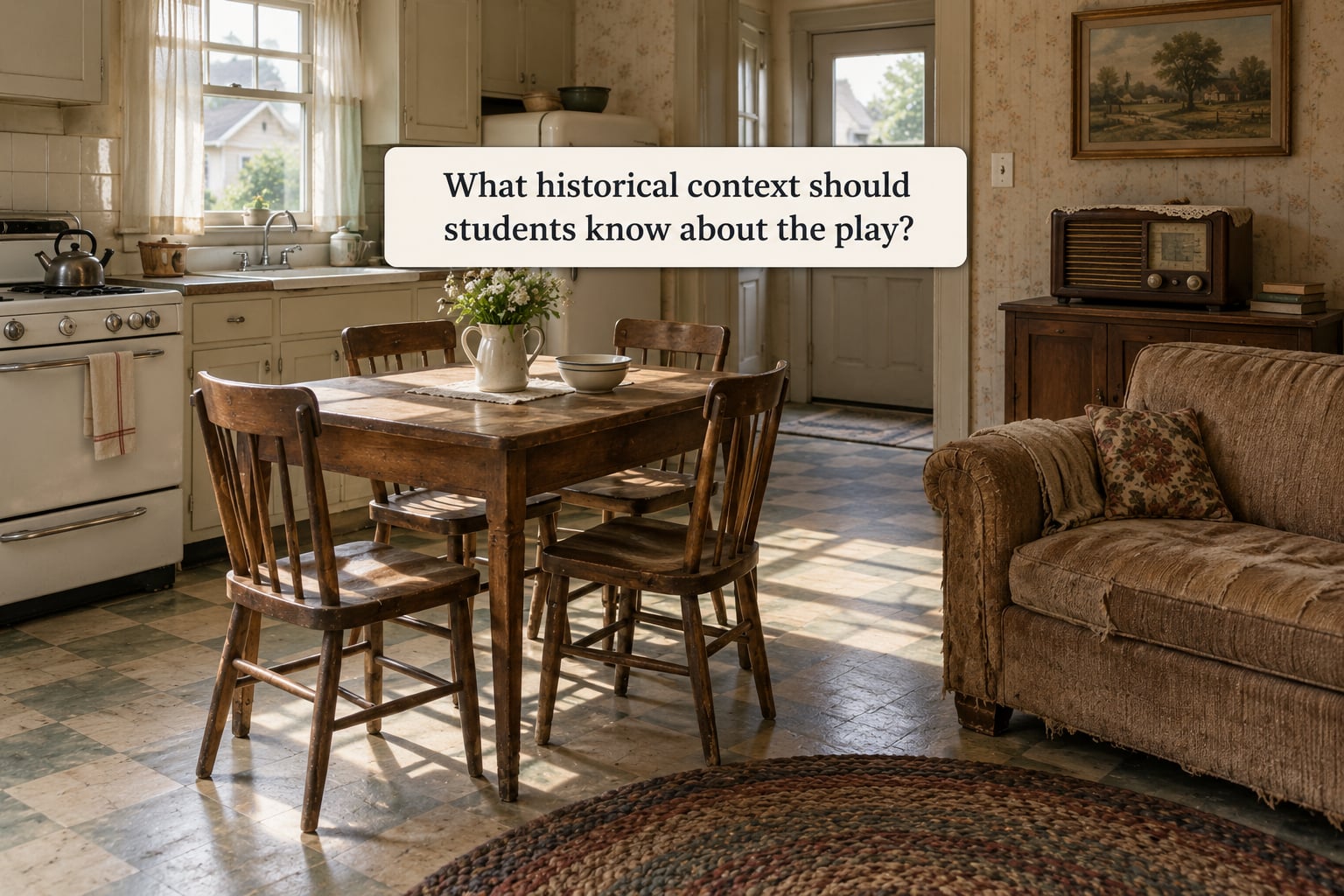
The play is set in postwar America, and almost every choice in it depends on that decade. Miller wrote it in the late 1940s, at the height of post-war economic expansion, when consumer goods were new and the idea of a paid weekly wage felt permanent. Willy’s business, selling durable goods nobody needs, is the economy of the moment exactly, and his insecurity is what a boom makes possible to feel.
There is also a detail worth knowing because it explains the ending. Accounts of Miller’s own family hold that a family friend sold insurance and killed himself so that his dependants would collect the payout. Miller was haunted by the thought that such a death could be a transaction, and he put that fear at the centre of the play’s last act.
Miller was born in 1915 in New York to Jewish parents, the son of a travelling salesman who lost everything in the 1929 crash. His uncle Manny Newman, a man Miller admired for his luck and his salesmanship, died by suicide, and Miller’s own suicide attempt in his twenties sat close to the material. He also published the essay Tragedy and the Common Man in the New York Times in 1949 to insist that the death of a working man in ordinary clothes is as tragic as the death of a king.
The world has moved on, and the revival that opened on Broadway in 2018, directed by George C. Wolfe with Nathan Lane as Willy and Laurie Metcalf as Linda, won six Tony Awards, the highest total ever for a revival. Critics have often read the timing as obvious: commission-only sales, unstable contracts and the squeeze of paying for a home. Nothing in the argument requires that reading, but it is the question the current production keeps asking out loud.
What are the major themes in Death of a Salesman?
Five themes carry most of the marks, and each one can be stated as an argument rather than a label.
The American Dream is a promise and a trap
The play argues that the Dream is not simply false, it is conditional in a way that destroys those who take it literally. Uncle Ben makes his money through luck, courage and timing, and Willy reads it as pure merit. Ben’s own line about it being a lucky, lucky thing, and that the only thing a lucky man can do is keep the appointments, is a quieter and colder truth than Willy’s version.
Reality versus illusion
Willy’s world is built on a false account of a Boston sale, and the play dramatises the cost of that account minute by minute. The structure itself argues the theme: reality is two days, illusion is a lifetime, and the audience is made to watch the second swallow the first.
Willy’s struggle with how he is seen
His memory of Dave Singleman, the old salesman he watched at a train station, is the key. Willy loves that Willy was “well liked”, and that is the standard by which he has judged his life. Bernard has the same charisma without the sales job, and the play shows what happens to charisma once the easy praise stops.
Fatherhood, love and the failure of guidance
Willy wants to be loved by his sons and only knows how to buy, correct and instruct them. Biff and Happy are shaped by the same competition, so his ambition produces a rivalry rather than a family. The clearest admission of the damage comes when Willy insists, near the end, that he never told Biff a thing about his life, which is true and is also the confession.
Being used up by a commercial system
The word used up recurs across the whole play for the house, the car, the refrigerator and, finally, the man. Miller’s charge is that a society which sells planned obsolescence will sell the idea of a life as a package with an expiry date, and that men who internalise the timetable are finished before they notice.
What symbols and motifs help explain the play?
A symbol is a concrete object carrying an idea; a motif is a pattern or phrase that repeats. The play uses both, and the difference is a quick mark in a literature exam.
| Symbol or motif | Where it appears | What it means |
|---|---|---|
| Seeds and the back yard | Willy plants them on Saturday afternoon and has to be called in | The old future he is dressing up for his sons, growing nothing; also the buried past, since the house sits on the fields Willy’s father farmed |
| The stolen baseball | Biff hid it in a cardboard box and still keeps it | Ambition, betrayal and innocence, carried for eighteen years |
| Walls and the shrinking rooms | The set has no rooms, only light and a sliding wall | Being boxed in, the pressure of a life that has nowhere to go |
| Being well liked | Dave Singleman’s memory | The substitute Willy chose for self-respect |
| Used up | House, car, and Willy himself | Planned obsolescence applied to a human life |
| The spark plug | Willy’s small invention, the only one he ever made | The line between inventing a thing and selling one; the death wish disguised as a product idea |
| The gas stove | Stage business around cooking; the boiler message | Domestic warmth that conceals the machinery of death, and a final instruction |
| The pool | Described, never shown | A small success, planned, and never reached; also the hidden past under the pavement |
| Boston and Alaska | Both are the dream place Willy was never in | Boston is the lie and the crime; Alaska is the chance he was too proud to take |
| The ceiling and the manila folder | Willy’s fix on the kitchen ceiling fixture | Being anchored and limited, the whole plot turned by a cheap question |
| The stockings | Happy and Biff in Act 2, who need money for new ones | Sexuality and money tangled together, and the one small moment of self-possession Linda allows herself |
| The flute melody | Willy hums it in the shop and in his memory; the requiem ends on it | Freedom, memory and the father the sons never had |
How does Arthur Miller use dramatic language?
Miller’s dialogue is plain to the point of plainness, and the power of the play is in how the plainness is arranged. Several techniques pay off in close-reading questions.
He builds speeches out of the same few words
Willy repeats phrases, and repetition is how the play shows a man circling. He returns to being well liked, to the house payments, to his boys, to the loan. Students often mistake this for a flaw in the writing. It is the technique: the same phrase means something different each time it comes back.
He puts two speeches in a row
Miller cuts between simultaneous voices rather than letting characters wait their turn. At Frank’s Chop House, Willy’s fear that his sons will end up in the same trap is answered by Ben’s story of the Alaska canoe trip, and neither man is really listening to the other. The interruption by memory works the same way: it is not a cut in a film, it is Willy losing the present because the past is louder.
He uses stage directions as argument
The direction to build the house as a place of memory rather than a home, the note that the walls must feel like pressure, and the instruction that the audience is to hear what Willy cannot hear all do argumentative work. The stage tells you the house is a memory before the characters do. On the page, Miller names the gas range, the palm tree, the punching bag and the kitchen ceiling, so any director has a score to work from.
He uses silence and the sound of the city
Willy’s silences are loaded, and so are the neighbours in the requiem, who describe the crash in flat, procedural detail. The closing flute is the last sound: a memory of a father humming, which is a memory the sons can keep and a life they never had.
He writes Willy so he cannot be believed
Willy’s asides are written as assertions, and other characters correct him in the moment. The audience is therefore never allowed to settle. The most usable line in the play for essay work is his own contradiction: he despises the job he has chased for forty years, and the refusal to notice that is the form his self-deception takes.
What is the significance of the ending?
The ending matters because it refuses to make Willy’s death a private failure. He kills himself in the knowledge that the insurance money will pay the last mortgage and leave the family secure in the house, which is the promise he has sold to other people for thirty years. Miller wrote the moment so that the tragic and the commercial are the same event.
The car crash is equally designed. Willy drives the car at night, thinking; the car is where his best memories live, and the crash comes at speed, so his final attempt at mastery is a mechanical one and it fails like everything else.
The requiem then withholds judgement. The neighbours are courteous and detached. Happy cries, Biff is silent, and Linda says that the wrong dreams were the family’s whole life and that nobody can charge a man for that. The audience is left to decide whether Willy was a victim of the system, a liar who destroyed his family, or both, and Miller’s whole argument is that both is the only defensible answer.
What should students know before writing an essay or taking a test?
Most marks are lost in the plan, not the reading. Here is the material most essays need, and how to use it.
| Quotation | Speaker | Act and scene | What it shows |
|---|---|---|---|
| I am stopped, boxed in like a shipment | Willy | Act 1, the kitchen | The line connecting private life to industrial life, and the source of the brick imagery |
| I never had a feeling of being superior | Willy | Act 1, the kitchen | The stable contradiction: he despises the job and craves the status of it |
| There is a beautiful, big, free country out there | Willy | Act 1, the pep talk | The gift speech, and the moment love turns into instruction |
| You phony little fake, you | Biff, in memory | Act 1, the restaurant | The unretracted charge that defines the whole relationship |
| You can’t go on living like a horse | Charley | Act 2, the bedroom | The friend who names Willy’s physical decline without ever accusing him |
| I don’t know why I can’t talk to you | Charley | Act 2, the bedroom | Two men who have known each other for years and never said this out loud |
| You never owned a wagon, did you | Biff, in memory | Act 2, the bedroom | The anagnorisis that nothing Willy promised was ever his |
| It’s not a gun, it’s a screwdriver | Biff | Act 2, the bedroom | Willy’s own words thrown back at him as proof he is a violent man |
| Uncle Ben was a lily-livered idiot | Willy | Act 2, Frank’s Chop House | Contempt for the luck he wanted for himself |
| He is not the finest character that ever lived | Linda | Act 2, the bedroom | Willy’s own tragic logic, stated by the person who loves him |
| I can’t give you anything, Pa. I don’t have a dime | Happy | Act 2, the afternoon | The second son’s version of the same emptiness |
| He would make a good production manager | Biff, on himself | Act 2, the afternoon | Biff’s quiet self-knowledge, and the life his father never imagined |
| I gave you my youth! | Willy | Act 2, the bedroom | The charge of a wasted life, the play’s moral centre of gravity |
| The wrong dreams, Babe | Linda | Requiem | The closing thesis, and the ambiguity no essay should resolve too fast |
Four misconceptions cost students marks every year.
- Did Willy really commit suicide? Yes, deliberately. He drives the car at night after fixing the boiler, and the death is meant as a transaction, not an accident. Exam answers that call it an accident fail on reading.
- Is Linda a fool? No. She understands the money from the beginning and buys silence with it, which is the only currency the house has.
- Is Biff the villain? No. He returns to force a reckoning, and the play treats his refusal to be bought as the one honest act in Act 2.
- Is the affair the cause of the suicide? No. The affair is evidence, not cause. The cause is a man who cannot bear the gap between the dream and the man.
A five-step method works for almost any essay question. Decide the claim in one sentence, the one Miller is making. Pick two symbols and trace how they change between Act 1 and Act 2. Take three quotations, one for each son and one for Linda. Then write the case, not the plot: each paragraph should push the argument, not summarise events.
For short-answer exam questions, keep the PEE shape. Point, the question’s own term. Evidence, one quotation and its line reference. Explanation, why Miller wrote it that way and what it does to the audience.
Try a five-question knowledge check before you revise anything else. Who is in the house at the end? Why does Willy go to Howard’s office in Act 2? What has Biff come home with? What is Charley’s connection to Linda? Which things in the play are described as being used up? If you cannot answer all five, reread the requiem and the Act 2 office scene.
Two more study habits pay off quickly. Learn the seven memories as a set, because exam questions rarely ask about one in isolation. And read the play with the family photograph visible, since the dialogue is full of direct addresses to a son who is not there.
Discussion questions for class or a reading group
These work well because they argue rather than recall. Start with the yardstick question: Willy insists that a man ought to leave his son something more than his life, and then quietly doubts whether anyone will remember him. Everything after that is argument rather than memory.
- Is Willy a tragic hero, a weak man, or a man destroyed by a system that did not owe him anything? Defend one position and answer the other two.
- If you had to give the play one image instead of the flute, what would it be, and why would it be better or worse?
- Biff tells Willy he is not loved by him, only tolerated. Is Biff right, and does it excuse anything?
- Linda keeps Willy’s secrets and pays for the mortgage. Is she protecting him, or is she part of the trap?
- What would the play lose if Willy had been a good salesman?
- The telegram from Howard is a set piece and almost a comedy beat. Why does Miller put it right before the ending?
- Happy and Biff have opposite futures and the same childhood. Which of them has escaped it?
- Miller asked for a play with no transitions. Does the two-day structure make the argument stronger, and what does the memory technique cost the audience?
How the play compares with Miller’s other work
Comparison essays are common set pieces, so a short map of where this play sits in Miller’s career saves hunting through the back catalogue.
| Play | Shared ground with Death of a Salesman | Where it differs |
|---|---|---|
| All My Sons (1946) | A father who hides a damaging truth from his family for what he believes are good reasons | His secrecy kills other people, not himself, and the moral judgement is much harder |
| The Crucible (1953) | Confession under pressure, and ordinary people destroyed by institutions that name themselves in defence of liberty | Salem is political and public; the Loman kitchen is domestic and private |
| A View from the Bridge (1955) | Men measured by the jobs they hold and by what those jobs will let them provide | Eddie Carbone is a patriarch defending his position, where Willy is a man losing his |
A useful short comparison for coursework sets Willy’s breakdown against Joe’s choice in All My Sons, which asks the same question in reverse. In one, a man is ruined by a dream he will not surrender. In the other, a father ruins his family to protect the dream he has already surrendered.
Frequently Asked Questions
What is the main message of Death of a Salesman?
The play argues that the American Dream is as much a trap as a promise. Willy Loman spends a lifetime borrowing against a success he never reaches, and the gap between his imagined life and his real one destroys him. Miller’s point is not that Willy is a weak man who deserved better, but that a society which measures a man by what he owns will use up the people who chase it. The closing line about the wrong dreams captures it.
Why is the American Dream so important in Death of a Salesman?
Willy believes hard work and charm will eventually make him a success, and the play shows a world where that belief fails him. Uncle Ben’s luck, Howard Wagner’s rules and the buyer’s change of mind all point the other way. Because the Dream is built on a metric Willy cannot meet, it becomes the engine of his self-deception. Essays do best when they show the Dream working as a promise and as a trap at the same time.
What does Willy Loman’s suicide mean?
Willy kills himself in the knowledge that the insurance payout will settle the mortgage and leave the family secure, which is the exact promise he has sold for thirty years. Miller makes the death a transaction so the tragedy sits at the level of the economy, not one man’s nerves. It is deliberate rather than accidental, and the requiem refuses to judge it, leaving the audience to weigh pity, responsibility and complicity together.
What are the most important symbols in Death of a Salesman?
The seeds Willy plants, the stolen baseball Biff still keeps, the walls that box him in, the phrase being well liked, the repeated word used up, and the flute melody that ends the play. Each one recurs with a changed meaning. Learn how two of them shift between Act 1 and Act 2 and you can answer most symbol questions without memorising a long list.
How should I study Death of a Salesman for an exam?
Separate what happens from what Willy remembers, because seven flashbacks sit across two days and most confusion comes from mixing the layers. Learn the cast as a set of pressures on one man, memorise the family photograph speech and the Boston revelation, then practise writing one paragraph in PEE shape per theme. Finally, work through the misconceptions above, since exam questions lean on them.
Conclusion
Start with the family photograph and the Boston hotel room, then build outward to the insurance, the house and the Dream. If you can explain how one symbol changes between the two acts, you can answer most exam questions that come at you, and you will have an argument rather than a summary.
Two resources sit alongside the play and are worth an hour each: Miller’s 1949 essay Tragedy and the Common Man, which explains exactly why he wrote a tragedy about a travelling salesman, and a good annotated edition, because a large share of the play’s meaning lives in the stage directions rather than the speeches.