
Lord of the Flies is William Golding’s 1954 novel about a group of British schoolboys stranded on an uninhabited island after their plane is shot down during a war, and about how their attempt to build a civilised society collapses into hunting, fear and ritual violence. This guide covers the plot, the characters, the symbols and the exam angles in one place.
If you are revising for GCSE or A-level English Literature, the fastest route through this novel is by theme rather than by plot. Know who Ralph, Jack, Simon and Piggy represent, know what the conch and the signal fire stand for, and you can answer almost any question the examiner sets.
Table of Contents
- What Is Lord of the Flies About?
- Lord of the Flies Chapter Summary and Key Events
- Part One: Arrival and Organisation (Chapters 1-4)
- Part Two: The Split (Chapters 5-8)
- Part Three: Simon, the Beast and the Fire (Chapters 9-10)
- Part Four: The Reckoning (Chapters 11-12)
- Who Are the Main Characters in Lord of the Flies?
- Lord of the Flies Themes and How to Analyze Them
- Civilization vs savagery
- Inherent human nature
- Leadership and power
- Conformity and the outsider
- Loss of innocence
- What Do the Symbols and Objects in Lord of the Flies Mean?
- Lord of the Flies Setting and Atmosphere
- How Does the Novel Show the Conflict Between Order and Chaos?
- Lord of the Flies Ending Explained
- Lord of the Flies Study Questions and Essay Prompts
- William Golding Lord of the Flies Study Guide Checklist
- Frequently Asked Questions
- Who is the Lord of the Flies in the novel?
- How does Simon die in Lord of the Flies?
- Why does Jack start his own tribe?
- What is the beast in Lord of the Flies?
- How does Piggy die and does Ralph survive?
- What are the main themes of Lord of the Flies?
- Conclusion
What Is Lord of the Flies About?
The novel follows roughly sixty schoolboys aged six to twelve who are evacuated from wartime Britain and crash-land on a deserted island. Two boys die in the crash. The survivors, known as the “littluns”, are too young to fend for themselves, so the older boys organise themselves into a “tribe” led by Ralph.
Ralph tries to build a society with rules, a shelter, a ration system and a signal fire on a mountain top to attract passing ships. Jack Merridew, the leader of the choir, resists and eventually splits away with his own group of hunters. What starts as argument over procedure turns into open war, and by the final chapter the island is burning and two boys are dead.
The central question the book asks is whether civilisation is real or just a thin layer over something older and darker. Golding’s answer, told through fable, is that human beings are born with a capacity for cruelty that decent rules barely hold down.
Lord of the Flies Chapter Summary and Key Events
Part One: Arrival and Organisation (Chapters 1-4)
The plane is shot down during a nuclear war, and the boys come down onto the island without adult supervision. Chapter 1 introduces Ralph, Piggy and the conch shell, which Ralph blows to summon the scattered survivors and is then chosen as leader partly because he has this token of authority.
Chapter 2 gets the boys organised. The littluns, the younger children who cannot look after themselves, are the weak point of the whole community from the first chapter onwards. Chapter 3 is a success: shelters are built, food is rationed, the fire works and the boys are comfortable. Jack leads the choir and wants more excitement than the rules allow.
Chapter 4 is where the mood turns. The boys explore the island and find the pig’s head on a stake, which they mistake for a monster. Jack and his hunters break under the tension.
Part Two: The Split (Chapters 5-8)
Chapter 5 brings the first real confrontation when Ralph’s assembly moves to the platform, a rocky ledge above the lagoon, so everyone can hear without the shell. The rules are made public there, including the rule that the conch can only be blown by the leader or by Piggy, the boy who found it. This platform becomes the novel’s image of democracy: fair procedure, fragile and easy to breach.
In Chapter 6, Jack’s hunters raid a smaller camp belonging to the littluns, and Ralph is humiliated when the stolen paint and sandals are returned. In Chapter 7, the boys feast and dance as savages on the beach while Ralph despairs of ever being rescued. Chapter 8 adds a real threat: Jack’s group spears a large pig, and Ralph’s group stabs a fat boy whose name is never given.
Part Three: Simon, the Beast and the Fire (Chapters 9-10)
Chapter 9 is the novel’s centre of gravity. Simon has already climbed the mountain, where he finds the body of the dead parachutist, and he tells the others that what they have been calling the beast is a real and harmless human being. He is the boy who understands, and he cannot make anyone listen. The chapter also fixes Simon’s gentle nature through the gentle turtle imagery and the way the littluns follow him rather than fear him.
In Chapter 10, Jack’s tribe raids the shelter and steals Piggy’s glasses, which they cannot actually see through. Samneric the twins, frightened at what they have helped do, tell Simon it was not really Jack who led them. Simon goes to tell Ralph what he has learned and is killed by the others on the way, in a frenzy, because he cannot explain where he has been or who the beast really is.
Part Four: The Reckoning (Chapters 11-12)
Chapter 11 brings the tribes together for a ritual dance on the beach. Ralph comes back from the castle rock, where he has seen a ship, only to find the tribe marking up their faces with clay and sticks. He tears down the shelters and Piggy’s head, and the hunt for Ralph begins in earnest.
Chapter 12 is the ending. Jack, Ralph, Piggy, Samneric and the sow’s head are all chasing Ralph through the thick scrub. Piggy is killed when the boar rushes the group, Roger falls on the sharp side of the rock face, and Jack fights Ralph over the conch and breaks it in half. Jack, bleeding and with no one left to lead, tells Ralph to weep for him. A British naval officer arrives, and Ralph, still the only one crying, is taken away.
Who Are the Main Characters in Lord of the Flies?
Golding’s characters work like parts of a single human being, which is why teachers ask you to compare them in pairs rather than treat them as separate people.
- Ralph is the elected chief, fair-minded but physically slight. He represents reason, order and common sense, and his symbol is the conch. He is chosen partly because his father was known in the community, partly because he blew the shell.
- Jack Merridew is the leader of the choir and the first to reject rules. He represents primal savagery, the need to lead for its own sake, and his symbol is the hunting spear and the mask.
- Simon is the quiet boy who tends the seedlings and understands the truth about the beast. He represents innocence and spiritual insight, and students often read him as a Christ figure.
- Piggy is the youngest boy, brilliant at analysis, mocked for his weight and his father’s death. He represents the intellect, and his symbol is the pair of broken glasses.
- Samneric, the twins, follow Ralph out of guilt after taking part in Simon’s killing. They represent ordinary human decency and are among the saddest figures in the book.
- Roger is the cruelest of Jack’s followers and the only one who hesitates at the cliff edge. He represents the sadistic streak that runs through all of them.
Two figures sit outside the system entirely. The naval officer at the end represents order returning from outside the island, and the dead parachutist represents the war that put the boys there in the first place.
Lord of the Flies Themes and How to Analyze Them
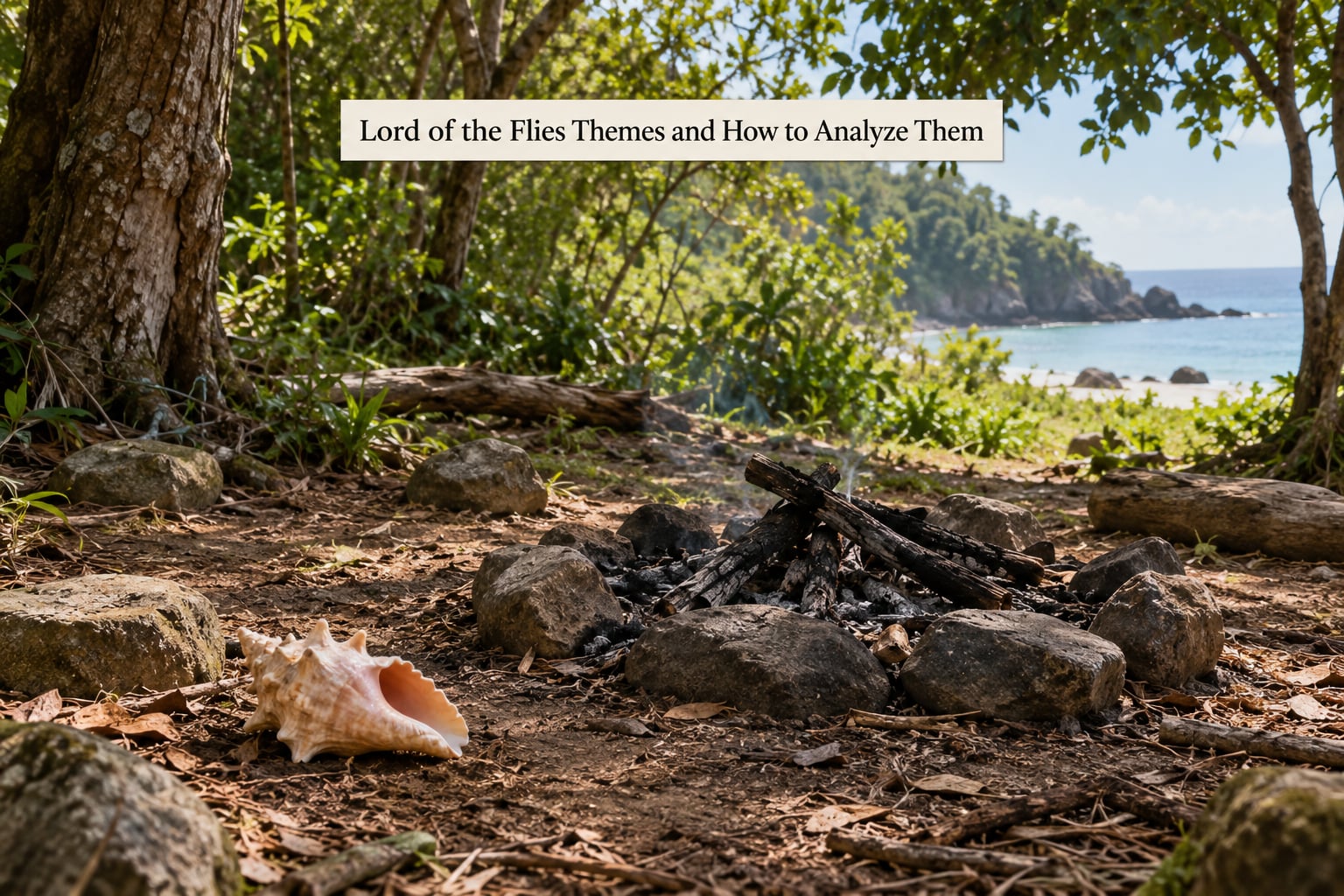
Every theme in this novel is trackable through an object or a place, so the strongest essays follow the symbol rather than the general idea.
Civilization vs savagery
The whole plot is built on this opposition, and the signal fire is the cleanest way to follow it. The fire stands for order, community and rescue. When Jack’s tribe steals the fire and relights it somewhere sheltered, or when the fire goes out at night while the boys are hunting, civilisation literally stops working. When the fire is finally used to burn Ralph’s shelter at the end, the theme reaches its conclusion in a single image.
Inherent human nature
Golding’s darker claim is that evil is not created by the island. Nobody introduces violence to a group of children who would otherwise be peaceful; the capacity is already there. Simon’s murder is the proof, because it is committed by frightened children with no leader and no excuse. Be careful here: Golding argues that bad institutions release what is already in people, not that every child is born evil.
Leadership and power
Compare the two leadership models directly. Ralph governs by consent, rules and shared assembly, and his authority depends on keeping the conch intact. Jack governs by fear, secrecy and charisma, and his authority depends on activity and on someone to hunt for. Golding is not arguing that either system works permanently; he is showing how quickly a democratic one collapses when its rituals stop being respected.
Conformity and the outsider
Simon is the outsider whose perception is right and whose voice is worthless. That gap between being right and being heard is the engine of the last third of the novel. The scene where the twins tell Simon the truth is the same scene in which they describe their own part in his death, which is what makes it so uncomfortable to read.
Loss of innocence
Golding was explicit in his 1954 introduction that the novel was written to show what boys actually are. The novel tracks the loss in stages, from the staging of the hunt in Chapter 7 to Simon’s death to Ralph weeping. The last line of the book, the officer’s puzzled response to an ordinary boy crying, is the hinge on which the whole theme turns.
What Do the Symbols and Objects in Lord of the Flies Mean?
| Symbol | Literal meaning | Symbolic meaning | Key chapter |
|---|---|---|---|
| The conch shell | A large pink shell found on the beach | Democracy, authority and civilised order; its destruction marks the end of the tribe | 1 and 12 |
| The signal fire | A fire lit on the mountain top | Hope of rescue, and the practical proof that the boys can cooperate | 3, 9, 11, 12 |
| Piggy’s glasses | Broken spectacles Piggy uses to see | Reason, knowledge and the ability to see clearly; also the thing that can start or put out a fire | 2, 4, 10, 12 |
| The beast | A shape seen in the jungle, the pig’s head on a stake | The inner evil the boys invent so they can blame something other than themselves | 4 and 9 |
| The pig’s head on a stick | A sow’s head mounted by Jack’s hunters | Idol worship, a god the tribe sacrifices to, and the visible face of fear | 4, 6, 11, 12 |
| Face paint and masks | Boys disguise themselves before a hunt | Loss of individual identity inside a group; a carnival face worn over a frightened child | 6 and 11 |
| The parachute | A fallen parachute that looks like a monster | War reaching the island; the dead airman who is the true beast | 9 |
| The naval officer | An adult who arrives by ship | Outside order and the rules of the adult world, arriving far too late to help | 12 |
Three further objects matter in exam answers. The platform where Ralph holds his assemblies represents democratic procedure, which is why the disruption of assemblies is such a strong sign of collapse. The mountain is ambiguous throughout: it is where the fire promises rescue and where Simon discovers the truth. The broken stick is a small but useful detail, because it stands in for the snapped spear Jack uses to kill Simon, a weapon of hunting turned on a human being.
Lord of the Flies Setting and Atmosphere
The island is not neutral scenery. Golding gives it a shape that mirrors the boys’ moral decline: safe, sheltered and orderly near the beach and the lagoon, dangerous and unknown as they move inland.
The lagoon is where they bathe, work and assemble, and it reads as the one genuinely civilised place on the island. The jungle is where the beast lives and where hunting happens. The mountain top is exposed and lonely, which is why it works for the fire and for Simon’s discovery. The rock by the sea where Ralph watches for ships is where hope and despair are most evenly balanced.
The atmosphere changes with the boys. Early chapters are warm and funny, full of swimming and practical jokes. By Chapter 10 the same beach is lit by moonlight and full of screaming. The island is a projection of the group’s inner state rather than an independent setting.
How Does the Novel Show the Conflict Between Order and Chaos?
The conflict is staged as two rival tribes rather than one group breaking down, because Golding wanted a civil war rather than a riot.
Ralph’s side has a set of rules, a fire kept going by Sam, the twins and Simon, and a shelter. Jack’s side has hunting, masks, no rules at all and a private fire on its own ground. The moment the text shows how far apart they have drifted is the raid on the littluns’ camp, followed by Jack refusing to say sorry and Piggy being hit as he names him.
The last scene puts the two systems in one image. On the platform, order was made by a conch that anyone could hear. At the end, Ralph and Jack fight for the conch in private and Jack breaks it. Order does not lose an argument with chaos; it is simply smashed.
Lord of the Flies Ending Explained
In the final chapter Ralph is hunted across the island by the boys of Jack’s tribe, who believe he is the beast. Piggy is killed by the boar during the chase and Roger falls on the rocks. Jack and Ralph grapple for the conch, Jack breaks it, and the two of them sit down exhausted, and Jack tells Ralph to weep for him. Ralph does weep, and he is the only one still crying when a naval officer appears with a soldier.
Two misconceptions are worth clearing up. Simon is not killed by Jack deliberately; he is killed in a frenzied group attack by frightened boys who barely recognise him in the dark. And Ralph’s weeping is not weakness. Golding ends the novel on that detail deliberately, because the adult cannot understand why a boy who should be relieved to be rescued is crying.
The naval officer matters because he is blind to what happened. He treats the island as a rescue, not a tragedy, which tells you that the adults never knew and still do not understand.
Lord of the Flies Study Questions and Essay Prompts
Below are the questions students are asked most often, with a short note on the analytical point each one expects.
- Why is Ralph chosen as chief? He blows the conch to gather the boys and is already known as the son of a respected man. Discuss how democratic his election really is, given that much of his authority rests on a lucky accident.
- Why does Jack think he should be chief? He has the charisma, the choir’s loyalty and the physical confidence that the island rewards. Contrast his claim to authority with Ralph’s claim in one paragraph.
- Why does Jack start his own tribe? He rejects the rules because hunting matters more to him than order, and because a tribe of his own gives him power he never had inside the assembly. Trace the raid on the littluns and the split of the fire as the two turning points.
- What does the beast represent? Answer on two levels, as examiners want: the dead airman on the mountain, and the fear the boys invent so they need not blame themselves.
- How is Simon a Christ figure? He sees the truth, is ignored, is killed by the crowd and is mourned by those who understand him. Argue both for and against the reading, then reach a conclusion.
- Why does the war matter to the story? Golding sets it in the early 1950s, at the height of Cold War anxiety, and says in his 1954 introduction that he wrote the novel to show the truth about human beings after a war in which the adults had failed. The island is the war seen at its worst.
For an essay, the safest structure is claim, then two pieces of evidence with close analysis, then a counter-reading, then a short link back to your claim. A paragraph that only retells the plot scores badly, so spend most of each paragraph on why a particular detail matters.
William Golding Lord of the Flies Study Guide Checklist
Work through this list and you are close to exam-ready.
- I can summarise the plot in under 200 words, naming the conch, the fire, Simon’s death and the ending.
- I can state the main theme in one sentence and give two pieces of evidence for it.
- I can list six symbols with their meaning and the chapter they matter in.
- I know what the title of the novel refers to and how the image on the cover is prepared.
- I can compare Ralph and Jack in terms of leadership style, methods and symbols.
- I can explain Simon’s role and why his death matters to the plot, not just the theme.
- I know the historical context: 1954 publication, post-war Britain, nuclear anxiety, Golding’s stated intent in his introduction.
- I have memorised at least four quotations and can explain what each one proves in an essay.
- I have a counter-reading ready for the biggest themes, so my argument is not one-sided.
- I know how the ending works and why the last line matters.
A 100-word summary you can revise from: a group of schoolboys are stranded on an island after their plane is shot down in a war, and elect Ralph as chief, but his attempts to build a civilised society are undermined by Jack, whose hunting tribe rules by fear until the island breaks into open war and the two leaders fight over the conch.
Frequently Asked Questions
Who is the Lord of the Flies in the novel?
The title is a quotation from the Gospel of Luke, and it refers to a severed pig’s head on a stake that Jack’s hunters plant in the bush. The boys treat it as a god and offer it meat, so the title symbolises evil on a shrine. It also works as a pun, because a headless body can stand for any of the boys. Neither meaning is a separate character; the title names the fear the group creates for itself.
How does Simon die in Lord of the Flies?
Simon is killed in Chapter 10 by the other boys in a frenzy as he runs back from the beach to tell Ralph that the beast is not real. He is so agitated that he cannot explain himself, and the crowd cries out his name without fully recognising him. Jack does not order it deliberately. Simon’s death is the turning point because after it Ralph’s tribe and Jack’s tribe can no longer be told the truth about the island.
Why does Jack start his own tribe?
Jack splits away because Ralph’s rules stop him from hunting whenever he wants, and hunting is the only kind of power that feels real to him on the island. He takes the boys who like excitement, moves them to a separate camp, protects his hunters from punishment and relocates the fire. The break becomes violent when his tribe raids the littluns’ camp and refuses to accept the consequences.
What is the beast in Lord of the Flies?
There are two answers, and the strongest ones give both. The real creature is the dead parachutist whose body Simon finds on the mountain, described as a bloated figure with a parachute for wings, and whose smell frightens the boys. But for most of the novel the beast is whatever the tribe needs it to be, an excuse for their fear. Simon’s discovery removes the external monster and leaves the internal one.
How does Piggy die and does Ralph survive?
Piggy is killed during the final hunt when the boar charges the group on the cliff edge and he is pushed off or lost behind the rock, along with his companion. Roger falls on the same rocks. Ralph does survive: after Jack breaks the conch, Ralph is found by a British naval officer and taken home, still weeping. Nothing further happens to him after that, which is why his fate is left open in the novel.
What are the main themes of Lord of the Flies?
The four that examiners use most are civilization vs savagery, inherent human nature, leadership and power, and loss of innocence, with conformity and the outsider as strong supporting themes. Each can be tracked through a symbol rather than an abstract idea: the signal fire for the first, Simon for the second, the conch for the third, and the whole arc of the hunt for the fourth. If you can name the symbol, you can usually write the paragraph.
Conclusion
If you take one thing from this William Golding Lord of the Flies study guide, start with the plot in order, then learn the characters as symbols, then attach each theme to one object. Most exam answers go wrong because students explain a theme without quoting anything, so memorise four quotations and know what each one proves.
Read the final chapter last, and slowly. The ending is short, and almost everything the novel has been arguing for is packed into two sentences of a weeping boy and a puzzled adult.