
A Raisin in the Sun is a 1959 play by Lorraine Hansberry about the Younger family, a poor Black family in a cramped Chicago apartment who receive ten thousand dollars in life insurance money after the father of the family dies. The check forces Walter Lee, Ruth, Beneatha, Travis and Lena Younger to argue about how to spend it, and the argument turns into a fight over who gets to define a good life.
This is a complete A Raisin in the Sun study guide for high school students, college readers, teachers and anyone meeting the play for the first time. It covers the full plot scene by scene, every principal character, the major themes, the symbols, the most assigned quotes with act and scene citations, and a set of discussion questions and essay prompts you can actually use.
Table of Contents
- What Is Lorraine Hansberry’s A Raisin in the Sun About?
- A Raisin in the Sun at a Glance
- A Raisin in the Sun: Plot Summary and Key Events
- Act I, Scene 1
- Act I, Scene 2
- Act II, Scene 1
- Act II, Scene 2
- Act II, Scene 3
- Act III
- The Climax and How the Play Resolves
- Who Are the Main Characters in A Raisin in the Sun?
- What Are the Major Themes in A Raisin in the Sun?
- What Does the Title A Raisin in the Sun Mean?
- What Are the Most Important Symbols in A Raisin in the Sun?
- What Is the Historical and Racial Context of the Play?
- How Do Lorraine Hansberry’s Writing Style and Dramatic Techniques Work?
- A Raisin in the Sun: Important Quotes and Their Meanings
- A Raisin in the Sun Study Guide: Discussion Questions and Essay Topics
- What Grade Level Is A Raisin in the Sun?
- Discussion Questions for Act I
- Discussion Questions for Act II
- Discussion Questions for Act III
- Essay Topics
- Frequently Asked Questions
- What is A Raisin in the Sun about?
- What grade level reading is A Raisin in the Sun?
- What is the most famous line from A Raisin in the Sun?
- What are the major themes of A Raisin in the Sun?
- What happens in Act III of A Raisin in the Sun?
- Was A Raisin in the Sun based on a true story?
- Conclusion: How to Use This Study Guide
What Is Lorraine Hansberry’s A Raisin in the Sun About?
The short answer: the play is about what happens when a family dream is suddenly funded and then spent, wasted, or broken. Hansberry wrote it in 1958, it opened on Broadway on March 11, 1959, at the ANTA Theatre, the house now called the Brooks Atkinson, and it ran for 453 performances. Claudia McNeil won the Tony Award for Best Actress for playing Mama, and the play won the New York Drama Critics’ Circle Award.
Lorraine Hansberry was 28 when the play opened and died at 33, largely from cancer, with the second act of her intended five-play cycle of Black life unfinished. She grew up in Chicago and moved into an all-white neighbourhood as a teenager, which is where the experience behind the play begins. The Supreme Court case Hansberry v. Lee, brought by her family over a restrictive covenant on their property, was decided in 1959, the same year the play premiered.
A Raisin in the Sun at a Glance
| Element | Detail |
|---|---|
| Author | Lorraine Hansberry (1930-1965) |
| First performed | March 11, 1959, Broadway |
| Setting | A cramped two-bedroom apartment on Chicago’s South Side, sometime after World War II |
| Structure | Three acts, six scenes total: two in Act I, three in Act II, one in Act III |
| Genre | Realist family drama, in the tradition of naturalism, with comic relief |
| Central characters | Ruth, Walter Lee, Beneatha, Travis, Lena (Mama), Walter Lee’s father (offstage) |
| Awards | Tony Award for Best Actress (Claudia McNeil); New York Drama Critics’ Circle Award |
| Adaptations | 1961 film with Sidney Poitier; 2008 television film with Sean Combs |
One point worth stating early, because students get it wrong constantly: Mama is Lena Younger, and she is the mother of Walter Lee, Ruth and Beneatha, and the grandmother of Travis. The dead man whose insurance money drives the play is Walter Lee’s father, not Hansberry’s father. Hansberry’s own father, Otto, was a handyman who moved north and died when she was fifteen; the Younger father died under circumstances Hansberry left deliberately unexplained.
A Raisin in the Sun: Plot Summary and Key Events
Here is the whole play in order, scene by scene, with what each scene is doing for the argument as well as the plot. Each of the Youngers wants something specific from the money, and the pressure between those wants is the play.
Act I, Scene 1
Early morning in the Younger apartment. Travis arrives late for school and needs a fifty-cent subway fare. Ruth is already up, anxious and sharp, because she has been through this before and because she is pregnant again without telling Walter. Walter, in a hurry and out of work as a chauffeur, gives Travis the money but the boy does not get to school on time.
Walter and Ruth argue about Walter’s job and his failure to act like a man. Walter’s boss at the South Side job, Jim, has vanished, and Walter has been driving a white man around instead. Beneatha comes in with her university boyfriend, Joseph Asagai, a Nigerian man newly returned from Africa, and teases Ruth about her hair before her brother Walter sees it. Walter reacts to Beneatha’s natural hairstyle with a shudder of disgust, and Ruth defends it.
Asagai argues that the world is changing, that his return from Africa is a sign of the new age, and he presses Beneatha to consider a life larger than a doctorate. He challenges her to check out realness rather than hide behind what he calls the “white man’s” programs. Walter enters and dismisses Asagai as a self-important student, which earns him a long stare and a long silence. The scene also introduces the young man who will later deliver the insurance check, Willy Harris, and ends when Walter and Ruth walk out arguing.
Act I, Scene 2
Mama arrives home from work, tired, with a smile for Travis, and the family pretends that everything is fine. Then she says she has bought a house. She paid a small deposit on an old, run-down house in Clybourne Park, an all-white neighbourhood, using her own savings accumulated over years. She shows Travis the money she has set aside for his education, and the family reacts badly. Walter laughs, Ruth calls it hopeless, Beneatha says Mama has wasted her savings, and Travis laughs too.
Mama also quietly gives Travis fifty cents, the first time she has handed him money without asking him to explain what he will spend it on. She explains that she has been saving for years because she refuses to see her son end up the way his father did, killed by the pressure of a life with no margin. She asks Walter what he wants for his future, and Walter answers honestly for once: he wants to be a man, and he wants to have something. This scene sets up the coming war over the insurance money.
Act II, Scene 1
Ruth and Mama talk quietly because Walter is asleep. Ruth confesses that she is pregnant, and the two of them quietly discuss abortion. Ruth is roughly two months along. Mama does not approve, and she is more disturbed by the fear that Walter would kill Ruth if he found out, and by the idea that anyone would try to use a bottle shop or a janitor to end the pregnancy. The argument is never fully resolved, and it shadows everything after.
In the living room, Beneatha and George Murchison argue, with Asagai present. Beneatha has been denied university scholarship money and the rest of her support has been cut, so she now needs money she does not want and does not have. She attacks George for thinking that his own good manners and career plans matter, and she attacks Asagai too, for a romantic Africa of her imagination that is not his real country. Asagai answers her line about assimilation, asking when assimilation became a virtue. Beneatha calls his speech a performed argument, using the word “indigenous” as a weapon.
Meanwhile Walter has been called into a meeting by Willy Harris, the neighbourhood man who knows how to move money around, and comes home excited. The play never shows the meeting, which lets the audience hear Walter’s retelling privately before learning the truth in Act II, Scene 2. The scene closes with a quiet picture of the family reading together, which is one of the play’s few moments of genuine peace.
Act II, Scene 2
This is the play in one scene. The insurance check has arrived, and Walter has already given every dollar of it to Willy Harris to invest in a liquor store partnership. He does not tell anyone. He is in a mood of reckless confidence, and the scene begins with him pretending to advise his wife on handling money, buying a record, and talking about their future.
Then the truth comes out in stages. Beneatha reveals that she has to take a loan from the university because the scholarship fell through, and Walter’s panic shows how little was actually his. The confrontation escalates. Walter accuses Ruth of having had an abortion; Ruth accuses Walter of building a business that was never real; Beneatha accuses Walter of having stolen her tuition. Walter reaches for money that is not there and ends up battering Ruth, blaming her for the miscarriage.
Walter’s line in this scene is the emotional low point of the play: you all have a million’s share of the world, I have a slice of it, and it is hardly enough to keep a family up. After his outburst he sits in the darkened kitchen, reaches for a glass, and the glass falls and shatters. He looks around the ruined room and says damn my eggs, damn all the eggs that ever was. Beneatha takes Ruth upstairs. The family is now in debt to Willy Harris, who intends to take Travis’s money as a collection fee, and Willy Harris arrives with a plan: Walter should stay in the liquor business, take the proceeds to a Black dry-cleaning operation, and then bring the money to a real estate dealer who is buying houses for white families in the neighbourhood. Hansberry’s stage directions describe the money in Walter’s pocket as cash that is now water and as a load of crumpled newspaper.
Act II, Scene 3
Saturday morning, the day after. Beneatha has left for a nursing school demonstration, which makes Mama suspect her daughter is pregnant, since her other excuse for being out, an instructor she actually saw, turns out to be the woman’s mother. Ruth and Mama argue about money in a cramped kitchen, and Walter enters trying to be the cheerful provider while failing to hide how badly things have gone.
Travis starts the crisis by asking for fifty cents, then a dollar. He sent the fifty cents back to his father and told his father, without being asked, that he had been done playing with the money. Walter, shamed and furious in front of his friends Bobo and Willy, accuses Travis of being a spoiled brat. Travis beats him up, and the adults separate them. Walter then tells Travis he is not his daddy, not his boss, and not his daddy, and that he is nothing at all. Travis cries and asks why he and Ruth live so badly while other people, even poorer people, do not.
Mr. Lindner, a white neighbour, arrives with his wife to warn the Youngers that they should move out of Clybourne Park before it becomes too hard. He offers money and admits that the reason the neighbourhood is changing is that the families who lived there before them, the ones who were his parents and grandparents, are being pushed out. He explains that his own family moved in when it was still poor, and the current residents can move too. He leaves a cheque for five thousand dollars.
When he returns, Walter tells him to keep offering his money and shows him the receipts for the new roof, the gutters, the siding and the new pipes, all bought on credit with money that never existed. He gives Lindner back his own money, and a moment later Willy Harris arrives, surrounded by angry Black neighbours who have realised Walter’s liquor store money bought nothing but debt, and who call Walter a fool. The scene ends with the Lindner cheque still on the table, unclaimed.
Act III
Morning, the day the family is meant to move to Clybourne Park. Beneatha has been locked out of the house and has spent the night at Asagai’s, which is why Walter and Ruth have been out looking for her. Walter is on the verge of collapse and begins by saying he is nothing, a man with nothing, a nothing at all. Beneatha arrives, having decided to forgive him, and hands him the house papers.
Walter proposes the obvious solution: sell the house to Lindner and take the money. He works out loud on what the family could do with five thousand dollars, and it is a decent life, and it means safety. Ruth agrees, because she is the one who will have to live with the consequences. That is when Mama delivers the speech, telling Walter to look at himself in the mirror and decide who he is.
Walter asks Beneatha what he should do. Beneatha tells him to move in, and then says something that alters the play’s ending: a clause in the deed says no one may sell the house back to the Black families who lived there before, and the Younger family’s own experience shows what that kind of covenant does to people. Walter suddenly understands the Lindners’ fear, which is one of the play’s hardest ideas to sit with, and he tells the family to move in. Mama agrees, and the last line of the play is Walter’s, thanking his wife and family and saying the homecoming in the morning will be worth it all. Mama and Beneatha and Ruth follow Walter, calling him brother, son, and husband, and the family leaves together, still arguing, which is the point.
The Climax and How the Play Resolves
The climax is the disagreement between Walter and Beneatha in Act III, not the arrival of the check or the fight in Act II. Walter’s plan is to sell the house and take Lindner’s money, which is honest, practical, and would work. Beneatha’s plan is to move in, which costs more and insults the man who lives next door. Beneatha’s argument about the restrictive covenant is what turns Walter, because the covenant that protected the Younger family is the same instrument that the Lindners will use to protect their house from the Younger family.
The resolution is deliberately smaller than a triumph. The family does not get rich, does not go back to Africa, and does not win anything. Travis gets to keep his fifty cents, Beneatha keeps her pride and her baby, and Walter has a job, a family, and a plan that is no more realistic than it was before. Hansberry ends the play with the family leaving together, so the answer to what happens to a dream deferred is that the dream gets bent, and the bending is what keeps the family standing.
Who Are the Main Characters in A Raisin in the Sun?
The Youngers disagree about nearly everything, but they all want the same thing underneath: a life that is not a reaction to how other people see them. Asagai, a man outside the family, functions as a foil, a character who highlights a different set of traits in the people he interacts with.
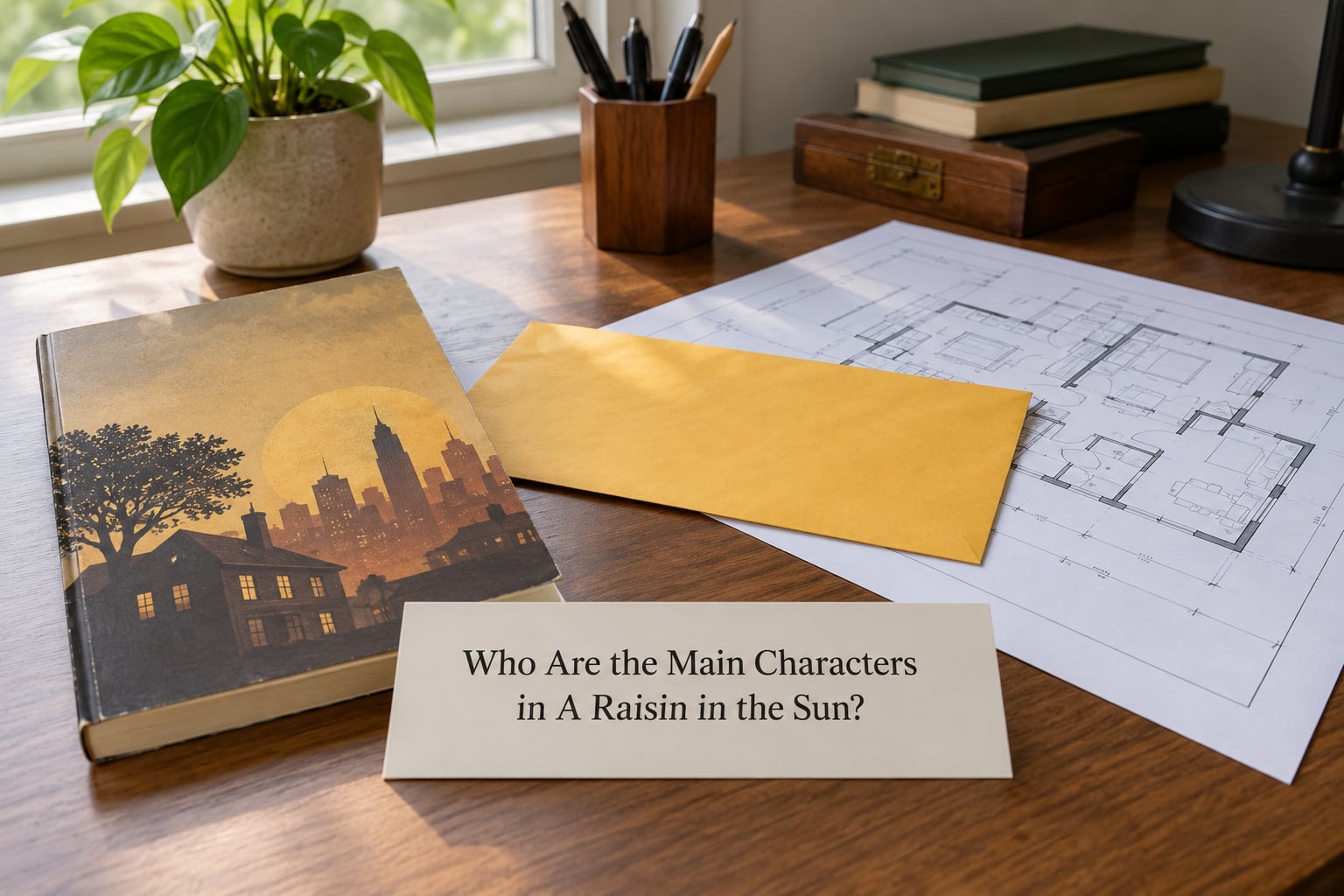
| Character | Role | Dream | What happens to it |
|---|---|---|---|
| Ruth Younger | Wife, mother, practical anchor | A home and a stable marriage, and to keep her second pregnancy secret | She gets the house, and the secret comes out |
| Walter Lee Younger | Second son, chauffeur, the frustrated centre of the play | To be a man, to have a business of his own | He abandons the business, which saves the family |
| Beneatha Younger | Youngest child, university student | To be a doctor, then a pioneering career outside convention | She keeps it, on her own terms, and forgives Walter |
| Travis Younger | Child, the family’s conscience | To be a man, and to be told the truth | He is told it, and he is beaten for it |
| Lena Younger (Mama) | Grandmother, matriarch, the play’s moral centre | A house in a good neighbourhood for her family | She gets it, and she pays for it |
| Joseph Asagai | Beneatha’s boyfriend, Nigerian nationalist | A unified Africa and a sister who understands it | Unresolved; he offers a future Beneatha is not ready for |
| George Murchison | Beneatha’s other suitor, a college man | To be a doctor and to keep his options open | He is left by Beneatha before the final scene |
| Karl Lindner | White neighbour, the antagonist of Act II and III | To keep Clybourne Park white | He fails, and his failure is not simple good news |
Ruth Younger is the play’s most underrated character and the one most often written about as merely bitter. She is not bitter, she is tired. Her dream is a house and a marriage that does not hurt anyone, and she is also secretly pregnant and terrified of Walter. She is the one who sees the money clearly and the one who never gets a scene in which she argues for her own wish. Beneatha’s teasing of her hair in Act I, Scene 1, and Walter’s claim that his wife is an “ain’t nothing” woman, both depend on Ruth being defined by other people.
Walter Lee Younger is the closest the play comes to a protagonist, and he is also its deepest problem. He is a chauffeur who is embarrassed by the job, a husband who has been out of work, a father who hits his son, and a man whose failure to act on his money costs the family everything. Hansberry gives him the most lines in the play and the most moral work to do. What changes him is not a lesson but a piece of information, the covenant in the deed, and that is the argument the play makes about how people learn.
Beneatha Younger wants to be a doctor and chafes at the idea. Her famous dialogue with Asagai in Act II, Scene 1, contains the play’s sharpest joke about assimilation, and her changes in hairstyle and ideology across three acts trace the difference between rejecting a corrupt system and rejecting a whole identity. She is the only character who does not need the insurance money at the end. She is also the only one who forgives Walter, and she does it as an act of will rather than sentiment.
Travis Younger gets the smallest stage directions and carries the largest moral weight. He is the child who returns fifty cents unasked, who takes a beating rather than lie, and who asks the question the adults avoid: why do we live so badly while other people, who are poorer, live so well. His fifty cents, the play’s only small money, is the cleanest measure of the family in Act I, Scene 2, and it is the number Walter cannot afford to lose in Act II, Scene 3.
Lena Younger, called Mama, is the matriarch and the engine of the plot. She bought the house in Act I, Scene 2 with her own savings, before the check exists, which is the single most important fact in the play. Her stage directions usually describe her as a woman of about sixty, and she is often called early thirties by readers who confuse her with Ruth; the discrepancy is worth naming, since her age is what makes her both matriarch and grandmother. She is also the only character who never speaks about money as an idea. She talks about houses, and her speeches close with “measure him right,” a phrase that means judging Walter by his own potential rather than by his present circumstances.
Joseph Asagai returns from Nigeria, where he has visited the Ashanti, and wants Beneatha to imagine herself inside a continental identity. Beneatha thinks his Africa is romanticised and says so, and Asagai calls that an “indigenous” instinct. He is idealistic and occasionally tedious, and the play uses him to ask whether a Black person’s answer to racism should be rejection or reinvention. The last we see of him is Beneatha’s note, written in her own hand, at the end of Act III.
George Murchison is the respectable college-educated suitor, and he is also useful to Hansberry as a contrast. He tells Beneatha in Act II, Scene 1 that he wants a girl who is a “nice little black girl” with a college degree, and he calls his own conformity a defence. He leaves before the climax, which leaves Beneatha without a plan other than Asagai and money she does not have.
Karl Lindner is the white neighbour and the play’s antagonist for two acts, and he is written with more care than his function requires. He admits in Act II, Scene 3 that his family moved into Clybourne Park when they were poor and that the families now leaving are the ones who were here first. His offer of five thousand dollars is not a threat; it is a transaction he genuinely believes is fair. The difficulty of the play’s last scene is that his fear and his greed are not the same thing, and Walter can only act once he confuses them.
Two other names matter for study purposes. Mrs. Johnson, a neighbour, appears in the restored complete edition and the PBS television version but not in the text of the original production; she is the one who asks where Travis will sleep in the new house and who says the family has been “welcome” to Clybourne Park. Willy Harris is the man who takes Walter’s money, and in Act II, Scene 2 he supplies the game’s answer: a liquor store, a dry cleaner, and a real estate dealer. Bobo, Walter’s only friend, appears in Act II, Scene 3, which is how Walter is found out in front of other people.
What Are the Major Themes in A Raisin in the Sun?
The overall message of the play is that a dream delayed by money, racism and family pride does not simply evaporate. It gets reshaped into something smaller and harder to carry, and the carrying is what the family’s love is for. Hansberry argues that the pressure of a racist society sits inside a family and distorts everyone in it, which is why Walter’s failure is not just a personal failing but a public condition.
- The deferred dream. The insurance money arrives as the chance to realise a dream, and it is destroyed by delay and secrecy. Walter’s scheme takes eight days and it costs the family its future.
- Racial discrimination as a private, not public, pressure. The Youngers are not fighting a law in this play. They are fighting neighbours, a school system, a scholarship office and a business partner, which is what makes the racism so corrosive and so ordinary.
- Family unity. Every one of the Youngers wants a different thing from the money, but the last page of the play has them leave the room together, calling each other brother, son and wife.
- Economic pressure and the working poor. Walter is a man with no margin, and the play never lets anyone forget that the money was a payment for a death. Ruth’s question about what can be sacrificed is an economic question, not a sentimental one.
- Gender expectations and masculine identity. Walter’s masculinity is defined by a business and a provider role he cannot hold, and the play is blunt about the damage that does to him and to everyone around him.
- Education, assimilation and African identity. Beneatha’s medical degree, Asagai’s return from Nigeria and her argument about assimilation form a genuine intellectual disagreement rather than a lesson with a correct answer.
- Class difference inside the Black community. The family and its neighbours are not equally poor, and not equally willing to compromise. Willy Harris, the dry cleaner, and the old woman who addresses the Youngers in Act I are all black and all outside the family’s own pride.
- Dignity, self-worth and community responsibility. The play’s closing argument is that you can be broke and still refuse to buy yourself out of your own values, and that refusing costs something.
These themes are not evenly spread. Act I, Scene 1 sets up gender, masculinity, education and identity, because it is the scene where the family is still performing normalcy. Act I, Scene 2 introduces the house, the fifty cents, and the family as a unit. Act II moves the pressure from dreams to money and from money to violence, and the two themes most readers write about, race and class, both reach their loudest point in Act II, Scene 2, in the liquor store reveal and Walter’s beating of Ruth. Act III tests every theme at once, since the family has to make a decision rather than feel about it.
What Does the Title A Raisin in the Sun Mean?
The title comes from Langston Hughes’s poem “Harlem,” also known as “A Dream Deferred,” which Hansberry quotes as an epigraph before the play begins. The poem asks what happens to a dream that is put off, and answers in images rather than promises: it is quick like a cat and a long reaching back in a dark where there have been no signs of light.
Hansberry takes the raisin, a dried fruit that is a grape with all its water gone, and the sun that shrivelled it. The image inverts the usual convention, because a raisin in the sun is a thing that has been sun-dried, concentrated, made small by something outside itself, and the moisture is exactly what has gone. Read that way, the Younger family are the raisin, and Chicago and the wider country that gave them their ration card and their run-down apartment are the sun.
Two other readings sit inside the same image. The raisin on the branch is a seed, a thing that could still be planted, and Asagai literally offers Beneatha a new landscape to plant it in, so the metaphor reaches out of the past into Africa. And the raisin is also an ordinary food, a poor family’s food, which is the point that keeps the metaphor from floating away: the family’s dream is not grand, it is a house with hot water and enough money left over, and the difference between a raisin and a grape is only whether anyone kept the water.
Hughes’s poem turns up a second time inside the play, uncredited but unmistakable. In Act I, Scene 1, Mama tells Walter her life has not been a crystal stair, a line that paraphrases Hughes’s “Mother to Son.” Two Hughes poems, one about a dream deferred and one about a mother who keeps climbing, frame the family between the social condition and the person who holds it together.
What Are the Most Important Symbols in A Raisin in the Sun?
Symbols in the play are mostly physical objects that the characters handle: the house, the check, the coins, the plant, the hair, the music. The strongest ones carry a single meaning and change slightly as the play goes on, which is what makes them worth writing about rather than listing.
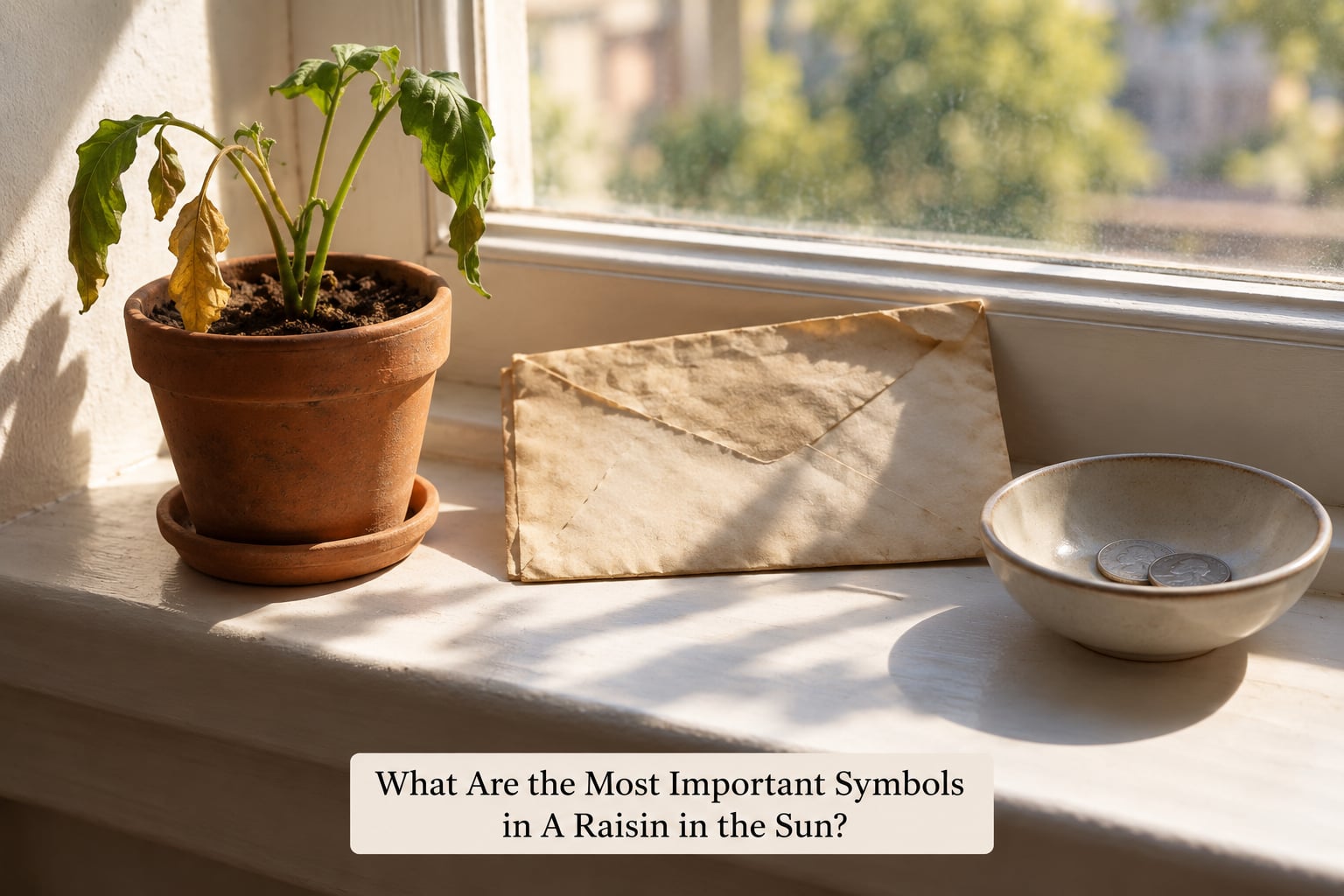
| Symbol | Meaning | Where it appears |
|---|---|---|
| The house in Clybourne Park | Dignity, family legacy and the cost of progress | Bought by Mama in Act I, Scene 2; the whole of Act III |
| The insurance check | Hope that becomes a trap; also the price of a death | Delivered in Act II, Scene 1; lost in Act II, Scene 2 |
| The fifty cents | Honesty, allowance, and the small change the family lives in | Act I, Scene 1; Act I, Scene 2; Act II, Scene 3 |
| Beneatha’s hair | Assimilation versus authenticity; pride and ridicule | Act I, Scene 1; Act II, Scene 1 |
| The wilted plant | Unfulfilled potential with no water and no sunlight | Act I, Scene 1; Act II, Scene 1; Act II, Scene 3 |
| Music and spirituals | The family’s inherited voice, the one thing money cannot buy | Act I, Scene 1; Act II, Scene 2; Act III |
| The gardening hat | Domestic as a form of resistance; a way to make a garden in a hostile place | Act I, Scene 2; Act II, Scene 1; Act III |
| Eggs, glass and light | Fragility of a plan with nothing under it | Act I, Scene 1; Act II, Scene 2 |
The house is the play’s biggest symbol, and it is deliberately ambiguous. The Youngers never see the inside of it until they are packed to move in, so the house is always described rather than shown, which lets each character project onto it. To Mama it is a garden. To Walter it is a wall he can put between himself and the world. To Lindner it is a boundary. The same object carries all three meanings and the play refuses to settle the argument.
The money works in layers too. Ten thousand dollars is more than the family has ever seen, less than the cost of a real house, and enough to make every one of them believe in a different outcome. In Act II, Scene 2 the stage directions turn Walter’s share into water and then into crumpled newspaper, so the money is destroyed visually before the characters understand it verbally. The two coins, in contrast, are the money the family can actually see. The moment in Act II, Scene 3 when Walter cannot produce fifty cents is more devastating than the loss of the check, because fifty cents is the one sum that was ever his to give.
The plant on the windowsill is the title made visible. It appears in Act I, Scene 1, and Hansberry repeatedly describes the Youngers’ apartment as having too little light. Walter’s wish to move to Clybourne Park is partly a wish for sunlight, and the plant goes with the family. Music works the other way round, since the spirituals the family sings cost nothing and arrive whenever they are needed, and Act II, Scene 2 has Ruth, Beneatha and Mama singing after Walter has destroyed the family money. In a play about a shortage of money, the one art the Youngers make for free is the one Hansberry uses to end Act II and, quietly, to end the play.
What Is the Historical and Racial Context of the Play?
A Raisin in the Sun takes place in a South Side Chicago apartment, and it is a play about a specific migration. Between about 1916 and 1970, more than six million Black Southerners moved to northern cities, which is the Great Migration. The Younger family are part of it. Hansberry drew on the Chicago Black community she grew up in, and the apartment is a version of it, not a neutral place.
De jure segregation ended with the Supreme Court decision in Brown v. Board of Education in 1954, and the play premiered in 1959. What that legal change did not do was end housing discrimination. In Chicago, redlining and restrictive covenants kept Black families out of white neighbourhoods for decades, and a covenant could be enforced against a buyer even after the buyer had never read it. Hansberry herself had been through this. Her family moved into an all-white neighbourhood in Chicago when she was a teenager, and after her father Otto died, neighbours tried to enforce a covenant, which led to Hansberry v. Lee.
Clybourne Park is the play’s version of that system, and the name is worth noting: it later became the title of Bruce Norris’s 2010 play, Clybourne Park, which takes place in the same house in 1959 and 2009, and which is often taught as a companion piece. Lindner’s offer in Act II, Scene 3 is not an insult. It is a settlement offer from a man who knows he is on the wrong side of history and has decided to negotiate instead. The Younger family’s position in 1959, which is the point of the play, is that they have very little to negotiate with and refuse to try.
The class context is the part most summaries skip. The Youngers are not poor by the standards of the Depression they came from, and they are not secure by any 1950s measure. Walter’s South Side job is a job, and that matters: a great deal of the play’s tension is the fear of losing standing that is thin but real. Willy Harris and the liquor store are not villains in any moral sense. They are the local economy the family is trying to move up in, and Hansberry writes them so the audience has to watch Walter’s plan fail in a system that also exploits him.
How Do Lorraine Hansberry’s Writing Style and Dramatic Techniques Work?
Hansberry writes in the realist tradition of American family drama, close to naturalism, the movement that treats environment as a cause of behaviour and refuses to reward anyone for being good. The apartment is not a backdrop, it is the cause. When people talk over each other, hit each other, and hide money from each other, it is partly because the room is too small and there is never enough of it.
Dialect and voice. The Youngers talk in an African American vernacular that Hansberry records precisely, and the play’s humour depends on it. Some lines have caused classroom friction: the family uses outdated slurs for their own community in Act II, Scene 1, when Beneatha is mocked for what she is learning about her own history. Teach that honestly. It shows a community arguing about itself in real time, not a writer being careless.
Stage directions as evidence. Hansberry’s directions carry as much meaning as her dialogue. In Act II, Scene 2 the money is described as water, then as a load of crumpled newspaper, and in Act II, Scene 3 the family’s new gutters, siding and roof are named in a list the audience is meant to hear as Walter’s fantasy. The directions also run a running count of light: the apartment’s windows are always referred to in ways that keep the light low.
Dramatic irony. Dramatic irony means the audience knows something a character does not. It powers the whole of Act II, Scene 2, because we watch Willy Harris leave at the end of Act II, Scene 1 while Walter believes he has just signed a deal, and we know the money is gone before the family does.
Anaphora and repetition. Walter’s speeches are built on repeated openings: nobody ever talks to me about this stuff, nobody. Beneatha’s are built on questions: after all, I am just a woman, am I not? Mama’s climax is built on the phrase measure him right, and the change in what that phrase means, from judging him to forgiving him, is the arc of the play in one word.
Foreshadowing and the play within a play. The Willy Harris meeting is set up in Act II, Scene 1 and reported in Act II, Scene 2, so the audience gets a private version of a lie before the public version. The larger device is Beneatha’s references to the annual performance of the Abiola Playhouse in Nigeria, a play-within-a-play that never appears, which gives her a career she has not mentioned and lets Asagai’s Nigeria stay partly hers.
Comic relief. Bobo’s malapropisms, Travis’s school-room recitation, Beneatha’s teasing about Ruth’s hair and Willy Harris’s imitation of a preacher all break the tension and, more importantly, prove the point of the play. These people are funny, and funny people are being shown the door of their own house.
Realist structure. The play is well made, with a clear climax at the end of Act II, Scene 3 and a short final act that lets the family make a decision rather than simply react. It is also, unusually for a 1950s Broadway play, a play with a Black female character who is not a servant and is not a mother of someone else’s plot. Lena Younger argues, refuses, and wins the argument, and the play ends with her walking out first.
A Raisin in the Sun: Important Quotes and Their Meanings
These six lines are the ones that turn up in quizzes and essays most often. Each is quoted with the act and scene so you can find it in your copy quickly, and each is followed by what it is doing, not just what it says.
1. “What happens to a dream deferred? It’s quick like a cat and a long like reaching back in a dark where there have been no signs of light.” Epigraph, from Langston Hughes’s “Harlem.” The question is the play’s thesis statement, and the answer is deliberately vague, which is why readers have argued about it for sixty years. Hansberry uses the question but never answers it directly, because the characters have to answer it with actions instead. Quote this when you write about the title, and pair it with the raisin in the sun image rather than treating it as a thesis.
2. “Life for me ain’t been no crystal stair.” Lena Younger, Act I, Scene 1. Mama’s paraphrase of Hughes’s “Mother to Son” says that her own life has been hard, and that she has kept climbing anyway. It matters for two reasons: it is a moment of genuine warmth in a play full of shouting, and it is Mama telling Walter, in advance, that she is not going to save him from the consequences of his own decisions.
3. “Check out realness.” Joseph Asagai, Act I, Scene 1. Asagai is telling Beneatha that the world has changed and that pretending it has not is a choice with a cost. The exchange matters because it establishes that the play’s argument about identity is a disagreement, not a lecture, and because Beneatha rejects him rather than being convinced by him on the spot.
4. “Assimilation! When did assimilation become a virtue?” Beneatha, Act II, Scene 1. Beneatha is attacking the idea that abandoning what you are in order to be accepted is morally superior. The line comes out of a fight with Asagai in front of George, which is why it stings: the person she is arguing with is one of the people she loves. If you write about the play’s treatment of African identity, this is the anchor quote.
5. “You all got a million’s share of the world; I got a slice of it, and it ain’t hardly enough to keep a family up.” Walter Lee, Act II, Scene 2. Walter is not being lazy here, he is being accurate, which is what makes the speech so hard to dismiss. It is also the moment his self-pity turns into a diagnosis of class, and the play asks the audience to hold both readings at once.
6. “Damn my eggs, damn all the eggs that ever was.” Walter Lee, Act II, Scene 2. Walter has just dropped a glass in a kitchen he believes he has just paid for with a business he does not have. The line is the whole of Act II in a single sentence, and it works because the eggs stand for the modest, ordinary future the family was going to have, and because the curses are aimed at a table instead of at the family. Essay prompts on Walter’s masculinity often turn here.
A Raisin in the Sun Study Guide: Discussion Questions and Essay Topics
What Grade Level Is A Raisin in the Sun?
The play is taught almost entirely in high school English, most often in grades 9 through 12 and most often in eleventh grade. It is also standard reading in introductory college American drama and African American literature courses. There is no official reading level published for it, since it was written for the stage rather than for a classroom, and the main barrier for younger students is Hansberry’s rendering of dialect rather than the vocabulary. Lexile and readability tools are less useful here than reading level expectations.
Discussion Questions for Act I
- Walter gives Travis the fifty cents. What does that tell you about Walter that the rest of Act I, Scene 1 does not?
- Why does Hansberry open the play with a fight rather than with the check?
- Beneatha and Asagai disagree about assimilation. Whose position is closer to the play’s own, and why?
- Mama has already bought the house in Act I, Scene 2, before the money arrives. What does that tell you about her?
- What does Mama mean by “measure him right,” and how does her meaning change by the end of the play?
- What is the significance of the family’s singing together in Act II, Scene 1?
Discussion Questions for Act II
- Is Walter’s liquor store plan a criminal act, a foolish one, or both? Does your answer change if you take the class position of Willy Harris?
- What does Ruth’s pregnancy add that the insurance money alone would not?
- Why does Hansberry give the audience eight minutes with Willy Harris before revealing what Walter agreed to?
- Travis returns fifty cents without being asked. Is that integrity, or is it a child’s version of a strategy?
- Karl Lindner admits his family was once the poor family moving in. Does that change what you think of him in Act II, Scene 3?
- Is the family’s violence in Act II, Scene 2 about money, or about dignity?
Discussion Questions for Act III
- Why is the climax a conversation between Walter and Beneatha rather than a visit from the Lindners?
- Does Walter’s decision in Act III make him principled, or does it just make him lucky?
- What does Beneatha’s note at the end of the play say about her future?
- The family never reaches the house on stage. What has Hansberry gained by ending the play before they arrive?
- Is “measure him right” a statement about Walter, or about Mama, or about both?
Essay Topics
These are grouped by how much groundwork they need. The first group works from a single scene or quotation, the second needs one theme developed across two acts, and the third asks you to argue something the play deliberately refuses to settle.
| Prompt | Where to look | Level |
|---|---|---|
| Trace the fifty cents from Act I, Scene 1 to Act II, Scene 3 and explain what the trail shows | Acts I and II | Starting |
| How does the plant in Act I, Scene 1 relate to the title? | Act I, Scene 1 | Starting |
| Is Beneatha’s natural hairstyle a symbol of pride, of assimilation, or of a dispute inside her family? | Act I, Scene 1; Act II, Scene 1 | Starting |
| Explain Mama’s speech in Act III using one quotation and one stage direction | Act III | Starting |
| Walter’s liquor store plan: argue whether it is a dream, a fantasy, or a delusion | Act II, Scenes 1 and 2 | Developing |
| How does the play use money to test the family’s unity at three separate points? | Acts I and II | Developing |
| Compare Beneatha’s Act II, Scene 1 argument with Asagai to the Lindner negotiation in Act III | Act II, Scene 1; Act III | Developing |
| How does Hansberry build Walter as both the protagonist and the antagonist of the play? | All three acts | Developing |
| The spirituals are the Youngers’ only free art. What does the play do with that? | Act I, Scene 1; Act II, Scene 2 | Developing |
| Is the ending optimistic, tragic, or both? Argue it from the last page. | Act III | Advanced |
| Walter understands the restrictive covenant in Act III and still moves in. What does the play ask of the audience here? | Act III | Advanced |
| Does the play endorse Beneatha’s politics, Asagai’s, or neither? Defend your position with two scenes | Act II, Scene 1; Act III | Advanced |
Frequently Asked Questions
What is A Raisin in the Sun about?
It is Lorraine Hansberry’s 1959 play about the Younger family of Chicago, who receive ten thousand dollars in life insurance money after the father of the family dies. Walter Lee, Ruth, Beneatha, Travis and Lena Younger disagree about how to spend it, and the argument becomes a fight over dignity, identity and what a good life costs.
What grade level reading is A Raisin in the Sun?
The play is taught almost entirely in high school English, most often in grades 9 through 12 and most often in eleventh grade, and it is also standard in introductory college American drama courses. The main difficulty for younger readers is Hansberry’s rendering of African American dialect rather than vocabulary, since no official reading level has been published for it.
What is the most famous line from A Raisin in the Sun?
The most quoted line is the question Hansberry takes as her epigraph from Langston Hughes’s poem Harlem: what happens to a dream deferred? The lines most often assigned for analysis after that are Walter’s damn my eggs speech in Act II, Scene 2, Beneatha’s question about assimilation in Act II, Scene 1, and Mama’s life for me ain’t been no crystal stair in Act I, Scene 1.
What are the major themes of A Raisin in the Sun?
The major themes are the deferred dream, racial discrimination as a private pressure inside the home, family unity, the pressure of poverty on working people, masculine identity and gender expectations, education and African identity, class difference inside the Black community, and dignity as something a family will not sell.
What happens in Act III of A Raisin in the Sun?
Act III takes place the morning the family is due to move to Clybourne Park. Beneatha returns after being locked out and forgives Walter. Walter proposes selling the house to Karl Lindner, Mama argues instead that he should measure himself against his own potential, Beneatha explains the covenant in the deed, and Walter decides to move in. The family leaves together, still arguing.
Was A Raisin in the Sun based on a true story?
Partly. The Younger family was inspired by Lorraine Hansberry’s own family in Chicago, and Hansberry grew up on the South Side. Her family moved into an all-white neighbourhood and was targeted by a restrictive covenant, the case that became Hansberry v. Lee, decided in 1959. The exact circumstances of Walter Lee’s father’s death are never explained in the play.
Conclusion: How to Use This Study Guide
The play’s central argument is that a deferred dream does not dry up and vanish. It hardens, it gets smaller, and someone in the family has to keep carrying it, and that carrying is the only thing Hansberry holds up as unqualifiedly worth having. The Younger family gets no money, no house they can keep, and no clean answer about the covenant. What they get is each other, walking out of the room in Act III, calling each other brother and son.
So study it in that order. Read the plot scene by scene first, because most confusion in this play is act-level confusion rather than interpretive. Learn the eight characters well enough to say what each one wants. Only then move to themes, symbols and context, where the act references will carry meaning instead of looking like a wall. When you get to quotes, the six above cover the ground most essays need, and the discussion questions in each act are written to be asked out loud, so use them in class rather than in your head.