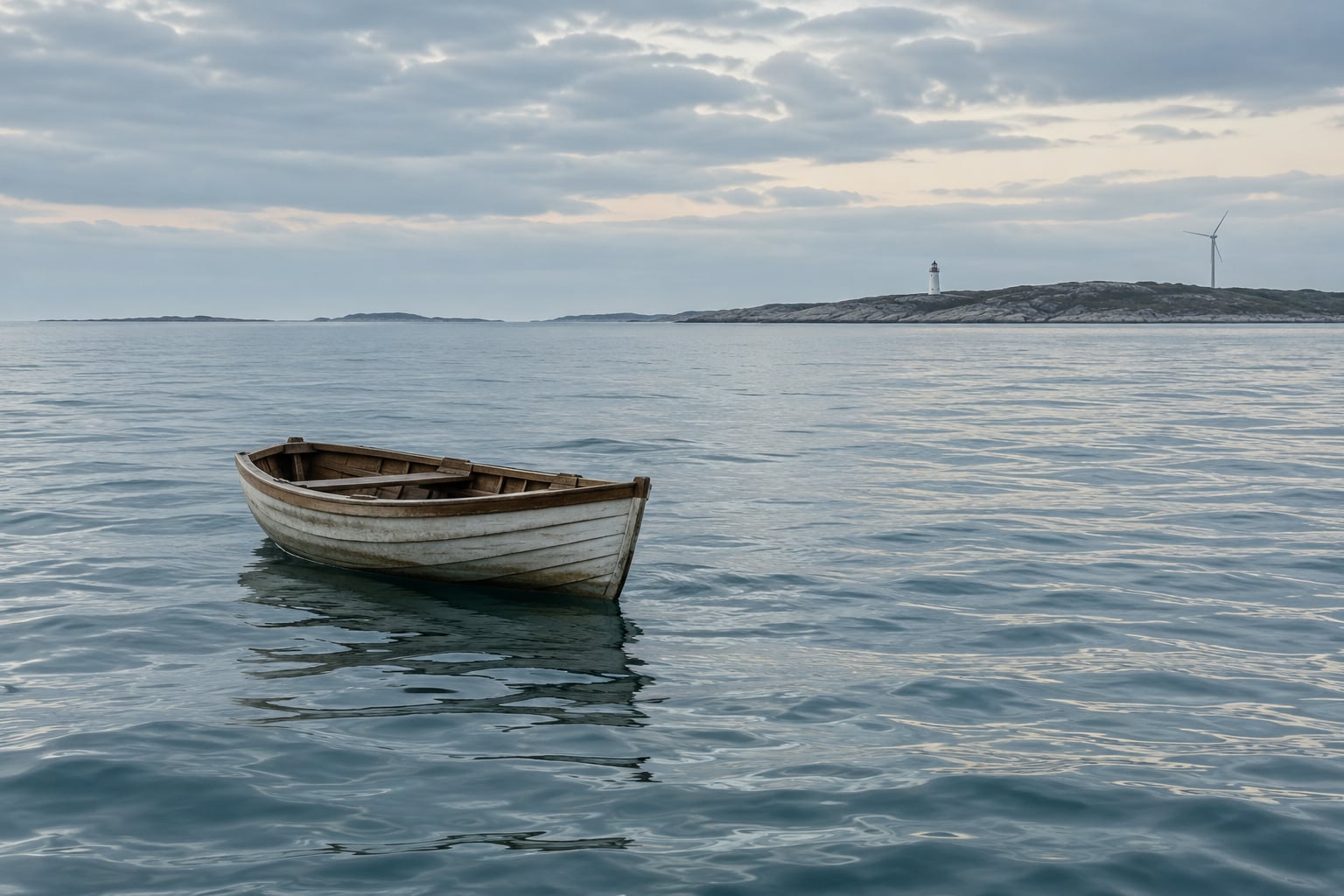
If you want stephen crane the open boat explained in a form you can actually use, here is the short version. The Open Boat is an 1897 short story by Stephen Crane, and it follows four men who spend roughly thirty hours in an open boat after their steamer sinks off the Florida coast. Its central idea is that the universe is indifferent to human fate, and that survival is a human achievement, not a gift.
Below you will find the plot, the four characters, the symbolism, the mood, the literary movement, and a practical method for turning all of that into an essay. I have kept the story’s ending unspoilt for the first few paragraphs.
Table of Contents
- Stephen Crane The Open Boat Explained in 60 Seconds
- What Is Stephen Crane’s The Open Boat About?
- Who Are the Characters in The Open Boat?
- What Happens in The Open Boat?
- Why Did the Small Boat Leave the Ship?
- What Are the Main Themes in The Open Boat?
- Human vulnerability
- Nature’s indifference
- Duty and moral responsibility
- Heroism as interdependence
- Courage and self-knowledge
- Isolation and the limits of control
- What Does the Open Boat Symbolize?
- How Does Stephen Crane Use Realism and Naturalism?
- What Literary Devices Does The Open Boat Use?
- Mood and tone
- What Is the Point of the Narrator’s Vision in The Open Boat?
- How Does the Ending of The Open Boat Work?
- How Do You Write an Analysis of The Open Boat?
- Thesis templates for a Stephen Crane The Open Boat explained essay
- A paragraph that works
- Where to read the full text
- Frequently Asked Questions
- What is the main message of The Open Boat?
- Why is the narrator in The Open Boat unnamed?
- What does the open boat represent in Stephen Crane’s story?
- Is the narrator’s vision of nature watching him literal or metaphorical?
- What happens to the captain in The Open Boat?
- What literary style does Stephen Crane use in The Open Boat?
- Conclusion: Start with the Story’s Central Tension
Stephen Crane The Open Boat Explained in 60 Seconds
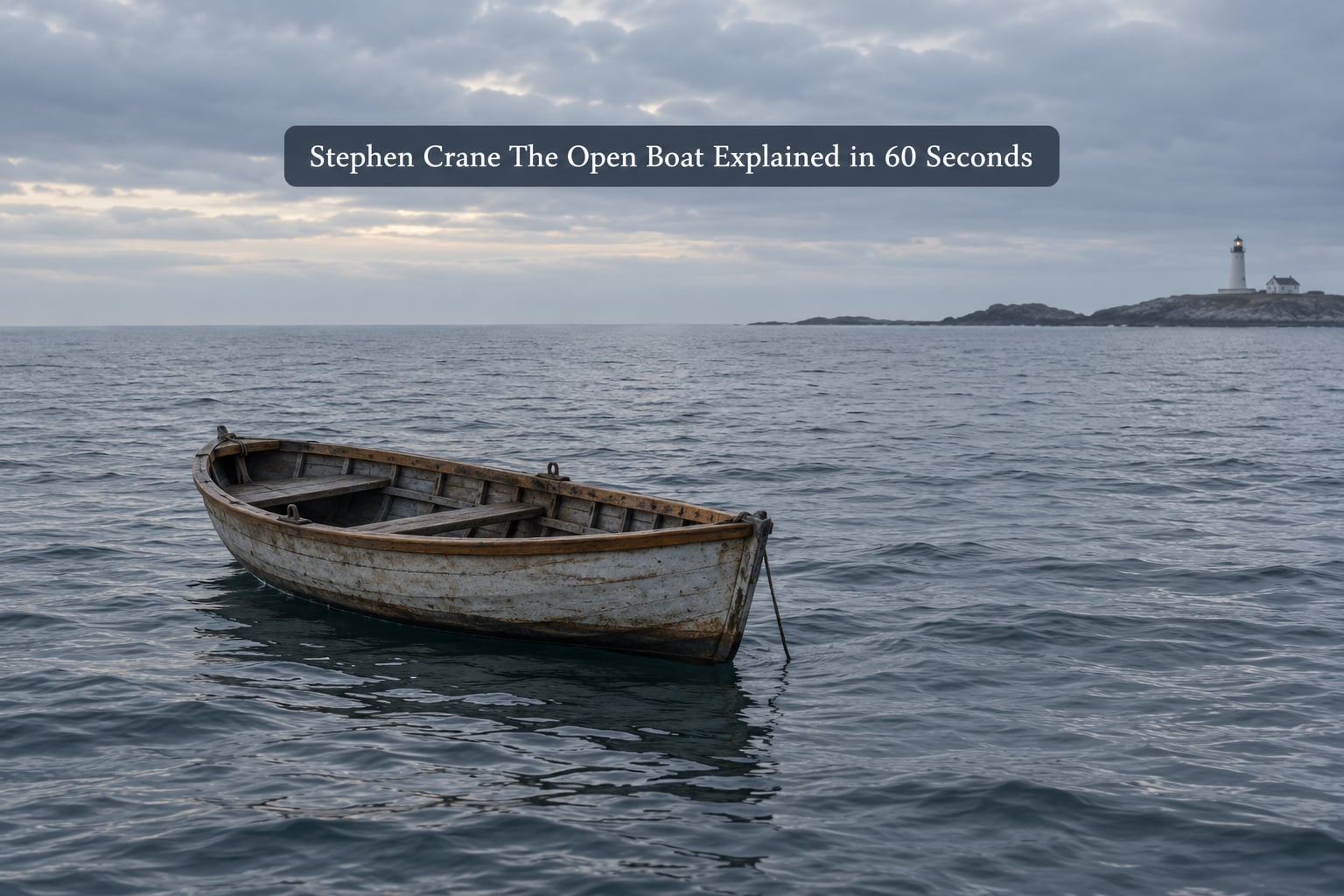
Crane (1871–1900) wrote The Open Boat in 1897 and subtitled it “A tale intended to be after the fact,” which tells you at once that it is a reconstruction rather than a transcript. He based it on his own survival after the steamship Commodore went down in January 1897 near Daytona Beach, Florida, while carrying arms for Cuban revolutionaries.
Four men escape in a small open boat: a narrator who is only ever called “the correspondent,” the captain of the wrecked vessel, the cook named Billie, and the oiler. For most of a day they row, bail, watch a lighthouse they cannot reach, and watch a shark circle them. Three of them are rescued. The fourth, the oiler, has already drowned, and the men learn of his death from a stranger.
Key facts at a glance
Author: Stephen Crane (1871–1900), American journalist and fiction writer
Published: 1897, in six short numbered sections
Subtitle: “A tale intended to be after the fact”
Real-life basis: Crane’s own survival after the wreck of the Commodore, January 1897, off Daytona Beach, Florida
Setting: An open boat on the Atlantic, roughly five miles from the Mosquito Inlet lighthouse
Cast: The correspondent, the captain, the cook (Billie), the oiler
Length of ordeal: Roughly thirty hours
Central idea: The universe is indifferent to human fate; human endurance and solidarity are what make survival meaningful
Ending: Three men are rescued, the oiler’s death is confirmed, and the correspondent goes ashore unable to interpret what happened
The central idea in one sentence: Crane shows that a meaningless, indifferent universe does not erase human value, because meaning is something the survivors build out of shared suffering rather than something the world grants them.
What Is Stephen Crane’s The Open Boat About?
It is about four men trying to cross a few miles of open water, and about how little of that struggle depends on courage. The external plot is simple; the interior argument is not.
Structurally, the story belongs to American literary realism of the 1890s, with strong naturalist leanings. Crane gives you working men, ordinary speech, an unglamorous setting and no transformation at the end. Nobody grows wise. Nobody is rewarded. One man simply is not there any more when the boat is picked up.
Underneath that realism sits a harder question: if nature is neither hostile nor helpful, what exactly is a person responsible for? Crane answers by shifting the moral weight off the sea and onto the crew. The danger is impersonal; the choices are personal.
That is why the story resists a tidy moral. The men are not saved because they deserve it, and they are not destroyed because they failed. What the story measures is what they do inside a situation that offers no explanation.
Who Are the Characters in The Open Boat?
Crane names only one of the four men, and that omission is deliberate: none of them is special enough to deserve a full identity in a world that does not pay attention to individuals.
| Character | Role | Defining behaviour | What he represents |
|---|---|---|---|
| The correspondent | Narrator; survivor who rows for most of the ordeal | Counts the miles, bails water, keeps watch through the night, imagines an audience on shore | Consciousness under duress; the habit of trying to interpret |
| The captain | Master of the wrecked vessel | Collapses early, then recovers; waves away a passing steamer so that others can be rescued first | Duty, hierarchy, self-sacrifice |
| Billie, the cook | Cook of the vessel | Bails steadily, suggests the rowing plan, stays practical to the end | Competence and endurance without ceremony |
| The oiler | Engine-room hand on the wrecked vessel | Scouts for the ship, spots the shark, survives the night, then swims back and drowns | Physical strength; the limits of strength itself |
A note many summaries get wrong: in the story, Billie is the cook, and it is the unnamed oiler who drowns. Some study guides swap the two names. If a class handout names Billie as the dead man, the text disagrees.
The correspondent is the story’s consciousness, and Crane gives him a restless, anxious intelligence rather than a heroic one. He is the man who notices that the boat is filling with water, who counts the inches of water, who asks what the sea’s silence means. He is also the man who, once the danger passes, cannot let it go.
The captain is the most interesting character because he is both an authority figure and a vulnerable body. He collapses, is nursed back to consciousness, and in his one clear act of agency he refuses a rescue that could have saved only the men nearest to it. Critics read that gesture differently: some see it as noble, some as a man asserting command he has not earned.
What Happens in The Open Boat?
Here is the plot in order, without the critical commentary. Read this part first if the ending matters to you.
- The wreck. A steamer runs into trouble off the Florida coast and begins to go down. Four men get into a small boat and push away from the sinking vessel. The narrator, a passenger rather than a sailor, is the only man aboard who has no business being there.
- Rowing back. The men row toward the wreck to recover supplies and check for survivors. The sea is too rough and the water is coming in over the gunwales, so they bail and steer away.
- The lighthouse. They sight the Mosquito Inlet lighthouse, which appears close but is in fact several miles off, separated from them by a current they judge they cannot beat. After a long argument, they turn away from the one fixed point that might have saved them.
- The shark. A large shark circles the boat. The oiler points at it and says only one word. Later they understand that what they were looking at was not what they thought they were looking at.
- The passing steamer. A vessel passes within sight. The captain has recovered enough to raise himself, wave the steamer away, and point out to the correspondent, who is nearest, that the men in the boat must be rescued first.
- The night watch. The correspondent takes a turn at the oars while the others sleep. Lying back in the boat and staring at the sky, he has a strange vision of being watched from the shore, and of there being no answer to his question about why.
- The rescue. At first light, a man in the lighthouse wind-tower spots them and launches a boat. They are taken aboard a larger vessel, and the captain, the cook and the correspondent are safe.
- The news. A sailor aboard the rescue ship tells the captain that a man was seen going back toward the wreck the previous afternoon and was not seen again. The captain, who knows exactly who it was, weeps. It was the oiler, and it was the best man he had.
- Ashore. The narrator reflects on how little he will ever know of the dead man’s last hours, and then walks up from the water toward the town, carrying the question with him.
Two details are worth flagging because students regularly misread them. The captain does not drown; he survives. And the oiler is not a sacrifice made in the moment of rescue; he had already gone missing hours before, on his own errand, in water the others judged too dangerous to enter.
Why Did the Small Boat Leave the Ship?
Because the men believed supplies and perhaps other men were recoverable, and because hope is the thing that keeps people rowing. Crane is careful about the practical reasoning too: the boat was sound, the sea around the wreck was rough, and the risk of staying close was high.
The more interesting question is why the narrator, a non-sailor, ends up with the oars. He takes command without any formal right to it. Crane never explains the transfer of authority, which is itself a point: in an emergency, position simply shifts to whoever is willing to act.
This is also where the moral question of the story starts. Four men are going back towards a vessel that is almost certainly already gone. Two of them barely know how to handle an oar. The decision to go back is not brave in any recognisable way; it is simply the decision people make when nobody has worked out what else to do.
Later, the narrator’s own reactions complicate that. He alternates between calm competence and a nervous, watchful interior monologue, and Crane lets both stand without comment. When he finally lies down to rest and something goes wrong in the boat, the reader is left to decide whether his exhaustion was weakness, necessity, or simply human limits.
What Are the Main Themes in The Open Boat?
Human vulnerability
Vulnerability here is physical first. The men are cold, tired, wet, and unarmed, and the boat is taking on water faster than four people can bail it. Crane keeps returning to small measurements, because that is how risk actually feels: inches of water, a mile that will not shorten, a body that will not keep going.
Nature’s indifference
This is the story’s famous idea, and Crane states it with unusual bluntness: the sea does not hate the men, does not spare them, and does not care whether they live. Indifference is worse than malice, because malice at least implies that you were noticed.
Duty and moral responsibility
The captain’s decision to wave away the passing vessel is the story’s clearest moral act. Nobody else in the boat can act on it. Crane builds the moment carefully so that it cannot be explained away as panic or delirium.
Heroism as interdependence
Nobody survives alone and nobody survives heroistically in the usual sense. The correspondent rows; Billie bails; the oiler watches the water. Remove any one of the three and the others have a much worse chance. The story’s version of greatness is shared labour under bad conditions.
Courage and self-knowledge
The correspondent learns what he is by being pushed to the edge of what he can do. What he learns is not flattering: he is frightened, tired, and capable of a little more than he thought. Crane ends the story before that knowledge becomes wisdom.
Isolation and the limits of control
The narrator spends the night trying to work out why he is out there. He fails. The ending refuses him a revelation, and that refusal is the argument: human beings live inside causes they cannot see and cannot correct.
What Does the Open Boat Symbolize?
Read the symbols as repeated images rather than as code. Crane circles back to the same handful of objects until they gather meaning through repetition.
| Symbol | What it means | Evidence in the text |
|---|---|---|
| The open boat | Exposure without protection; the whole human position rather than any particular hero | The boat is described as open from the first paragraphs, and it is still open at the end |
| The sea | Indifferent nature; vast, cold, uninterested in human plans | Its voice is present throughout and never answers a question |
| The shark | Not evil but simply hungry; nature without malice | It circles, it is watched, and it never attacks |
| The lighthouse and wind-tower | A goal that is visible, real, and out of reach | It appears close, is measured by the men, and is eventually given up |
| The imagined watcher on shore | The mind inventing meaning where none exists; possible audience or indifferent nature | The narrator asks why he is watched and receives no answer |
| The crystals in the water | Beauty that persists without caring; nature as indifferent ornament | They are noticed in the final passage, after the danger has passed |
The shark is the symbol students misread most often. Nothing in the story suggests it is a punishment or a portent, and it never attacks. Read it as evidence for the theme rather than as a device with a moral label attached.
How Does Stephen Crane Use Realism and Naturalism?
Realism in the 1890s meant writing about ordinary people and observable detail rather than about heroic types. Naturalism took that further: characters are shaped by environment and heredity, and events are treated as outcomes of forces larger than anyone involved. The Open Boat is usually labelled realist with naturalist leanings.
Crane’s realism shows up in the texture. Working men talk in short, functional lines. Nobody makes a speech. The narration lingers on a bailing bucket, a swollen foot, the cold in a man’s hands, and the arithmetic of how far they can row against a current. That documentary attention is why the story feels like memory rather than invention.
The naturalist side appears in the refusal of consolation. Nobody is rewarded, nobody learns a lesson, and the universe observes the whole episode without participating in it. What the naturalist framework supplies is the pressure of environment; what Crane does with it is refuse to let that pressure explain away human value.
Some critics, following Buitenhuis and others in the 1960s scholarship, argue that the story is not really naturalist at all, because nature in it follows no law that can be deduced. If there is no law, there is nothing for a naturalist world view to appeal to. That argument pushes the story toward existentialism, and Crane’s younger contemporaries found the technique closer to impressionism, where the narrator’s perceptions are the actual subject. James B. Colvert’s 1958 study of style and meaning remains the standard scholarly starting point.
The defensible position for most essays: call it realist in method, naturalist in outlook, and experimental in form. That claim can be defended with evidence, which matters more than picking a label and repeating it.
What Literary Devices Does The Open Boat Use?
- Point of view. Third-person limited, almost entirely inside the correspondent. The reader sees the shark because he sees it and gets the word “shark” because he hears it. Other men’s thoughts are reported from the outside, which keeps him isolated even inside a group of four.
- Understatement. The crisis moments arrive flat and quiet. A man says one word about a shark. The captain waves away rescue in a sentence. Crane lets the reader supply the emotion he refuses to narrate.
- Irony. The lighthouse that looks reachable is not. The sea that frightens them offers no opinion about their fate. The man who does the most physical work is the one who ends up in the water.
- Repetition and parallelism. Lines return in altered forms, particularly around counting, bailing and watching. Structure performs the same compulsion the characters feel.
- Imagery of measurement. Miles, inches of water, oar strokes, minutes of rest. Precise numbers replace adjectives about fear.
- Personification. The sea gets a voice and gestures; the wind-tower is personified as a watcher. Crane gives nature just enough agency to unsettle and then denies it.
- Sensory detail. Cold, wet wool, salt in the mouth, the smell of the cook’s food. The story stays with the body because the body is the argument.
Mood and tone
The mood is tense, cold, anxious and lonely, and it tightens rather than releases. The tone is controlled to the point of unnervance: Crane narrates a nightmare with the voice of someone taking notes. The result is a feeling of being watched by a story that will not look away.
Mood is what the reader feels; tone is how the writer behaves. In this story the tone is restrained, observational and almost clinical, and that restraint is what makes the mood so severe. When the ending finally loosens into open water and cliffs, it does not feel like relief so much as a change of pressure.
What Is the Point of the Narrator’s Vision in The Open Boat?
The vision is the night scene in which the Correspondent, lying back in the boat, imagines someone watching him from the shore and asking why. The story gives him no answer, and the passage ends with him still holding the question.
Read it figuratively and the vision is about anxiety. A frightened man invents an audience in order to feel that the situation means something. If someone is watching, there is a reason; if there is a reason, suffering is not random. Crane denies him the comfort of that reason, which is why the scene unsettles readers.
Read it more strictly as a narrative device and it does something else entirely: it makes the reader aware that they are being watched too. The story models the act of interpretation from the inside, and then shows how badly interpretation performs out here.
Students sometimes try to argue that the shore figure is a real person who never answers. There is nothing in the text to support that. The passage works because it stays unresolved, and an essay that treats it as a puzzle with a hidden solution will have to invent the solution.
How Does the Ending of The Open Boat Work?
The ending does two things at once. It delivers the rescue and the confirmation of the oiler’s death, then refuses to let the rescue function as consolation.
On the rescue ship, the news arrives as reported speech. A man went back towards the wreck; nobody saw him again. The captain, who knows who it was, cries, and calls him the best man he ever had. Crane keeps the report at one remove from the action, so the death arrives as information rather than as a scene, and the men learn it the way we do, secondhand, from someone who was not there.
Then comes the reflection. The narrator thinks about how little he will ever know of the dead man’s last hours, and about the strange chance that put him in that boat rather than on the deck. The idea he circles is the one readers in reading groups consistently return to: having survived, they can now be interpreters of what happened. That line, readers say out loud, is the story’s thesis. Survival does not answer the question; it makes you the person who tries to answer it.
The final images are not the dead man but the sea, the light, and the narrator walking ashore. They matter because the closing movement is away from the water and towards ordinary life, with no revelation awaiting him. Readers looking for a resolution of the oiler’s death will not find one, and that absence is the point rather than a flaw in the telling.
Where a claim rests on the text, it belongs in an essay. Where it rests on your own feeling about the story, it should be marked as interpretation. Examiners can tell the difference immediately, and the difference is worth most of the marks.
How Do You Write an Analysis of The Open Boat?
The difficulty students hit is not evidence. It is the story’s irresolution, which feels like an absence rather than a subject. Convert it into a question about form, and it becomes workable: not “what does the story mean” but “how does Crane make the ending refuse consolation, and what effect does that refusal have.”
Thesis templates for a Stephen Crane The Open Boat explained essay
- Symbol: The lighthouse works as a symbol of a goal that is real, visible and unreachable, which allows Crane to measure the men’s hope in miles rather than in feelings.
- Technique: By restricting the story to the correspondent’s limited third-person view, Crane makes the reader experience the ordeal as the narrator does, as a problem of interpretation rather than of rescue.
- Theme: Crane’s most radical choice is the shark’s failure to attack, which removes villainy from the sea and leaves indifference as the only available reading of nature.
A paragraph that works
Topic sentence, one piece of evidence, an explanation of how the device works, and a link back to a theme. For example: Crane never kills the captain, and a reader who assumed he did has to correct that assumption, which is itself part of the story’s method. The oiler’s death reaches the men only as reported speech from a stranger on a rescue ship, so grief arrives as information rather than as witnessed fact. The effect is to strip the ending of any chance to feel resolved, which supports the argument that Crane’s world offers meaning as a human construction rather than a natural given.
Three short paragraphs of analysis are worth more than three paragraphs of plot. Summarise in one sentence and spend the rest of the space on what the language is doing.
Where to read the full text
The story is in the public domain and free to read online. The Project Gutenberg edition of The Open Boat and Other Tales and the US State Department PDF edition are both complete and free. Quote from one of these and give a section reference, since the story is divided into six numbered sections.
Frequently Asked Questions
What is the main message of The Open Boat?
Crane’s message is that the universe takes no interest in human fate, yet human beings create meaning anyway through shared effort. Nothing in the story rewards the men or punishes them, so the only value available is the one they build by rowing, bailing and standing watch for one another.
Why is the narrator in The Open Boat unnamed?
Crane calls him only the correspondent, a passenger who has no role on a working ship. The name keeps him anonymous so the story cannot treat him as a hero or a lesson. It also isolates him: even inside a boat with three other men, he is largely alone with his own thoughts.
What does the open boat represent in Stephen Crane’s story?
The boat stands for human exposure: small, fragile and entirely open to a sea it cannot control. Because it stays open from the first page to the last, it works as a picture of the human position rather than of any single character. It also makes shared survival literal, since three men can only survive in it together.
Is the narrator’s vision of nature watching him literal or metaphorical?
It should be read as metaphorical. The correspondent imagines someone watching him from shore and asks why, and the story gives him no answer. The vision dramatises his anxiety and his need for the ordeal to mean something, and Crane’s refusal to supply a reason is what links it to the theme of nature’s indifference.
What happens to the captain in The Open Boat?
The captain survives. He collapses after the wreck, recovers, and later waves away a passing vessel so the men in the boat can be rescued first. He learns aboard the rescue ship that the oiler drowned trying to return to the wreck, and he weeps. Many summaries wrongly report that the captain dies; he does not.
What literary style does Stephen Crane use in The Open Boat?
Crane writes realist fiction with naturalist leanings: ordinary working men, precise physical detail and an unsentimental narrator. Critics also read it as experimental, closer to impressionism or early existentialism, because the story denies consolation and refuses a tidy moral. A safe essay position is realist in method, naturalist in outlook, experimental in form.
Conclusion: Start with the Story’s Central Tension
The lesson of The Open Boat is not that people are helpless, and it is not that people are conquerors. It is that the world will not tell you what your suffering means, and that you still have to decide what to do next.
When you start writing, begin with the correspondent’s search for control. He counts miles, measures water, watches the lighthouse and finally asks the sea a question it will not answer. From there, everything follows: the shared labour that keeps the boat afloat, the captain’s sacrifice, the oiler’s death, and the quiet walk ashore.
Pick one device, find one quotation that proves it, and explain what it does. That is where good essays on this story begin.