O. Henry The Gift of the Magi explained in one line: it is a 1905 Christmas short story about a poor young couple who each sell their most treasured possession to buy the other a gift, only to find that each sacrifice has made the other’s gift worthless. The point is not the gifts. It is what the giving cost.
Written by William Sydney Porter, who published under the pen name O. Henry, the story appeared in the New York Sunday World in 1905 and still turns up in middle school and high school reading lists more than a century later. If you have been handed the story cold, this page gives you the plot, the characters, the symbols and the ending in plain language, with no paywall in the way.
Table of Contents
- What Is O. Henry’s The Gift of the Magi About?
- What Happens in The Gift of the Magi?
- Why Do Della and Jim Sell Their Most Valuable Possessions?
- What Is the Meaning of the Ending?
- What Are the Main Themes in The Gift of the Magi?
- What Do Della’s Hair and Jim’s Watch Symbolize?
- How to use these symbols in an essay
- Why Is the Story Called The Gift of the Magi?
- How Does O. Henry Create Irony in The Gift of the Magi?
- What Is the Message of The Gift of the Magi?
- Frequently Asked Questions
- What is the moral lesson of The Gift of the Magi?
- What does O. Henry mean by the Magi?
- What is the climax of The Gift of the Magi?
- Is The Gift of the Magi a parable or a fable?
- Why did Della sell her hair?
- Why do the Magi in this story show up as foolish as well as wise?
- Start With the Last Four Paragraphs
What Is O. Henry’s The Gift of the Magi About?
It is about a young married couple named Della and Jim who live in a small New York flat with almost no money. At Christmas, Della wants to give Jim a real present, so she sells her long hair. Jim does the same thing in secret, selling his gold watch to buy her beautiful hair combs. Each buys exactly the gift the other gave up, so the two gifts cancel each other out and both end up empty.
O. Henry calls this a parable: a short story with one point, told through everyday people rather than abstract types. No animals, no talking objects, just a flat on Christmas Eve and two decisions that make no economic sense whatsoever. That is the tension the whole story runs on.
The interpretive question students usually write about is this: are the Magi wise or foolish? The story answers both at once, and the final paragraph holds both answers without picking one.
What Happens in The Gift of the Magi?
Here is the story in five beats. Read them in order, because the ending only works if you have the sequence right.
- The count. Della has one dollar and eighty-seven cents. That is the entire family income, and she sits on the steps outside her flat sorting coins into three piles, working out what she can afford.
- The idea. She thinks of the combs she used to admire in a shop window, and she has a check that would buy them if the shop allowed a trade-in on her hair.
- The sale. She sells her hair for twenty dollars. The hairdresser makes a tight permanent curl across her forehead, and she stares at herself in a small mirror, almost not recognising her own face.
- Jim’s side, hidden. Jim comes home, sees Della’s altered hair, and goes quiet. That night he sells his gold watch to a pawnbroker and buys the hair combs, while Della spends her twenty dollars on a gold chain meant for his watch.
- The discovery. Della opens the case where Jim keeps his watch and finds it empty. Jim gives her the combs, then opens the box that held the chain and finds it empty too. He laughs, and then he says he had better not laugh any more because he is about to cry.
The gifts are useless in a literal sense. Each one points straight back at the loss the other person made, so no one ends up with a present at all.
Why Do Della and Jim Sell Their Most Valuable Possessions?
Della sells her hair because giving a gift matters more to her than keeping her hair. She sees the combs, she knows Jim noticed them, and she decides that a Christmas with no gift for him is worse than a Christmas where she looks different. Her hair is not vanity; it is the one beautiful thing she owns and has kept for him.
Jim sells the watch for the same reason, in reverse. The watch was his father’s, and the watch was gold, which is the closest thing to money he has. He buys the combs without hesitating.
Three things make this plausible rather than silly. First, the flat is genuinely poor: one dollar and eighty-seven cents is not a figure chosen for decoration. Second, O. Henry explicitly says that neither of them ever tells the other how much the other means to them, so the sacrifice is the only available way to say it out loud. Third, they each know what the other one values, which is why both gifts land exactly where they were meant to.
What Is the Meaning of the Ending?
The ending works because O. Henry hands you two empty boxes. The chain for a watch that is sold. The combs for hair that is cut. The money is not wasted and the objects are not damaged, they are simply displaced, which is why nothing can be fixed and nothing needs to be fixed.
Jim’s laugh is the pivot. He finds the whole thing absurd, and then in the same breath he calls himself and Della the wisest people who ever gave gifts, and says he wants to be thought wise the next time too. O. Henry repeats the phrase in almost identical wording at both the start and the end of the story, so the last line lands back on the first line with a completely different charge.
So the ending is not a joke and it is not a tragedy. It is a verdict that keeps both halves: they were foolish about money and wise about love, and the story refuses to separate the two.
What Are the Main Themes in The Gift of the Magi?
Four themes carry the story, and each one has a piece of evidence you can quote.
Love measured by sacrifice. Neither character says anything tender out loud. The love shows up entirely in what they give up, which is why the ending works as a payoff rather than a shock.
Material wealth against emotional wealth. Della and Jim end up with less than they started with, in cash and in objects, and richer in nothing measurable. The story does not say money is worthless; it says the ranking of what counts is the couple’s own.
Poverty as pressure, not as excuse. The one dollar and eighty-seven cents sets the terms. The story never moralises about being poor; it just shows what poverty makes possible and what it makes impossible.
Generosity that costs something. A gift that costs the giver nothing says very little. O. Henry builds the entire plot on the difference between those two things.
What Do Della’s Hair and Jim’s Watch Symbolize?
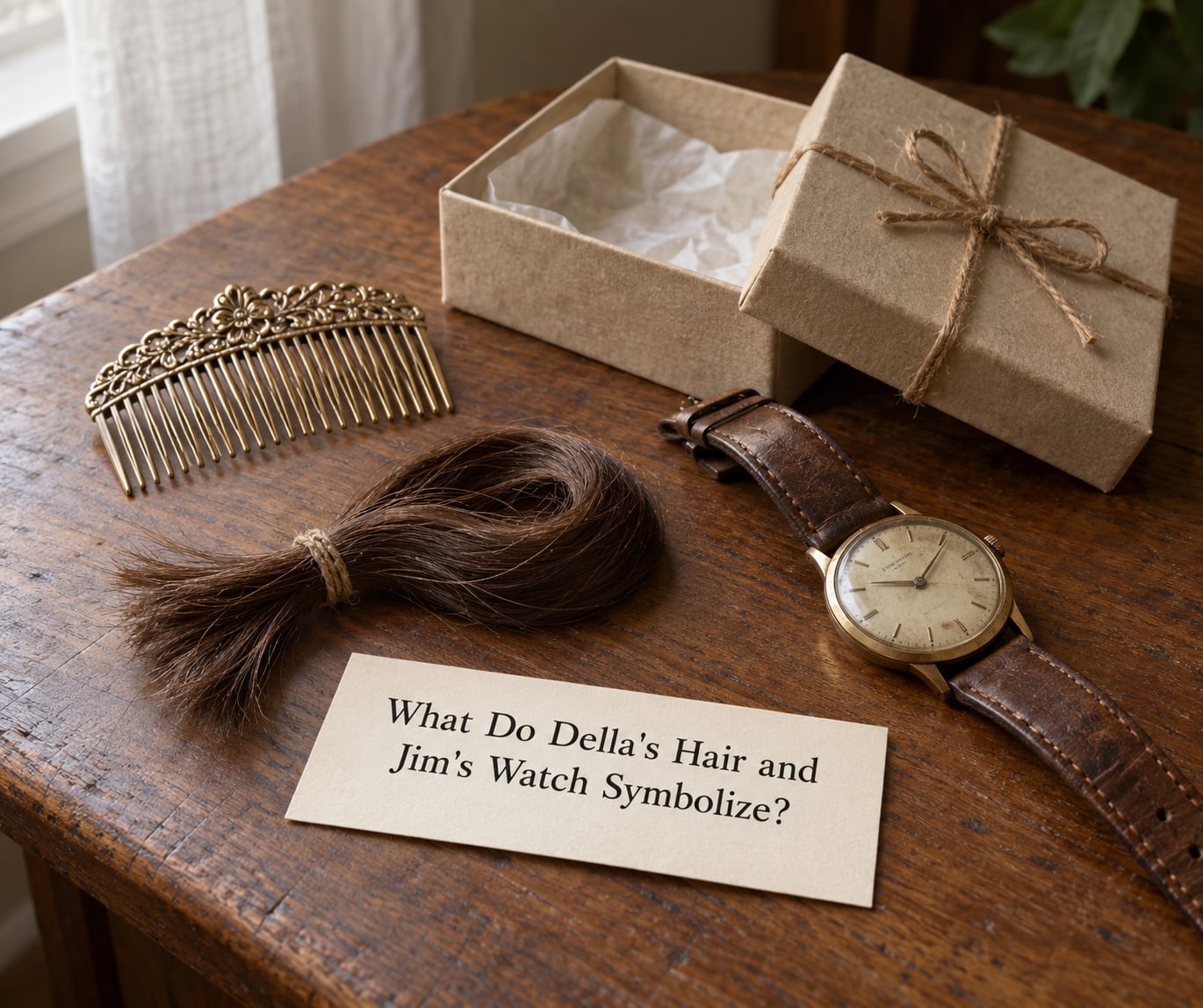
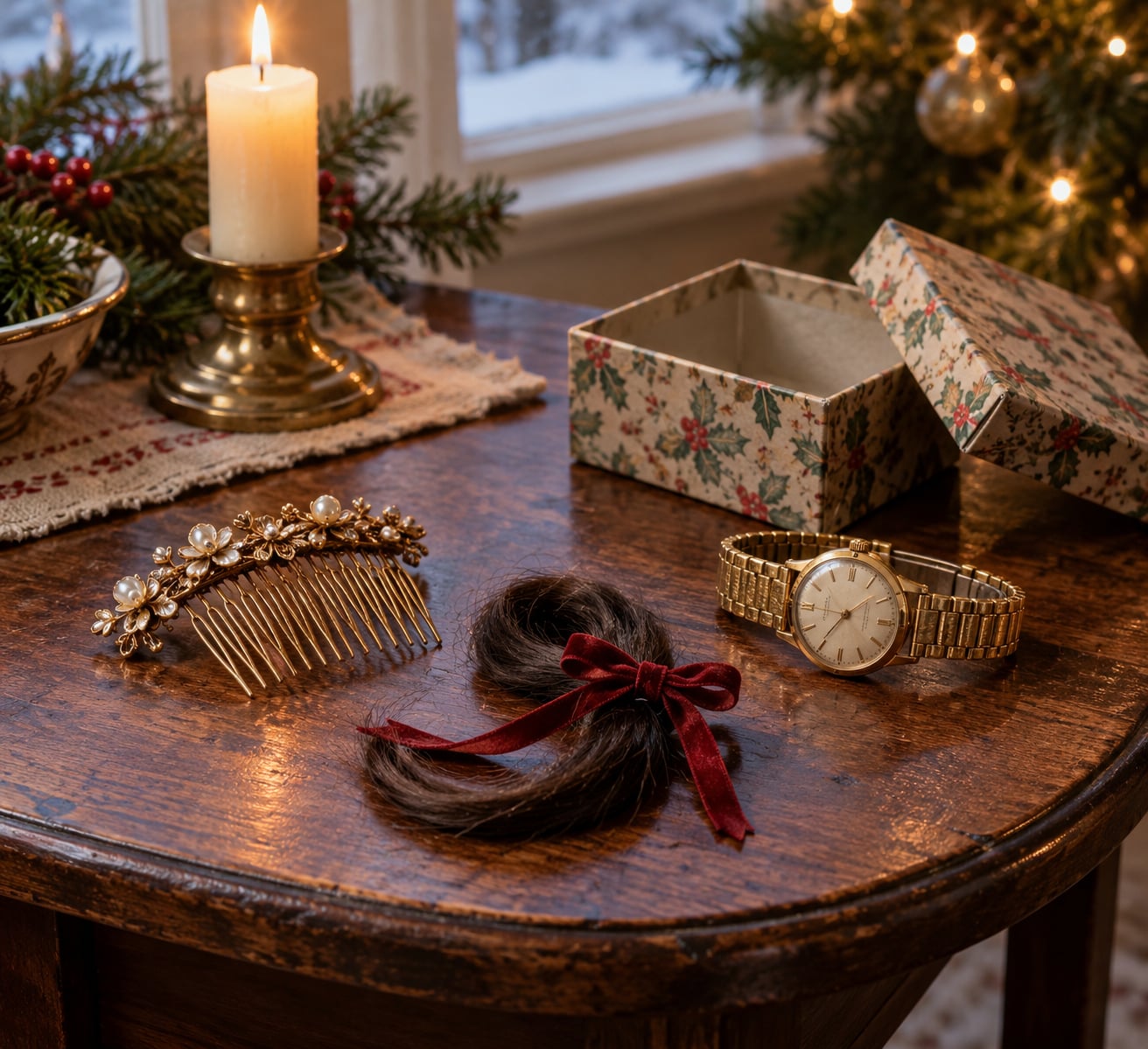
Della’s hair represents her beauty, her youth and her identity as a young woman in a period that measured women on exactly those things. Selling it is selling a piece of herself, which is why the hairdresser’s mirror moment lands so hard.
Jim’s gold watch represents inherited worth. It came from his father, so selling it means trading family memory for a Christmas present, which is a much bigger sacrifice than the price suggests.
The rest of the objects are supporting symbols. The chain says what the watch cost. The combs say what the hair bought. The empty boxes are the sharpest one: they hold the shape of what is missing, so the reader sees two absences instead of two presents. And the one dollar and eighty-seven cents is a symbol too, the standing evidence that none of this was ever about money.
How to use these symbols in an essay
Name the object, quote the line that introduces it, then state the meaning in one sentence. For example: Jim sells his gold watch, an object he describes as valuable because his father owned it, and that detail turns the sale into a sacrifice rather than a purchase.
Why Is the Story Called The Gift of the Magi?
The Magi are not characters in the story. That is the single most common point of confusion, so it is worth being plain about it: there are only three characters, Della, Jim and the narrator. The title points to the wise men described in Matthew 2:11, the visitors who travelled to see the infant Jesus and brought gold, frankincense and myrrh.
O. Henry compares Della and Jim to those visitors, and the comparison is about giving something valuable to someone who needs it. The Magi gave costly gifts to people they had never met. Della and Jim give costly gifts to each other.
The word choice is the joke. Magi comes from a root that can mean wise, and O. Henry deliberately leans on the other meaning too. They gave away the very things a wise person would have kept, which is why the final line asks to be thought of as wise the next time.
How Does O. Henry Create Irony in The Gift of the Magi?
Students are often asked for three examples of situational irony. Here they are, labelled.
- The combs are useless as a gift. They are lovely, they are exactly what Della once wanted, and they buy nothing because her hair has already been cut.
- The chain is worthless as a gift. It is gold and expensive, and it fits nothing, because the watch has already been sold.
- The two most valuable things the couple owned are gone by Christmas Eve. A story about getting presents ends with the couple owning less than when it began.
There is dramatic irony underneath that. From the moment Jim sees Della’s hair, the reader suspects he is going somewhere with money, while Della is still wondering whether she has done something foolish. The reader knows more than either character does, which is what turns surprise into recognition.
The narrator also does something clever with time. Jim’s decision is withheld until near the end, in a single retrospective paragraph, so the story runs backwards for a moment and reassembles itself. Everything you thought was a mistake turns out to have been happening in parallel.
What Is the Message of The Gift of the Magi?
The message is that the worth of a gift lives in the sacrifice behind it, not in the object or its cost. Della’s combs and Jim’s chain are broken gifts by any commercial measure, and they are the most valuable things either of them ever received.
If you need the two-sentence version for an essay: O. Henry argues in The Gift of the Magi that genuine love is proven through costly self-sacrifice rather than through what a person can afford. The Magi give away gold and receive something no price can match, and Della and Jim do exactly the same thing.
Frequently Asked Questions
What is the moral lesson of The Gift of the Magi?
The lesson is that the value of a gift lies in the sacrifice behind it, not in the object or its price. Della and Jim each give away the one possession that made the other’s gift possible, so both presents arrive broken. O. Henry calls them wise anyway, because their generosity is the truest thing in their poverty.
What does O. Henry mean by the Magi?
The Magi are the wise men from Matthew 2:11, not characters in the story. There are only three characters: Della, Jim and the narrator. O. Henry compares the couple to the Magi because those visitors brought costly gifts to someone they had never met, which is exactly what Della and Jim do for each other at Christmas.
What is the climax of The Gift of the Magi?
Most readers place the climax at the moment Della finds Jim’s watch-case empty and realises he has sold the watch. Up to that point the story reads as a comedy about one woman’s bad haircut. The empty box converts it, and the final scene with the two empty boxes, the chain and the combs delivers the payoff.
Is The Gift of the Magi a parable or a fable?
It is usually called a parable rather than a fable. A fable teaches its lesson through animal characters and events that could not happen, like Aesop’s tortoise and the hare. A parable teaches through ordinary human beings in a realistic situation, which is what O. Henry uses: a poor couple, a real Christmas custom and a real financial choice.
Why did Della sell her hair?
Della sells her hair because she wants to give Jim a Christmas gift and cannot otherwise afford the hair combs he once admired in a shop window. Her hair is the one beautiful thing she owns and has kept for him, so the sale is a genuine loss of identity rather than a casual purchase. She never tells Jim, because she expects him to be pleased.
Why do the Magi in this story show up as foolish as well as wise?
O. Henry leans on the double meaning of the word. In ordinary use the Magi are celebrated as wise men, yet Della and Jim gave away the very things a wise person would have kept, which makes them look foolish in money terms. The story keeps both verdicts at once, asking to be thought wise the next time they give gifts.
Start With the Last Four Paragraphs
If you read one thing before writing anything about this story, put the final four paragraphs next to the scene where Della counts her money. Everything about the ending is set up there and nowhere else. Once you have seen the price of the combs and the price of the chain, the Magi line stops being a puzzle and starts being an argument.