Picking the right poems to teach in middle school comes down to three things: can a sixth grader read it aloud without stalling, is there enough craft in it to name and analyze, and does it leave room for a kid to argue about what it means. The ten selections below clear all three, and each one comes with a grade band, a discussion prompt, and a classroom activity you can run the next day.
All ten sit in the grades 6–8 range, which is wider than most lists admit. A poem like Thayer’s baseball ballad works in sixth grade with no prep at all. Dickinson’s compressed hope metaphor needs a slower eighth-grade room and a diagram on the board. Knowing that difference up front saves you from picking a text that stalls on line four.
One more note before the list: every poem here is public domain, so you can print, copy, and hand out as many classroom sets as you need without tracking permissions. That solves the question teachers ask me most often about classroom poetry.
Table of Contents
- Poems to Teach in Middle School at a Glance
- 1. “Casey at the Bat” by Ernest Thayer
- How to Use Poems to Teach in Middle School Without Overloading Students
- 2. “The Road Not Taken” by Robert Frost
- 3. “O Captain! My Captain!” by Walt Whitman
- 4. “Annabel Lee” by Edgar Allan Poe
- 5. “Hope Is the Thing with Feathers” by Emily Dickinson
- 6. “Dreams” by Langston Hughes
- 7. “Mother to Son” by Langston Hughes
- 8. “Paul Revere’s Ride” by Henry Wadsworth Longfellow
- 9. “Daffodils” by William Wordsworth
- 10. “Stop!” by William Francis Ross
- Frequently Asked Questions
- What are the best poems to introduce to middle-school students?
- How do I choose poems that are challenging but not frustrating?
- Which poetry devices should middle-school students learn first?
- How can I teach a poem without turning it into a worksheet exercise?
- How should I introduce poems with historical or sensitive contexts?
- How do I assess whether students understood a poem?
- Conclusion
Poems to Teach in Middle School at a Glance
The fastest way to choose is to scan the table first, then read the sections that match your class. Grade bands below are suggestions, not ceilings; a ready eighth-grade class can handle “Dreams” in sixth grade if you plan the discussion.
| Poem | Suggested Grade Band | Central Theme | Emotional Tone | Strongest Instructional Use |
|---|---|---|---|---|
| Casey at the Bat | 6th | Expectation and reversal | Cheerful, then wry | Reading aloud and prediction |
| The Road Not Taken | 7th–8th | Choice and uncertainty | Calm, quietly ironic | Close reading and misreadings |
| O Captain! My Captain! | 7th–8th | Grief inside celebration | Mournful, ceremonial | Repetition, sound, tone |
| Annabel Lee | 6th–7th | Idealized love and loss | Tender, dreamlike | Imagery and rhyme |
| Hope Is the Thing with Feathers | 7th–8th | What hope actually does | Light, persistent | Extended metaphor |
| Dreams | 6th–7th | What a life without dreams costs | Urgent, warning | Repetition and pairing |
| Mother to Son | 6th–7th | Persistence across hardship | Warm, candid | Figurative language and voice |
| Paul Revere’s Ride | 7th–8th | Warning and consequence | Urgent, driving | Narrative pacing and fact |
| Daffodils | 6th–7th | Memory as consolation | Quiet, wistful | Observation versus recollection |
| Stop! | 8th | Agency and command | Firm, rallying | Voice, address, and repetition |
Read that table twice. Items one and four are the friendliest on-ramps; items two and ten are where the interesting arguments live.
1. “Casey at the Bat” by Ernest Thayer
A batter named Casey strikes out, waits for the next pitch, and swings at something that turns out to be a giant melon. The whole poem is one long setup for that joke, and kids who know baseball will tell you the ending is not a triumph.
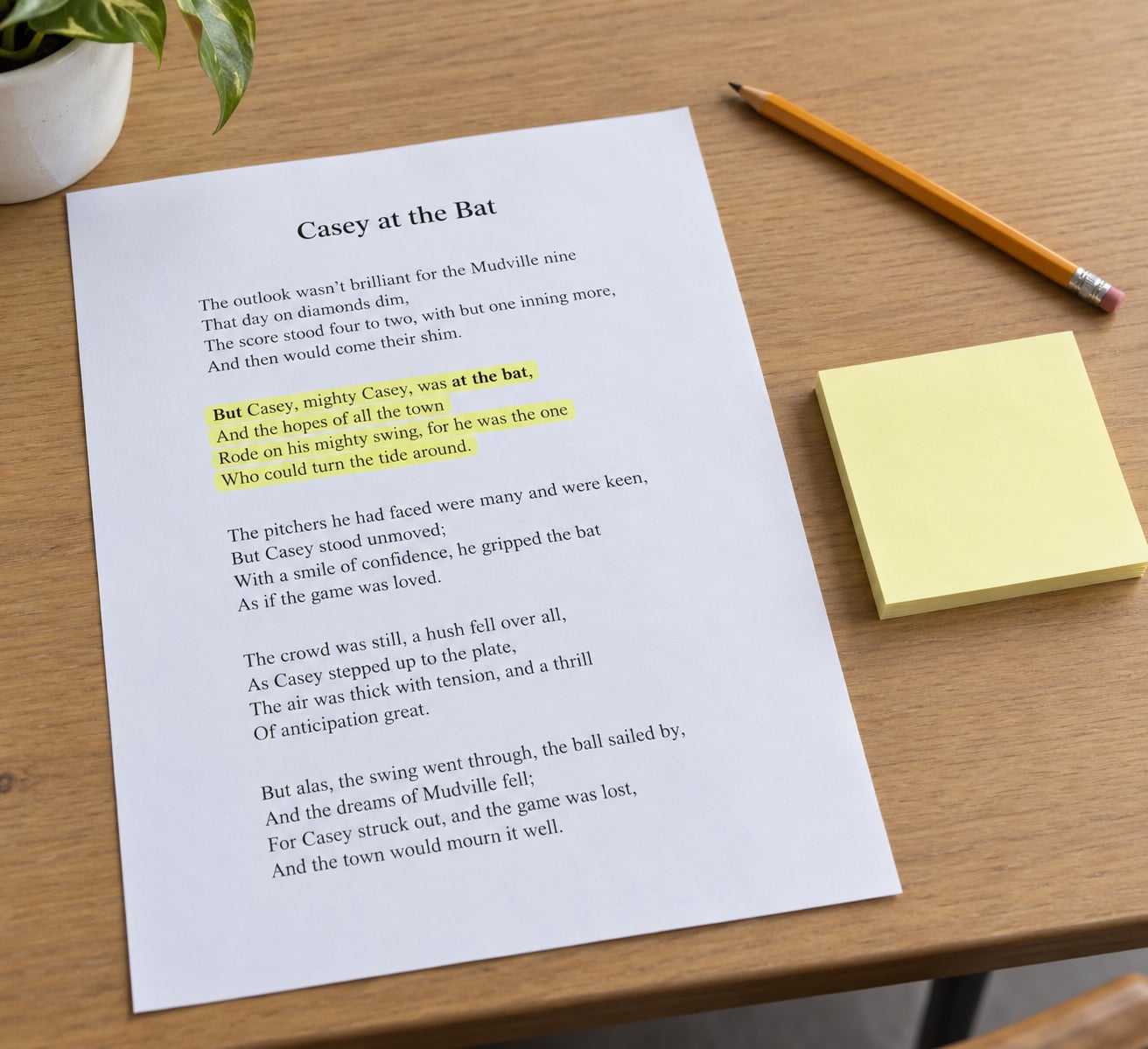
The poem works because the sound carries the meaning. Rhymes like “might” and “flight” and “night” mimic the crowd’s noise, so students hear the anticipation before they understand it. The chant structure is a genuine literary device, not decoration.
Before reading aloud, hand out the final two stanzas only and ask for predictions on a sticky note. Then read the whole poem and let them compare. The follow-up question is the real teaching moment: is Casey’s swing a victory, a failure, or neither? Students who argue that the poem refuses to give them a win are usually reading closer than students who call it happy.
For an extension, have students mark every time the poem repeats a word or a rhyme and chart the pattern. You end up with a visual proof that this is a build-and-punch joke, not a story.
How to Use Poems to Teach in Middle School Without Overloading Students
Use the same five moves every time, and any poem on this list becomes teachable in about forty minutes: activate prior knowledge, read aloud, annotate key images, discuss interpretation, then finish with a short written response. Because the sequence never changes, students stop spending energy decoding the routine and start spending it on the poem.
Step one is two minutes of background knowledge, not a lecture. For “Casey at the Bat,” ask what a strikeout means and why a crowd would care. Step two is reading aloud, by you or by a student, with no stopping to explain anything. Step three is annotation with a purpose: students underline every image that is not a literal person or object. Step four is the discussion, and it is the only step that takes real time.
Step five is the one teachers skip, and skipping it is why a poem disappears by Friday. A single prompt on an index card, collected at the door: which line did you underline, and why that one? Nothing longer. It gives you a formative check and it tells you what to reteach without a grade attached.
Differentiation lives inside this sequence rather than beside it. Struggling readers get the poem with two or three questions already marked on it, so annotation has an anchor. Advanced readers get a second task: find one line that complicates the poem’s central claim and defend it in writing. Neither group gets a different poem, which keeps the whole class in the same conversation.
2. “The Road Not Taken” by Robert Frost
Everything you think you know about this poem is probably the misreading. The speaker takes a “less traveled” road and admits, four lines later, that both roads wore “really about the same” amount of tire marks. The sigh many students quote is relief disguised as regret.
Frost builds the choice slowly: the speaker looks at the diverging roads before he chooses, and the deciding thought arrives only after the turn. That order matters. Ask students to diagram the timeline, marking where the choice happens versus where the sigh happens, and the irony surfaces on its own.
A paired-choice activity works well here. Give each student two half-sheets describing two imagined futures, one written in vivid sensory detail and one written as a vague plan, and ask which they would choose. The point is to separate an imagined future from a present decision, which is exactly the distinction Frost dramatizes. Then push the ambiguity: if the roads were the same, was there a choice at all?
Students in eighth grade can handle the harder question, which is whether the speaker is being honest or self-deceiving. There is no clean answer in the text, and telling them so is the most useful thing you can do for readers who will meet this ambiguity again in high school.
3. “O Captain! My Captain!” by Walt Whitman
Whitman repeats the title line three times, and each repetition hurts more than the last. The first is public, the second breaks under grief, and the third barely gets out. Students can hear that arc in their own voices when they read it.
Start with sound before meaning. Have the class read the refrain chorally three times in a row, once per appearance. Then read it once more alone and silently. The contrast teaches tone shift without a single vocabulary word.
The central discussion is the gap between collective and personal response. Everyone on the street is celebrating the same dead man, yet the speaker’s “the ship is gone” lands differently on him than on the crowd around him. Ask students to find one line where the speaker is part of the public moment and one line where he is entirely alone in it.
For symbolic analysis, have students list every object in the poem, including the ship, the flag, the shipyard, and the shoes. Then ask which objects belong to the country and which belong to the speaker’s private world. The answer is a short list, and it gives reluctant analyzers a concrete win.
4. “Annabel Lee” by Edgar Allan Poe
Poe’s narrator describes a childhood love in a fairy-tale kingdom, loses her to a fever, and then spends years listening to the sea for the announcement of his own death. The imagery is beautiful, and the logic underneath it is strange on purpose.
Model the close reading by picking one image and refusing to move on until the class has described it in physical detail. The “kingdom by the sea” and the bells that “ring a sweet sound” are two good candidates. Ask what changes in the poem when you notice the narrator remembers the smell and sound of the place but not the sound of his own name.
The rhyme does real work, too. Poe wrote in trochaic octameter, and the eight-beat lines feel like waves. Have students mark the stressed and unstressed beats with a slash and a dot, then read it aloud to their own rhythm. Hearing the meter beats the worksheet.
Close by asking whether the narrator’s memories are reliable. Students who say the poem is nostalgic, and students who say it is delusional, are both describing the same evidence. That disagreement is worth more than a theme statement.
5. “Hope Is the Thing with Feathers” by Emily Dickinson
Dickinson opens by naming hope directly, then spends the rest of the poem refusing to define it. The bird is never explained. She tells us where it sings, what it has never done, and that it has eaten crumbs in the stomach of a child, and that is all. The vagueness is the point.
The tense shifts are worth catching. “I heard” versus “I has heard” versus “I have heard” is not grammar trouble; it is Dickinson changing how certain the speaker is about something memory cannot confirm. Eighth graders can handle that once you name tense out loud.
A concept-map activity gets them underneath the poem rather than over it. On a clean sheet, students draw the bird in the middle and add three branches: what hope sounds like, what hope looks like, what hope has never done. They fill in the branches with evidence from the poem, then compare against Dickinson’s lines. Where their bird looks nothing like hers, you have found a discussion.
End by asking what happens to the poem if you swap hope for patience or for pride. Dickinson’s image holds for hope, and only for hope, and students can hear the difference themselves.
6. “Dreams” by Langston Hughes
This poem is sixteen lines long and takes about forty seconds to read. A person who does not dream lives “a broken-winged bird that cannot fly” and “a barren field frozen with snow.” It is the shortest analysis text on this list and one of the hardest.
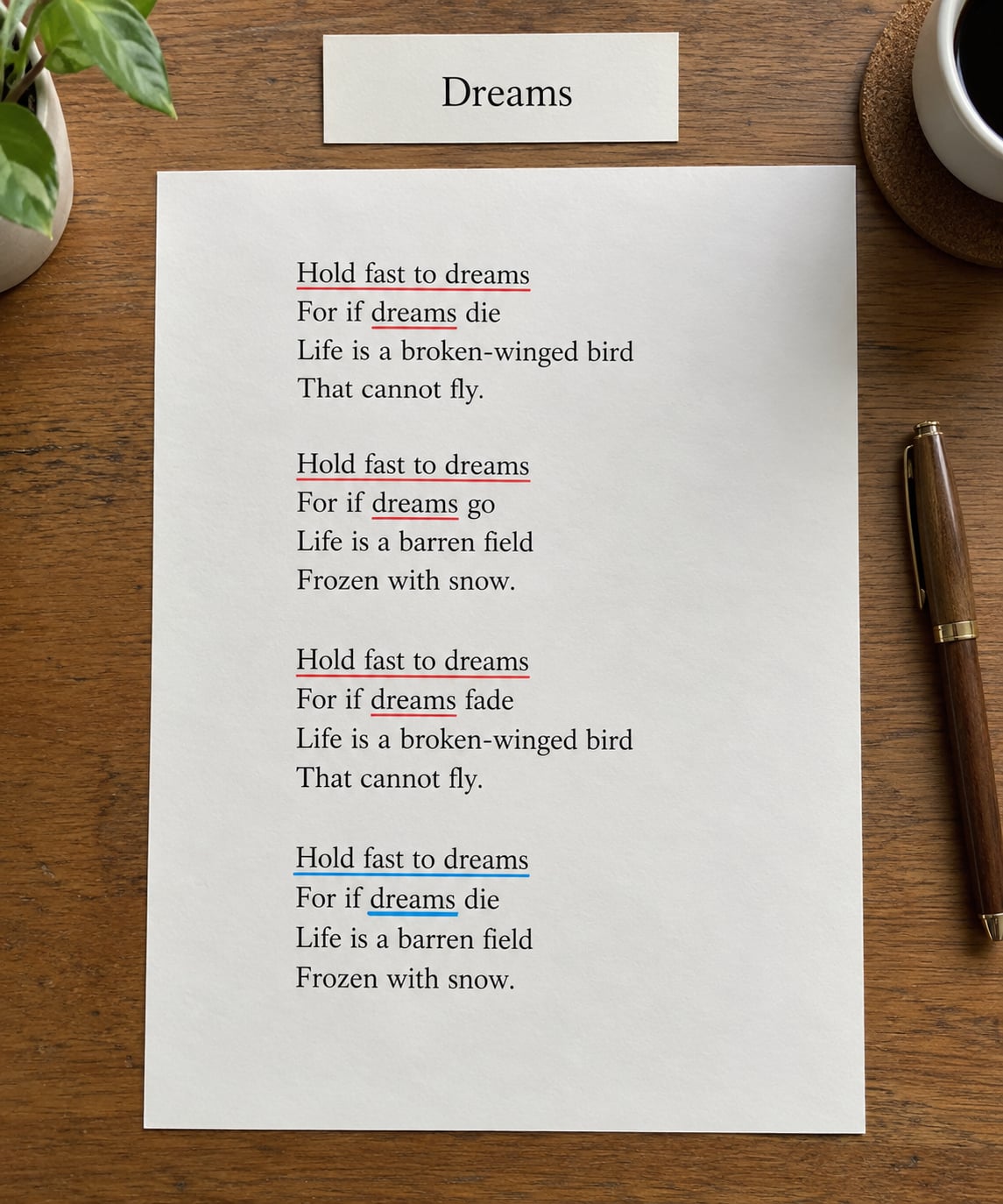
The repetition is the argument. The words if and then return in both stanzas, so the two consequences of an undreamed life arrive in an identical shape, like a legal warning read twice. Have students underline every repeated phrase and then explain why Hughes chose to build the poem as a matched pair instead of two unrelated images.
Pair it with “Mother to Son” on the same day. One warns, one encourages, and the contrast between the two voices is where the real analysis happens. Ask which speaker has more reason to be skeptical, and make them cite lines from both poems in the answer.
The follow-up question belongs to the whole class: what is a realistic barrier, and what is an imagined one? Students often say they do not have dreams, which usually means they are afraid of the effort. Hughes did not write a poem about motivation. He wrote a poem about consequences, and that distinction is worth twenty minutes.
7. “Mother to Son” by Langston Hughes
The speaker tells her son not to give up, and she proves it by describing a staircase that is “no gin colored glass” and “no square colonial window.” The poem is advice delivered straight, without softening, and it reads fast enough for a struggling student.
Have students annotate each step in the staircase metaphor and note what kind of hardship it represents. Some steps are still, some are torn, and the stairs go “in the dark.” Then ask them to underline the three phrases where the mother describes her own persistence, which is not the same as describing the staircase.
A useful second pass is asking how the hardship changes over time. The early steps are damaged, the later ones are simply hard, and the climb continues in both cases. Students who notice that the difficulty eases while the persistence does not are doing real close reading without knowing the term for it.
For writing, ask them to rewrite the message for a goal they actually have, keeping the advice honest rather than motivational. Peer pressure, a running habit, a math grade, a friendship argument. The voice requirement is what makes the rewrite hard, and the voice is the point.
8. “Paul Revere’s Ride” by Henry Wadsworth Longfellow
Longfellow tells an accurate history in a rhythm built for recitation. The poem was meant to be heard, and students should perform it, not just analyze it. Read the refrains, “Listen! I have heard,” and “We will ride and not be faint,” in a call-and-response pattern so the chant structure becomes audible before you name it.
The sequencing activity is the most useful one here. Give students the ride’s events as shuffled index cards, including the signal lanterns, the midnight row through Cambridge, Old Church, the ground at Concord, and Paul’s warning sent ahead. They place the cards in order, then identify which three details the poet repeated to build suspense and which one detail Longfellow leaves out.
That missing detail is the assessment. Longfellow never tells readers what message Paul carried, only that he rode ahead to warn. Ask students to write the message themselves in three sentences using the poem’s language. The strongest ones sound like Longfellow, which is the point.
Finish with personification. “The window of the church” is a watcher, and “the town still lay in sleep” is a landscape holding its breath. Both images turn objects into participants, and once students see that, they cannot unsee it in their own reading.
9. “Daffodils” by William Wordsworth
Wordsworth saw daffodils once, and then again years later, and the poem is mostly about the gap. For most of its length he watches the flowers in a field; at the end he remembers them, and the memory makes him dance with the Later Years.
The distinction to teach is observation versus recollection. Ask students to underline every line describing what he sees and every line describing what he later remembers. The observed lines are specific and short. The remembered lines suddenly include dances and crowds, and none of that happened in the present scene.
Compare it with “I Wandered Lonely as a Cloud” from the same poet. Both contain daffodils, and they do not feel the same at all. Students can identify the energetic version by its verbs, then decide which one they would rather be given on a bad afternoon. That preference is a legitimate piece of evidence about tone.
For a quiet assessment, ask students to write one paragraph about something they saw once and still think about. The paragraph teaches for itself whether they can separate the event from the memory of it.
10. “Stop!” by William Francis Ross
This short, forceful poem belongs in eighth grade and not before. It was written in the era of the Civil Rights struggle, and it speaks directly to young people, urging them to stop being passive in the face of injustice and to treat their own rights as worth defending.
The defining feature is its one-word title repeated as a command. That word is the poem’s whole strategy: you cannot quietly argue with a stop. Have students count the repetitions and note where the rhythm accelerates, then read it aloud as a chant to hear the pacing change.
The language is deliberately restrained. There is no ornate imagery and no scenic description, which makes the poem a good contrast with “Paul Revere’s Ride.” Ask students why this voice needs no daffodils, no ships, no landscape, and what that tells them about the kind of poem they are reading.
Close with the hardest and best question: what would it mean to write a “stop” poem today, and what would that poem demand of the person speaking it? Connect their answers to current youth-led movements they already follow. Handle the discussion the way you would any contested topic: name the history, let students disagree, keep the focus on how language works.
Frequently Asked Questions
What are the best poems to introduce to middle-school students?
Start with poems that are short, publicly readable, and easy to perform: Casey at the Bat, Annabel Lee, Dreams, Mother to Son, and Daffodils. Each fits on one page, contains at least two nameable devices, and gives students something genuine to argue about. Introduce a harder poem like The Road Not Taken or Hope Is the Thing with Feathers in the second or third week, once your students trust the routine.
How do I choose poems that are challenging but not frustrating?
Read the poem aloud yourself and note where you slow down. If you stumble at line three, a struggling reader will quit. If you finish it without noticing anything, the poem is too easy for analysis. The sweet spot sits just above what students can comfortably read, where the difficulty is in meaning rather than vocabulary. Test any candidate on yourself first.
Which poetry devices should middle-school students learn first?
Start with rhyme, rhythm, and repetition, often called the three Rs, because students can hear all three before they can name any of them. Move to simile and metaphor next, then personification, then enjambment and tone shift. Meter, volta, and form names such as sonnet or villanelle can wait until eighth grade. Teach devices with a poem in hand, never as a definition list.
How can I teach a poem without turning it into a worksheet exercise?
Follow one five-step sequence: activate background knowledge, read aloud without interruption, annotate the strongest images, discuss interpretation with evidence, then end with a short written response on an index card. The discussion carries the learning, and the written card tells you what landed. Worksheets test recognition of devices; this sequence tests understanding of meaning.
How should I introduce poems with historical or sensitive contexts?
Give the context before the poem, in two or three sentences, and explain why you chose it. For Stop! or Paul Revere’s Ride, name the historical moment and let students know the conversation will include disagreement. State plainly which poems contain profanity, violence, or grief imagery so families and administrators are not surprised. Screen every poem yourself before printing.
How do I assess whether students understood a poem?
Ask for one claim and one piece of evidence: which line supports your reading, and why that line instead of another. Look for a quoted line and a reason, not a theme word alone. A three or four sentence paragraph is enough. Collect it as an exit ticket so you can group students by reading, reteaching, and stretching without assigning a grade to the conversation.
Conclusion
A great classroom poem does three jobs at once. It is readable out loud by a twelve-year-old, it has craft a student can name and point to, and it leaves an argument worth having. Every poem on this list does those three things, which is why they keep circulating in teacher recommendation threads year after year.
So pick three. Start with the one that matches what your students are struggling with right now: sound and pattern if they find poetry hard, imagery if they need vocabulary, voice and history if they are ready for weight. Read it aloud, ask one good question, and let them argue. That is the whole method.