The best book about World War Two for a high school reader depends on two things: how well the prose matches their reading level, and how much historical weight the story can carry. Most guides answer with a title and nothing else, which is why the same four books get handed to every generation of students.
The short answer for most classrooms is The Book Thief by Markus Zusak, because it opens a genuine narrative voice on 1930s Germany while staying readable. For a student who reads below grade level but cares about military history, the accessible narrative nonfiction options and the graphic titles on this list will serve better than any dense novel.
I have organized these picks the way a teacher actually assigns them, with a comparison table first, then a short case for each title, then guidance on reading level, content warnings, and pairing. Every entry notes genre, reading band, historical value, and what to warn students about before class. Publication details are accurate as of 2026; availability shifts between library, ebook, and audiobook, so check your local catalog rather than assuming.
Table of Contents
- Books About World War Two for High School Readers at a Glance
- 1. The Book Thief by Markus Zusak
- Books About World War Two for High School Readers: How The Book Thief Fits
- 2. The Boy in the Striped Pajamas by John Boyne
- 3. The Diary of a Young Girl by Anne Frank
- 4. Night by Elie Wiesel
- 5. All the Light We Cannot See by Anthony Doerr
- 6. Salt to the Sea by Ruta Sepetys
- 7. The Complete Maus by Art Spiegelman
- 8. A Terrible Thunder by Peter Sis
- 9. The War: An Intimate History, 1941-1945 by Geoffrey C. Bestor
- 10. The World War II Desk Reference by John S. Bowman
- Frequently Asked Questions
- What is the best book about World War Two for a high school student?
- Are The Book Thief and The Boy in the Striped Pajamas appropriate for high school?
- What are good World War Two books for students who do not want to read traditional history?
- Are World War II graphic novels useful for high school students?
- How should teachers introduce novels with Holocaust or war violence?
- Should high school students read firsthand accounts or historical fiction first?
- Conclusion: Where to Start
Books About World War Two for High School Readers at a Glance
This table compares all ten titles by genre, reading band, main historical or literary value, and content notes. Use it to shortlist before you read a synopsis.
| Book | Author | Genre | Reading band | Main value | Content notes |
|---|---|---|---|---|---|
| The Book Thief | Markus Zusak | Historical fiction | Grade 7-10 | Narrative craft and moral choice under Nazi rule | Violence, death of family members, brief concentration camp scenes |
| The Boy in the Striped Pajamas | John Boyne | Historical fiction | Grade 6-9 | Child’s-eye view of the Auschwitz boundary | Injustice, executions implied; historical accuracy debated |
| The Diary of a Young Girl | Anne Frank | Primary source, diary | Grade 7-11 | A firsthand document, not a novel | Restrictions, persecution, implicit camp violence |
| Night | Elie Wiesel | Memoir | Grade 10-12 | Testimony on faith and survival | Shoah, Auschwitz, deaths of prisoners; short and relentless |
| All the Light We Cannot See | Anthony Doerr | Historical fiction | Grade 9-12 | Occupied France, Resistance, blind narrator | Violence, execution, Holocaust deaths |
| Salt to the Sea | Ruta Sepetys | Historical fiction | Grade 7-11 | Refugee routes and the wreck of the MS Stutthof | Shipwreck deaths, loss of parents, hunger |
| The Complete Maus | Art Spiegelman | Graphic memoir | Grade 9-12 | Shoah testimony in image and text | Explicit images of death and mass murder |
| A Terrible Thunder | Peter Sis | Picture book memoir | Grade 6-10, all ages | Occupation of Czechoslovakia told in pictures | Minimal; discussion of adult endangerment |
| The War: An Intimate History | Geoffrey C. Bestor | Illustrated narrative history | Grade 8-12 | Chronological context in short passages | Photographs of casualties, camps, destruction |
| The World War II Desk Reference | John S. Bowman | Reference | Grade 7-12, reference use | Dates, battles, leaders, weapons, quick lookup | Clinical imagery in some entries |
1. The Book Thief by Markus Zusak
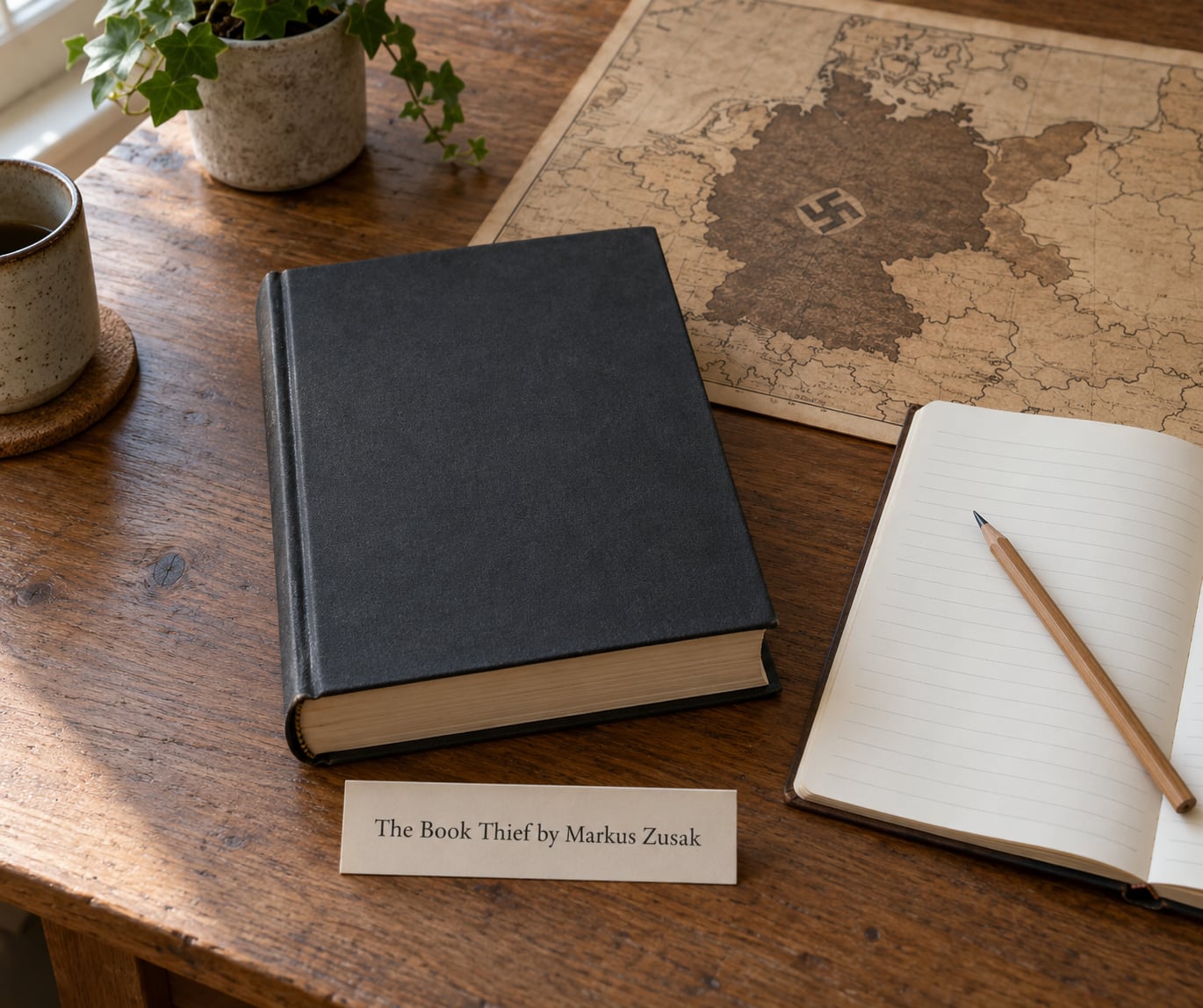
The Book Thief belongs on any list of books about World War Two for high school readers because it earns literary analysis on its own. Liesel Meminger, a young German girl, steals books during the chaos of 1930s Nuremberg while her foster father tries to teach her to read. The novel won the 2006 Michael L. Printz Honor and has stayed in print ever since, which says something about how little the appeal depends on its date.
Its framing device is unusual: Death narrates, and does so with a dry humor that some students find off-putting and others find disarming. That device lets Zusak compress, jump years, and withhold information for effect, so a class reading the structure closely is doing real craft analysis rather than plot recall.
Mature material is present. The novel includes bombing raids, the death of Liesel’s brother, deaths of friends, and a scene set near a concentration camp. None of it is gratuitous, but it is not softened, and I would tell students that before assigning it rather than after.
Books About World War Two for High School Readers: How The Book Thief Fits
For reading level, treat this as a grade 7 to grade 10 title. Zusak writes in short chapters and plain sentences, which is why it works for readers who struggle with long dense paragraphs even though the vocabulary and the emotional content sit well above a middle-grade floor. Do not guess a Lexile figure; publishers vary by edition, and the useful number is whatever the edition your students hold reports.
Classroom use is straightforward. A two-week unit pairs it with a narrative nonfiction title and asks two questions: what does the narrator know, and what does the narrator choose not to know? The themes of reading as rescue, responsibility for others, and the slow collapse of ordinary morality under law give a strong analytical essay prompt, which is what makes it a common choice for books to teach World War II in class.
2. The Boy in the Striped Pajamas by John Boyne
This novel follows Bruno, a German boy whose father is posted to a camp, and his friendship with a Jewish boy named Shmuel who is a prisoner on the other side of the fence. It is fiction, not memoir, and that distinction matters in a classroom. Some teachers and historians have argued that the plot compresses history into a fable and leaves the larger structure of the Shoah too tidy.
Used carelessly, it can teach the wrong lesson. Used well, it teaches that ordinary people inside an unjust system face small choices, and that children see the moral line long before adults admit it. A useful discussion question is why the story ends where it does, and what a different ending would have cost.
Reading level is forgiving, roughly grade 6 to grade 9. The prose is simple and the chapters are short, so it pairs well with a memoir for a first unit on the Holocaust. Content guidance: imprisonment, hunger, and implied executions around the fence. Go in knowing you will need a closing conversation, not a closing worksheet.
3. The Diary of a Young Girl by Anne Frank
The Diary of a Young Girl is the most assigned primary source in this entire list, and also the most badly taught. Anne Frank wrote her diary in hiding in Amsterdam between 1942 and 1944, and the document survives as both a teenager’s private record and one of the best-known firsthand accounts of Nazi persecution in Europe.
The mistake is treating it as a novel with a sad ending. It is a real diary of a real fourteen-to-fifteen-year-old, so her irritation with her mother, her crush on Peter, and her boredom are not distractions. They are the reason students engage with it, and they are why historians read it as a primary source with limits rather than a complete account of the war.
A good passage-analysis activity: give students one month of entries and have them mark sentences that sound like a fifteen-year-old writing for herself versus sentences that sound like someone performing for a reader. Then compare that with a page from Night. Students should leave able to state plainly what a diary can and cannot tell us, which is a skill that transfers to every source they will meet later.
Reading level runs grade 7 to grade 11 because the language is plain but the situations are not. Content notes cover forced restrictions, persecution, and the shadow of the camp system, though the entries stop before Anne reaches Auschwitz.
4. Night by Elie Wiesel
Night compresses a decade into roughly one hundred pages. Elie Wiesel recounts his deportation from Romania, the rail journey, Auschwitz, and the death marches, and the central question is what happened to his faith as he watched it happen. That is why it works as a book for advanced students rather than as an on-ramp.
Short does not mean easy. The compression means students carry a great deal with little scaffolding, and many readers need a second pass or a guided discussion to separate what the book argues from what they feel about it. For a class with time, pairing it with Anne Frank’s diary makes the comparison direct: two young people writing from inside the same system, in completely different registers.
Preparation matters more here than for almost any other title. Give students a content briefing before the unit, not a warning slip on day one. Tell them plainly that the book contains Auschwitz, hunger, disease, and death of prisoners, and that the tone is deliberately unemotional in places because the narrator had no other register available. Grade 10 to grade 12 is the right band.
5. All the Light We Cannot See by Anthony Doerr
All the Light We Cannot See interweaves two stories: Marie-Laure, a blind French girl living in occupied Paris, and Werner, a German boy conscripted into the program that sent young scientists toward the French radio laboratories. Their lives touch through a radio he is ordered to locate and cannot find. Doerr won the 2015 Pulitzer Prize for Fiction, and it is one of the best World War II books for high school readers that is actually literary prose rather than a classroom vehicle.
The structure rewards close readers. Alternating chapters, shifting points of view, and a third historical voice give students a real analytical problem about how a novel assembles history. The historical grounding is unusually solid for fiction, and it fills a gap most lists leave open: occupied France and the French Resistance rather than the Eastern Front.
A strong classroom task is asking whether the invented material and the documented material are doing equal ethical work in the book, and where the line between them should sit. Reading level is grade 9 to grade 12. Content notes cover execution, violence, and Holocaust deaths, with no softening.
6. Salt to the Sea by Ruta Sepetys
Salt to the Sea follows refugees escaping Lithuania, Poland, and Germany in 1945, trying to reach safety by sea. It is built on a documented event: the sinking of the MS Stutthof in 1945, when refugees aboard a former German cargo ship were torpedoed in the Baltic. Sepetys’s fourth character, a shipping agent who tries to intervene for the passengers, moves between fact and invention so that readers can feel the pull of both.
What it covers well is the refugee experience, which most World War II reading lists skip in favor of battles. What it covers poorly is combat. If your curriculum requires campaign history, pair this with a narrative nonfiction title rather than expecting a novel to supply it.
Reading level is grade 7 to grade 11, which makes it a good fit for independent reading credit as well as a paired unit. Content notes: a shipwreck with mass casualties, orphaned children, hunger, and the deaths of family members. The pacing is fast, and students who dislike being emotionally steamrolled tend to struggle with it.
7. The Complete Maus by Art Spiegelman
The Complete Maus is the collected form of Spiegelman’s graphic memoir about his parents’ experiences in Nazi-occupied Poland and Auschwitz, adapted from the comic that won the 1992 Pulitzer Prize. The form is the point. Words are sparse and heavily bordered, and the panels do work that a sentence cannot, so a class reading it is doing visual argument analysis as well as historical reading.
It also reaches back past the camps, following Vladek’s account of hiding in an apartment with the help of his wife Anja’s friends, which gives students a view of rescue and of bystanders who risked themselves. A related volume covers Vladek’s present-day return to Poland and his strained relationship with his son, the artist. The historical and the personal sit in the same book, and students notice that.
Expect explicit images of mass death. This is the title on the list with the highest content sensitivity, and the one most worth reading aloud as a classroom set so the whole group is working from the same pages. For reluctant or below-level readers, graphic format is often the only door in. In one widely cited teacher thread on low-reading-level war books, commenters repeatedly raised graphic novels and comics as the on-ramp for students who are behind, and this is the strongest example of that in the genre. Grade 9 to grade 12, with flexible placement.
8. A Terrible Thunder by Peter Sis
Peter Sis’s picture book memoir follows a Czech boy named Franz whose father is targeted by the Gestapo after the assassination of Reinhard Heydrich in Prague. There is no camp and no starvation. The horror is quieter: hiding, waiting, packing a bag to leave, and discovering that adults are frightened. The final pages are wordless, which is the most powerful part of the book.
Because it is a picture book, people assume it is for young children, and that assumption costs high school classrooms a title they could use well. It is legible to any reader, it never condescends, and the images carry the historical information that the sparse text omits. It also works as a format comparison: set it beside a conventional memoir and ask what the pictures add that sentences cannot.
Reading level is broad, roughly grade 6 upward, with no ceiling. Content notes are mild for the topic: danger, arrest, loss of safety. It is the easiest book on this list to hand to a family, and one of the best to read aloud in ten minutes before a longer text.
9. The War: An Intimate History, 1941-1945 by Geoffrey C. Bestor
Bestor’s illustrated narrative history is built for students who need the chronological spine before they can hold a novel. Each short section takes a person rather than a campaign: a pilot, a nurse, a displaced child, a codebreaker. That choice is what separates it from an encyclopedia-style survey, and it is why it teaches chronological context faster than most textbooks.
The demand on a reader is moderate. Short entries, heavy illustration, and clear sequencing mean a motivated student can move through it, but it is not a first contact with the war for students who know nothing. Use it as the second book, after a novel that has made them care. Pairing it with The Book Thief gives an English class the factual grounding that fiction cannot supply on its own.
Content notes are photographic. Expect images of casualties, camps, bomb damage, and displaced populations, presented without commentary. Suitable for grade 8 and up, and useful for students looking for a nonfiction alternative to fiction.
10. The World War II Desk Reference by John S. Bowman
Bowman’s World War II Desk Reference is a lookup tool: dates, battles, commanders, weapons, theaters, and terms, organized so a student can find an answer in a minute. It is the one title here that does not want to be read front to back, and treating it as a reading assignment wastes it.
Its real classroom value is scaffolding. A student fact-checking a scene from a novel, looking up an unfamiliar regiment, or building a timeline for a research assignment needs this on the desk more than on the reading list. One useful exercise: have students choose five events from the novel they have read and verify each against the reference, flagging any place where the fiction and the record disagree.
Reading level is grade 7 to grade 12, but it functions as reference rather than text. Content notes include clinical or graphic imagery in some entries, which is why a teacher preview before recommending it to a particular class. It is also the easiest title here to find free through a library.
Frequently Asked Questions
What is the best book about World War Two for a high school student?
The Book Thief by Markus Zusak is the most widely used starting point because it pairs accessible prose and short chapters with sophisticated literary devices, which makes it work both as independent reading and as a text for analysis. Students who read well below grade level do better starting with an accessible narrative nonfiction title or a graphic memoir such as The Complete Maus. For a class rather than a single reader, All the Light We Cannot See carries the most literary weight.
Are The Book Thief and The Boy in the Striped Pajamas appropriate for high school?
Both are widely taught at the high school level, and both carry real content demands. The Book Thief includes bombing, family deaths, and scenes near a concentration camp. The Boy in the Striped Pajamas includes imprisonment, hunger, and implied executions, and historians have debated how accurately it represents the historical record. Give a content briefing before the unit begins, and leave time to talk about the story after students finish.
What are good World War Two books for students who do not want to read traditional history?
Historical fiction is the usual answer, and Salt to the Sea or The Book Thief are easier to finish than most narrative nonfiction. But graphic and illustrated titles serve the same readers better than fiction does, because short panels and strong visuals lower the barrier. The Complete Maus, A Terrible Thunder, and The War: An Intimate History all appear in that category. Teachers running threads on low-reading-level war books repeatedly point to graphic format as the working on-ramp.
Are World War II graphic novels useful for high school students?
Yes, and they are among the most underused titles in the category. The Complete Maus carries the most historical and literary weight, and students can analyze panel composition, silent panels, and the way images argue where text cannot. A Terrible Thunder uses picture book format to convey occupation and fear without prose exposition. Graphic novels also help students who read below grade level, since decoding difficulty drops sharply when the narrative runs through images.
How should teachers introduce novels with Holocaust or war violence?
Brief the content before the unit, not during it. Tell students specifically what appears in the text, why the author includes it, and what they should do with their reaction to it. Plan a closing conversation rather than a quiz, because these books rarely end on a note students can resolve alone. Where possible, read the first pages aloud as a class so everyone starts from the same footing and can ask questions early.
Should high school students read firsthand accounts or historical fiction first?
It depends on what you are teaching. Start with fiction when the goal is engagement and ethical reasoning, then add a firsthand account so students can test the novel against the record. Start with a firsthand account when the goal is source analysis, and use fiction afterward to show what the record leaves out. Anne Frank’s diary paired with The Complete Maus, or The Book Thief paired with an illustrated narrative history, both work as two-week units.
Conclusion: Where to Start
Pick one title and match it to the job. If the student needs historical context before anything else, start with an illustrated narrative history or a desk reference. If the student needs a primary source they will actually read, start with Anne Frank or the accessible graphic titles. If the student needs a story that will not let them put the book down, start with The Book Thief, All the Light We Cannot See, or Salt to the Sea.
Then give that reader one question before the first chapter, not after the last. Which one they will bring back to you says more than a quiz does, and it turns a title from a list into a conversation. Updated for 2026, with publication and reading details checked against current editions.