If you are building a classroom library, a summer reading list, or just want a novel that finally looks like your own life, this list is built to be used rather than admired. The best books by Asian American authors for students range from a 160-page graphic novel to a 490-page family saga, so the useful question is never “which is best” but “which one fits the reader in front of you.”
The Asian American experience is the lived reality of people who are Asian American, shaped by immigration and exclusion, the pressure of the model minority myth, conflicts between generations over language and obligation, and the everyday work of belonging somewhere that treats them as permanently foreign.
One clarification before the list begins, because it trips up almost every search on this topic: these are books written by Asian American authors. Plenty of well-known novels feature Asian American characters and were written by authors of a different background, and those belong on a different shelf. Every title below is written by an Asian American author, with the Pacific Islander and Southeast Asian voices deliberately included rather than folded silently into an East Asian category.
Each entry gives you the grade band it fits, the theme it handles best, and a note on sensitive content. That last part matters more than people expect, since teachers have learned the hard way not to hit an internment camp scene in week two of a unit.
Table of Contents
- Books by Asian American Authors for Students at a Glance
- 1. The Joy Luck Club by Amy Tan
- 2. The Namesake by Jhumpa Lahiri
- 3. The Interpreter of Maladies by Jhumpa Lahiri
- 4. The Sympathizer by Viet Thanh Nguyen
- 5. Pachinko by Min Jin Lee
- 6. The Farewell Arithmetic by Ping Wang
- 7. Crazy Rich Asians by Kevin Kwan
- 8. The Best We Could Do by Thi Bui
- 9. American Born Chinese by Gene Luen Yang
- 10. Exhalation by Ted Chiang
- 11. On Earth We’re Briefly Gorgeous by George Saunders
- 12. The Paper Menagerie and Other Stories by Ken Liu
- How to Choose the Right Book for Your Reading Level
- How to Use These Books in Class
- Frequently Asked Questions
- What are good books by Asian American authors for high school students?
- Are the books in this list appropriate for middle school readers?
- Which books on this list are available in audiobook format?
- How can teachers introduce Asian American literature without tokenizing students?
- What is the difference between Asian American and Asian literature?
- Which book should a reluctant reader choose first?
- Where to Start
Books by Asian American Authors for Students at a Glance
Use this table to match a book to a reader, a theme, or a unit length before you commit. If you need a single title for a mixed-ability group, Crazy Rich Asians or American Born Chinese will get the most readers to finish it.
| Book | Author | Genre and format | Grade band | Core themes | Best classroom use |
|---|---|---|---|---|---|
| The Joy Luck Club | Amy Tan | Literary novel | 9-12 | Intergenerational conflict, migration, filial duty | Family and identity unit |
| The Namesake | Jhumpa Lahiri | Literary novel | 9-12 | Naming, belonging, cross-cultural romance | Coming-of-age discussion |
| The Interpreter of Maladies | Jhumpa Lahiri | Short story collection | 8-12 | Loneliness, translation, misunderstanding | Short-unit assessment |
| The Sympathizer | Viet Thanh Nguyen | Historical novel | 10-12 | War, double identity, betrayal | Honors or seminar course |
| Pachinko | Min Jin Lee | Historical novel | 10-12 | Displacement, colonialism, four generations | Independent reading, semester project |
| The Farewell Arithmetic | Ping Wang | Contemporary novel | 10-12 | Mental health, achievement, family obligation | Mental health in family unit |
| Crazy Rich Asians | Kevin Kwan | Romantic comedy | 8-12 | Class, wealth, duty, representation | Reluctant-reader hook |
| The Best We Could Do | Thi Bui | Illustrated memoir | 6-12 | Refugee parents, inheritance, memory | Immigration paired with history |
| American Born Chinese | Gene Luen Yang | Graphic novel | 6-12 | Myth and modernity, family expectation, masculinity | Format-agnostic entry point |
| Exhalation | Ted Chiang | Science fiction stories | 11-12 | Consciousness, language, ethics | Seminar or advanced independent |
| On Earth We’re Briefly Gorgeous | George Saunders | Experimental novel | 11-12 | Class, race, sexuality, grief | Guided, small-group reading |
| The Paper Menagerie and Other Stories | Ken Liu | Short story collection | 8-12 | Family, folklore, translation, belonging | Close reading and pairing |
1. The Joy Luck Club by Amy Tan
This is the novel most people mean when they name Asian American literature, and it still holds up because the structure does the teaching for you. Nine chapters alternate between four mothers living in China and their adult American daughters, so every chapter sets two generations of the same family side by side and lets the reader draw the conclusions.
The friction is specific rather than generic. A daughter treats her mother’s caution as irrational; the mother can see exactly why the caution exists, because she lived the version of the story the daughter is dismissing. Ask students to write down what each character gets wrong about the other, and you have a lesson on context in ninety minutes.
Best for grades 9 through 12 in a family, identity, or migration unit. The prose is plain and the chapters are short enough that a class can assign one per week and build a running comparison.
Content note: one daughter dies by suicide, and the novel includes decades of racism in the United States, including its earliest decades. Preview before assigning to a younger or more vulnerable group.
2. The Namesake by Jhumpa Lahiri
Gogol Ganguly is born in New Jersey and named after a character his father admired in a Russian novel, a small detail that becomes the whole book. He travels to India as an adult, tries to reconnect with relatives who see him as an American stranger, and spends years oscillating between two lives that both feel slightly wrong.
Lahiri keeps the culture clash quiet. Nothing explodes; people mispronounce names, meals go uneaten, conversations stall in translation. That makes it an easy book to teach through close reading of small details rather than through plot summary.
A concrete classroom use: have students list the college or major decisions Gogol makes, then write their own list with a one-sentence reason for each. The gap between their reasons and his is usually the discussion.
Best for grades 9 through 12. Content note includes an extramarital affair, a death, and some adult situations.
3. The Interpreter of Maladies by Jhumpa Lahiri
Pick this when a full novel will not fit the unit. The collection is under 200 pages, made of nine self-contained stories, and several run as short as twenty pages, which makes it the rare book that a reluctant reader can actually finish in a fortnight.
The recurring subjects are loneliness and the gap between what people say and what they mean. In “The Third and Final Continent,” an elderly woman in London deals with a son’s boyfriend who cannot eat her cooking; the whole tension sits in a kitchen and a biscuit tin.
Pair one story with a personal reflection prompt. After “Mrs. Sen’s,” where a Bengali wife relives a happy afternoon every Sunday in her imagination, ask students to write about a place or hour their mind returns to when the real version is gone.
Best for grades 8 through 12, and the strongest pick here for a two-week unit.
4. The Sympathizer by Viet Thanh Nguyen
Set in the aftermath of the Vietnam War, this novel is narrated by two men who need each other: a communist spy embedded in a group of South Vietnamese refugees in California, and the writer who arranged for him to be there. Each chapter carries both voices, and the reader learns to read them differently.
That structure is the reason to teach it. The spy is offered an offer he cannot refuse, a level of access to an American community that very few writers have had, and the novel tracks what access does to a person’s judgment. War appears through the spy narrator as political analysis and through the writer as memory and shame.
Best for grades 10 through 12 in an honors or seminar setting, especially for students ready to discuss colonialism, the Vietnam War, and unreliable perspective. It is a demanding read, roughly 380 pages, so pair it with a shorter project or seminar rather than daily discussion of the whole text.
Content note: graphic violence, war atrocities, sexual violence, drug use, and sustained profanity. This is the one on this list most likely to need a conversation before it starts, not during.
5. Pachinko by Min Jin Lee
Four generations of one Korean family, opening in 1920s Korea with a woman named Sunja who is deceived into marriage and ends up in Japan as a Korean resident under Japanese colonial rule. The novel then moves forward in single chapters, following each generation into a different bargain with a different country.
The historical scope is enormous, but the emotional unit is small: a parent making a decision on behalf of a child, and the child growing up and revising it. That is why it works as independent reading. Students can carry one generation each and present it in five minutes.
Best for grades 10 through 12 who can sustain a long book. Content note includes hardship, illness, domestic violence, and discrimination under colonial rule. Frame it for older students or as a semester project rather than a quick classroom read.
6. The Farewell Arithmetic by Ping Wang
Hawley is a first-generation American college student whose mother, diagnosed with terminal cancer, has hidden it from the family. Hawley’s plan is to find the money to help her end her own life, a plan she knows will break her father, and the novel is about the family that has to be dismantled to protect someone from it.
At roughly 200 pages, this is the most contemporary-feeling novel on the list and the one students most often finish without being pushed. It treats academic achievement as a family obligation rather than a personal triumph, and it talks about depression and anxiety without melodrama.
Best for grades 10 through 12. It pairs naturally with a short unit on mental health in immigrant families, or with a creative writing exercise where each student writes the letter the family never receives.
7. Crazy Rich Asians by Kevin Kwan
Pei-Pei Cheng has spent her life in a Singapore family of staggering wealth and total mismanagement, and she travels to New York to meet her boyfriend’s family, who turn out to be even more intimidating. The comedy is broad and fast, and the social commentary runs underneath it without pausing the plot.
Why it earns a place on a classroom list: the chapters are short and dialogue-driven, so reluctant readers finish it, and it still supports real cultural analysis. The questions it raises about class, family duty, and who is allowed to be wealthy are the same ones raised by Tan and Lee, but they arrive through jokes rather than through struggle.
Best for grades 8 through 12. Content note is light: mild language, some drinking, some sexual content in later chapters, and frequent stereotyping of wealthy Asian families that is itself worth naming as a topic.
8. The Best We Could Do by Thi Bui
This illustrated memoir is told largely through pictures, and the pictures are about the parents the author did not grow up with. Her father escaped Vietnam by boat and spent years running a donut shop; her mother left behind her own family. Bui draws the distance between what she inherited and what actually happened.
The drawings are deliberately unsentimental. Scattered photographs, a house drawn from a description rather than memory, and family members who are rendered more carefully as they age. Students who feel they have no photographs of their own grandparents often find that gap recognized here rather than ignored.
Best for grades 6 through 12 and for visual learners who struggle with prose-heavy memoir. Pair it with a short history of Vietnamese migration and with a photography activity in which students reconstruct a family tree from what they have been told.
9. American Born Chinese by Gene Luen Yang
Three stories that turn out to be connected: a Chinese American teenager who wants to become the Monkey King, the Monkey King himself in his own era, and a white teenager whose family history turns out to involve someone he has been taught to think of as a caricature. The structure lets Yang move between Chinese mythology and contemporary American life without explanation.
The jokes arrive first and do a lot of work. Students who would not pick up a novel about identity will read this one because it is funny and fast, roughly 160 pages, and then end up in a conversation about masculinity and parental expectation they did not plan.
Best for grades 6 through 12. Content note includes drug use, some sexual situations, and a deliberately uncomfortable racial caricature used as a teaching device. Flag it before reading and explain why it is there.
10. Exhalation by Ted Chiang
Chiang writes science fiction that is really about consciousness. Each story takes one idea, holds it still, and turns it over until the implications become uncomfortable. “Exhalation” begins with an engineer considering a slow-release device to end hunger and then follows the consequences of the decision.
This is the hardest book on the list and the most rewarding for advanced readers. The individual stories work as standalone assignments, which means a class of varying ability can each take a different story and meet at the end of the unit. Ask writers in the class to pick one, explain its premise in under 200 words, and then find a real-world problem it resembles.
Best for grades 11 and 12, or for an independent reading list for advanced students in earlier grades.
11. On Earth We’re Briefly Gorgeous by George Saunders
A 26-year-old named Gordon is writing a single long letter to the mother he believes is dying, and he does not know whether she reads it. The book is written in that one voice, with breaks rather than chapters, and it moves between his Vietnamese American childhood in coastal Virginia, his present life, and his family’s history of shame and secrecy.
What Saunders does well is refusal to simplify. Gordon is funny, bitter, articulate, and damaging, and the book does not resolve that contradiction for the reader. Students can argue for hours about whether the letter is honest or self-serving.
Best for grades 11 and 12 in a small discussion group rather than a full class. Content note: heavy profanity, sexual content including an assault recounted at one point, racism, and death. Check your policy and your students before assigning.
12. The Paper Menagerie and Other Stories by Ken Liu
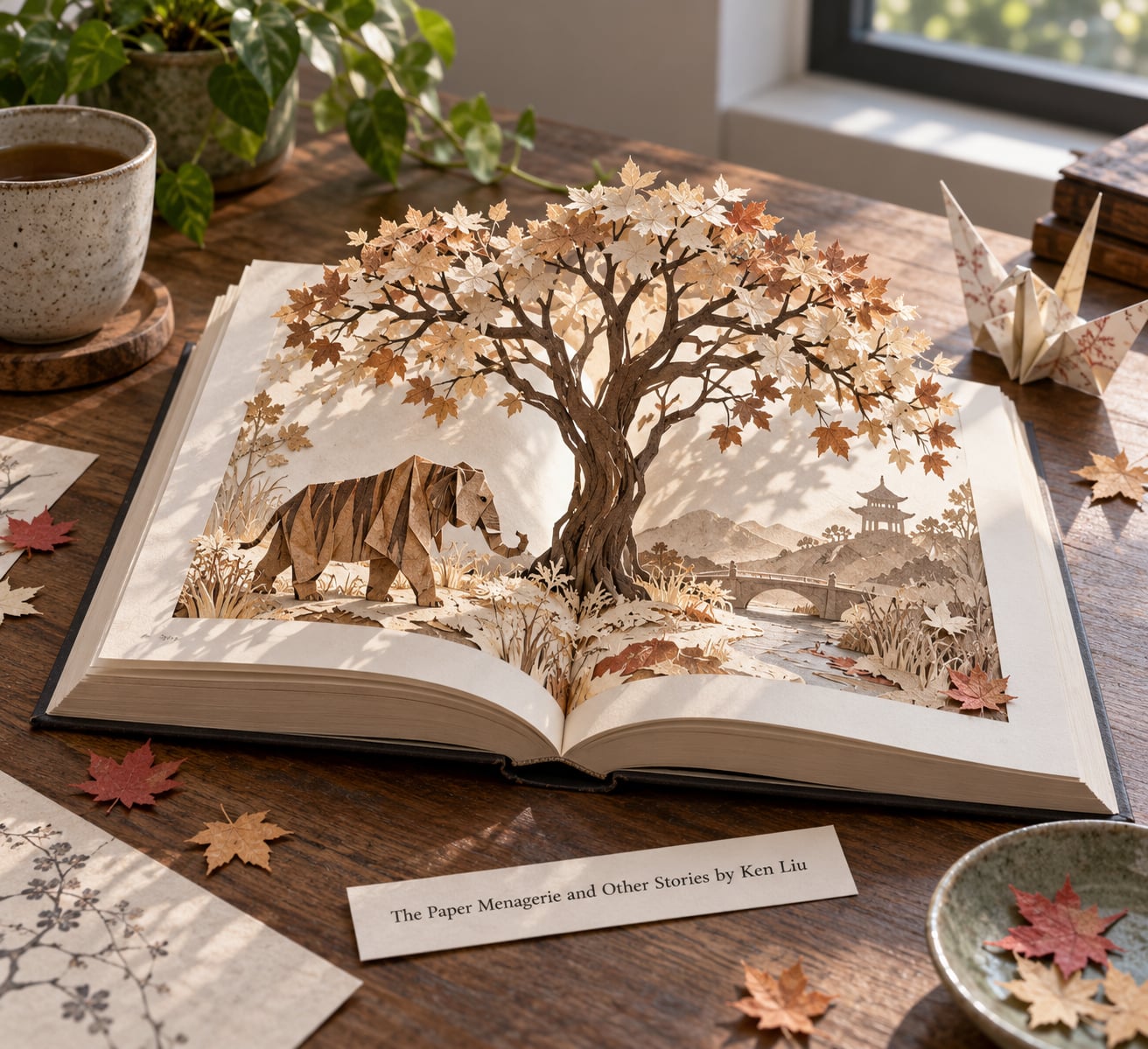
The title story is about a child who does not speak, builds paper animals for a mother she has never met, and then learns Chinese so she can talk to her. The paper animals come alive. That is a magic premise used for a very grounded purpose, which is exactly what makes Liu’s collections work in classrooms.
This is the bridge title on the list. It is genuinely a thriller, a historical story, and a family drama depending on which story you start with, so students who claim they do not read literature often get absorbed without arguing about it. The title story also works as a model for close reading, since the origami in the first chapter means one thing and quite another by the last page.
Best for grades 8 through 12. Pair “The Paper Menagerie” with “Aunts” and “The Waves” for a short unit, or use the title story alone for a single close-reading lesson. Content note is mild; nothing beyond difficult family situations and one death.
How to Choose the Right Book for Your Reading Level
Match the format first, then the theme, then check the content note. A student two grade levels below the target rarely struggles with the subject matter; they struggle with sentence length and vocabulary, so the fix is a different format rather than a different topic.
- Below grade level: picture books and illustrated memoir work well here. The Best We Could Do carries a heavy history at a low reading load because the images carry the weight.
- At grade level: contemporary novels such as The Farewell Arithmetic, Crazy Rich Asians, and The Namesake read at or slightly below the target and hold attention.
- Above grade level or short on time: single stories from The Interpreter of Maladies or The Paper Menagerie and Other Stories give a full thematic arc in a fraction of the pages.
- Ready for dense historical fiction: Pachinko and The Sympathizer reward readers who have already finished a long novel successfully.
- Mature readers only: Exhalation and On Earth We’re Briefly Gorgeous need the discussion group, not a reading log.
For anyone comparing options before buying a classroom set, remember that most of these titles circulate through school and public libraries, and many are available to borrow digitally through OverDrive or Hoopla. Check the catalog first.
How to Use These Books in Class
Annotate rather than summarize. Give students three columns: one moment where a character is treated as foreign, one where family language or silence does work, and one where the narrator’s tone shifts. Those three columns fill a notebook page per chapter and turn a novel into evidence rather than a plot to retell.
Read two books side by side instead of finishing one. The Paper Menagerie against The Best We Could Do puts a child’s constructed relationship with an absent parent next to a daughter’s constructed relationship with the same absent parents. American Born Chinese against The Sympathizer puts a myth retelling next to an account of the war that myth replaced.
Build historical context in short, dated bursts rather than one long preamble. A day on the Chinese Exclusion Act of 1882, a day on the incarceration of Japanese Americans between 1942 and 1946, a day on the Immigration and Nationality Act of 1965. Students meet the history when the book raises the question, not three weeks before.
Run discussion circles with a written question first. Silent writing for three minutes removes the students who would otherwise sit out, and it matters more in this subject than in most.
End with a short creative response rather than an essay. A two-paragraph letter to a character, or an alternate ending from the moment a parent signs something. It produces work from students who freeze at “write a five-paragraph response about the theme of duty.”
On stereotypes and tokenizing: the fear that a teacher is about to make one child the spokesperson for an entire culture is a good fear. Read the book with the whole class, put the questions to the book, and never to a student’s heritage. If a student volunteers personal experience, thank them and move the conversation back to the page. Also note that these books do not only belong in May; a February unit on family obligation or an October unit on satire works just as well.
One coverage note worth keeping: Pacific Islander, Southeast Asian, Central Asian, and adoptee narratives remain thinner than East Asian ones on most classroom shelves. Check your library for Kao Kalia Yang, Christina Soontornvat, Malaka Gharib, and Thanhhà Lại to widen the list beyond what most rankings surface.
Frequently Asked Questions
What are good books by Asian American authors for high school students?
For grades 9 through 12, the strongest picks are The Joy Luck Club for intergenerational conflict, The Namesake for identity and belonging, and The Farewell Arithmetic for a fast contemporary read. If your students want something shorter or in a different format, American Born Chinese and The Best We Could Do both finish in under 250 pages. For a full-year or semester commitment, Pachinko or The Sympathizer reward the extra time.
Are the books in this list appropriate for middle school readers?
Several are. American Born Chinese and The Best We Could Do work well from grade 6, and Crazy Rich Asians and The Interpreter of Maladies hold up from grade 8. The Joy Luck Club, The Sympathizer, and On Earth We’re Briefly Gorgeous need older readers because of suicide, war violence, and explicit content. Preview any title before assigning it rather than trusting the cover.
Which books on this list are available in audiobook format?
Most of them are, though narrators and editions change over time. Check your library catalog or an app like OverDrive or Hoopla rather than assuming. The Interpreter of Maladies, The Paper Menagerie and Other Stories, Crazy Rich Asians, and American Born Chinese are all widely narrated, and several are read by their authors. Audio also solves the reading-level problem for students who follow the argument but struggle with the page.
How can teachers introduce Asian American literature without tokenizing students?
Keep the focus on the text and on history rather than on any student’s identity. Put discussion questions to the book, not to the room. Teach author backgrounds before students encounter the story, so a text is never used as evidence about its author’s community. And spread the reading list across authors, genres, and formats so no one book and no one student stands in for everyone.
What is the difference between Asian American and Asian literature?
Asian literature is generally written by authors living in Asia and rooted in the traditions and histories of those places. Asian American literature is written by authors in the United States and deals with the immigrant, racial, and cultural experience of living in America. A novel set in Seoul by a Korean author is Asian literature; a novel about a Korean American family in Los Angeles is Asian American literature. Some books sit deliberately in the overlap.
Which book should a reluctant reader choose first?
Start with American Born Chinese or Crazy Rich Asians. Both are fast, funny, and under 400 pages, and neither reads like homework. American Born Chinese works best for a student who likes comics or anything visual, and Crazy Rich Asians works best for a student who enjoys a party scene or a love story. Give them the choice of two and let them pick; that decision matters more than which one you would choose.
Where to Start
Pick one book that matches the reader in front of you, not the reader you wish you had. Open it at the first chapter or the first story, read ten pages, and go from there.
Then use the table above to choose a second book in a different format, and you have a two-book pairing that will hold a discussion on its own.