This little women study guide for students covers Louisa May Alcott’s 1868 coming-of-age novel in one page: what the book is about, who the March sisters are, what happens in all 47 chapters, the themes teachers test, the symbols behind the iceberg and the troublesome flame, plus study questions and essay prompts you can actually use. No download required, and nothing gated behind an email form.
Most free Little Women study guides online are PDF lead magnets, and the good ones stop being helpful the moment you start writing. This one is written to be marked up. Print it, split it by chapter group, and keep it open while you read.
Table of Contents
- Little Women Study Guide for Students at a Glance
- What Is Little Women About?
- Who Is Louisa May Alcott and Why Did She Write Little Women?
- Who Are the Main Characters in Little Women?
- How the Four Sisters Compare
- What Is the Plot of Little Women?
- How Does the Novel Change from Part One to Part Two?
- Chapter-by-Chapter Summary and Key Events
- How to Read the Little Women Study Guide for Students
- Part One: Chapter-by-Chapter Summary
- Part Two: Chapter-by-Chapter Summary
- What Are the Major Themes in Little Women?
- Work as the answer to poverty
- Marriage and money
- Art versus usefulness
- Being genuine
- Gender roles and their limits
- What Do the Christmas Journals Reveal About the March Sisters?
- How Does Amy March Change?
- Is Little Women a Feminist Novel?
- What Symbols and Motifs Does Little Women Use?
- Important Quotes and What They Mean
- Little Women Discussion and Essay Questions
- How Do You Write a Strong Essay About Little Women?
- What Is a Simple Study Plan for Little Women?
- How difficult is Little Women to read?
- Frequently Asked Questions
- What are the main lessons of Little Women?
- How many chapters are in Little Women and how are they divided?
- Why does Jo marry Professor Bhaer instead of Laurie?
- Why is Amy important to Little Women?
- What is the significance of Little Women for modern students?
- What Should You Study First?
Little Women Study Guide for Students at a Glance
| Author | Louisa May Alcott (1832-1888) |
|---|---|
| Publisher and dates | Roberts Brothers, Boston. Part One published September 30, 1868; Part Two (titled Good Wives when first issued) published April 14, 1869 |
| Genre | Bildungsroman (coming-of-age novel), with a domestic novel, semi-autobiographical family saga, and loose Christian-allegorical frame |
| Setting | Concord, Massachusetts, and then Europe; Civil War years 1861-1865 running through the background of Part One |
| Point of view | Third person, centered on the March household but shifting freely among the sisters; Alcott narrates like a chatty older sister |
| Main characters | Meg, Jo, Beth, and Amy March; their mother Marmee; Mr. March; Theodore (Laurie) Laurence; Professor Bhaer; Aunt March; Hannah, the cook |
| Total chapters | 47, split into two parts: chapters 1-23 and chapters 24-47 |
| Framing device | John Bunyan’s The Pilgrim’s Progress, given to the girls by their father and used as a running metaphor for their separate journeys toward their own forms of adulthood |
| Central conflict | Four sisters with very different temperaments must work out what a woman is supposed to do with her life in a period that offered almost no options beyond marriage |
| Best study angle | Each sister represents a different answer to that conflict, so character comparison is the fastest route into the book’s themes |
What Is Little Women About?
Little Women is an 1868-69 coming-of-age novel by Louisa May Alcott about four sisters, Meg, Jo, Beth, and Amy, growing up in Civil War-era Massachusetts. It follows them from childhood into adulthood as they negotiate family duty, artistic ambition, money, marriage, and what it means to be a woman in the 1860s, and it has been continuously in print ever since.
That is the whole premise, and it is more useful than it first sounds. Because the four sisters have sharply different personalities, Alcott can run four arguments at once through a single household.
Meg wants a home. Jo wants to write. Beth wants peace and music. Amy wants beauty and a position. The novel’s real question is not whether any of them gets what she wants. It is what each of them has to give up, and whether the trade was worth it.
The answer changes depending on who you ask, which is exactly why the book survives a semester in a classroom and decades of re-reading. Modern readers often argue that the ending is a compromise Alcott was forced into by her publisher, while others read it as deliberately honest about how little choice women actually had.
Two structural facts will help you more than most summaries do. First, the novel was published in two parts a year apart, not as one book, and the tone shifts noticeably between them. Second, Alcott wrote it fast, on commission, under pressure from her publisher.
Who Is Louisa May Alcott and Why Did She Write Little Women?
Louisa May Alcott grew up in Concord, Massachusetts, the daughter of the transcendentalist philosopher Bronson Alcott. The family was intellectual, financially unsteady, and deeply unconventional, which is not the background a girl needed if she hoped for a conventional life.
Her father ran a school, failed at several ventures, and was often away. Her mother was permanently exhausted by poverty that never quite lifted. Alcott began writing to support the household, producing potboilers and adventure fiction with a market that wanted bright, violent, profitable stories about women.
The March family is drawn from Alcott’s own. Her real sisters Anna, Elizabeth, and May appear in softened form as Meg, Beth, and Amy, with May, who did become an artist, closest to her fictional counterpart. The poverty, the improvising, the mother’s weariness, the local intellectual milieu, all of it is autobiography bent to serve a plot.
What is not autobiographical is Jo’s refusal to be Mrs. Laurie. Alcott’s publisher, Thomas Niles at Roberts Brothers, had asked for a “sensible” book, meaning a domestic story about marriage rather than an adventure story about a woman who would rather write. Jo’s voice, her appetite for writing, and her bluntness about marrying for money are Alcott’s own.
The Civil War matters to the novel’s shape rather than its plot. Mr. March serves as a chaplain with the Union Army, leaving Marmee and the girls alone for most of Part One, and the family’s wealth comes from a legacy the grandfather made rather than from the father. That income is what allows Jo to write, and the novel never lets students forget that.
Alcott went on to write Little Men (1871) and Jo’s Boys (1886), continuing the Plumfield material because the readers wanted it. She was also a committed suffragist who wrote arguments for women’s right to vote, which sits in useful tension with a novel that ends four of its heroines in houses rather than at a polling place.
Who Are the Main Characters in Little Women?
Jo March is the novel’s center of gravity, a restless, sharp-tempered, physically clumsy writer who would rather be a wild, independent genius than a nice young lady. She is funny, angry, hungry, and allergic to sentimentality, which is why students tend to adopt her and why her marriage unsettles readers who read it as a surrender.
Meg March is the eldest and the most conventional. She wants the modest domestic life she can see clearly, marries John Brooke, a poor but honorable man, and discovers that poverty is more romantic in theory than in practice. Her arc is about learning that chose poverty has consequences, including the spoiled twins Daisy and Demi.
Beth March is the youngest at the start, a shy, domestic child who plays the piano and never asks for much. Her death from scarlet fever in Part One, chapter 22, is the novel’s emotional hinge, and everything after it is shaped by grief.
Amy March is vain, artistic, and funny about her own vanity. She cannot draw, she knows she cannot draw, and she decides to become serious about art anyway. Her growth from spoiled youngest to working artist is one of the clearest arcs in the book.
Marmee runs the household through willpower and moral example. She is warm rather than severe, and the famous scene where she waits until her own anger cools before speaking to the girls is the novel’s standard for parenting.
Mr. March, a Civil War chaplain, appears briefly and looms constantly. He gives the girls Bunyan’s Pilgrim’s Progress and calls them his little pilgrims, which is where the book’s allegorical frame comes from.
Theodore Laurence, called Laurie, is the wealthy neighbor who has everything except a use for it. He is charming, restless, and a bit spoiled, and he proposes to Jo in Part One, chapter 21, in a scene students often misremember.
Professor Bhaer is a poor German-American schoolteacher in Heidelberg, aunt to the Hummels, and the only character who treats Jo as a writer rather than a girl. He is also thirty years her senior, which is the detail responsible for most modern reader discomfort.
Aunt March is Laurie’s rich, cold great-aunt. She funds the family’s income through a trust, adopts Amy after Beth’s death, and quietly makes sure Jo knows that the Bhaers have been left money. Her stinginess is one of the novel’s best running jokes.
How the Four Sisters Compare
| Sister | Defining trait | What she wants | What she gets | What she argues about womanhood |
|---|---|---|---|---|
| Meg | Practical, conventional, proud of her family | A modest home and a good husband | John Brooke, twin babies, and money worries | That domesticity is a real choice with real costs, not a lesser one |
| Jo | Restless, funny, allergic to sentiment | To write and to keep her freedom | A publishing career and a partnership with Bhaer | That work and marriage can coexist, on unequal terms |
| Beth | Shy, musical, undemanding | Home and a quiet place | Brief domestic happiness, then death | That a placeless, unmarried life is not a failure but it is not available either |
| Amy | Ambitious, vain, resilient | Beauty, art, and status | A real career, and Laurie | That a woman can refuse social rules as long as she can pay |
The table is worth memorizing because nearly every essay prompt on Little Women can be answered with two columns from it. Compare Jo and Amy on art and money. Compare Beth and Meg on marriage. Compare Jo and Beth on what they give up.
What Is the Plot of Little Women?
Beth dies of scarlet fever in Part One, and Jo marries Professor Bhaer rather than Laurie, who marries Amy. Those are the two facts students most often get wrong, usually from the 2019 film, so they are worth stating before anything else.
The novel opens with Marmee reading her husband’s letter to the girls. He is serving as a chaplain in the Union Army, and he hands them his copy of The Pilgrim’s Progress, asking them to go on their own journeys while he is away. The daughters, with their neighbor Laurie, set out to improve themselves, and their journals become the novel’s opening experiment.
Their father is injured and comes home just before Christmas. In Chapter 7 Marmee takes the exhausted family to Meg’s small house on the river, where they play and quarrel and eat too much. Back in Concord, Amy burns the manuscript Jo has been writing at night. Jo lets it go, and Beth turns out to have been the only one who knew about it.
The Plumfield period follows. Meg marries John Brooke, whose family opposes the match over his money, and Amy accompanies Aunt March to Europe. Amy’s letters from Europe are comic and acid, and her paintings improve under the pressure of trying to keep up with the continent’s artists.
Laurie throws his love at Jo, fails to win her, and goes to Europe after her. He comes back with Amy, who has grown into a serious painter and has decided she does not want a husband at all. Beth, who has always been ill, is exposed to scarlet fever in the garden and does not recover. Chapter 22 kills her, and Chapter 23 closes Part One with the family learning to live without her.
Part Two opens with the time jump into adulthood. Amy refuses Laurie a second time on grounds she explains honestly, then accepts once he has asked her to love him rather than marry him. Jo takes a job editing and writing for a magazine and runs into Bhaer again in Germany. Marmee moves to Meg’s house, Beth’s cottage is finished, and the four women’s outcomes are stated one by one in a chapter often called the settlement chapter.
Jo marries Bhaer in Part Two, chapter 33, refuses to give up her career, and turns her and Bhaer’s house into a boarding school for working women. Alcott then compresses two more chapters of domestic follow-up, in which Beth’s daughter and Amy’s girl receive the names Jo, Meg, Beth, and Amy.
How Does the Novel Change from Part One to Part Two?
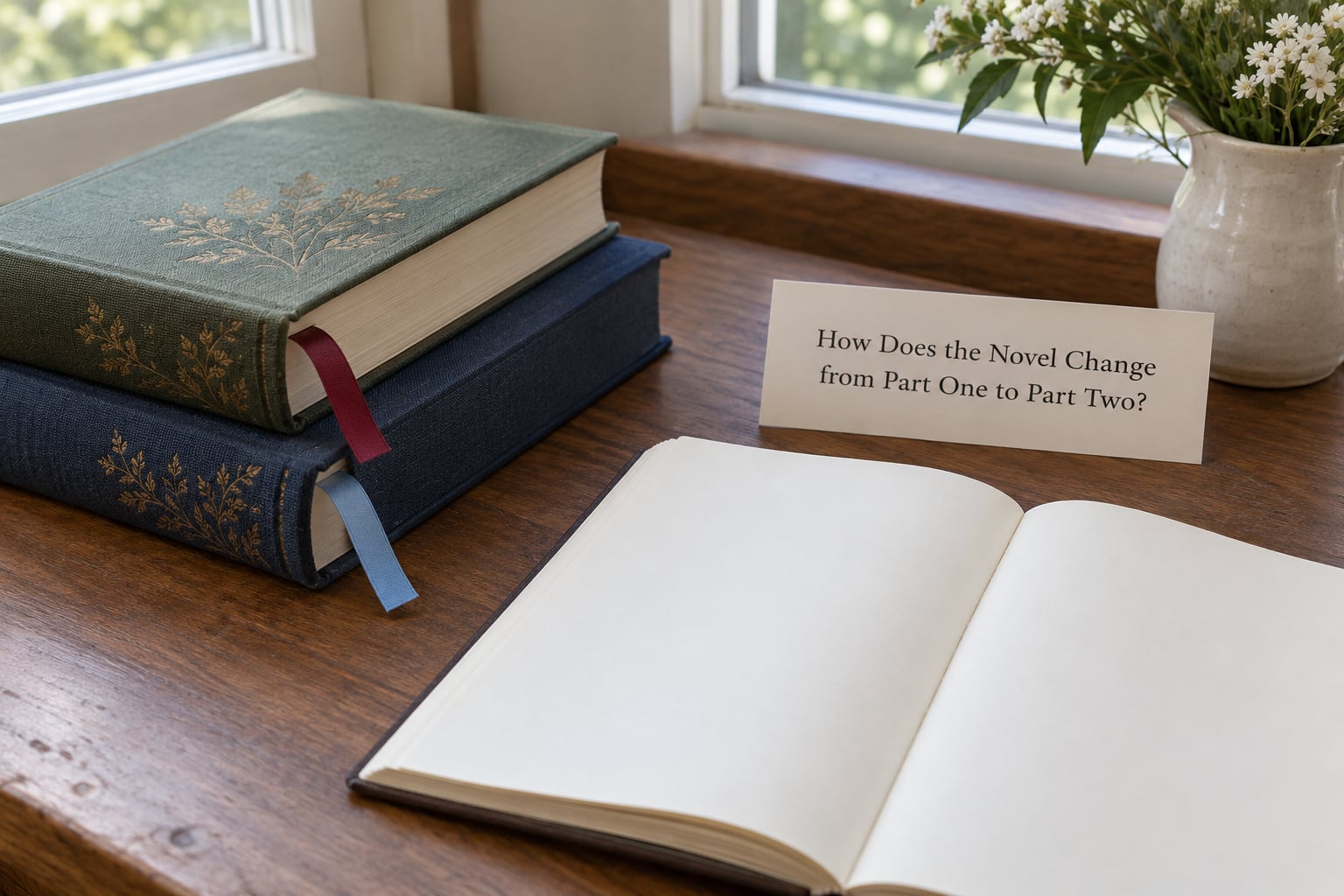
Part One is a comedic coming-of-age novel in chapters 1-23. Part Two is a quieter novel about work, money, and loss in chapters 24-47. The change is structural, not just chronological, and essay questions on the two-part design reward students who notice it.
| Element | Part One (Ch. 1-23) | Part Two (Ch. 24-47) |
|---|---|---|
| Tone | Fast, comic, episodic, full of running jokes about Amy and Laurie | Slower, more reflective, elegiac |
| Central question | What will the girls grow up to be? | What will the women make of their lives? |
| Mr. March | A hero, wounded and restored | Absent for most of the section, then dying in chapter 45 |
| Marriage | Arranged and resisted: Meg marries, Amy refuses, Jo refuses | Completed and complicated: Amy marries Laurie, Jo marries Bhaer |
| Money | Rarely discussed; the family is poor but comfortable | A subject: Aunt March’s allowance, Jo’s earnings, Amy’s studio |
| Work | Jo’s writing is a private secret | Jo’s writing is a public career |
| Beth | Alive, then ill, then dead at the close | Present only through her cottage, her husband, and her baby |
| Closing image | Laurie and Amy leaving for Europe | Four babies named Meg, Jo, Beth, and Amy |
Chapter-by-Chapter Summary and Key Events
Alcott was a fast writer, and the summaries below group chapters by narrative movement rather than one by one. For exam purposes, the four things worth being able to place precisely are Beth’s death at chapter 22, Laurie’s proposal to Jo at chapter 21, Jo’s marriage at chapter 33, and the chapter-45 death of Mr. March.
How to Read the Little Women Study Guide for Students
Read it in three passes, not one. Before you start, skim the at-a-glance table and the sister comparison table, then write down your own guess about what each sister will want at sixteen.
As you read Part One, mark Jo’s ambitions in one color and Amy’s in another. The most useful annotation habit students develop is flagging every time money is mentioned, because the family’s comfort depends on an inheritance and that fact shapes the ending.
Then read Part Two looking for what each sister is doing for work. The change from Jo’s secret nighttime writing to Jo’s paid editing is the single cleanest piece of evidence you can use for the theme of work.
Keep a separate quotation card rather than hunting for lines later. Record the line, the speaker, and the chapter. That single habit removes most of the panic that happens when an essay prompt asks for evidence.
Above all, do not let the first four chapters push you away. They are slow for most readers, they are funny once you accept that Jo narrates the whole book, and Chapter 4 sets up the framing device for everything that follows.
Part One: Chapter-by-Chapter Summary
Chapters 1-6 (the Christmas and the journals). Marmee gives the girls the letter, Mr. March’s gift, and the charge to continue their own pilgrimage. The sisters declare their ambitions: Jo will be a writer and not a wife, Beth a singer, Amy an artist, Meg a housekeeper. Marmee corrects Beth’s spelling. The girls meet Laurie, who is playing at being a gentleman, and he is struck by Jo’s refusal to be impressed. The chapter that matters most for study purposes is Chapter 4, in which Jo says she will be a trumpet rather than a warbler, which is the whole book in one line.
Chapters 7-10 (the river house). Marmee takes everyone to Meg’s house for Christmas, where the sisters quarrel and reconcile. Amy is mocked for her topographical drawings. Beth is the one who consoles her with a blessing, which matters later. Meg and Jo argue about their futures; Jo says she means to write, and Meg says the same. Marmee gently points out that Jo is repeating her own mother’s life in reverse, which is a genuinely sharp exchange and a common short-answer question.
Chapters 11-16 (the call and Amy in Paris). Amy burns Jo’s manuscript, about six pages of it. Jo is unusually gracious about it. Beth’s freezing vigil over Amy through a fever is the first hint of the illness that ends her. Aunt March offers to take Amy to Europe, and Amy goes, leaving Jo behind in a household that has become too quiet. Jo writes to Amy about being a feminist, insisting that women should have equal rights and will “get it yet.”
Chapters 17-20 (Beth at the shore, Jo’s growth at home, Laurie abroad). Beth stays at the Hummel cottage and grows weak. Jo works as a governess, then as a companion to Aunt March, saving money in a respectable middle-class way. Laurie goes to Europe, and the sisters exchange letters. Marmee writes to Jo with advice about love and money, and Jo’s response, that she will not marry a man she does not love even if she is poor, is the moral spine of Part One.
Chapters 21-23 (the proposal, Beth’s death, the close). Laurie proposes to Jo, offering everything his uncle can give him. Jo refuses, telling him plainly that she will not marry for money and does not love him that way. Beth contracts scarlet fever after being caught out in the garden by the gardener who had warned her, and Amy, who let her in and refused to tell anyone, never forgives herself. Beth dies, and Jo takes the news to Amy in the garden, where Amy sits sketching a chrysanthemum. Chapter 23 closes the part with the sisters grieving, Laurie promising to protect Amy, and a sense of an ending that is also a beginning.
Part Two: Chapter-by-Chapter Summary
Chapters 24-28 (four years later). The novel resumes with Meg married, Amy abroad, and Beth gone. Marmee has moved next door. Amy rejects Laurie when he proposes on the moat, because she does not love him. Amy tells Jo in a long letter that she is too selfish and worldly to marry for the life she actually wants, and Jo writes back urging her to do her duty. Laurie appears at Plumfield, the empty family house, and begins to reinvent himself.
Chapters 29-32 (Germany and Bhaer). Jo goes to Germany as a traveling companion. She works as a newspaper correspondent and enjoys being treated as a lady, then gets caught in a political riot and is helped by a poor man with a limp, who turns out to be Professor Bhaer. Their friendship is built on books and teaching rather than manners, and Jo begins to see that her prejudice against him was snobbery. Aunt March, dying and arranging her money, puts enough aside to secure the Bhaers’ comfort, which Jo finds humbling.
Chapters 33-35 (the marriages and the settlement). Amy marries Laurie in a small wedding at Aunt March’s house, having found that she loves him after all. Jo marries Bhaer in Chapter 33 and keeps her career. Chapter 34, the chapter teachers love to hand out, states each sister’s fate in turn: Beth’s short marriage and death, Meg’s hard-won domestic happiness, Amy’s art school and house, Jo’s independence and marriage. Chapter 35 gives Jo’s famous line about no longer being afraid of storms.
Chapters 36-41 (the American half). Jo and Bhaer’s marriage settles into work, money, and conflict. They argue about poverty. Jo publishes a story, earns well, and invests. Amy and Laurie travel, Amy’s art sells, and Meg’s children are a delight and a drain. The Jo and Bhaer household becomes the boarding school for working women that Alcott’s readers have built replicas of ever since.
Chapters 42-47 (loss and coda). Marmee returns to the Concord house. Beth’s daughter, Amy, is sick and dies. Mr. March dies after Meg’s children have been given to the sisters, and the family learns to consolidate its happiness. Beth’s cottage becomes a school too. The last chapter matches the four couples and their children to the four Pilgrims, closing the allegory that opened the book, and names the last two daughters Meg, Jo, Beth, and Amy.
What Are the Major Themes in Little Women?
The dominant theme is the tension between familial duty and personal growth, and every other theme in the book connects to it. None of the four sisters escapes the choice Alcott gives them, and that is the point.
Work as the answer to poverty
The clearest lesson in Little Women is that independence is a matter of skill, not sentiment. Jo supports herself first by governing, then by accompanying Aunt March, then by writing and editing for pay. Amy’s art career is equally financial, because it takes until after Meg marries and goes without for three years that she understands what a choice actually costs.
Meg’s experience of the same theme is the sharpest. She chooses poverty over an easy match, discovers that John cannot earn enough, and spends years resenting the mallets and the fire and the bills. By the settlement chapter she has stopped resenting them, which is growth rather than surrender.
Marriage and money
Alcott keeps testing marriage against money. Laurie offers Jo wealth and love and she refuses both. Amy, who wants wealth, learns she cannot buy herself out of her own preferences. Bhaer has nothing and asks only for a chance to work and a chance to be good to her, and Jo takes him in an atmosphere of cheerful absurdity when they arrive at their first rented house with no butter, no eggs, and no money.
Art versus usefulness
Amy insists she is serious about art even when she is not good at it, and the novel insists she is right about that even while she is often wrong about other things. Jo’s writing is treated as trivial by her own father until it starts earning money, which is exactly when he takes it seriously.
Being genuine
The March family worships sincerity, and the novel tests it constantly. Beth’s flawless patience is praised; Jo’s violent temper is excused but corrected; Amy’s vanity is mocked, but her honesty about it is admired. Alcott’s standard is not perfection but the willingness to say the true thing, even about yourself.
Gender roles and their limits
Alcott lets Jo argue explicitly for women’s rights, and lets Marmee tell Beth that being a housewife is not good enough for a grown woman. The novel also shows the limits of that position, because every sister who does something unusual is financially supported by family wealth. The March sisters are arguing about what to do with a freedom they did not have to fight for.
What Do the Christmas Journals Reveal About the March Sisters?
The opening journals are the novel’s characterization in miniature. Each sister writes what she wants to become, and Alcott lets the reader spot the gap between ambition and ability before the story does.
Meg’s journal describes housekeeping as her vocation, and by Chapter 4 she has discovered that neither she nor her sisters consider housekeeping good enough for respectable young women. That contradiction is the whole social critique in one entry.
Jo’s journal is the one that gets quoted, and it announces both her ambition and her sneer. She wants to write, and she wants the freedom not to love, which is a motive she will have to unlearn. The note about being a trumpet rather than a warbler comes in the same early stretch.
Beth’s is the shortest and the saddest, because what she wants is a copy of her mother’s place, and the story has already told us she will not get it. Amy’s is the most specific: she draws faces and landscapes and wants to become an artist, which is the one ambition that survives intact and becomes a career.
At the end of the novel, Alcott returns to the same four columns and compares what each sister has become against what she wanted. The comparison is deliberately uncomfortable. Meg gets what she wanted and finds it hard, Jo gets independence and a husband she did not expect and is almost relieved, Amy gets art and a good house, and Beth gets a few years of the life she wanted and nothing after.
That structure is what makes the book a bildungsroman rather than a story with a happy ending. Growth in Little Women is not the same thing as getting everything you asked for at Christmas.
How Does Amy March Change?
Amy starts as a thirteen-year-old who cannot draw and thinks she can, and who is far more aware of her own vanity than any reader is. She cries when the going gets hard, and she turns her tears on Beth and Jo more than once.
Europe is where she gets a real education. She discovers that her skill is small and her ambition is large, and instead of quitting she converts ambition into method. She studies, she copies engravings, she paints from models, and she accepts that she will not be the best painter in any room she enters.
Her refusal of Laurie in Part Two, chapters 24-28, is the pivot of her arc. She tells him she does not love him, and she tells Jo in a letter that she is too selfish to marry for the life she does not want. This is often called the book’s boldest moment, and it is genuinely surprising in a novel that is about to marry almost everyone off.
What changes is not her taste or her manners but her honesty. She stops managing her image to get what she wants. When she finally marries Laurie, she does it from a place of knowledge rather than convenience, and in the settlement chapter she has an art school, a studio, and real money.
Amy also carries the novel’s guilt about Beth’s death. Letting the gardener’s warning pass, and then telling Amy it was Jo’s fault, is a small act with a lifelong cost, and Amy spends Part Two trying to live in a way that earns forgiveness she never receives explicitly.
Is Little Women a Feminist Novel?
Little Women is a feminist novel in its arguments and only partly feminist in its ending, and the strongest essays on it take that tension seriously rather than picking a side.
The feminist case is easy to state. Jo refuses to marry Laurie because she will not trade her work for his money. She tells Amy in letters that women should vote and that they will get the vote eventually. Marmee tells Beth that being a housekeeper is beneath her. The novel repeatedly treats a woman’s marriage as a matter of economics, which in 1860s America it literally was.
The counter-case is equally strong. Every sister’s independent life is underwritten by a fortune left by a grandfather, and Jo’s marriage to Bhaer still ends in a boarding school run inside her home. Beth, the sister who most wanted the domestic life, dies young and is remembered by her family mainly as the one who left. And the suffrage arguments sit in letters, not in the plot.
The more productive reading treats the ending as an argument about what was possible rather than what was ideal. Alcott gave Jo a career and a man who cooks, which is genuinely rare in 1869. She gave Amy money and status, which is what art required. She gave Meg exactly what Meg asked for and made her pay for it.
Amy’s line about being too selfish and worldly to marry without love, delivered at the height of the marriage plot, is the sentence most modern readers and most 2019 viewers come back to. Alcott wrote it as a correction to Jo’s romance, but it reads as a defense of a woman’s right to want something for herself.
What Symbols and Motifs Does Little Women Use?
| Symbol or motif | Meaning | Where it appears |
|---|---|---|
| The Pilgrim’s Progress | The Christian frame of the whole novel; Mr. March hands it to the girls as their shared task | Given at the opening, echoed at the close |
| The troublesome flame | Jo’s restless drive to achieve, named and lampooned by her father as a thing to be managed | Part One, chapters 4-6 |
| The iceberg | Laurie’s fear of emotional depth, drawn by Jo during the skating chapter | Part One, chapter 8 |
| The moat | Amy meets Laurie at the moat of Aunt March’s estate to end his proposal | Part Two, chapter 25 |
| Amy’s china face | Delicacy treated as a form of female power, and its limits | Part One, during the burnings and the poverty episodes |
| Beth’s piano | Art that asks nothing of anyone, and Beth’s longing for a place of her own | Throughout Part One |
| Books and writing | Jo’s vocation, the family’s intellectual inheritance, and the escape from poverty | Throughout both parts |
| The chrysanthemum | Beauty and fragility; Amy sketching flowers while Jo tells her Beth has died | Part One, chapter 23 |
The Pilgrim’s Progress framing deserves its own paragraph because almost no study guide explains it. Mr. March is the guide, the girls are pilgrims, and each sister reaches her own Celestial City by a different road. Alcott borrows the religious convention and then quietly secularizes it, since Jo’s writing is her pilgrimage and nobody ends up discussing religion much.
Important Quotes and What They Mean
Quotations from Little Women are widely circulated online in shortened and sometimes reshuffled forms, so quote from your own edition and check the chapter number in the text before you attribute a line in an essay.
- “I am not afraid of storms, for I am learning how to sail my ship.” Jo, Part Two, Chapter 35. This is the novel’s maturity statement and the safest single quotation to use.
- “Far away there in the sunshine are my highest aspirations. I may not reach them, but I can look up and see their beauty.” Jo, Part One, around Chapter 16. Jo’s ambition stated as hope rather than as demand.
- “I like good strong words that mean something.” Jo, Part One, Chapter 5, in her conversation about her name. The line explains why Jo resists genteel femininity and why her pen name matters.
- “Love is a great beautifier.” Meg, early in Part One. Popular reproductions sometimes attribute this to Jo or to Amy; it is Meg’s line and it sets up what she will discover about marriage.
- “Housekeeping ain’t no joke.” Meg, Part One, Chapter 2. Alcott’s plainest statement of the economic reality underneath the domestic plot.
- “I am too selfish and worldly to be unselfish and unworldly.” Amy, in her long letter to Jo after refusing Laurie in Part Two. Frequently quoted out of context; the full passage argues that she cannot pretend to love a man for a social position.
- “I’m not afraid, Marmee. I’d like to go to mother.” Beth, in the death scene at the close of Part One, chapter 22. Students should be able to place this one.
- Mr. March’s letter to Jo, apologizing for undervaluing her writing, delivered in Part Two after the two weddings. Rarely quoted, and one of the strongest pieces of evidence for the theme of fathers undervaluing daughters.
Chapter numbers shift slightly between editions because early printings and later popular editions differ in division. Give the chapter as your edition numbers it and, when you can, add the scene.
Little Women Discussion and Essay Questions
Each of these is phrased so that a good answer has to make an argument and quote at least two places. That is the difference between a question you can answer from a summary and one you have to read for.
- Does Jo’s ending represent triumph or compromise? Address the boarding school, the survival of her career, and the thirty-year age gap between Jo and Bhaer.
- Why does Alcott give Beth the shortest life? Consider what Beth’s early death does to Amy’s guilt and to the family’s definition of a successful woman.
- Contrast Jo’s and Amy’s relationships to money. Quote Jo’s refusal of Laurie’s offer and Amy’s letter about being worldly.
- How does the moat scene change Amy’s role in the novel? Compare her refusal of Laurie with her earlier refusals of her sisters and of Marmee.
- What does Mr. March’s letter about Jo’s writing reveal about fathers and daughters? Look at when in the novel he admits he was wrong.
- Is Marmee’s approach to discipline strict or permissive? Use the chapter in which she waits out her anger before speaking to the girls.
- Why is Laurie drawn as sympathetic rather than as a villain? Examine what he does after Jo refuses him.
- What does the two-part structure accomplish? Compare the ending of Part One with the settlement chapter in Part Two.
- How does Alcott use Beth to complicate the idea of female ambition? Beth wants her mother’s life and is not praised for it, yet she is the most loved.
- Does the novel support or criticize marriage as an institution? Gather one sentence in favor and one sentence against from the same chapters.
- What role does the ice house and Beth’s illness play in Amy’s moral development? Track Amy’s self-blame into Part Two.
- Is Little Women a feminist novel? Take a position and defend it with Jo’s letters, Marmee’s speech to Beth, and the chapter 34 settlement.
How Do You Write a Strong Essay About Little Women?
Most weak essays on Little Women summarize the book and then state an opinion about Jo. The ones that score do something different: they make one arguable claim and test it against two or three specific scenes.
Step one is a thesis with a real edge. “The novel is about family” is not a thesis. “Alcott shows that marriage only looks like an escape from economic dependence for women who already have it” is, because it can be argued and can be partially contradicted, which is what good essays do.
Step two is choosing one theme rather than three. Work, marriage, art, gender, money. If you cannot name your theme in a phrase, you are not ready to write yet.
Step three is selecting two or three embedded examples and analyzing them. One example with deep analysis beats five examples with plot summary. For each one, ask what the scene does that narration alone would not do.
Step four is quoting accurately and in context. Use the chapter number from your edition, and give a short setup line before the quotation so the reader knows who is speaking and why.
Step five is organizing. When you are comparing two characters, organize by theme and bring both into each paragraph. When you are tracing one character’s development, organize chronologically and group chapters into phases.
Close with the implication. A strong final sentence tells the reader what the evidence adds up to, rather than restating that the novel is important.
What Is a Simple Study Plan for Little Women?
A ten-day plan works, and it works better if you do the plot and character work before you do any theme work. Try this sequence and adjust the chapter numbers to your own edition.
- Day 1: Read the at-a-glance table and the sister comparison table here. Write four sentences, one per sister, on what you expect her to want.
- Day 2: Read chapters 1-7. Track Mr. March’s letter, the gift of The Pilgrim’s Progress, and the journals.
- Day 3: Read chapters 8-16. Note Amy burning the manuscript and Marmee’s exchange with Jo about their mother’s future.
- Day 4: Read chapters 17-23. Mark Beth’s illness, Laurie’s proposal, and Amy’s regret.
- Day 5: Read chapters 24-28 and the moat scene. Write two paragraphs on what Amy refuses and why.
- Day 6: Read chapters 29-35, including the riot, the reunion with Bhaer, both weddings, and the settlement chapter.
- Day 7: Read chapters 36-47 quickly. Focus on the work, the money, and the deaths.
- Day 8: Fill in the sister comparison table with what actually happened, then compare it to your Day 1 guesses.
- Day 9: Build a quotation card with eight lines, each with speaker and chapter.
- Day 10: Choose one discussion question above and write a timed response of 40 minutes.
How difficult is Little Women to read?
Little Women is an easy read in terms of sentence length and plot, and a hard one in terms of nineteenth-century social assumptions. The prose is clear Victorian English with long but well-punctuated sentences. The genuinely difficult parts are vocabulary and context, not difficulty of comprehension.
On grade level, editions of Little Women are usually catalogued around grades 6 to 9, which makes the book accessible to middle-school readers and appropriate for high school study. Lexile measures vary by edition because of differing illustration packages and text resets, so your teacher’s edition may carry a different number on the back cover.
The words that slow students down are mostly social rather than archaic. In 1860s usage, interesting means respectable and admirable, genteel means well-bred and refined, demure means quietly modest, and temper means character or disposition rather than anger. Gentlewoman means a woman of good family, not a servant. Marmee is a term of address for a mother that reads like a name.
The first four chapters are the most commonly disliked part of the book, and no amount of summary makes them move faster. They read slowly because Alcott is establishing the frame, the jokes, and each sister’s voice at once. Give them four chapters and then reassess, which is exactly what a teacher would tell you.
If your edition is abridged, say so in your essay and keep the unabridged edition nearby for checking quotations, since abridgements cut whole conversations and change chapter boundaries.
Frequently Asked Questions
What are the main lessons of Little Women?
The central lesson is that independence depends on skill and money, not on wanting it. Jo supports herself by writing, Amy by painting, and Meg learns what chosen poverty actually costs. The novel also argues that work and family can coexist, that self-knowledge matters more than social approval, and that character is measured by honesty rather than by perfection.
How many chapters are in Little Women and how are they divided?
The novel has 47 chapters divided into two parts published a year apart. Part One, chapters 1 through 23, follows the sisters from childhood through Beth’s death and ends with Amy and Laurie leaving for Europe. Part Two, chapters 24 through 47, jumps forward four years and covers the marriages, careers, losses, and the closing naming of four daughters.
Why does Jo marry Professor Bhaer instead of Laurie?
Jo refuses Laurie because she does not love him and will not trade her work for his money. She marries Bhaer after Germany, where their friendship was built on books and teaching rather than manners, and she tells her family plainly that she will not give up writing. She keeps her career, runs a boarding school, and treats marriage as a partnership rather than an ending.
Why is Amy important to Little Women?
Amy is the character who tests the novel’s limits. She refuses Laurie at Aunt March’s moat, arguing that she is too worldly and selfish to marry without love, which is the boldest statement of female choice in the book. She also turns her ambition into a real art career, showing that the same social rules that restrict Jo can be negotiated by a woman with money.
What is the significance of Little Women for modern students?
It is unusually well suited to classroom debate because one plot carries four different answers to what to do with a life, so students can argue about gender, money, and marriage using the same families. Alcott wrote explicit arguments for women’s rights alongside a plot full of marriages, which gives essay writers real material for assessing whether the ending is feminist. It has also never been out of print.
What Should You Study First?
Start with the plot-and-character overview, not with the themes. If you are taking a test, use the chapter-by-chapter sections until you can place Beth’s death at chapter 22, Laurie’s proposal at chapter 21, and Jo’s marriage at chapter 33 without hesitating.
If you are writing an essay, pick one theme and one pair of sisters, then build a quotation card with at least eight lines before you draft a sentence. Most essay problems with this book are evidence problems wearing a disguise.
Then run the ten-day plan above. One thing to remember in 2026 and every year after it: the details that trip students up are the marriage outcomes, not the plot. If you can state who married whom and why, everything else in this study guide has somewhere to attach.