The Picture of Dorian Gray is Oscar Wilde’s 1890 novel about a handsome young Londoner who discovers that a portrait of him ages and decays while his own face stays young. Every choice he makes after that discovery is written onto the canvas instead of his body, so the painting becomes a record of his moral corruption. This study guide covers the plot, the characters, the themes, the symbols, Wilde’s style, and how to turn all of that into essay answers, which is what makes it useful as a The Picture of Dorian Gray study guide for exam prep as much as for coursework.
If you are studying for an exam, start with the plot summary and the character table, then jump to the scenes section. If you are writing an essay, go straight to the thesis model at the end. The novel runs to twenty chapters and roughly 250 pages depending on the edition, so a few hours of reading is enough to cover it if you keep the structure below open beside you.
One warning before you start. The book is a portrait of a person as much as a portrait in a frame, and it deals with suicide, murder, blackmail, and an underground sexual world. Nothing is described graphically, but the subject matter is adult throughout. Chapter 1 opens lightly, almost like a comedy, and that tone shift is deliberate rather than a flaw.
Table of Contents
- Key Facts About The Picture of Dorian Gray at a Glance
- Plot Summary of The Picture of Dorian Gray
- The opening chapters and the wish
- Chapter 6 to chapter 10: the second version of Sibyl
- Chapter 10 to chapter 15: the murder
- Chapters 16 to 20: the hunt and the end
- What Historical and Cultural Context Shaped the Novel?
- The 1890 magazine version and the 1891 book version
- Victorian morality and respectability
- Aestheticism, the dandy, and art for art’s sake
- What the Preface is doing, and why you should read it
- Class, money, and the new fame
- How does it compare with Jekyll and Hyde and the Faust legend?
- How difficult is the novel to read?
- Who Are the Main Characters in The Picture of Dorian Gray?
- Why Lord Henry Wotton matters more than he first appears
- Basil, Sibyl, and the two kinds of love in the book
- How Does Dorian Change Throughout the Novel?
- Stage one: confident but unformed
- Stage two: the wish and the seduction of the yellow book
- Stage three: cruelty without passion
- Stage four: knowledge, then paralysis
- What Are the Major Themes and Ideas?
- Beauty against morality
- Appearance against reality
- Identity, performance, and the instability of the self
- Pleasure and its consequences
- Class, status, and the freedom of money
- Dorian Gray syndrome
- The Picture of Dorian Gray Study Guide: Key Analytical Takeaways
- Ten quotations worth knowing, with what each one does
- What Symbols and Motifs Should You Know?
- How Does Oscar Wilde’s Writing Style Shape the Novel?
- Epigrams
- Rhetorical reversals and the pattern of the three
- The frame and the unreliable narrator
- How to Analyze the Novel’s Most Important Scenes
- 1. The wish in the studio
- 2. Dorian and Sibyl at the theatre
- 3. Lord Henry’s influence
- 4. The death of Sibyl
- 5. The abandonment of the first portrait
- 6. The final bedroom confrontation
- Why Does Dorian Keep the Portrait Hidden?
- How Does the Novel End, and What Does It Mean?
- How to Write a Strong Essay About The Picture of Dorian Gray
- A model thesis and how to build one
- Evidence and quotation handling
- Mapping prompts to arguments
- Topic sentences that carry weight
- What Is a Useful Study Plan for the Novel?
- Before and during the first pass
- The second pass: characters and themes
- The third pass: analysis and timed practice
- Help for the parts that slow people down
- Frequently Asked Questions
- Is The Picture of Dorian Gray based on a true story?
- How does the portrait change, and is Dorian physically aging?
- What is the significance of the yellow book Dorian reads?
- Why does Dorian call Sibyl a heroine after her death?
- How can I use a The Picture of Dorian Gray study guide without spoiling major scenes?
- Conclusion: Begin with the Central Contrast
Key Facts About The Picture of Dorian Gray at a Glance
If you only have two minutes, these are the details an exam answer needs and most students forget.
| Element | Detail |
|---|---|
| Author | Oscar Wilde, Irish writer, poet and dramatist |
| First publication | Lippincott’s Monthly Magazine, July 1890, in a cut version |
| Book edition | 1891, revised and about 13,000 words longer |
| Genre | Gothic novel, philosophical fiction, frame narrative |
| Structure | Twenty chapters, each with a Biblical epigraph |
| Setting | London, roughly 1875 to 1900 |
| Point of view | Third person, through unnamed observers and a frame narrator |
| Length | Roughly 250 pages, about five to six hours of reading |
| Companion text | The unnamed yellow book, generally read as Joris-Karl Huysmans’s A Rebours |
| Wilde’s fate | Convicted of gross indecency in 1895 and imprisoned for two years |
Four things to know before you read. The tone in the first six chapters is deliberately light and conversational, so the later darkness will not feel like a different book. The portrait changes gradually rather than dramatically, which is why some readers underrate what it is doing. Dorian’s beauty never fades at any point, so any claim that he is shown ageing early is wrong. And the ending is genuinely uncertain, so do not expect the last chapters to hand you a moral in plain words.
Plot Summary of The Picture of Dorian Gray
Dorian Gray is a young man of unusual beauty who sits for a portrait by his friend Basil Hallward. Before the work is finished, Dorian prays that the painting might age in his place. The wish is granted, and the picture absorbs his moral life while his body stays unchanged. The rest of the novel follows what that arrangement costs him and everyone around him.
If you would rather not have the whole plot in front of you, the short version is this: an attractive young man trades his soul for permanent youth, spends twenty years chasing sensation, destroys everyone who loved him honestly, and finally dies when the portrait is destroyed. Everything between those two points is Dorian slowly discovering that consequences can be deferred but not avoided.
The opening chapters and the wish
Chapter 1 is all talk. Basil finds Dorian in his studio and admires him openly, which he says is the problem, because an artist should love his work for its own sake. Lord Henry Wotton arrives, calls Basil’s admiration of Dorian worship, and delivers a long speech about beauty, youth, and the fact that we have nothing else. Dorian’s reaction, “What a wonderful thing a man is,” sets up the whole book, and the portrait on the easel seems to change just as Dorian hears himself agree that life and art should not be separated.
In Chapter 2, the elopement with Lady Agatha and Lord Russell is announced and treated as a scandal, even though their marriage is perfectly happy. Dorian becomes a celebrity overnight. Lord Henry teaches him to look at himself in the mirror and to enjoy the shock of his own image, a habit Dorian forms early and never breaks. Henry begins to say things like “I never approve of the principles of others,” and Dorian absorbs the idea that having a private morality is the height of modernity.
Chapter 3 brings Sibyl Vane into the story, an actress Dorian falls for at the theatre. Her troubles are described in chapter 4: a drab, unremarkable house, a tyrannical and distant mother, a small salary, and a man named James Vane who loves her badly and expects her to keep the family going. Chapter 5 is important because Dorian openly tells Henry that Sibyl is talented but the stories she acts are not worth reading. Sibyl overhears, and the wound is immediate and total.
Chapter 6 to chapter 10: the second version of Sibyl
Dorian makes it right by showering Sibyl with flowers, jewellery, theatre tickets, and money. She is transformed, her company flourishes, and she begins to love him. Then comes the worst moment in the novel. She acts Hamlet and faints in front of the audience because she is pregnant, and Dorian, desperate to escape a life with her, tells her she is wasting her talent on a man who does not deserve her. She runs to her mother’s landing, rides into the night, and kills herself with a bottle of laudanum and prussic acid.
Dorian finds the yellow book that Sibyl had asked him to read, the novel she had called poison and the only book she thought romantic, and he begins to live out its pages. Chapter 7 is where the corruption starts in earnest. He goes to the theatre, is hissed by Sibyl’s brother James for taking advantage of her, and tells James the truth about the death. James weeps and threatens him, then disappears with the intention of killing Dorian in his sleep.
Chapter 8 and 9 follow. Lord Henry takes Dorian out for a long drive to cheer him, then leaves him alone for a month, and Dorian falls deeper. Basil finds him again and asks him to pose. Dorian refuses to be painted, says he has grown too old, and Basil responds that the picture would be a masterpiece because of what is in his face. Basil says one word that changes everything: that he loves the boy because of what he is, not what he could be for a portrait.
Chapter 10 to chapter 15: the murder
When Dorian looks in the mirror, he sees the face of a debauched man staring back at a beautiful one, and he does the thing that shocks him most: he destroys the portrait. Then he goes downstairs and looks at the real one on the easel, which is hideous, filled with foul weather, and clearly a work of art. He says that beauty is a terrible thing, that it is truth, and that nothing is true without it. He asks Basil for another portrait the next day, partly out of genuine appreciation.
Basil is in love with him, and Dorian knows it. He feels the knife and kills him, then sends the evidence to Alan Campbell to make the death look like suicide. He goes to confession, but the priest refuses absolution because Dorian will not name the real sin, the murder. He is sick afterward, and sends Henry a request that Henry ignores or does not understand. The scene closes with Basil’s body, the servants looking up from the graves, and the woodsman remark that a hare has been shot.
Chapters 11 through 15 track the fall. Henry is worried and tries to draw Dorian back, but Dorian says the soul is dead. The police, led by the enthusiastic Inspector Lanyon, investigate; Lanyon has a connection to Dorian’s past through his father that is only hinted at. Hedwig, a woman from Dorian’s past, confronts him in the railway carriage and announces loudly that his mother’s name was Vane.
James Vane survives his own suicide attempt and is quietly nursing himself back to health, resolving to kill Dorian. The dens in Eastcheap are revisited and a lesbian poet named Talia Trevelyan is introduced, partly as a comic, savage portrait of a bohemian circle that watches while its members sell their bodies to the crowds below. The women of the theatre share that work, and Dorian goes along to be seen by people who want nothing from him except proximity. The yellow book falls, and Dorian sees on its pages a phrase he will repeat at the end: the only way to be free is to accept the consequences of everything he has done.
Chapters 16 to 20: the hunt and the end
Chapter 17, chapter 18, and chapter 19 belong together. Dorian spends months in the country with Lady Agatha, and he is a different person there, gentle, attentive, and loved. He remembers Sibyl and reads the yellow book again, and he understands what it means to be thirty-eight years old in body and a very old soul. He resolves to repent and to change, or at least he resolves to seek absolution.
Hearing what happened, Henry runs to him, but he is too late. Dorian, terrified of the other portrait James is carrying, destroys the picture with an unspecified knife. The painter screams and falls dead. The servants come, then Lord Henry arrives for the portrait and is handed a folded yellow paper instead. Henry cannot read it: the eye of the victim cries for blood. Then the boots stop moving. Chapter 20 is the final scene, and the interpretation of the ending follows in the sections on the hidden portrait and the novel’s close.
There is an ambiguity in the last pages worth flagging early. Wilde never states plainly that the portrait’s destruction frees Dorian’s soul, and Henry cannot read the final line. You can argue that the loss of the painting is death, or that it is redemption followed by death. Strong essays pick one and show the textual pressure that supports it.
What Historical and Cultural Context Shaped the Novel?
Wilde wrote and published the novel between 1889 and 1890, in a very specific set of social conditions. Understanding them explains why a book about vanity carries so much weight.
The 1890 magazine version and the 1891 book version
The novel first appeared in Lippincott’s Monthly Magazine in July 1890 in a cut version, edited by the publisher. It was longer when it came out as a book the following year, at roughly 13,000 words more, and the restored material is where the sensual passages and some of the violence live. Wilde also split the text into twenty chapters for the book edition, with a chapter title drawn from a Bible quotation at the top of each. Examiners and teachers may set you either version, so it is worth checking which one your course uses before quoting.
Even the book edition was attacked. Reviews called it decadent, morbid, and immoral, and Wilde was asked to trim the text again. He refused and left England for France, and in 1895 he was convicted of gross indecency and imprisoned. That trial changed how the novel is read now: Wilde stopped being a celebrated playwright and became a public symbol of suppressed sexuality and punished art.
Victorian morality and respectability
London in the 1890s was a city that punished visible deviation. Public opinion turned on morality, respectability, and the marriage contract, and the novel attacks those standards from a position of deliberate leisure. Dorian’s harm causes no social consequence; he goes to parties, and no one asks questions. That is the scandal of the book. His acts are private, his reputation stays perfect, and Wilde is showing a society that punishes visible difference while ignoring what actually happens behind closed doors.
Aestheticism, the dandy, and art for art’s sake
The Preface is a manifesto in miniature: art should not be judged by its moral or social usefulness, and the artist who mixes morality into art ruins both. The term art for art’s sake came out of that argument, and the movement also carried the name decadence, with its worship of beauty, luxury, and sensation. Lord Henry is a dandy, a man who dresses carefully, says little, and treats life as a performance, and he is drawn as Wilde’s sharpest self-portrait. The aphorism is his weapon, and the novel’s wit is at its densest in his mouth.
What the Preface is doing, and why you should read it
The Preface is twenty-one aphorisms with no characters, and it reads like a separate essay, which is why readers skip it. Skip it and you lose the argument the novel is illustrating. Its claim is that art is valuable on its own terms, that moral instruction is not art’s job, and that the artist who mixes the two ruins both. Lord Henry turns that argument into a lifestyle, and every disaster that follows is the practical version of an aesthetic theory. If your assignment has a question about art for art’s sake, the Preface is the primary source, and quoting it is a strong move.
Class, money, and the new fame
Dorian inherits money, and that inheritance does the work of a plot device. He never has to earn, so nothing he does has an economic cost, and Wilde is sharpening the point about what wealth buys in a society where reputation is currency. The rise of the newspaper and popular celebrity is part of the same picture. By the 1890s Londoners followed trial and scandal in print, and Wilde knew that a scandalous novel was also a marketing machine.
How does it compare with Jekyll and Hyde and the Faust legend?
Readers ask this constantly, because all three deal with a man who trades himself for a second self. The differences are sharper than the similarities, and knowing them makes your own reading stronger.
| Element | The Picture of Dorian Gray | Dr. Jekyll and Mr. Hyde | Faust legend |
|---|---|---|---|
| Supernatural mechanism | A painted portrait absorbs the years | A potion splits the personality | A literal pact with the devil |
| Cause of the change | Repeated moral choices | Scientific curiosity and black market dealings | Desire for knowledge and power beyond men |
| Who tempts him | Lord Henry, through conversation | No one; he seeks the compound himself | Mephistopheles, as a contract |
| Body | Unchanged; the face stays young | Visibly transformed and monstrous | Ageing is bought and must be paid for |
| Conscience | Moves outside the body, into the painting | Returns as the body changes | Walks with him as an old friend |
| Ending | The portrait is destroyed, and he dies | He reverts, then dies a reformer | His soul is taken; the body is saved for a moment |
The point of the comparison for study purposes is tone. Stevenson’s transformation is a public event with witnesses, a scandal, and a detective. Wilde’s is private, quiet, and hidden in an attic, which is what makes it feel modern. And Faust’s pact is a contract, while Dorian’s wish is a prayer, which is why the story is about sin rather than about a bargain.
How difficult is the novel to read?
Shorter than it looks. The book has about 250 pages in a standard edition, an active dialogue-heavy style, and no more than four characters who matter, so the reading time is roughly five to six hours. What slows people down is not vocabulary but the number of names and the long descriptive passages in the middle chapters.
A rough guide to the difficulty: an AP or GCSE student with strong reading stamina will find chapters 1 to 6 comfortable, the middle chapters slow but readable, and the ending demanding because of its imagery. The Preface is the hardest passage in the book and is not required to follow the plot. If you have read Jane Eyre or Wuthering Heights you are already prepared for the Victorian sentence length, and that is genuinely the main adjustment.
Who Are the Main Characters in The Picture of Dorian Gray?
Eight people carry the story. The table below gives each one’s relationship to Dorian, their motive, and why they matter for analysis.
| Character | Relationship to Dorian | Primary Motive | Significance |
|---|---|---|---|
| Dorian Gray | The protagonist | To keep pleasure, youth, and admiration | His choices, not the painting, drive every consequence |
| Basil Hallward | Painter and friend | Artistic love and truth | His murder is the point of no return, and he is the one who asked for the portrait |
| Sibyl Vane | Actress and lover | Escape from her home and family through art | Her death splits the book in half and defines Dorian’s real self |
| James Vane | Sibyl’s brother | Revenge for his sister’s death | External guilt that follows Dorian for years |
| Lord Henry Wotton | Mentor and confidant | To influence without appearing to | Supplies the ideas Dorian acts on, and misses the evidence that proves his corruption |
| Lady Agatha and Lord Russell | Wife and husband who adopted Dorian | To build a respectable family life | They show the class world Dorian moves through untouched by his actions |
| Alan Campbell | Dorian’s blackmailer | Money, then the payment of his own crime | He takes a fall intended for Dorian and ends up murdered in Paris |
| Inspector Lanyon | Relative of Dorian’s father | To see through the facade | His collapse when he learns what Dorian’s father did connects the plot to Dorian’s inheritance |
Why Lord Henry Wotton matters more than he first appears
Henry is not a villain and he is not a mentor in the sincere sense. He is an idea with a voice, and he says out loud the things Dorian would rather only think. His longest speeches on beauty, on youth, and on the value of influence plant the ideas that Dorian turns into actions, but Henry is always detached. The climax of his character is that he never sees the second portrait, and that the sight of it would have told him everything. Readers on Goodreads often treat him as Wilde’s sharpest self-caricature, which is a fair reading even if it flattens a more interesting man.
Basil, Sibyl, and the two kinds of love in the book
Basil and Sibyl both love Dorian for what he is, and both suffer for it. Basil’s love is artistic and confessional, and his last word to Dorian, sincerity, is a direct accusation. Sibyl’s love is emotional and dependent on him, and she asks for nothing, which is exactly what makes the other characters doubt her. The book’s two honest relationships are its two casualties.
How Does Dorian Change Throughout the Novel?
Dorian changes in four stages, and the change is cumulative rather than sudden. Understanding the stages is what turns plot recall into analysis.
Stage one: confident but unformed
At the start he is vain, a little bored, and entirely susceptible. He has no opinions of his own and says so. That is why Henry can shape him so easily.
Stage two: the wish and the seduction of the yellow book
After Sibyl’s death he starts performing the role of a man without feelings. He treats people as mirrors and audiences, and the yellow book gives him permission to do it. Nothing in him appears to change, which is the point of the arrangement.
Stage three: cruelty without passion
He takes James’s confession and turns it into a plan to destroy him. He murders Basil, blames it on Alan Campbell, and feels the physical shock of it. The important change is not that he becomes violent but that he becomes bored by violence. He is more interested in the story of his life than in the doing of it.
Stage four: knowledge, then paralysis
In the country he is genuinely good to Lady Agatha and fears what he has become. He knows, he says he will change, and he does not. He destroys the portrait out of terror, not repentance. The change is from a man who does not know what he is to a man who knows and cannot act on the knowledge, which is a more disturbing ending than simple corruption.
Keep one distinction in mind for essays: the portrait does not choose for him. Every entry in the sequence that he reads, every cruelty, every kindness is a decision he makes, and the painting is a record rather than an author. Critics who call the wish a curse miss this, and using it as a counter-argument scores well.
What Are the Major Themes and Ideas?
Wilde runs several ideas at once, and they are meant to be argued with rather than summarized. The most useful approach is to hold two of them against each other in a single scene.
Beauty against morality
The wish is the whole novel in miniature: Dorian chooses to keep beauty and gives up everything else. Wilde complicates it by making his art genuinely good. Basil’s portrait, and the second one, are described as masterpieces, so the argument is never that beauty is bad but that beauty will not save you.
Appearance against reality
Every character in the book is a performance. Sibyl acts other people’s grief on stage, Lord Henry performs the world-weary cynic, and Dorian performs the ideal self that the portrait has taken over. The repeated instruction to look in the mirror, and Henry’s line that the mirror is the source of his counsel, is Wilde’s shortest statement of the theme.
Identity, performance, and the instability of the self
There are moments when Dorian cannot locate himself. He says the stab of a knife could be the stab of conscience, which tells you conscience has migrated from inside him to outside him. Many readers now read the novel through a queer lens: a young man whose desire, for Sibyl, for Basil, and for his own reflection, is never resolved into a stable identity, and whose society punishes the ambiguity rather than the cruelty.
Pleasure and its consequences
The book’s arithmetic is simple and merciless: nothing is free, and the bill always arrives. Sibyl’s death is the interest payment. The last line of the yellow book, on accepting the consequences of everything, is the moral of the plot.
Class, status, and the freedom of money
Dorian’s money buys him time, privacy, and immunity. He mixes freely with aristocrats and with the poor, and is treated as a charming oddity in both, which is a satire of how a society forgives the powerful.
Dorian Gray syndrome
The term was coined in 1993 from the novel, and it names a pattern in which a person becomes preoccupied with hiding aging, illness, or damage, and lets the appearance take over. It is a descriptive label rather than a diagnosis in the clinical sense, and it is useful in essays as a way of naming the difference between vanity and the more pathological version of it.
The Picture of Dorian Gray Study Guide: Key Analytical Takeaways
The central claim you can defend in writing is this: Wilde uses the supernatural portrait to separate visible identity from moral character, and the novel’s real subject is the gap between the two. Everything else in the plot is built to test that gap. Lord Henry can only see the portrait of a beautiful boy, so he never sees Dorian; Basil’s love is honest precisely because he looks past the surface; Sibyl’s death is invisible to society, which only cares about her talent. The wish, the yellow book, the hidden attic, and the final knife are all devices for widening that gap. If your essay can trace a single gap from the first chapter to the last line, you have the spine of a good paper.
Ten quotations worth knowing, with what each one does
Learn these rather than the first line of the novel. Examiners reward the lines that carry argument, not the famous opening.
- “Beauty is a terrible thing.” Chapter 10, after he destroys the first portrait. His verdict on the thing he has just done.
- “Beauty is truth, truth is beauty.” Same chapter, and the line Dorian uses as a motto. It is the novel’s most quotable and most ironic sentence.
- “The soul is born old.” Lord Henry, in the speech after Sibyl’s death.
- “We are all in the gutter, but some of us are looking at the stars.” Lord Henry, and the line most often taken out of context.
- “The only way to be free is to accept the consequences of everything you have done.” The last line of the yellow book, and the plot’s moral in one sentence.
- “The eyes of the victim cried for blood.” The final line, said by Lord Henry, who still cannot bring himself to look.
- “I can play the fatal weapon.” Dorian, in chapter 11, at the height of his self-mythology.
- “A man who does not think is a fool.” Lord Henry, on independence of mind.
- “There is such a thing as a man doing too much for his art.” Basil, which foreshadows his own death.
- “I am not sorry.” Dorian, after Sibyl’s death, when he means that he is not sorry she died.
What Symbols and Motifs Should You Know?
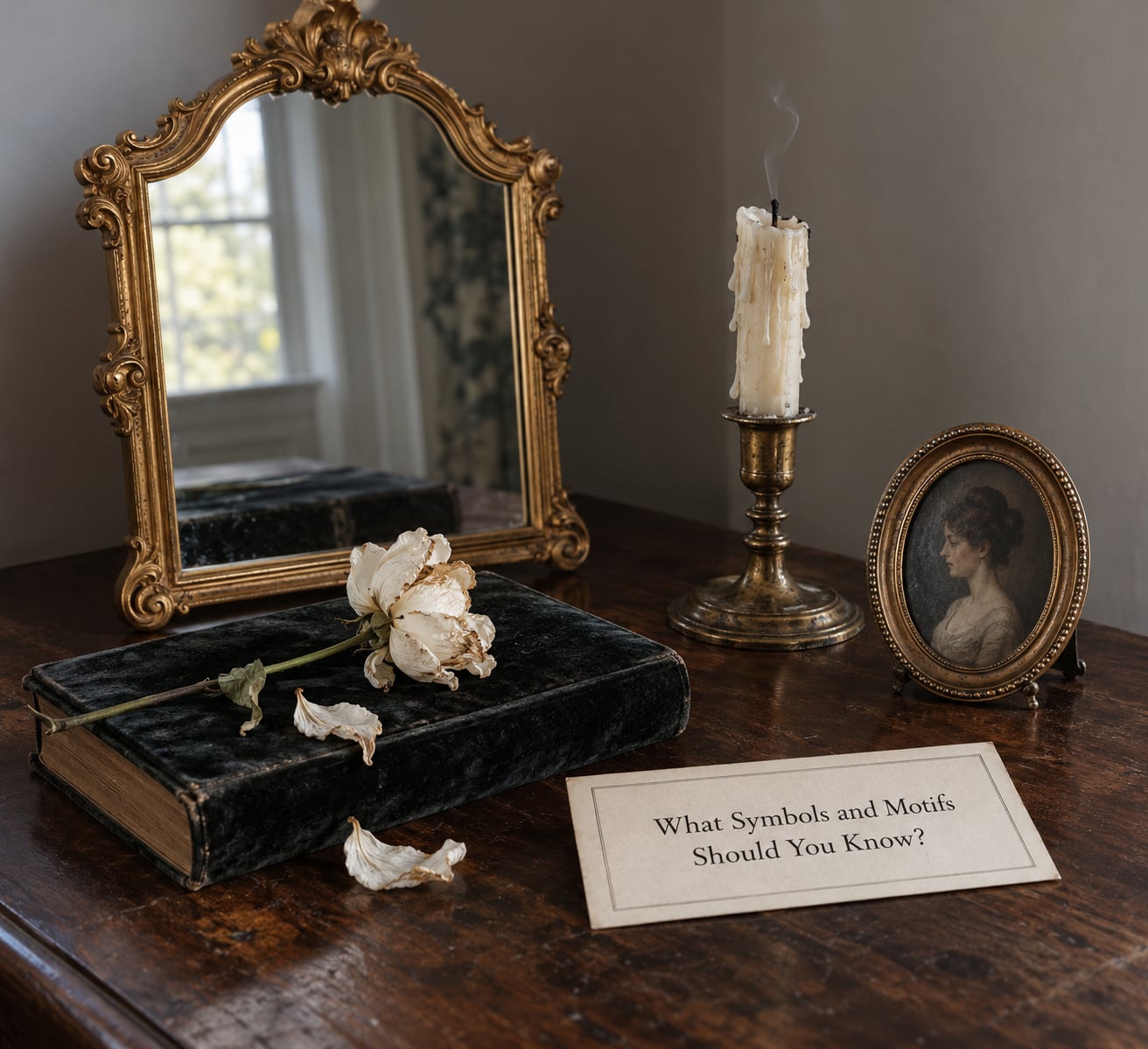
Symbols in this novel repeat with the insistence of a leitmotif. Here are the ones that pay off when you write about them.
- The portrait itself: an artwork, a mirror, and a conscience at once. It is beautiful, it is the only honest thing in the book, and it is also the reason it is kept.
- Mirrors: Dorian looks in them compulsively, and the mirror is a stand-in for Henry. The moment he sees an aged man in his own face is the moment he stops recognizing himself.
- Flowers: roses for love and the arts, jasmine for secrecy and physical desire, and the withered flowers after Sibyl’s death, which are the clearest sign that something natural has died with her.
- The yellow book: a book, but really a manual, and it is Dorian’s only genuine education. It is also the object that travels from Sibyl to him, so it is where her influence lives on.
- Candles and light: candles burn down through the long nights of his corruption, and the symbolism of a body that looks fine and burns down runs through the book.
- Hands and knives: the hand is described as a symbol of real feeling, and the hand that holds the knife is the one that acts, while the face performs.
- Jewels, incense, and the senses: the catalogue of his possessions in the middle chapters is not filler. Wilde uses it to show taste replacing feeling, and it is a good example of how sensation becomes an anaesthetic.
- The unrealized hiding place: Dorian never tells anyone where the first portrait is, and the reader is left with a gap. Wilde had talked about the novel as a story told by a man who finds the picture in a locked room, but the idea is not used. The secrecy matters more than the setting.
How Does Oscar Wilde’s Writing Style Shape the Novel?
Wilde is a stylist before he is a plotter, and the style is where much of the meaning sits.
Epigrams
Lord Henry speaks in polished, quotable sentences, and the pattern makes readers want to agree with him. It is a trap that the plot then proves out. There is a risk in the style, since the book slows when Lord Henry and Dorian argue about taste in chapter 11, and the dialogue can sound like a case of a very clever man being very clever. The device works when you read it as dramatic irony rather than as wit for its own sake.
Rhetorical reversals and the pattern of the three
Wilde builds sentences that turn inside: a statement of what is expected, then the surprising consequence. The clearest one is in chapter 4, where Sibyl’s private failures are described in language so full of charm that the reader is caught approving of what should appall them. The three-part list is the structure beneath almost every good sentence in the book, and it is a rhythm you can point to in an essay.
The frame and the unreliable narrator
The novel is a story told by someone who has read about it, and that story is told by a man who liked the young beautiful version of the man rather than what he went on to do. Readers often note that the books the narrator praises are the books that describe killing, which is not an accident. The book inside the book is a smaller, uglier version of the novel you are reading.
The style complicates rather than reinforces. Wilde wrote a novel that sounds beautiful and behaves monstrously, and the sound is a warning. If a teacher asks you to write about tone, the strongest answer is that the elegance of the prose is what makes the horror possible.
How to Analyze the Novel’s Most Important Scenes
Six scenes carry the argument. For each, here is what happens and the questions worth asking of it.
1. The wish in the studio
Dorian says that the portrait should be finished because it is a work of art and must live, and that he is not a work of art. Notice that the wish is not a deal offered to him and that he prays, which makes it a sin rather than a contract.
Ask yourself: who is being punished, the artist or the model? What does the word art mean in this sentence, and is it the same word Henry uses?
2. Dorian and Sibyl at the theatre
He tells her she is less beautiful in real life than on stage, and she says he has no heart. This is the first time his beauty preference becomes a cruelty.
Ask: is he being honest or performing cruelty, and is the scene the novel telling us or showing us?
3. Lord Henry’s influence
The long speech after Sibyl’s death, on the two sides of the soul and the value of being misunderstood, is the engine of the second half. It is also the most quotable thing in the book.
Ask: is Henry giving permission or giving instructions, and how much of Dorian’s cruelty would exist without this conversation?
4. The death of Sibyl
She takes laudanum and acid on the same night he is cruel to her, and the book is clear that the cruelty comes first.
Ask: why does Wilde delay her death for years, and what does the delay do to the reader’s trust in the narrator?
5. The abandonment of the first portrait
He destroys it in a fit, then praises the second one and asks for another sitting from Basil. This is the clearest evidence that the corruption is a habit rather than a lapse.
Ask: if he is horrified by the portrait, what does that say about what he now thinks a person is?
6. The final bedroom confrontation
He destroys the second portrait, the painter dies, and Henry is handed a yellow paper he cannot bear to look at. The last line of the novel is the eye crying for blood.
Ask: who is the victim in that last line, and why will Wilde not let Henry read it? Compare the two endings: is the second destruction redemption or panic?
Why Does Dorian Keep the Portrait Hidden?
The first portrait is hidden, and the reason is practical before it is symbolic. If anyone saw it, they would see a monster where a beautiful young man is standing in a drawing room, and the entire life Dorian has built would collapse. The secret is the mechanism of his protection.
Then there is attachment, which is the more interesting reason. He is dependent on the picture. It is proof that his beauty is real and that his youth has been secured, and the yellow book’s warnings mean that he cannot risk losing the one thing keeping him safe. Secrecy and self-interest turn out to be the same instinct.
Symbolically, the hiding place marks the collapse of his private and public identities. In public he is charming, harmless, and loved. In private he is carrying a horror in the attic, and nobody in the story is allowed to know. That split is the whole argument of the novel, and the moment he is found out, the book ends. A character whose identity depends on hiding cannot survive exposure, and Dorian dies at the moment he is seen.
How Does the Novel End, and What Does It Mean?
Dorian wakes to knock at his locked door, tells the servant the master is ill, and hears his own name spoken by Lord Henry outside. He realizes James Vane is in the house with the second portrait and that he will be found out. He does not repent. He pulls out the knife he used on Basil, tells himself he is destroying an evil influence, and destroys the second portrait instead.
Basil Hallward screams and falls dead. The servants come up. Lord Henry arrives for the portrait, and the servants give him a folded piece of yellow paper. He cannot look at it, because the eye of the victim cries for blood. The boots on the cobblestones stop, and the novel ends with Henry saying that they will never know who killed him.
There are four readings, and any of them works if you support it from the text. First, the destruction of the portrait is release: the soul goes back into the body and the body finally dies. Second, the ending is deliberately unsatisfying and the destruction is panic, so the moral of the story is that knowing is not enough. Third, the ending is a punishment rather than a redemption, since the soul is never shown to be saved. Fourth, the story is about Lord Henry, and the tragedy is that he never turned the paper over.
For essays, the ending is where the warning becomes explicit. Dorian dies with the same face he had at twenty, which is the most literal statement in the book that appearance and character have come apart and cannot be reunited. And Henry’s line, that they will never know who killed him, suggests that the truth about a beautiful life is always hidden from the people who admired it. Critics who read the ending as a critique of respectability are using the same facts: the scandal is the portrait, not the murder.
How to Write a Strong Essay About The Picture of Dorian Gray
Start with a thesis that makes a claim, not a summary. “The novel explores the conflict between beauty and morality” is a topic, not a thesis.
A model thesis and how to build one
A workable thesis: Wilde uses the portrait to make visible what a society trained on appearances refuses to see, so the supernatural device is really a social instrument, and the novel’s real corruption is the corruption of the audience, not only of the painter’s model. That is arguable, and you can prove it with the review scene in chapter 11 and the final scene with Henry.
Evidence and quotation handling
Take two or three short quotations, no more, and put them inside your own sentence rather than in a separate block. Never quote the first line of the novel as your opening move; begin with a claim and then bring the quote in as proof. Page numbers vary by edition, so cite by chapter and give the publisher’s edition in your bibliography.
Mapping prompts to arguments
- Beauty and morality: the wish, the second portrait, and chapter 10, where Dorian admits beauty is truth.
- Identity and performance: the mirror scenes, Lord Henry’s advice, and Dorian’s line about the stab of the knife.
- Free will and the bargain: the prayer in the studio, and the fact that nobody compels him to destroy the second portrait.
- Class and respectability: Dorian’s marriage, the society gossip, and the fact that no one investigates his private life.
- The portrait as a conscience: its appearance after the wish, and Henry’s refusal to look at the last image.
Topic sentences that carry weight
Write topic sentences that claim something about the evidence that follows, using language like the fact that, what makes this moment decisive is, and the argument breaks down here because. Then close your essay on the ending, since the last line is the most compressed piece of evidence in the book and examiners reward an argument that arrives there.
What Is a Useful Study Plan for the Novel?
A plan that works for most people takes three passes, not one.
Before and during the first pass
Read straight through without notes for chapters 1 to 6. The voice is deliberately light here, and readers who fight it lose the tonal shift. Then start a second reading with a single rule: write down one sentence for each chapter about who wants what. That single column is enough to build a plot diagram, and it is what the middle chapters lack for most readers.
The second pass: characters and themes
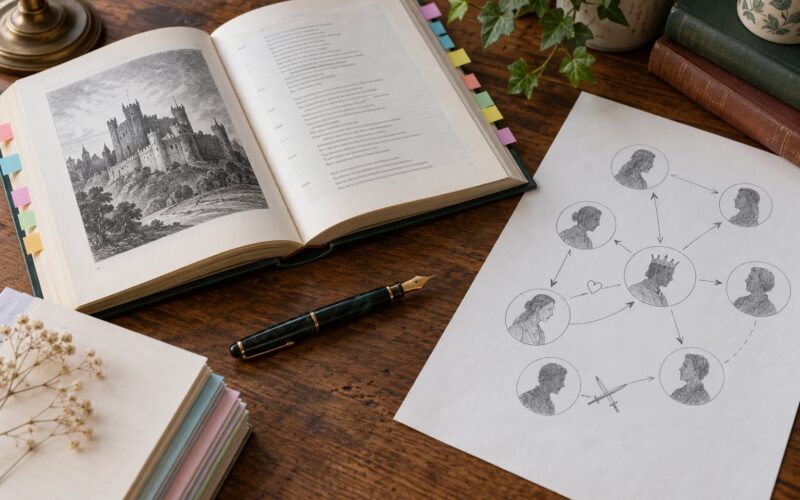
Fill in a character map with the table from earlier as your skeleton, then add edges. The edges that matter are Dorian and Henry as influence, Dorian and Basil as love, Dorian and Sibyl as damage, and Dorian and James as revenge. For themes, keep a two-column sheet: the chapter on the left, the appearance and reality contrast on the right. Fill it in as you read, and the middle chapters stop feeling like filler because you are recording the slow accumulation.
The third pass: analysis and timed practice
Pick three scenes and do a close reading of each using the questions above. Then write a timed answer to one study question, and check it against the evidence in the book rather than against your memory of it. Practising with the text open is the habit that carries over to the exam hall.
Help for the parts that slow people down
If the middle chapters drag, read them for the catalogue of pleasures, since that list is the point: taste has replaced feeling. If the language feels old, keep a short word list for archaic terms and proper names, because the names are the real obstacle. Half the difficulty readers report is the number of people to hold in mind, not the sentences. If you lose the thread of who is related to whom, use the character table before you read on rather than after.
If you are reading with a group, the slowest chapters make the best discussion because everyone has a different memory of them. Ask what Dorian was doing in that month, and you will find the disagreement is about the point of the chapter rather than the facts.
Frequently Asked Questions
Is The Picture of Dorian Gray based on a true story?
No. Oscar Wilde invented the story, though the world around it is real. He set it in the London he knew as a successful young man, and drew on his friendship with the artist Basil Hallward and on the fashionable men he spent time with. The novel also carries real scandal: it was attacked when it appeared in Lippincott’s Monthly Magazine in 1890, and Wilde was convicted of gross indecency in 1895, two years after the book edition appeared.
How does the portrait change, and is Dorian physically aging?
No. Dorian does not age in the ordinary sense, and that is the whole point of the bargain. The painting records him instead: it gains lines, blotches, and a ruined expression while his face stays as it was at twenty. As the novel goes on, the changes stop being cosmetic. The marks become bruises, the eyes go from blue to red, and by the final chapters the picture is a swollen, foul-smelling thing while Dorian remains untouched. Only at the end, when the second portrait is destroyed, does the body finally give out.
What is the significance of the yellow book Dorian reads?
It is a single volume that Sibyl asked him to read, and she called it poison. It is widely read as Joris-Karl Huysmans’s A Rebours, a novel about a man who retreats into art and sensation. For Dorian it works as a manual: he reads it after her death and begins living out its pages. He keeps it for years, drops it on the floor at a party and picks it up again, and at the very end a yellow paper from it is what Lord Henry is handed instead of a portrait. It also gives you a clean essay topic about art as a drug.
Why does Dorian call Sibyl a heroine after her death?
He is being dramatic and self-pitying rather than generous. Immediately after he tells her she is wasting her talent, and after that single cruel line she takes her own life, he goes to the theatre and asks whether the great tragedienne of the century has passed away young. He has already chosen how the story will go in his head, and in it he is the young man who loved a great artist. The callousness of that phrasing is one of the best pieces of evidence for essays on his self-deception.
How can I use a The Picture of Dorian Gray study guide without spoiling major scenes?
Read the summaries in chapter order, not all at once, and keep them a few chapters ahead of where you are. Stop before each summary if you want to make your own notes first, then compare. This guide is arranged the same way: the plot section gives you the frame in stages, the scene section waits until you have read the chapter, and the character table is safe to use at any point. If your assignment has a no-spoiler rule, check the header of each section before you scroll.
Conclusion: Begin with the Central Contrast
If you take one thing from this guide, take the contrast at the heart of the book: Dorian’s face stays young while his character rots, and the whole novel exists to make that gap visible. Start there, then use the character table, the symbol list, and the six scenes to prove it. Dorian’s choices, not the painting, are the subject of the book, and any essay that keeps that distinction clear will hold up.