Frankenstein is a 1818 Gothic novel by Mary Shelley about Victor Frankenstein, a scientist who builds a living creature, then runs from it and is destroyed by the consequences. This frankenstein study guide for students gives you the plot, the characters, the themes, chapter help, quotations and study questions in one place, so you can prepare for class or start an essay without hunting across a dozen websites.
One habit to build early: Victor Frankenstein is the scientist, and the Creature (often called the monster) is the being he made. Students who mix those two up lose marks in almost every assignment, so keep the names straight from page one.
The prose is harder than the story deserves at first. Volume I, Chapters 1 and 2 in particular slow many first-time readers down, mostly because of the sentence structure rather than the vocabulary. Read the story first without worrying about elegance, then go back for the language once you know what happens.
Table of Contents
- Frankenstein Study Guide for Students at a Glance
- How to use this Frankenstein study guide for students
- What Is Frankenstein About?
- Frankenstein Plot Summary and Chapter Analysis
- How the story is told: three narrators, one frame
- The whole plot in brief
- Walton’s letters, then Volume I, Chapters 1 to 7
- Volume II, Chapters 1 to 5, and the Creature’s first story
- Volume III, Chapters 1 to 7, and the final confrontation
- 1818 or 1831: which edition to read
- Frankenstein Characters and Their Relationships
- Major Themes, Motifs, and Symbols in Frankenstein
- The eight themes to memorise
- The motifs that keep repeating
- Theme, motif, symbol: how to use the words correctly
- How to Write a Frankenstein Analysis Essay
- Frankenstein Study Questions and Learning Activities
- Comprehension questions for the first half
- Analysis questions for the second half
- Essay and exam-style prompts
- Four activities that speed up revision
- Frequently Asked Questions
- What is the main lesson of Frankenstein?
- Is Frankenstein a science fiction novel?
- Who is the monster in Mary Shelley’s Frankenstein?
- How does the frame narrative work in Frankenstein?
- What are the most important themes in Frankenstein?
- How do I start a Frankenstein analysis essay?
- Conclusion
Frankenstein Study Guide for Students at a Glance

| Full title | Frankenstein; or, The Modern Prometheus |
|---|---|
| Author | Mary Wollstonecraft Shelley (published anonymously in 1818, named on the title page from 1831) |
| Genre | Gothic novel, Romantic literature, and widely treated as the first science fiction novel |
| First published | 1 January 1818, published anonymously; revised edition 1831 |
| Length | About 75,000 words across 24 chapters in three volumes, plus the frame letters |
| Time setting | Late 18th century, roughly the 1770s to the early 1800s |
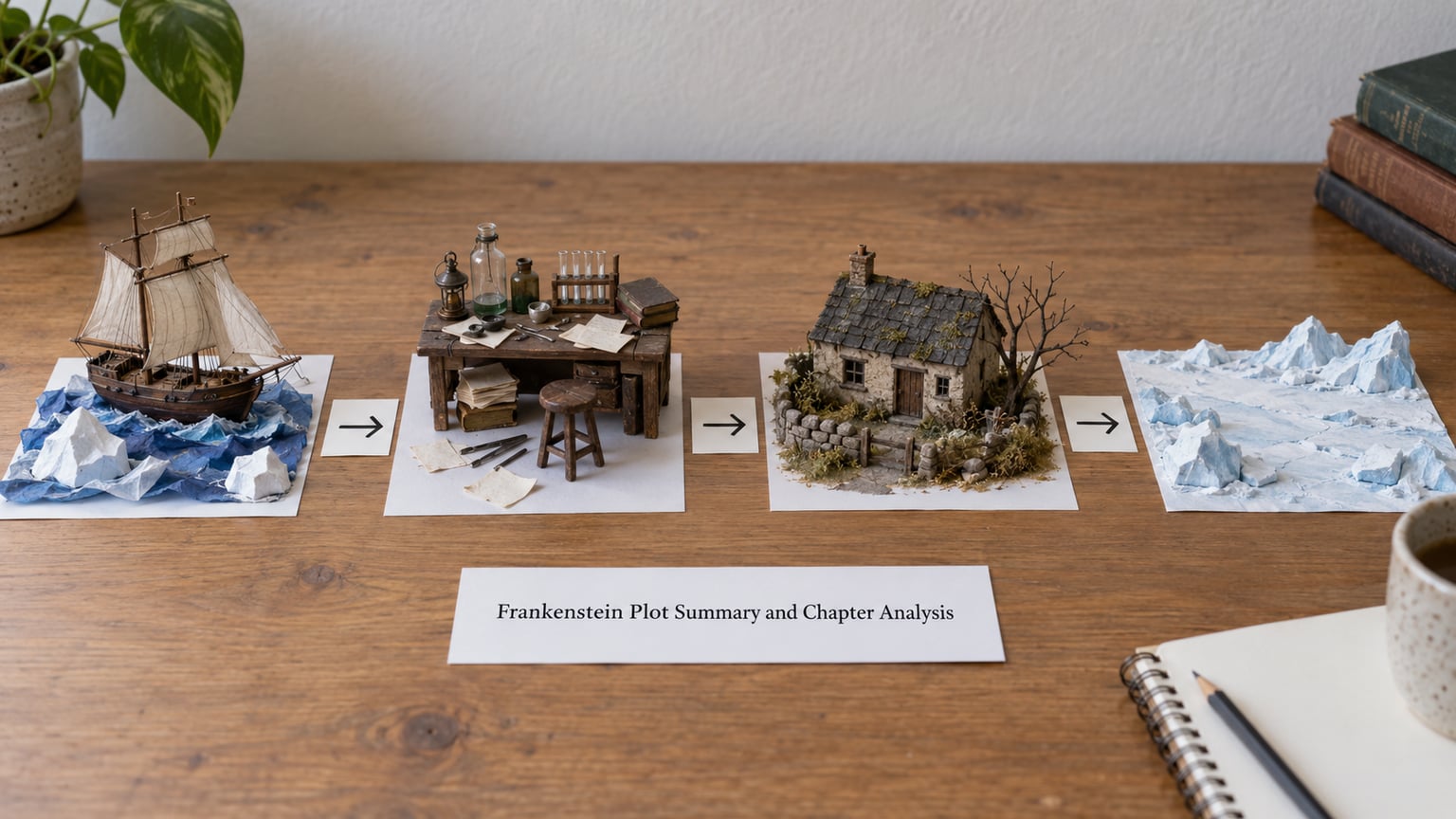
| Place setting | Geneva, Ingolstadt, the Alps, the De Lacey cottage near Ingolstadt, and the Arctic ice near the North Pole |
| Structure | Nested frame narrative: Robert Walton’s letters contain Victor’s account, which contains the Creature’s account |
| Common reading level | Usually assigned in grades 9 to 12, AP Literature, GCSE, and A-level courses |
Add those facts to the front of any notes you keep. Examiners like short factual questions, and the table above covers most of what gets asked.
How to use this Frankenstein study guide for students
Read the plot section once through before you start, so the shape of the story is familiar. Then work chapter by chapter: read the novel’s chapter, check what happened, and note the one thing you did not understand.
Keep a separate page for quotations. Write the line, the volume and chapter, and one sentence about why it matters. That page becomes your essay bank later.
If you are studying for an exam rather than reading for pleasure, do the study questions at the end out loud or in writing before you look at the answers. Getting something wrong first is what makes the correction stick.
What Is Frankenstein About?
Frankenstein is about a man who takes on more than he can control, refuses to be responsible for what he made, and spends the rest of his life paying for it. Victor Frankenstein assembles a living being from assembled parts, brings it to life, is horrified by how it looks, and flees. The being he abandons is intelligent, learns language, reads, and wants affection, and every human who meets him either runs away or attacks him. The novel follows what happens when that gap between a creator’s intentions and a creation’s needs goes unanswered.
Three narrators carry that story, which is why first-time readers often feel lost. Robert Walton, an Arctic explorer sailing alone, writes letters to his sister back in England. Victor Frankenstein tells Walton his life story out loud. Inside Victor’s story, the Creature narrates its own history in the longest section of the novel. The story you finish is Walton’s, and that distance matters.
The novel is still read because it asks questions that have not gone away. Who is responsible when a project goes wrong? What happens to a mind denied human contact? Is it cruelty to create something and then walk away? Those are the questions Shelley put in front of readers two centuries ago, and the awkward, contradictory answer is part of the point. The novel has no villain who explains everything at the end.
A quick note on the science. There is no working method for what Victor does, and Shelley never claims there is. The novel is interested in the ethics of the pursuit, not in how to build anything. Classroom arguments still turn on whether the creature is the real monster or the story of a man who was never loved, and that argument is worth joining.
Frankenstein Plot Summary and Chapter Analysis
How the story is told: three narrators, one frame
Robert Walton is writing letters to Mrs. Sawyer, his sister, and he adds a journal as he goes. His letters are the outermost layer, and the reader is at one remove from everything. Victor’s story is told inside those letters, and the Creature’s story is told inside Victor’s. When Walton is at the end of the novel, he is holding a story he was told by a dying man, which changes what his judgement is worth.
Ask yourself one question at every chapter break: who is speaking, and to whom? That single habit solves the confusion that makes the novel feel complicated.
The whole plot in brief
Victor Frankenstein grows up in Geneva, fascinated by science, and goes to Ingolstadt to study. There he assembles a being roughly eight feet tall and brings it to life. Horrified, he leaves it in the room, walks the city at night, and collapses. Henry Clerval nurses him back to health. The creature, meanwhile, leaves Victor’s apartment, wanders toward Ingolstadt, and finds a family of immigrants living by firelight in a cottage: the blind father De Lacey, his son, and their boarder, Safie.
The creature watches them for months, learns the family routine, and begins to long to join them. When he approaches them, they drive him away. He then finds Victor, who is now in the mountains above Chamounix, and demands a companion. Victor, terrified and irritated, destroys the second being he promised. The creature vows revenge against Victor and everything Victor loves. Henry Clerval is killed on the road to Geneva and framed, because Victor’s clothes are found on the body. Justine Moritz is executed for a murder the creature committed, and Elizabeth Lavenza is killed on the night of Victor’s wedding.
Victor chases the creature north to the Arctic. Walton rescues him from the ice. The creature comes to Victor’s bed, explains his own history, and then kills him. The creature vows to end his own suffering, and Walton sees him leave over the ice toward the Inuit. Walton returns to England, and the novel ends.
Walton’s letters, then Volume I, Chapters 1 to 7
Walton’s first letters introduce a man who wants companionship as much as discovery. He is friendless at sea, and this is the first appearance of the novel’s central problem in a different costume.
Volume I, Chapter 1 is Victor’s account of Geneva: his father Alphonse’s approval, his mother’s death, his bond with Elizabeth Lavenza, and his friendship with Henry Clerval, who is the son of a man Victor’s family had wronged. Look for the way Victor links science to God from the start, in the claim that a chemist is “a sage” who could “immortalise” his work.
Chapters 2 and 3 are the ones students stall on. They cover the move to Ingolstadt, Krempe’s lectures on obsolete alchemy, Waldman’s sympathetic approach, and Victor’s abandonment of his family to work alone. The 1831 edition adds more of this stretch, which is one reason it reads slower for beginners.
Chapters 4 and 5 show the work itself: collecting body parts, the repeated animation attempts, and the moment of success. Read for the gap between Victor’s joy and his immediate horror. That reversal is the novel in miniature.
Chapters 6 and 7 cover the collapse, Clerval’s care, Victor’s return home in a delirium, and his father’s death. Chapter 7 ends with William, Elizabeth, and Justine taking the news badly, which sets up the trial in Volume II.
Volume II, Chapters 1 to 5, and the Creature’s first story
Justine’s trial in Chapter 1 is the most painful early scene. She does not know the dead man, but she is the family servant and has no real way to prove where she was. Victor knows who the murderer is and says nothing, because speaking would expose his own story. The trial shows how his secrecy already harms innocent people before the creature ever touches anyone.
Chapter 2 moves Victor to Ingolstadt, where Clerval is working. Chapter 3 is where the creature takes over, and it is the pivot of the whole novel. The Creature describes watching the De Lacey family without being seen, learning to talk from their mouths, and looking for books in the schoolroom.
What the creature learns from those books is a favourite exam question. It finds Volney’s Ruins of Empires, which attacks religion and government and argues that unhappiness comes from society rather than individuals. It finds Plutarch’s Lives, which teaches that public virtue outranks private safety. It then finds Milton’s Paradise Lost and identifies with Satan, the fallen being who rebels and suffers. The creature writes: “I was ambitious. It was a vice which I shared with Satan.”
That reading changes the creature. It decides it deserves a place among humans, approaches the family, and is driven off. In Chapters 4 and 5 the creature threatens Felix De Lacey, tricks him into continuing to describe a portrait of a beautiful woman, and Felix, in a fit of rage, abandons him. The creature vows never to be benevolent again.
Volume III, Chapters 1 to 7, and the final confrontation
Chapter 1 opens on the mountain above Chamounix, where Victor has retreated in despair. The creature tracks him down and demands what he promised: a female companion. He then tells Victor the entire history of his rejection.
Victor agrees, swayed by pity, and builds the second being. The moment he finishes, he realises what he has made. He tears it to pieces in front of the creature, and Frankenstein takes a second life from his own creation.
From here the novel moves fast. The creature vows to destroy everything Victor loves. Henry Clerval is killed on the way back to Geneva and is framed, since Victor’s clothes are found on the body. Elizabeth is killed at the family’s home on the same night, and Victor finds her dying in his room. Justine is executed for the crime.
Victor leaves to pursue the creature across Europe and into the Arctic. Walton, wrecked and icebound, finds him weakened and takes him aboard. Walton’s crew start to mutiny. In the final chapter the creature visits Victor’s bed and finishes the story from his own side, and Walton adds a closing entry before sailing home to England.
1818 or 1831: which edition to read
Read whatever edition your teacher assigned, and know that the differences are real, not imagined. The 1831 version is longer, more clearly explained, and shaped by thirteen years of reflection and by the deaths of Shelley’s parents, husband, and children. Some teachers set one and expect the other to be discussed.
| Feature | 1818 edition | 1831 edition |
|---|---|---|
| Title page | Published anonymously | Author named on the title page |
| Volume II | Four chapters, which are famously confusing for modern readers | Split into five chapters, with a clearer structure |
| Frame | Walton’s letters begin abruptly and are partly withheld | A longer, revised opening that explains Walton’s situation and motive |
| Wording | Rougher, with some awkward or archaic phrasing | Revised and softened throughout |
| Tone | More sardonic and quick | More reflective, mourning, and personal |
Ask a teacher or a librarian which edition your class uses before buying one, and check whether the chapter numbers in your set match the ones quoted here.
Frankenstein Characters and Their Relationships
Five characters carry almost all of the meaning: Victor Frankenstein, the Creature, Robert Walton, Henry Clerval, and Elizabeth Lavenza. Everyone else exists to sharpen the pressure on those five.
| Character | Role | Key chapters | Why they matter |
|---|---|---|---|
| Victor Frankenstein | Scientist and creator | Vol. I, Ch. 2 to 7; Vol. III | His ambition and his refusal of responsibility drive the plot |
| The Creature | Victor’s creation | Vol. II, Ch. 3 to 5; Vol. III, Ch. 1 | The most eloquent voice in the novel, and its most damaged one |
| Robert Walton | Arctic explorer, framing narrator | Opening letters; Vol. III, Ch. 4 to 7 | Makes ambition visible from outside and gives the story its moral distance |
| Henry Clerval | Victor’s closest friend | Vol. I, Ch. 1, 6, 7; Vol. II, Ch. 2; Vol. III, Ch. 4, 5 | His death is the clearest measure of what Victor’s secrecy costs |
| Elizabeth Lavenza | Victor’s adopted sister, later fiancee | Vol. I, Ch. 1, 4; Vol. III, Ch. 6 | Represents the family Victor chose over science and then lost |
| Alphonse Frankenstein | Victor’s father | Vol. I, Ch. 1, 3, 7 | His trust in Victor shows what Victor has been given, not earned |
| Justine Moritz | Family servant, executed | Vol. II, Ch. 1; Vol. III, Ch. 7 | The first innocent destroyed by Victor’s silence |
| De Lacey family | Father, son, and boarder Safie in a cottage | Vol. II, Ch. 3 to 5 | Show the kind of home the creature longs for and is denied |
| Krempe and Waldman | Professors at Ingolstadt | Vol. I, Ch. 3 | They show how easily Victor mistakes admiration for knowledge |
Victor Frankenstein is a brilliant student who is bored by ordinary teaching. He is not a villain in the way a villain works: he loves Elizabeth and Clerval, he means no harm to his father, and he is capable of grief. What he will not do is take responsibility for an outcome he cannot control, and that single refusal explains the deaths of everyone around him.
The Creature is the novel’s most interesting argument. It is described in hideous physical detail at the start, which is deliberate, because the reader meets it as Victor does. Everything after that is the novel arguing with that first impression. The creature learns language, reads philosophy, wants to help the De Lacey family, and kills Elizabeth on the night of Victor’s wedding. Both of those are true, and the refusal to resolve them is the point.
Robert Walton is the outsider with the strongest claim to judgement. He admires Victor, saves him, and ends up trusting a man who has lied about almost everything. When his own crew turn against him, the reader is left wondering whether Victor’s story is the warning, or whether Walton is about to repeat it.
Elizabeth Lavenza, Henry Clerval, and Alphonse Frankenstein exist as contrast. They are the ordinary human warmth that Victor trades away, and their deaths are written quickly, which makes the cruelty land harder. The death of Clerval, framed with Victor’s own clothes, is the moment the reader stops forgiving Victor.
Justine Moritz and the De Lacey family both test the same question: who gets treated as human, and on what basis? The De Laceys at least try. Justine is condemned because she is a servant with no version of the truth worth hearing.
Major Themes, Motifs, and Symbols in Frankenstein
Shelley’s themes are about responsibility rather than about science being bad. The novel’s argument is that the wrong lies in abandoning others to the consequences of your own choices, not in the pursuit itself. If you can hold onto that distinction, most of the theme questions become easier.
The eight themes to memorise
1. Unchecked ambition. Victor wants to be a name that outlives him and pursues it past the point where anyone could help him. His own summary of the result is: “I had desired it with an ardour that far exceeded moderation.”
2. The consequences of isolation. Almost every disaster in the novel comes from a character being alone. Victor works alone, the creature observes alone, and Walton sails alone.
3. Creator’s responsibility. Shelley insists that making something means owing it care. Victor abandons his creation at the moment of success, which is the novel’s central failure.
4. Rejection and revenge. Every time the creature is refused, it becomes less human. The refusals of De Lacey and of Victor’s family, then of Victor himself, build the murder plot step by step.
5. Appearance versus inner worth. The creature is called monstrous because of what it looks like, and it argues that it has the same feelings as everyone else. Novels of this period often ask who gets to define normality.
6. Forbidden knowledge. The alchemical texts Victor throws into the fire when he rejects Krempe are not just discarded books. He chooses certainty over exploration, and pays for it.
7. Nature versus science. Shelley’s nature is not decorative. The mountains, the glaciers, the storms, and the clear pool at Chamounix show a world that does not need human ambition to be impressive.
8. The nature of goodness. The novel refuses to sort people into good and bad. The creature can be generous and murderous, and Victor can be loving and cruel, and the ending does not tidy that up.
The motifs that keep repeating
Fire and light. Fire is how knowledge is transferred, and it is also what the creature burns when he leaves the De Lacey cottage, an act of destruction that costs him his last chance at belonging. Lightning works the same way, striking Victor’s laboratory and, at the end, illuminating Walton’s ship as Victor’s story finishes.
Darkness and sight. The creature has functional sight but is described as unable to see well, and it learns through touch, sound, and listening. Watching the De Laceys, it is close to them and invisible, which is exactly the position it will hold over Victor.
Ice and the Arctic. The story ends on the frozen ocean, far from the warmth of the family home Victor abandoned. The setting inverts the firelit cottage, so the last image of the creature is cold and solitary.
Chains and fetters. The creature finds chains and armour in a ruined barn, and the novel’s title image of a bound Prometheus runs underneath all of it. Shelley subtitled the book The Modern Prometheus, who stole fire and was punished for it, and Victor is a version of that figure.
The natural world and the Sublime. The Alps, Mont Blanc, and the polar ice are Romantics’ Sublime: scale that overwhelms a person and makes them feel small. Victor is not so much rebellious as dwarfed, and that is a different kind of tragedy.
Milton’s Paradise Lost. The creature reads the poem and recognises the resemblance: a being created and then cast out by its maker, reading a story about a fall. The connection is explicit, so a comparison with Satan is easy to justify in an essay as long as you note that the creature also resembles Adam, learning to live and to labour.
Theme, motif, symbol: how to use the words correctly
A theme is an idea the novel explores, written as a statement about people or the world: “abandonment creates its own damage.” A motif is a recurring detail that builds that idea: the fires, the ice, the thresholds. A symbol is one specific thing standing for a larger meaning: the pomegranate seed Clerval brings from Malta stands for connection, because it is food shared and later refused.
If a student uses the three words interchangeably, marks drop. Getting the terms right is cheap and it makes an essay sound precise.
How to Write a Frankenstein Analysis Essay
The most common mistake is writing about the whole novel instead of one thing. A workable claim names a pattern, points at a text, and says why it matters. A simple formula helps: “Shelley uses [detail] to suggest that [idea], which matters because [consequence].”
Try: “Through Victor’s account of the cottage fire, Shelley suggests that the Creature’s cruelty grows directly out of being denied, which makes the novel’s central tragedy a result of rejection rather than of nature.”
Build each paragraph in five steps. Quote something short and specific. Explain the words around it rather than the words themselves. Connect it to a named theme. Link it to a character choice. End with a sentence about why this matters to the novel as a whole.
A worked paragraph on Victor and the creature can sound like this. When Victor destroys the second being, the narrator describes his inner revolt in one line: “I had turned loose into the world a depraved wretch, whose delight was in carnage and misery.” The word depraved is the catch. Before this moment Victor has never used that language about anyone, including himself, so the shift shows him accepting that the same blind impulse drove both lives. Connect it to creator’s responsibility, and you have a paragraph that argues rather than summarises.
Pick a quotation you can explain without the book open. If you cannot say in two sentences what the surrounding sentences are doing, choose a different line. For exam format, check the mark scheme first: AP Literature rewards sustained argument, while GCSE and A-level papers often reward a clear point, embedded reference, and an explanation.
Frankenstein Study Questions and Learning Activities
Comprehension questions for the first half
1. Why does Walton describe himself as lacking a friend, and how does that shape the novel’s frame?
2. What does Victor’s decision to reject Krempe in favour of Waldman’s chemistry tell you about him? He accepts praise and certainty over instruction, which is the first sign that he prefers admiration to learning.
3. Why does Victor run out into the streets of Ingolstadt after animating the creature? The joy of creation and the horror of appearance arrive at the same moment, and he can hold neither.
4. What happens in Justine’s trial, and why does Victor stay silent? Silence protects his own reputation and leaves an innocent woman condemned, which shows his self-preservation at work before he has lost anything.
5. Is Dr. Frankenstein a good student? He is an exceptional one who mistook being praised for being taught, so the answer separates ability from judgement.
Analysis questions for the second half
6. How does the Paradise Lost episode change the Creature’s plans, and how did it learn to read? Volney and Plutarch teach it that society causes unhappiness and that virtue may demand sacrifice, and Milton gives it a language for its own rebellion.
7. Why does the creature choose revenge after the De Laceys drive it away? It has evidence that a family can exist and it has just been excluded from one, so violence becomes the only leverage it believes it has.
8. Is Victor the real monster in the novel? A strong answer weighs the deaths he causes against the fact that he feels grief, and argues that the novel’s title attaches the word to the one who refused responsibility.
9. What is the symbolism of fire in the novel? Fire carries the transmission of knowledge, the cottage fire destroys the creature’s chance at a home, and lightning ends Victor’s work, so the motif links knowledge with destruction rather than with progress.
10. How does the novel end? Victor dies aboard Walton’s ship, the creature vows to end his own suffering, and Walton returns to England, so the story closes on loss rather than resolution.
11. Is there LGBTQ content in Frankenstein? Shelley does not write explicit romantic relationships, but critics have argued that Victor’s refusal of fixed identity, the bond between Walton and Victor, and the creature’s longing for connection support a queer reading, and it is a defensible essay angle when argued from specific passages.
12. Is Frankenstein a metaphor for autism? Some readers see Victor’s intensity, his social isolation, and his rejection for difference, but Shelley offers no such framework and many scholars object to reading a condition as a figure for harmful conduct. Treat it as a contested interpretation rather than a fact.
Essay and exam-style prompts
13. Argue whether the novel blames Victor or the Creature for the murders. A strong response says it blames the conditions of rejection and refuses both simple answers.
14. Compare Victor Frankenstein and Robert Walton as examples of the same flaw at different scales.
15. “The novel is about empathy, not science.” Defend or attack this claim with reference to the De Lacey scenes and the trial of Justine.
16. How does the frame narrative change what we think of Victor? Hearing his story from a witness who believes him, then watching the creature supply the missing version, makes him less trustworthy as he talks.
17. Trace the pomegranate seed from Clerval’s arrival to Elizabeth’s death. It works as a symbol of offered connection that keeps being refused.
Four activities that speed up revision
Track the Creature’s emotions across a single page. Column one for what happens, column two for what it feels, column three for what it does next. When the third column turns violent, you have the evidence for a paragraph on rejection and revenge.
Make a two-column comparison of Victor and Walton: what each wants, who each one meets alone, how each one fails. It takes twenty minutes and it produces most of a comparative essay.
Map consequences rather than plot. Put Victor’s decisions in the left column, the deaths in the right. Justine, William, Clerval, Elizabeth, and Victor all follow from choices he made alone.
Run a gallery walk of quotations. Give groups one line each, and ask them to write the claim that line supports, then make them defend it to the room.
Swap summaries for discussion prompts when a class stalls. Questions on free will, destiny, rejection, and responsibility draw stronger responses than questions that ask what happens next.
Frequently Asked Questions
What is the main lesson of Frankenstein?
The main lesson is that ambition without responsibility destroys everyone around you. Victor Frankenstein pursues knowledge past the point of any help, then abandons what he makes, and the novel spends its length showing how that single refusal spreads outward until it kills his family and friends. The creature is not born violent; he is made hostile by rejection. This frankenstein study guide for students returns to that lesson in the theme, character, and essay sections because most exam questions circle back to it.
Is Frankenstein a science fiction novel?
It is generally credited as the first science fiction novel, though it was published in 1818, before the genre existed, and it is also a Gothic romance and a Romantic-era work of philosophical fiction. Shelley was not writing a book about machines. The scientific detail is thin on purpose; what the novel examines is the ethics of the desire to create life and the suffering that follows when a creator withdraws. Most study guides place it at the meeting point of all three genres.
Who is the monster in Mary Shelley’s Frankenstein?
The monster is the being Victor Frankenstein builds and then runs from, usually called the Creature. He is eight feet tall, grey-skinned, and unusually strong, but he is also the most articulate and reflective character in the novel. The question that confuses students is not who the monster is but whether Victor is; the novel deliberately blurs that. A good answer says both are responsible, in different ways, for the deaths.
How does the frame narrative work in Frankenstein?
Three layers of storytelling sit inside each other. Robert Walton’s letters to his sister form the outer frame, Victor tells his life story to Walton inside those letters, and the Creature tells its own history inside Victor’s account. Each narrator has a motive and a reliability, so readers hear the same events retold with different bias. The structure is what allows the novel to withhold the creature’s story until the reader has already formed a hostile opinion of it.
What are the most important themes in Frankenstein?
The most important themes are unchecked ambition, the consequences of isolation, a creator’s responsibility to what it creates, rejection and revenge, appearance versus inner worth, forbidden knowledge, nature versus science, and the nature of goodness. The first six carry the plot, and the last two explain why the novel feels unresolved. For exams, pick two and trace them through a specific quotation rather than listing all eight in the introduction.
How do I start a Frankenstein analysis essay?
Start with a pattern, not a summary. Choose one recurring moment, such as Victor’s account of the cottage fire or his refusal to speak in Justine’s trial, and write a thesis that says what Shelley does with it and why. The formula that works is: Shelley uses a specific detail to suggest an idea, which matters because of a stated consequence. Then open the body with a short quotation and explain the words around it.
Conclusion
Frankenstein is not really a story about making a monster. It is about a man who could not stand being responsible for one, and about what that refusal costs everyone who depends on him. The creature is made cruel by rejection rather than born cruel, and the novel deliberately refuses to settle the argument between them.
Start with the at-a-glance table to fix the facts, use the plot section to follow the story chapter by chapter, and turn to the theme and character sections when you need something to argue with. Then write one paragraph properly. One well-explained quotation will do more for your grade than a summary of the whole novel.