Great Expectations is Charles Dickens’s 1860-61 novel about Pip, an orphan from the Kent marshes who is told he has been left a fortune by an unknown benefactor, and whose rise through Victorian society teaches him that status and money matter less than humility and love. This great expectations study guide for students covers the plot in three stages, ten main characters, the eight expectations Pip forms, the symbols that carry the themes, and the essay and review questions teachers actually assign.
It is written for the reader who finishes a chapter and still cannot say who Magwitch is versus Compeyson, or who tells Pip about the fortune and when he finds out. Nothing here is locked behind a subscription, and every chapter number matches a standard edition, so you can check anything against the book in front of you.
Table of Contents
- Great Expectations Study Guide for Students at a Glance
- How to Use This Great Expectations Study Guide for Students
- What Is Great Expectations About?
- Plot Summary and Chapter-by-Chapter Overview
- Chapters 1-18: the convict, the village, and Satis House
- Chapters 19-39: a gentleman in London
- Chapters 40-59: the revelation, the penance, and the hand
- Which ending is the real one?
- Major Characters and Their Development
- Themes, Motifs, and Symbolism in Great Expectations
- Pip’s eight expectations
- What Estella symbolizes
- The motifs that keep repeating
- Victorian Context and the Novel’s Historical Setting
- Key Quotations and Language to Analyze
- How to Write a Great Expectations Essay
- Weak and strong thesis statements
- A paragraph frame that works
- Study Questions for Chapters and Themes
- Comprehension questions for Chapters 1-39
- Analytical questions for Chapters 40-59
- Questions that need interpretation, not recall
- Frequently Asked Questions
- How long is Great Expectations and is it hard to read?
- Why is Great Expectations considered a coming-of-age novel?
- What does the fog symbolize in Great Expectations?
- Is Estella a bad character in Great Expectations?
- What is the main message of Great Expectations?
- How should students study Great Expectations for an exam?
Great Expectations Study Guide for Students at a Glance
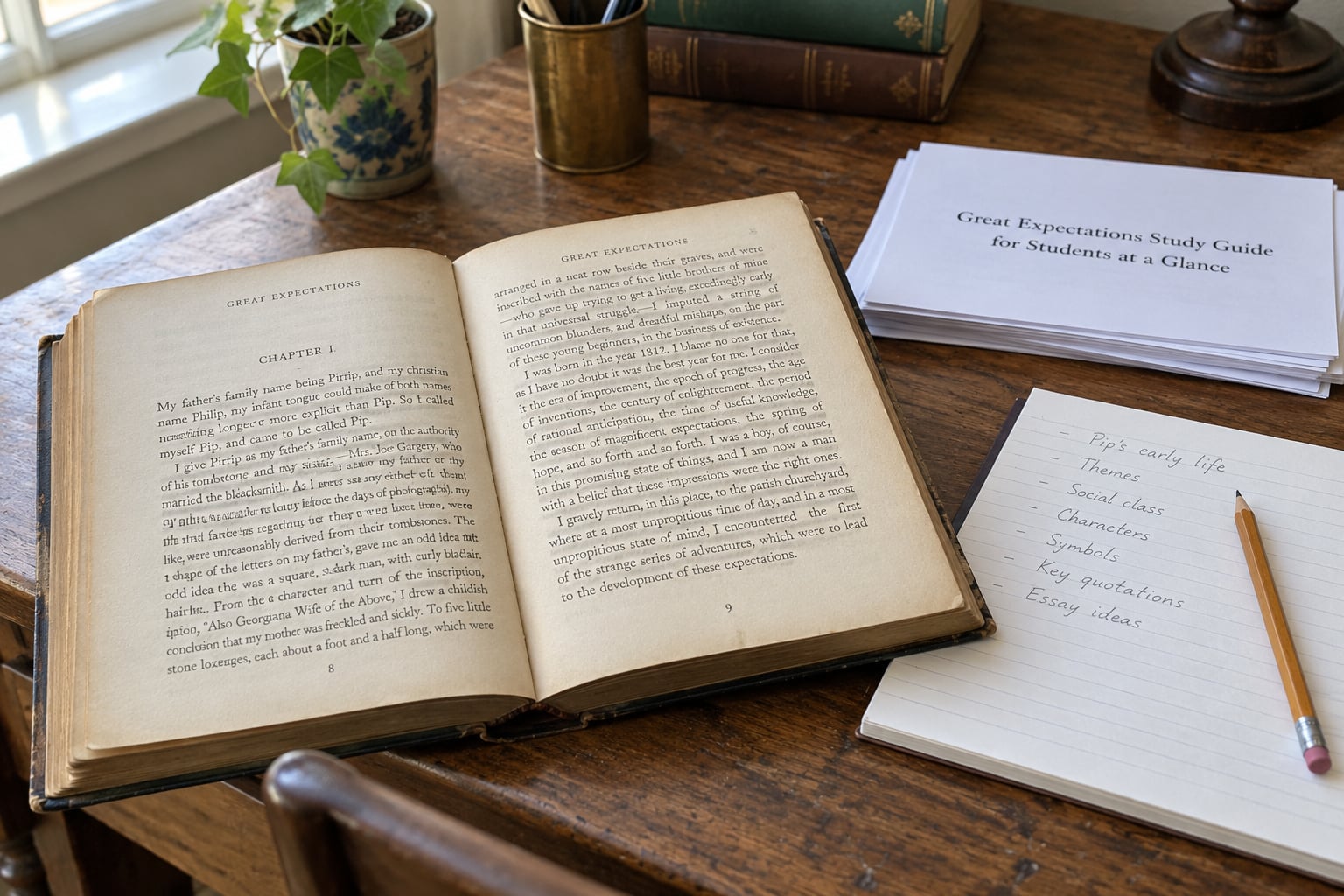
The novel is a bildungsroman, a coming-of-age story narrated by the adult Pip looking back at his childhood. The table below holds the facts that get asked about most, including reading level and how long the book takes.
| Detail | Answer |
|---|---|
| Author | Charles Dickens |
| First published | Serialized in All the Year Round, December 1860 to August 1861; book form in three volumes, July 1861 |
| Number of chapters | 59 in the standard edition |
| Narrator | Pip (Philip Pirrip), an orphaned blacksmith’s son, remembering his childhood |
| Setting | The Kent marshes and village, Satis House, and nineteenth-century London |
| Genre | Bildungsroman, coming-of-age novel, satirical novel, novel with gothic elements |
| Reading level | Roughly 1200 to 1250 on the Lexile scale, generally taught in grades 11 and 12 |
| Length | Roughly 110,000 words, about 480 to 500 pages depending on the printing |
| Time to read | About 10 to 14 hours of reading; a half-hour-a-day reader finishes in about four weeks |
How to Use This Great Expectations Study Guide for Students
Read the chapters in groups rather than one at a time. The book is built from three movements, and every mystery in it is planted early and paid off late, which is exactly why a chapter-by-chapter recap feels thin on its own.
Keep a running list of who owes whom something. Much of the confusion in this novel is bookkeeping confusion: two men are being transported together, one of them has a daughter living in London, and the same lawyer is connected to three different families.
Do not over-analyze on the first read. Readers who get stuck often report that trying to decode every sentence in the marshes kept them from enjoying the story. Read straight through, then come back for the language work with the quotations section below.
What Is Great Expectations About?
Great Expectations is a coming-of-age novel about a boy who believes he has been promoted out of his own life, and who has to lose almost everything before he learns to be content with who he is and what he already has.
Charles Dickens published it in installments in All the Year Round between December 1860 and August 1861, and it became one of his tightest and most psychologically honest books. Pip, an orphaned blacksmith’s son from the Kent marshes, is told that a benefactor has settled a fortune on him and that he is to be raised as a gentleman in London. Each expectation Pip forms is then dismantled in turn, and by the end he understands that class is a costume rather than a character and that his worth was never the money at all.
Two ideas sit under every scene. The first is that social class in Victorian England determines almost everything about a person’s options, and the second is that ambition, when it outruns self-knowledge, costs more than it wins. Everything else, the convict in the graveyard, the girl who cannot cry, the burned-down house, the linked hands in the dark, grows out of those two ideas.
The word “expectations” in the title is plural on purpose. Pip holds several at once, and they conflict: he wants to be a gentleman and wants Joe to stay his friend, wants Estella to love him and wants her to know his real name, wants his sister to be proud of him and wants his secret kept. Every time he picks one over another, the novel costs him something.
Plot Summary and Chapter-by-Chapter Overview
The plot runs in three stages: a boy on the marshes takes pity on a convict, a young man in London discovers what that pity was worth, and an adult Pip sits in a quiet house by a quiet river learning who he actually is. Here is how the chapters divide.
Chapters 1-18: the convict, the village, and Satis House
Pip, a small boy with a sickly father and a widowed mother, visits the graveyard with his sister Mrs. Joe to clean up the family headstones. A stranger breaks out of the churchyard and grabs him, asking for food. Pip steals bread and gives it to the man, who is a convict who has been transported and is held in a prison hulk. Before he disappears, the man plants the first expectation: if Pip helps him, a man who has been rich will pay him back one day.
Joe Gargery, Pip’s blacksmith uncle, runs the forge, and Biddy, a girl from the village, keeps house. Joe is proud of his trade, honest to the point of discomfort, and quietly fond of Pip. Pip, at this stage, considers him common. That snobbery is the novel’s first real moral event, and it is not resolved for a long time.
Miss Havisham, a wealthy and reclusive woman on the marshes, sends for Pip because she wants to see a child. She raises Estella, a girl about Pip’s age, and arranges their play, then drills Estella until she can say her own age and her own name. Pip declares his love for Estella almost at once, on a piece of chalk in the garden, and Estella replies that she has no heart and will not let anyone in. Miss Havisham also asks for a break in her heart, and Mrs. Joe goes to Satis House to perform the service.
While the women are away, Pip meets the convict again at the graveyard and lets him watch the weather. The man tells him to remember him and not to tell anyone. Around this time, Pip is dragged back to Satis House and told that his sister has had a violent seizure. Back at the forge, Pip tells the whole story and Joe reacts with roughly the wrong amount of alarm; it is also implied that Pip was in danger near the churchyard and nobody listened.
Meanwhile, the letters arrive. Announcements reach Joe, then Mrs. Joe, then Wemmick the clerk, then Mr. Jaggers the lawyer: Pip has been left an annuity of one hundred pounds a year by an unknown benefactor and is to come to London to be a gentleman. Mrs. Joe tells everyone in the village, and Pip leaves for London with a very clear sense of his own importance.
Chapters 19-39: a gentleman in London
In London, Pip is met by a young servant named Herbert Pocket and taken to a suite of lodgings in a house on a fashionable street. The household is run by Mr. Jaggers, the lawyer who delivered the letters, and by his housekeeper Molly, who is warm to Pip in a way that Jaggers rarely is. Wemmick, the cheerful and unnervingly literal clerk, becomes Pip’s closest London friend. Pip is also given a small allowance per week, a new suit, and a very clear instruction to spend nothing on himself.
At eighteen Pip writes home asking Joe to come to London. Joe does, and Pip is ashamed of him for standing at the servants’ door rather than the family door. He uses Joe as a servant in front of Wemmick and then snaps at him and shoves him out. Pip’s later account is honest about how much the visit costs him in self-knowledge, even though at the time he is only irritated by his uncle’s clothes.
Estella arrives and is sent to a finishing school in Essex, where she is placed under Miss Drummle, the sister of Bentley Drummle. Bentley Drummle himself is a rude and coarse young man who has been left money on the condition that he marry Estella. Pip visits Satis House again, is made ill by the heat of the unlit rooms, and hears that Estella has become beautiful and hard. Biddy comes to London to be Estella’s teacher and quietly tells Pip that Estella has learned to say a great deal with no feeling at all. Estella begins to confide to Pip that she would like to be his friend, which is about as much as she offers anyone.
Just before he is due to go back to Kent, Dr. Wopsle, Joe’s friend who has turned from medicine into the church, tells Pip that a convict who escaped from the hulks while being transported with someone else was found at a nearby house. Pip realizes the convict came home to see him. Magwitch, meanwhile, is living on stolen money, sick with scurvy and watched by a man who has traced him, so Pip keeps the man’s identity a secret from Estella and continues to receive the allowance.
Back on the marshes, Pip tells Joe about the escaped convict, which reaches Mrs. Joe, who turns it over to Jaggers. Then Miss Havisham collapses. A fire later destroys her wedding dress and hair, and Pip finds her lying on the floor, using her last strength to ask him to be saved. Magwitch, now dying, reveals himself as Pip’s benefactor and has been put on the trail by the escaped accomplice, Compeyson. Pip turns to Magwitch’s lawyer to arrange to get him away, and Drummle, who dies of fever, leaves Pip a fortune of about two thousand pounds. Pip is suddenly both financially secure and completely changed in his own eyes.
Chapters 40-59: the revelation, the penance, and the hand
The lawsuit against Compeyson happens largely offstage, and Magwitch is convicted of a lesser offence and dies in prison. Pip pays his debts with the new money, loses his fortune, and works for Herbert as a clerk. He proposes to Estella at Satis House; she tells him she has other ties and that she has always known he was common. He is devastated, starts over in a modest house, and eventually goes back to the marshes to say goodbye.
There, in a room over a shop, he finds Estella living a hard life with a small daughter. He accepts that they cannot be husband and wife. The girl is named Estella too, and the discovery undoes Pip more than the rejection did. Pip leaves, and Estella, who has never known her own mother, resolves to trace Magwitch’s daughter in the world, which turns out to mean finding herself.
Magwitch himself is buried on the marshes, by the headstones of Pip’s parents, at Joe’s arrangement. Joe recovers from the stroke that has disabled him, and Pip, the child who once called him common, cares for him until Joe dies.
Then in the revised ending, Pip and Estella walk by the river one last time, the old shop and the churchyard behind them, and say their quiet goodbyes. The book closes not with a wedding or a title but with two people who learned the same lesson from different directions, standing in the same cold light.
Which ending is the real one?
Students often ask whether the unhappy ending is the real one. Both endings are Dickens’s, and the answer matters for essays.
The serialized version ended in Chapter 59 with Pip and Estella parting for good, and Pip insisting that it was not a parting at all. Dickens had already disliked that ending, and he went back to it for the 1861 book edition, adding the final chapter in which the two Estellas meet and the story turns toward forgiveness, family, and quiet companionship.
George Bernard Shaw attacked the revised ending in his 1897 edition, calling it sentimental, and critics have argued about it ever since. Some read the added chapter as Dickens correcting a commercial mistake for readers who wanted a happy finish. Others read it as the honest ending, because Pip learns that Estella is not a prize to be earned but a person to be met halfway, and the closing gesture is the novel’s only real image of healing. If you have to argue either side in class, say which position you take and give one piece of evidence, and you will have done the assignment properly.
Major Characters and Their Development
Each main character tests the novel’s question about class and self-worth from a different angle. Pip is the one who changes, Estella is the one who barely does, and the people around them show what the world does to people who stay where they are born.
| Character | Role | Key chapters | One-line takeaway |
|---|---|---|---|
| Pip (Philip Pirrip) | Orphan, narrator, protagonist | All, especially 1, 8, 19, 34-35, 57-59 | A boy who treats status as identity and has to unlearn it |
| Estella Havisham | Raised by Miss Havisham; Pip’s love interest | 8-9, 16-19, 32-38, 40-41, 55-59 | Taught to have no feelings, and slowly learning that she can |
| Miss Havisham | Rich, reclusive woman on the marshes | 8-9, 34-36, 48-50 | A woman so rejected by one betrayal that she stopped living |
| Abel Magwitch | Convict, secretly Pip’s benefactor and father figure | 1, 5, 8, 34-35, 40-41, 54-56 | The novel’s moral centre, and the father Pip chose himself |
| Joe Gargery | Pip’s blacksmith uncle | 4-7, 25, 34-35, 54-58 | Kindness without self-interest, and the standard Pip measures himself against |
| Mrs. Joe | Pip’s sister, married to Joe | 4-7, 9, 12-16, 37-38 | Loud, controlling, and a product of the same class system she enforces |
| Mr. Jaggers | London lawyer and magistrate, connection to both households | 16, 20-26, 34-36, 40-42, 48-50 | A man of wealth whose hands and house show what his work costs |
| Biddy | Village girl, teacher, later Pip’s housekeeper | 4-7, 14-19, 37, 47, 54-56 | Steady, practical love, and the person who stays honest |
| Herbert Pocket | Pip’s friend in London, raised by an uncle who claims a connection to Miss Havisham’s family | 19, 22-26, 32-33, 39-41 | A good friend with a name he has to change before he can marry |
| Wemmick | Jaggers’s clerk | 20, 26, 34-35, 40-42 | Mildness in a cruel trade, and a man of portable rituals |
| Orlick | Joe’s apprentice | 7, 13, 15-16, 54-56 | Resentment worn quietly, and a warning about wasted lives |
| Bentley Drummle | Estella’s intended husband | 18, 32-38 | A man chosen by inheritance rather than love, and Pip’s rival in no way that matters |
| Mr. Wopsle | Joe’s friend, doctor turned clergyman | 13, 16, 18, 24, 40-41 | Self-important, decent at heart, and a comic study of pretension |
Pip begins as a small, resentful child who invents a richer identity for himself. His moral development runs through four stages: using others (Joe), admiring and trying to copy others (the Pockets, Drummle, Estella), being honest about what he has done, and finally caring for someone without any gain in return. The third stage is the hardest and it costs him Estella’s respect in a real sense, since she believes his claim to gentility for much of their friendship.
Estella is not the villain of the novel, and treating her as one is the most common misreading. Miss Havisham raises her as an experiment in breaking a child, Estella tells Pip early on that she has no heart, and she does feel warmth for him, Miss Havisham, and Jaggers, but she has never been allowed to know what to do with feeling. Her cruelty is real, and it is also training.
Miss Havisham’s whole life is a case of expectation reversed. She was left at the altar by Compeyson, responded by freezing herself into a single hour of her life, and spends it trying to hurt the man who hurt her by shaping a child into a weapon. Her request that her heart be broken, and later that Pip save her, are the only evidence that she wants out.
Magwitch is the novel’s ethical anchor and the reason the title is plural. He is a man who was denied a life by a court that gave him no fair trial, who built one anyway, and who spent it on a boy who once stole bread for him. He never asks for repayment and never asks Pip to be grateful, and he wants only to be remembered as someone rather than as a criminal record.
Joe Gargery is Pip’s first model of adult goodness and the yardstick Pip measures everyone else against. His pride is in work, not birth, which is exactly the value the fashionable world treats as naive. He is also mocked throughout, and the novel is honest about the fact that kindness without ambition often gets left behind.
Three pairs of characters get confused on almost every first reading, so keep them apart. Magwitch is the convict Pip feeds; Compeyson is the other transported man, the one with the money who abandons him. Jaggers is the working lawyer whose hands shake; Wemmick is his clerk, the one who jokes about Jack the Ripper and reads to his father’s patients. Dr. Wopsle is Joe’s friend who keeps changing his profession; Orlick is Joe’s apprentice who works quietly against everyone in the forge.
Themes, Motifs, and Symbolism in Great Expectations
Class, ambition, identity, guilt, love, and redemption are the six themes students can argue about with evidence from any chapter. The symbols below are the ones teachers point to, and each connects to a moment in the plot rather than standing alone.
Pip’s eight expectations
A common classroom list of Pip’s expectations includes eight. They are not all equal in importance, but together they account for most of his mistakes.
- To become a gentleman, and to be regarded as one by people who already are.
- That Estella will love him and marry him.
- That Estella never thought him common and never will.
- That his benefactor is Miss Havisham.
- That the convict he helped is safely dead in the hulks and cannot embarrass him.
- That Joe and his sister are his family and will stay close to him.
- That Dr. Wopsle is a distinguished man, and that his own cleverness will be rewarded.
- That his fortune is permanent and cannot be lost, refused, or given away.
Almost every plot event is one of these expectations failing. The fortune turns out to belong to a convict, the convict turns out to be alive, the money turns out to be criminal money that can be seized, and the family he was ashamed of turns out to be the family that stays.
What Estella symbolizes
Estella symbolizes the damage done when affection is treated as a lesson rather than a relationship. She is also the novel’s clearest image of class: she is raised to be displayed, and she is trained to treat her own interior life as something to be arranged for other people’s benefit.
She is not a symbol for the reader to decode and discard, though. She is a person with a bad childhood, and the closing chapters give her the ordinary work of a life and a child of her own, which is how the novel shows that a person can be damaged without being ruined.
The motifs that keep repeating
- Chains and handcuffs. The convict is stolen from and chained; Jaggers’s hand is cuffed, swollen, and burned. Justice, in this novel, leaves marks on the people who carry out its sentences, including Pip, whose own hands do the washing and the nursing later.
- Hands. Jaggers hides his, Joe’s are black with iron, Magwitch’s are rough and soft at once, and Pip and Estella are joined by linked hands in the darkness of the hulks. Cold hands mean fear or indifference; warm hands mean someone has been working or caring.
- Light and darkness. Miss Havisham lives in one room lit by one candle, and her match burns out at the end. Magwitch is associated with the light of a solitary garden lamp. Light is what people share and darkness is what they hide in, including Pip’s secrets about his origin.
- Doors and gates. Doors that never open, a gate Pip passes through to London, and the locked door of the house he later returns to. Doors in this book mark the difference between who you are at home and who you are outside.
- Clothing. Pip’s new clothes from the Pockets, Miss Havisham’s wedding dress, Joe’s Sunday outfit, Drummle’s finery. Clothing changes before the person does, which is why Pip’s London wardrobe is the visible sign of a change he has not made.
- Money and its absence. The annuity, the estate swamped by small debts, Drummle’s two thousand pounds, the settlement with creditors, and the ten pounds a year Magwitch sends home for years. Money is the plot’s clock.
- Water, salt, and the marshes. Brackish tidal water, rain that will not stop, the hulks, and the muddy ground where Magwitch is buried. The marshes are where Pip starts and ends, and they are never dry.
- Fog. London fog, storm fog, and the fog that hides Magwitch’s approach. Fog stands for the haze of self-deception: for much of the novel Pip cannot see his own situation clearly because he is looking at an idea of himself rather than the life in front of him.
- Salt. The harsh, healing, corrosive stuff that cleans wounds and ruins leather. It is a fair image for Magwitch’s presence and for the kind of love that helps and hurts at once.
- The ticking of the heart. Pip’s terror that his heart will stop, and Miss Havisham’s frozen heart that stopped on a different level. The image runs from the opening chapters to the last.
Victorian Context and the Novel’s Historical Setting
Dickens wrote the novel in the middle of a real industrial transformation, and he expected readers to know what he was describing. Conviction, transportation, and the law meant one thing in 1861 and something else on the page.
Britain sent convicts to penal colonies in Australia, but men sentenced to transportation were held first in prison hulks, moored ships in river estuaries, because the colonies were so far away. Magwitch spends years in one. A man could also earn a conditional pardon before the end of his sentence, which is what happens to Magwitch, and the pardon is legally valid but socially ruinous, because a pardoned convict was watched everywhere.
Newgate Prison in London was the gaol for serious offences, and death by hanging was the standard sentence for many of the crimes Pip fears. Jaggers is a magistrate as well as a lawyer, which explains why he has had so much to do with prisoners, and why his hands are in the state they are in.
Class in the story is economic, legal, and social all at once. The Pockets have no money and only the idea of gentleman rank. Miss Havisham has both and uses neither. Joe has steady work and a good name and no interest in moving up. Pip’s surname is literally “Pirrip,” blacksmith, and the gravestone gives his name to him, which is why inheritance matters to him before he knows what inheritance really means.
Money in the period worked differently from the way most students picture it. An annuity from a settled estate could be stopped if the benefactor died or was convicted. A gentleman’s estate could be swamped by small debts. Nobody in a shop or a smithy expects to be protected from losing everything, and that fragility is why Pip’s loss of his fortune is a disaster of status, not of comfort.
On marriage and women’s lives: Miss Havisham’s engagement ends when Compeyson abandons her for money, Estella is raised to marry Drummle on financial grounds and has no say in it, and Biddy, who has real skills, is treated as a servant who is lucky to be noticed. That is the ordinary nineteenth-century deal for women without money, and Pip’s obliviousness to it is part of what the novel is criticising.
Dickens’s own biography sits underneath the story. He was sent to Warren’s Blacking at twelve to paste labels on bottles, then worked at a blacking warehouse, and his father was in Marshalsea debtors’ prison. When he later burned his early papers, some scholars connect that to the schoolmaster who kneels with a ruler in the novels. Pip’s forge, Pip’s shame about manual trade, and Pip’s fear of being thought common all run along that line.
The orphan ward, Mrs. Joe’s hard household, and the fear of being thought common all come out of the same world Dickens grew up in: a household where an adult’s pride was precarious, and where a boy’s prospects could collapse over debt or a black mark.
Key Quotations and Language to Analyze
These are the lines that show up on most tests, with a plain-English version of each. Chapter numbers follow the common editions; where an edition numbers the added final chapter differently, check the wording.
“Keep still, little Pip, little Pip, still!” (Chapter 8) — Magwitch at the graveyard. In modern English: let me hide here quietly and do not give me away. The repetition of his name is affection and fear at once, and the line works as foreshadowing because it makes the convict’s return feel like a debt being collected.
“I loved her against reason, against promise, against peace, against hope, against happiness.” (Chapter 9) — Pip watching Estella on the first Satis House visit. In modern English: I knew this was hopeless and I did it anyway. The list structure, where each noun is something he is giving up, is the sentence to quote when you write about romantic self-deception.
“I am a gentleman!” (Pip to Joe, after his return from London) — In modern English: look what I have become. Pip shouts it as a boast and it comes back on him later, since the word gentleman in this book turns out to mean nothing. Quote it for tone: the exclamation marks and the shouting carry more argument than a paragraph would.
“I have other ties.” (Estella, rejecting Pip’s proposal) — In modern English: I belong to someone else, and it is not a free choice. It is the shortest devastating line in the novel, and it reframes the whole courtship as something Estella was never permitted to have.
“Turn in your sleep, Pip, and I will turn mine.” (Chapter 55) — Magwitch on his deathbed. In modern English: rest when you rest, and know that I am doing the same. The image of two people turning in the same bed is a father and a son, which is exactly what Magwitch is to Pip.
“Lord, be merciful to a poor servant.” (Chapter 55) — Magwitch’s last prayer. In modern English: let a man who did his best, and did wrong, be treated gently. He asks for mercy without claiming innocence, and Dickens’s novel about punishment ends on a plea rather than a sentence.
“So far, so far.” (final chapter) — Estella, describing the possible life she and Pip might have had. In modern English: that is how close we came to something different. It is the only line of pure regret in the ending, and it is why the revised ending reads as sad rather than consoling.
Dickens’s language itself is worth naming in an essay. He uses comic deflation, so that a moment of grief arrives after a joke and lands harder. He repeats a phrase and changes its meaning, which is how “gentleman” turns on itself four hundred pages in. And he uses hands, chains, salt, and water as verbs as well as images, so that a physical object becomes an argument.
How to Write a Great Expectations Essay
An essay on this novel works when the argument is about Pip’s choices rather than about the plot. You are never being asked to retell the story; you are being asked to explain what Dickens uses the story to show.
Weak and strong thesis statements
A weak thesis restates the question. “The theme of class in Great Expectations is important because Pip learns about class” tells the reader nothing and can only be filled with summary.
A workable thesis makes a claim that could be argued and points at specific scenes. “Dickens uses Magwitch’s return rather than his death to destroy Pip’s ambitions, because a living benefactor has to be acknowledged rather than mourned” is arguable, specific, and rooted in Chapters 40-41.
Three more you could adapt: “Pip’s snobbery in Chapter 34 is not snobbishness but a failed attempt to protect the one adult who has ever been kind to him.” Or: “The novel’s treatment of Estella suggests Dickens saw damage done by a class that could afford to damage people.” Or: “The added final chapter changes the novel from a story about learning to a story about company, which is a different and less comfortable claim.”
A paragraph frame that works
Build each body paragraph the same way so you do not waste time: a short point sentence making the claim, one quotation or scene as evidence, a sentence analysing the language Dickens uses, and a sentence linking it to the theme and the wider point. Four sentences is usually enough, and a student essay that does this six times beats one that tells the whole story twice.
Pick evidence that has language in it. Satis House being pitch dark, Joe’s hand being burned and swollen, Estella’s broken fingers, Magwitch’s wet and cold hands, the salt on the moor, the fog, the single candle, the anchor and the chain, and the sound of the tide are all usable, because you can say what the image is doing. “Pip falls in love” is not evidence; the chalk garden scene is.
The five most-assigned prompts are class and social mobility, ambition and false expectations, guilt and redemption, Estella’s symbolism, and the two endings. For each of those, prepare three pieces of evidence from different stages of the novel, because a good paragraph in those essays always moves the reader from an early scene to a later one and shows the change.
Keep the distinction between what the novel says and what critics say. The claim that the added ending is sentimental is George Bernard Shaw’s argument from 1897, not a fact about the book. Labelling it as criticism makes your writing look more careful and takes nothing off your own position.
Study Questions for Chapters and Themes
Questions are grouped by where they apply in the reading. The ones marked interpretive cannot be answered from memory of the plot; they need an argument with evidence.
Comprehension questions for Chapters 1-39
- What does Pip learn about his own name and his parents in Chapter 1, and what does it do to his opinion of himself?
- Why does Pip steal bread for the convict, and what does the exchange establish about how the two of them will relate for the rest of the novel?
- How does Joe’s reaction to the story of the convict differ from Mrs. Joe’s? What does that difference suggest about the two of them?
- What has been done to Estella by the time Pip meets her again in London? Use the evidence of her speech and her face.
- Why does Pip hide the truth about Dr. Wopsle’s theatre visitor, and what does the lie cost him later?
- Why is Pip ashamed of Joe at the servants’ door? What does that moment tell us about the distance between his two lives?
- Why is it significant that Biddy, not Estella, is the person Pip returns to and confides in?
Analytical questions for Chapters 40-59
- Interpretive: does Magwitch’s plan to emigrate show integrity or arrogance? Use his argument to Jaggers as evidence.
- Interpretive: why does Pip tell Estella about the convict before asking her to marry him? What does the timing reveal about his honesty?
- Interpretive: is Estella’s account of her feelings in Chapter 40 a defence, an apology, or a correction? Argue one.
- Why does the novel give Biddy the work of the house and the deathbed scenes with Magwitch rather than Estella or Joe?
- Interpretive: what does the linked-hands scene at the hulks do that a description of their conversation alone could not?
- Compare the two endings. Which one is more honest about the world Pip actually lives in, and which one is more honest about what the novel is for?
- Interpretive: the novel ends with two people who did not get what they wanted. Why might Dickens have refused to give them the marriage instead?
Questions that need interpretation, not recall
These are the ones worth practising, because they are what separates a good answer from a restated chapter summary. If you are stuck on any of them, find one quotation and one scene, and answer in four or five sentences.
- Is Dickens arguing that class is unjust, or that people who use class are foolish? What in the novel supports the reading you choose?
- Interpretive: whose story is this, really? What would the novel look like told by Estella, Joe, or Magwitch?
- How does the adult Pip looking back change the reader’s judgement of the child Pip? Give two scenes where the older narrator forgives or excuses behaviour the younger one should have been stopped from.
- Which is more damaging in this novel, being thought common or being treated as common? Defend your answer with two episodes.
- Interpretive: is the marriage plot a failure of social mobility, a failure of love, or both? Rank the causes and justify your ranking.
- What work do the marshes do at the beginning and at the end of the novel? Why is the burial of Magwitch next to Pip’s parents the final image of the marshes’ meaning?
Frequently Asked Questions
How long is Great Expectations and is it hard to read?
The novel runs to 59 chapters and roughly 110,000 words, about 480 to 500 pages depending on the printing. It sits in the 1200 to 1250 range on the Lexile scale, which places it in the grade 11-12 band. Most readers finish in 10 to 14 hours of reading. The difficulty is vocabulary rather than length: the Victorian idioms slow readers down, but the plot itself is simple once you know who the two transported convicts are.
Why is Great Expectations considered a coming-of-age novel?
Because the whole novel follows one boy learning who he is and what he wants. Pip begins with a name taken from a gravestone and a longing to be more than a blacksmith’s son. He acquires money, clothes, education, and a London address, and each one turns out to make him lonelier rather than happier. By the end he has learned to value his own judgement, his memory of Joe, and the people who are actually there.
What does the fog symbolize in Great Expectations?
Fog stands for the haze of self-deception and for what class hides. London fog makes Pip anonymous, which is exactly what he wants at first; storm fog on the marshes conceals Magwitch’s return. It also marks the limits of what Pip can see about his own situation. Because he is looking at an idea of himself rather than the life in front of him, he cannot see who his benefactor really is until the fog lifts in the later chapters.
Is Estella a bad character in Great Expectations?
She behaves badly for much of the novel, especially to Joe, and she tells Pip she has no heart. But she is raised as an experiment in breaking a child, taught to say what she is told, and given no say in the marriage arranged for her. She is a victim of Miss Havisham before she is a cruel person. The closing chapters give her a hard life and a daughter of her own, which is how Dickens shows that damage is not the same as ruin.
What is the main message of Great Expectations?
That wealth and social rank tell you very little about a person’s worth, and that ambition which outruns self-knowledge destroys the life it was meant to improve. Each of Pip’s expectations is built on something false: the convict is alive, the benefactor is a criminal, Estella was never the prize he thought. He only gains a settled view of himself once he has given up status and money, which is why the novel ends with companionship rather than a title.
How should students study Great Expectations for an exam?
Read in three stages instead of chapter by chapter: chapters 1-18, 19-39, and 40-59. Keep a short list of who owes whom something, since the confusion in this novel is mostly bookkeeping. Then learn eight things cold: the two convicts, the two London houses, Miss Havisham’s history, Magwitch’s plan, Pip’s expectations, the symbols, the two endings, and roughly seven key quotations with chapter numbers. Essay practice should come last, once the arguments are familiar.
Start tonight with the three stage headings above and write one sentence for each: who Pip is, what he wants, what he loses. Everything else in this guide hangs off those three sentences. When you can say why Magwitch’s return matters more than his death, the rest of the book gets much easier to hold in your head, and the essay questions stop feeling like a puzzle.