
A summer reading list for middle school students works best when it matches a kid’s grade and interests instead of just stacking titles on a page. This one covers ten books for grades 6 through 8, roughly ages 11 to 14, with a reason to read each one and something concrete to do afterward.
Most of these have been read aloud in my house or handed to a student in my extended circle, and the titles are ones that hold up whether a reader is starting middle school or finishing it. Every title here is available at a public library, which matters more than most book lists admit.
Table of Contents
- Summer Reading List for Middle School Students at a Glance
- 1. Holes by Louis Sachar
- 2. Because of Winn-Dixie by Kate DiCamillo
- 3. The One and Only Ivan by Katherine Applegate
- 4. A Wrinkle in Time by Madeleine L’Engle
- 5. Bridge to Terabithia by Katherine Paterson
- 6. The Giver by Lois Lowry
- 7. Hatchet by Gary Paulsen
- 8. The Tiger Rising by Kate DiCamillo
- 9. Roll of Thunder, Hear My Cry by Mildred D. Taylor
- 10. The Crossover by Kwame Alexander
- How to Build a Balanced Summer Reading Habit
- Frequently Asked Questions
- What is a good summer reading list for middle school students?
- How many books should a middle school student read over the summer?
- What are the best summer reading books for reluctant readers?
- How can parents encourage their middle school child to read?
- Should summer reading assignments be graded or tested?
- How do teachers choose books for students with different reading levels?
- Conclusion
Summer Reading List for Middle School Students at a Glance
| Book | Author | Main appeal | Suggested level | Best fit |
|---|---|---|---|---|
| Holes | Louis Sachar | Three timelines converging on one place | Grades 5-7 | Readers who like puzzles |
| Because of Winn-Dixie | Kate DiCamillo | Loneliness turning into friendship | Grades 4-6 | Readers who want a warm read |
| The One and Only Ivan | Katherine Applegate | An animal narrator with a moral to act on | Grades 4-7 | Readers who like emotional stories |
| A Wrinkle in Time | Madeleine L’Engle | Science fiction built on family courage | Grades 6-8 | Readers who like big ideas |
| Bridge to Terabithia | Katherine Paterson | Friendship that changes everything | Grades 5-8 | Readers ready for real emotion |
| The Giver | Lois Lowry | A safe world that costs too much | Grades 6-8 | Readers who like ideas to argue with |
| Hatchet | Gary Paulsen | Plain-prose survival and resourcefulness | Grades 5-8 | Readers who like physical action |
| The Tiger Rising | Kate DiCamillo | Grief, mystery, and one hard choice | Grades 5-7 | Book clubs that like surprises |
| Roll of Thunder, Hear My Cry | Mildred D. Taylor | First-person history with a child’s voice | Grades 6-8 | Readers ready for hard topics |
| The Crossover | Kwame Alexander | Verse, twins, and basketball | Grades 6-8 | Poetry readers and sports fans |
1. Holes by Louis Sachar
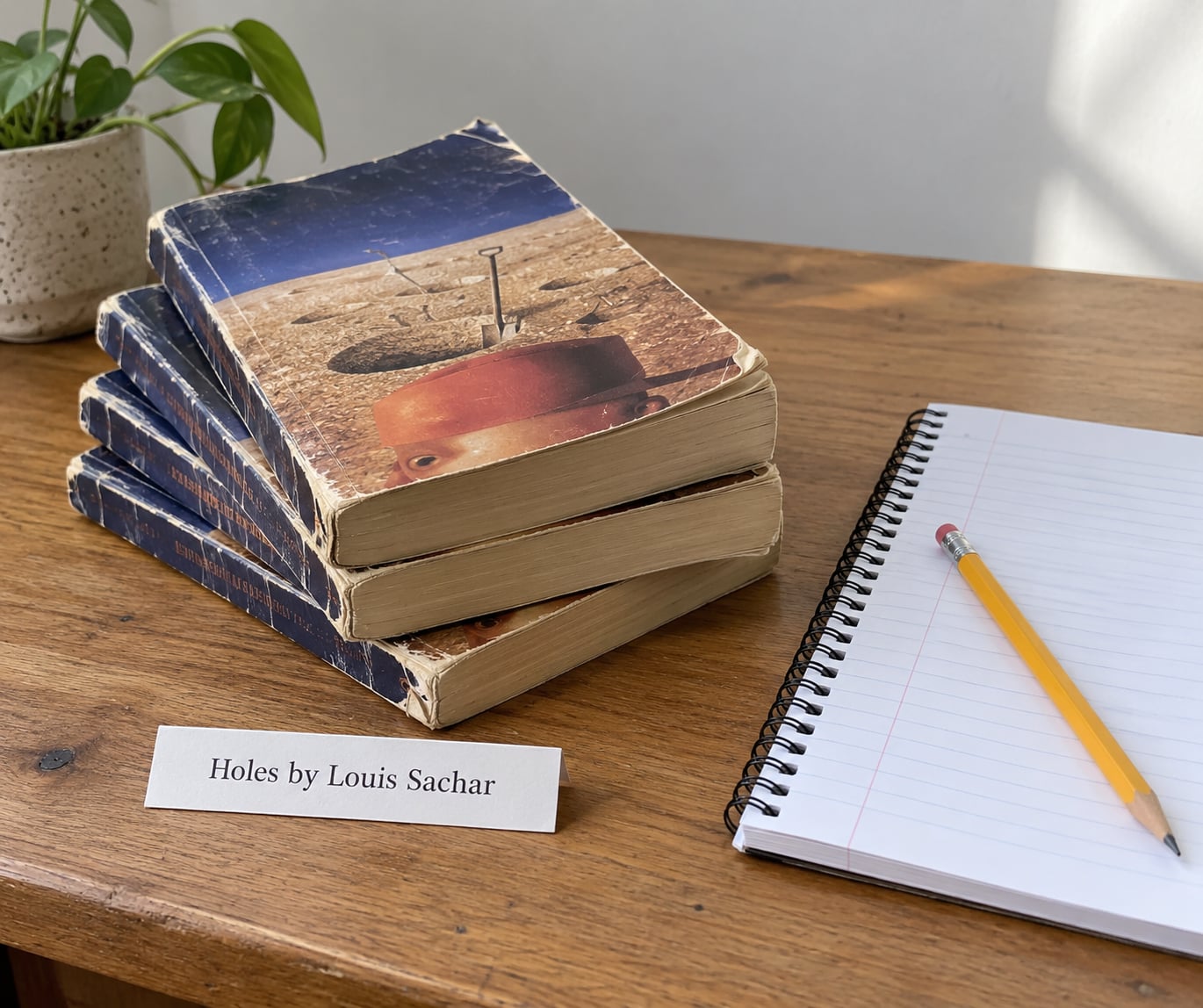
Holes is the rare book that satisfies a reader who wants a puzzle and a reader who wants a story about being stuck. Stanley Yelnats is sent to Camp Green Lake, where he is made to dig holes in a dry lakebed, and the digging turns out to connect to a family curse, a broken promise made generations earlier, and a famous historical figure.
The three timelines only click near the end, which is exactly why it works as a summer book. Nothing to rush through, and plenty to argue about.
Concrete way to use it: give the reader a notebook and ask them to keep a page per character who appears in the present-day camp. Each time Sachar drops in a line about a curse or a green hat, they underline it. When the past catches up with Stanley, they flip back and see how many of those clues they had already read twice.
It is also the safest book on this list for a younger sibling to share, because the camp scenes are genuinely tense without being graphic. Read-aloud, it holds up with a group, and the questions come out of it on their own.
2. Because of Winn-Dixie by Kate DiCamillo
Eleven-year-old Opal moves to Florida with her father and a polar bear glass sculpture she does not yet understand. In a grocery store parking lot she meets Winn-Dixie, a stray dog who becomes the first friend who feels like hers.
DiCamillo writes in short, plain paragraphs that are easy to read aloud, and the whole book fits in a weekend without losing its shape. The best material for discussion sits in the first fifty pages, when Opal starts naming people in her life after pets and uses that to work out who she can trust.
DiCamillo’s Florida is specific enough to feel like somewhere real: heat, humidity, a town where everyone knows the same few people. The supermarket is where most of the book happens, and that is a selling point. It is a low-effort read, in the good sense.
Concrete way to use it: after finishing, have the reader write one paragraph about a moment when they felt outside a group, and one about what it took to be let in. Then compare it to Opal’s summer.
3. The One and Only Ivan by Katherine Applegate
Ivan is a silverback gorilla who lives in a shopping mall exhibit with a wall of paintings, and he has spent most of his life watching humans without being asked anything. When a baby elephant arrives and a new animal is brought in, Ivan starts to consider whether staying where he is means staying silent.
Readers who get attached to animals tend to finish this one fast. The narration is in first person and it stays calm even when the situation is not, which makes the ending land harder than a louder book would.
Concrete way to use it: ask the reader to track each animal’s captivity differently. Ivan has space but no choice. Stella has a mate taken from her. Ruby is bought and never arrives. Building that list turns the book into an argument rather than a story they only felt things about.
4. A Wrinkle in Time by Madeleine L’Engle
Meg Murry’s father vanished in a flash of light, and the family is scattered across the country. Meg, her younger brother Charles Wallace, and her friend Calvin travel through time and space looking for him, meeting a woman called Mrs Who, Mrs Which, and Mrs What along the way.
The physics is loose, and that turns out to help readers at this age. They are not being asked to check the science, so they can concentrate on Meg being underestimated at every stop and choosing to go anyway.
Concrete way to use it: have the reader write down three times Meg moves forward while someone with more authority tells her to wait. The last one is the hardest. That short list is usually the whole theme of the book in three lines.
It is the only science fiction on this list, and it is the one readers most often come back to years later. Nobody outgrows it, which is a strange thing to say about a book marketed to twelve-year-olds.
5. Bridge to Terabithia by Katherine Paterson
Jess Aaron is a quiet kid who loves books and gets beat up for it. He befriends a girl named Leslie, and the two of them build an imaginary kingdom called Terabithia that they rule between them. Then something happens that changes everything, and Jess has to learn how to carry it.
Readers often meet this book younger than they should. It is short, it never softens what happens, and it treats a twelve-year-old’s grief as something serious enough to be named rather than managed.
Concrete way to use it: read it alongside a discussion, not silently. Ask what the imaginary kingdom is doing for Jess that friendship in real life cannot. Have a conversation about the ending before the reader turns the last page, so the shock lands as recognition instead of confusion.
Tell an adult in the house when this one is starting. It is the shortest book here and the heaviest, and a kid who finishes it alone at midnight and then cannot sleep is a common enough outcome to plan for.
6. The Giver by Lois Lowry
Jonas lives in a community that calls itself safe, orderly, and correct. He is chosen to receive the memories of the past from an old man called The Giver, and what he receives is color, music, snow, hunger, and a great deal of pain.
It is a short book, and the idea underneath it is not subtle, which makes it a good one to argue about rather than just discuss. The tradeoff at the center is the one worth naming: the community chose safety and it got sameness along with it.
Concrete way to use it: ask what the reader would refuse to give up. Most land on pain or memory. Then ask what the community gave up and whether it had a real choice, which is the harder question.
Lowry wrote it in under a hundred and fifty pages, so a student who finishes one book this summer can finish two. The sequel, Gathering Blue, goes deeper into the rules the community follows and suits an eighth grader who argued with the first one.
7. Hatchet by Gary Paulsen
Brian is twelve, bored, and looking forward to visiting his father’s cabin in the woods. His mother reminds him not to travel alone, and he does anyway. The plane crashes on take-off and his mother is the one who dies, so he has to survive on what he can remember and what he can build.
The prose is deliberately plain. That is the point: it makes a survival story readable by someone who would bounce off anything more ornate, and the pace never slows to admire itself.
Concrete way to use it: have the reader list the decisions that keep Brian alive in order, from grabbing the hatchet at the crash site to not walking into open water. Ranking the decisions makes plain that he survives on judgment, not luck, and it sets up a good question about which one he would have gotten wrong.
Paulsen wrote it partly from his own teenage summers alone in the Minnesota woods, and the accuracy shows. Readers who like this one often go looking for Brian’s Return next, but start here first.
8. The Tiger Rising by Kate DiCamillo
Rob’s mother has just died, and he has been packed off to live in a motel with his father, who cries in his sleep. In the woods behind the motel there is a caged tiger. And in the woods there is also a real tiger, one that was shot and buried under a tree, which Rob digs up.
Like most DiCamillo, the tone stays gentle even when the story turns cruel, so it sneaks past readers who think they do not like sad books. Rob makes one decision near the end that everything hinges on, and almost nobody sees it coming.
Concrete way to use it: run it as a book club pick and ask readers to keep a running list of every object Rob collects, and where it ends up. The pattern of keys, water, clothes, food is easy to see afterward, and it explains his choices better than a plot summary does.
If your group already read Because of Winn-Dixie, this is the natural pairing. DiCamillo’s two middle grade novels sit close together in difficulty and are the same reader’s taste, which is why both appear on this list.
9. Roll of Thunder, Hear My Cry by Mildred D. Taylor
Cassie Loggins narrates this one herself, and the sound of her voice is the reason to read it aloud if you can. Set in Mississippi during the years before the Civil War, it follows her family as they respond to escalating violence against Black farmers in their community.
It covers racism, intimidation, and violence directly. That is true of A Wrinkle in Time too, and worth telling an adult reader before a young one starts either one.
Concrete way to use it: after reading, ask what Cassie is allowed to do that her father is not, and what each of them does with that limit. The answers draw a clear line between what age buys a child in this world and what it cannot buy her.
10. The Crossover by Kwame Alexander
Josh and Jordan are identical twins who have played basketball together since they could walk. Then Josh starts noticing girls, and the two of them start pulling apart. Alexander tells the whole thing in verse, and it won the Newbery Medal, which is part of why so many adults reread it later.
Verse is the reason to pick this over a novel version of the same story. Line breaks carry the argument. Short lines land fast when things are going well, and they stretch out and slow down exactly when the brothers stop talking to each other.
Concrete way to use it: ask the reader to read a page about the brothers’ first disagreement out loud and mark where the lines shorten. Then find a page from early in the book and read that the same way. The contrast does the whole job without a teacher explaining anything.
For students who have never read a novel in verse, this is the gentlest possible on-ramp. Alexander also wrote Booked, which is prose about a kid who wants to play soccer more than he wants to graduate eighth grade, and it works well as a follow-up.
How to Build a Balanced Summer Reading Habit
The goal is not a number of books. It is the habit of picking a book up without being reminded, which is why the list above mixes formats and genres instead of proposing a single target.
Mix four things on one list. Fiction for pleasure, which is most of what is here. Nonfiction in the shape of a biography, a true-crime story, or a book about something they already like, whether that is soccer, space, or video games. Poetry, which reads in minutes and does not feel like homework. And one book with short chapters that can be finished in a single sitting on a bad day.
Set a pace that survives a bad week. Thirty minutes a day is the number most families land on, and it is lower than it sounds, because audiobooks count for many readers. Give the goal a weekly checkpoint instead of a total, so one lost week is not the whole summer.
Decide in advance what counts. Print, ebook, audiobook, and graphic novels are all reading, and arguing about that in July is a fast way to kill the habit. If a school requires a paper copy, check the wording with the teacher before the first week, not after.
Give readers a way to get books without money. Most middle schoolers have a public library card, and Libby or a library app puts the catalog in their pocket with no cost. Plenty of libraries also run a free summer reading program with a finish line worth aiming at.
For a child who says they hate reading, start with an audiobook of a book they have already seen recommended, then switch to print for one they finish. Readers who stall on long books often lose interest in reading itself rather than in the book. A fast success changes that.
For teachers and librarians working with a group, the same list doubles as a classroom set. Sort it by interest rather than by reading level, and let students pitch one title each in September. That takes about an hour and buys you a room that argues about books on purpose.
One warning from experience: do not hand a student the whole list and ask them to pick four. Ten titles read as an assignment. Hand them three and let them bring back a request for a fourth, and the request itself tells you more about the reader than any quiz would.
Frequently Asked Questions
What is a good summer reading list for middle school students?
A good list covers grades 6 through 8 and offers reasons for each title rather than names alone. Look for books published within the last few years, mix genres, and pair each hard book with an easier one. A list works when a student can find something that matches their interests inside a minute of picking it up.
How many books should a middle school student read over the summer?
Six to eight books is a reasonable range for most middle schoolers over a ten-week break, or about one every week and a half. Short books and audiobooks count the same as a long novel for the purpose of a habit. A student who reads four books enthusiastically beats one who pushes through eight and stops reading in September.
What are the best summer reading books for reluctant readers?
Short chapters, immediate stakes, and a format that is not a wall of text work best. Hatchet and The Tiger Rising move quickly and are hard to put down, and graphic novels or audiobooks often restart a stalled reader faster than a longer print novel. Pairing one high-interest book with one easier one keeps the summer from feeling like a test.
How can parents encourage their middle school child to read?
Ask your child what they want to read rather than assigning a book, keep paperbacks and graphic novels where reading happens, and let audiobooks count. Reading aloud together works even with teens who would refuse to admit they enjoy it. Avoid tracking minutes or asking them to report on every book.
Should summer reading assignments be graded or tested?
Most schools do not grade summer reading, and treating it like an assignment is a fast way to end the habit before it starts. If a teacher assigns a book with a reflection sheet, do it honestly and treat it as the assignment it is, not as a check on your child. Ungraded reading that gets finished is worth more than graded reading that stalls on page three.
How do teachers choose books for students with different reading levels?
Match interest level first and reading level second, then let a student read above their assessed level if the premise hooks them. Pair each challenging title with a lower-level book on a related subject, and include graphic novels and audiobooks for students decoding written text slowly. Many libraries print these lists, and Scholastic’s book finder helps match a title to a student.
Conclusion
These ten books cover mystery, survival, science fiction, verse, grief, and history, and they run from easy-enough-for-sixth-grade to hard-enough-for-eighth. Start with the one whose premise sounds closest to something your student already watches or plays, not the one with the best reputation in the school hallway.
Then pick one habit, not ten. Thirty minutes a day, a library card, and a weekly check-in is a summer reading habit that survives August.