There is a reliable way to teach thesis statements to beginners: model a strong and a weak one side by side, deconstruct the prompt together, build the claim with a sentence frame, practise it anonymously with peers, then assess against a checklist students can self-check. Beginners do not struggle because the idea is hard. They struggle because nobody has shown them the move from prompt to claim.
I have watched the difference in a single class period. A ninth-grade group that gets a definition first writes paragraphs with no argument in them at all. A group that gets three annotated examples before the definition writes arguable sentences by period two.
This guide walks through the whole sequence, roughly 45 minutes end to end, and then unpacks the four mistakes that keep showing up in drafts and how to fix each one. It works for middle school, high school, adult ESL classes, and first-year composition.
Table of Contents
- What You Need
- Step-by-Step
- Step 1: Show Students What a Thesis Does
- Step 2: Model a Strong Thesis in Think-Aloud
- Step 3: Contrast Weak and Strong Examples
- Step 4: Let Students Build a Thesis from Reasons
- Step 5: Practice Matching Theses to Evidence
- Step 6: Apply the Thesis to a Student Paragraph
- Step 7: Assess and Revise Independently
- Common Mistakes
- Differentiating for Mixed Skill Levels
- Frequently Asked Questions
- What is a thesis statement and where does it go in an essay?
- How long should a thesis statement be?
- Should I teach a formula first or let students discover the structure?
- What is a good example of a thesis statement?
- How do I know if my students’ thesis statements are strong?
- What is the difference between a thesis statement and a research question?
- Conclusion
What You Need
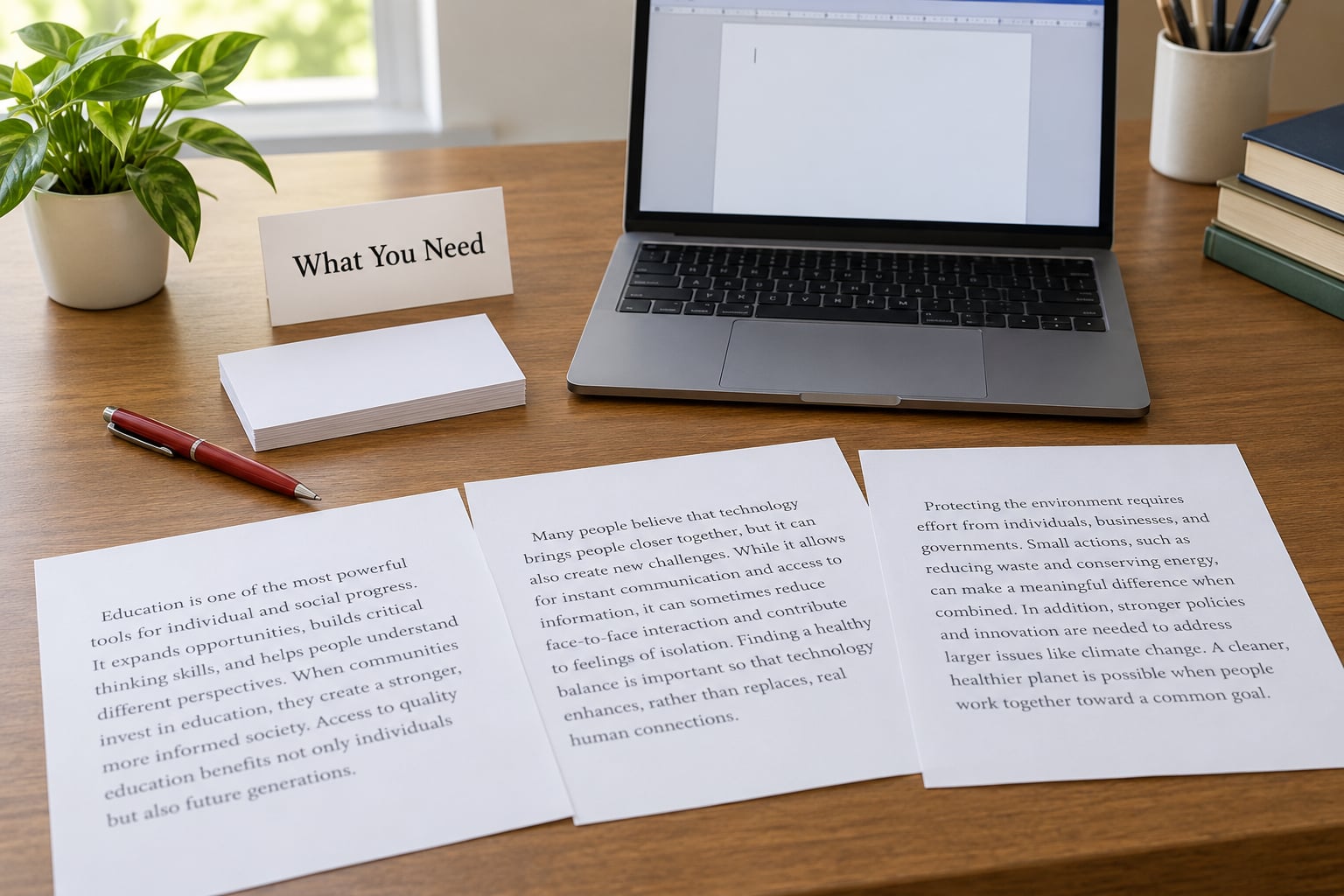
You need less than most teachers expect: one weak and one strong thesis example printed for every student, one prompt they can all argue about, and a way to collect anonymous drafts fast. Everything else on this page is optional scaffolding for the students who need it.
- A weak and a strong thesis pair. Use the same topic for both so the only variable is quality. The examples in Step 1 work well for this.
- A genuinely arguable prompt. Avoid prompts with a settled answer. “Is school starting too early?” beats “What is the importance of school?”
- Annotation tools. Two colours are enough: one for what the sentence claims, one for what it promises the essay will do.
- Sentence frames or a one-page worksheet. Six frames, printed, cut into strips or listed down the margin.
- Student drafts from earlier in the year or last term. Anonymous paragraphs are the best material you will ever get for teaching focus.
- Index cards or half-sheets for the anonymous round. Paper that folds over the name works even better.
Collect drafts before you plan the lesson. Twenty real paragraphs from your own room tell you more about what to teach than any handout, and using them keeps students interested because they can recognise the writing without recognising the writer.
Step-by-Step
Here is the full sequence for teaching thesis statements to beginners, with each step timed for a 45-minute period. The order matters more than the minutes: students need to see the target before they hear the label, and they need a sentence frame before they are asked to write alone.
Step 1: Show Students What a Thesis Does
A thesis statement is the writer’s specific argument about a limited topic, stated in one complete sentence, usually at the end of the introduction. Its job is to tell the reader what the essay will claim and how it will be supported.
Skip the dictionary definition in the first five minutes. Put a sample paragraph on the board without labelling anything and ask one question: where is the writer standing? Most beginners can point at a sentence even when they cannot name it.
Then name it. Three distinctions cover almost every beginner problem:
- Topic versus thesis. “School uniforms” is a topic. “Mandatory uniforms reduce bullying but cost low-income families more than the bullying does” is a thesis.
- Opinion versus fact. “Most teens text more than they talk” cannot be argued with. “Teenagers use texting to manage friendships in ways spoken conversation cannot” can.
- Thesis versus question. “Should schools start later?” is a research question. “Starting school an hour later would improve attendance because it aligns the school day with adolescent sleep patterns” is a thesis.
The so-what test does the rest of the work. Ask students to say “so what?” after the claim and see whether anything meaningful comes back. If nothing does, the sentence was a topic, not a thesis.
Step 2: Model a Strong Thesis in Think-Aloud
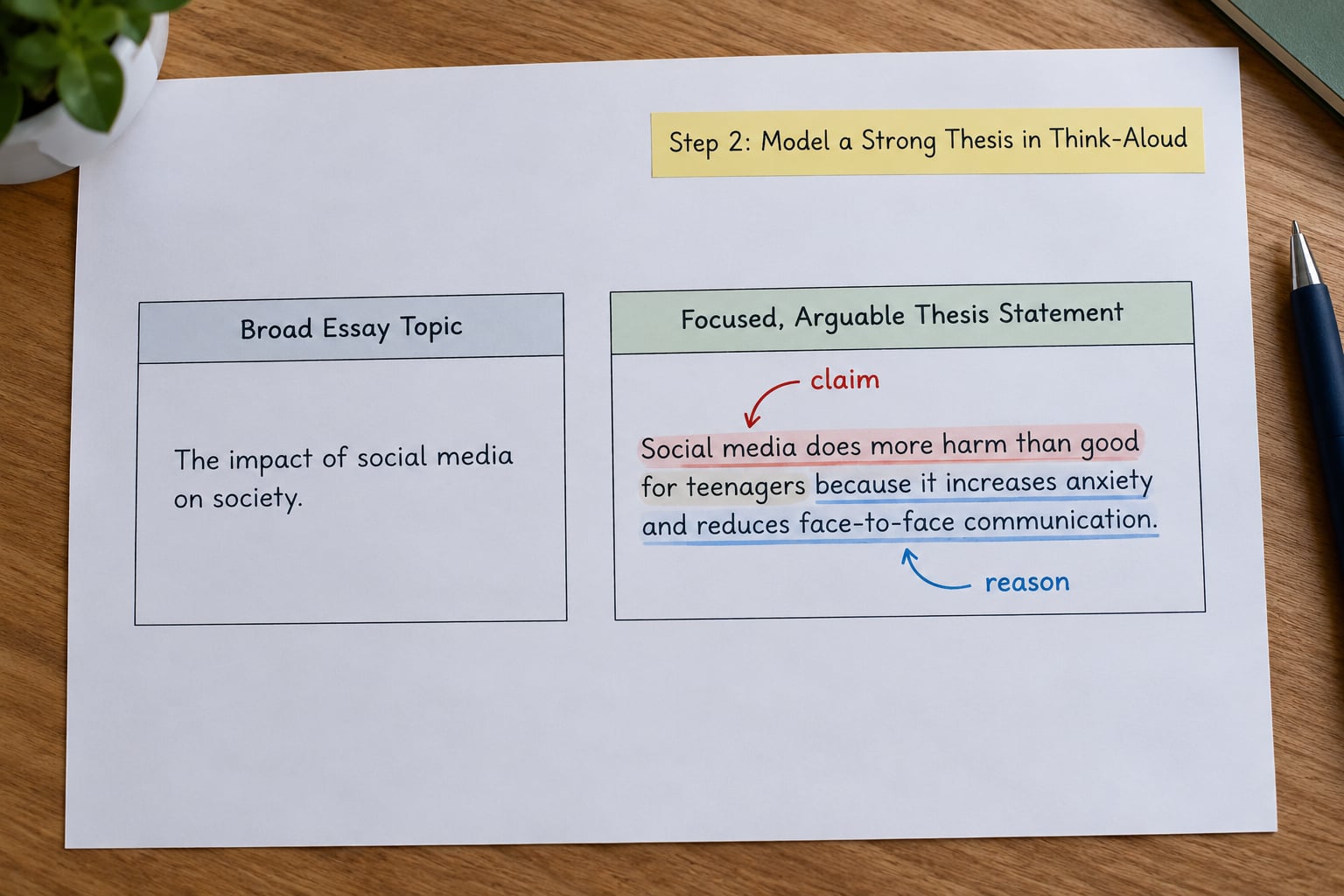
Think aloud while you build a thesis from scratch. Say the messy parts out loud, including the wrong turns, because beginners need to hear that a strong thesis is revised rather than discovered whole.
A simple formula gets you most of the way: limited subject, precise opinion, blueprint. The limited subject narrows the topic. The precise opinion takes a position a reader could dispute. The blueprint names the main reasons.
Model it like this, on the board, in about four minutes:
Prompt: Should high schools start later in the morning?
Limited subject: Not school schedules in general, but start times for high schools.
Precise opinion: Later start times are worth the cost in scheduling.
Blueprint: because current start times cut into adolescent sleep, and because the academic gains already documented outweigh the logistics.
Thesis: High schools should start later because current start times cut into adolescent sleep, and the academic benefits already documented outweigh the scheduling headaches.
Then say what each part is doing, in words a beginner can reuse. The first half narrows. The middle half takes a side. The last half previews the reasons, which means the essay already has a shape.
Step 3: Contrast Weak and Strong Examples
Show several weak theses together, name the specific failure in each, and have students revise them. Comparing beats correcting, because the students do the correcting.
| Weak version | Why it fails | Strong version |
|---|---|---|
| School uniforms | Topic, not a claim | Mandatory uniforms reduce bullying in most schools |
| Should students have homework? | Stays a question | Homework reinforces gaps in support that class time cannot close |
| Social media has changed how people communicate. | Nobody can disagree | Social media rewards performance over connection, which reshapes real friendships |
| In this essay I will discuss cell phones in schools. | Announces instead of claims | Banning phones improves note-taking more than it disrupts learning |
| Technology is good. | No limited subject | Technology access in the classroom improves writing when students are given structured practice with it |
| School start times should change and also lunch should be longer. | Two ideas, no focus | Later start times would do more for tired students than any change to lunch |
| Many people believe that homework is important. | Reports belief instead of holding one | Homework is most harmful in the classes where students need the most help |
| Reading is important in many ways. | Vague, unlimited | Independent reading builds writing fluency that assigned reading rarely produces |
The revision itself is the lesson. Give pairs five minutes with two weak examples and require them to write a repair, then say which part of the sentence they changed and why.
For a fast formative read, keep a checklist on the board: answers the prompt, takes a side, names a limited subject, previews a reason, one sentence. Students hold their own example against the five checks. Most revised theses in a beginner class fail the second check, and that is the one worth reteaching.
Step 4: Let Students Build a Thesis from Reasons
Now they write, but not from nothing. Give a prompt, three supporting reasons, and a frame that forces the reasons into one sentence. Beginners can produce a strong thesis from reasons long before they can invent one from a blank page.
The frame I use most often: Although [counterargument], [position] because [reason one], [reason two], and [reason three].
Work one on the board with the class, then let them try a second one with a partner before anyone writes alone. If you only have ten minutes, this is the step that matters most, because it is where the sentence frame turns into a habit.
Here is what that looks like filled in:
Although some students use phones to stay organised, schools should require phones to be locked away during class because divided attention lowers note quality, because silent notifications interrupt retrieval practice, and because the habit of checking is hard to unlearn mid-lesson.
Notice what the frame does. It forces a counterclaim, which forces a bounded position, which forces reasons. Beginners often write weak theses because they never had to defend anything, and the counterargument slot is where that habit breaks.
Additional frames worth printing:
- [Text] uses [technique] to suggest that [claim], even though [surface detail].
- By the end of [text], the reader should understand that [claim].
- Many readers assume [popular belief], but the text shows that [claim].
- [Author] argues [claim], and proves it through [technique one] and [technique two].
- The strongest argument in [text] is not the obvious one: it is [claim].
- Despite [counterargument], [claim] because [reason one] and [reason two].
Keep the frames visible on an anchor chart for the rest of the unit. Teachers are constantly asked for the printable version of this, and the honest answer is that the chart is six sentences on poster paper.
Step 5: Practice Matching Theses to Evidence
Hand out two or three thesis statements and a short set of supporting details or quotations, mixed up. Students match each thesis to the evidence that genuinely supports it, then explain why.
This is where students learn that a thesis is not decoration. A claim with no evidence behind it is an opinion, and an opinion in an analytical essay is the beginning of a problem.
Some will match correctly for the wrong reason, usually because the topics are adjacent. Push them: which quotation would your essay actually be wrong without? If removing a piece of evidence does not weaken the claim, that evidence was decoration.
Step 6: Apply the Thesis to a Student Paragraph
Ask students to write or revise an introductory paragraph that contains a focused thesis, a hook, and enough reasoning to preview the body. Then check the paragraph against the thesis rather than against a generic rubric.
Four questions, asked in this order, catch most problems in ninety seconds:
- Does the thesis answer the prompt in the prompt’s own terms?
- Can a reader who disagrees name your position in one sentence?
- Would each body paragraph you plan still make sense if the thesis changed?
- Is there a second idea hiding in this paragraph?
The third question does the most work. Students who answer no have written a thesis that their essay will argue around rather than with, and that shows up as drift three paragraphs later.
Connect the thesis to topic sentences out loud. A strong thesis generates three body paragraphs almost automatically; a weak one leaves students inventing structure after they have already written an introduction.
Step 7: Assess and Revise Independently
Finish with a self-check students can run alone, so the skill survives after the lesson. Give them this on a half-sheet:
- I can name my position in one sentence a stranger would understand.
- My thesis could be disagreed with by a reasonable person.
- It names a limited subject rather than the whole topic.
- It answers the exact question I was asked.
- It holds one idea, not two joined by and.
- I know which reasons will support it.
- My conclusion will say something new, not repeat the claim.
Students tick what they have and circle one thing they will change. Then they revise silently for five minutes. That silent revision is the assessment, and it tells you who is ready to move on and who needs the frame again tomorrow.
An exit ticket closes the period: one sentence, no names, “Write a thesis for the prompt on the board.” Collect them and sort into three piles before you leave. That sort is tomorrow’s plan.
Common Mistakes
Beginner theses fail in predictable ways, and each failure has a specific fix rather than a general instruction to be more specific. Diagnose the error, name it, model the repair, and have the student redo that one sentence.
| What the student writes | The error | Exact fix |
|---|---|---|
| In this essay I will talk about… | Announcement | Replace the announcement with a claim a reader could dispute. Delete “I will” first. |
| Should school uniforms be required? | Question left standing | Turn it into a statement and add because plus a reason. A question cannot preview an argument. |
| Social media affects teenagers. | Fact with nothing to argue about | Apply the so-what test three times. If nothing comes back, add an attitude. |
| School is important for many reasons. | Unlimited claim | Narrow to one reason, then name it: important because it does X specifically. |
| Cell phones are banned and teachers should be paid more. | Two ideas welded together | Cut in half. One thesis, one essay. Keep the stronger half. |
| The reader should know that this is important. | Tells the reader instead of arguing | Replace the meta-statement with the actual position the sentence is standing in for. |
| The thesis restated word for word in the conclusion | The thesis box | Teach the conclusion as new ground: implication, stakes, or the question left open. |
The thesis box deserves its own mini-lesson, because it is the failure that survives revision. Students believe the thesis is the only thing the essay has to say, so they return to it in every paragraph and again at the end. The fix is to make the thesis a starting position rather than the destination, and to show them what a conclusion looks like when it moves past the claim.
Two more classroom realities. When several students write the identical thesis on a popular prompt, do not mark it as cheating. Cluster the theses on the board, show the class that a genuine argument has range, and ask what each writer would need to change to make their claim more precise. Repetition usually means the prompt was too narrow, not that the students were lazy.
On ordering, the forum consensus among working teachers is not to start with the definition. Show examples first, name the pattern second. Beginners who hear “a thesis statement is a controlling idea” before they have seen five of them will write that phrase on the worksheet and hand you a sentence with no claim in it.
Differentiating for Mixed Skill Levels
One class rarely needs one version of this lesson. Layer the support instead of splitting the room, and let students move up the frame ladder as they get stronger.
| Group | Support | Extension |
|---|---|---|
| Struggling writers | Reasons provided, frame fully written out, one thesis per paragraph rather than per essay | Revise a partner’s weak thesis and justify the change |
| On-level | Reasons listed, frame with blanks | Add a counterclaim clause |
| Advanced writers | Blank frame, prompt only | Write two competing theses, then argue which one the evidence supports |
| ELL learners | Claim-first paragraphs, sentence frames in a side-by-side visual, oral rehearsal before writing | Compare how the same claim changes across two languages |
| Adult learners | Connect the thesis to a workplace or community situation they already argue about | Write the counterargument essay and rebut it |
For middle school, drop the counterclaim clause and run the whole sequence in two shorter periods. For ninth and tenth grade, run it in one and expect the revision step to take a second session. College composition students usually have the sentence already; what they lack is the discipline to narrow, so spend your time on limited subject rather than on structure.
One more judgement call that comes up constantly: whether the thesis must sit in the introduction. Teach the end of the introduction as the default, because beginners need the anchor. Students who want to place it elsewhere are almost always avoiding commitment, and you can let them try it once the claim itself is solid.
Frequently Asked Questions
What is a thesis statement and where does it go in an essay?
A thesis statement is one clear, arguable sentence that states what your essay will claim and how it will be supported. It is usually the last sentence of the introductory paragraph, though some writers place it first. For beginners, teach the end of the introduction as the default because it gives students a stable anchor point while they are still learning what a claim is.
How long should a thesis statement be?
One sentence, usually between 15 and 35 words. If it runs longer, it is usually carrying two ideas or a full outline. If it is shorter than ten words, it is often too vague to argue with. If your students struggle to keep it to one sentence, have them draft the claim and the blueprint separately, then join them with because.
Should I teach a formula first or let students discover the structure?
Teach the formula second, not first. Beginners who hear limited subject, precise opinion, and blueprint before they have seen five real examples tend to copy the vocabulary without the logic. Show three weak and strong pairs, ask students to say what makes the strong version work, and then hand them the frame. The pattern gets named once it is already visible.
What is a good example of a thesis statement?
A strong example is specific, arguable, and complete. Consider: “High schools should start later because current start times cut into adolescent sleep, and the academic benefits already documented outweigh the scheduling headaches.” It narrows the topic, takes a side a reader could dispute, and previews the reasons the essay will develop. Any sentence that could be agreed with by everyone is too weak to use as a model.
How do I know if my students’ thesis statements are strong?
Run five checks: it answers the prompt in the prompt’s own terms, it takes a disputable position, it names a limited subject, it holds one idea, and it previews the reasons. Have students self-check against those five before you read anything. What usually fails first is the second check, so spend your feedback time there rather than on grammar.
What is the difference between a thesis statement and a research question?
A research question asks what the writer intends to find out, and it is open. A thesis statement reports what the writer already argues, and it is settled enough to organise an essay. Research questions belong to the proposal stage; thesis statements belong to the drafting stage. Advanced writers sometimes keep both, but beginners should pick one and commit.
Conclusion
Start small. Take one prompt, write one weak thesis and one strong thesis on the same topic, and have students say aloud what changed. That single comparison, done properly, teaches more than a definition, a diagram, or a page of notes.
From there, the sequence runs in a fixed order: show examples, name the pattern, deconstruct the prompt, build the claim with a frame, match it to evidence, apply it in a paragraph, then revise against a checklist. Students who walk that ladder in one period can write a workable thesis; students who skip to independent writing usually cannot, and that is what you would see next week in a draft that restates the prompt.
Keep the frames on the wall, keep collecting anonymous drafts, and keep lowering the stakes early in the unit. A thesis that feels risky is a thesis a beginner will not take a position on.