
How to differentiate reading assignments for mixed levels comes down to a single decision: keep one text and one learning goal for the whole class, then change one variable for each group, whether that is the amount of scaffolding, the thinking the questions demand, or the format of the response. Build that once and each new unit takes about twenty minutes. The rest of your planning time goes back to teaching.
The reason this matters is that a single on-level worksheet handed to a class reading anywhere from three grade levels below to three above measures decoding, not comprehension. The readers below grade level spend all their effort getting words off the page and produce thin evidence. The readers above it finish in fifteen minutes and spend the rest of the period off task. Neither set of results tells you anything about reading.
So differentiation here is a design problem, not a volume problem. You are not writing five lesson plans. You are writing one and making three or four deliberate decisions inside it, which is what Carol Ann Tomlinson has argued since her 2001 ASCD book on mixed-ability classrooms: adjust the content, process, or product of a task so that students at different readiness levels can all reach the same goal.
Table of Contents
- What You Need
- Step-by-Step: How to Differentiate Reading Assignments for Mixed Levels
- Step 1: Set one shared reading goal
- Step 2: Choose a common text or an aligned text set
- Step 3: Adjust the amount of text and processing support
- Step 4: Differentiate the questions and task demand
- Step 5: Add extension options that deepen thinking
- Step 6: Use common success criteria and collect evidence
- Common Mistakes
- Frequently Asked Questions
- What does differentiating reading assignments mean?
- How can I differentiate reading assignments without using easier texts?
- Should mixed-level students read completely different books?
- How many reading levels should I plan for a mixed class?
- How do I support students who struggle with reading comprehension?
- How can I differentiate reading assignments without embarrassing students?
- Conclusion
What You Need

Before you change anything, gather five inputs. Skip one and you will end up differentiating the wrong variable.
A core text everyone can reach. This is the spine of the unit. It can be a novel, a short story collection, a poem set, or a nonfiction text. For students who are two to three levels below, add access rather than a replacement: an audiobook version of the same book, a chunked or abridged print version, a read-aloud, or text-to-speech on the same pages. Students who read on level get the text as written. Advanced readers get the same text plus a question set that pushes further into it, not the next book in the series.
Readiness data, not a single label. A grade-level number such as a Lexile or guided reading score tells you how hard the words are, not how well a student constructs meaning. A student can decode a grade-nine novel accurately and still collapse on inference. Use recent evidence instead: a running record or fluency check, a short comprehension probe on the first chapter, and the question of who can already hold a discussion about this book. Fluency and comprehension move separately, and mixing them into one number hides exactly the students you need to see.
One student-facing goal. Students should be able to read the assignment sheet and say what they are proving. See step one.
Your constraints. What prep time do you actually have? How many versions can you sustain for six weeks without resentment? Writing three versions of one task is realistic. Writing twelve is a fantasy that collapses in week three.
What counts as evidence. Decide how you will know the goal was met: a written response, an annotation set, an exit ticket, a discussion. This is what keeps three versions comparable rather than three separate assignments.
Step-by-Step: How to Differentiate Reading Assignments for Mixed Levels
The short version, before the detail:
- Set one reading goal the whole class shares, and write it in student language.
- Pick one core text, then add access options rather than replacement books.
- Vary the amount of text and the processing support around it.
- Vary the cognitive demand of the questions, not the evidence requirement.
- Add extensions that deepen thinking rather than add pages.
- Publish common success criteria and collect evidence on every version.
Step 1: Set one shared reading goal
Write the goal as a knowledge, skill, or interpretation target that every student in the room can reach. “Understand the theme of the novel” is too vague to plan against. “Explain how Okonkwo’s fear of change drives the choices he makes in chapters 4 through 9, using two pieces of evidence” can be planned against, tiered, and assessed.
Then split it into three columns on your own planning page. The essentials column holds what everyone must demonstrate. The support column holds the scaffolding, prereading, and access options you will offer. The extension column holds the deeper work for students who are ready. Keeping the essentials column short is what stops differentiation from quietly becoming a different, easier standard for some students.
Step 2: Choose a common text or an aligned text set
Most of the time you want one core text read by everyone, with access supports attached. Sometimes a text set works better. These are the three models worth deciding between deliberately:
Same novel, plus access. Everyone reads the same book. Below-level readers get audiobook or text-to-speech alongside the print copy, chunked sections, pre-teached vocabulary, and a guided-reading partner for the first pass. Best for novel studies with discussion, essays, or group projects. Watch for students who follow the audio and never touch the print, and students who stall completely at the early two-way ports where a new subplot opens, and lose the plot for good.
Parallel novels on the same theme or topic. Three books, one essential question, three text sets. Best for short-story or poetry units, thematic units, and independent reading where no shared discussion is required. Prep cost is highest here, because you are matching three texts for complexity and theme rather than adjusting one. Watch for uneven quality, and for the reader who simply needs support with the one book everyone else reads.
Excerpt plus access. Everyone reads the same excerpt, and students who need more processing time get the same excerpt repeated in smaller sections with a guided question before each chunk. Best for nonfiction, poetry, and short texts where the skill is close reading rather than sustained reading. Lowest prep cost of the three and the easiest to keep fair across versions.
Whichever you pick, judge text complexity qualitatively as well as quantitatively. Two-way ports, nested structures, dense symbolism, and unfamiliar cultural context can block a reader whose decoding score looks fine. Ten minutes of pre-teaching on those features does more than any leveled list.
Step 3: Adjust the amount of text and processing support
This is the variable most teachers should change first, because it changes the least about the thinking. Chunk a chapter into four sections of ten pages and put one guiding question at the head of each one. Pre-teach eight words that carry the chapter’s argument before anyone reads. Give the audio version alongside the print. Provide a story map or annotation frame with the columns already on it.
None of that reduces the rigor of the task. It moves the load off working memory and onto the part of the reading you actually want to assess.
Then check readiness in five minutes. Ask students to write three sentences on one question from the opening chapter and sort the responses into two piles: got it and needs another pass. Students who can cite a detail and say what it implies are ready for the on-level questions. Everyone else starts with the scaffolded version and the additional chunk. You have just done your first formative assessment and your first grouping without a label anywhere on it.
Step 4: Differentiate the questions and task demand
This is where most attempts go wrong, because the easy version is usually just a shorter list of surface questions. Retrieval is not the same task as analysis, and handing a struggling reader a worksheet of recall questions is not differentiation, it is a different lesson dressed up as the same one.
Move through the demands instead. Here is one assignment, the same chapter and the same goal, at four levels of thinking:
- Retrieval. “List three things Okonkwo does that shows he is uncomfortable with the new arrangement.” Response: a short list. Scaffold: sentence frame with the first clause supplied.
- Supported inference. “The narrator calls the market ‘a kind of argument.’ What is the narrator’s judgment, and which detail supports it?” Response: two or three sentences with a quote. Scaffold: sentence stems for claim plus evidence plus explanation.
- Cross-detail analysis. “Track how Okonkwo’s behavior changes between the two scenes. What causes the change, and does it reverse by the end of the chapter?” Response: a structured paragraph or an annotated timeline. Scaffold: a partially completed chart.
- Evaluation. “The chapter ends without resolving the argument. Write the author’s next scene and defend your choice against two details from the chapter.” Response: extended evidence-based writing. Scaffold: none, by design.
Every version requires evidence from the text. That constraint is what keeps the standard constant while the thinking rises. What changes is how much of the interpretation the student does alone.
Step 5: Add extension options that deepen thinking
Tomlinson’s warning here is worth quoting, because it is the fastest way to lose a willing reader: asking students to do more of what they already know is hollow. Extra pages, the next book in the series, and a longer question packet all read as punishment, which is exactly how motivated advanced readers experience them.
Better extensions change the question rather than the volume. Ask them to compare the author’s word choice in two scenes and argue for why the diction changed. Ask them to trace a single theme across this novel and a poem the class read earlier. Ask them to write the strongest counterargument to the class’s reading of the ending and state what evidence would settle it. Ask them to compress the chapter into a scene that keeps every essential beat and explain what they cut and why.
Choice helps too. A small menu with three genuine options, not four busy choices and one real one, gives advanced readers ownership without handing them filler.
Step 6: Use common success criteria and collect evidence
Publish the same success criteria for every version, written in thinking language rather than task language: accurate evidence, reasoning that explains rather than restates, and revision based on feedback. Then collect evidence quickly. A 3-2-1 exit ticket, three questions answered, two pieces of evidence cited, one question still open, takes about three minutes and tells you who is ready for the next tier.
Look at the responses and regroup before the next task. Students move into and out of groups as the evidence changes, and nobody announces it. If the analysis version is producing thin work across the board, the problem is usually the instruction on evidence, not the students.
Common Mistakes
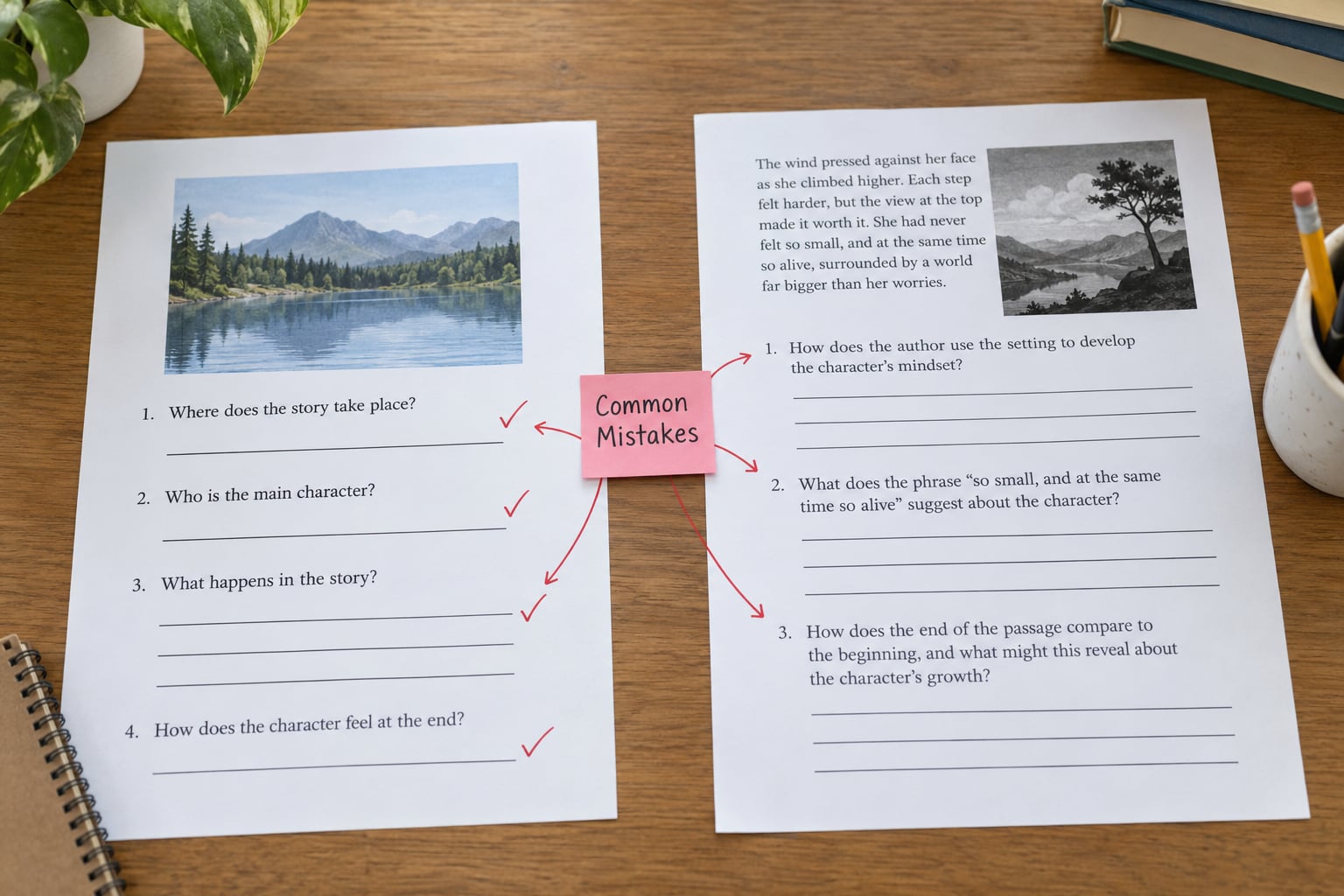
Assigning fewer pages. Cutting a struggling reader’s load from 40 pages to 15 does not differentiate, it shrinks the evidence base. Fix: keep the text identical, change the support. Tip: give the longer task to everyone and change the number of questions and the response format instead.
Lowering the intellectual target. If the on-level version asks why a character chose what they chose and the below-level version asks what the character chose, you have given away the reasoning. Fix: hold the reasoning, vary the support. Tip: put the reasoning into the sentence stem rather than removing it.
The same work with different labels. Handing out three worksheets that are all the same ten questions with three different titles teaches students that differentiation is cosmetic. Fix: vary the demand, visibly. Tip: if you cannot name the thinking difference between two versions, you do not have two versions.
Over-scaffolding capable readers. Pre-teaching every word, reading the chapter aloud to everyone, and giving sentence frames to the whole class removes the work the task was designed to create. Fix: put supports on the table and let students opt in. Tip: word pre-teaching for a small group, open access for the rest.
Choosing texts that are too easy. Below-level versions that are two to three grades simpler than the core text teach nothing transferable, and the student knows it. Fix: keep the text, add audio or chunking. Tip: ask whether the student can still answer the on-level question with support. If not, the text was too easy.
Treating differentiation as tracking. Fixed groups, permanent seats, and a low table are not differentiation. Fix: regroup on current evidence, every few tasks, and let students self-select where you can. Tip: publish the groups as temporary, the way you would announce a schedule change.
Two more situations come up constantly. When a student refuses the scaffold because accepting it signals where they sit, hand the scaffold to the whole class and let the choice be individual, so nobody is the one who took the easy version. And when differentiation is genuinely the wrong move, say so. A single difficult text read together, with the vocabulary taught and the discussion protected, is often the strongest reading instruction you can give.
The most useful thing teachers say about this work is that the split is support, not content. One thread on r/AustralianTeachers puts it plainly: differentiate by support, not content, give the same text, read it together, discuss key vocabulary. That approach also fits what the research digest literature says about readiness-based adjustment, where the adjustment follows the student and the task stays intact.
Frequently Asked Questions
What does differentiating reading assignments mean?
It means adjusting access to the same learning goal, not handing out different assignments with different goals. You keep one text and one standard for the class, then change a single variable per group: how much scaffolding is offered, how much thinking the questions demand, or what format the response takes. The goal and the evidence requirement stay the same across every version.
How can I differentiate reading assignments without using easier texts?
Change the support instead of the text. Keep the same chapter or excerpt for everyone, then add chunking, an audiobook or text-to-speech version, pre-teached vocabulary, and a guiding question before each section. From there, raise the demand through the questions rather than lowering the text. Students read the same words and do increasingly harder thinking about them.
Should mixed-level students read completely different books?
Usually not. A shared text keeps your discussion, essays, and group work intact, and it stops reading level from becoming a visible status marker. Use parallel books only when there is no shared discussion to protect, such as a thematic short-story unit or independent reading time. Even then, match the three books for complexity and theme, not just for interest.
How many reading levels should I plan for a mixed class?
Three is the workable number: access plus core, core plus guided support, and extension. Some classes need only two, and a few need four in the early weeks of a novel. Resist building more than that, because each extra version costs you prep time and creates another artifact to assess. Add levels only when your exit-ticket data shows students are not ready.
How do I support students who struggle with reading comprehension?
Separate the fluency problem from the comprehension problem first, because the fixes differ. If decoding is the barrier, add audio access, chunking, and guided rereading. If the student reads accurately but cannot infer, keep the text and support the thinking with sentence stems, a graphic organizer, and one worked example of evidence leading to a claim. Mixed signals usually need both.
How can I differentiate reading assignments without embarrassing students?
Offer supports to the whole class and let students choose, so nobody is visibly the one who needed the easy version. Publish success criteria in thinking language rather than level language, and say plainly that everyone reads the same book and everyone is proving the same thing. Group in the moment from written evidence, then regroup after each task so no group becomes permanent.
Conclusion
Start with one goal and one shared text, then decide which single variable you are changing for this particular group this particular week. Add support where decoding or processing is the barrier. Add demand where the thinking is the barrier. Publish the same success criteria for everyone and collect evidence on all of it.
Once the versions exist, they cost about twenty minutes per unit to reuse, and as of 2026 that is a trade most mixed-level classrooms can afford. Differentiation raises access without lowering the bar, which is the version of it that does not require you to build a separate low track.