A reading log students will actually use is short, optional in tone, and built around a few fields a student can fill in about three minutes without checking a book for a single fact. The way to get one is simple: decide what the log is for, cut the field list down, write the prompts in student voice, take every reward and punishment out of it, and then sit down with the student and look at what they wrote.
Most logs fail on design, not on effort. Teachers ask for a title, an author, a rating, minutes read, a summary, a favorite quote, a prediction and a self-assessment, then grade the whole page for completion. Students fill in eight columns of invented minutes, and nobody opens the folder again until June.
What follows is the build process, the field lists by grade band, a prompt bank you can copy, and what to swap in when a log is not the right tool for your room.
Table of Contents
- What You Need
- Step-by-Step: How to Create a Reading Log Students Will Actually Use
- Define a Clear Purpose for the Log
- Keep the Template Simple and Flexible
- What should be included in a reading log?
- Field lists by grade band
- Use Prompts That Invite Real Thinking
- Prompt bank
- Model Exactly What a Strong Entry Looks Like
- Build a Simple Weekly Routine
- Use the Responses to Make Reading Visible
- Common Mistakes
- What to do instead of reading logs
- Frequently Asked Questions
- How long should a reading log entry be?
- Should teachers grade reading logs?
- What is the best reading log template for students?
- How do I help students who do not finish their reading logs?
- Can reading logs work for nonfiction and poetry?
- Should reading logs be completed in class or at home?
- Start With One Field You Can Delete
What You Need
You do not need a paid template or a new app. You need a one-page format and four decisions made before you hand anything out.
- A shared template. One page, one format for the whole class. If every student uses the same page, you can scan a stack in a few minutes and spot patterns.
- Book or passage details. Title and author are enough for fiction. Add the chapter or section name if you plan to use entries for discussion.
- One short response area. Three to five sentences of the student’s own thinking. This is the only part that cannot be faked from the back cover.
- A submission method. Paper in a folder that stays in the classroom, or a shared digital doc the teacher owns. Both work; mixed systems are the ones that get abandoned.
- An optional digital or paper choice. Some students write faster on paper, some students will not lose a laptop. Let the student pick the medium, not you.
Keep the physical copy somewhere it is already used. Teachers who place the log next to the reading basket or at the front of the independent reading routine report far more completed entries than those who send it home in a backpack.
Step-by-Step: How to Create a Reading Log Students Will Actually Use
Define a Clear Purpose for the Log
Write one sentence that says what the log is for, and refuse to collect anything that does not serve it. A teacher who cannot name the instructional use of a field should delete that field.
The three workable purposes are data, habit and conversation. A data log exists to show you what students actually read and at what difficulty, so you can plan conference groups. A habit log exists to make reading time visible to the student, so streaks and totals matter. A conversation log exists to give you something real to talk about in a book talk or a small group.
A concrete purpose statement: “This log tells me what you read this week and gives you one reason to keep or drop it, so we can pick your next book together.” That sentence does more work than any form. Students who know the log feeds a conference with their teacher stop treating it as homework for a grade.
If the honest purpose is “the district requires a reading record,” say that out loud to the students too. They can handle the truth, and it takes the sting out of the fake compliance they would invent on their own.
Keep the Template Simple and Flexible
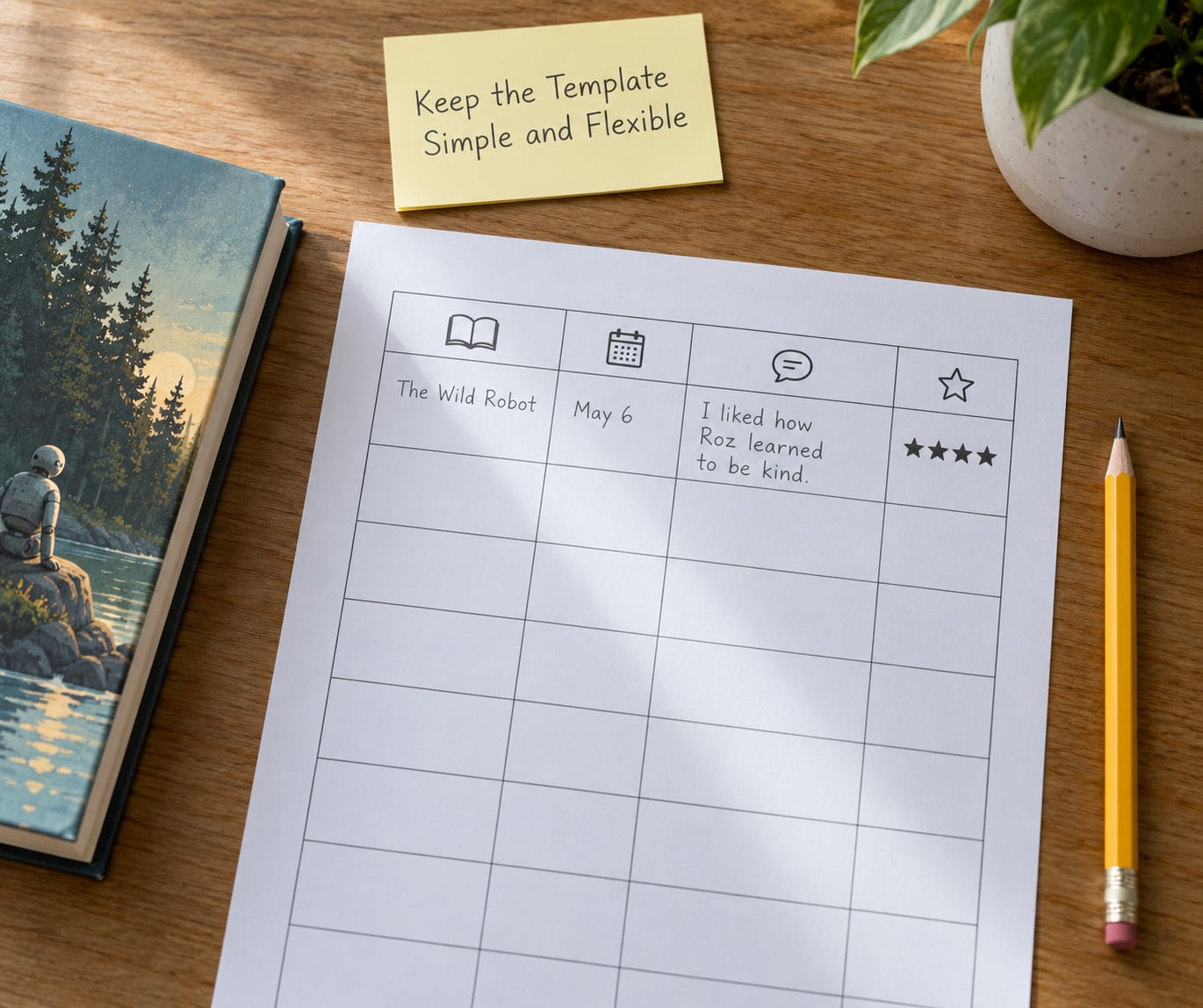
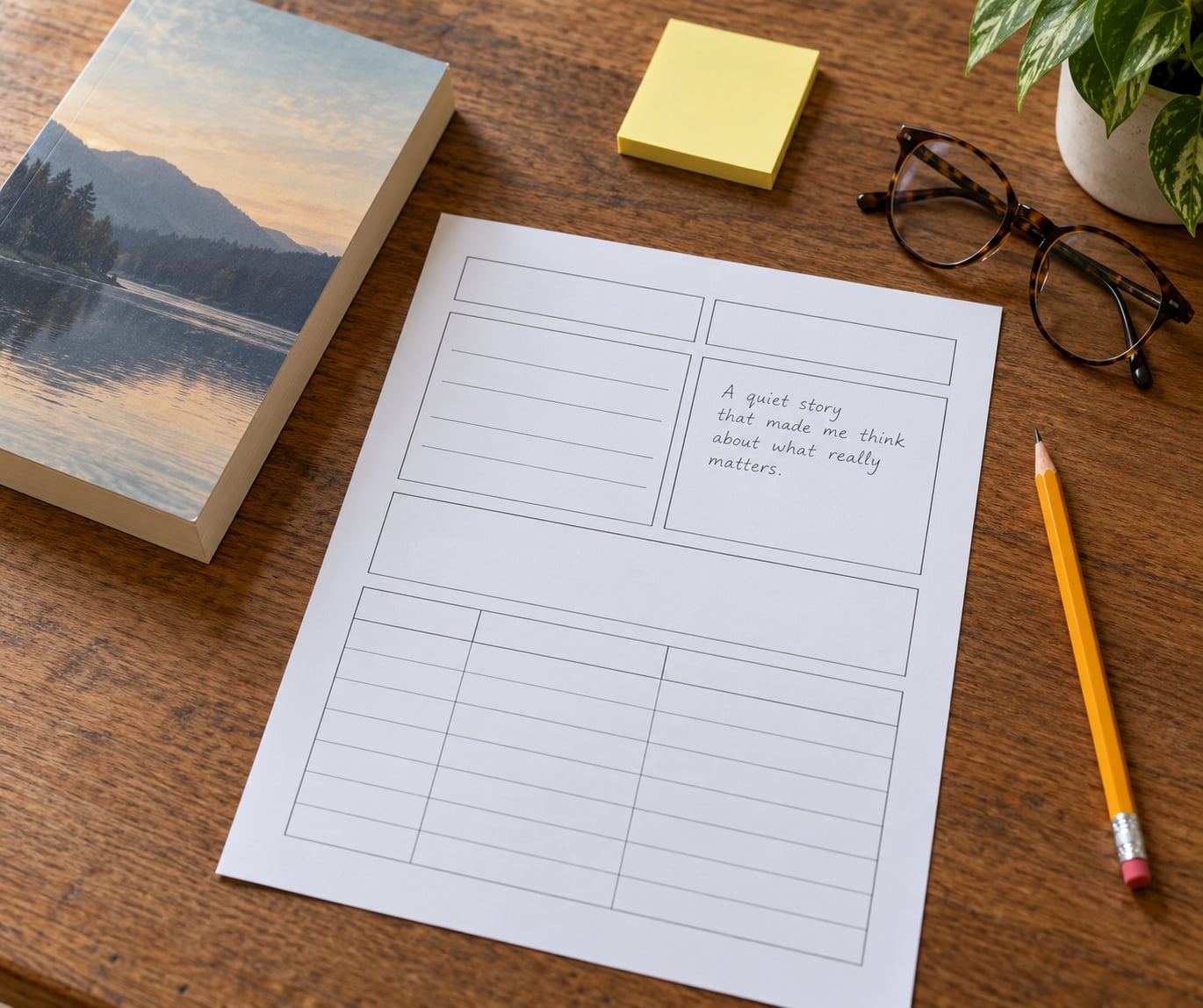
Five to seven fields is the ceiling. Past seven, students start writing to please you instead of writing to think, and the entries flatten out.
What should be included in a reading log?
- Title and author, or the section of a longer text
- Date and how the reading happened, at home or in class
- Minutes read, or pages finished for a graphic novel
- A quick rating you can read in one second, stars or a number
- One question the student still has about the text
- One line of reaction in the student’s own words
- A one-word state of mind after reading, glad, unsure or stuck
Label the required fields clearly and leave the rest optional. A required field that nobody reads is the fastest way to make a log feel like compliance, and students are good at spotting the difference.
One template can cover novels, short stories, poetry, nonfiction and assigned passages if you keep the response prompts genre-neutral. A prompt like “what did this make you think of?” works for a poem and a history chapter. A prompt like “describe the setting” does not.
| Log type | What it tracks | Time per entry | Best for |
|---|---|---|---|
| Title-only list | Books finished | Under a minute | Quick surveys and library goals |
| Minutes log | Time spent reading | About a minute | Habit visibility and home-school communication |
| Reflection journal | Student thinking | Three to five minutes | Comprehension data and conferences |
| Challenge tracker | Progress toward a goal | Under a minute | Class energy and reluctant readers |
| Digital log | Whatever fields you set | Same as paper | Remote weeks and students who type faster |
Pick one row, not all five. A tracker stacked on a journal stacked on a minutes sheet is the busywork problem wearing a nicer cover.
Field lists by grade band
| Grade band | Fields that work | Response length |
|---|---|---|
| K-2 | Book title, date, minutes or pages, one drawing or one spoken sentence | A drawing or a single sentence |
| 3-5 | Title, author, date, minutes, star rating, one question, one reaction | Two to three sentences |
| 6-8 | Title, author, date, minutes, rating, one question, one evidence-based reaction | Three to five sentences |
| 9-12 | Title, author, date, minutes, rating, one passage quote, one claim about craft or idea | Three to five sentences |
For students with dyslexia, an IEP or a 504 plan, shrink the fields before you shorten the text. Give them four fields instead of six, allow the response as an audio note or a voice memo, and pre-fill the title and author so the motor load stays off the page. A log is an accommodation surface, so treat it like one.
Paper versus digital comes down to where the reading happens. Paper wins in a classroom with shared devices, and it lets a student sketch a scene instead of describing it. Digital wins for a student who types fast, for a class you need to sort by column, and for any week that is not in the room. Teachers report that student-run digital logs collapse when they promise notifications and badges the teacher cannot deliver, so promise nothing extra.
Use Prompts That Invite Real Thinking
Generic prompts are the second failure point. “Write a summary” produces a copied back-cover blurb. A prompt that asks for evidence, prediction, connection or reaction produces something a teacher can actually use.
Mix fast prompts with deeper ones so an entry never feels like an essay. The quick prompts take one sentence and keep reluctant readers moving. The deep prompts ask for a reason and a piece of text, and they should appear once or twice a week rather than every entry.
Prompt bank
Basics:
- What were you reading, and where did you stop today?
- How long did you read, and was it one sitting or several?
- Would you pick this book again, and what decides it?
Story and structure:
- What happened that you could tell a friend in two sentences?
- What did the writer do early on that set up the ending?
- Which scene would you cut, and why?
- Where did the story slow down for you?
Characters and craft:
- Who made the hardest choice in this part, and what did it cost them?
- Which line of dialogue tells you the most about a character?
- What did the author choose not to tell you, and how did you notice?
- How does the first page set a promise the book keeps or breaks?
Your response:
- What did this text make you think of that you read before?
- What do you predict will happen next, and what in the text supports that?
- What part did you argue with?
- What question would you ask the author if you could?
- Did anything in this reading change your mind about something?
Reading level is not a reason to lower the thinking. A student working below grade level can still answer “what did the writer do early on that set up the ending?” using audio or a partner scribe. Keep the cognitive demand and change the access.
Model Exactly What a Strong Entry Looks Like
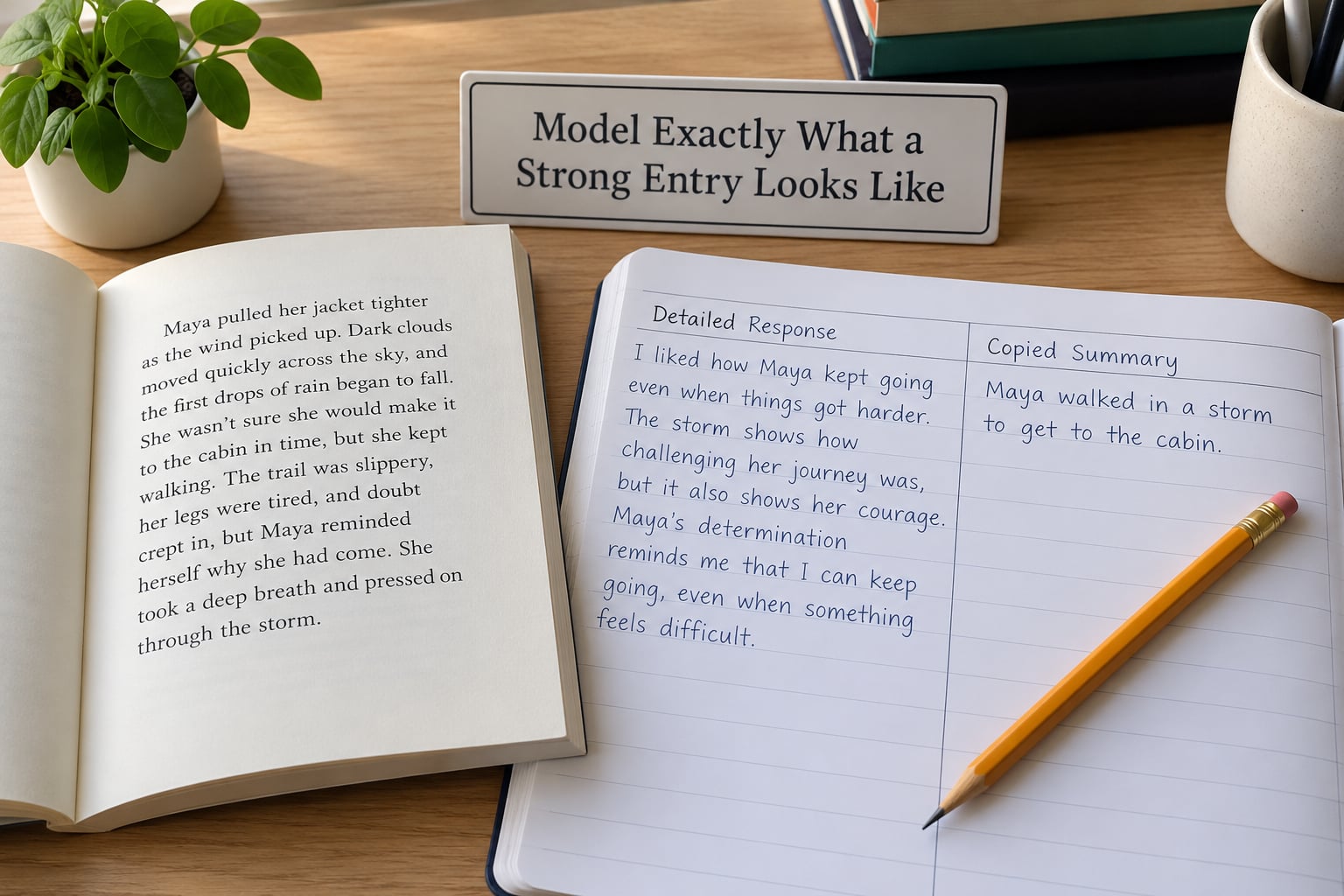
Take a short passage everyone has already read, project one entry, and think out loud as you fill it in. Say the awkward parts of your thinking out loud, including the uncertainty, because students need to hear that a real response can be unfinished.
A filled model entry for a middle grade class:
- Book: “Title, author”
- Date and minutes: Tuesday, 24 minutes at home
- Rating: 4 of 5
- Still thinking about: why the narrator agreed to the deal in chapter six
- My reaction: I did not believe him either. He describes his friend’s worry as “nothing” twice in two pages, and the author keeps cutting back to that word every time something goes wrong.
Now show the two failures beside it. A copied summary repeats sentences from the back cover and mentions nothing the reader noticed. An unsupported opinion says “it was a good book” with no reason and no text behind it. Naming both failures out loud saves you weeks of marking comments.
Let students revise. A sticky note on the log saying “add one sentence that says why” teaches more than a red pen, and it keeps the revision expectation low enough that students actually do it.
Build a Simple Weekly Routine
Routines decide whether a log survives the term. The pattern that works is short, frequent and predictable.
- Monday: five minutes at the start of independent reading. Students set the week’s number and choose the book.
- Two or three times a week: three to five minutes at the end of reading to complete one entry in class.
- Friday: two minutes to look back, mark a personal goal, and hand the page in or submit the row.
- Every week or two: you read a stack of ten pages and write one question on three of them.
Three-minute entries finished every time beat one thorough page a month. If you assign it as homework instead, expect completion rates to drop and paper to come back crumpled, or not at all.
If some entries are incomplete, do not start a punishment spiral. Ask for the entry that is missing and find out what got in the way: not enough time, no access to the book, a page too dense, or a writer who was stuck and would not say so.
Use the Responses to Make Reading Visible
A log you collect and never open teaches students that their thinking does not matter, and next year they write less in it. Budget ten minutes a week to actually reading the responses, and use them for something visible to the student.
- Quick writes. Take three question lines, put them on the board, and let students respond for two minutes.
- Partner conversations. Pair students whose entries answer the same prompt, then have them compare.
- Exit tickets. One question from the log becomes the last thing students write before they leave.
- Conference questions. Pull the student with three graphic novels in a row and ask what they liked about the format. That conversation is where you pick the next book.
- Class patterns. Tally how many students read poetry, nonfiction or graphic novels and show the count. Reading stops looking like a private struggle and starts looking like something the room does together.
You do not need to grade every detail. Look for comprehension signals, not neatness: can the student name what happened, cite a piece of text, and predict what comes next based on evidence. Grade on the quality of the thinking in two or three entries a week and let the rest be practice.
The question to ask is worth writing on the back of the template: what will I do differently because I read this? If you cannot answer it, the log is decoration, and students can tell.
Common Mistakes
Mistake one: too many fields. A nine-column log takes ten minutes and produces thinner thinking than a five-field log that takes three. Cut until every remaining column has a job you can name.
Mistake two: generic prompts. “Write a summary” invites copying. Swap in one prompt about evidence and one about reaction, and the copied text disappears.
Mistake three: grading completion instead of thinking. A hundred percent on a page of invented minutes tells you nothing. Score the quality of two or three entries a week and treat the rest as practice.
Mistake four: rewards and punishments. Losing recess over an unfinished log teaches students that reading is a threat to be avoided, not a thing they want. Research on reading motivation, including the work behind No More Reading for Junk, points the same direction: extrinsic rewards attached to reading tend to damage the habit they are meant to build.
Mistake five: assigning too much at once. A whole novel plus a detailed log plus a parent signature is three homework assignments wearing one cover. Drop to a weekly entry and no signature.
Mistake six: never following up. If the log only comes back to be initialed, students read that instantly. Ask three students one question a week about what they wrote. That is the whole fix.
What to do instead of reading logs
Some rooms and some students do better without one. Four formats cover most of what a log was doing.
- Book talks. The student recommends one book in two minutes, without a written page. Strongest for reluctant readers who write little but talk well.
- Class challenge tallies. Students add their finished books to a shared count on a board or chart that the class updates together. Reading becomes visible to the room instead of audited by the teacher.
- Reading conferences. Two minutes a week with each student and a sticky note in the book. No form at all, and the note stays with the text.
- Passage annotation. Students mark one passage in the text and bring it to the discussion. You get the same evidence as a response field without a page of writing.
A hybrid often works best: a short title-and-minutes record for the data you need, plus book talks or annotation for the thinking. Teachers who switch to this combination usually keep more of what the log gave them and lose the paperwork.
Frequently Asked Questions
How long should a reading log entry be?
Three to five minutes of writing, roughly three to five sentences, is the working target. Short entry titles and minutes can take under a minute; keep one response area for the thinking. Students who write three minutes every time will finish a term’s worth of entries. Students who write for twenty minutes once a month will not finish at all, and that gap is where logs usually die.
Should teachers grade reading logs?
Grade the thinking in a small sample rather than the completion of every page. Two or three entries a week is enough to see whether a student can name what happened, cite text and predict what comes next. Marking every field on every entry is what turns a log into busywork, and students read that signal quickly. Completeness belongs to the routine, not the gradebook.
What is the best reading log template for students?
The best template is one page with five to seven fields, student-facing wording, and one short response area. Include title, date, minutes or pages, a one-second rating, one question and one reaction for most middle and high school readers. Younger students need fewer fields and a drawing or single sentence. Digital versions should be a table with one row per entry, not a free-form document.
How do I help students who do not finish their reading logs?
Ask what got in the way instead of assigning a consequence. Usually it is time, book access, text difficulty or blank-page paralysis, and each has a different fix. Cut the fields, offer audio responses, swap the book for an easier one, or let them write the response with a partner. A student who feels accused will stop trying; a student who feels stuck usually still wants to read.
Can reading logs work for nonfiction and poetry?
Yes, as long as the prompts are genre-neutral. Replace plot questions with idea questions: what the writer claims, what evidence supports it, what you would push back on. For poetry, ask about a single line, its sound, and what changed when you read it twice. Audiobooks count too, and logging minutes rather than pages makes that easy to record.
Should reading logs be completed in class or at home?
In class works better, because three to five minutes at the end of independent reading time is far more reliable than homework. It also keeps the log from becoming a lost-paper problem and lets you check understanding while it is fresh. If you assign it at home, ask for once or twice a week rather than nightly, drop the parent signature, and accept the entries digitally.
Start With One Field You Can Delete
Pick last week’s stack of logs and remove every field you did not look at. What remains is your template, and the response section you kept is the part that makes it worth collecting.
The single highest-return habit is five minutes at the end of reading time, three fields, one question, no signature and no points. Run that for two weeks before adding anything else.