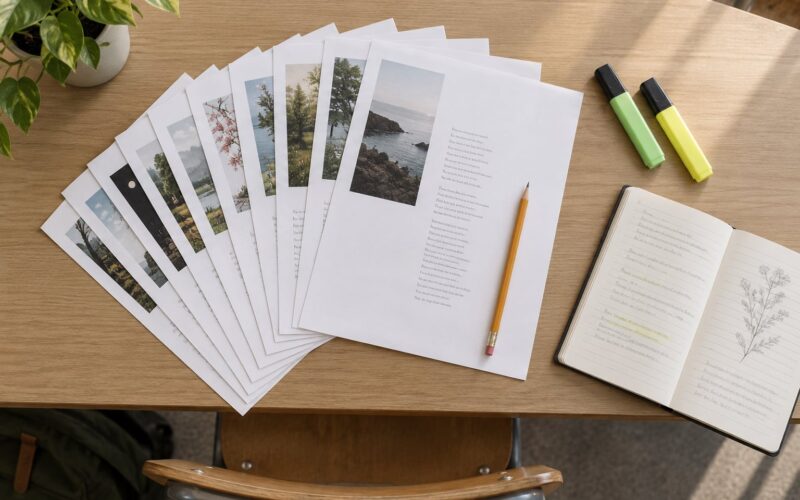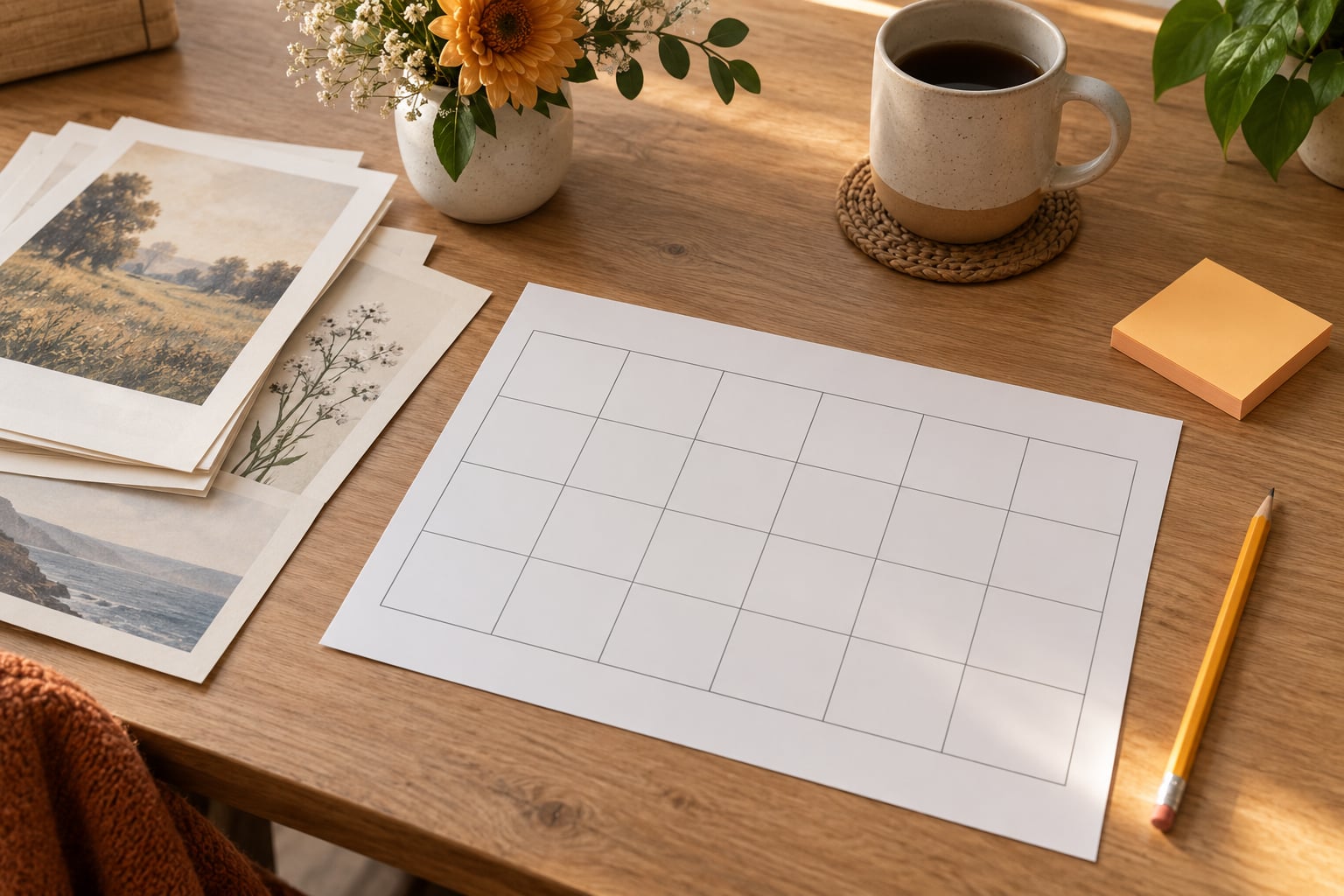
To plan a poetry unit for the whole month, map 18 to 20 class periods across four weekly arcs: a launch that builds foundations, a reading week built on interpretation, an analysis week with real student choice, and a final week of writing, revision, and a public share. The finished plan fits on one page, with one focus, one anchor text, one writing product, and one checkpoint per week.
Most units drift because nobody decided in advance which week the writing lives. Analysis expands until it eats the workshop, or the workshop starts in week one and students spend three weeks calling everything a poem. Writing down the four arcs first keeps both halves in the room.
A month is roughly right. Teachers on r/ELATeachers say two weeks mostly skims the surface, and I have watched a single week turn into a disconnected pile of craft worksheets. Four weeks gives students enough repetition to stop treating poetry as a strange assignment and start treating it as material they can use.
Table of Contents
- What You Need
- Step-by-Step
- Week 1: Build Poetry Foundations
- Week 2: Read and Interpret Poetry
- Week 3: Analyze Craft and Context
- Week 4: Create, Present, and Assess
- How to adapt the same four weeks by grade level
- Common Mistakes
- Frequently Asked Questions
- How many poems should I include in a month-long poetry unit?
- How many class periods does a four-week poetry unit need?
- What should students learn first in a poetry unit?
- How can I differentiate a poetry unit for struggling readers?
- What is a good final assessment for a poetry unit?
- Can a poetry unit work for elementary or advanced students?
- Conclusion
What You Need
Gather these before you build the calendar, because each one constrains something downstream. Students working with nothing but a photocopied poem list will stall in week three, and a unit with no assessment checkpoints is impossible to rescue at the halfway mark.
- One anchor poem. Short, published, and complicated enough to argue about. It becomes the poem you return to on days when the lesson runs short.
- A text set of 8 to 12 poems. Vary the form, the length, and the voice. Include at least two written by poets from backgrounds your students do not sit inside.
- Notebooks or loose paper for drafts, since students need room to cross things out.
- Annotation materials: highlighters in two colors, a one-page guide that names what to mark, and a poetry word wall posted where students can see it.
- A plus/minus quick write for a diagnostic on day one, an exit ticket you can reuse all month, and a single rubric you will not revise until the unit ends.
- Conference sign-up sheet for the workshop week, so conferring time is scheduled rather than promised.
Then check the one constraint that quietly ruins poetry plans: usable minutes. Teachers on r/Teachers describe four back-to-back 40-minute ELA sections, where transitions, attendance, and bell work eat 5 to 15 minutes before any teaching starts. Plan against the minutes you actually get, not the minutes on the schedule.
| Period length | Bell work | Buffer for transitions | Instruction and reading | Writing | Exit ticket |
|---|---|---|---|---|---|
| 40 minutes | 4 min | 5 min | 18 min | 8 min | 5 min |
| 50 minutes | 5 min | 5 min | 24 min | 10 min | 6 min |
| 55 minutes | 5 min | 5 min | 26 min | 12 min | 7 min |
Several teachers say they plan only 40 to 45 minutes of a 60-minute period on purpose, and that buffer is what keeps the next class on time. If your periods are 40 minutes, cut the text set to 8 poems before you cut writing time.
Step-by-Step
Before you open a document, make seven decisions. Each one is quick, and each one saves you a rewrite later.
- Name the outcome. One measurable statement: by the end of the month, students can identify figurative language in a poem and support an interpretation with two pieces of text evidence.
- Choose the anchor poem and read it yourself twice, marking where you resisted it.
- Count your real sessions and subtract the two you know will be lost. That number is your calendar.
- Assign one skill to each week and refuse to add a second.
- Fix the writing product per week so students are never staring at a blank page without a shape.
- Place the assessments before you write the lessons, not after.
- Decide the culminating event in week one, so the writing in week four has an audience.
Here is the whole month on one page.
| Week | Focus | Anchor text | Skill | Writing product | Checkpoint |
|---|---|---|---|---|---|
| 1 | Launch and foundations | Anchor poem, read aloud twice | Line breaks, sound patterns, imagery, diction | Found poem: copy a poem, change one thing, explain it | Plus/minus quick write and one annotated stanza |
| 2 | Reading and interpretation | Three contrasting poems | Tone, perspective shift, literal vs. implied meaning | Paragraph response: what the poem leaves out | Exit ticket naming one shift in tone |
| 3 | Craft and analysis | Student-selected poem plus context source | Evidence-based analysis, structure, context | Analysis of a poem the student chose | Conference notes and a rough thesis |
| 4 | Create, revise, share | Student’s own draft | Revision against a rubric | Final poem or analysis, read aloud or published | Summative rubric and anthology page |
Week 1: Build Poetry Foundations
Open with a diagnostic and a hook in the same period. The plus/minus quick write takes four minutes: students write one sentence on what poetry is for, then one on whether they like it. You are not grading it; you are finding out who is already defensive before you hand them a poem.
Read the anchor poem aloud, twice, with no text in front of anyone the first time. Then give it out and model annotating one stanza out loud, thinking through your own choices. Students copy that behavior more reliably than they follow a list of instructions.
Cover the five basics students will use all month: line breaks and stanza, sound patterns, figurative language, imagery, and tone. Ten minutes of direct instruction here pays back in weeks two and three.
Close the week low-stakes. A three-line response to a prompt, or an exit ticket asking which line of the anchor poem they would cut and why. Nobody has written original poetry yet, and that restraint is deliberate.
Week 2: Read and Interpret Poetry
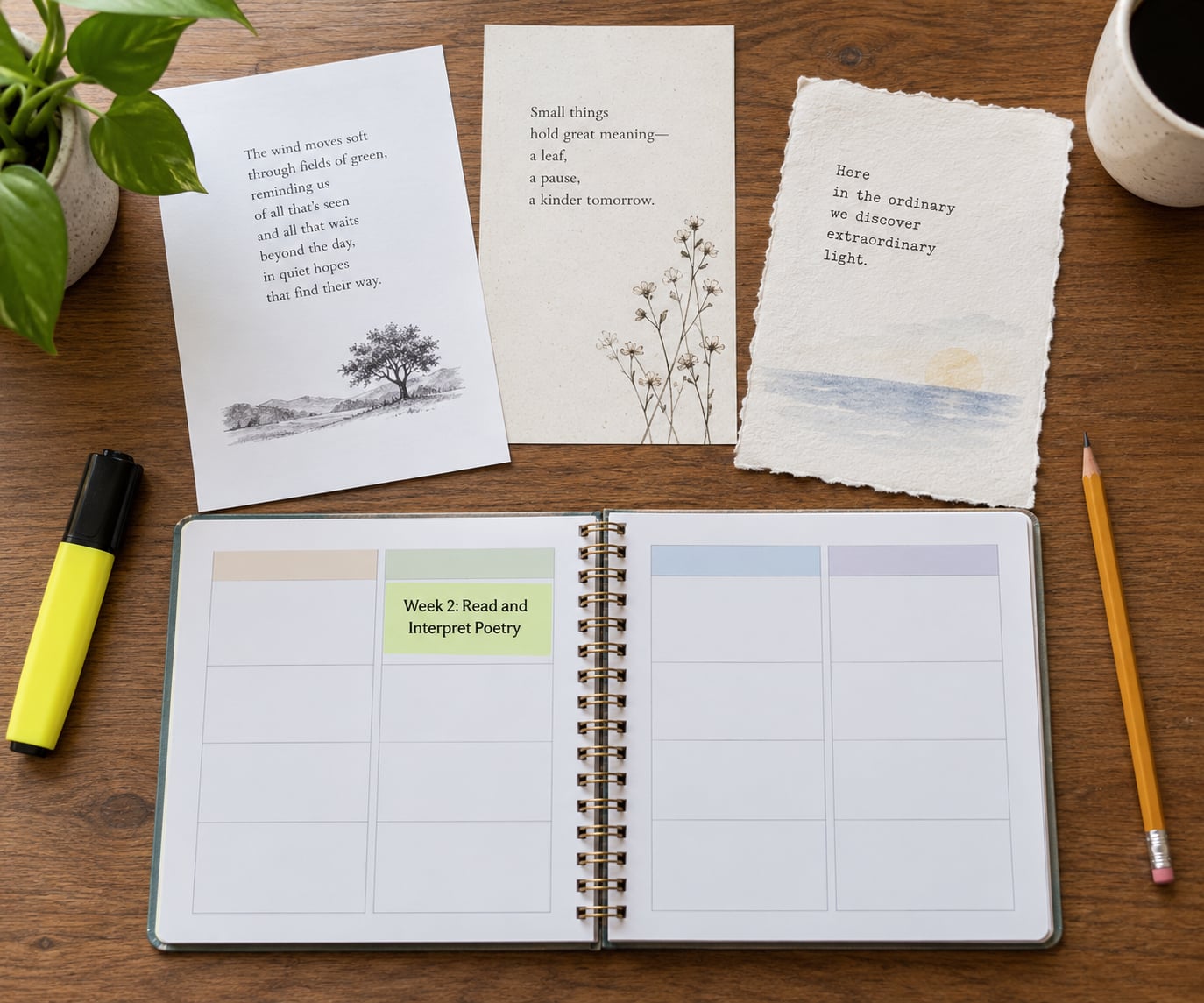
This is the reading week, and the goal is meaning, not terminology. Choose three poems that argue with each other: one with a strict form, one in free verse, one in a voice your students rarely meet.
Work through the five elements as questions rather than definitions. Ask what the line breaks are doing, where the sound pattern pulls you, which image you can see and which one you only infer, and how the tone changes across the poem.
The distinction that matters most this week is literal meaning versus implied meaning. Students who stop at the literal will call a poem about a house about a house. Push for the gap between what is written and what is meant, using one short paragraph response as the week’s writing product.
Ask about perspective shift directly: who is speaking in line one, and who is speaking by line ten? A poem where the speaker changes is worth more class time than three more examples of the same device.
Week 3: Analyze Craft and Context
Give students a genuine choice here. Let each student pick from four or five poems for the analysis assignment, which usually raises the quality of the work when a poem is not assigned.
Teach one repeatable analysis structure so the writing is manageable: claim about how a craft choice creates an effect, two pieces of evidence, and an explanation of the effect on the reader. Then set the context: a short historical, cultural, or biographical source that explains what the poem is responding to.
Context comes before the analysis paragraph, not after. Students who meet the background first can ask better questions about the poem, and they stop treating the poem as an artifact with no circumstances.
Run the week as discussion plus writing rather than lecture plus worksheet. Four or five students presenting a claim and a piece of evidence each buys you a model that the rest of the class can borrow.
Week 4: Create, Present, and Assess
The last week runs on a workshop rotation: a short mini-lesson on one revision move, ten to twelve minutes of silent writing time, and conferences from the sign-up sheet. Students revise against the same rubric they will be graded on, because a rubric they have not seen is a surprise rather than a tool.
The culminating event does not have to be a poetry slam. A class anthology, a paired reading with one response poem, a recorded spoken word performance, or a letter explaining a choice from the poem all count. Pick one in week one and tell students the audience on day one of the unit.
Here is what to check at the end of each week, so nothing depends on a memory you will not have in week four.
| End of week | Formative check | Decision it drives |
|---|---|---|
| 1 | Annotated stanza and exit ticket | Who needs a smaller poem or a guided template in week 2 |
| 2 | Literal vs. implied meaning paragraph | Who is ready for analysis, who needs another guided text |
| 3 | Thesis plus two pieces of evidence | Conference order and which students need the rubric walked through |
| 4 | Final rubric score and self-assessment | Next unit’s placement and what to reteach |
How to adapt the same four weeks by grade level
The arc holds at every level. What changes is the text, the reading load, and how much of the analysis you hold students responsible for.
| Band | Anchor text | Reading load | Writing product | Cut first |
|---|---|---|---|---|
| K-2 | Short patterned and list poems read aloud | Teacher reads, students listen and repeat | Fill-in frames, acrostics, sound poems | All written analysis |
| 3-5 | One short free verse poem | 2 to 4 poems per week, annotated together | Found poem and a single paragraph response | Independent poem selection |
| 6-8 | One sonnet and one contemporary free verse poem | 4 to 5 poems per week | Analysis paragraph with evidence, then one original poem | The context source, not the analysis |
| 9-12 | A longer sequence of two to three related poems | 6 to 10 poems across the month | Full analytical essay or a curated anthology with commentary | Nothing; extend the workshop instead |
Common Mistakes
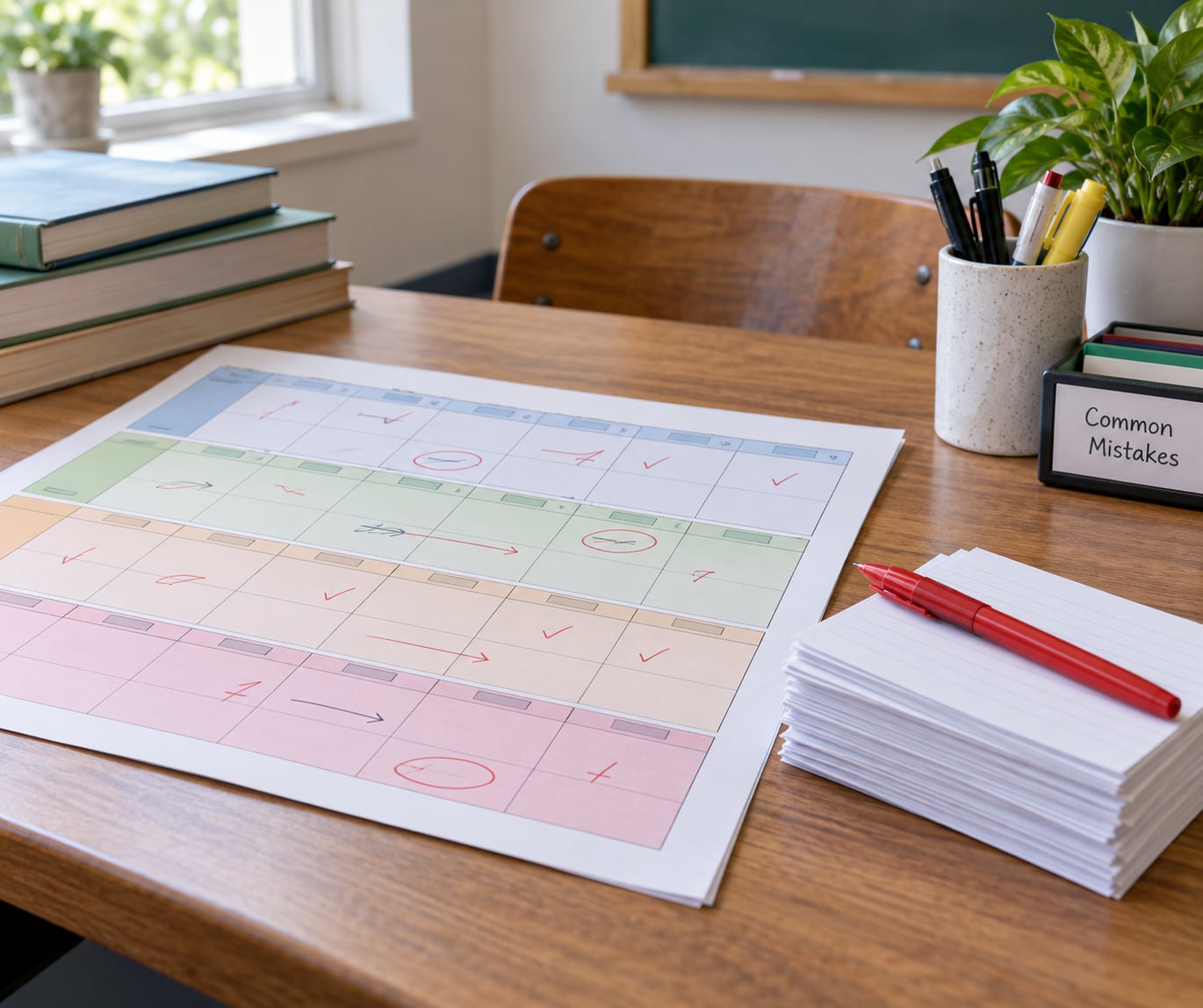
Most of these are planning errors rather than teaching errors, which means they are fixable on a calendar in about ten minutes.
Choosing too many poems. Twelve texts in four weeks sounds generous and produces shallow reading. Fix it now by cutting the set to 8 for 40-minute periods, and by naming three of them as the core the others support.
Delaying context to the end. A poem about a specific event or a specific community makes no sense to students who do not know what is being answered. Put a short context source in front of the poem in the same week, not in the final session.
Skipping formative checks. If the only check is the final poem, you find out in week four that half the class could not tell implied meaning from literal meaning. A five-minute exit ticket each week costs you 20 minutes total and saves the unit.
Assessing only the writing. A good poem and a weak analysis of a poem are different results. Use two criteria, one for the poem itself and one for the reading, and grade them separately.
Starting the workshop in week one. Students who have not read enough poetry yet produce imitation. Hold the writing light for three weeks, then give them the month-long workshop in the final week.
Planning every minute. The plan above is a spine, not a script. When a discussion runs long, borrow from the buffer instead of squeezing the next activity.
And when the unit slips, which it will around testing weeks and absences, cut in this order: the second read-aloud, the independent poem selection, the context source, the extra workshop day. Never cut writing time, and never cut the culminating share, because that is what students remember.
One last problem has no calendar fix. Some students arrive saying they hate poetry, and analysis is the last thing that will convert them. Hand those students a performance or publication task early, let them hear a poem read well, and give them a shorter text to start with. Attitude usually moves when the audience is real.
Frequently Asked Questions
How many poems should I include in a month-long poetry unit?
Aim for 8 to 12 poems across four weeks, and pick three as your core. Three or four are read closely and analyzed, the rest are read aloud or taken home for response work. With 40-minute periods, stay at 8. More than 12 and students read nothing closely enough to make claims about.
How many class periods does a four-week poetry unit need?
Plan for 18 to 20 class periods, which is five days a week for four weeks. Subtract the two periods you know you will lose to testing, assemblies, or a holiday, and plan against what is left. If you only have 10 periods, keep weeks one and two and fold analysis into a single block rather than rushing all four arcs.
What should students learn first in a poetry unit?
Start with reading and attention, not writing. In week one, students learn line breaks, sound patterns, imagery, figurative language, and tone through close reading of one anchor poem you read aloud twice. They also write a short diagnostic so you know which students resist poetry. Original writing comes in week four, once they have read enough to imitate.
How can I differentiate a poetry unit for struggling readers?
Shorten the text, not the thinking. Offer three or four shorter poems as the required set, and pair each new poem with one that repeats a familiar device so students have something to hold onto. Use a one-page annotation guide, keep the poetry word wall visible, and let a partner read aloud before discussion. Scaffolded template paragraphs build the evidence claim without removing it.
What is a good final assessment for a poetry unit?
Use two pieces assessed separately: an evidence-based analysis of a poem and a piece of original writing, each with its own criteria on one rubric. Add a short reflection naming one craft move the student borrowed and where they used it. A public share, an anthology page, or a recorded reading makes the work feel consequential, which is part of the grade in a writer’s workshop.
Can a poetry unit work for elementary or advanced students?
Yes, with a different text set and different expectations. In K-2, read aloud, work with patterned and list poems, and use writing frames instead of analysis paragraphs. In 9-12, expand to a related sequence of two or three longer poems, add a curated anthology with commentary, and let the workshop stretch across two weeks. The four-arc structure stays the same at every level.
Conclusion
Start with three decisions today. Write the outcome in one measurable sentence, choose the anchor poem and a set of 8 to 12 texts, and put one reading task and one writing product on the calendar for each of the four weeks. Everything else, the activities, the handout, the exit ticket, gets built around that spine.
Print the calendar, keep the assessment checkpoints visible where you plan, and protect the writing time first when the month gets crowded.