The best way to memorize a poem for class is to split it into small sections, learn each one by reading it aloud with the page covered, and spread your practice across several days instead of one long session. That is chunking plus active recall, and it beats rereading every time.
Most students lose poems the same way. They read the poem over and over on the bus, it starts to look familiar, and they walk into class believing they know it. Then they open their mouths at line one and nothing comes out.
Familiarity is not recall. Rereading builds the feeling of knowing without building the ability to produce the poem on demand. Real memorization means you can put the text away and say it back word for word, with the right pauses and the right pronunciation.
If you have anywhere from two days to two weeks before the recitation, the six steps below will get you there. Start with the step that feels most obvious, not the one that sounds most impressive.
Table of Contents
- What You Need
- Step-by-Step: How to Memorize a Poem for Class
- 1. Understand the poem before memorizing it
- 2. Break the poem into manageable sections
- 3. Create a first-accuracy memory
- 4. Use cues for line order and meaning
- 5. Practice without the poem
- 6. Rehearse for the class performance
- Common Mistakes
- Frequently Asked Questions
- How long does it take to memorize a poem for class?
- What is the best way to memorize a long poem quickly?
- Should I memorize a poem silently or read it aloud?
- How can I remember a poem’s line order?
- What should I do if I forget a line during the class presentation?
- Is it okay to memorize from a partially visible copy?
- What to Do First Tonight
What You Need
Before you memorize anything, confirm what the assignment actually asks for. Some teachers want the whole poem from memory. Others want four selected lines, and being ready to recite the full thing wastes hours you did not have. A third group asks for a dramatic reading, where accuracy matters less than how you perform it. Ask your teacher, in those words, and get a straight answer before session one.
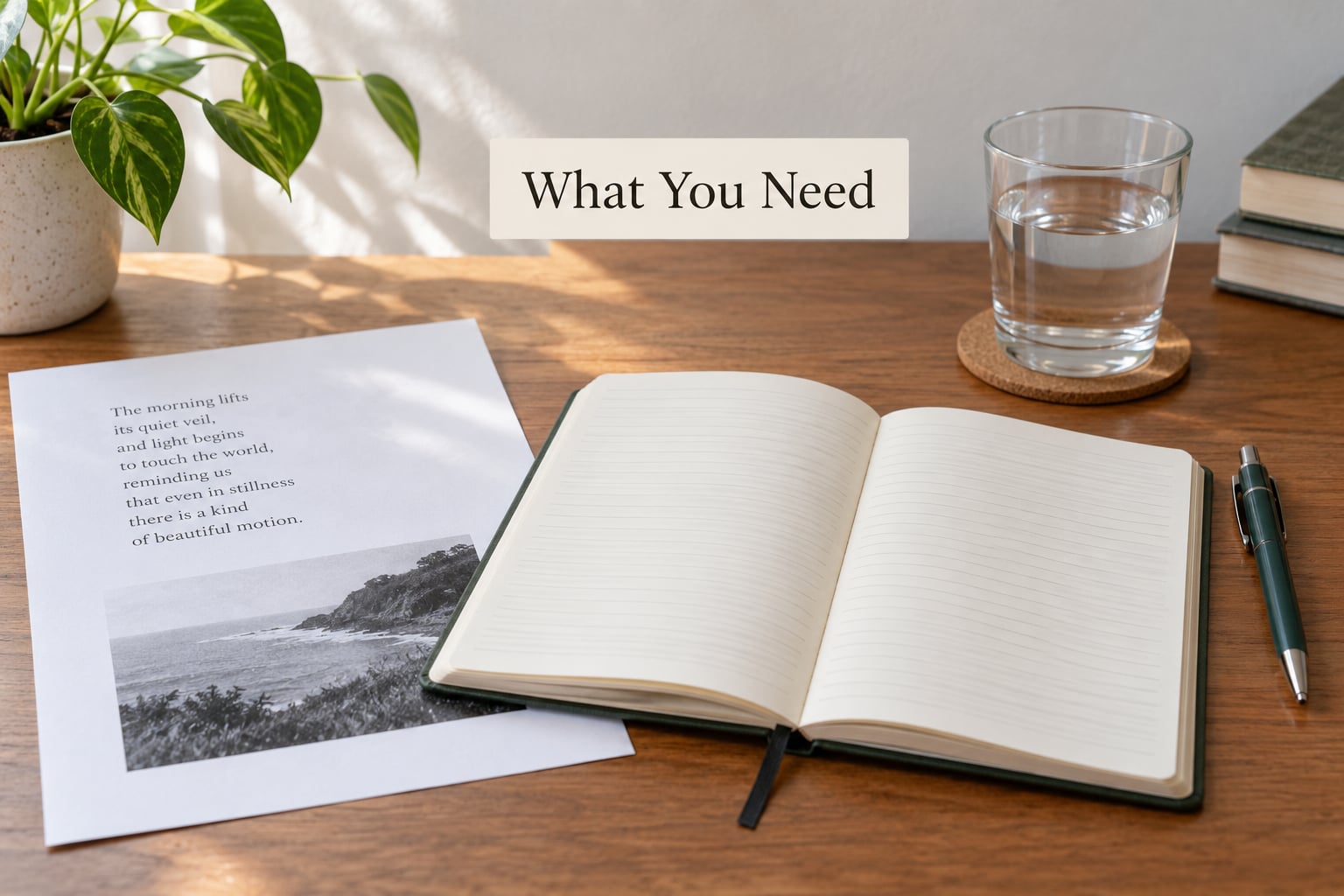
Then gather five things: a clean printed copy of the poem with the line breaks intact, a notebook for your chunks and cues, a pen or highlighter, a phone for recording yourself, and somewhere quiet enough to hear your own voice. The phone matters more than students expect. Hearing yourself mispronounce a word once does more than a dozen silent readings will.
A time estimate helps too. A 14-line sonnet is a one- or two-day job for most people. A 40-line narrative poem with no line breaks is closer to a week of short sessions. A 300-line poem is a project, and pretending otherwise is how students end up cramming and then forgetting.
Step-by-Step: How to Memorize a Poem for Class
1. Understand the poem before memorizing it
Read the poem out loud twice before you try to store it. Not silently. Out loud, at a normal speaking pace, so you hear the line breaks, the punctuation, and any word that stops you.
Then answer four questions in your notebook: who is speaking, what is the subject, what is the mood, and where does it turn. Most poems have at least one shift, usually signalled by a dash, a semicolon, a new stanza, or a change in tense. If you can name where the turn is, you have built yourself a landing point, and landing points are what stop you freezing in the middle.
Now paraphrase the hard lines. Take a line you do not understand and rewrite it in plain words, as if you were explaining it to a friend. If you cannot paraphrase it, you are memorizing a sound pattern with no meaning attached, and it will dissolve the first time you are nervous. This is the single biggest difference between students who recite well and students who freeze.
How do you know it worked? You can say what the poem is about in three sentences without quoting it.
2. Break the poem into manageable sections
Divide the poem into chunks small enough to hold in your head. For most poems, that means one stanza, or three to five lines if the poem runs on without breaks. A chunk should be small enough that you can hold it while reciting, and large enough to have its own shape.
Poems without regular stanzas still chunk well. Look for the natural joints instead: a change of setting, a change of speaker, a shift in tense, a question that gets answered, or a run of short lines after a run of long ones. Emily Dickinson’s poems break almost every rule and still chunk perfectly, because most of them turn on a single word like because or though.
Write the chunks in your notebook with a label each: Chunk 1, Chunk 2, and so on. Label them in order and number the lines inside each one. The moment you need to find a specific stanza in the middle of a rehearsal, that notebook saves you a lot of guessing.
Smaller units are easier to memorize accurately because you get fewer things wrong per attempt. A mistake inside an 8-line chunk is one mistake. The same mistake inside a 60-line chunk is one you may not notice for days.
3. Create a first-accuracy memory
For each chunk, do look, cover, check. Read the chunk aloud three times while looking at it. Cover it with your hand. Recite it back from memory. Check the text and fix every error out loud before moving on.
That loop is called retrieval practice, and it is the part students skip. The covering is what turns passive reading into real work. If you never test yourself, you never find out what you actually retained.
Notice the difference between recognizing and recalling. Recognizing is the feeling of the line looking right when you see it. Recalling is producing it with nothing in front of you. Only the second one is worth anything in class, so every practice session should end with your eyes off the page.
Move to the next chunk only when you can get the current one right twice in a row with no slip. For a sonnet that is four chunks and you might finish in a single sitting. For a longer poem, do one or two chunks per session and stop while you are still getting them right.
Record yourself on your phone at the end of each session. Listening back takes thirty seconds and catches dropped endings, swallowed line breaks, and words you have been pronouncing wrong for a week.
4. Use cues for line order and meaning
Line order is where most recitations fail. You remember the words but not which line comes next. Anchor each line or each small group of lines to something you can picture.
Build a mental image per chunk. Concrete images stick far better than abstract ones. If a poem describes a winter morning, picture a specific one: frost on a kitchen window, one red mitten on a fence post, grey light on a road nobody has driven down yet. Attach each image to the lines that describe it, in order, like frames in a film.
Poems with repetition give you free anchors. Anaphora, where a phrase repeats at the start of consecutive lines, works like a numbered list. If your poem opens three lines with the same words, you do not need to remember three separate openings. You remember one opening and count to three.
Rhyme does the same job at the end of lines. Once you know how a line ends, the next line narrows down dramatically. Alliteration, repeated consonant sounds, works the same way in the middle of lines, and so does meter. Tap the rhythm on your desk as you read. Iambic pentameter has a pulse you can feel, and once you are riding that pulse you stop needing to remember where each line stops.
Finally, remember the last few words of each stanza as a bridge into the next one. If Chunk 2 ends on a particular image, that image becomes the doorway to Chunk 3. Stanza endings are natural reset points, and reset points keep you from drifting off the tracks.
5. Practice without the poem
Use a practice ladder, and climb it gradually. Start by reciting a chunk from memory with the copy fully covered. When that is solid, move to a blank page, since even an open copy tempts you to glance. When the blank page is comfortable, try holding the copy so only the first two words of each line are visible. Finally, put the poem in another room.
Between attempts, correct yourself out loud. Do not restart the whole chunk after one error. Say the line you missed, then carry on. Restarting teaches you to fear small mistakes, which is exactly the wrong reflex when you are standing in front of a class.
Studying with a partner works well. Give each person one stanza, have you learn yours, then recite the whole poem in order to each other. Nobody can fake it, because the next person is waiting on your lines. For students who learn better by doing, act out the physical movements the poem describes while you say it, or clap or tap the stress on the important words. Users on r/GetStudying and similar study forums repeatedly describe chunking plus reading aloud as the combination that finally worked for them, and the pattern holds up.
Space your sessions. The gap between two practice sessions is doing work. A poem practiced for 25 minutes on Monday, 25 minutes on Wednesday, and 20 minutes on Friday will hold up far better in next week’s class than the same total time in one three-hour session on Sunday night. Each gap is a chance to retrieve, and retrieval is what builds long-term memory.
How do you know a chunk is ready? You can recite it twice in a row with no errors, at least a day after you learned it, without checking.
6. Rehearse for the class performance
Memorizing the words is only half the assignment. Stand up and perform the whole poem out loud, at the pace you will use in class, with the pauses the punctuation asks for. A pause at a full stop and a pause at a comma are not the same length, and getting them right makes you sound like you belong on stage rather than reciting.
Pronunciation is where marks are quietly lost. Older poems and translated poems often contain words in a dialect or a language you do not speak. Listen to a recording by a competent reader, or ask your teacher to say the difficult words for you, then do listen-and-repeat: play a short clip, pause, and say it back exactly. Do this for every unfamiliar word before you try the lines that contain it.
Some students hit assigned audio that contradicts how they naturally speak and end up with two versions of the word competing in their head. Decide once which version you will use, write it down phonetically in your notebook, and commit. Consistency matters more to your recall than which choice you make.
Practice to the back row. Stand at the far end of a room, or at least across it, and project. People who have only recited quietly to themselves are often too quiet in front of an audience, and you can hear the difference from the back of a classroom. Slow down slightly. Nerves speed everyone up.
Run two timed full recitations in the days before the performance, with no pauses and no starting over, so you know whether you are finishing inside the time your teacher allows. Then do one final read-through with the poem in front of you, and put it away. Do not drill it on the morning of the performance.
If you blank mid-recitation, do this: stop, breathe once, and say the last few words you delivered correctly. Recovering backwards from words you have already said is far easier than jumping forwards, and the last line of any chunk will usually pull the next one in behind it. If you are truly stuck, name what is happening, paraphrase it in your own words, and keep going. A paraphrase with a slip still earns far more credit than silence.
Common Mistakes
Rereading instead of retrieving. Reading the poem feels productive because the difficulty drops every time. That ease is the problem. Fix it by ending every single session with the text covered and reciting from memory. Extra tip: put your copy in a folder and only take it out for the look, cover, check part.
Practicing only silently. Silent reading trains your eyes, and you will be reciting with your voice. Reading aloud engages a second channel and locks in phrasing, stress, and line breaks at the same time. Fix it by reading every chunk aloud, even if you feel silly. Extra tip: stand up. It changes your breathing and your volume without you deciding to change them.
Skipping the hard lines. Everyone rehearses the sections that feel easy, which is why those are the only sections they can do in class. Fix it by spending half your practice time on your weakest two chunks, even if they are your favorites. Extra tip: if a line will not stick, say it five times, then immediately recite the lines on either side of it.
Ignoring punctuation and line breaks. Punctuation is a set of performance instructions. A comma is a breath, a semicolon is a longer pause, a dash is an interruption. Ignore them and your recitation will sound breathless and you will be tempted to run lines together. Fix it by reading with your finger tracking the punctuation marks. Extra tip: write the pause type next to the line in your notebook.
Cramming the night before. A three-hour session feels like enormous effort, but a tired brain consolidates nothing well. This is why students can recite a poem perfectly at midnight and lose the first stanza by breakfast. Fix it by starting a week out, even if it is only ten minutes a day. Extra tip: if you genuinely have one night, learn chunks in order, record yourself, and sleep before the recitation rather than practicing until the alarm.
Treating memorization and understanding as one skill. Some students can recite a poem perfectly and write nothing intelligent about it. Others can analyze it beautifully and freeze at line one. These are separate skills trained separately. If the assignment also involves analysis, study the poem twice: once for meaning, once for the words. Extra tip: pull three quotation lines you could drop into an essay, and learn those to the same standard as the recitation.
Frequently Asked Questions
How long does it take to memorize a poem for class?
It depends almost entirely on length. A 14-line sonnet takes one focused afternoon plus a second check the next day. A 40-line narrative poem with few line breaks usually needs three to five short sessions. A long poem of 200 lines or more is a week of daily practice. Budget roughly 20 minutes per 10 lines of rhymed verse, and more if the poem has unfamiliar vocabulary or no end-rhyme to hang lines on.
What is the best way to memorize a long poem quickly?
Chunk it and never attempt the whole thing at once. Divide a long poem into sections of 20 to 40 lines based on scene changes or speaker shifts, learn the first chunk until you can recite it twice with no slip, then add the next. Practice retrieval with the text covered every single session, and leave the hardest chunk for last so it gets your freshest attention. Spreading sessions across a week beats one long cram session.
Should I memorize a poem silently or read it aloud?
Read it aloud, every time. Speaking the poem trains phrasing, stress, and line breaks at the same time as the words, and you will be performing with your voice in class, not your eyes. Speaking also slows you down enough to catch mistakes you would skim past silently. Use silent reading only as a quick warm-up before an aloud session, never as the session itself.
How can I remember a poem’s line order?
Anchor each line or group of lines to a picture, and use the poem’s own structure as a guide. Rhyme tells you how a line ends, repetition of a phrase tells you where you are, and a change of tense or speaker marks a new section. Memorize the last few words of each stanza as a bridge into the next one. Practice jumping straight to any stanza you name, so you are not only running the poem from the top.
What should I do if I forget a line during the class presentation?
Stop, breathe once, and repeat the last few words you said correctly. Going backwards into what you have already delivered is much easier than jumping forwards, and it usually pulls the next line in behind it. If you are truly stuck, say the idea in your own words and keep moving rather than stopping. A paraphrase with a slip earns far more credit than a long silence.
Is it okay to memorize from a partially visible copy?
Yes, but only as a late-stage rehearsal aid, not as your main method. A copy where you can see just the first words of each line is a useful final check before a performance. Studying that way from the beginning lets you lean on the page, and you will not have trained the retrieval you need. Learn chunks fully covered first, then use the partial copy only to test whether you can find your place under pressure.
What to Do First Tonight
Chunk the poem before you do anything else. Divide it into labelled sections in your notebook, find the turn where the meaning changes, and learn the first chunk tonight with the text covered. Then put session two on tomorrow’s calendar, even if it is only twenty minutes.