
The fastest way to get students participating in book discussions is to replace open-ended questions with a structured protocol where every student has a defined role, a rehearsed way into the conversation, and a reason to listen. Think-pair-share, a Socratic seminar, or literature circles with role cards raise talk time far more than any prompt you write on the board.
Most teachers searching how to get students to participate in book discussions are not short on questions. They are watching three confident students answer everything while the rest of the class stares at the desk. The silence is structural, not attitudinal, and it responds to structure.
Each move below takes about fifteen minutes of prep the night before. Start with the first two steps and you should see a difference in the first week.
Table of Contents
- What You Need
- Step-by-Step
- How to Get Students to Participate in Book Discussions: Prepare Them First
- Start With a Predictable Discussion Structure
- Use Questions That Require Evidence
- Offer Multiple Ways to Participate
- Respond Without Taking Over the Conversation
- Close With Reflection and Follow-Up
- Common Mistakes
- Frequently Asked Questions
- What do I do when only a few students participate in book discussions?
- How can I include shy students without forcing them to speak in front of the whole class?
- What questions get students talking about a book instead of only saying whether they liked it?
- Should I grade students on their participation in book discussions?
- How long should a book discussion last with middle school or high school students?
- How do I keep a discussion focused when students give unrelated answers?
What You Need
None of this needs a new curriculum or a subscription tool. It needs six things you can assemble in one sitting.
- The text, narrowed down. Decide which chapters or sections are actually discussable. A novel unit covers 300 pages; a discussion that lasts 40 minutes can only touch four or five moments.
- Six to ten questions, preselected. Write them on paper or in a shared doc. Questions invented live in front of 28 students sound vague, and vague questions get vague answers.
- A response method everyone can use. Annotation in the book, sticky notes, index cards, or a shared document. The medium matters less than the fact that all 28 students are using the same one.
- Role or protocol cards. Facilitator, questioner, connector, summarizer, vocabulary enricher. Five roles per group of five is enough for most novel units.
- A pacing plan with a visible timer. Knowing what you are skipping matters more than having time for everything.
- A quiet option. Writing first, partner talk, or a pass token. Every room needs a way for a student to contribute without being watched.
Step-by-Step
How to Get Students to Participate in Book Discussions: Prepare Them First
Students who sit down unprepared sit down silent. Five minutes of low-stakes writing before the discussion does more for participation than any facilitation trick you can pull out afterward.
Ask students to mark two passages they could quote and write one sentence about why each one matters. That gives you a bank of quotable lines from every reader in the room, including the student who would never volunteer a thought cold.
Then sort your preselected questions into three groups: comprehension, craft, and connection. Students who freeze on open questions will often answer a narrow one. Give them the narrow one first.
Assign roles before class starts, not on the fly. Students know who is facilitating and who is asking questions, so they know they will be called on by name and role rather than by surprise.
A middle school teacher in one English teachers forum described the same habit working in reverse: a K-5 special education co-teacher runs affinity mapping because it begins as quiet individual thinking before anyone has to speak in a group. The written start is what makes the spoken part survivable.
Start With a Predictable Discussion Structure
Predictability is what lowers anxiety. Students who know the shape of the next twenty minutes can spend their attention on the book instead of on the social risk of talking.
Put the goal on the board in student language. Not Discuss the novel but One thing that changes how you read chapter 14 works because it tells students what an answer sounds like.
Teach the response-and-listen routine explicitly, even in week one. One person speaks, everyone else listens without interrupting, then the listener has to name something they added. Practise it once with something trivial before you use it on a novel.
Wait longer than feels comfortable. After a question, most teachers count to about two in their head. Count to five in yours. The last two seconds are usually where the actual answer arrives.
For K-2, keep the whole routine to one norm: hands stay quiet, everybody talks once. For 9-12, add talk moves and let students argue about interpretation.
Use Questions That Require Evidence
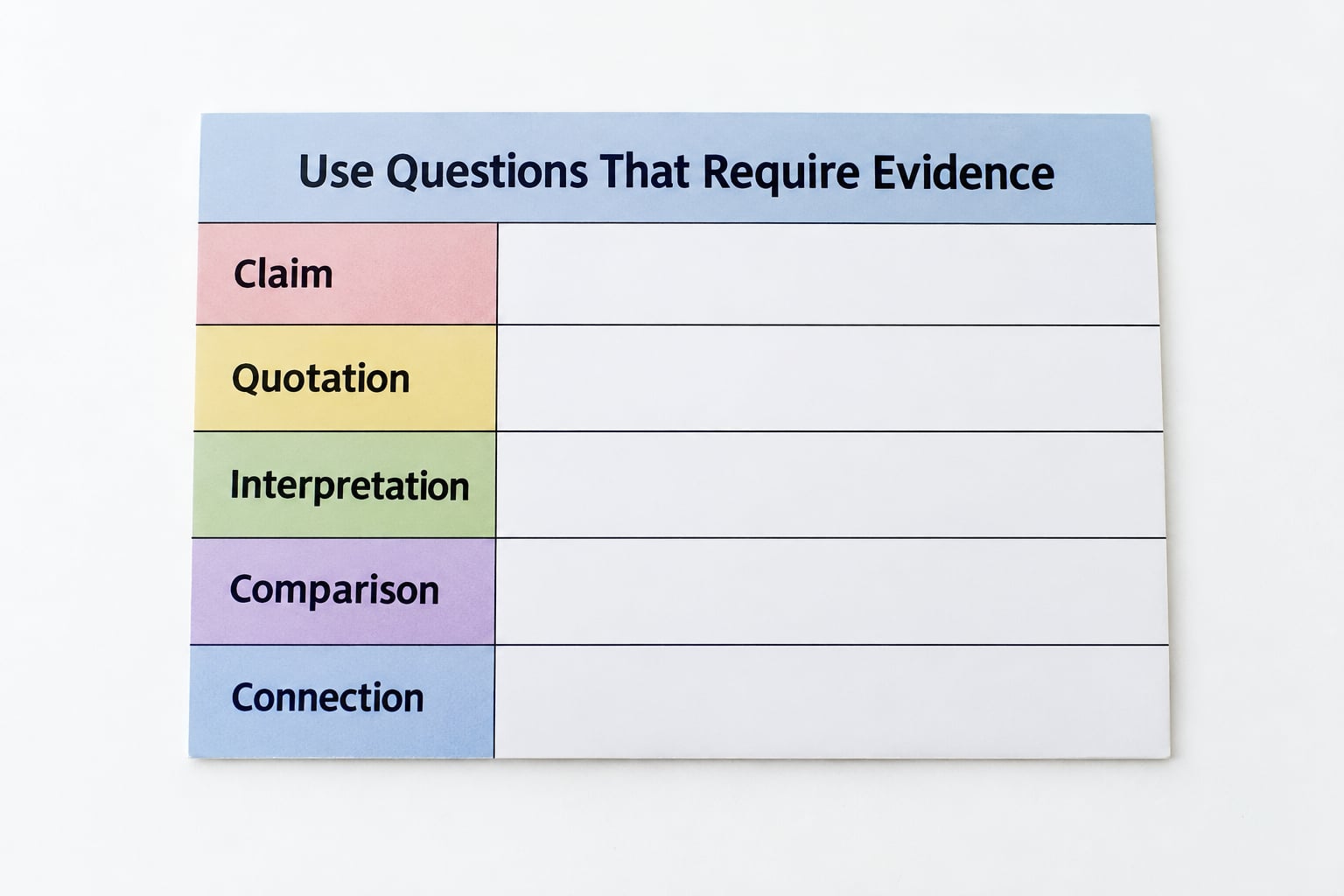
I liked it is not an answer to anything. Questions that require students to point at the text give quiet readers something to hold onto and give you a way to tell guessing from reading.
Build questions in five moves, and escalate through them:
- Claim. What does this section suggest about the central conflict? Which word or sentence in it carries the most weight?
- Quotation. Find one line that proves your point and explain why the author chose those words.
- Interpretation. What changed for this character between the beginning and the end of this chapter, and what sentence shows it?
- Comparison. How does this character handle the same problem differently from the one in chapter 3?
- Connection. Where does this moment show up in the last quarter of the book that you did not expect?
Watch what happens when you require evidence: the discussion stops being about whether students liked the book and starts being about what the book is doing. That is the shift you are after.
Offer Multiple Ways to Participate
Not every student thinks out loud. Matching the format to the student is the difference between a class where six people talk and one where twenty-eight people contribute something.
| Format | Prep time | Every student contributes | Best for | Grade band |
|---|---|---|---|---|
| Think-pair-share | 5 min | Yes, in pairs first | Launching any unit cold | K-12 |
| Turn and Talk | 2 min | Yes, in pairs | Checking understanding mid-lesson | K-12 |
| Silent written discussion, then share | 5-10 min | Yes, on paper | Shy writers, anxious speakers, ELL students | 3-12 |
| Literature circles with assigned roles | 20-30 min | Yes, role by role | Sustained novel units | 3-12 |
| Fishbowl | 10 min | Partly, observers rotate | Modeling good discussion language | K-8 |
| Gallery walk | 20 min | Yes, in writing | Lots of student work on display | 4-12 |
| Four Corners | 10 min | Yes, by standing | Fast formative check on a question | 2-12 |
| Socratic seminar | 15-20 min | Partly, by design | Close reading and theme work | 6-12 |
| Harkness or Spider Web | 30 min+ | No, student-run | Advanced groups, honors, seminar | 9-12 and college |
Three details make a role system actually work. Hand the role out at the start, not as a reward for talking. Give each role a job that is not answering questions, so quiet students are not forced into the same slot as loud ones. And keep roles for two to three sessions before rotating, so students actually learn them.
Online and hybrid rooms need their own version. Silent written discussion in a shared document works better than video threads, and a backchannel chat lets students type a thought to you privately before you take the class to the board.
If students write first, they say more. One teacher described running silent written discussion in groups of three and four so shy students got heard and everyone was forced to listen before responding.
Respond Without Taking Over the Conversation
The fastest way to kill participation is to answer your own question or to praise and move on before a student has finished a sentence. Facilitation means staying on the side of the room.
Three sentences do most of the work. What do you mean by that? How did you come to that conclusion? Have you considered another reading? Each one hands the floor back instead of closing it.
To bring in someone who has not spoken, remove the audience first. Ask the group, then ask the quiet student to be the one to press the speaker for evidence, not to add a new idea of their own.
To handle a dominant voice, give them a job: facilitator, with the task of pulling three other people in. It flatters them and moves the floor without a confrontation.
When a student gives you one word, do not move on. Repeat the question back with a condition attached. Give me one sentence and tell me which line it came from. That single re-prompt fixes most of what teachers call unhelpful answers.
The talk moves below are worth printing on a small card and leaving on students’ desks. They are the language of accountable talk, and they make a claim, an addition, and a challenge possible for a student who has never used them out loud.
Adding on to what ____ said, I want to add ____.
I agree with ____ because on page ____ it says ____.
I see it a different way. The part that makes me say that is ____.
Can you say more about what you mean by ____?
I want to push back on ____ because ____.
My evidence for that is the line ____.
One more thing nobody prepares you for: once participation works, the discussion can take over your unit. A middle school teacher reported losing four to five class periods per novel because so many students had something to say. Budget for that by choosing the discussion moments in advance and writing down the one you will cut.
Close With Reflection and Follow-Up
A discussion that ends without a written artifact leaves you with nothing to assess and nothing to build on. Close it deliberately.
Use an exit slip with three prompts: one idea I did not expect today, one question I still have, one sentence I could use as evidence. Five minutes, and you get comprehension and participation data in the same pass.
Track who spoke, not just who spoke loudly. A quick tally on a seating chart during partner talk tells you something no amount of hands-raising will: that half your class contributed without anyone noticing.
Then carry it forward. Start the next session by naming two anonymous contributions from the exit slips, and build the next discussion on the questions students wrote instead of the ones you planned.
Do not grade speaking volume or personality. Grade the artifact: the quality of the evidence, the clarity of the claim, the questions a student generated.
Common Mistakes
Mistaking a discussion for a question-and-answer session. If you are doing most of the talking, or answering your own questions, you are teaching at them. Cult of Pedagogy named this pattern Fisheye Teaching, and it is the single most common cause of dead class conversations. Fix: aim for a ratio where the teacher talks under a third of the time, and count it once for one lesson.
Asking what do you think. It invites opinion and returns nothing. Fix: attach a condition to every question. Which sentence in the text supports that?
Relying on volunteers. Hands tell you who is comfortable, not who is prepared. Fix: assign roles, or use a structure that requires every student to produce something first.
Forcing participation through a tally. A rule about everyone responding at least twice produces exactly the shallow one-line answers it was meant to prevent. Fix: grade the written artifact instead of the count, and let the count be a formative signal for you.
Letting discussion eat the unit. This is the problem nobody warns you about. Once students actually engage, a 40-minute plan becomes three periods. Fix: decide in advance which chapters get live discussion and which get a written response, and protect the rest of your calendar.
Skipping students who did not finish. One unprepared voice can derail a whole seminar. Fix: give a catch-up option before the discussion, and treat it as ordinary rather than as an exception to call out.
Three habits keep a discussion culture alive over a school year. Keep the structure identical for three or four weeks before you change anything. Celebrate a student building on someone else’s idea by name, publicly, early in the year. And keep a small stack of written fallbacks in your desk, because the format that works on Tuesday can collapse on Wednesday.
One more objection worth taking seriously. Some teachers hear structured protocols and think of them as parlor games, and the research on discussion quality is not uniformly friendly to formalized formats. The honest answer is that protocols are scaffolding. A student who learns the moves in September can drop the scaffolding in March, and a good unit should end with a plain conversation nobody is managing.
Frequently Asked Questions
What do I do when only a few students participate in book discussions?
Stop calling on volunteers and switch to a format where talking is not a public act. Think-pair-share, silent written discussion, and four Corners all produce a contribution from every student within a minute. Once everyone has a position in writing or on paper, you can bring those positions into the whole class. Three confident speakers cannot dominate a room where everyone already has an answer.
How can I include shy students without forcing them to speak in front of the whole class?
Give them a written or small-group route first, then a role that is not answering. Silent discussion, partner talk, and literature circle roles such as vocabulary enricher or summarizer let a quiet student contribute without standing in front of 27 people. Asking a shy student to press someone else for evidence is another low-visibility option. Many will volunteer for whole-class talk once they have said it once in writing.
What questions get students talking about a book instead of only saying whether they liked it?
Ask questions that cannot be answered with an opinion. Try Find one line that proves your point and tell me why the author chose those words, or What changed for this character, and which sentence shows it. The five-move pattern of claim, quotation, interpretation, comparison and connection gives you a sequence to escalate through. Evidence requirements also let you redirect a student who drifted off the text.
Should I grade students on their participation in book discussions?
Grade the artifact, not the volume. An exit slip with a claim, a quotation, and a question tells you far more about comprehension than counting hands, and it does not punish students who are quiet or have processing delays. A participation rubric can still be useful if its criteria are the quality of evidence and the quality of questions a student generates.
How long should a book discussion last with middle school or high school students?
Budget 25 to 35 minutes for a focused middle school seminar, longer if the protocol includes a writing start. A sixth-grade teacher reported that TQE, a thoughts-questions-epiphanies routine, works well but eats 30 to 45 minutes on its own. Keep the format consistent and short rather than long and variable, and decide in advance which chapters get live discussion so one conversation does not consume the unit.
How do I keep a discussion focused when students give unrelated answers?
Interrupt with the text rather than with authority. Ask which sentence the comment came from, or ask the student to connect it to the chapter goal written on the board. If an answer is genuinely interesting but off-topic, park it visibly on a parking lot chart and move on. Students stay focused when they trust that the interesting thought will not be lost.
Start tomorrow with five minutes of writing: every student marks two passages and writes one sentence about each. Then run partner talk on the first question and require a quotation. That single sequence, done the same way four times in a row, is how to get students to participate in book discussions without anyone being put on the spot.