Most people who say they hate poetry do not hate poetry. They had one bad classroom experience, opened a dense book at random, or were handed a poet who assumed they already knew the rules. Pick a book that meets you where you are and reads out loud well, and the dread usually dissolves within a few pages. These ten titles, current as of 2026, are chosen for immediate readability rather than literary reputation.
Start with the table below if you want to choose by reading style instead of by fame. Everything here can be borrowed from a library, so you can try three or four before you commit to a single purchase.
Table of Contents
- Poetry Books for Beginners Who Think They Hate Poetry at a Glance
- 1. How to Read a Poem by William Easterling
- Reading Poetry Books for Beginners Without Pretending to Like It
- 2. Sound and Sense by Perrine
- 3. The Poetry Handbook by Mary Oliver
- 4. Poetry 101 by Michael B. Devlin
- 5. The Penguin Book of American Poetry by various poets
- 6. How Poetry Works by David D. Orr
- 7. Puck of Pook’s Hill by Rudyard Kipling
- 8. The World as We Knew It by John Burnside
- 9. Nasty Women by Ada Limón
- 10. Ordinary Light by Mark Strand
- Frequently Asked Questions
- Do I need to understand poetic terms before I start reading poetry?
- Why do some poems feel confusing when other writing seems straightforward?
- How should I annotate a poem without turning it into homework?
- How do I choose poetry books for beginners who think they hate poetry?
- Is it normal not to understand or like a poem on the first reading?
- Should I read poetry aloud or only silently?
- Conclusion
Poetry Books for Beginners Who Think They Hate Poetry at a Glance
This table lists each book by the format it takes and the kind of reading experience it offers, so you can pick the route that matches your taste rather than its reputation.
| Book | Format | Main appeal for reluctant readers | The experience you get |
|---|---|---|---|
| How to Read a Poem by William Easterling | Compact guide | Explains the devices you were never taught | Technique first, poems second |
| Sound and Sense by Perrine | Textbook | Answers the mechanics question once and for all | Structured, thorough, dry in patches |
| The Poetry Handbook by Mary Oliver | Short essays | Reassures you before asking anything of you | Advice, encouragement, attention |
| Poetry 101 by Michael B. Devlin | Anthology with an introduction | Answers what counts as poetry and why | History plus a wide sampler |
| The Penguin Book of American Poetry | Large anthology | Many voices, so one will fit | Survey across three centuries |
| How Poetry Works by David D. Orr | Critical guide | Shows why line breaks and rhyme matter | Interpretation with examples |
| Puck of Pook’s Hill by Rudyard Kipling | Narrative poems | Stories you follow without decoding anything | Plot, character, wit |
| The World as We Knew It by John Burnside | Contemporary collection | Ordinary subjects rendered freshly | Precision, quiet strangeness |
| Nasty Women by Ada Limón | Contemporary collection | Direct voice, humour, sensory punch | Forceful, funny, contemporary |
| Ordinary Light by Mark Strand | Contemporary collection | Counterweight to poems that shout | Spare, quiet, rewards rereading |
1. How to Read a Poem by William Easterling
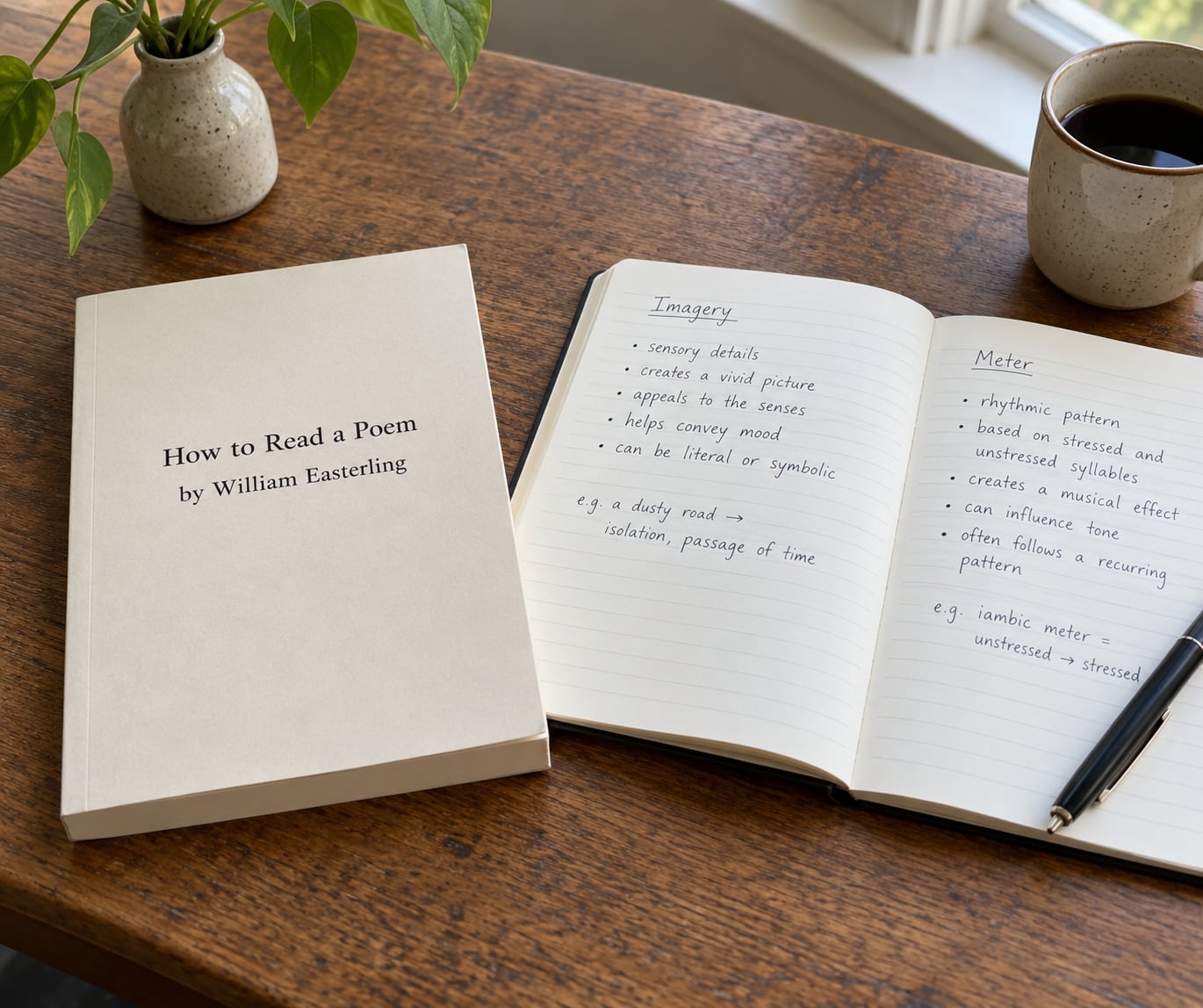
Easterling’s guide is the shortest path through the barrier. It walks through imagery, syntax, sound, and line breaks in plain paragraphs, then shows how those elements combine in a reading, without assuming you have ever studied literature.
The useful part is not the definitions. It is the shift in attention they create. Before, a poem was a wall with a hidden message. After a few pages, you start noticing that the poet chose that word, that break, that repeated sound, and that noticing is most of the reading.
Try this on one image-heavy poem before moving on. Read it once for the first physical reaction, ignoring interpretation entirely. Then read it line by line and write a plain paraphrase of each line in your own words, as if telling a friend what happened.
Reading Poetry Books for Beginners Without Pretending to Like It
Use the guide actively rather than as background reading. Underline the images that stay with you, mark repeated words, and say each stanza aloud to hear where the breath lands.
The point of that exercise is diagnostic. A poem that leaves you cold but clear probably is not for you, and that is fine. A poem that leaves you muddled on the first pass is often just one you have met for the first time.
Give it a second reading the next day before you file it away. Most reluctant readers I have talked to describe the same pattern: nothing on the first read, something small on the second, something that stays on the third.
2. Sound and Sense by Perrine
Perrine’s textbook is the book people mean when they say they studied poetry and hated it. It covers rhythm, rhyme, diction, metre, tone, and figurative language in a careful, systematic order, with examples for each.
Used as a reference rather than a read-through, it is genuinely useful. A beginner who keeps hearing terms they do not own can look up rhyme scheme, iambic metre, or paradox in a page and get a workable definition plus an example.
The chapter on figurative language pays off fastest. Learn simile, metaphor, metonymy, personification, synecdoche, and irony there, and a large share of ordinary poems become readable on the spot.
A nursery-rhyme cadence helps. Take a short, rhyming poem with a plain tune and count its stresses while you tap the table. Once you hear the beat, an abstract poem stops feeling arbitrary, because the rhythm is doing the same work.
3. The Poetry Handbook by Mary Oliver
Oliver’s handbook is part craft advice and part permission. She writes about attention, patience, imagery, and the value of rereading, in short chapters you can read between other books.
Her argument is that a poem rewards the reader who slows down. That is easy to agree with and hard to do, which is why her prompt is practical: choose one poem, read it once, read it aloud once, then read it again the next morning.
Her prose collection Devotions is the gentler companion to the handbook, and it is built from short pieces that fit in a spare ten minutes. Readers who finish a chapter of prose in a queue often go on to open a poem next.
Beginners who start here usually end up with a daily habit rather than a finished collection, which is the better outcome anyway.
4. Poetry 101 by Michael B. Devlin
Devlin’s anthology answers the questions a first-time reader is too embarrassed to ask. What counts as poetry, where the major movements came from, why form changed, and how to talk about a poem without performing expertise.
That last point matters more than it sounds. Beginners often feel they need a vocabulary before they are permitted an opinion. The introduction gives enough language to describe what you notice, which is all you need to have a real response.
Because the selections span a range of periods and styles, the book also quietly demonstrates that there is no single house style. Free verse, rhymed verse, narrative poems, and dense short lyrics all sit in the same book, all legitimate.
Read the introduction, then read twenty poems and see which two you would rather have again. Those two are your entry point.
5. The Penguin Book of American Poetry by various poets
A big anthology is useful precisely because it is undemanding. No one is chosen for you, no one is expected, and you can stop whenever a poet does not interest you.
The temptation with a book this wide is random browsing and fatigue. Instead, start with five poems by one poet. Read them in sequence, let the voice settle, and notice whether you want a sixth.
You do not need to catch every historical reference. A poem from 1915 will allude to things you will not know, and the poem still works without them, the same way a song still works when you cannot place its story.
Treat the anthology as a map rather than a syllabus. A poet whose five poems all leave you indifferent can be skipped permanently, and that is a fast, painless way to find your own handful of names.
6. How Poetry Works by David D. Orr
Orr’s guide explains the machinery: form, sound, syntax, line break, rhyme, and the choices a poet makes. It is written for readers who want to understand technique rather than chase feeling alone.
The payoff is that you start hearing effects you used to absorb without noticing. A line break can hold a thought suspended. A rhyme can pull two distant words together and give the line an extra jolt on landing.
This is the book that answers the reader who says, I got the emotion but I do not see why it is arranged that way. It supplies the reason without turning poetry into a code to be cracked.
Work through one chapter at a time, then apply it to a poem you already enjoyed from feeling alone. The gap between what you liked instinctively and what you can now name is where the reading habit starts to feel like skill.
7. Puck of Pook’s Hill by Rudyard Kipling
This is the recommendation for anyone convinced that poetry has to be hard to be worth reading. Kipling’s poems here are short, narrative, and funny, with characters, plot, and dialogue. You can follow the story without any apparatus at all.
The framing device is a small mythological creature narrating history to a group of children on a Sussex hillside, which means the book is a collection of tales rather than an argument.
Read two selections aloud in one sitting. The rhythm shows itself immediately, and the humour lands harder with a voice behind it. Children read these at school for a reason: the stories move fast.
It is also a useful corrective to the idea that poetry is modern, fragile, or only for adults having a difficult afternoon. The book is old, and it is a pleasure.
8. The World as We Knew It by John Burnside
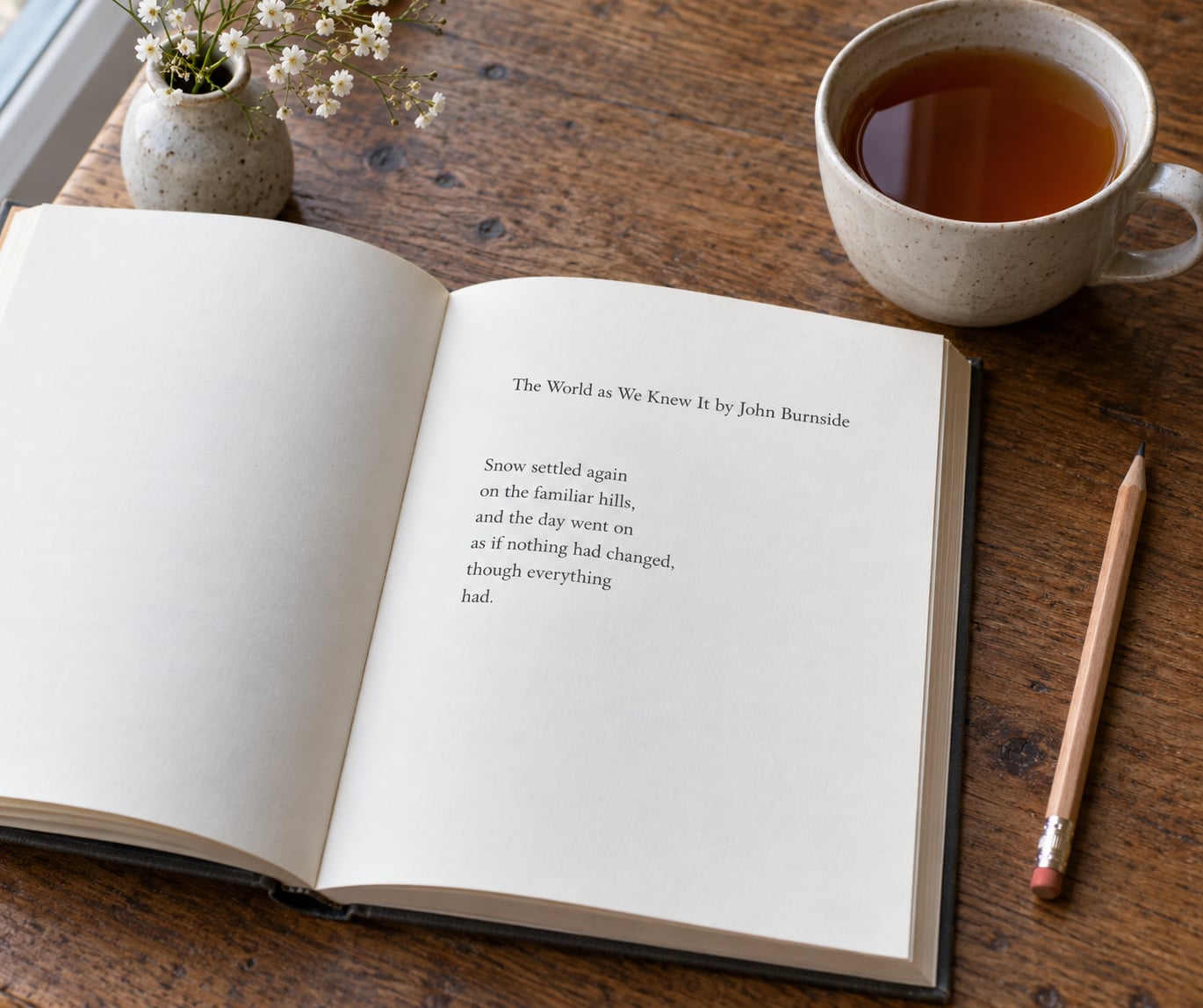
Burnside writes about ordinary things, including the small dead animals kept in drawers and cupboards, and renders them with a plainness that can be quietly unsettling. Nothing about the subject matter demands a technical vocabulary.
The poems are accessible in the literal sense: everyday words, clear scenes, a first-person voice. That makes this a good collection for readers who felt excluded by poems built entirely out of abstract nouns.
Work through one accessible poem twice. On the first pass, list every concrete image in the order it appears. On the second, ask what shifts between the opening images and the closing ones, and you will have the shape of the poem before you touch a single critical term.
That order matters. Listing images first keeps a beginner out of the trap of reaching for a theme before they know what is on the page.
9. Nasty Women by Ada Limón
Limón writes in a voice that arrives at full volume. The poems are contemporary, funny at times, bodily, and unembarrassed about strong emotion, which is exactly the opposite of the classroom register that turned many readers off.
If your objection to poetry is that it feels like homework performed for a teacher, this collection is a clean break. There is no ceremony in it, and the lines are easy to read aloud because they were written to be spoken.
Use a recurring image as your thread. Pick one that appears more than once, write down every place it shows up, and then note what its meaning does at each stop. It will begin as one thing and end as another, and the shift is usually the poem’s real subject.
Limón served as U.S. Poet Laureate, so it is also a reasonably safe recommendation when someone asks who is worth reading now.
10. Ordinary Light by Mark Strand
Strand is the counterweight on this list. His poems are quiet, short, and built from spare images rather than dramatic subject matter, which makes them the hard sell for readers who assume poetry means heightened emotion.
Most poems here fit on a screen. Line breaks and small shifts in tone do the work that grand statements do elsewhere, so the craft is visible if you slow down.
Choose one that looks almost too simple and read it three times. Notice how the meaning tilts slightly between the second and third pass, when the literal reading gives way to a quieter, stranger one.
If nothing in this list reaches you and this one does, you are not a person who dislikes poetry. You are a person who prefers understatement, which is a preference, not a deficiency.
Frequently Asked Questions
Do I need to understand poetic terms before I start reading poetry?
No. You can read any collection on this list without a glossary open. Terms like stanza, quatrain, sonnet, and free verse take about a minute each to learn, and you can look them up as they appear instead. Starting with a primer helps, but plenty of readers begin with an anthology and only seek out a guide when curiosity kicks in.
Why do some poems feel confusing when other writing seems straightforward?
Poetry compresses: it leaves out the explanations a novel would supply and expects you to supply them yourself. That gap feels like difficulty when you were trained to hunt for a single correct interpretation. It is also why reading aloud works so well, since the ear catches rhythm, pause, and emphasis that the eye skims past.
How should I annotate a poem without turning it into homework?
Keep it light. Underline what you notice, circle repeated words, and write a few words beside any line that hits you. Aim for under five marks per poem. If the page ends up more annotated than the poem, you have turned reading back into schoolwork, which is the opposite of the point.
How do I choose poetry books for beginners who think they hate poetry?
Choose by format and length rather than reputation. Guides explain technique, anthologies offer many voices, narrative poems need no decoding, and contemporary collections run short. Pick something you can finish in a week and read one or two poems a day instead of forcing it cover to cover. Finishing is what builds the habit.
Is it normal not to understand or like a poem on the first reading?
Yes, and it is the most common experience reported by new readers. Poems reward repetition: the first pass gives you a feeling or an image, the second gives you structure, and the third gives you meaning. Not liking a poem you fully understand is also normal, and simply means that poet is not for you right now.
Should I read poetry aloud or only silently?
Read it aloud. Sound is half of what a poem is doing, and your voice will find the stresses, the pauses, and the turns that silent reading often flattens. If other people are around, silent reading on a commute still works, but make the first reading of any poem an audible one. It changes which poems you keep.
Conclusion
Do this much and nothing else: borrow one guide from the list, read three poems, and use the active method of first impression, paraphrase, and a second reading the next day. That is a complete first session.
Then choose your next book by preference rather than prestige. Want explanations? Take a primer or Orr. Want history and range? Take Devlin or the Penguin anthology. Want stories? Take Kipling. Want the present tense, plain and vivid? Take Burnside or Limón. Want quiet? Take Strand.
You will not like every poet, and that has never been the point. The goal of poetry books for beginners who think they hate poetry is simply to get you past the fear long enough to find two writers you would read again.