
If you want one place to start with the essays, begin with the title piece in Notes of a Native Son and then move outward through the collections in publication order. This James Baldwin essays reading guide sets out five proven starting points, the themes that run through all of them, and a four-pass method for reading work that resists being hurried.
The essays are not a warm-up before the novels. For a lot of readers they are the more usable books, because Baldwin argues there rather than narrates, and the argument arrives with sentences you can underline.
One clarification before you start: almost none of these pieces began as books. Notes of a Native Son (1955) is a compilation of work first scattered through Harper’s, Partisan Review and The New Leader. Readers who expect a continuous narrative get confused at the seams, and the seams are the point.
Table of Contents
- James Baldwin Essays Reading Guide: Best Essays at a Glance
- Which Baldwin Essay Should You Read First?
- Notes of a Native Son: why this reading guide starts here
- Everybody’s Protest Novel
- The White Man’s Burden
- The Amen Corner
- Letter from a Region of My Mind
- What Are the Main Themes in Baldwin’s Essays?
- Race and American history
- The language of power
- Religion and its double
- Family and inheritance
- Belonging and exile
- Violence and the threat of violence
- The artist’s responsibility
- Masculinity and self-invention
- How Do You Analyze Baldwin’s Voice and Style?
- How to Use This James Baldwin Essays Reading Guide
- How to work through this James Baldwin essays reading guide
- What Makes Baldwin’s Essays Difficult to Read?
- Historical distance
- Language that has aged
- Compressed context
- Shifting voices
- Emotional intensity
- How to read without simplifying
- Discussion and Writing Prompts
- Frequently Asked Questions
- What is the best James Baldwin essay to read first?
- Do I need historical context before reading Baldwin’s essays?
- Which James Baldwin essays are most commonly assigned in college?
- Why does Baldwin shift between personal stories and public arguments?
- How should I cite quotations from a James Baldwin essay?
James Baldwin Essays Reading Guide: Best Essays at a Glance

Five essays do most of the recruiting work for the rest. Here they are side by side, with what each one asks, where it came from, and who tends to get on with it best.
| Essay | Form and origin | Central conflict | Where readers get stuck | Best reader for it |
|---|---|---|---|---|
| Notes of a Native Son | Autobiographical essay, 1954, later the title piece of a 1955 collection | Whether a son can accept a father’s faith when he has seen what that faith costs Black people in America | The pivot from personal memory to national history in the second half | First-time Baldwin readers, high school and undergraduate students |
| Everybody’s Protest Novel | Criticism, 1949, published in Commentary | Whether a novel that wants to be morally useful can still be a real novel | The early polemic against Uncle Tom’s Cabin feels harsh until you see what Baldwin is defending | Readers who argue about art and politics, book clubs with a strong opinion |
| The White Man’s Burden | Historical argument, 1952, later revised and collected | The idea that American domination of other countries is a moral duty | The mid-century vocabulary of chosen people and Manifest Destiny | Students with an interest in American exceptionalism or postcolonial criticism |
| The Amen Corner | Short story, 1954, also Baldwin’s first play | Whether a man can hide inside respectability while his private life collapses | The sermon passages, which are written like scripture on purpose | Readers drawn to religion, family and hypocrisy as subjects |
| Letter from a Region of My Mind | Letter and reflection, 1963, written in answer to Martin Luther King Jr. | Whether belonging to a race gives an individual writer any authority to speak for it | Its assumption that you already know who King is and what he argued | Civil rights readers, anyone picking up Baldwin for the first time in 2026 |
Read the table as a menu, not a ranking. The first essay on it is the safest door in. The fourth is the most fun if you like watching a man dig himself a hole in public.
Which Baldwin Essay Should You Read First?
It depends on what brought you here. A student with a syllabus needs one essay that stands on its own. A curious reader who has just finished a Baldwin novel needs something that changes the temperature. Here are five situations and the essay that fits each.
Notes of a Native Son: why this reading guide starts here
The title essay of the 1955 collection is Baldwin’s most controlled piece of anger, and control is what makes it accessible. He writes about his strict, God-fearing stepfather who died in Baldwin’s childhood, then widens the frame until a private grievance becomes a reading of the century.
The essay’s argument is that the nation’s story is built on a Cain-and-Abel pattern in which Black suffering functions as proof of white innocence. Baldwin is careful to keep himself inside the argument rather than above it, which is why readers stay with it.
Two elements make it a good first essay. The autobiographical material gives you a person to follow, and the essayistic sections keep converting that person into a claim. It is also self-contained, which matters when you have forty pages of homework.
If you want the strongest argument for going straight to Baldwin rather than warming up with background, “Notes of a Native Son” is the shortest route.
Everybody’s Protest Novel
Written in 1949 when Baldwin was twenty-five, this is his earliest statement of the idea that runs through the whole body of work: art that has been conscripted into service of a message usually fails at both jobs. He takes Harriet Beecher Stowe’s Uncle Tom’s Cabin as his example and argues that a book judged only by the morality of its conclusion is not being read.
Choose it first if your interest is in the relationship between writers and political movements. It also predates nearly everything else in the canon, which makes it a good way to see a young Baldwin forming the argument he would spend forty years sharpening.
One caveat for modern readers. Protest writing has been accepted as a literary form since then, so a good number of the people who meet this essay today find its premise faintly antique. That reaction is useful. It lets you ask the essay’s question yourself rather than simply receiving Baldwin’s answer.
The White Man’s Burden
This one takes on the idea that America’s power abroad is a moral obligation rather than an imperial habit. Baldwin borrows the phrase from Kipling and then dismantles the vocabulary that made domination feel obligatory: chosen people, providence, uplift, undeveloped territory.
It is the best starting point if you are reading Baldwin alongside history or postcolonial criticism, because the argument is entirely about public language. It is the worst first choice if you have no interest in mid-century foreign policy, since the examples assume a reader who already knows the debates they come from.
The Amen Corner
The shortest fiction Baldwin ever published and the first play he staged. Its preacher, John Grace, has built a respectable Harlem church on a secret life, and the whole story is the slow arithmetic of a man discovering he cannot hold both halves.
Pick it up first when religion is your subject. The sermon passages repay close reading because Baldwin writes them in the cadence of scripture and then lets the scriptural promise turn into a bill. There is not much of it, so it is also a good one-evening read.
Letter from a Region of My Mind
Baldwin wrote this in answer to King’s Letter from a Birmingham Jail, and it circulated before it reached print in The Nation. It is worth distinguishing from the book that grew out of it later, because the essay is shorter, looser and more personal than the material that became Blues for Mister Charlie.
Its central question is the one that most often flattens Baldwin in summaries: does being a member of a people hand an individual writer any special authority to speak for that people? He concludes no, then spends the essay explaining what a writer is actually left with.
This is the best entry point for readers arriving now. It is short, it assumes the civil rights era as shared knowledge, and it blends recollection, cultural criticism and reflection in roughly equal measure, which is the blend most people discover they prefer.
What Are the Main Themes in Baldwin’s Essays?
Eight themes account for most of what Baldwin returns to. Each one shows up in more than one essay, which is how you can tell a theme from a mood.
Race and American history
The recurring claim is that racism is not a series of unfortunate incidents but a founding arrangement that America keeps rewriting rather than resolving. In “Notes of a Native Son” it shows up as the Cain story; in “Stranger in the Village” it shows up as a small white French village living in fear of something it has never seen.
The language of power
Baldwin pays close attention to how a vocabulary gets built and who builds it. In “The White Man’s Burden” he traces the moral grammar of empire, word by word, and shows how a sentence can make an atrocity feel like a duty.
Religion and its double
The church appears across the essays as both the thing that survived and the thing that demanded too much. Down at the Cross and “My Dungeon Shook” work the two ends of that tension: one prays at the ceiling of a Harlem tenement, the other weighs faith against his father’s certainty.
Family and inheritance
His stepfather’s death, his father’s silences, and the aunt who raised him give the essays their recurring emotional floor. Baldwin is not chasing sentiment here; he is testing whether a son can inherit a faith and still tell the truth about it.
Belonging and exile
Baldwin left Harlem for Paris in his twenties and never really returned, and the essays carry that geography. No Name in the Street is the most extended version, and “Letter from a Region of My Mind” is the most compressed.
Violence and the threat of violence
Fear of Black men is one of his most consistent subjects, and he treats it as a structure rather than an attitude. “Stranger in the Village” is the pure version: an entire community organizes itself around an imagined visitor who never arrives.
The artist’s responsibility
His position keeps being stated and keeps being revised. A writer cannot speak for a people as its representative, but cannot opt out of consequence either. “Everybody’s Protest Novel” and “Letter from a Region of My Mind” are the two clearest statements, and they do not quite agree.
Masculinity and self-invention
Whether the subject is a preacher, a singer, a father or a young man visiting Harlem from the South, Baldwin keeps asking how a man is built and by what. “Going to Meet the Man” is the sharpest short treatment.
How Do You Analyze Baldwin’s Voice and Style?
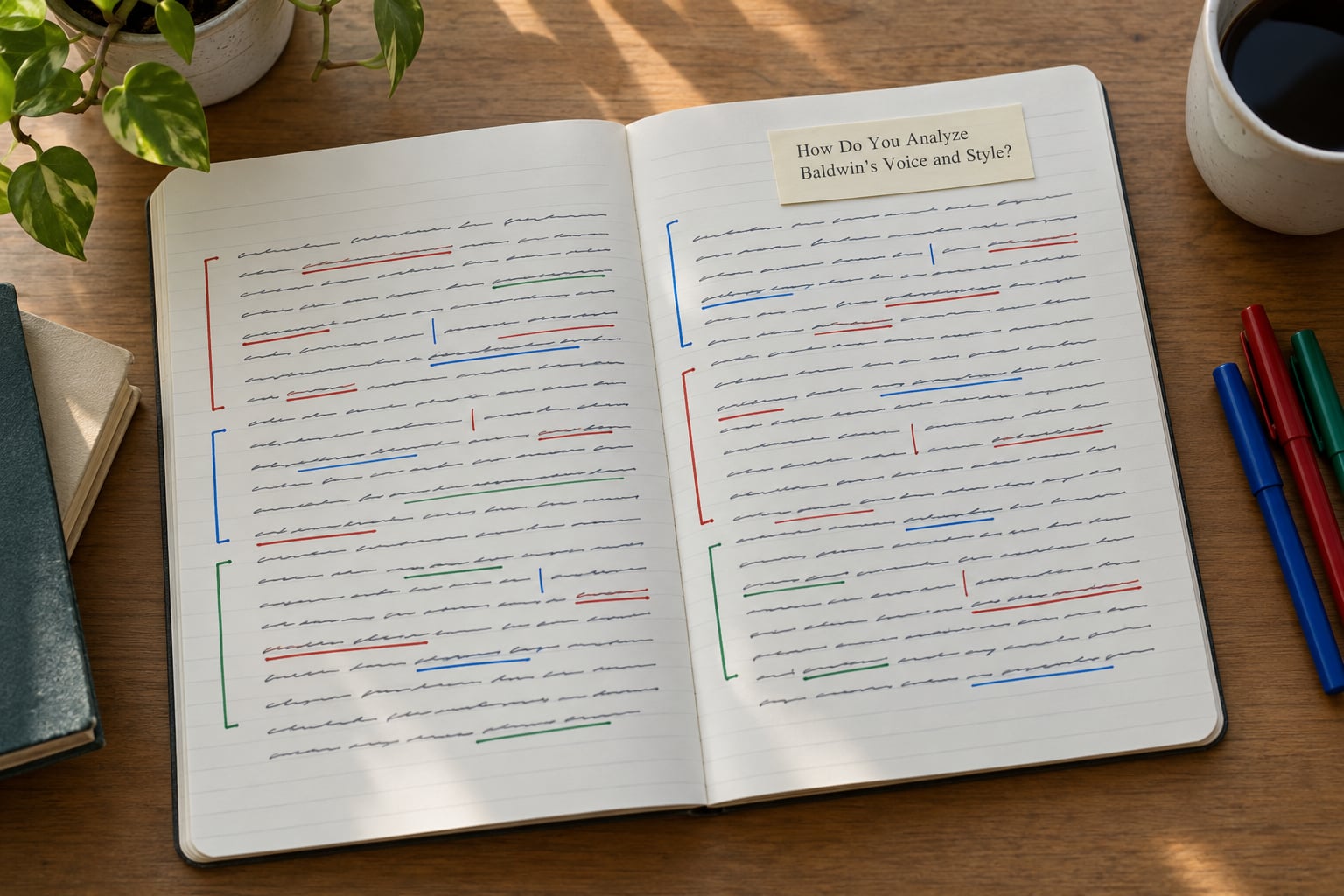
Baldwin’s voice is not one thing. He moves between registers inside a single page, and the movement is the analysis. Mark the switch every time it happens.
- Intimate memory. He drops into the first person without warning and uses a short, plain sentence to reset the pressure.
- Public address. The word you does heavy lifting. He moves from describing something to accusing the reader of it, and the pronoun is the hinge.
- Sarcasm and irony. Praise is his sharpest tool. When he commends something effusively, find out what he actually means.
- Rhetorical questions. He strings them together to build momentum, then answers none of them. Often the next paragraph answers a question he has not asked yet.
- Repetition. A word or a clause comes back with a changed meaning the second time. Track what shifted, not just that it returned.
- Understatement. The calmest sentence in a paragraph usually carries the heaviest fact. Find it and ask why it is delivered quietly.
A practical exercise: copy one paragraph and rewrite it in neutral reporting language. Anything you have to work hard to say plainly was doing work in the original. That is your paragraph’s argument in a sentence you can use in a paper.
How to Use This James Baldwin Essays Reading Guide
Four passes, in order. Skipping the first one is the most common reason an essay feels unreadable on the second attempt.
- Preview the context. Before the first page, note the year, the magazine, and what was happening politically. Ten minutes here removes most of the difficulty later.
- Annotate claims and tone shifts. Mark the move from memory to argument, and mark anything that made you flinch. Do not resolve the flinch yet.
- Map the argument. In three sentences at the top of a fresh page, state what Baldwin claims, what evidence he uses, and what he wants you to concede.
- Build a thesis. Write a claim you can defend from two specific passages, not one. One passage gives you a summary; two give you an argument.
How to work through this James Baldwin essays reading guide
For classroom use, the order matters less than the passes. Give a group “Notes of a Native Son” with no context and a week; give them the same essay with the publication date and one page of history and a week, and the discussion goes somewhere different.
For writing craft, pair two essays that disagree. Down at the Cross against “My Dungeon Shook” is the cleanest example, since Baldwin is arguing with himself in consecutive decades.
Keep a running list of sentences you want to steal the rhythm of. Reading aloud catches the cadence faster than any grammar analysis, and cadence is most of what makes Baldwin readable aloud.
Here is a checklist to keep beside you. For each essay, can you name the year, the venue, the central claim, two passages that support it, one moment where the tone changes, and one thing you disagree with? Six items. If you can fill all six in, you have read it.
What Makes Baldwin’s Essays Difficult to Read?
Some of the reputation for difficulty is deserved and some of it is a mismatch of expectations. Here is what actually gets in the way.
Historical distance
Many of the essays assume a mid-century public argument that has since dissolved. When a passage sounds like it is answering someone who no longer exists, look up who that someone was; the sentence usually lands.
Language that has aged
Baldwin wrote in a period when published Black American prose still used period racial vocabulary and older grammatical habits. The language is historical evidence about his world and about who was permitted to publish in it, and it reads differently now.
You do not need to sanitize it to read it seriously. Mark it, note it, and keep going. Quoting the language of a historical text in an analytical paper is not the same as adopting it.
Compressed context
A single paragraph can move from a Harlem storefront in 1935 to a claim about the nineteenth century without signposting. This is deliberate and it works once you catch on. Reading a paragraph aloud usually reveals the structure that looked missing.
Shifting voices
Register changes faster than in most essays, which reads as inconsistency until you notice it is the technique. Keep the tone-marking habit from the analysis section and this stops being an obstacle.
Emotional intensity
“Going to Meet the Man” describes a lynching with a calm that lands harder than any explicit description would. That is not evasion; it is a technique, and it works best on a reader who is prepared.
How to read without simplifying
The failure mode is treating complexity as obscurity and concluding that the essay means less than it does. The opposite failure is treating everything as brilliant and dropping the analysis. Write the argument out in three plain sentences before you decide whether it landed, and check the historical question separately from the literary one.
Discussion and Writing Prompts
These work for a seminar, a book club, or an exam you are writing yourself.
- Baldwin argues in “Everybody’s Protest Novel” that a novel cannot succeed if it is first judged by the morality of its conclusion. Does his own essay meet that standard, and what happens to the argument when we hold it to itself?
- Trace how personal experience functions in “Notes of a Native Son.” Is Baldwin claiming authority from the universal, from the personal, or from the collision between them?
- “Stranger in the Village” ends on an image of a young man singing in a village square. What has the essay built that the final sentence pays off?
- Compare the sarcasm in “Everybody’s Protest Novel” with the sarcasm in “The Amen Corner.” What changes when Baldwin attacks an idea rather than a person?
- Baldwin says in “Letter from a Region of My Mind” that no individual writer can speak for a whole people. If that is true, what is he doing in the essay, and does the performance of writing it answer the objection?
- “My Dungeon Shook” was written later and more privately than “Down at the Cross.” Does the later essay revise the earlier one, or refuse to?
- What can an essay do that a novel cannot, and what can a novel do that an essay cannot? Use two Baldwin texts on opposite sides of that question.
- Does Baldwin’s insistence on naming things precisely become more forceful or more exposed when the subject is a religious belief held by people he loves?
Frequently Asked Questions
What is the best James Baldwin essay to read first?
Start with the title essay in Notes of a Native Son (1955). It is self-contained, its autobiographical material gives you a person to follow, and it widens into a national argument without assuming you already know the background. If you prefer something shorter, pick Letter from a Region of My Mind (1963).
Do I need historical context before reading Baldwin’s essays?
Ten minutes of it, yes: the year, the magazine, and the political situation the piece responds to. Most of Baldwin’s difficulty disappears once you know what argument he is joining. Reading with no context is not fatal, but it means rereading later, and for an essay as short as The Amen Corner a second pass is rarely necessary.
Which James Baldwin essays are most commonly assigned in college?
Notes of a Native Son (1955), The Fire Next Time (1963), and Everybody’s Protest Novel (1949) appear on most undergraduate syllabi. Nobody Knows My Name (1961) shows up often because Stranger in the Village is short and self-sufficient. No Name in the Street (1971) appears in seminars focused on the civil rights era and Black autobiography.
Why does Baldwin shift between personal stories and public arguments?
Because the shift is his method, not a lapse of discipline. He uses a private memory to earn attention and then presses the general claim out of it, which is why he moves between I and you so quickly. Read a Baldwin essay as a continuous argument in different registers rather than as an essay that keeps changing its mind.
How should I cite quotations from a James Baldwin essay?
Cite the author, the title of the essay, and the collection it appears in, then add the page number from the edition you actually read. Since the same essay appears in different collections with different pagination, always name the edition. MLA and Chicago both treat Baldwin’s collections as standard short-form sources.
Do one thing this week: read the title essay in Notes of a Native Son with a note beside you, and mark the moment it stops being about one family. That turn is where the rest of the essays begin.