
Naturalism in American literature explained in one sentence: it is a late-nineteenth-century movement, borrowed from the French writer Emile Zola, that treats people as products of heredity, environment, and social conditions rather than as free agents steering their own lives. It ran roughly from the 1880s to the 1930s, and it changed how American novels talked about poverty, crime, sex, and industrial power.
If you have ever read a novel where the narrator watches a character make one bad decision after another and you thought, of course it ends badly, nothing else was possible, you have already read naturalism. This guide gives you the definition, the history, the five characteristics you can point to in a passage, the difference from realism and modernism, the authors worth knowing, and a method for writing about any of it.
Table of Contents
- Naturalism in American Literature Explained: What It Is and Why It Matters
- What Is Naturalism in Literature?
- How Did Naturalism Develop in America?
- The Main Ideas and Techniques of Naturalism
- How Naturalism Differs from Realism
- Major American Naturalist Authors and Their Works
- How to Analyze a Naturalist Novel
- Frequently Asked Questions
- What is naturalism in American literature?
- What are the five main characteristics of naturalism?
- What is the difference between realism and naturalism?
- Which American writers are considered naturalists?
- Is An Occurrence at Owl Creek Bridge realism or naturalism?
- How do I identify naturalism in a passage in an exam?
Naturalism in American Literature Explained: What It Is and Why It Matters
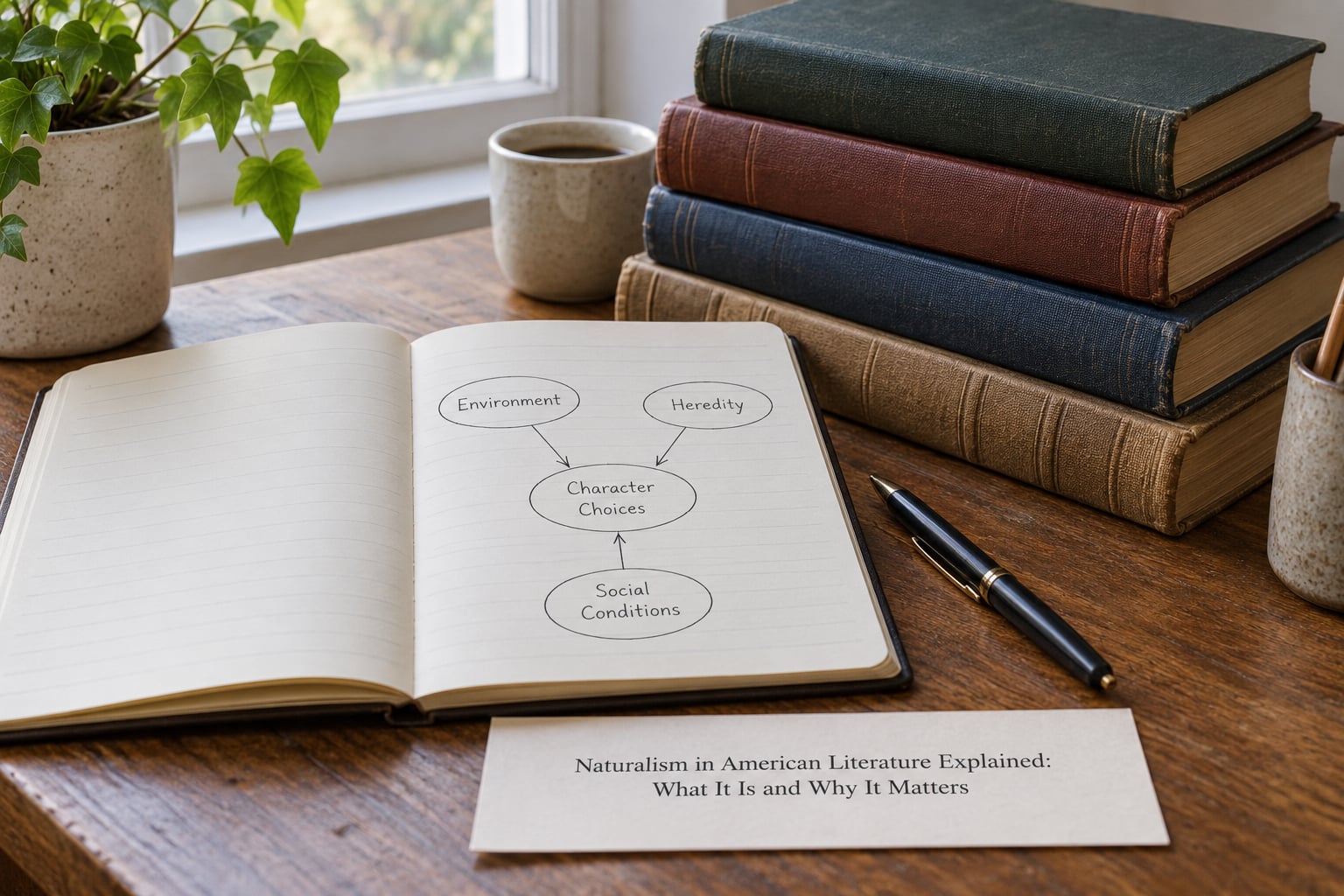
Naturalism grew out of realism and then argued with it. Realist writers like William Dean Howells wanted to show ordinary life honestly. Naturalists looked at the same ordinary lives and asked a harder question: what made those lives turn out that way?
The answer they gave was blunt. A person’s chances were largely settled before they were born by the body they inherited, the rooms they grew up in, and the wage economy they happened to be born into. What looked like free will, they argued, was mostly the sum of pressures a character could not see and could not escape.
Three things make the movement matter for a student today. It brought scientific thinking into fiction as a method rather than as a subject. It made poverty, prostitution, crime, and industrial labour legitimate things to write about seriously. And it handed the twentieth century a vocabulary of determinism that writers like John Steinbeck and William Faulkner kept using long after the label faded.
One caution before you start. This is literary naturalism. The word also means a philosophical position and a style of painting, and searching the bare term usually pulls you toward those. Add the phrase in American literature and you will stay on the right track.
What Is Naturalism in Literature?
Here is the formal version: naturalism is a literary approach in which characters are presented as determined by biological heredity, physical environment, and social or economic conditions, and in which the writer renders that determination with the detached, factual precision of a scientific observer.
And here is the plain version: a naturalist writer builds a character the way an entomologist builds a specimen, then asks the reader to notice what the specimen was made of rather than what it chose.
Three terms do most of the work in the definition, and it is worth knowing each one separately because exams often ask for them by name.
Heredity means the traits a character arrives with at birth, including physical makeup and what the novelist treats as inherited temperament. In Frank Norris’s McTeague, the title character’s small, weak jaw and his violent rages are treated as things he was issued rather than things he developed.
Milieu means the surroundings: the tenement, the railroad camp, the factory floor, the city block. The French critic Taine framed the trio as heredity, milieu, and moment, and American naturalists borrowed the whole formula.
Determinism is the philosophical claim underneath both. It holds that every event, including human action, follows from prior causes and that the appearance of choice is an effect, not an independent act.
Determinism is not quite the same as fatalism. Fatalism says a person’s fate is fixed by some outside decree and leaves causes unexplained. Naturalism insists on causes and then shows you how far down the chain they go, which is why the fiction is so full of doctors, prisons, tenements, courtrooms, and laboratories.
How Did Naturalism Develop in America?
The American movement began as an import. In 1880 Zola published Le Roman expérimental, an essay arguing that the novelist should work like an experimenter: observe a subject in its environment, record what happens, and treat the people involved as governed by the same laws as chemical or physical processes. His twenty-volume Rougon-Macquart cycle applied the method to a family across a French imperial society, and the books were translated, discussed, and imitated almost at once.
Two other currents fed into it. Charles Darwin’s account of evolution gave writers a language for competition and survival that they promptly bent into social Darwinism, the idea that economic life is a struggle in which some groups succeed because they are better adapted. The nineteenth-century faith in science and positivism, the belief that society could be studied as rigorously as nature, supplied the tone: cool, detailed, unsentimental.
Then there was the country itself. Industrialization had swallowed small manufacturing, cities had grown enormous and chaotic, immigration had flooded tenements with people the dominant culture treated as alien, and monopolies had consolidated enormous private power. Naturalist novelists wrote inside those conditions. Their pessimism was not a mood; it was a reading of the evidence.
Censorship also pushed the subject matter. Obscene material and frank sexual content were restricted, so naturalists leaned on documentary detail, medical or anthropological language, and long stretches of reported fact. Zola himself had been prosecuted for Germinal, and American writers who pushed hardest against obscenity laws found the tactic useful for a different reason: detachment itself became the style.
Naturalism faded after the 1930s because its method had been absorbed. The New Deal and the Depression made economic systems a legitimate political subject, modernism offered more interesting formal experiments with fractured narrative, and by mid-century the confident claim that science could explain human misery no longer carried the same authority it had held in 1890. The writers did not disappear. Their deterministic view of character simply became one ingredient among many.
The Main Ideas and Techniques of Naturalism
Five characteristics cover almost every text on the syllabus. Learn them as a checklist you can hold against a passage.
- Determinism. Behaviour is explained by causes that precede the character, and the plot moves toward an ending the character cannot steer. A student can point to determinism by showing a decision that the environment or the body has already made for the protagonist.
- Heredity. Inherited physical or temperamental traits carry weight in the story. Look for a description of a body that seems to predetermine a fate.
- Environment. Setting is not background. It is a cause: the tenement, the factory, the blizzard, the railroad district. Remove the environment and the plot cannot happen as written.
- A detached, factual tone. The narrator reports rather than sympathizes, often with clinical or quasi-scientific precision. Stephen Crane will tell you a man is dead in the same flat register he uses for the colour of a sky.
- Dark or taboo subject matter and a pessimistic outlook. Poverty, crime, prostitution, addiction, violence, and animal struggle are treated seriously, and redemption usually arrives in weakened form if at all.
The supporting techniques are easier to spot than the ideas. Expect an objective or third-person narrator who explains without judging, setting described so precisely that it reads like evidence, long stretches of sensory and physical detail, scientific or pseudo-scientific framing such as case history or experiment, dialogue that reports speech plainly instead of rendering it as conversation, and a plot shaped like pressure rather than choice.
Subjects also cluster. Survival in a hostile natural world, the lower classes and urban poverty, inherited criminality, sexual taboo, monopoly and labour conflict, and the female character whose options are narrowed by economics and reputation. Stephen Crane’s Maggie: A Girl of the Streets, Frank Norris’s McTeague, and Theodore Dreiser’s Sister Carrie all belong to that last cluster as much as to the poverty theme.
How Naturalism Differs from Realism
Realism and naturalism share subject matter, so the difference is one of emphasis rather than content. Realism reports life in detail and trusts that accurate representation carries its own meaning. Naturalism adds an argument: the conditions being reported are causes, not just circumstances.
Here is the three-way comparison students most often need, including modernism because confusing it with naturalism is the single most common error on this topic.
| Feature | Realism | Naturalism | Modernism |
|---|---|---|---|
| Peak period in the US | 1870s to 1890s | 1890s to 1930s | 1910s to 1940s |
| View of human nature | People are complex and largely in charge | People are shaped by heredity, environment, and economy | People fracture the self and distrust coherent meaning |
| Sense of fate | Open to moral choice | Settled by prior causes | Uncertain and unstable |
| Tone | Sympathetic, sometimes gently comic | Detached, clinical, sombre | Ironic, experimental, fragmented |
| Typical subjects | Domestic life, work, courtship, small towns | Poverty, crime, the city, labour, sex, survival | Alienation, identity, perception, the crisis of self |
| Typical form | Plain narration, regional detail | Flat narration, heavy setting, case-study framing | Stream of consciousness, shifting time, unreliable voice |
| Representative authors | Howells, James, Twain | Crane, Norris, Dreiser, London, Wharton, Cather | Faulkner, Hemingway, Fitzgerald, Steinbeck |
So how do you sort a text that carries features of both? In a classroom discussion of Ambrose Bierce’s An Occurrence at Owl Creek Bridge, students split roughly in half, which tells you the question is genuinely hard rather than badly posed. A workable decision rule: ask what the ending does. If the story closes with a twist that overturns the apparent meaning of what came before, and the reader is invited to see how completely the apparent reality was an artifact of circumstance, that machinery is naturalist. If the story ends with the world understood a little better and the character still standing inside it, that is realist.
Bierce’s story holds both, which is why it is worth teaching. Bierce was a realist journalist with a naturalist streak, and the ending’s double edge lets either reading stand. In an essay, the strongest move is usually to argue for one and acknowledge the other in a sentence, rather than pretending the categories are clean.
Two related terms cause trouble. Literary naturalism has nothing to do with philosophical naturalism, the position that the natural world is all there is and that a deity is not required to explain it. It also has nothing to do with artistic naturalism, which means rendering nature accurately in a painting. The four types of naturalism that show up in philosophy and theology are not types of literary naturalism.
Major American Naturalist Authors and Their Works
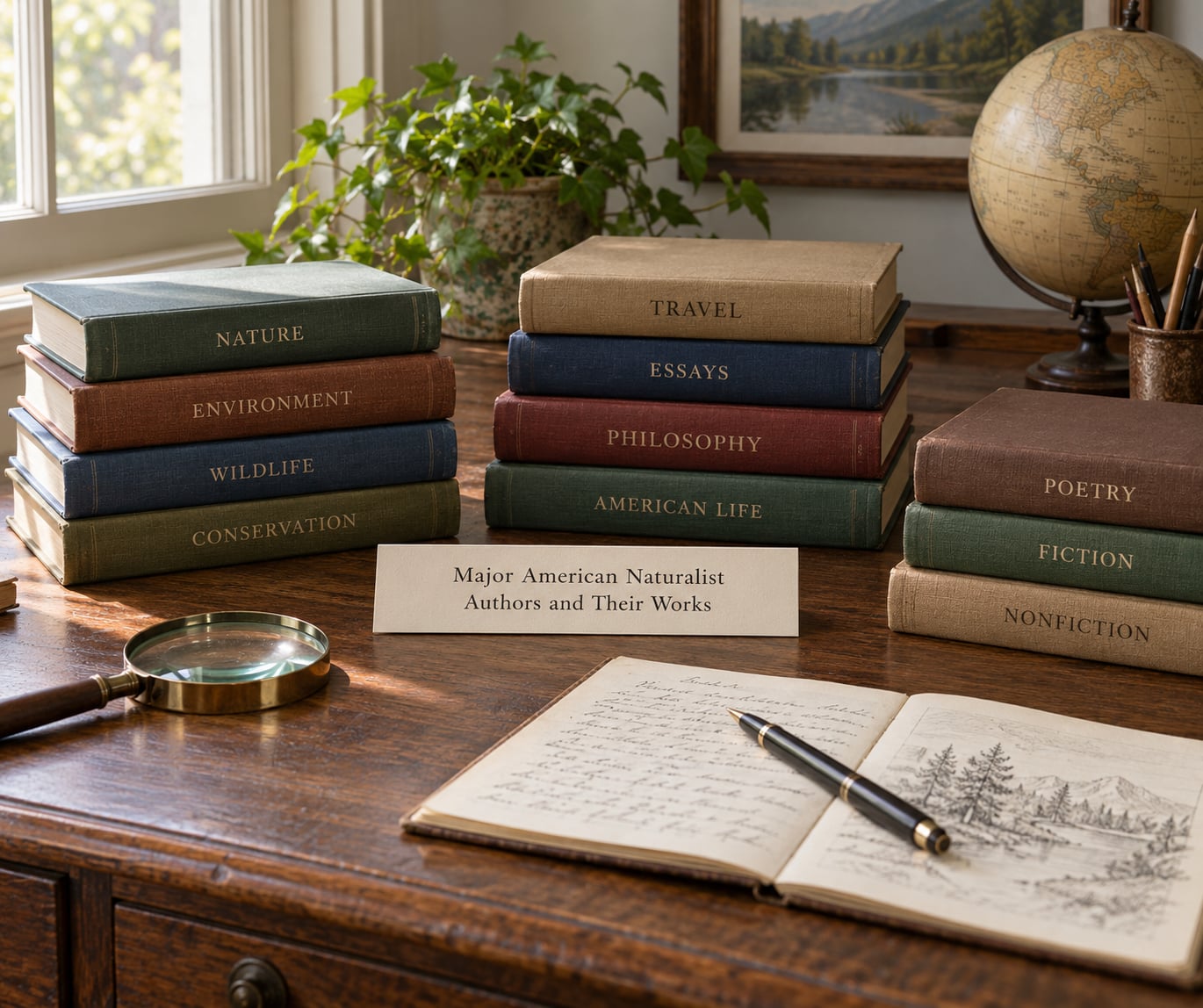
These are the authors and titles that show up on nearly every syllabus, with the naturalistic question each one asks.
| Author | Work | Year | Naturalistic takeaway |
|---|---|---|---|
| Stephen Crane | Maggie: A Girl of the Streets | 1896 | Poverty and chance determine a life almost from birth |
| Stephen Crane | The Red Badge of Courage | 1895 | Cowardice, fear, and instinct are set against a child’s longing for glory |
| Stephen Crane | The Open Boat | 1897 | An indifferent universe tests whether human solidarity means anything |
| Frank Norris | McTeague | 1896 | Heredity, city poverty, and a dentist’s ambition against each other |
| Frank Norris | The Octopus | 1901 | A railroad monopoly swallows an entire California town |
| Theodore Dreiser | Sister Carrie | 1900 | Urban desire and economic calculation redirect a farm girl’s life |
| Theodore Dreiser | An American Tragedy | 1925 | Heredity and social ambition collide in a murder trial |
| Jack London | To Build a Fire | 1908 | Cold, distance, and inexperience overwhelm effort and planning |
| Jack London | The Call of the Wild | 1903 | Domestication stripped away returns him to an older inheritance |
| Ambrose Bierce | An Occurrence at Owl Creek Bridge | 1890 | Reality, dream, and escape cannot be separated with certainty |
| Edith Wharton | The House of Mirth | 1905 | Money, class, and reputation fix the terms of a woman’s survival |
| Willa Cather | The Grapes of Wrath | 1939 | Land and weather determine a family’s migration more than will does |
A few notes that help when you meet these writers for the first time.
Stephen Crane is the tightest short-story naturalists in English, and he adds formal experimentation on top: The Red Badge of Courage has no battle scenes, only a boy’s reconstructed memory of them. In The Open Boat students reliably identify pessimism and the absence of free will as the two clearest signals, and several read the captain’s self-sacrifice as contradicting naturalism, which is a productive mistake to argue with. A naturalist text can still carry moral weight in an indifferent world.
Frank Norris is the most explicitly heredity-driven of the major novelists, and The Octopus is the one to read for social rather than biological determinism: the railroad is the antagonist, and no individual decision changes its power.
Theodore Dreiser wrote the characteristic naturalist sentence better than anyone: characters are swept along by forces they never fully perceive, and the narrator records the movement without blessing or blaming it. His later An American Tragedy adds a courtroom, which lets him put the deterministic argument on trial.
Jack London applies the method to the body and the climate. In To Build a Fire the man is not a bad man; he is simply a warm-blooded creature with thin shoes in an arctic trial no amount of effort can win.
Edith Wharton and Willa Cather count as naturalists, though teachers disagree about them. Wharton shows economics as a form of destiny in The House of Mirth. Cather moves the pressure outward into land and weather, and The Grapes of Wrath sits at the edge of the movement. William Faulkner is usually taught as a modernist, though his determinism about the past is naturalist in spirit, and Hemingway’s damaged characters inherit that lineage.
How to Analyze a Naturalist Novel
Use a fixed order. It keeps an analysis from drifting into summary, and it works the same way for a short story, which is exactly what an exam prompt will give you.
Step 1: Name the character and the pressure on them. One sentence. Not a plot summary: who wants what, and which force is in the way.
Step 2: Find the inherited and environmental factors. Look for a body described early on, a room, a wage, a neighbourhood, a law. Quote one sentence of description and show what it does to the character’s options.
Step 3: Trace one causal chain. Pick the moment the character believes they are choosing and show the earlier detail that made that choice inevitable. This is the move that earns credit.
Step 4: Read the ending against the beginning. Naturalist plots usually close without redemption, or redirect the protagonist to something older. Say what the last page refuses to give the reader.
Two thesis templates that hold up:
In McTeague, Frank Norris presents inherited physical weakness not as a limitation the character overcomes but as the mechanism by which the city destroys him, so that the novel’s ending feels less like misfortune than like a result. And in To Build a Fire, Jack London removes every external aid, including companionship and a warm fire, to show that the man’s failure is a failure of adaptation to his environment rather than a failure of courage.
Structure a body paragraph the same way: claim about the technique, short quotation, explanation of the mechanism, one sentence on what it means for the argument. Cut any paragraph that only retells what happens.
Three mistakes cost the most marks. Treating determinism as meaning characters have no agency at all, which flattens the novels and lets the author off; calling anything dark naturalism without checking the causal logic; and quoting a critic’s summary in place of the text.
One last framing point. Naturalism is not a claim that people are machines, and it is not a claim that nothing matters. It is a claim that explanation and responsibility can coexist: you can show precisely why a character ended up where they did and still hold them accountable for what they did there.
Frequently Asked Questions
What is naturalism in American literature?
Naturalism is a late-nineteenth-century American literary movement, borrowed from the French writer Emile Zola, that presents characters as determined by heredity, environment, and social or economic conditions. It runs roughly from the 1880s to the 1930s, and it renders that determination with the detached, factual tone of a scientific observer rather than with sentiment or moral instruction.
What are the five main characteristics of naturalism?
The five are determinism, heredity, environment, a detached or clinical tone, and dark subject matter paired with a pessimistic outlook. If you can point to a passage for each one, you have a naturalist text. Most student essays fail on tone and setting, because those are shown rather than argued.
What is the difference between realism and naturalism?
Realism shows ordinary life in accurate detail and trusts that accurate reporting carries meaning. Naturalism makes the same detail causal: the tenement, the body, and the wage are presented as the forces that produce the character’s fate. Both use plain narration and everyday subjects, so the cleanest test is whether the ending feels earned by circumstance or chosen by the character.
Which American writers are considered naturalists?
The core figures are Stephen Crane, Frank Norris, Theodore Dreiser, Jack London, and Ambrose Bierce. Edith Wharton and Willa Cather are commonly included, and Richard Wright is sometimes grouped with the movement. William Faulkner is usually taught as a modernist even though his deterministic view of inherited guilt has naturalist roots.
Is An Occurrence at Owl Creek Bridge realism or naturalism?
It is a genuine boundary case and both readings are defensible. The twist ending and the collapse of apparent reality suit naturalism; the newspaper realism of the framing story and the return to ordinary life suit realism. In an essay, argue for one reading and acknowledge the other in a sentence rather than treating the categories as neat.
How do I identify naturalism in a passage in an exam?
Ask three questions in order. What does the description of the body or setting tell you? What pressure does the character show that comes from outside their will? Does the ending confirm or overturn what the narrator seemed to promise? If the passage gives you a setting, a constraint, and a fatalistic turn, it is naturalist even if the story also contains realist elements.
If you do one thing before an exam, learn the five characteristics well enough to quote a line under each one. Everything else in this guide hangs off that list: the history explains why the pressures existed, the comparison table tells you which label a text carries, and the four-step method turns the labels into an argument you can actually write.