The Harlem Renaissance was a cultural movement in which Black writers, artists, musicians, and performers reshaped American expression during the 1920s and early 1930s, mostly in Harlem, New York City. This guide gives you the dates, the key writers, the major works, and a way to study it that holds up in class.
One thing to clear up right away: it was not only a literary movement, and it was not only a music movement. Painters, sculptors, playwrights, dancers, and journalists were all part of it, which is why teachers often call it the most important burst of Black cultural creation in American history.
Table of Contents
- What Was the Harlem Renaissance?
- When Did the Harlem Renaissance Happen?
- Harlem Renaissance Explained for Students: A One-Minute Overview
- Why Was the Harlem Renaissance Important?
- What Themes and Ideas Did Harlem Renaissance Writers Explore?
- Who Were the Major Harlem Renaissance Writers and Artists?
- What Are the Most Important Harlem Renaissance Works?
- How Is the Harlem Renaissance Different from the Black Arts Movement?
- How Can Students Study the Harlem Renaissance?
- Frequently Asked Questions
- What is the New Negro?
- What were the main themes of the Harlem Renaissance?
- Why did the Harlem Renaissance end?
- Was the Harlem Renaissance just a music movement?
- Who were the major writers of the Harlem Renaissance?
- How is the Harlem Renaissance different from the Civil Rights Movement?
- Conclusion: Start with One Writer and One Work
What Was the Harlem Renaissance?
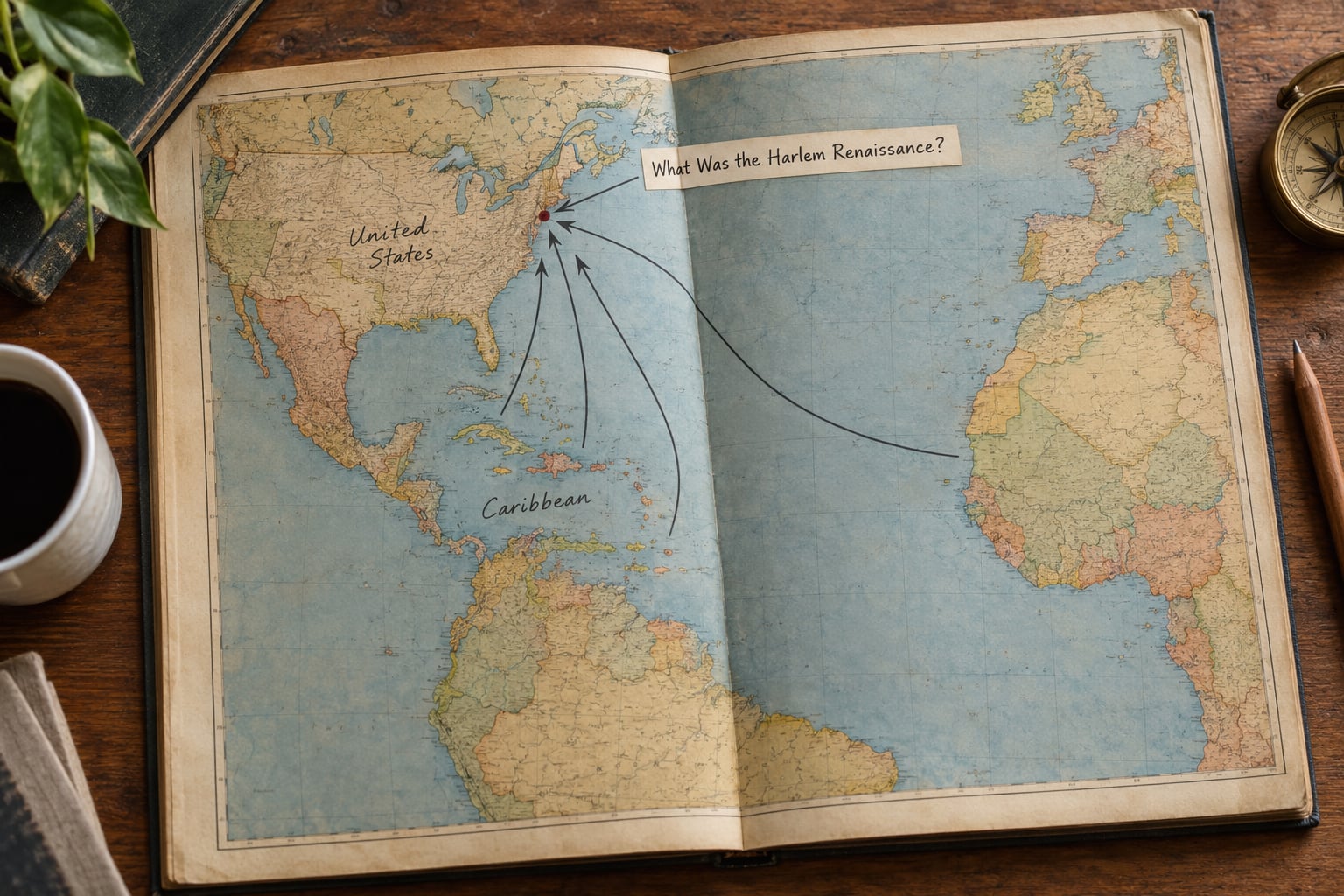
The Harlem Renaissance was a movement of Black artistic and intellectual creation that began in the years after World War I and peaked in the 1920s and early 1930s. It centred on Harlem but reached well beyond it, into Black communities in Chicago, Philadelphia, Washington, Atlanta, and Los Angeles.
Before this period, Black American writing existed for a long time. What changed in the 1920s was access. Black writers could reach a large paying audience through magazines and books they controlled, and they could stop trying to sound like white writers in order to get published.
Historians still argue about the best label for it. Some use “Harlem Renaissance” because Harlem was the centre of gravity. Others, including the Metropolitan Museum of Art, frame it as “the Harlem Renaissance and Transatlantic Modernism” because so much of the work travelled to Paris, London, and Berlin and came back changed. Either way, the core idea is the same: Black people describing their own lives instead of accepting the roles others had written for them.
In short: it was a movement of self-definition, and it happened in every art form, not only in books.
When Did the Harlem Renaissance Happen?
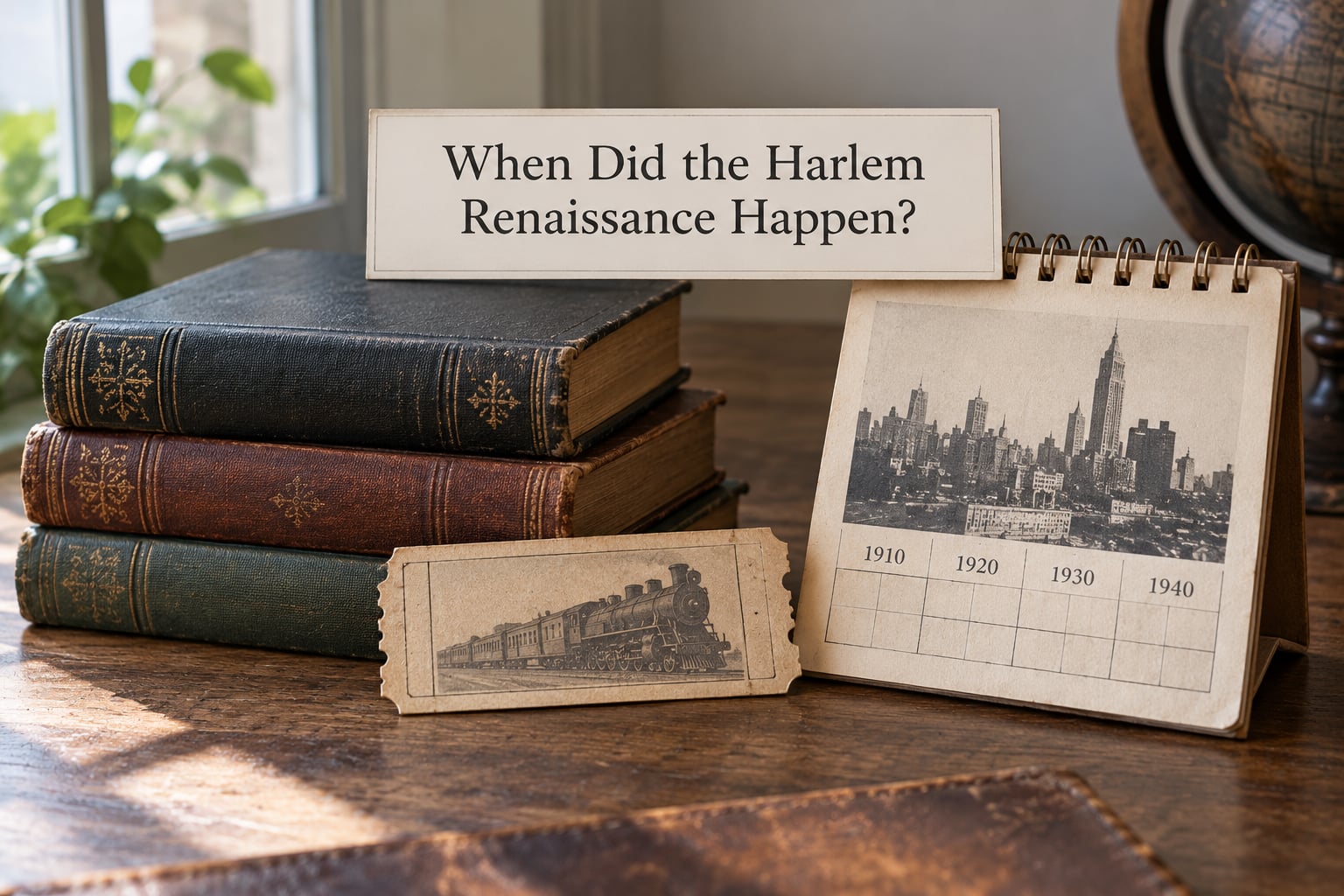
There is no single start date. Most historians place the movement between about 1918 and the mid-1930s, with its peak from 1920 to 1929. The early date comes from the end of World War I and the Great Migration that followed it. The end date comes from the Great Depression and the political pressure of the early 1930s.
Harlem Renaissance Explained for Students: A One-Minute Overview
The Harlem Renaissance was a cultural movement in which Black writers, artists, musicians, and performers reshaped American expression during the 1920s and early 1930s. It grew out of the Great Migration, the mass movement of Black families from the Jim Crow South to northern cities, which made Harlem the largest Black community in the country. Concentrated there, artists found publishers, clubs, churches, and theatres. Alain Locke’s 1925 anthology The New Negro announced the new mood: confidence, self-definition, and a demand to be taken seriously.
| Year | Event | Why it matters |
|---|---|---|
| 1903 | W. E. B. Du Bois publishes The Souls of Black Folk | Introduces “double consciousness,” the idea central to Harlem Renaissance writing |
| 1918 | World War I ends; northern industry keeps hiring | Migration to northern cities accelerates sharply |
| 1920 | Harlem becomes the largest Black community in the United States | Creates the audience and the neighbourhood that made the movement possible |
| 1923 | Jean Toomer publishes Cane | Shows the range of Black experience, from the rural South to the city |
| 1925 | Alain Locke edits The New Negro | The anthology that named and defined the movement |
| 1926 | Langston Hughes publishes The Weary Blues; Opportunity magazine awards a literary prize | Poetry and the Black press reach a mass national audience |
| 1927 | Aaron Douglas paints God’s Trombones | A signature image of Black cultural achievement |
| 1934 | Aaron Douglas completes Aspects of Negro Life | Four murals on Black history made for a Harlem public space |
| 1935-1937 | Depression, Red Scare pressure, and dispersing writers | The movement’s publishing and patronage collapse |
Why Was the Harlem Renaissance Important?
First, it changed who got to define Black culture. Earlier Black writers were usually asked to imitate European models, to write in a “correct” white style, or to write only about slavery. Harlem Renaissance writers refused that and treated Black American life as its own subject worth serious study.
Second, it produced a body of work that is still taught. Zora Neale Hurston’s Their Eyes Were Watching God, the poems of Hughes and Countee Cullen, and Nella Larsen’s two short novels all appear in classrooms today, often decades after they were written.
Third, it gave political movements cultural confidence. The civil rights campaign of the 1950s and 1960s did not spring from nowhere; the essayists, poets, and artists of the 1920s spent decades making the case for equality in print.
It was not a perfect success. Patronage still flowed largely through white institutions, many Harlem Renaissance artists faced racism even at the height of their fame, and Hurston’s career shows how quickly support could vanish. Saying the movement “changed everything” is too simple. It changed what was possible.
What Themes and Ideas Did Harlem Renaissance Writers Explore?
The main themes were racial pride, identity and heritage, and equality. Around those three sat a set of related concerns that came up again and again in poems, novels, plays, and paintings.
- Race and identity. What does it mean to be Black in America, and who gets to answer that question.
- Migration and the South. Leaving the South, arriving in the city, and deciding whether home is a place or a memory.
- Racism and discrimination. Segregation, lynching, and the daily indignities of Jim Crow, named plainly rather than softened.
- Everyday urban life. Rent parties, streetcars, churches, clubs, and neighbours as worthy literary subjects.
- Language and music. Blues and jazz rhythms shaped the cadence of poems and prose, and call and response moved between stage and audience.
- Family and gender. Mothers and sons, husbands and wives, and the pressure on Black women to hold a family together under unequal law.
- Art versus protest. Whether a writer should spend time celebrating Black life or spend it demanding rights.
In short: the writers asked what a culture looks like when the people who were excluded from it get to build it themselves.
Who Were the Major Harlem Renaissance Writers and Artists?
Langston Hughes (1901-1967) was a poet, novelist, and playwright whose plain language and jazz rhythms made everyday Black life central to American literature. His 1926 collection The Weary Blues and his poem “Mother to Son” are standard classroom texts.
Zora Neale Hurston (1901-1960) was a novelist, short story writer, and anthropologist from Eatonville, Florida. She worked as a research assistant for the anthropologist Franz Boas and brought that fieldwork into fiction such as Their Eyes Were Watching God (1937) and “Sultana’s Dream.”
W. E. B. Du Bois (1868-1963) was a sociologist, historian, and co-founder of the NAACP. His 1903 The Souls of Black Folk and the idea of double consciousness shaped everything written after him.
Alain Locke (1885-1954) was the Harvard-trained philosopher who edited The New Negro (1925) and gave the movement its name, its slogan, and its argument for a distinct Black aesthetic.
Countee Cullen (1903-1946) was a poet who insisted on classical technique while writing about Black experience, which proved that formality and race pride did not have to be opposites.
Claude McKay (1889-1948) was a Jamaican-born poet whose “If We Must Die” and his novel Home to Harlem brought Caribbean and rural speech into the movement’s argument. He spent later years as a journalist in Harlem and in Russia, which is why he turns up less often in short study lists than he deserves.
Jean Toomer (1894-1967) wrote Cane (1923), a single book of poems, prose sketches, and short fiction that ranges from the Georgia countryside to Harlem. Teachers like it as a compressed view of the whole decade, and it is the one Harlem Renaissance title students can read start to finish in an afternoon.
Nella Larsen (1891-1964) was a novelist whose two 1929 books, Quicksand and Passing, probed mixed-race identity and passing, the practice of hiding one’s ancestry to move through a segregated society.
| Person | Key work | Year | Why it matters |
|---|---|---|---|
| Langston Hughes | The Weary Blues | 1926 | First book by a Black American to win a major poetry prize |
| Zora Neale Hurston | Their Eyes Were Watching God | 1937 | Peak of the movement’s literary achievement |
| W. E. B. Du Bois | The Souls of Black Folk | 1903 | Source of double consciousness |
| Alain Locke | The New Negro | 1925 | Anthology that defined the movement |
| Countee Cullen | Cronkin’ on De Prayers (with Langston Hughes) | 1925 | Poetry in a deliberately formal voice |
| Claude McKay | If We Must Die; Home to Harlem | 1919, 1928 | Caribbean idiom and rural Black life in the same movement |
| Jean Toomer | Cane | 1923 | Rural South and city in one short book |
| Nella Larsen | Quicksand and Passing | 1929 | Race, passing, and identity in two novels |
| Aaron Douglas | Aspects of Negro Life | 1934 | Four murals tracing Black history for a public audience |
| Augusta Savage | Harlem Renaissance sculpture | 1920s-30s | Commissioned public works that centred Black subjects |
Beyond these names, look for Wallace Thurman, James Weldon Johnson, Georgia Douglas Johnson, Anne Spencer, Meta Fuller, William H. Johnson, Palmer Hayden, Duke Ellington, and Bessie Smith. A classroom that teaches only four of them teaches a fraction of what was happening.
What Are the Most Important Harlem Renaissance Works?
You cannot read everything, so start with texts that are short, teachable, and available free in school libraries or public archives.
Poetry. Hughes’s “Mother to Son” and “Theme for English B,” and “The Weary Blues,” give you voice, struggle, and music in a handful of pages. Zora Neale Hurston is better known for prose, but reading one of her poems beside a Hughes poem shows how differently two writers handled the same decade.
Novels. Their Eyes Were Watching God gives you Janie Crawford’s search for herself, told in a voice nobody had used in American fiction before. Zora Neale Hurston’s fieldwork in Florida, where she arrived in the early 1920s and worked with the blues singer and performer Fannie Porter, sits behind the book’s ear for local detail.
Anthology and essay. Alain Locke’s introduction to The New Negro (1925) is the shortest route to what the movement believed it was. Du Bois’s The Souls of Black Folk (1903) explains the problem the movement was arguing against.
Art. Aaron Douglas’s God’s Trombones (1927) and the Aspects of Negro Life murals (1934) are worth looking up in any museum collection, because they use silhouette and angular shapes to compress centuries of Black history into flat, powerful panels.
A note on one 1926 novel often listed here: its author used a racial slur in the title, and no responsible classroom treats that word as acceptable. Knowing the book exists and knowing why the title is condemned are two different pieces of historical knowledge.
How Is the Harlem Renaissance Different from the Black Arts Movement?
The Harlem Renaissance ran from about 1918 to the mid-1930s. The Black Arts Movement ran roughly from the mid-1960s to the mid-1970s, more than thirty years later. Both asked Black artists to speak for themselves, but they worked in different decades, in different cities, and toward different political ends.
| Aspect | Harlem Renaissance | Black Arts Movement |
|---|---|---|
| Main years | 1918 to mid-1930s | Mid-1960s to mid-1970s |
| Main centres | New York City, Chicago, Washington, Atlanta, Los Angeles | New York, Chicago, Oakland, Atlanta |
| Political pressure | Jim Crow, then the Red Scare raids of the 1920s and 1930s | Civil rights era, urban uprisings, Vietnam |
| Style | Realism, formal verse, sculpture and muralism | Free verse, spoken word, graffiti, collage |
| Leading figures | Hughes, Hurston, Locke, Douglas, Ellington | Amiri Baraka, Gwendolyn Brooks, Maya Angelou, the Watts Writers Workshop |
| Relationship | Set the cultural ground the later movement stood on | Directly political and protest-oriented |
The short version: the Harlem Renaissance built the language and confidence, and the Black Arts Movement used that confidence for overt protest. Students often blur the two because both are taught in the same unit.
How Can Students Study the Harlem Renaissance?
Start with one writer, not with all of them. A single poem read closely teaches more than six authors skimmed. Pick “Mother to Son” or “Theme for English B” for your first read.
Next, learn three dates: 1918, 1925, and 1935. If you can explain what happened in each of those years, you have the frame that the rest of the topic hangs on.
Then separate context from text. Context is the Great Migration, the 1920s economy, the segregation North as well as the South. Text is the poem in front of you. In an essay, context belongs in the introduction and the body, not in the middle of a close reading quote.
For a thesis, three patterns work well. First: “Hughes uses the language of the stairway in ‘Mother to Son’ to turn structural hardship into persistence.” Second: “The New Negro presents cultural self-definition as a political argument, not merely an artistic one.” Third: “Hurston’s use of rural Florida detail argues that folk culture is a source of authority, not a lack of sophistication.”
Finally, test yourself. Who was Alain Locke and what was his job in 1925? What double consciousness means. Which two reasons explain the movement’s decline in the 1930s. If you can answer those four without notes, you are ready to write. Teachers who want a second set of eyes on a poem often start students with a short guided analysis before the essay.
Frequently Asked Questions
What is the New Negro?
The New Negro was a term promoted by philosopher Alain Locke for a confident, self-aware generation of Black Americans in the 1920s. Locke used it in his 1925 anthology The New Negro. The phrase rejected old stereotypes of servility and demanded to be treated as equals. It is also the title of that anthology, which students often confuse with the general term.
What were the main themes of the Harlem Renaissance?
The main themes were racial pride, identity and heritage, and a demand for equality. Writers also explored migration from the South, the daily effects of racism, urban Black community life, family relationships, and the use of jazz and blues rhythms in poetry. The unifying idea was self-definition: Black people describing their own lives rather than accepting roles written for them.
Why did the Harlem Renaissance end?
It faded rather than stopping on one date. The Great Depression cut the patronage that had funded artists, the Red Scare and anti-radical pressure intimidated writers with socialist sympathies, and white support shifted after the 1929 crash. Key writers scattered to Paris, the Caribbean, and other cities. Most historians place the decline between 1935 and 1937.
Was the Harlem Renaissance just a music movement?
No. Jazz and the blues gave the movement its sound and many musicians an income, but poetry, novels, painting, sculpture, theatre, dance, and journalism were all central. Duke Ellington, Bessie Smith, and Fats Waller belong in the story, but so do Langston Hughes, Zora Neale Hurston, Aaron Douglas, and the journalists who built Black newspapers and magazines.
Who were the major writers of the Harlem Renaissance?
The major writers include Langston Hughes, Zora Neale Hurston, W. E. B. Du Bois, Alain Locke, Countee Cullen, Claude McKay, Jean Toomer, Nella Larsen, Wallace Thurman, James Weldon Johnson, Georgia Douglas Johnson, and Anne Spencer. For an assignment, most teachers expect you to know Hughes and Hurston in depth plus two or three others well enough to explain their contribution in a sentence.
How is the Harlem Renaissance different from the Civil Rights Movement?
The Harlem Renaissance ran from about 1918 to the mid-1930s and worked mainly through art, literature, and intellectual argument. The Civil Rights Movement ran from the mid-1950s to the 1960s and worked through organizing, protest, and the law. The Renaissance built the cultural confidence that the later movement drew on, but they are separate movements with separate methods and leaders.
Conclusion: Start with One Writer and One Work
The Harlem Renaissance explained for students comes down to this: between about 1918 and the mid-1930s, Black writers, artists, and musicians in and beyond Harlem used their own voices and their own subjects to change what America expected from Black culture. It gave the century its literary voice in Hughes, its sharpest fiction in Hurston, its clearest argument in Locke, and its public art in Douglas.
Here is your first step. Read one short poem tonight, write two sentences on what the language is doing, and check the dates 1918, 1925, and 1935. Everything else gets easier from there.