Sandra Cisneros is a Mexican-American poet, novelist, essayist and short story writer, born December 20, 1954 in Chicago, Illinois, and best known for The House on Mango Street. This sandra cisneros life and writing guide connects her biography to the choices on the page, so you can read her work as a writer rather than as a memoir. It is written for students meeting her for the first assignment, for teachers building a unit, and for readers who finished Mango Street and assumed it was her only book.
She has published for more than four decades and the bibliography is still growing, so any profile that stops in the early 2000s is out of date. Updated for 2026, this guide works from her Chicago childhood through her most recent poetry.
Two things are worth saying up front. First, her life explains her subjects but does not reduce her work to autobiography; the writing transforms experience into structure. Second, the reading order matters, because the first book people meet is not the easiest entry point for every reader.
Table of Contents
- Sandra Cisneros Life and Writing Guide: A Quick Overview
- How Did Sandra Cisneros’s Early Life Shape Her Writing?
- Where the autobiographical line sits
- What Education and Experiences Influenced Sandra Cisneros?
- What Are Sandra Cisneros’s Major Works?
- How Does The House on Mango Street Tell Cisneros’s Story?
- What Themes Define Sandra Cisneros’s Writing?
- What Writing Techniques Does Cisneros Use?
- How Does Cisneros Explore Language, Culture, and Identity?
- How Has Sandra Cisneros’s Work Influenced Readers and Writers?
- How Can Students Study Sandra Cisneros’s Life and Writing?
- Sandra Cisneros Life and Writing: Timeline
- Sandra Cisneros Life and Writing: Common Essay Connections
- Frequently Asked Questions
- Who is Sandra Cisneros?
- What is Sandra Cisneros best known for?
- Why is The House on Mango Street considered autobiographical?
- What themes are most important in Sandra Cisneros’s writing?
- Is Sandra Cisneros’s writing bilingual?
- Which Sandra Cisneros books should students read first?
- Conclusion
Sandra Cisneros Life and Writing Guide: A Quick Overview
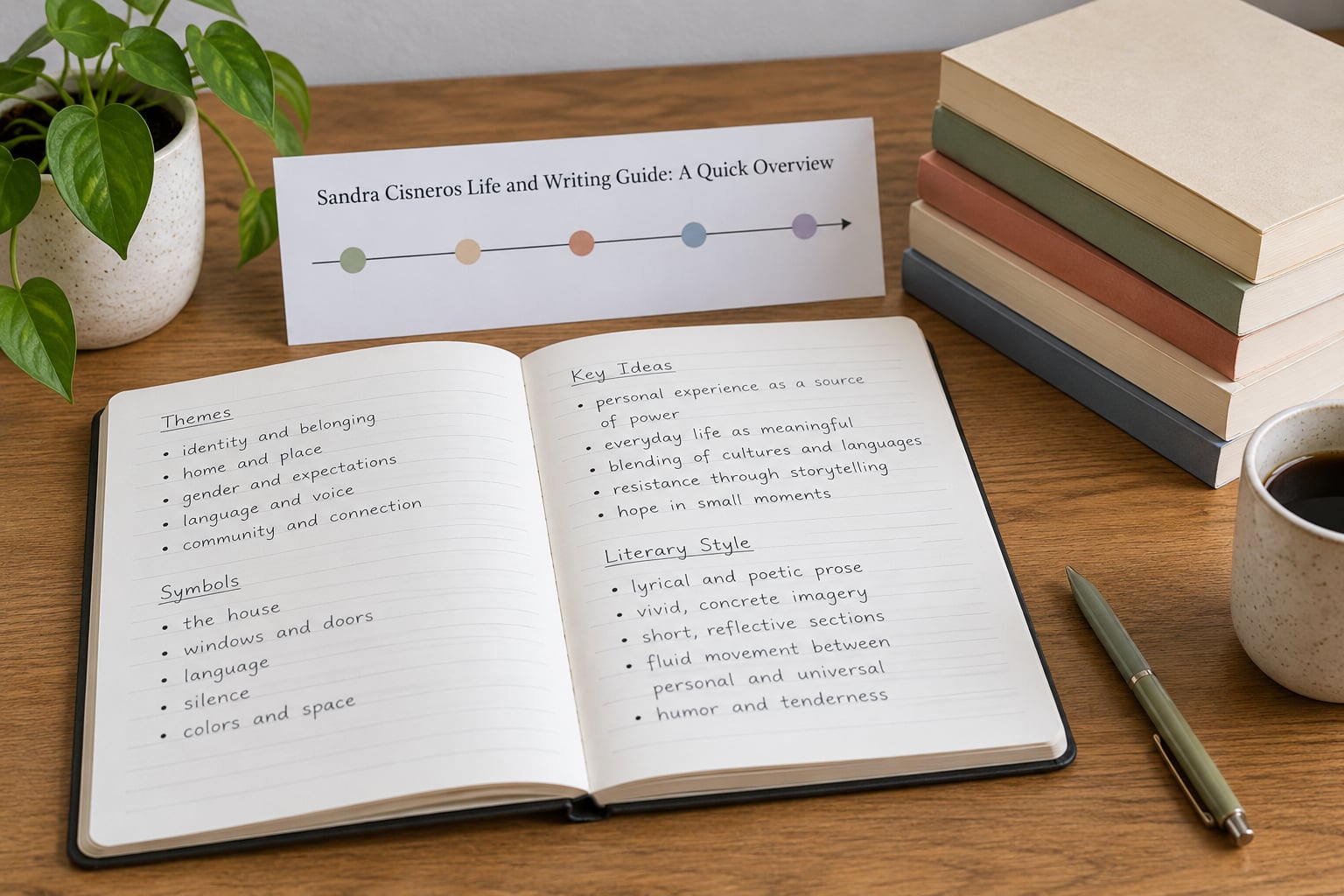
Cisneros writes about working-class girls, mothers and daughters, bilingual households and the specific pressure of growing up between two languages. Her prose moves in short, image-heavy bursts, and her poetry moves in free verse that reads almost like song lyrics. Below are the facts most searches ask for.
- Born: December 20, 1954, in Chicago, Illinois
- Background: Mexican-American; father from Mexico City, mother from the Mexican countryside; the only girl among seven children, with six brothers
- Citizenship: Dual United States and Mexico citizen
- Education: Loyola University Chicago, then an MFA in poetry at the Iowa Writers’ Workshop
- Teaching: Taught creative writing, including at the University of Missouri, alongside workshops and residencies
- Signature work: The House on Mango Street (1984), over six million copies sold and translated into more than two dozen languages
- Other work: Woman Hollering Creek, Woman of the Hour, Caramulo, A House of My Own, Loose Woman, My Wicked, Wicked Ways, Martita, I Remember You, Woman Without Shame
- Major honors: National Book Award, MacArthur Fellowship, National Medal of Arts, PEN/Nabokov Award, Ruth Lilly Poetry Prize (2022), Texas Medal of the Arts
She supports herself by her writing and has said plainly that, as a single woman, she chose books over children. More on that below.
How Did Sandra Cisneros’s Early Life Shape Her Writing?
She grew up poor on the near north side of Chicago, in a household where the language at the table was Spanish and the language of school was English. That gap is not background colour in her fiction; it is the situation her characters are living.
As the only daughter among six brothers, she grew up in a family that was large, loud and male-centred. That is the world Woman Hollering Creek draws on, where daughters are loud, funny, unruly and mostly invisible at the same time. Her narrator in that collection narrates her own story to her brothers as if they were an audience she is both performing for and dismissing.
Her mother is the reason she reads. She bought books when there was no money for anything else, and she modelled the stubbornness of loving a song, a story or a person in a poor house. Her writing inherits that stubbornness: affection is usually shown as something a woman does while surrounded by people who do not see her doing it.
Chicago itself appears repeatedly, both as a place on a map and as a trap. The neighbourhood is safe and narrow at the same time, and the danger in the stories is rarely a stranger. It is a rule, a relative, a house with too many people in it, or a girl who has decided she cannot wait.
Where the autobiographical line sits
The House on Mango Street draws on Cisneros’s childhood in Chicago, and critics rightly call it autobiographical in substance. But the character Esperanza is not the author. The novella gives its narrator a younger sister, a recurring fear, and a private interior life that lets the story examine girlhood rather than record a life.
Cisneros has also said the novella’s manuscript was written on a Greek island, a distance that matters. You do not write a book about a specific street from memory alone; you rewrite it from a place you no longer live.
What Education and Experiences Influenced Sandra Cisneros?
She studied English and literature at Loyola University Chicago, then took an MFA in poetry at the Iowa Writers’ Workshop. The workshop trained her in craft, but it did not give her a subject; she brought her own life to it.
What followed was teaching. She taught creative writing, including at the University of Missouri, and ran workshops and residencies that moved her between cities and countries. Teaching also explains why The House on Mango Street reads the way it does: she wrote it for her students, in a form a classroom could actually be built around.
There was a long stretch of admin jobs, residencies and travel in between, and she has been open about being broke through much of it. The MacArthur Fellowship in the 1990s changed the arithmetic, giving her years in which writing could be the work rather than the thing squeezed around it.
In an October 2023 public talk to high school students, she described writing as a way to heal and to connect with other people, and told them that the biggest censor a writer has is themselves. That is the practical lesson from her career: the training gave her a craft, and the decades of teaching and travel gave her enough distance to see that her own life was the material.
What Are Sandra Cisneros’s Major Works?
Eight titles cover most of what readers need, and they divide cleanly into fiction, short stories, essays and poetry. The shortlist below is where I would send a student, a book club and a teacher with different aims.
| Title | Year | Form | What it does |
|---|---|---|---|
| The House on Mango Street | 1984 | Novella | Esperanza’s restricted Chicago childhood and the images she carries forward |
| Woman Hollering Creek | 1990 | Short stories | Daughters, mothers and female friendship; the funniest and bluntest of her books |
| Woman of the Hour | 1989 | Short stories | Includes the title story on the cost of beauty and attention |
| My Wicked, Wicked Ways | 1998 | Poetry | Her earliest collection, written in the voice of a young woman coming of age |
| Loose Woman | 1995 | Poetry | Poems on family, daughters, duty and the narrator’s own limits |
| A House of My Own | 1996 | Essays | Writing life, travel and the house she built for herself, literally and otherwise |
| Caramulo | 2001 | Prose for young readers | A boy and his grandfather cross from Mexico to work in an auto plant in Chicago |
| Martita, I Remember You | 2021 | Stories | Memory, friendship and a voice lost to violence |
| Woman Without Shame | 2022 | Poetry | Poems on beauty, class, ageing and the price of being looked at |
Two cautions for readers. Woman Hollering Creek gets reduced to a poverty memoir more often than any other of her books, and it deserves better than that. And A House of My Own contains deliberate footnotes that argue with the text, a formal experiment that confuses students who expect the essay to sit still.
How Does The House on Mango Street Tell Cisneros’s Story?
It tells a girl’s story as a sequence of small, linked scenes rather than one plot. Esperanza narrates in short numbered episodes, each one an observation, a memory or a conversation that ends with a line that keeps moving.
The form does several things at once. The short pieces make the book readable aloud in a classroom and easy to use for close reading of single paragraphs. The episodes let Cisneros move between comedy and ache without warning, which is exactly how memory of that age works.
Images carry the argument instead of dialogue. Windows, doors, a house that belongs to nobody, a room with a door on the wrong side, a song on the radio, a woman waiting for the light. Esperanza keeps deciding what her body is for, and keeps finding the world has already decided. Running shoes, a dance, a narrow street: each one is an offer of freedom the neighbourhood can absorb and neutralise.
What makes it teachable is that the stakes look small and are not. The book takes under a hundred pages, and every sentence in it can be argued about.
What Themes Define Sandra Cisneros’s Writing?
Belonging is the theme underneath all the others. Cisneros is consistently asking what it costs a woman to be allowed to want something, and who decides the terms.
On identity, her characters sit between two systems at school, at home and in the street, and the writing refuses to let either system claim them whole. Language carries this: the girl who is loud in one language goes quiet in another, and the narration records the switch as loss.
On class, her fiction is unusually specific about money. Rent, a brother’s job, a mother working, the difference between needing something and being allowed to want it. Poverty is the situation, not the subject.
On gender, she writes the interior weather of girlhood: the beauty rules, the attention that costs money, the girl who is funny because funny is available and pretty is regulated. Woman of the Hour and Woman Without Shame take this head on across two decades.
On family, her stories keep a complicated affection. The mothers are exhausting and entirely loved, often in the same paragraph. Writing as healing runs under nearly everything she has published.
What Writing Techniques Does Cisneros Use?
The techniques are named, teachable and easy to spot. If you can recognise these in a paragraph, you can analyse Cisneros without guessing.
| Technique | What it is | What it achieves |
|---|---|---|
| Vignette form | Short, numbered scenes rather than one continuous plot | Makes memory feel assembled from fragments, and allows comic and painful turns in quick succession |
| Code-switching | Moving between English and Spanish mid-sentence or mid-scene | Puts the reader inside a bilingual mind, where one language is intimacy and the other is public life |
| Repetition and refrain | A phrase or image returned to with a small change each time | Turns a single observation into a running pressure across the book |
| Lyrical imagery | Concrete sensory detail doing the work of argument | Lets a narrator who has no power still make meaning, and often make it better than the adults do |
| First-person intimacy | A narrator speaking directly, sometimes as performer | Collapses the distance between speaker and reader, which suits stories about being watched |
| Footnotes and self-correction | Marginal notes that argue with the essay’s own text | Turns the writer into a visible revision process, particularly in A House of My Own |
| Free verse | Poetry without fixed metre or rhyme scheme | Keeps her verse close to speech and to song, and lets Spanish sit inside English lines |
| Irony and undercutting | A statement whose second half contradicts the first | Marks the gap between what is said in a family and what is true |
When a teacher or reader asks what her writing style is, the short answer is this: image-driven, rhythmic, bilingual, and structurally fragmentary. If people describe her prose as musical, that is not vagueness. Her sentences are built to be heard.
How Does Cisneros Explore Language, Culture, and Identity?
Code-switching simply means moving between languages within a sentence, a conversation or a paragraph. Cisneros uses it as a narrative tool, not decoration: the switch tells you where the speaker is standing and who is allowed to hear her.
Family expressions carry objects with them. Spanish nicknames, songs, kitchen instructions and jokes move into the English text unchanged, and their oddness to a non-Spanish reader is the point. The reader hears a household that is fully functional in two languages and only half-legible in either.
Her essays make the political argument behind the technique explicit. To write only in the language of school is to accept the schoolroom’s terms, and her work refuses that trade. For students who do not read Spanish, this is worth naming plainly rather than treating the passages as obstacles: the switching is characterisation.
Culturally specific objects also matter, from tortillas and Catholicism to the beauty rituals and family rituals that run through Martita, I Remember You. They are not decorative detail. They are what a working-class family’s world is made of, and the writing treats that world as fully modern rather than as a category of experience to be explained.
How Has Sandra Cisneros’s Work Influenced Readers and Writers?
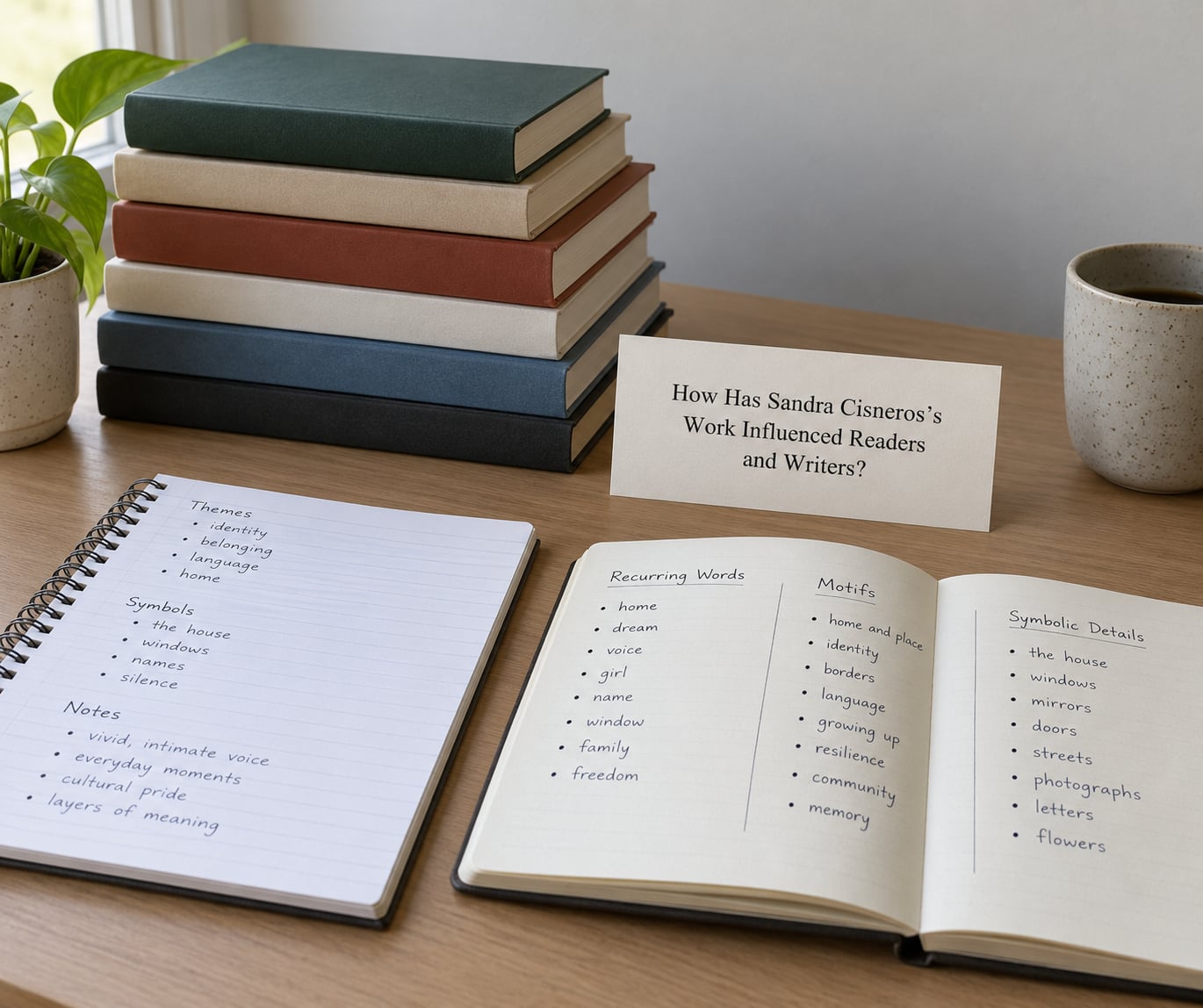
Her influence is easiest to measure in classrooms. The House on Mango Street has been required reading in American schools for decades, so most readers meet it before they meet her, and many meet it twice, once at home and once in class.
Readers often describe the book as one that changed how they read rather than simply what they read. Teachers describe it as a book about a diverse group of people who come together, and recommend it warmly to students. A generation of adults who first loved the book because a parent read it to them now teach it.
For writers, the lesson is technical. Cisneros proved that a book under a hundred pages, written mostly in short scenes, with frequent Spanish, could sit on required reading lists in the United States. That opened a door for a great deal of Chicana and Latina literature that followed.
The bibliography remains current, which surprises people who assume her career ended with Mango Street. Martita, I Remember You arrived in 2021, Woman Without Shame in 2022, and the Ruth Lilly Poetry Prize in 2022 recognised a career still moving.
How Can Students Study Sandra Cisneros’s Life and Writing?
Read her the way you would read any writer: biography first for context, then the text on its own terms. The method below moves from facts to close reading to argument, and it works whether you have ten days or a full term.
Sandra Cisneros Life and Writing: Timeline
| Year | Life | Work and recognition |
|---|---|---|
| 1954 | Born December 20 in Chicago, the only daughter of six brothers | — |
| 1960s | Grows up in a working-class Chicago household where Spanish and English coexist; finds refuge in reading | — |
| 1970s | Studies English and literature at Loyola University Chicago | — |
| Early 1980s | Earns an MFA in poetry at the Iowa Writers’ Workshop; begins teaching | — |
| 1984 | — | The House on Mango Street published; a major national award for young adult literature |
| 1990s | Teaches creative writing including at the University of Missouri; travels and writes between residencies | Woman Hollering Creek (1990), Woman of the Hour (1989), My Wicked, Wicked Ways (1998) |
| 1995-1996 | — | Loose Woman (1995), A House of My Own (1996) |
| 2001 | — | Caramulo |
| 1990s onward | MacArthur Fellowship gives her years to write full time; travels between the United States, Mexico and Greece | PEN/Nabokov Award, National Medal of Arts, Texas Medal of the Arts |
| 2021-2022 | — | Martita, I Remember You (2021), Woman Without Shame (2022), Ruth Lilly Poetry Prize (2022) |
Three events do most of the explanatory work. Her childhood on the near north side of Chicago gave her the material. Her Iowa training gave her the craft. Her decades of teaching gave her an audience and a reason to write short.
Sandra Cisneros Life and Writing: Common Essay Connections
These are defensible links between life and page. Each one can carry a paragraph of evidence and a line of interpretation.
- Chicago and place. Narrow streets, shared walls and no private space in The House on Mango Street map directly onto the crowded household she grew up in.
- Only daughter, six brothers. The narrator’s need to be heard in Woman Hollering Creek reads as autobiography sharpened into comic form.
- Teaching. The short, classroom-sized form of Mango Street follows from writing it for students; the book was built to be taught.
- Travel and distance. The essays show a writer using physical distance to gain enough room from her own material to write it.
- Language and self-censorship. Her comments on writing as healing, and on self-censorship as the obstacle a writer sets for themselves, explain why the work keeps returning to voices that were not heard.
For classroom use, the practical sequence works well: read two vignettes aloud, identify one recurring image across the book, then write a short personal vignette and compare structure rather than subject matter. Teachers who have never assigned Chicana literature often report that her work gives them a confident way into the field, and the discussion questions land best when the code-switched passages are treated as deliberate rather than as difficulty.
Frequently Asked Questions
Who is Sandra Cisneros?
Sandra Cisneros is a Mexican-American poet, novelist, essayist and short story writer born on December 20, 1954 in Chicago, Illinois. She holds dual American and Mexican citizenship, studied at Loyola University Chicago, earned an MFA in poetry at the Iowa Writers’ Workshop, and has taught creative writing. She supports herself by her writing.
What is Sandra Cisneros best known for?
She is best known for The House on Mango Street, published in 1984, a novella about a girl growing up in a poor Chicago neighbourhood. It sold more than six million copies, has been translated into more than two dozen languages, and is required reading in schools across the United States. Her short stories, essays and poetry collections are substantial in their own right.
Why is The House on Mango Street considered autobiographical?
The novella draws heavily on Cisneros’s own childhood in a working-class Mexican-American family in Chicago, and its narrator, Esperanza, grows up on a street much like the ones she knew. But it is fiction rather than memoir. Esperanza is given her own interior life, fears and sister, and Cisneros wrote the manuscript on a Greek island, rewriting memory from a distance.
What themes are most important in Sandra Cisneros’s writing?
Belonging, identity, gender, class, language and family run through nearly everything she writes. Her characters sit between two languages and two systems of expectation, and she follows the cost of wanting something the surrounding world has not agreed to allow. Writing as healing and the silencing of women’s voices appear across four decades of the work.
Is Sandra Cisneros’s writing bilingual?
Her writing moves between English and Spanish, often inside a single sentence or conversation. She treats this as characterisation rather than decoration: the language a character reaches for tells you who is listening and what intimacy is available. For readers who do not read Spanish, the switching marks the distance between home, school and public life.
Which Sandra Cisneros books should students read first?
Start with The House on Mango Street for plot-free introduction, then read Woman Hollering Creek, which is funnier, blunter and shows her range as a short story writer. Poetry readers can go to Loose Woman or My Wicked, Wicked Ways. Students writing memoir or vignettes find A House of My Own useful because the essays explain her own working method.
Conclusion
Cisneros’s biography explains the material of her work, and her craft explains why that material feels the way it does: short scenes, recurring images, bilingual speech and a narrator who notices everything and is heard by almost no one. Her life supplies the subjects; the vignettes and the repetition turn them into literature.
If you are starting now, read The House on Mango Street first, then pick one image that returns across the book and trace it through Woman Hollering Creek and Woman Without Shame. That single thread will give you more to argue about than any biography, and it will show you a writer still working in 2026.