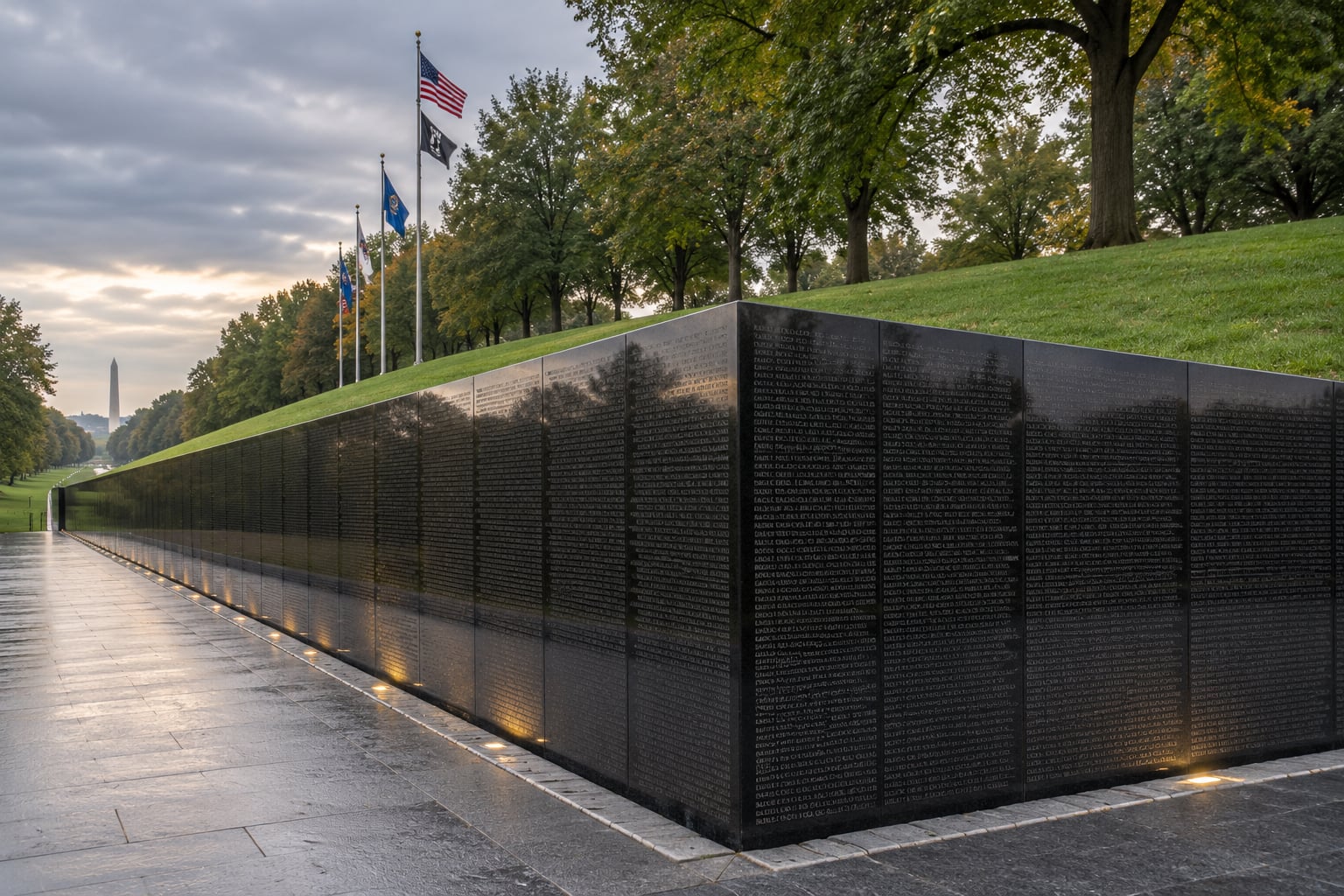
The Vietnam Veterans Memorial on the National Mall in Washington, D.C. was designed by Maya Lin, a 21-year-old Yale architecture student who won a public design competition out of 1,421 anonymous entries. She cut two long walls of polished black granite into the earth, set them in a V, and covered them with the names of more than 58,000 service members who died in the Vietnam War.
It is now the most visited memorial in the National Mall system, and almost nobody argues with it. That is worth pausing on, because when it was dedicated on November 13, 1982, it was one of the most fought-over pieces of public design in American history.
This guide walks through what the memorial actually is, who Lin was, how a classroom seminar brief turned into a national monument, what her design means, and why it caused such an uproar. It also covers how the memorial works for visitors today, especially anyone looking for a specific name.
Table of Contents
- What Is the Vietnam Veterans Memorial?
- Who Was Maya Lin?
- How Maya Lin and the Vietnam Veterans Memorial Came Together
- What Does Maya Lin’s Design Mean?
- Why Did the Memorial Look Unusual?
- How the Memorial Honors Vietnam Veterans
- What Is the Memorial’s Legacy Today?
- Maya Lin and the Vietnam Veterans Memorial: Key Facts
- Frequently Asked Questions
- What is Maya Lin’s Vietnam Memorial?
- How to find a name on the Vietnam War memorial?
- Why were some people against Maya Lin’s design of the Vietnam Veterans Memorial?
- What are some interesting facts about the Vietnam Veterans Memorial wall?
- What are some of Maya Lin’s most famous works?
- Why was the Vietnam War so controversial?
- Conclusion
What Is the Vietnam Veterans Memorial?
The Vietnam Veterans Memorial is a V-shaped monument of two black granite walls, built into the ground on the National Mall in Washington, D.C. Designed by Maya Lin and dedicated on November 13, 1982, it carries the names of more than 58,000 American service members who died in the Vietnam War, arranged in chronological order by date of death.
That definition paragraph is the short answer. Everything below is the longer version of what the thing is, why the war it commemorates was so contested, and how a wall of names turned out to be the most powerful piece of war commemoration in the United States.
Physically, the memorial has three parts that meet at a single point. The main feature is the two polished black granite walls forming the arms of the V, and their faces are covered edge to edge with names cut into the stone. A third, lower wall continues past the point of intersection, so the whole structure reads as a chevron driven into the landscape rather than a monument set on top of it.
The visitor approaches along an avenue of flagpoles and descends gradually toward the walls. At the base, a bronze group of three soldiers stands guard beneath trees. The memorial is also paired with two companion sculptures nearby, the Three Soldiers by Frederick Hart and the Vietnam Women’s Memorial, both added after the main dedication and both separate works by other artists.
Names continue to be added. The wall was carved with the names known at the time of construction, and later additions have covered service members who died afterward but whose deaths were connected to the war through the determination process.
One piece of context matters before the design makes sense. The war itself was deeply divisive, and that division is exactly what the memorial responds to. Public disillusionment grew through the late 1960s, the anti-war movement grew stronger, resistance to the draft spread, and the United States withdrew from Vietnam in 1973 before Saigon fell in 1975. The country ended the war without a victory ceremony, and the returning veterans were not received the way earlier generations had been.
A monument built in that mood had an obvious problem to solve: how do you honor people from a war your country lost, in a way that people would actually accept? Almost every design decision that follows answers that question.
Who Was Maya Lin?
Maya Lin was born on October 5, 1959, in Athens, Ohio, to parents who had emigrated from China. Her father, Henry Huan Lin, was a ceramicist, and her family moved frequently, so she attended high school in Phoenix, Arizona.
She studied architecture at Yale University and was in her third year of architecture studies when a professor mentioned a national design competition to his seminar students. It was an assignment, not an audition. Lin turned it in, and the assignment outlasted the course by a wide margin.
At the time of the competition she was 21. That fact is the one most people remember, and it is genuinely unusual. A jury of architects, designers, and veterans had selected a public design over a field that included working professionals with decades of practice, and the winning submission came from an undergraduate who had never built anything at that scale.
Her background also sat apart from the establishment that ran national memorial commissions. Lin is Asian American, and her parents’ immigrant history placed her outside the veteran and military networks that typically commission monuments. That is worth naming here because it shaped the memorial’s character: a design that deliberately steps outside the visual language of military commemoration was submitted by someone who had no stake in that tradition.
After Yale she built a substantial career in landscape architecture, sculpture, and public art, with commissions in Chicago, Minneapolis, Montgomery, and elsewhere. The Vietnam Veterans Memorial was her first major public work and remains her best known.
How Maya Lin and the Vietnam Veterans Memorial Came Together
The memorial was not the federal government’s idea. It came from Vietnam veteran Jan Scruggs, who wanted a national monument, and from the Vietnam Veterans Memorial Fund, the nonprofit formed in 1980 that eventually built and still operates the site. The process ran roughly like this.
1. The commission opens, fall 1980. The Vietnam Veterans Memorial Fund began calling for a national memorial, and the design was put out to open public competition rather than handed to a favored architect. Anyone could enter.
2. Lin hears about it in a seminar. A Yale architecture professor mentioned the competition to his students almost in passing. Lin, then a third-year architecture student, took the brief back to her room and treated it as a studio assignment.
3. 1,421 entries arrive. Submissions came from architects, landscape architects, sculptors, and students across the country and from abroad. The competition brief asked for something that would be congruent with a soldier, dignified, and contemplative, and it explicitly said the memorial should not be a flagpole, a statue, or a garden.
4. Judging is anonymous. Entries were stripped of names and judged by number alone. This detail comes up constantly in classroom retellings, and it matters: no panel was selecting a famous designer. Maya Lin’s submission was entered as number 1026.
5. The winners are told, May 1981. During finals week at Yale, two men came to Lin’s dormitory and asked whether she was the person behind entry 1026. Her first thought, by the story she has told since, was that she had broken some rule.
6. The design becomes a fight. The Commission on the Vietnam Veterans Memorial selected the design but struggled with the public response, and the statue commission went through its own extended, separate controversy. Construction was delayed while the commission tried to settle what the memorial should say about the war.
7. Ground is broken and the memorial opens. Ground was broken on March 26, 1982. The memorial was dedicated on November 13, 1982, in a ceremony attended by tens of thousands, and it has been open to the public ever since.
The commission’s struggle in step 6 is the part most retellings skip, and it is the part that explains everything that followed. Lin’s design had already been selected. The fight that followed was never really about whether her design was good.
What Does Maya Lin’s Design Mean?
Lin’s intent was to make the visitor stand level with the names instead of below a heroic figure, and to present the war as a record of individual loss rather than a story of triumph. Almost every element of the memorial follows from that one move.
The V as an open wound. Lin described the shape as a wound in the earth, opened and not quite closed. The V is not a victory gesture or a chevron on a uniform. It reads as damage, and the two arms suggest the injury opening and the two directions in which the loss ran.
Two arms, two points. Lin intended the arms to point to two places in the war’s story: where it began, and the point at which it was torn away from the country. The visitor walking down the western arm moves toward one; walking back up the eastern arm moves toward the other. You cannot stand in the middle of the V without choosing which direction to walk.
Descending into the earth and returning. The site is graded down as you approach, and the walls are set below grade at their highest point. You go down to meet the names and you climb back up on the way out. The physical effort of the visit is part of the design.
Level with the names, not beneath a hero. The names are cut at roughly eye level, and the wall rises above you. Every other major war monument in Washington asks you to look up at someone. This one asks you to read. A 21-year-old’s name and a sergeant’s name are given the same height and the same typeface.
Polished granite that reflects you. The stone is finished so that it holds a reflection. Visitors frequently describe seeing themselves in the wall next to a name, which turns an abstract casualty count into a specific encounter with one face.
A roster, not an inscription. A traditional victory monument carries a sentence about glory. This carries 58,000-plus names, ordered by date of death, with the year markers along the top edge and the state of each casualty indicated within the blocks. It is a document, not a claim.
Here is how the design breaks with the war memorial tradition it replaced:
- Traditional memorials: raised on a pedestal or a plinth, commanding the visitor from above.
- The Vietnam Veterans Memorial: below grade, so the visitor is level with the stone and inside the experience.
- Traditional memorials: a heroic figure, usually a general, on top.
- The Vietnam Veterans Memorial: no individual hero; the three soldiers at the base stand guard, they do not triumph.
- Traditional memorials: an inscription about victory and gratitude to the nation.
- The Vietnam Veterans Memorial: a chronological list of the dead, unadorned.
- Traditional memorials: the visitor looks up.
- The Vietnam Veterans Memorial: the visitor looks down, reads, and is reflected back.
- Traditional memorials: celebration.
- The Vietnam Veterans Memorial: witness.
Lin’s design brief was explicit that the result should be dignified and congruent with a soldier, and the reflective stone and the 140-inch cap height of the names are engineering answers to that brief. The granite had to be thin enough to read as a leaf of stone rather than a cliff, and the polishing had to be precise enough to work as a mirror across thousands of letters.
Why Did the Memorial Look Unusual?
The design was attacked on five specific grounds, and the objections were less about taste than about what a memorial was supposed to do.
- It was black. Previous national war memorials were light stone, white marble, bronze. Black granite read to critics as funereal, as mourning rather than celebration, and one commentator described the design as a black gash of shame.
- It descended into the ground. A memorial that goes below grade was widely read as a dishonor, as putting the dead underneath the living. This is the objection that usually appears in exam questions, and it is the easiest one to explain: the wall did not honor the fallen by raising them up.
- There was no heroic statue. No general, no flag-waving soldier, no triumphant pose. The bronze group at the base stands quietly rather than celebrating.
- It refused to glorify the war. The design records a defeat and a loss. Some veterans and veterans’ organizations wanted a monument that honored the courage of those who served, and read Lin’s memorial as a statement that the war was a wrong to be mourned rather than a sacrifice to be honored.
- The designer was 21. A student winning a national commission unsettled people who expected a national memorial to be designed by an established figure, and it made the design easy to dismiss as naive.
Two prominent figures on the commission withdrew their support for the project in the face of the criticism, and writer Tom Wolfe used the design as a punchline, dismissing it as a tribute to Jane Fonda. The national press picked up the word gash and ran with it.
Sculptor Frederick Hart, who held a separate statue commission, pushed back in the pages of the Commission on the Vietnam Veterans Memorial’s own documents. His argument is the one worth remembering: it is not Maya Lin’s memorial, nor Frederick Hart’s memorial, but a memorial to, for, and about the Vietnam veterans, erected by the American people.
On the design side, Ross Friend, who had been associated with the more traditional statue faction, produced the bronze group of three soldiers now standing at the base of the wall. The Three Servicemen is not on a pedestal and does not wave anything. The two sculpture debates and the wall debate overlapped, but they were not the same fight.
Emogene Cupp, the widow of a Marine killed in Vietnam, is usually credited with shifting veterans’ opinion. She supported the wall, argued that the veterans themselves wanted recognition of their individual loss rather than a speech about the war’s meaning, and her advocacy helped carry the project through Congress. Jan Scruggs, who had started the effort, held the line on the design.
By the time the wall opened, the argument had largely flipped. The most-visited memorial in the country had a design that many people had called an insult to the dead. Nobody rebuilt it, and nobody asked for the statue back.
How the Memorial Honors Vietnam Veterans
The memorial’s entire argument is that the dead should be named individually, which means the practical details of how it is carved matter to anyone using it.
The names run in chronological order by date of death, with the year markers set above the names along the top of the wall. Within a date block, names are grouped by state of casualty, and each state group is alphabetical, so a name can be found by scanning the headers rather than reading every letter. The wall has been extended and recarved several times as names were added, so the newer portions are physically distinguishable from the original 1982 carving.
Finding a specific name works like this:
- Identify the date of death and the state of the person you are looking for.
- Walk to the section of the wall marked with that year, then the date.
- Scan for the state header within that date block.
- Read alphabetically from there.
- If the name is not where you expect, use the name index at the visitor center, which lists every name by state and by date and gives the wall panel location. The same search is available through the Vietnam Veterans Memorial Fund’s online wall.
The visitor center, which also functions as a Memory Resource Center, holds records, photographs, and research materials for people trying to trace a service member. Staff there will help with a search that a visitor cannot complete alone.
People bring things to the wall and put them into the seams at the base: letters, flowers, photographs, small notes, military items. The visitor center collects some of these items for preservation because many are biodegradable. At three in the afternoon each day, a reader names the casualties of that day in Vietnam, and the practice has continued for decades.
The Moving Wall is a traveling replica of the memorial that goes to veterans’ events around the country, a rough three quarters of the size of the original. For people who cannot get to Washington, it is the same experience, and it often functions as the first encounter a family has with the names.
It is worth being precise about what Lin designed. The Vietnam Veterans Memorial is the two granite walls, the Avenue of the Flags, the landscape, and the layout. The Three Servicemen is by other hands. The Three Soldiers by Frederick Hart and the Vietnam Women’s Memorial, honoring the 58,000-plus women who served, are separate commemorations placed nearby, dedicated in later years. Students routinely conflate the four.
What Is the Memorial’s Legacy Today?
The Vietnam Veterans Memorial changed what a national monument was supposed to be. Before it, American war memorials largely celebrated victory and elevated commanders. The wall documents a loss, lists the dead without rank, and asks the visitor for something closer to witness than applause.
That model spread. The most visible inheritor is the National September 11 Memorial, where names of the dead are cut directly into bronze panels at ground level, a design that a public familiarized with reading names in stone was primed to receive. The wall-of-names format, where a mass casualty event is honored by an individual list rather than a heroic figure, is now standard practice in American public design.
Lin’s own career continued along the same lines. Her other best known works include the Civil Rights Memorial in Montgomery, Alabama, from 1989, which lists the dates of major events in the civil rights movement in a circular arrangement in the ground; the Vietnam Women’s Memorial from 1993, made with Thea Van Liem; and the Seven Rays storm drain art system in Minneapolis from 1999, a series of painted utility covers that turns storm drains into neighborhood storytelling sites. Across all of them the constant is public participation, which is a different register from the heroic state monument.
For most people the legacy is simpler than any of that. It is the family that walks in knowing roughly where a name is, and finds it.
Maya Lin and the Vietnam Veterans Memorial: Key Facts
- Designer: Maya Lin, born October 5, 1959, in Athens, Ohio, to parents who emigrated from China; her father, Henry Huan Lin, was a ceramicist.
- Age when selected: 21, a third-year architecture student at Yale University.
- Commission: initiated by Vietnam veteran Jan Scruggs and the Vietnam Veterans Memorial Fund, formed in 1980.
- Competition: open to the public, judged anonymously by entry number.
- Entries: 1,421.
- Lin’s entry number: 1026.
- Notified: May 1981, during finals week at Yale.
- Ground broken: March 26, 1982.
- Dedicated: November 13, 1982.
- Location: National Mall, Washington, D.C.
- Form: two black granite walls set below grade in a V, with a third lower wall continuing past the point of intersection.
- Names: more than 58,000 service members who died in the Vietnam War, added over time.
- Ordering: chronological by date of death, grouped by state of casualty, alphabetical within each state.
- Names cap height: about 140 inches at the highest point.
- Signature component: The Three Servicemen, a bronze group at the base of the wall, not part of Lin’s design.
- Related sites: The Moving Wall, a traveling replica; the visitor center and Memory Resource Center with a name index.
- Best-known later work: the Civil Rights Memorial in Montgomery, Alabama, 1989.
Frequently Asked Questions
What is Maya Lin’s Vietnam Memorial?
The Vietnam Veterans Memorial is a V-shaped pair of black granite walls set into the ground on the National Mall in Washington, D.C. Maya Lin designed it in 1981 at age 21 while a student at Yale, and it was dedicated on November 13, 1982. The walls carry the names of more than 58,000 service members who died in the Vietnam War, arranged in chronological order by date of death.
How to find a name on the Vietnam War memorial?
Names on The Wall are ordered by date of death, with the year set above each block, and grouped by state of casualty, alphabetical within each state. Locate the year and date, scan for the correct state header, then read the names from there. If the name is not where you expect, the visitor center keeps a name index that lists every name with its wall location, and the same search is available online.
Why were some people against Maya Lin’s design of the Vietnam Veterans Memorial?
The objections were specific: the granite was black rather than light stone, the walls were set below grade instead of raised on a pedestal, there was no heroic statue, the design declined to glorify the war, and the designer was a 21-year-old student. Some veterans and figures on the commission withdrew support, and Tom Wolfe mocked the design as a black gash of shame. Others, including Emogene Cupp, argued veterans wanted individual recognition, not a verdict on the war.
What are some interesting facts about the Vietnam Veterans Memorial wall?
The design competition was open to the public and drew 1,421 entries, judged anonymously by number, and Lin’s winning entry was number 1026. The memorial holds more than 58,000 names, the granite is polished so reflective that visitors see themselves in it, and names are cut to about 140 inches at the cap height. Ground was broken on March 26, 1982, and the memorial was dedicated on November 13, 1982.
What are some of Maya Lin’s most famous works?
Beyond the Vietnam Veterans Memorial, Lin’s best known public works include the Civil Rights Memorial in Montgomery, Alabama, from 1989, which sets dates of the civil rights movement into the ground; the Vietnam Women’s Memorial from 1993, made with Thea Van Liem; and the Seven Rays storm drain art system in Minneapolis from 1999, a set of painted utility covers based on a community design process. She works in landscape architecture, architecture, and sculpture.
Why was the Vietnam War so controversial?
Disillusionment grew through the late 1960s as the scale of American involvement became clear, the anti-war movement grew stronger, resistance to the draft spread, and the United States withdrew from Vietnam in 1973 before Saigon fell in 1975. The war ended without a declared victory or a homecoming ceremony for the troops, and its meaning divided the country. That unresolved public argument is the condition the memorial’s design responds to.
Conclusion
Maya Lin and the Vietnam Veterans Memorial are a single idea executed in granite: put the visitor at the same height as the names, list the dead one by one, and let the visitor decide what the war meant instead of telling them. The black stone, the wound-shaped V, the descent below grade, and the reflective surface all serve that single move.
Start by standing at the wall and reading five names. Notice that they are at your eye level, that no one is celebrated above them, and that your own face is in the stone next to the letters. That experience is the design, and once you have seen it, the 1982 argument about a black gash of shame looks like a different argument about a memorial people had not seen yet.