
Richard Wright’s Native Son (1940) is a three-part novel — Book One: Fear, Book Two: Flight, Book Three: Fate — narrated entirely through Bigger Thomas, a young Black man in Depression-era Chicago who accidentally kills Mary Dalton, a white heiress. This Native Son study guide gives you the plot, characters, themes, symbols, passages worth analyzing, and classroom questions, free and complete.
Wright was 31 when the book came out in March 1940. It was the first novel by a Black American writer to sell to a mass white readership, and it remains the sharpest argument in American fiction that racism does not merely persecute people, it manufactures them.
If you are studying the book rather than just finishing it, start below. Work through the plot and character sections once, then come back to the passages section with a pen in your hand.
Table of Contents
- Richard Wright Native Son Study Guide: Quick Guide
- What Is Native Son About?
- How Does the Plot of Native Son Unfold?
- Book One: Fear — Bigger grows up in the Black Belt
- Book Two: Flight — The job, the hunt, the murder
- Book Three: Fate — Trial, sentence and a strange peace
- Who Are the Main Characters in Native Son?
- Bigger Thomas
- Mary Dalton
- Boris A. Max (Max A. Westoff)
- Britten
- Mr. and Mrs. Dalton
- Bessie and Bigger’s mother
- What Are the Major Themes in Native Son?
- How Does Richard Wright Use Symbolism?
- What Is the Historical and Social Context of Native Son?
- Which Passages Should You Analyze?
- 1. The rat hunt in the second-floor bedroom
- 2. Bigger telling Bessie she can have anything
- 3. The mob hunting an innocent Black man
- 4. Mr. Dalton’s testimony
- 5. Max’s closing speech
- 6. The final chapter and the sun
- How Is Bigger Thomas Portrayed?
- Native Son Discussion and Study Questions
- On plot and structure
- On characters
- On themes and evidence
- Essay prompts
- Frequently Asked Questions
- What is the main message of Richard Wright’s Native Son?
- Why does Bigger Thomas kill Mary Dalton?
- What does the rat symbolize in Native Son?
- Is Bigger Thomas a sympathetic character?
- How does the ending of Native Son relate to its themes?
- Conclusion
Richard Wright Native Son Study Guide: Quick Guide
| Author | Richard Wright (1908–1960) |
|---|---|
| Published | March 1940, by Harper & Brothers |
| Wright’s age | 31 |
| Setting | Chicago, 1920s–1930s: the South Side “Black Belt” and the white Hyde Park ward |
| Structure | Three parts — Fear, Flight, Fate |
| Point of view | Third-person limited, focused on Bigger Thomas throughout |
| Length | About 380 pages in standard editions |
| Reading level | Grade 10–12; roughly an 8th–9th grade readability score, with heavy dialect |
| Genre | Protest novel, social realism with naturalist and existential strain |
| Notable history | Selected by the Book-of-the-Month Club; restored text published 1991 by the Library of America |
Reading level is the thing students ask about most, and the honest answer is that the prose is simpler than it feels. Wright writes in short declaratives and heavy dialect: the sentences are easy, the situations are not. Where readers slow down, it is almost always a word, not a sentence — Wright reproduces 1930s Chicago slang, street speech and period phrasing that no longer travels.
Two editions matter for coursework. The 1940 text is shortened; Wright cut roughly a quarter of the manuscript, including the most explicit Klan and mob passages. The Library of America restored edition (1991) puts those back. If your class says “the 1991 text,” the restored material is what you are reading.
What Is Native Son About?
Native Son is about a man whose environment gives him almost no room to choose, and about what a society does when a man it made small finally acts large. Bigger Thomas grows up in a Chicago tenement with his mother and sister, sees his father killed in a street fight, and learns early that Blackness itself is treated as dangerous. He is intelligent, quick and absolutely aware of the line he is not allowed to cross.
When a job with the wealthy Dalton family gives him a room, a paycheque, and a chance to feel human, he is handed a symbolic gift: a large, blunt Black man. The hunt for the rat he is supposed to kill collapses into Mary Dalton’s bedroom. Bigger kills her, and the state machine that closes around him — police, mob, trial, sentence — treats his entire life as evidence of his guilt.
Wright’s argument is not that Bigger is innocent. It is that the system convicts him twice: once for the murder, and once for being who he is.
How Does the Plot of Native Son Unfold?
The plot moves in three movements that repeat a single shape: Bigger is confined, he tries to break out, and the world closes tighter than before. Each part ends with a kind of trap — a wall, a forced marriage, a prison cell.
Book One: Fear — Bigger grows up in the Black Belt
The novel opens in darkness with an alarm ringing. Bigger lies in a room shared with his mother and sister Bessie, in a building where rats are ordinary. His father, killed in a fight, is the first absence. Bigger learns that his blackness is a public danger: a white woman screams at him in the street, and his mother makes him promise to stay out of white people’s way.
He takes a job as a dishwasher in the Daltons’ Hyde Park house, where the family is generous to a fault — Mrs. Dalton gives money to poor Black families, hires Black help, treats Bigger’s strangeness as a phase. He is drawn to Mary, the daughter, whose bedroom is light, cool and open to him in a way nothing else has ever been. He tells himself he does not want her. He is lying to himself, and he knows it.
Book Two: Flight — The job, the hunt, the murder
Bigger is given two jobs and a mission: kill the rat in the second-floor bedroom. He waits in the dark room, the flashlight on his face, listening to Mary bathe behind a screen. Mr. Dalton is in bed nearby. Bigger retreats, waits, and finally lifts the rifle that he has been told hangs on the wall.
When Mary comes in and Bigger stumbles out, she falls and he strikes her with the rifle to stop her screaming. She dies. Britten, a private detective working for the Dalton family, has been hired to kill Bigger, which means Bigger is simultaneously the suspect, the target of a racist mob, and prey for a man he does not know exists.
Hiding in an abandoned apartment, Bigger falls in love with Bessie and tells her she can have anything she wants. When he realizes he would trade her for his own freedom, he tells her to go — a moment the restored text renders more painfully than the 1940 version did.
Book Three: Fate — Trial, sentence and a strange peace
Bigger is caught, and the trial is a public spectacle. Mary Dalton’s white family is divided: Mr. Dalton accepts that his daughter was careless and that Bigger is psychologically disturbed; Mrs. Dalton, blinded by a stroke and never having fully registered Bigger’s presence, treats the murder as a mystery rather than a crime. Boris A. Max, a communist lawyer, mounts a defense built on the argument that Bigger was made by his environment — and is ignored or mocked by a jury that has already decided.
Bigger is sentenced to death. In the epilogue he says he has made no bargain with God, and that he will accept whatever comes. He tells Max he is going to tell the truth, and then he tells the reader that Black people have no claim on the sun. The final chapter gives him a vision — he sees the sun and believes for the first time that life was not sent to torment him. He is executed the following day.
Who Are the Main Characters in Native Son?
Nearly everyone in this novel exists to define a limit of Bigger’s world. The useful study move is to ask, for each figure, what they think he is allowed to be.
Bigger Thomas
The protagonist, roughly 16 at the start of Book One and older by Book Three. He is perceptive, funny, resentful, and physically large — the size is part of his social category rather than his personality. His interiority is the novel’s real subject: Wright gives him a mind that is sharp and searching under pressure, not empty or monstrous. Bigger understands that he is treated as a threat, and he behaves like one, which makes the novel’s central accusation impossible to dodge.
Mary Dalton
Mary is not a villain, and that matters more than anything else in Book Two. She is careless rather than cruel: she hums a tune while bathing, she leaves her door open to a man she has never properly looked at, she does not see him as a threat. In a novel where Black men are treated as automatic dangers, her obliviousness is not innocence but a consequence of the same blindness. Her death exposes her.
Boris A. Max (Max A. Westoff)
The Communist lawyer who becomes Bigger’s only advocate. Max’s political framework — that environment makes the criminal — is exactly Wright’s argument, but the courtroom rejects it. He matters because he is the only adult in the novel who treats Bigger as a person capable of explanation, and because he loses anyway, which keeps the book from being a polemic.
Britten
The detective hired by the white South Side to murder Bigger. The novel’s racism is fully naked in him: he is not a criminal, he is an employee, and the mob that chases Bigger is his client. He dies early, so he never has to answer for it.
Mr. and Mrs. Dalton
Mr. Dalton is decent, squeamish and reasonable — a good man inside an unjust structure. Mrs. Dalton has gone blind; she never truly saw Bigger, and she spends the trial trying to understand a stranger rather than a murderer’s son. Her charity, which reads as generous in Book One, is powerless in Book Three. Both of them are evidence for Wright’s argument that white benevolence cannot substitute for structural change.
Bessie and Bigger’s mother
Bessie is Bigger’s sister, first his protector and then his partner in flight, the one person who treats him as ordinary rather than dangerous. His mother, Mrs. Thomas, is the novel’s conscience: she is a Black mother whose fear for her son is the price of living in the country he was born in. She is the last person Bigger sees before he dies.
What Are the Major Themes in Native Son?
Racism as environment, not attitude. Wright argues that racism produces behaviour rather than merely condemning it. Bigger’s violence is not an exception to his character; it is what his character was made into. Every character who calls him “a good boy” or “a fine man” is describing a small, safe corner of a self he never had the room to build.
Fear and violence as a cycle. Bigger is afraid of white people, white people are afraid of Bigger, and both fears produce violence. The rat hunt, the murder, the mob and the trial all run on the same fuel.
Poverty as entrapment. Bigger’s options are jobs he cannot keep, rent he cannot meet and a father dead for no reason. Wright refuses to treat poverty as a circumstance; he treats it as a set of doors that close.
The illusion of white benevolence. The Daltons fund Black families, give Bigger a job and call themselves good. By the end of the novel, that goodness has cost Mary her life and done nothing for Bigger. Charity is not justice.
Fate versus free will. The title of Book Three is the argument. The 1940 ending is harsher, and the restored ending leans harder toward a moment of spiritual recognition that still resolves into death. Wright holds both: Bigger has a mind and makes choices, and the choices were pre-shaped for him.
Identity and Blackness. Bigger’s final speech about the sun is the novel’s argument with itself. Can a man whose Blackness was used as evidence against him claim a share of the world’s light?
How Does Richard Wright Use Symbolism?
Wright’s symbols do not decorate the novel; they do its work. Track them in a list as you read and the plot starts to look like a series of warnings.
- The rat. The job Bigger is given is to kill a rat, and the rat is Bigger. He is hired to destroy what he is. Bigger later tells Bessie he no longer wants to be a rat.
- The sun. In Book One the sun is hot, hostile, a thing that makes him sweat and hides the “blackness” people talk about. In the final chapter it becomes a claim he is owed. Same symbol, reversed meaning.
- The dark room. The second-floor bedroom where Bigger waits with a flashlight, near the woman who does not know he is there. Wright makes darkness literal and psychic at once — Bigger’s inner life is also unlit.
- The rifle. He takes it to kill a rat and uses it to kill a woman. The weapon makes the whole plot turn on a single, quiet motion.
- Fire. Bigger’s childhood memory of his father returning home burned and beaten is the novel’s template: violence arrives in the house, and no one can stop it.
- The newspaper. Papers carry the mob’s frenzy, Britten’s candidacy and the public story that convicts Bigger before a jury sees him. Wright shows how a headline is a verdict.
- The bathtub. Mary sings behind a screen while Bigger watches. The sound is innocent; the effect is menacing. It is the novel’s cleanest example of dramatic irony.
Notice the pattern. Symbols usually appear first as objects and later as meanings, so a second read of Book One will show you the endings hiding inside the setup.
What Is the Historical and Social Context of Native Son?
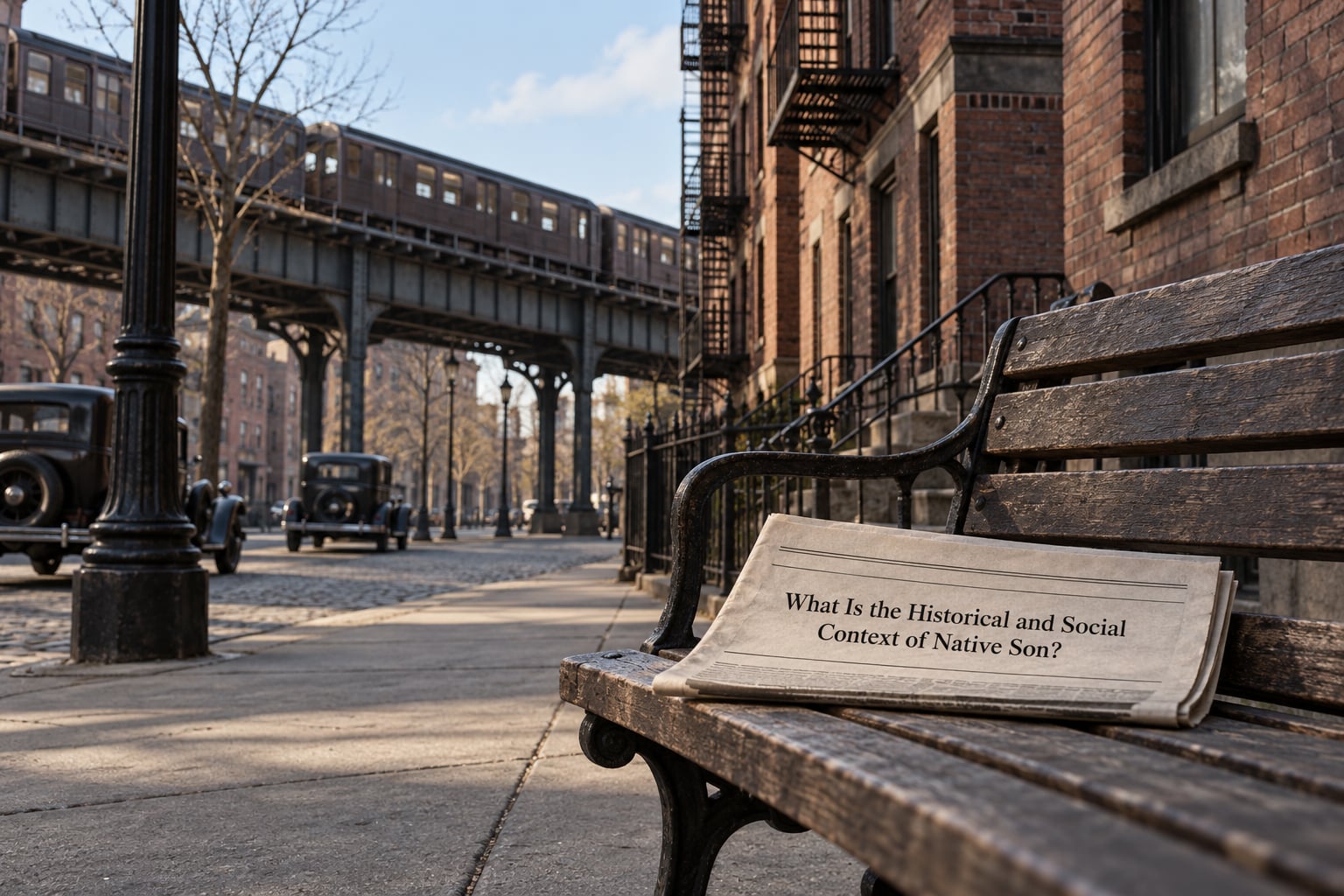
The novel is set in Chicago between the First World War and the Great Depression, but Wright’s target is the myth that the North was different from the South. The Great Migration had brought hundreds of thousands of Black Southerners to Chicago, and white flight had already turned the South Side into the “Black Belt,” the most densely segregated large city in the country.
The Dalton house in Hyde Park matters. It is the wealthy, progressive, abolitionist-sympathizing zone of the city — and Bigger still cannot enter it as an equal. If he is admitted at all, it is as a servant with a symbolic object to fetch. That single room is the whole argument about Northern progress.
White-on-black violence in this Chicago is legal-adjacent and organised. An unsolved murder triggers an armed mob that beats and kills an innocent Black man before Bigger is found. That scene, cut from the 1940 printing, is exactly the material the Book-of-the-Month Club and its reviewers objected to, and exactly what the 1991 restoration put back.
Two historical threads run underneath. Wright’s communism gives Max his closing argument — that environment makes the man — and the red scare of the late 1930s is the political weather around the book’s publication. And the novel was published in 1940, before the Civil Rights Act, before Brown, when Chicago police departments were deeply segregated. Wright is writing a warning from inside the machine, not from hindsight.
Which Passages Should You Analyze?
Six scenes carry the argument. For each, note what the passage shows, what Bigger is doing in it, and which theme it serves — that three-part note is the difference between a summary and an essay.
1. The rat hunt in the second-floor bedroom
The key to the whole novel. Bigger is alone in the dark with a rifle, waiting, and he describes Mary in terms that oscillate between admiration and predation. Analyse how Wright’s third-person limited narration puts the reader inside a mind that is watching, without telling us what to think of it.
2. Bigger telling Bessie she can have anything
A short scene that carries the moral centre of the novel. He would give Bessie anything except himself; he wants his freedom more than the person he loves. The restored text makes this moment more explicit and more brutal, which is one reason the 1991 edition changed classroom readings of the book.
3. The mob hunting an innocent Black man
Cut from the 1940 edition and restored in 1991. A white man is beaten to death by a mob because of the race of the man he is suspected of being. Compare what you read with what you know was removed, and ask what a publishing decision does to a novel’s argument.
4. Mr. Dalton’s testimony
He testifies for the defence, concedes his daughter was careless, and is treated as a traitor. A fair man inside an unjust structure cannot testify fairly. Quote his hesitation as much as his words.
5. Max’s closing speech
Max tells the jury that Bigger is the product of a hundred years of oppression, and is largely ignored. The strongest passage in the novel for an argument about who is permitted to speak and who is presumed guilty.
6. The final chapter and the sun
Bigger rejects God’s bargain, then says he will tell the truth and claim the sun. Read it in two passes: first as despair, then as the novel’s only moment of claim. What has changed, and has anything been solved?
How Is Bigger Thomas Portrayed?
Bigger is intelligent, funny, watchful, resentful and afraid, and he kills. Every reader who finishes the book faces the same question: what kind of character is a man like this? Wright’s answer is deliberately uncomfortable — he gives Bigger an interior life rich enough that the crime cannot be reduced to badness, then shows a world that would have produced that interior life in almost any environment.
The debate usually runs two ways. In the sympathetic reading, Bigger is a victim of forces he never chose, and the trial convicts him for his skin. In the deterministic reading, the novel removes agency so thoroughly that it becomes an argument about society rather than about him, which some readers find a weakness: you cannot admire a character the author has made into a case study.
Both readings come from the text, which is why this is the best classroom argument in the book. A strong essay takes a position and then shows the other side’s best evidence, rather than assuming the novel has already settled it.
Two details keep him human rather than symbolic. He lies to Bessie out of love, and he talks to his mother at the end with plain tenderness. Wright gives him the capacity for attachment in a system designed to deny him anything that cannot be consumed.
Native Son Discussion and Study Questions
These are written to be analytical rather than comprehension checks. Any of them works as a timed response, a Socratic seminar question or a book club opener.
On plot and structure
- Each part ends with Bigger enclosed — a wall, a marriage, a cell. What does the repetition suggest about escape?
- Why does Wright give us no scene of the murder from any witness’s point of view? What does that withholding do?
- Track how many times Bigger is told he is free before he is convicted. What is the pattern?
On characters
- Mary Dalton is written as careless, not cruel. How does the novel ask you to hold both judgements at once?
- Mr. Dalton testifies for Bigger and loses standing for it. Is he a good man or a weak one? Defend your answer with evidence.
- Mrs. Dalton’s blindness is literal and structural. How does Wright use it?
- Why does Britten have to die early in the novel?
On themes and evidence
- Argue for or against the claim that the novel blames Bigger’s environment more than it blames Bigger.
- How does the hired rat function as a metaphor for the job Bigger is given in white society?
- The sun changes meaning between Book One and Book Three. Trace the reversal.
- Max’s defence is correct and it fails. What does the novel gain from a correct argument that loses?
Essay prompts
- Wright said the novel’s purpose was to show what happens to a man “in a world where he is always being pushed to the edge.” Use evidence from three parts to explain what he means.
- How does the 1940 text and the 1991 restored text differ in their political argument? Argue which is the stronger novel and why.
- Compare Bigger Thomas with the narrator of Ralph Ellison’s Invisible Man: what does each novel argue about the difference between being unseen and being unseen because of race?
- Is the novel’s ending hopeful or fatalistic? Defend one position and acknowledge the strongest evidence for the other.
Frequently Asked Questions
What is the main message of Richard Wright’s Native Son?
Wright’s main message is that racism and poverty produce behaviour rather than merely punishing it. By narrating the whole novel through Bigger Thomas, he argues that a society which confines a man economically, legally and psychologically cannot then treat his violence as proof of a fixed nature. The trial in Book Three convicts Bigger twice: once for the murder, once for his Blackness.
Why does Bigger Thomas kill Mary Dalton?
Bigger is told to kill a rat in the second-floor bedroom. He hides in the dark with a rifle and listens to Mary bathe, caught between his hunger for her attention and his terror of being discovered. When she enters and he stumbles out, she falls and begins to scream, and he strikes her with the rifle to stop it. The killing is both panic and the collapse of every distinction he had been holding.
What does the rat symbolize in Native Son?
The rat stands for Bigger himself. The job he is given at the Dalton house is to find and destroy it, which makes him the hired instrument of his own dehumanization. The symbol develops further when Bigger tells Bessie he no longer wants to be a rat, a rat being something hunted with no place to hide. Wright uses the same idea of an animal hunted to shape the mob’s violence in Book Two.
Is Bigger Thomas a sympathetic character?
This is the central classroom debate, and honest readers land in different places. Bigger has wit, perception, fear and real attachment to his sister and mother, which makes him legible. He also kills a woman who never threatened him. Wright’s design keeps both facts in play by giving him a full inner life and a society that produced it, so the strongest response takes a position and then presents the other side’s best evidence.
How does the ending of Native Son relate to its themes?
The final chapter has Bigger refuse God’s bargain, say he will speak the truth, and claim a share of the sun, which he earlier described as an enemy. His execution the next day keeps the ending from turning hopeful. Wright balances fate against agency: Bigger chooses to speak and to see, but he has no power over the sentence. The 1991 restored text strengthens this moment of recognition without changing the outcome.
Conclusion
If you take three things from this Native Son study guide, make them these: identify Bigger’s central conflict, which is a man trying to become human inside a system that priced him as property; track the symbols, starting with the rat and the sun, because Wright foreshadows his endings in his openings; and write with evidence, because the sympathetic-versus-deterministic argument only works if you can cite both sides.
Read Book One for what is being taken from Bigger. Read Book Two for what he does with what is left. Read Book Three for who the law chooses to hear.