
This ralph ellison invisible man study guide covers the plot, the political subtexts, the symbols and the questions students actually get asked about Ellison’s 1952 novel, written for readers meeting it for the first time in 2026.
The book is dense, and most free guides stop at a chapter-by-chapter recap. That approach leaves the hard parts untouched: why the narrator has no name, what the Brotherhood actually wants from him, and why the ending refuses to feel like a victory. This guide fills those gaps.
Table of Contents
- What Is Ralph Ellison’s Invisible Man About?
- What Historical and Biographical Context Should You Know?
- The Great Migration and the Harlem Renaissance
- Jim Crow, segregation and racial passing
- Black nationalism, Marxism and the Brotherhood
- Ellison’s own background
- Who Is the Narrator, and Who Is He Talking To?
- What Happens in Invisible Man, Chapter by Chapter?
- Prologue: the storyteller in hiding
- Chapters 1 to 2: childhood and the grandfather’s curse
- Chapters 3 to 6: school, the death of Tod Clifton, and the Golden Temple
- Chapters 7 to 9: the college, the theft, and Dr. Bledsoe
- Chapters 10 to 12: New York and the deception
- Chapters 13 to 16: Lily, the men in the street, and Brother Jack’s arrival
- Chapters 17 to 21: Trueblood, the machine, and the raid
- Chapters 22 to 25: the apartment, Mary, and the collapse
- Epilogue: the basement in darkness
- What Are the Most Important Symbols and Motifs?
- The chain and the master/slave reversal
- The crow, the Sambo doll and the yams
- The white statue on the college campus
- The briefcase, the mask and the horse
- Paint, the elevator and the factory
- The card game and the number
- Which Characters Shape the Narrator’s Conflict?
- The narrator
- Peter Emerson and the men on the street
- Tod Clifton
- Professor Hull and Brother Clinton
- Mary Rambo
- The women and the Rinehart disguise
- What Does the Ending Mean?
- What Literary Techniques Does Ellison Use?
- Irony
- Symbolism and imagery
- Characterization through dialogue
- Motif
- Understatement and tonal shifts
- Second-person address and stream of consciousness
- Which Themes and Quotations Are Best for Essays?
- Ralph Ellison Invisible Man Study Guide: Major Themes
- Identity versus accommodation
- Institutional racism in education
- Freedom and responsibility
- Naming and visibility
- The individual against the community
- How Can You Build a Strong Study Plan?
- Frequently Asked Questions
- What is the narrator’s name in Ralph Ellison’s Invisible Man?
- What does invisibility mean in Invisible Man?
- How should students interpret the ending of Invisible Man?
- What are the most important symbols in Invisible Man?
- Is Invisible Man appropriate for high school students?
- Conclusion: What Should You Study First?
What Is Ralph Ellison’s Invisible Man About?
Invisible Man follows an unnamed Black narrator who grows up in 1930s America believing education and hard work will earn him a place in the world, then discovers that powerful people, both Black leaders and white benefactors, decide his visibility for him. His search for identity and purpose collides with racism, racial passing and political manipulation, and the central conflict is whether he can become himself without performing for anyone else.
The novel is a bildungsroman, a coming-of-age story, but one in which growth mostly means losing illusions. It runs in three parts: the college years in the South, the political years in New York, and the collapse in Harlem. It won the National Book Award and remains the most assigned African American novel in American classrooms.
What Historical and Biographical Context Should You Know?
Ellison wrote during the Great Depression and the Second World War, and published the novel in 1952, two years before Brown v. Board of Education. Knowing the era turns several chapters from puzzling to obvious.
The Great Migration and the Harlem Renaissance
Between roughly 1910 and 1970, millions of Black Southerners moved north to cities including Harlem. That migration created the neighborhood where the narrator’s final chapters unfold, and the Harlem Renaissance gave writers like Langston Hughes and Zora Neale Hurston a public voice at exactly the moment Ellison was forming as an artist.
Jim Crow, segregation and racial passing
Jim Crow laws and custom kept Black Americans in a separate and unequal position throughout the South. When Mr. Norton drives the narrator south on a scholarship-funded tour, he shows him the segregated facilities white money funds and expects nothing from them. Dr. Bledsoe’s photograph of the black college founder on his desk makes the same point in a quieter way.
Black nationalism, Marxism and the Brotherhood
The Brotherhood draws on communist organizing and black nationalist thinking of the 1930s and 1940s. Neither side in Part Two is written as a simple villain, and both want to use him. Readers who skip this context usually find the political chapters unreadable.
Ellison’s own background
Ellison was born in Oklahoma City in 1914, spent his childhood in segregated surroundings, and read widely, especially jazz and blues. He was the grandson of a slave, and his grandfather’s stories fed directly into the novel’s opening chapter. Invisible Man was his only novel; he published essays and short fiction afterward, then largely withdrew from public view.
One more note. Search confusion between this novel and H. G. Wells’s 1897 The Invisible Man is common. Wells’s book is a science fiction story about a scientist who turns invisible. Ellison’s is a modernist novel about being unseen socially. If your assignment says Ellison, it is not Wells.
Who Is the Narrator, and Who Is He Talking To?
The narrator is a fictional character, not Ralph Ellison. He is never named in the novel, which is deliberate: his lack of a name mirrors his lack of a stable public identity. Almost every person who claims him wants to rename him, from the white men who call him a racial type to Brother Jack, who wants him to surrender his individual ambition to the movement.
Ellison frames the book as a story the narrator is telling years later, from somewhere offstage after the events in Harlem. That prologue creates a second layer. The narrator now has a name and a career, but he writes as if he cannot reveal it, because naming it would break the identity the book depends on.
He also addresses a second person, the reader, as you. This shifts the question from what happened to the narrator to what you did with the story. For essays, that distinction matters: claims about the narrator’s blindness are claims about a constructed speaker, while claims about Ellison are claims about the artist who built that speaker.
What Happens in Invisible Man, Chapter by Chapter?
Spoilers follow for every section below.
Prologue: the storyteller in hiding
The narrator describes being hunted by men with searchlights and explains that people see in him what they expect to see rather than what is actually there. He is black, southern, and therefore treated as a type. The frame establishes the novel’s central complaint before a single scene of the past begins.
Chapters 1 to 2: childhood and the grandfather’s curse
In the narrator’s childhood in a southern town, his grandfather lies on a bed of nailed boards, bleeding, and tells him to keep his mind. The grandfather names his final wish: overcome them with yams, a taunt about the family’s past, and insists the boy carry it out of loyalty rather than fear. The chapter ends with the boy vomiting on the yams, a scene many readers find the most memorable in the book.
Chapters 3 to 6: school, the death of Tod Clifton, and the Golden Temple
The narrator, a gifted student, is assigned a program of advancement under Jim Trent, the principal. He meets Tod Clifton, who shows him the abandoned Golden Temple, a burned-out building whose hidden rooms have become a meeting place for local black men. Clifton’s speeches grow more radical, and the two argue over strategy. When the men who follow Clifton prepare to burn a man alive, the narrator helps stop it and then freezes while Clifton orders him out. Clifton is later shot by the police, shot by his own people. The narrator does not bury him.
Chapters 7 to 9: the college, the theft, and Dr. Bledsoe
Arriving at the black college under Jim Trent’s sponsorship, the narrator is assigned to the task of escorting the wealthy white trustee Mr. Norton around campus. During the drive, a white woman gives the narrator a hundred dollars for her son, and he gives it to Jim Trent. Trent’s mental collapse follows, and the narrator reads the man’s private letters. He is expelled on a Friday morning and finds a note from Dr. Bledsoe, the college’s stern administrator, offering a scholarship to a Negro school in New York.
Chapters 10 to 12: New York and the deception
Dr. Bledsoe hires him as chauffeur, promises to advance his career and introduces him to downtown white society. He gives him letters of introduction to a prominent white donor, but burns the most important letters before the narrator can deliver them. The narrator arrives in New York to discover his benefactor has no record of him.
Chapters 13 to 16: Lily, the men in the street, and Brother Jack’s arrival
He finds lodging with the small and watchful Lily, and attempts to write his own story back into shape. Then men block the street and beat him for speaking as a black man, a lesson he learns through his own blood. Brother Jack arrives from Washington with the Brotherhood, and the narrator is swept into meetings, training sessions and a renaming ceremony.
Chapters 17 to 21: Trueblood, the machine, and the raid
Hobson, another Brotherhood man, refuses to kill a man holding him at gunpoint, and the leadership sends the narrator to discipline him. Instead the narrator reads him a story about a black man and a white woman and gets himself arrested and beaten. On release he finds Brother Jack selling copies of an inflammatory pamphlet to white customers at night, exactly the accommodation the Brotherhood claims to reject. Jack is ousted, and the narrator is elevated in his place.
Chapters 22 to 25: the apartment, Mary, and the collapse
The Brotherhood gives the narrator an apartment and a new name, Brother Clinton, and treats him as a living example. Mary, a woman from Harlem, loves him, and he mistakes her devotion for his own importance. When he misses a crucial meeting for an evening with her, she is attacked by men connected to the movement, and she tells him that he is invisible to her. The Brotherhood sends him south to raise money from the Golden Temple crowd. He reaches the Grand Canyon at night, reverses direction, and returns to Harlem.
Epilogue: the basement in darkness
He tries to drum up tenants in the rented basement and falls asleep in a cave of light with a gramophone. He wakes to find himself invisible to the New York men, who walk through him as he screams. They believe him, search the basement, and overlook his body. He escapes to the streets, still hunting him, and finally faces the possibility that he must start over and speak with his own voice.
What Are the Most Important Symbols and Motifs?
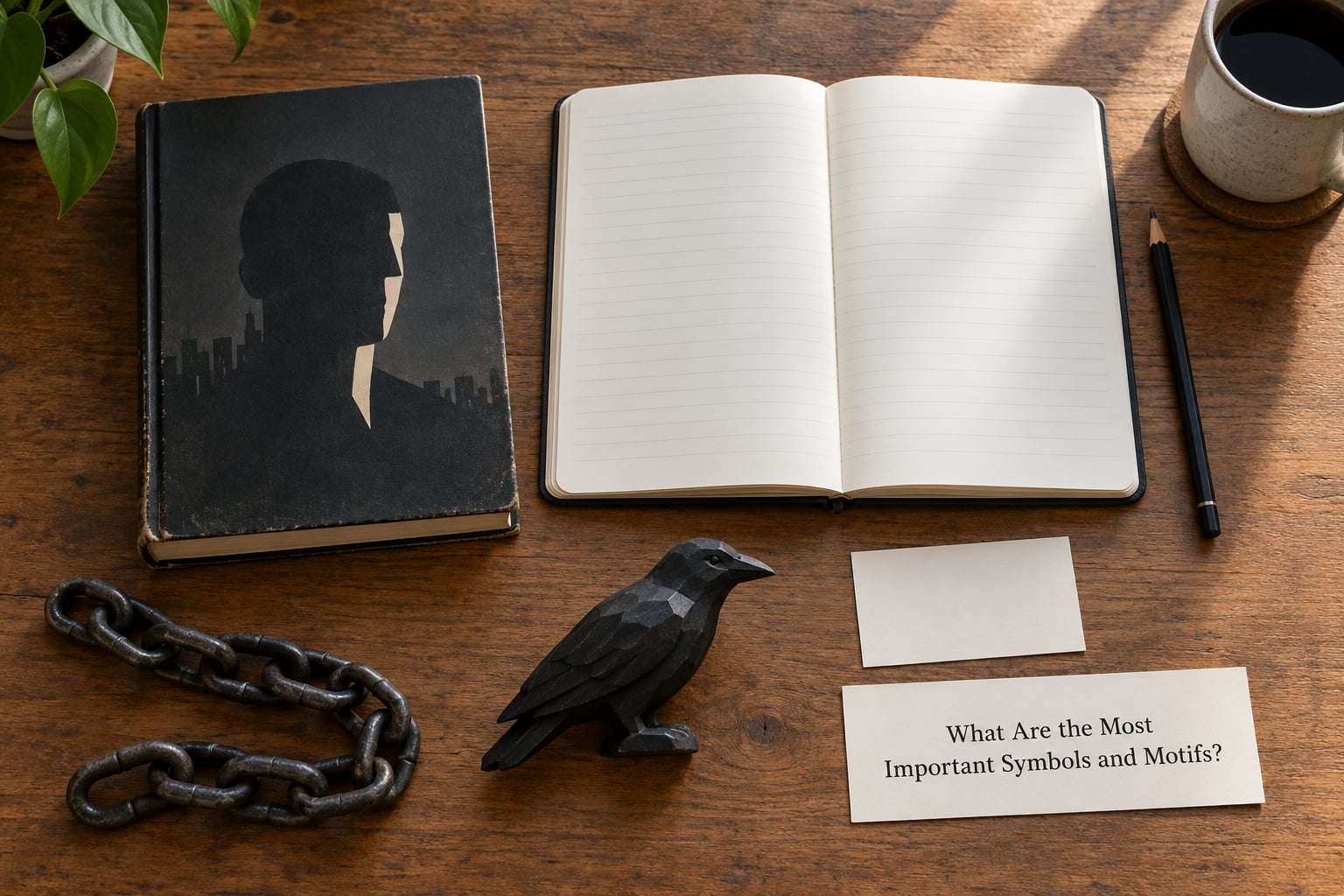
A symbol is one concrete thing that carries meaning beyond itself. A motif is a pattern, object or image that recurs across the novel so often that its repetition becomes the argument. Ellison uses both, and the difference matters when you write about them.
The chain and the master/slave reversal
The opening image of the grandfather on a bed of boards is a chain, and the boards are made of wood from the same tree as the master’s house. The symbol is not simply oppression. It also raises the question of who is tied to whom, and whether inherited suffering can be handed forward or has to be broken.
The crow, the Sambo doll and the yams
The Sambo doll and the yams are two versions of a white caricature of Black inferiority, and the grandfather’s dying request is a demand to defeat them with the very image used to humiliate him. The crow, by contrast, offers a different reading of the same folklore: black in form, white in song, a trickster who survives by being underestimated. Read the pair together rather than separately.
The white statue on the college campus
The founder’s statue does not mean one fixed thing. It represents the college’s dependence on white money, the worship of white achievement as the standard the students are told to meet, and a public claim to respectability that also marks the students as visible only when donors are looking.
The briefcase, the mask and the horse
The briefcase arrives as a gift and later hides a message and money; it carries the narrator’s plans without ever holding his self-image. The mask shows him what performance costs, since each disguise during the Rinehart episodes buys him confidence by removing him from himself. The unnamed horse on which he rides through Harlem at night belongs to no one and is beaten by whoever claims it, which is a fair description of how the city treats him.
Paint, the elevator and the factory
The paint factory is the novel’s most argued-over scene. The narrator, looking for Mr. Emerson, is mistaken for a worker and swept into painting a woman’s face, white paint on top of black. The paint can support a reading of enforced artificial brightness, a reading of the industry literally producing the images America assigns to Black people, and a reading of his own face being overwritten. Keep it open in discussion; the best essay arguments here come from holding two readings together.
The card game and the number
The name Rinehart comes from a card hand, and the deception is only possible because people see a confident stranger and fill in the rest themselves. That is the novel’s thesis in a single detail.
Which Characters Shape the Narrator’s Conflict?
The narrator
His gift for reading people and speaking well is the same trait that makes him useful and disposable. He is not passive; he studies, organizes and even runs a faction, but he repeatedly mistakes reflection for understanding. Most essay topics about him come down to this gap.
Peter Emerson and the men on the street
Emerson appears to be the one white man who sees the narrator as an individual, until the narrator assumes it is a summons and manufactures a plan around an imagined reconciliation. His lesson is that the narrator projects what he needs onto others. The men who attack him in the street make the opposite point: strangers see a Black man and nothing else.
Tod Clifton
Clifton represents conviction without a method. He argues that black men will save themselves and then retreats from the consequences of that claim. The narrator’s refusal to bury him is a moral failure he carries into Part Two.
Professor Hull and Brother Clinton
Hull, the old socialist, offers warmth and shows the narrator a print of Lenin placed face down on a table as a lesson in reading people honestly. Brother Clinton is the name the Brotherhood gives the narrator, and watching himself be used as its best example is the moment he understands that being visible to a movement is not the same as being known by a person.
Mary Rambo
Mary is the closest the narrator comes to love, and the scene where she says she could not love a man who would not see her is the emotional center of the book. She matters because she offers a relationship without an audience, and he keeps treating her as part of his career.
The women and the Rinehart disguise
The women he meets while calling himself Rinehart each want something from the character they imagine, and the performance collapses the moment any of them asks who he really is. Whether you read them as collaborators in his deception or as mirrors of his self-invention, they mark the low point of his integrity.
What Does the Ending Mean?
The ending is not a triumph, and it is not despair. The narrator escapes and starts moving, but he escapes by promising himself to rebuild his life from scratch, and the novel stops before we see him do it. His insight that he must accept responsibility and begin again is real; so is the fact that the men hunting him still walk through him as he screams.
The stairway in the prologue is usually read as a movement from darkness into a role he has chosen to play, which is the same ambiguity he names at the end. That reading should be presented as an interpretation, not a fact. The tension the ending holds is between three things: his private self-determination, the historical reality of racism that will not move because he has decided to try, and the responsibility he now feels to people like Mary, whom he used.
For essays, the strongest claims treat the ending as a beginning he must keep earning, rather than a resolution the book hands him.
What Literary Techniques Does Ellison Use?
Irony
The gap between what is said and what is meant runs through the novel, especially when Bledsoe speaks of “my people” and of the narrator’s potential while burning the letters that made the trip possible. Note the effect: the reader understands the betrayal before the narrator does.
Symbolism and imagery
The chain, the statue, the paint and the gramophone carry meaning beyond their description. Track what each object does in a scene, not just what it resembles.
Characterization through dialogue
Ellison builds characters almost entirely in conversation. Bledsoe’s speeches, Clifton’s sermons and the women’s questions each reveal a worldview in a single exchange.
Motif
Money, masks, names and light recur across all three parts. When you trace one motif across a section, you are showing how the novel’s argument develops rather than restating it.
Understatement and tonal shifts
The horror of the yams, the burning and the beating is often delivered in a flat, reporting voice. That restraint is the technique: a detached tone makes the events harder to dismiss and forces the reader to feel what the narrator cannot yet express.
Second-person address and stream of consciousness
The address to you, and the long associative passages where one image pulls in the next, put the reader inside the narrator’s head while keeping him at a distance. That double position is the modernist technique most students need to name in an essay.
Which Themes and Quotations Are Best for Essays?
Ralph Ellison Invisible Man Study Guide: Major Themes
This ralph ellison invisible man study guide treats themes as arguments the novel keeps reopening, not a checklist to memorize. Each one below is tied to the scenes that develop it and to the essay questions it can answer.
Identity versus accommodation
Every person who helps the narrator also asks him to become a version of himself. An essay can argue that the novel treats accommodation as a spectrum rather than a betrayal. Useful passages: the grandfather’s insistence on yams, and Bledsoe’s speech about the race’s potential.
Institutional racism in education
The college educates men to be grateful to donors rather than to question them. The Norton trip, Jim Trent’s breakdown and Bledsoe’s desk photograph all support the argument that the school prepares students for a role in someone else’s institution.
Freedom and responsibility
The Brother Jack pamphlet sequence shows what happens when political freedom is used as a transaction. Pair it with Mary’s account of the attack to ask whether responsibility is personal, collective, or both.
Naming and visibility
The novel is about what happens when other people assign your name, your title and your meaning. The Rinehart episodes and the Brotherhood renaming are the two clearest tests of that idea.
The individual against the community
This is the novel’s live argument rather than a settled lesson, and there is no correct reading. A good essay acknowledges that Brother Jack’s critique of the ego is fair while still rejecting his method.
Use quotations to open an argument, then keep writing. Verify each line against the edition assigned to you, since editions differ in pagination, and anchor any quotation to a scene rather than a page number alone.
How Can You Build a Strong Study Plan?
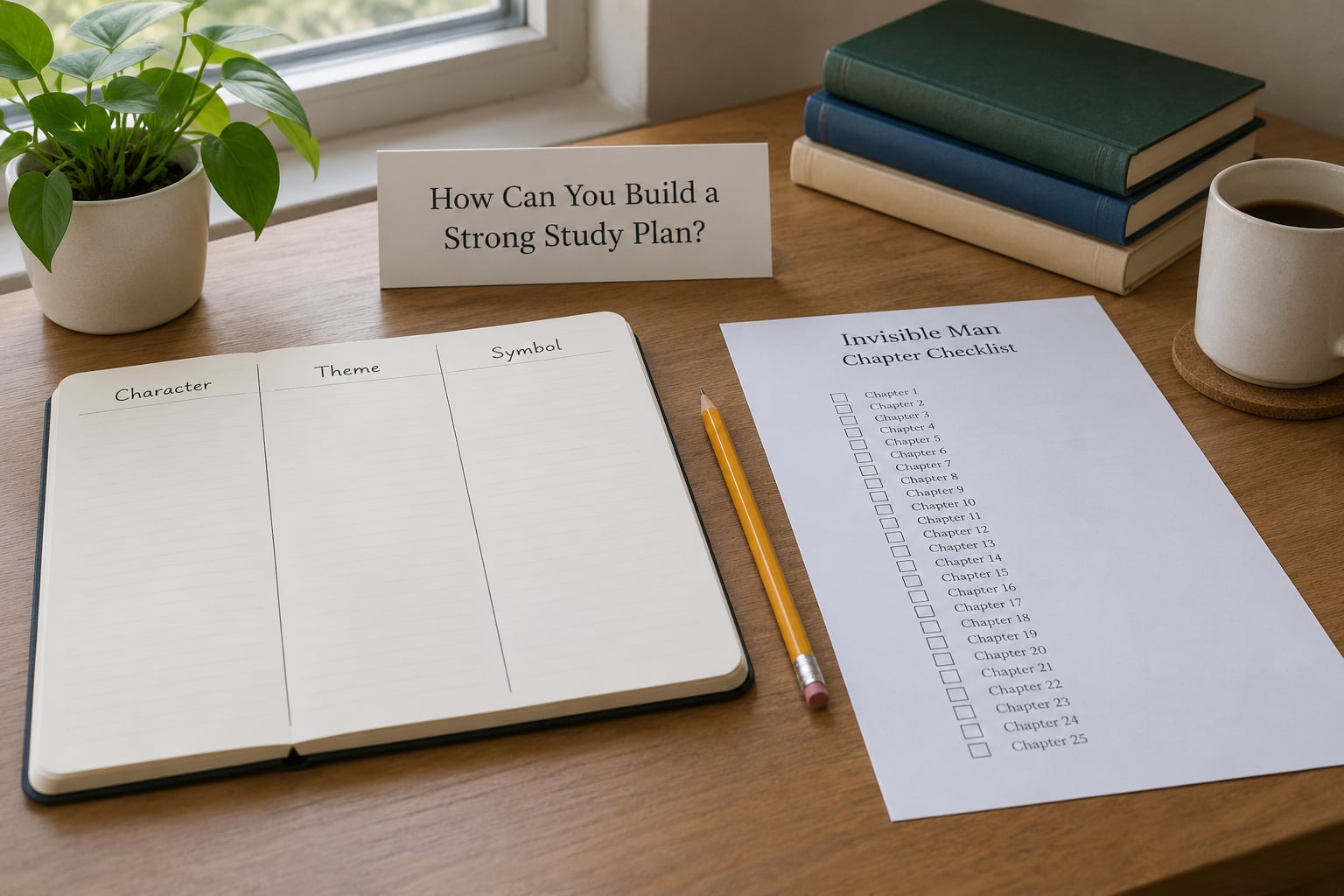
Read in order, but annotate for three things only: who is shaping the narrator, what he believes at the end of the section, and which object or name repeats. Reading for themes before you finish is why readers stall around the Brotherhood, and no ralph ellison invisible man study guide can summarize that stretch for you.
Keep a running page for each character with their first appearance, what they want, and the last time you see them. Then draft a two-page timeline of the narrator’s changing goal, which doubles as your thesis evidence for most essay prompts.
| Section | Task | Question to ask | Note target |
|---|---|---|---|
| Prologue and Ch. 1-2 | Annotate the yams scene | Who defines the narrator first? | 3 notes |
| Ch. 3-6 | Map Clifton’s argument | Where does the narrator choose? | 4 notes |
| Ch. 7-9 | Track Bledsoe’s promises | What does he want in return? | 4 notes |
| Ch. 10-16 | Chart the Brotherhood’s rise | When is he recruited rather than convinced? | 5 notes |
| Ch. 17-21 | Outline the raid sequence | Who pays for the strategy? | 5 notes |
| Ch. 22-25 and Epilogue | Trace his goal again | Has it changed since page one? | 4 notes |
Finish by writing a paragraph on the ending before you start an essay on it. Most marks come from tying one specific scene to a named theme, and that paragraph is where you find the scene.
Frequently Asked Questions
What is the narrator’s name in Ralph Ellison’s Invisible Man?
The narrator is never given a name in the novel. Ellison leaves him unnamed to show that other people assign his identity for him, from white observers who see a racial type to Brother Jack, who renames him Brother Clinton in the Brotherhood chapters. In the prologue, written years later, he alludes to a name and career he cannot reveal without breaking the story he is telling.
What does invisibility mean in Invisible Man?
Invisibility means being unseen as an individual while still being seen as a type or a function. The narrator is invisible to white society, which reads him as a stereotype, and later invisible to black political leaders, who use him as an example rather than a person. The novel argues that visibility is controlled by others, so identity has to be claimed through self-definition rather than recognition.
How should students interpret the ending of Invisible Man?
Treat the ending as a beginning rather than a victory. The narrator escapes the men hunting him and resolves to rebuild his life from scratch, but the novel ends before he keeps that promise. The stairway in the prologue can support a reading of movement from darkness into a chosen role, though that remains an interpretation. A strong response balances his new responsibility to others against racism that does not move because he has decided to try.
What are the most important symbols in Invisible Man?
The most important symbols are the chain on the grandfather’s bed of boards, the yams and the Sambo doll, the crow of black folklore, the white statue on the college campus, the briefcase, the mask, the horse, the paint factory and the gramophone in the epilogue. Track what each one does in a scene rather than assigning a single fixed meaning, since Ellison deliberately leaves the statue and the paint open.
Is Invisible Man appropriate for high school students?
It is commonly taught in AP English Literature and college survey courses, usually from grade ten upward, because the language and political context suit older readers. It contains violence, a lynching threat and racial slurs, and the Part Two political chapters are demanding for younger students. Readers often describe it as the hardest book they have attempted, so pairing it with a study guide and classroom discussion helps a great deal.
Conclusion: What Should You Study First?
Start with one question: what does the narrator want at the beginning, and what does he want at the end? In Chapter 2 he wants recognition through the system his grandfather distrusted. In the epilogue he wants to be left alone long enough to become himself. Everything between those two points is the book arguing with him.
From there, keep the context close. The Great Migration and Jim Crow explain the southern chapters, and black nationalism and Marxism explain the Brotherhood, so the political subtext stops feeling like noise. Build your argument on three themes, choose invisibility, education and self-determination, and tie each one to a scene you can name.
Treat this ralph ellison invisible man study guide as a working document rather than something to memorize. Check quotations against the edition your class uses, since page numbers shift between printings. With that groundwork done, the novel stops being the hardest book on the shelf and starts being one you can argue with, which is the only useful relationship to have with it.