
If you’re searching for a Toni Morrison Beloved study guide, you probably want the plot straightened out, the characters identified, and a handful of quotes you can actually write about. Beloved is a hard novel to read cold: the chronology fractures, the pronoun shifts, and Morrison withholds the novel’s central event until well past the halfway mark. This guide gives you the structure first — the two timelines, the three parts, the characters, the evidence for each theme — so your own reading has something solid to attach to. Updated for 2026.
A note before we begin. Beloved contains graphic depictions of slavery, whipping, rape, and infanticide. If those are live issues for you right now, talk to a teacher, counselor, or librarian before starting, and know that skipping forward is legitimate. Several university and high school courses build that flexibility in from the start.
Table of Contents
- Toni Morrison Beloved Study Guide at a Glance
- What Is Toni Morrison’s Beloved About?
- Spoiler-Labeled Summary of Beloved
- Historical Context: Slavery, the Fugitive Slave Act, and Reconstruction
- Who Are the Main Characters in Beloved?
- What Are the Main Themes in Beloved?
- How Does Toni Morrison Use Memory in Beloved?
- How Is Love Shown in Toni Morrison’s Beloved?
- Beloved Symbols: Chains, Cowries, and the Rememory
- Why Does the Title Include the Word Beloved?
- Important Quotes from Beloved and How to Analyze Them
- “Freeing yourself was one thing. Claiming ownership of that freed self was another thing.”
- “I am not me. The girl who was me is dead.”
- “Evil is nothing more than the underside of love.”
- “Schoolteacher made me write down how I liked having my milk. He described me…”
- “Love is not the main thing with me. It’s the only thing.”
- “Sure she wasn’t mine. She was mine.”
- “She is my sister… she was born a slave.”
- “So it’s not a story to pass on.”
- How to Write a Strong Analysis Paragraph About Beloved
- Discussion and Essay Topics for Beloved
- Frequently Asked Questions
- What does took my milk mean in Beloved?
- Why did Sethe pee when she saw Beloved?
- What does beloved symbolize in the novel?
- What year did Toni Morrison write Beloved?
- Why is the book Beloved controversial?
- How long does it take to read Beloved, and how should you read it?
- Conclusion
Toni Morrison Beloved Study Guide at a Glance
| Detail | Fact |
|---|---|
| Author | Toni Morrison, published 1987 |
| Awards | Pulitzer Prize for Fiction, 1988; Morrison herself won the Nobel Prize in Literature in 1993 |
| Genre | Historical novel, with ghost-story and picaresque elements |
| Length | Roughly 95,000 words; about 324 pages in the standard Knopf edition |
| Structure | Three parts, 28 chapters; chapter lengths vary widely by design |
| Primary setting | Cincinnati, Ohio, roughly 1873, plus flashbacks to the Sweet Home plantation in Kentucky |
| Historical source | The 1856 Margaret Garner case, in which an enslaved woman escaped and killed her daughter rather than see her returned to slavery |
| Dedication | “Sixty Million and more” — a figure for enslaved people who died |
| Central relationship | Sethe, her daughter Beloved, and the haunting that connects them |
| Key term to know | Rememory — the involuntary, physical return of a traumatic past |
Two things make this novel unusual before you even reach the themes. First, it is built on a real court case rather than pure invention. Second, its prose is deliberately unstable: when a section reads like a fever dream, that is usually the past breaking into the present, not a puzzle you failed to decode.
What Is Toni Morrison’s Beloved About?
At its center, Beloved is about a mother who killed her daughter to keep her from being enslaved, and about the ghost of that daughter coming back to finish what the mother started. Underneath that relationship, Morrison is writing about slavery as something that does not end when the law says it ends — it persists in memory, in bodies, and in houses.
It is tempting to call the novel a horror story, and the supernatural surface supports that reading. But Morrison built her career on insisting that the book is a realist novel, and most scholars treat Beloved as a person rather than a ghost. Sethe is haunted by her own unresolved relationship with the past; the Beloved who arrives at 124 Bluestone Road is that past made physical.
The novel’s other live themes run in parallel: what freedom is worth when it costs everything, whether love is a possession or a release, how naming asserts humanity against a system built on renaming, and whether healing is an individual achievement or a communal job. Those are the questions to hold the text against, and this guide takes them one at a time.
Spoiler-Labeled Summary of Beloved
Everything below this line reveals the full plot, including the ending. If you are reading for the first time, come back after Part One.
Sethe escaped the Sweet Home plantation in Kentucky roughly eighteen years before the novel opens, and arrived in Cincinnati, Ohio, with her husband Halle, her son Henry, and her baby daughter. She gave birth to a third daughter, whom she names Beloved. Two years later, on the eve of escaping, a slave catcher arrives with a warrant. Schoolteacher has written down Sethe’s features — her age, her milk, her years of likely childbirths — as property records. Halle’s mother, Amy, arrives and helps Sethe escape by carrying her across the Ohio River. Sethe is captured and returned to Sweet Home, where she kills Beloved with a bedsaw rather than let the girl be sold back into slavery. She then escapes again with the help of Stamp Paid, a paid Black Underground Railroad conductor, and one other enslaved man. The story jumps forward roughly eighteen years to 1873, where Sethe now lives in Cincinnati with her daughter Denver at 124 Bluestone Road. Three of her children survive, but she has lost them all except Denver.
A second thread runs in parallel. Paul D, who once shared Halle’s chain gang, arrives at 124 after eighteen years of drifting, and takes up residence in the carriage house. He is capable, guarded, and slowly thawing. Sethe and Paul D begin something like a partnership. Then a young woman arrives calling herself Beloved, claiming to be the daughter Sethe supposedly killed. She is three years old, manipulative, and increasingly physical. Her presence reactivates the past.
As the memory of the killing returns to Sethe, her family suffers. She tries to kill Beloved again, and Denver, desperate to save her mother, kills Beloved instead and later takes her own life. In the final chapter, a year later, a woman working as a carpenter in a nearby town named Grace gives birth and calls the child Beloved. Sethe is at the house, sewing. She asks the woman what she calls her, hears the name, and understands. The novel closes with a chorus: the laugh, the song, and the statement that this story cannot simply be handed on.
Understanding the chronology is the single biggest problem readers report. Here is the two-timeline system that makes it manageable.
| Present-day line (1873, Cincinnati) | Past line (Kentucky and the escape, roughly 1850s) |
|---|---|
| Sethe keeps the house at 124 Bluestone Road with Denver | Sethe lives at Sweet Home, owned by the Garner family |
| Paul D arrives after years of drifting and chain-gang labor | Paul D was chained alongside Halle during a failed escape attempt |
| A woman calling herself Beloved arrives and settles in | Sethe bears Beloved, then kills her with a bedsaw |
| Amy Denver arrives as a paid mourner and community help | Amy helps Sethe escape across the Ohio River before she is captured |
| The haunting intensifies; Sethe tries to kill Beloved again | Stamp Paid, the Black conductor, helps Sethe escape to Cincinnati |
| Beloved is killed by Denver, who later kills herself | Schoolteacher’s written descriptions of Sethe’s body circulate as sale paperwork |
A second structural key: the novel is organized in three parts whose names change as you read. The early chapter titles in Part One are single words — “Sethe,” “Sweet Home,” “The House” — that read like neutral labels. As memory takes over, the titles grow into descriptive statements, and the shift itself is Morrison signalling that the narration is no longer under Sethe’s control. In Part Two, chapter titles come from Beloved’s perspective. By Part Three, the chapters are named for places, ending at the house.
Historical Context: Slavery, the Fugitive Slave Act, and Reconstruction
The legal condition behind Sethe’s flight is the Fugitive Slave Act of 1850. It required citizens in free states to assist in the capture of escaped enslaved people, denied those fugitives trial by jury, and paid officials extra for conviction. It effectively made Ohio a border that offered no real refuge.
Morrison’s Beloved is set after the Civil War, in a period when freedom on paper coexisted with Black Codes — state laws restricting the movement and rights of freed people — and with rising extralegal violence against anyone claiming emancipation. A slave who ran was recaptured by law. A slave who had already been free and was still claimed could be seized by anyone with a claim and no way to contest it. This is the world Paul D returns from, and the reason Sethe’s Cincinnati is never entirely safe.
Writing a historical novel in 1987, Morrison also wanted readers to see that this was not ancient history. The dedication “Sixty Million and more” refers to the estimated number of enslaved people who died in American slavery — a deliberately unfinished figure that implies the death toll was never fully countable. Critics have read the dedication as both memorial and accusation: as though the novel itself is one more form of counting.
The real case that Morrison used as a source is the Margaret Garner story of 1856. Garner, an enslaved woman in Kentucky, escaped with her husband and children in what became known as the “longest escape,” traveling roughly six hundred miles over weeks through freezing terrain. When federal officers caught up with her, Garner killed her two-year-old daughter rather than let her be taken. Newspapers covered the trial widely; the family was eventually reunited and moved to Ontario. Morrison read the coverage in archives as a teenager and returned to it as an adult, and the novel reworks the case from the inside out, filling in what the newspapers left blank: Sethe’s interior life.
Who Are the Main Characters in Beloved?
| Character | Role | Defining trait or moment |
|---|---|---|
| Sethe | Protagonist; escaped enslaved woman, mother | Carries a “split-off” mind and a “too thick” love; makes the novel’s impossible choice |
| Beloved | Sethe’s daughter; ghost, memory, or both | Appears as a three-year-old; moves between a child’s pronouns and an adult’s vengeance |
| Denver | Sethe’s surviving daughter | Raised in isolation, “the Beloved,” moves from terror to self-possession |
| Paul D | Former chain-gang prisoner; Halle’s friend | Carries a rusted tobacco tin; brings the capacity for ordinary life |
| Baby Suggs | Former enslaved spiritual leader at Sweet Home | Sold Beloved’s freedom; his “Clearing” sermon is the novel’s communal ideal |
| Schoolteacher | Sweet Home overseer-turned-entrepreneur | Writes down Sethe’s milk and childbirth potential as inventory |
| Halle | Sethe’s husband; father to her children | Acquires and melts down his own milk as punishment |
| Amy Denver | Formerly enslaved journeyman; becomes a mourner | Crosses the river to save Sethe; later helps Sethe re-enter the world |
| Sixo | Sweet Home man who stole his own milk | Gunned down by the posse for helping Sethe escape |
| Stamp Paid | Paid Black conductor of the Underground Railroad | Names his fee honestly: “I paid five dollars.” |
| Mr. and Mrs. Garner | Sweet Home owners; Mrs. Garner is half-Choctaw | Treat Sethe as a daughter, which confounds both enslavers and the enslaved |
| Ella | Sethe’s friend and neighbor | A symbolic mother figure who brings Sethe back into the neighborhood’s care |
| Mr. Bodwin | Ambitious white newcomer to the neighborhood | Sethe’s ice pick in his face ends the attempt to move her family South |
Two of these deserve extra emphasis because they carry more argument than the rest. Schoolteacher is the novel’s cold engine of dehumanization — his ledger reduces a woman to milk and future offspring, which is precisely the arithmetic Sethe refuses to accept when she kills her child. And Baby Suggs matters because his vision of freedom looks nothing like Sethe’s. He imagines a community that shares its resources and rejoices together. Sethe’s freedom, by contrast, is solitary and costed in blood.
Beloved herself is deliberately unfixed. She shifts between the third-person narration of an adult recalling childhood and the direct first-person of a three-year-old, and the effect is unsettling on purpose. Readers who insist on a single explanation for her tend to get stuck; the more useful reading treats her as the shape of Sethe’s rememory, carrying the unbearable part of the story back to the person who buried it.
What Are the Main Themes in Beloved?
The major themes are memory and haunting, motherhood and “too thick” love, slavery and dehumanization, identity and naming, freedom versus emancipation, home and belonging, moral ambiguity, and communal healing. Here’s the quick version with the scene that anchors each one.
| Theme | Where it appears | Textual anchor |
|---|---|---|
| Memory and haunting | The return of the killing; 124 itself | Sethe’s flashbacks triggered by the house and by Beloved’s presence |
| Motherhood and love | Sweet Home nursing scenes; the bedsaw | “Good milk,” and the nephews who “took my milk” |
| Dehumanization | Schoolteacher’s ledger; the chain gang | Sethe’s body described as property; Paul D’s bitten-off name |
| Identity and naming | Naming Sethe; Paul D; Stamp Paid; Beloved | Slavery renames and disowns people; naming reclaims them |
| Freedom and cost | Baby Suggs’s Clearing; Sethe’s “own self” | “Freeing yourself was one thing. Claiming ownership of that freed self was another thing.” |
| Home | Sweet Home; 124; Baby Suggs’s house | Home as a name applied to a place, and as belonging rather than address |
| Moral ambiguity | The killing and its aftermath | Sethe as both perpetrator and victim; no verdict from the narrator |
| Communal healing | The community at the end; the women’s shoulders | “She had sat in that cold room… Beloved, beloved, beloved” carried by other women |
How Does Toni Morrison Use Memory in Beloved?
Morrison uses memory as a physical event rather than a mental one. Sethe’s past does not return gently; it arrives through the body, unbidden and uncontrollable, and it disrupts the present tense of the novel. That disruption is the form: the fragmented chronology isn’t a puzzle for you to solve, it’s the experience of a mind that cannot keep past and present in their proper compartments.
The novel names the mechanism: rememory. Rememory is not simply recall. It’s involuntary, unchosen, and physically located, closer to the way a body remembers a blow. It can’t be filed away or talked out of, only held, integrated, or acted on. Every character in the novel responds differently. Sethe refuses it and is destroyed by it. Paul D tries to repress it and calls it “the world before Pickens.” When he finally talks about the chain gang, he does it with the other Black men at 124, in a scene that functions as mutual recognition. Amy Denver, who carries her own memories of being sold away from her children, recognizes Sethe’s condition because she has lived it.
The bodies-remember point matters for exam writing. Sethe’s involuntary urination when she sees the woman calling herself Beloved is a physical register of rememory — a response the mind did not authorize and cannot stop. The moment where Sethe denies the return of her own milk, and chooses the killing over surrendering the child, is the same faculty turned forward. If you cite rememory in an essay, anchor it in one of these scenes rather than in the abstract term alone.
How Is Love Shown in Toni Morrison’s Beloved?
Morrison refuses a simple definition of love, and the four versions in the novel disagree with each other. Sethe’s love is “too thick,” the phrase she uses to describe it herself — it is consuming, suffocating, and inseparable from ownership. Denver’s love for her mother is protective and, at the climax, decisive. Paul D’s love is practical and cautious, built on shared labor and a locked chest. And the community’s love, embodied in the neighbors and in Amy Denver, is the only version that doesn’t destroy anyone.
What makes this provocative for readers is that Sethe’s love is the most powerful and the most destructive. Morrison isn’t condemning her. She’s showing what a system designed to treat people as property does to the impulse to protect what’s yours — including your child. Sethe’s act is an act of love inside a structure that gives her no other option, and the book refuses to resolve whether that makes it a crime.
Beloved’s name carries the same tension. She’s the object of Sethe’s love and she becomes the instrument of its consequence. In the final chapters the relationship inverts: the child now contains and destroys the mother. That’s the argument for the title. If you take one idea from the themes section, take this: the novel asks what happens when love is all you have and nothing else is available to you.
Beloved Symbols: Chains, Cowries, and the Rememory
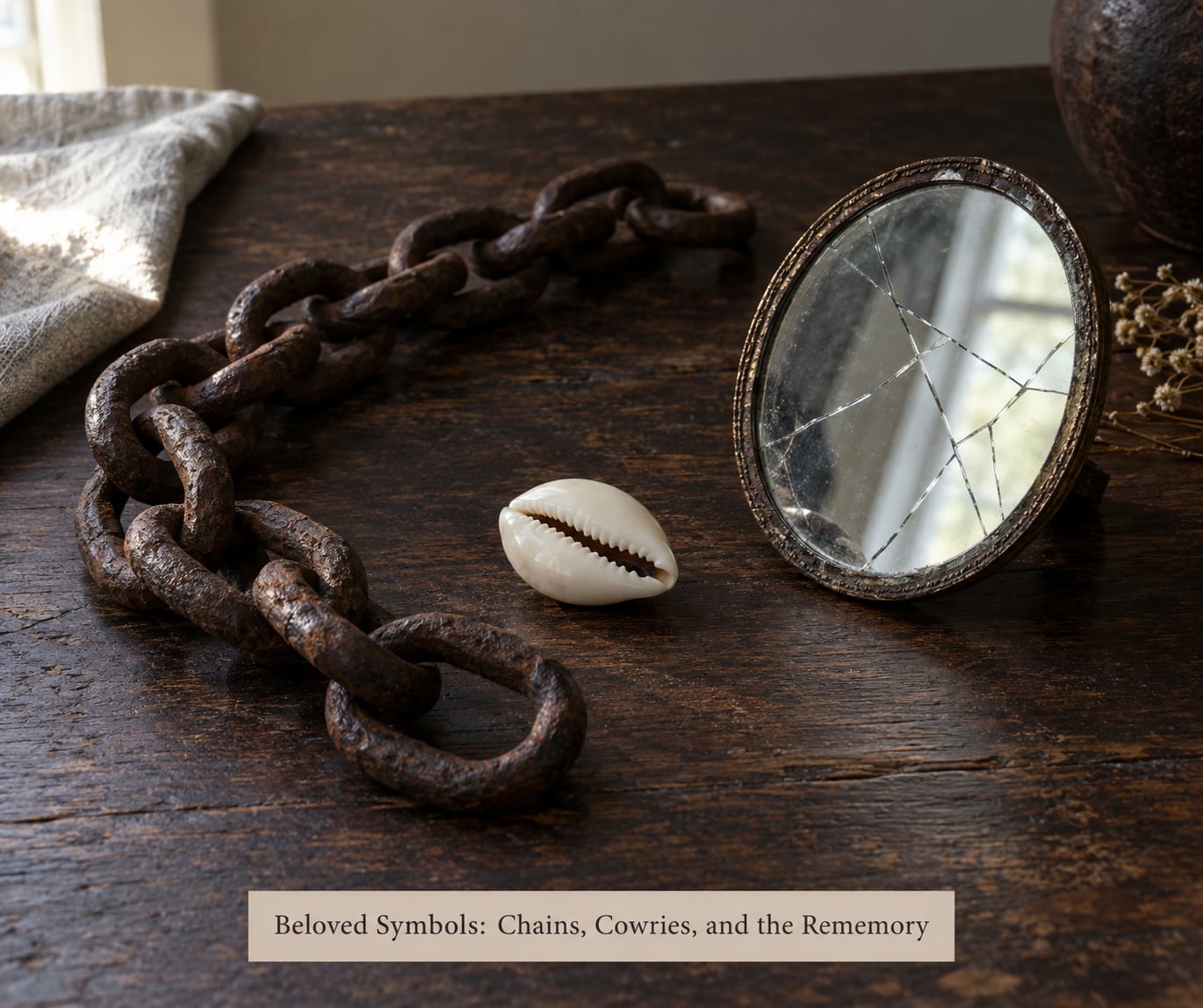
The novel runs on a small set of repeated objects. Knowing what each one does is worth more than reading three more chapters of commentary, because the same objects keep changing meaning as the story moves.
| Symbol | What it means |
|---|---|
| 124 Bluestone Road | The house number skips 123, meaning that address as a home is destroyed. The missing number is also widely read as the lost third child, Beloved. |
| Chains and irons | Enslavement’s claim on the body. The chain gang scars Paul D’s mouth; melted-down buttons become Sethe’s earrings; “the iron bit” is in Sethe’s mouth when she reaches Sweet Home. |
| Cowrie shell and mirror | Beloved’s possessions. The cowrie was currency in parts of Africa, and the small mirror lets her see herself. Together they mark her as a child rather than a ghost. |
| Paul D’s tobacco tin | A rusted lockbox containing the shank, weeds, a parrot beak, and a piece of a Tom and Jerry comic. He has carried his past without opening it. |
| Water and the river | Crossing the Ohio River is the passage from bondage to a contested freedom. Sethe finds release in water repeatedly, and the river also marks where she is captured and returned. |
| The Clearing | Baby Suggs’s vision: freed people dancing, sharing, reclaiming the term “Negro.” It’s the novel’s communal ideal, and a benchmark for how far Sethe is from it. |
| The bedsaw | The murder weapon, a tool of the plantation economy turned into the instrument of a mother’s refusal. Beloved’s “lips” are described as stuck together, with blood filling the space where her front teeth would be. |
| Cold things | Ice in Sethe’s back, ice water, cold rooms, and cold hands. Warmth signals life and safety; the novel’s climactic healing happens when warmth finally arrives. |
Two details worth memorizing. First, the number 124 is 124 in a row of houses where 123 is conspicuously absent. Second, Begin’s Book — the album in which Cincinnati’s white women recorded the community’s racial sins, and in which Sethe’s labor and Denver’s baby are both entered — reads the Black household the same way. That album is one of the novel’s quietest arguments: the neighborhood kept careful records of everything it judged Sethe for.
Why Does the Title Include the Word Beloved?
The title does two contradictory things at once, and the tension between them is the point. Beloved is a term of affection — the name a parent gives a cherished child — and it is also the name of a person the law treated as chattel. Calling the enslaved baby Beloved is an act of assertion: this child is loved, and therefore she is a person, and therefore she is not property.
The second reading is that Beloved is not a name so much as a status assigned by others. Throughout the novel, enslaved people are renamed, called “property,” denied their parents’ choices. Sethe’s insistence on naming her daughter is a refusal of that machinery, and it establishes the novel’s ethical vocabulary: naming is the opposite of enslaving.
There’s a third layer. As Beloved grows inside 124, she becomes a word rather than a child — the haunting itself, the shape a community gives to collective unprocessed grief. The title therefore names a whole category of erased people: the sixty million and more, all of them beloved to someone. Morrison dedicated the book to them, and the title is where that dedication first lands.
Important Quotes from Beloved and How to Analyze Them
Here are eight quotations worth knowing, with the context that makes each one arguable. For each, look at who is speaking, what word the sentence leans on, and what the scene around it is doing.
“Freeing yourself was one thing. Claiming ownership of that freed self was another thing.”
Sethe says this to Boston, the Black man she meets on the road, after he asserts that she has made her choice. The sentence matters because it separates legal emancipation from psychological self-possession, and it names the gap that defines her life: she is legally free and cannot own herself. To analyze it, track the repeated construction — two sentences, one word, one thing, then another thing — which makes the distinction sound mechanical and inescapable.
“I am not me. The girl who was me is dead.”
Beloved’s line after she accuses Sethe of being too thick, too tied up. It’s the moment Beloved names the problem and takes it away from Sethe at once. Analyze the pronoun: “the girl who was me” splits Beloved into a person and a self, the same split Morrison describes as Sethe’s “split-off” mind. The two women are mirroring each other and destroying each other.
“Evil is nothing more than the underside of love.”
The line reworks Sethe’s earlier “too thick” formulation and pushes the idea to its dark limit: the destructive capacity of love is not a separate substance but the same substance turned over. For an essay, pair it with the bedsaw scene and ask whether Morrison endorses it or diagnoses it. The novel’s restraint suggests the second.
“Schoolteacher made me write down how I liked having my milk. He described me…”
Sethe’s summary of Schoolteacher’s examination is quoted for the way Morrison lists her body as data: age, milk, and likelihood of future children. Look at the verb — “described” — against what description does in an advertisement. That’s the sentence’s whole argument about dehumanization, and it needs no commentary from the narrator.
“Love is not the main thing with me. It’s the only thing.”
Denver says this to Amy Denver as she explains why she cannot leave 124. Analyze the punctuation and the plain declarative rhythm. It reads like a child’s flat statement of fact, and its flatness is what makes it devastating — Denver has never had any competing value to weigh love against.
“Sure she wasn’t mine. She was mine.”
Sethe’s contradiction about shadows, told to Denver to explain why shadows matter. It’s a clean model of double meaning: she is talking about shadows and about ownership, ownership of her children, and of herself. Point out that the sentence refuses to choose between the literal and the figurative, which is exactly Morrison’s method.
“She is my sister… she was born a slave.”
One of Beloved’s early claims, in which her narration conflates adult knowledge with a child’s speech. Whether Beloved is remembering or imagining is the source of the novel’s central ambiguity, so this quote is the best place to analyze the narration. The sentence is also a compact argument about how a person’s knowledge of their own history can be fragmented and reassembled wrongly.
“So it’s not a story to pass on.”
The last line, following the chorus that voices the laugh, the song, and the story. The double meaning is the whole reading: not a story to relay secondhand because it cannot be survived secondhand, and also not a story to hand over to your children as inheritance of suffering. The prefix “so” ties it to the women discussing how the story might be told — the question of whether recounting it is a rescue or another abandonment.
How to Write a Strong Analysis Paragraph About Beloved
Most weak Beloved paragraphs summarize and stop. The fix is structure: a claim you can defend, a piece of the text that proves it, and an explanation that connects the two. The claim should be arguable — if nobody could disagree with it, it isn’t a claim, it’s a description.
Use the C-E-A shape: Claim, one sentence, naming what the passage does and where it does it. Evidence, a short quotation embedded in your own sentence rather than dropped as a block. Analysis, two or three sentences on what the diction, syntax, or imagery is doing and why the choice matters. Keep the analysis longer than the evidence.
Here is a model. Claim: When Sethe denies that her milk ever belonged to Sweet Home, Morrison writes the escape as a theft of a self that others have already defined. Evidence: Sethe insists that she is “the milk of my own body,” the phrase returning earlier in the novel as a claim of self-ownership. Analysis: The syntax compresses identity into a single possessive, and the earlier iteration of the phrase tied it to nurture rather than property. By repeating it after the escape, Morrison relocates the sentence from a description of a woman’s body to a statement of what a person owns, making the same words carry the opposite legal weight.
Common traps to avoid. Quoting more than a sentence or two and analyzing none of it is the most frequent. Second, describing Beloved as a ghost in your thesis without acknowledging the competing reading, since Morrison and many critics resist a supernatural reading. Third, treating the moral question of Sethe’s choice as settled, when the whole novel exists to keep it open. Fourth, using Morrison’s critical vocabulary without a scene attached to it, which makes rememory read like a term dropped for points instead of a working analysis.
One practical tip for exam days: memorize three quotations with their part and chapter numbers. When you know the citation cold, you can spend the exam’s thinking energy on the argument rather than on retrieval.
Discussion and Essay Topics for Beloved

These are grouped by theme. For each one, a strong answer takes a side, acknowledges the counter-reading, and cites at least one specific scene rather than generalizing about the novel’s darkness.
Memory and trauma
- How does Morrison’s fragmented chronology reproduce the way trauma actually returns? Where does the technique work best?
- Is rememory something Sethe suffers from, something she needs, or both? What does the final chapter suggest?
- Compare how Paul D and Sethe each manage their memories. Whose strategy fails, and why?
Motherhood and love
- Is the killing an act of love, a monstrous act, or a thing that cannot be categorized? Argue from the text, not from your own judgment of Sethe.
- How does the theft of Sethe’s milk function differently from the theft of her daughter?
- What does it suggest that Denver eventually kills Beloved?
Slavery and its aftermath
- Is Beloved a historical novel? What does the genre let Morrison do that a documentary could not?
- How does the Fugitive Slave Act shape the plot? Would the novel work without it?
- Compare the Margaret Garner case as reported in newspapers with the novel’s version. What has Morrison added, and what has she refused to resolve?
Identity, naming, and community
- Why is naming so central to the novel? Discuss Paul D, Stamp Paid, and the naming of Beloved together.
- Is 124 Bluestone Road a home? Compare it with Baby Suggs’s house and with Sweet Home.
- Why does Denver need the community of women to survive, and what does that imply about healing?
Craft and ethics
- How does Beloved’s shifting point of view affect your sympathy for her?
- Does the novel endorse or criticize Sethe? Defend a position that accounts for the ambiguity.
- Why does the novel end with the carpenter Grace rather than with Sethe’s story?
Frequently Asked Questions
What does took my milk mean in Beloved?
The nephews hold Sethe down and take her breast milk, recording the theft in Schoolteacher’s book along with her age and likely future pregnancies. Literally, it shows his access to her body. Symbolically, it steals the one thing Sethe could give her child on her own terms, which is why she later calls the killing of Beloved an act of keeping her own milk. It establishes that everything a mother owns can be legally appropriated.
Why did Sethe pee when she saw Beloved?
Sethe had not seen her daughter since the killing, and Beloved appears looking exactly as Sethe remembers her. The urination is an involuntary physical response, the body registering a traumatic encounter the conscious mind has spent decades suppressing. Morrison uses it to show that memory lives in the body rather than only in the mind, and that Sethe’s past can overwhelm her control without her permission.
What does beloved symbolize in the novel?
Beloved functions on several levels at once: the murdered child, the shape of Sethe’s unresolved past, a haunting that externalizes repressed memory, and a stand-in for all the enslaved people who died unnamed. That last reading is why the book is dedicated to sixty million and more. Morrison resists fixing Beloved as purely supernatural, so essays score better when they track how her meaning shifts across the three parts.
What year did Toni Morrison write Beloved?
Morrison wrote and published Beloved in 1987, after three earlier novels. It won the Pulitzer Prize for Fiction in 1988, and Morrison herself received the Nobel Prize in Literature in 1993. Some editions carry a 1988 copyright for later printing, so cite 1987 as the publication year unless your edition says otherwise.
Why is the book Beloved controversial?
Beloved appears on challenge and restricted-reading lists in some school districts, typically because of its depictions of slavery, sexual violence, and infanticide. Critics have argued it is emotionally manipulative and unsuited to young readers. It is also frequently taught at university level and in AP Literature, where supporters defend its literary achievement and its subject matter as central to American history rather than gratuitous.
How long does it take to read Beloved, and how should you read it?
At roughly 95,000 words, most readers take six to eight hours, and first-timers often longer. Read it straight through rather than in sittings, because the meaning of early chapters changes substantially once the flashbacks are understood. If the fractured chronology is defeating you, track the two timelines separately on paper rather than trying to hold both in your head at once.
Conclusion
Start with one relationship: Sethe, Beloved, and the memory that connects them. Everything in this guide — the two timelines, the symbol table, the quotations, the essay prompts — makes more sense once you’ve decided for yourself how much Beloved is a ghost, a person, or a piece of Sethe’s own mind. Read the chapters that return to the bedsaw last and slowest, then come back to the early ones. If you take a single question into your discussion section or your essay, make it the one the novel refuses to settle: what does a person owe a child she saved at the cost of destroying her?