
Oedipus Rex is a tragedy by Sophocles, written around 429 BCE, in which the king of Thebes hunts for the man who killed his predecessor and discovers that the killer is himself, married to his own mother. This oedipus rex study guide for students walks through the plot, characters, themes, symbols, and dramatic techniques, then turns all of it into material you can actually use in an essay or a seminar.
If you have twenty minutes, read the plot section first, because nearly every question your teacher asks comes back to how the investigation works. After that, go straight to the themes and the scene breakdown.
Table of Contents
- What Is Oedipus Rex About?
- Who Is Sophocles and Why Does Oedipus Rex Matter?
- How Does the Plot of Oedipus Rex Unfold?
- Stage 1: The Plague and the Proclamation
- Stage 2: Creon Returns from Delphi
- Stage 3: Teiresias Refuses to Speak
- Stage 4: The Messenger Reveals the Truth
- Stage 5: The Self-Blinding
- Who Are the Main Characters in Oedipus Rex?
- What Are the Major Themes in Oedipus Rex?
- Fate and Free Will
- Truth Against Concealment
- Hubris
- Identity and the Limits of Knowledge
- Family, Prophecy, and Tragic Justice
- Oedipus Rex Study Guide for Students: Core Interpretive Questions
- Does the ending prove that fate controls everything?
- Are the gods cruel?
- How is Oedipus heroic if he committed murder and incest?
- Is justice truth-seeking or punishment?
- What Symbols and Motifs Should Students Notice?
- How Does Sophocles Create Suspense, Irony, and Tragedy?
- Which Scenes Are Most Important for Essays?
- How Can Students Write a Strong Oedipus Rex Essay?
- Build an arguable thesis
- Choose precise evidence and cite it accurately
- Connect quotation to interpretation
- Use real criticism and real opposition
- Compare rather than summarize
- What Discussion and Review Questions Should Students Use?
- Comprehension
- Theme
- Character
- Symbolism and dramatic technique
- Comparison and essay
- Frequently Asked Questions
- What is the central message of Oedipus Rex?
- Did Oedipus Rex choose to kill his father and marry his mother?
- Why is the ending of Oedipus Rex a deus ex machina?
- Is Oedipus a hero or a villain in Sophocles’ play?
- What is the best way to study Oedipus Rex?
- Why did the oracle tell Oedipus that he would kill his father?
- Conclusion
What Is Oedipus Rex About?
Oedipus Rex is an ancient Greek tragedy by Sophocles in which the plague-stricken king of Thebes investigates the murder of the previous king, Laius, only to discover that he committed the crime himself and has been living with his mother as his wife.
The engine of the plot is dramatic irony. We learn in the opening seconds that the Oracle of Apollo told Oedipus long ago he would kill his father and marry his mother, so every question he asks in public already has an answer we can see. Oedipus does not know this, which means he investigates his own identity like a man trying to find the fingerprint that will convict him.
For your writing, treat the play as a collision between truth and self-image. Oedipus wants truth, genuinely and stubbornly, and that is exactly what destroys him.
Who Is Sophocles and Why Does Oedipus Rex Matter?
Sophocles wrote Oedipus Rex for the City Dionysia, the Athenian festival where thousands of citizens watched tragic competitions in an open-air theatre, and he won first prize for it. It is one of seven plays by Sophocles that survived, which is why it has so much attention focused on it.
The play is the first of the Theban cycle. Oedipus at Colonus, written late in Sophocles’ career, follows Oedipus as a blind exile, and Antigone picks up the next generation. Read together, they trace a single family from self-knowledge to burial to civic duty.
Aristotle used Oedipus Rex as his working example in the Poetics, which is why the play still supplies our vocabulary for plot structure. The reversal (peripeteia), the recognition (anagnorisis), the tragic error (hamartia), and catharsis are all easier to teach with this text than any other.
Freud added a different layer in 1899, proposing an unconscious Oedipus complex in which a child wishes for the parent’s death and possession of the opposite-sex parent. That reading is now disputed by most scholars, who point out that Oedipus shows no such longing in the play, but it still shapes how people talk about the story.
How Does the Plot of Oedipus Rex Unfold?
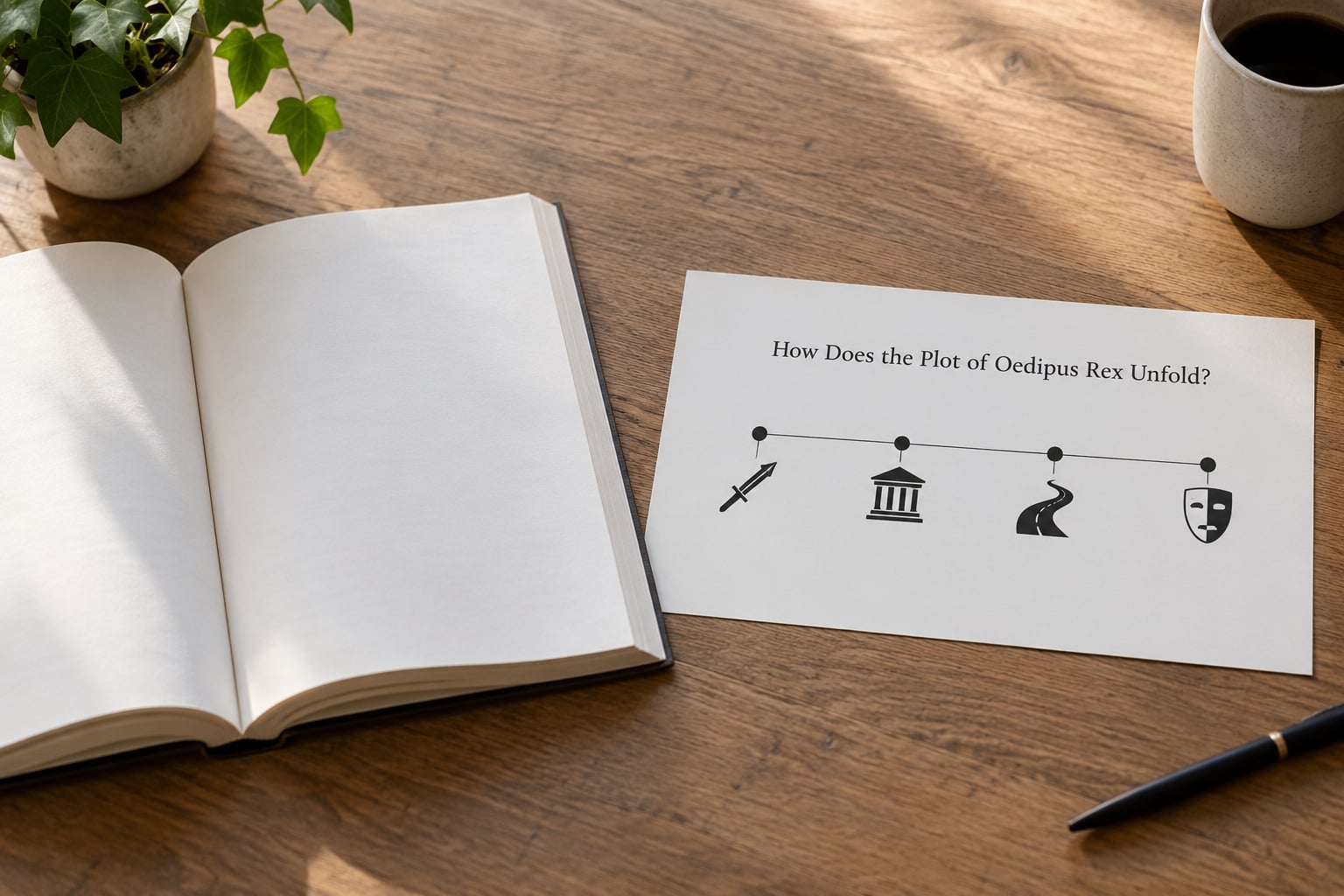
The plot moves in five stages, and each one is caused by something Oedipus does in the stage before it. Keep that cause-and-effect chain in your head, because most essay questions about this play are really asking you to describe it.
Stage 1: The Plague and the Proclamation
Thebes is dying. Crops fail, cattle go stillborn, children die, and bodies pile up unburied. Oedipus sends for the prophet Teiresias because, as he puts it, he has tied himself to the riddle and cannot stop until he solves it. Oedipus declares that whoever killed Laius will be exiled and publicly mourned, which is a public vow to hunt himself.
Stage 2: Creon Returns from Delphi
Creon reports the Oracle’s words: Laius was killed by his own son, and the murderer is a protector of the city who has taken his father’s place. Oedipus assumes this describes Jocasta’s son, and he swears to find and execute the boy.
This is the most consequential misreading in the play. Oedipus has just described himself in front of the Chorus and the audience without recognizing the description.
Stage 3: Teiresias Refuses to Speak
Teiresias confirms the plague is caused by a living pollution inside the city, and when Oedipus pushes him to name the killer, the prophet goes silent. Jocasta pleads with him privately, then Creon accuses him of being part of a conspiracy. Teiresias finally names Oedipus as the murderer and then adds the worst sentence: Oedipus is married to Jocasta.
Earlier, the audience already saw Jocasta’s suicide reported in a messenger’s speech, so the audience is now ahead of Oedipus again. That gap is where the horror lives.
Stage 4: The Messenger Reveals the Truth
Jocasta hangs herself, and Oedipus locks himself in the palace apartment. A messenger from Corinth arrives with news that Polybus, the king Oedipus believes is his father, has died of natural causes. That single event should have relieved Oedipus, since a dead father cannot be murdered by his son. Instead it destroys his last defence, because the Corinthian then continues with a second piece of news: Oedipus was not Polybus’ son at all.
A herdsman from Mount Cithaeron follows with the full account. It was Laius and Jocasta who raised Oedipus as an infant, the child was taken by a shepherd to Corinth, and the prophecy has been true for decades.
Stage 5: The Self-Blinding
No one blinds Oedipus for him. He goes to the palace, tears out the weights of the great bronze shields that line the royal corridors, and uses them to blind himself. He argues that it would be wrong for him to look at a living person who is also his murderer and his wife, so he blinds himself to look at no one ever again.
Creon enters, is horrified, but agrees to exile him. The Chorus closes the play by repeating a line from an old story about a god who warned men not to call a day painless until it was over.
Who Are the Main Characters in Oedipus Rex?
These six figures carry the plot. The table gives each one’s status, motive, and specific job in the mystery.
| Character | Status and relation | Motivation | What they reveal or conceal |
|---|---|---|---|
| Oedipus | King of Thebes, husband of Jocasta, son of Laius and Jocasta without knowing it | To find Laius’ killer and save the city | Reveals nothing willingly; his own body is the final evidence |
| Jocasta | Queen, widow of Laius, wife to Oedipus | Avoids any possibility that Laius’ death be traced to her own family | Conceals her origin and Oedipus’ origin, and both deaths |
| Creon | Brother of Jocasta, a king of a neighbouring city | Public duty, then genuine care for his sister | Carries the Oracle’s prophecy into the play and later Oedipus’ exile order |
| Teiresias | The blind prophet of Apollo | Duty to Apollo, plus exhaustion at being used | Names Oedipus as the murderer and Jocasta as his wife |
| The Chorus | Elders of Thebes | To restore the city through Oedipus | Offers perspective, restates the moral frame, and answers the theme in its final line |
| Priest of Zeus | Opens the play, arriving with supplication | To secure Oedipus’ attendance | Establishes Oedipus as a god who has saved Thebes before |
| Corinthian Messenger | Messenger of the court at Corinth | To report Polybus’ death | Reveals Oedipus’ true parentage and that he did not kill Polybus |
| Shepherd of Cithaeron | A local herdsman | To insist on the truth when told to stay silent | Confirms the infant, the swaddling pins, and the identity of Laius and Jocasta |
What Are the Major Themes in Oedipus Rex?
The main themes of Oedipus Rex are the tension between fate and free will, the search for truth against the will to conceal it, the damage caused by hubris, the instability of identity, and the strange terms on which justice operates. These themes run through specific scenes rather than standing alone.
Fate and Free Will
The Oracle predicts; Oedipus chooses; the outcome is fixed by prophecy. The play never settles whether prophecy causes the outcome or simply describes it. Oedipus leaves Corinth because a prophecy frightened him, which is the clearest evidence in the text that free will operates inside the trap rather than outside it.
Truth Against Concealment
Almost every character tries to bury a fact. Jocasta will not say who her first husband was. Teiresias declines to answer. The shepherd is told to stay silent. Oedipus will not let the investigation drop. The theme shows that concealment makes things worse in this play, not safer.
Hubris
Hubris means excessive pride before the gods. Oedipus calls himself the servant of Apollo and servant of men, declares that no mortal can match his insight, and dismisses the prophecy about himself as belonging to Apollo. The text supports hubris as a real force, but notice that the play also insists he asked for the truth first.
Identity and the Limits of Knowledge
Oedipus cannot know who he is. The most educated man in the play, he lacks the one piece of information that matters, and every reader holds that piece while he searches. This is why the play works on a stage: the audience watches a character stand inside an insight they can already see.
Family, Prophecy, and Tragic Justice
The prophecy couples two crimes across two generations. Oedipus fulfills both, which makes the gods’ justice look mechanical, so many readers hold that the gods never actually command the act and only warn against it. Whether Sophocles endorses that reading or exposes it is still argued, and it makes a strong essay question.
Oedipus Rex Study Guide for Students: Core Interpretive Questions
Does the ending prove fate controls every choice, are the gods cruel, and is Oedipus heroic despite his crimes? Here are the four questions that come up most often in class, with answers you can argue from rather than repeat.
Does the ending prove that fate controls everything?
It proves that prophecy is reliable, which is not the same claim. Oedipus makes genuine decisions throughout: he leaves Corinth, he takes the throne, he raises the investigation. Read the play as fatalism and his choices become decorative; read it as a warning about knowledge and you get a character who is consistent from start to finish.
Are the gods cruel?
The Oracle never commands Oedipus to kill Laius or marry Jocasta. Apollo tells him to stop, and the guilt for staying silent belongs to Jocasta and the shepherd. Whether the gods are cruel depends on whether you read the prophecy as a warning about a future act or as a sentence handed down in advance, and that ambiguity is deliberate.
How is Oedipus heroic if he committed murder and incest?
Aristotle’s tragic hero is defined by a fall from status through a single error, not by virtue. Oedipus is heroic in his answer to a plague-stricken city: he gives himself entirely to the problem, accepts no comfort, and drives himself toward a truth that costs him everything. In Sophocles’ political world, that kind of total public commitment is the virtue in view.
Is justice truth-seeking or punishment?
Teiresias states the play’s cleanest formulation: the city’s justice is the same as the god’s justice, meaning that purity and truth come as a single package. Oedipus accepts that logic and blinds himself. Whether the punishment fits the crime is a separate question, and the play does not soften the answer.
What Symbols and Motifs Should Students Notice?
The key symbols in Oedipus Rex include the plague, the crossroads, the footprints, the swaddled infant, bloody hands, light against darkness, blindness against sight, and repeated references to disease and inheritance. Some have long-established readings, and some are open to argument.
- The plague. Famine, stillbirth, and unburied corpses represent pollution, a wrong inside the city. This reading is well supported.
- The crossroads. Oedipus consulted the Oracle at a crossroads before killing Laius. He mentions the meeting repeatedly, so the location is factual in the play. Reading it as a symbolic choice about a fork in identity is interpretation, and a good one, but mark it as such.
- Footprints. The herdsman says he walked in mud, which means his tracks could be traced and identifies him uniquely. This supports the reversal mechanism rather than a symbolic theme.
- The swaddled infant and the pins. The details that prove identity. They recur in the infant Oedipus and in the play’s recognition scene, which ties the childhood mystery to the political one.
- Bloody hands and the bronze shields. Laius’ blood marks Oedipus’ hands, and the same blood is what he uses to blind himself. That is the play’s most concrete symbol: the guilt becomes the instrument of the punishment.
- Light and darkness. Apollo is called the god of light and Oedipus says he has no business enquiring into the secrets of the earth and invisible things. His blindness is often read as gaining a kind of inward sight, which is an interpretation rather than a stated fact.
- Blindness against sight. Teiresias is physically blind and sees the truth; Oedipus is physically sighted and blind to himself. This inversion is the play’s central image and is well supported.
- Disease and inheritance. Plague in the city and rot in the bloodline are described in parallel terms, which links public and private.
How Does Sophocles Create Suspense, Irony, and Tragedy?
Sophocles builds suspense by giving the audience the answer first and the question second, then delaying the moment when the character and the audience collide over it.
- Foreshadowing. The Messenger’s speech after Jocasta’s death tells us she has hanged herself before the characters onstage learn it.
- Dramatic irony. We know the prophecy; Oedipus does not. The most quoted line in the play comes from this gap.
- Delayed recognition. Teiresias, Jocasta, the shepherd, and even Creon each know a piece. Recognition arrives only when the last piece arrives.
- The messenger scene. A minor character carrying unbearable news is standard Greek practice. Forum readers on r/classics and r/AncientGreek often call the Corinthian messenger’s arrival a plot convenience, and they are partly right, but the coincidence is required: recognition in Greek tragedy depends on witnesses, so the play needs someone to walk in.
- Reversal. In Aristotelian terms the peripeteia is Oedipus moving from confident investigator to confessed criminal in a few exchanges.
- Recognition. The anagnorisis is the herdsman’s plain, unadorned statement of who Oedipus is, which lands harder than the speeches before it.
- Stichomythia. Short rapid exchanges in the confrontation scenes let suspicion escalate almost physically.
- Deus ex machina. No god appears to explain or fix anything. Exile is a human decision, and the play ends unresolved.
Which Scenes Are Most Important for Essays?
Six scenes carry most of the analysis in this play, and you can build a full paper on any one of them.
| Scene | What happens | What it gives you for an essay |
|---|---|---|
| The proclamation opening | Oedipus vows to find the murderer and never rest | His hubris, and the fact that his vow is a death warrant for himself |
| Meeting with Teiresias | The prophet refuses to answer, then names Oedipus as murderer and names his marriage | The reversal, and the play’s sharpest definition of justice as truth |
| Jocasta’s appeal | She begs Teiresias to stop, then tells Oedipus not to investigate the oracle again | Her motive for concealment and the play’s only sustained attempt to hide the truth |
| The second oracle | Apollo names the pollution inside the city, and Jocasta repeats her oath to stay silent forever | Shows the play has more than one person hiding, so the tragedy is not one man’s fault |
| The Paethanes shepherd scene | The herdsman insists on truth and gives the infant history | The recognition, and the moment deception collapses |
| The final self-punishment | Oedipus blinds himself with the shields | The meaning of sight, self-knowledge, and whether his penalty is justice or pride |
How Can Students Write a Strong Oedipus Rex Essay?
A strong essay on this play argues something, and treats the plot summary as a paragraph inside the argument rather than as the essay. Take the claim first, then find the scenes that prove it.
Build an arguable thesis
Weak: Oedipus is a tragic hero. That is a fact your teacher already knows.
Stronger: Sophocles makes Oedipus heroic and monstrous in the same paragraph, and the play’s claim is that the two are one action. Now you have something to defend.
Choose precise evidence and cite it accurately
Line numbers differ across translations, so check yours against the edition you are reading and cite the translator. Common classroom translations are Robert Fagles, Bernard Knox, David Grene, Donald Storr, and Ian Johnston, and they handle the most-quoted lines very differently.
| Idea | Line often cited | Translation note | How to use it |
|---|---|---|---|
| No one should call a man happy before he dies | The Chorus’ final line, near 1488 in many editions | Storr is widely quoted as “Count no man happy till he dies”; Fagles and Johnston phrase it differently | Close on the fact that the play ends by withdrawing the word happy from the story |
| Oedipus calls himself the pollution of the land | Near 1388 in many editions | Grene and Storr render it in terms of sickness; Fagles uses the word incest | Pair it with the opening plague to show the private sin becoming a public one |
| Teiresias on justice | Around 316 in many editions | Knox and Fagles both emphasize that the city’s and the god’s justice are one | Use it as the play’s own definition of justice, then test it against the ending |
| The oracle’s warning | Called variously the prologue or lines 87-150 | Worded differently in every translation | Compare two translations to show how tone changes |
Connect quotation to interpretation
Never drop a quotation and move on. Say what the line does, then what it proves. “Oedipus calls himself the pollution of the land” is a quotation; “he adopts the vocabulary of sickness that was applied to the city, which shows the play collapsing public health into private guilt” is analysis.
Use real criticism and real opposition
Reference Aristotle on the structure of the Poetics, and check the current edition of Tyrrell’s Scholarship and Psychoanalysis for the critique of the Freudian reading. A sentence naming a critic and the position you are arguing against does more work than three sentences of your own opinion repeated.
Compare rather than summarize
Most prompts are comparisons dressed as single-text questions. Compare Oedipus with Hamlet, both kings with blinded sight and both stalled by delay. Compare Oedipus with Creon, both convinced that the city’s survival depends on their judgment. Or compare the play with Antigone, where private loyalty replaces Oedipus’ public duty. Comparing Oedipus Rex with Oedipus at Colonus is even sharper, since the blind elder king is the same character ten years later.
What Discussion and Review Questions Should Students Use?
These questions are grouped by what they ask you to do. For any of them, answer in two moves: state the claim, then anchor it to one specific scene.
Comprehension
- Why does the plague threaten Thebes, and who does Oedipus believe is responsible?
- What does Creon report that the Oracle said at Delphi?
- Why does Teiresias initially refuse to speak?
- What two pieces of news does the Corinthian messenger bring?
Theme
- Does the Oracle cause the outcome, or only warn about it?
- Is Oedipus’s blindness a punishment, a punishment and a gift, or an act of pride?
- Who is responsible for the catastrophe: Oedipus, Jocasta, the gods, or the silence of everyone who knew?
- How does the play treat the idea that knowledge is worth any price?
Character
- How does Oedipus change between the prologue and the final scene?
- Is Jocasta a villain for keeping the secret, or a woman protecting her family?
- What does Teiresias lose by telling the truth, and what does he gain?
- Is Creon a politician, a brother, or both at once?
Symbolism and dramatic technique
- Why does Sophocles open with a disease rather than a murder?
- What does the blind prophet and the sighted king tell us about seeing?
- Where does dramatic irony do the most work in the play?
Comparison and essay
- Compare Oedipus’ treatment of the oracle with Hamlet’s treatment of his ghost.
- Compare Oedipus and Creon as leaders who justify harsh action for the city’s sake.
- Is the messenger’s arrival a plot convenience or a deliberate structural choice?
For short-answer quizzes, keep a mental file of four things: the plague, the Oracle’s words, Teiresias’ two accusations, and Jocasta’s hanging. Most factual questions come from one of those four.
Frequently Asked Questions
What is the central message of Oedipus Rex?
The central message is that human beings cannot outrun what is already true of them. Oedipus uses every resource available to a king, including the Oracle’s own words, and reaches the truth too late to use it. The play pairs that warning with a second idea: the commitment to find truth is genuinely noble, and it is also what ends his reign. Most essays sit in the space between those two claims.
Did Oedipus Rex choose to kill his father and marry his mother?
No, not as conscious choices, and the play goes out of its way to show that. He kills Laius in a quarrel at a crossroads without knowing who Laius is, and he marries Jocasta years later because she was presented as a queen with no living husband. What he chose freely was the investigation, which is why the ending punishes his character rather than his ignorance alone.
Why is the ending of Oedipus Rex a deus ex machina?
Many students and teachers say it is, and the term is worth using in class. A deus ex machina is a god who appears at the end and settles things by fiat. In this play no god arrives: Creon, a human character, decides on exile, and the Chorus closes with a general warning about calling a life painless. That absence is the point, and it is why the ending feels unresolved.
Is Oedipus a hero or a villain in Sophocles’ play?
Both, and keeping the tension is better than picking one. He is a hero in Aristotle’s sense because he starts at the top, falls through a single error, and gains insight at the end. He is villainous in act, having killed his father and slept with his mother. The play refuses to resolve the contradiction, which is exactly what makes it a tragedy rather than a moral lesson.
What is the best way to study Oedipus Rex?
Track two timelines in parallel: the public investigation into Laius’ murder and the private history of a baby given away twenty years earlier. An Oedipus rex study guide is most useful when you map how the public and private stories meet. Then read the play for the three reversals, Teiresias, the messenger, and the shepherd, and note how each one narrows the gap between what Oedipus knows and what you know.
Why did the oracle tell Oedipus that he would kill his father?
Prophecy in Greek tragedy reports what will happen; it rarely gives reasons. Apollo also issued a prohibition against killing one’s father, and the Oracle’s warning functions as a rule rather than an instruction. Oedipus therefore obeys the command and violates the prohibition at the same time, which is why the prophecy is a trap and not a command.
Conclusion
The tension worth writing about is that Oedipus’ search for truth is the same act as his destruction. He does not fail because he stops asking questions, and he does not fail because he asks too many.
Start your analysis with one scene where dramatic irony, symbolism, and the conflict between truth and identity work at the same time. The confrontation with Teiresias is the best candidate, and from there you can reach the whole play in about four pages.