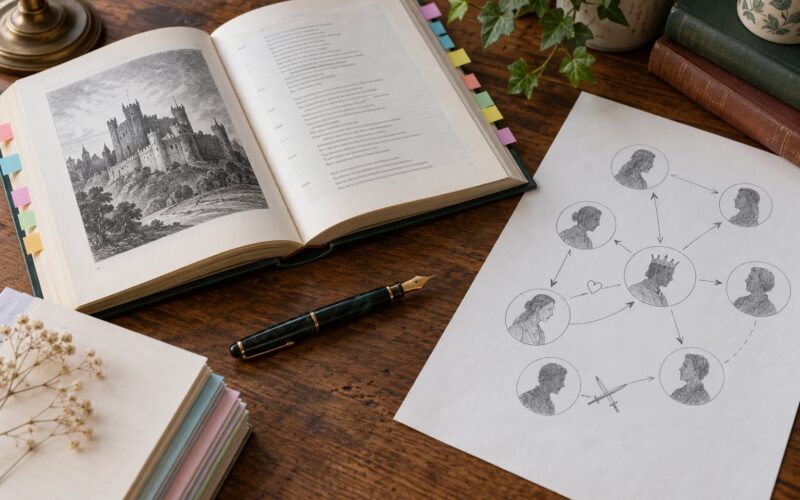
Jane Eyre is a first-person novel about a plain, poor orphan who refuses to trade her self-respect for a comfortable life, and Charlotte Brontë published it in 1847. This Jane Eyre study guide for students gives you a plot summary, a chapter-by-chapter map, character and theme analysis, key quotations with chapter numbers, essay topics and study questions in one place, all free and no sign-up.
If you have read the first thirty pages and stalled, that is normal. The opening moves slowly and the Victorian sentences stack up, but the book sharpens considerably once Jane reaches Thornfield. If you are short on time, this guide also tells you which chapters matter most and which you can skim.
Table of Contents
- Jane Eyre Study Guide for Students: Quick Guide
- How to use this Jane Eyre study guide for students
- What Is Jane Eyre About?
- Jane Eyre Plot Summary: What Happens in the Novel?
- 1. Gateshead: the unwanted child (Chapters 1-4)
- 2. Lowood School: friendship and cruelty (Chapters 5-9)
- 3. Thornfield Hall: the post and the proposal (Chapters 10-27)
- 4. St. John Rivers and the inheritance (Chapters 28-36)
- 5. The return to Ferndean (Chapters 37-38)
- Chapter-by-Chapter Analysis of Jane Eyre
- Volume I, Chapters 1-7: the making of a voice
- Volume II, Chapters 8-16: loss and reinvention
- Volume III, Chapters 17-27: the revelation
- Volume IV, Chapters 28-38: the argument for freedom
- The ten chapters to prioritise when time is short
- Who Are the Main Characters in Jane Eyre?
- Jane Eyre, the narrator
- Edward Rochester
- Bertha Mason
- St. John Rivers
- Helen Burns
- Mrs. Fairfax, Miss Temple, Grace Poole and Adèle Varens
- Mr. Brocklehurst, Mrs. Reed and John Reed
- What Are the Major Themes in Jane Eyre?
- Independence and self-respect
- Social class and the governess
- Gender and marriage
- Religion, morality and doubt
- Confinement and freedom
- Appearance versus reality
- Colonialism and the Caribbean
- How Does Jane Eyre Develop as a Character?
- What Is the Significance of the Gothic and Bildungsroman Elements?
- Why it is Gothic
- Why it is a bildungsroman
- Important Symbols, Imagery, and Settings in Jane Eyre
- Settings and what each one does to Jane
- Key Quotes from Jane Eyre and What They Mean
- 1. “I am no bird; and I netless to my snare…” (Chapter 23)
- 2. “I would always rather be happy than dignified…” (Chapter 34)
- 3. “I am no longer a girl…” (Chapter 37)
- 4. “I am a free human being with an independent will…” (Chapter 31)
- 5. “Cheerful orphan life… has not been the lot of my happiness” (Chapter 8)
- 6. “Reader, I married him” (Chapter 38)
- 7. “Do you think I am an automaton?…” (Chapter 22)
- 8. “I am glad to see you. I was afraid you would be dead” (Chapter 9)
- Jane Eyre Study Questions and Essay Prompts
- Plot questions
- Character and theme questions
- Essay topics with a suggested angle
- How to Study Jane Eyre Effectively
- A four-week plan
- An essay structure that works
- Four pitfalls to avoid
- Frequently Asked Questions
- Is Jane Eyre hard to read?
- What are the most important chapters in Jane Eyre?
- Why did Jane Eyre leave Rochester?
- Was Mr. Rochester obsessed with Jane Eyre?
- What is Jane Eyre’s most famous line?
- How does a Jane Eyre study guide for students help with essay writing?
- Conclusion: Begin with Jane’s Independence
Jane Eyre Study Guide for Students: Quick Guide
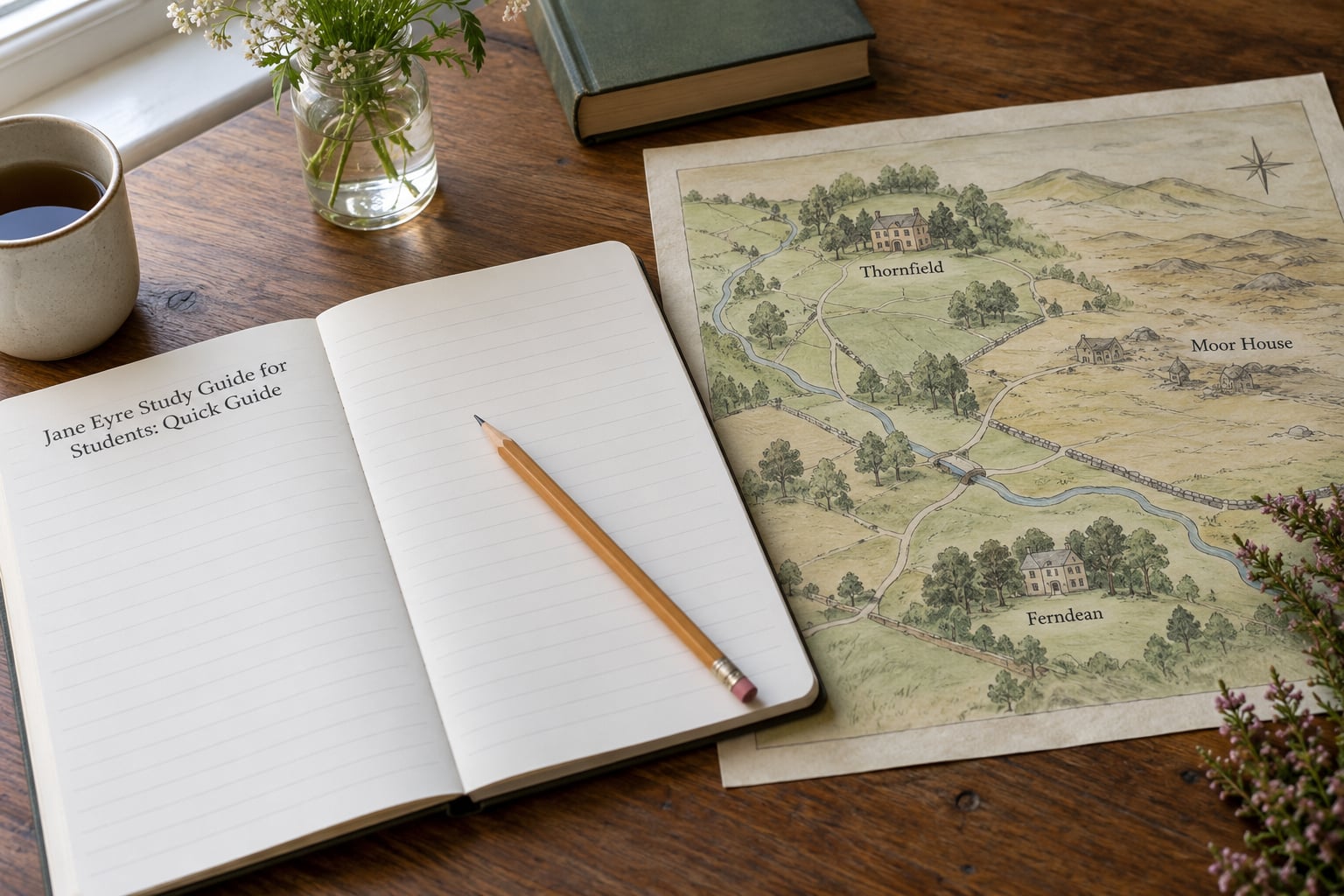
Everything below is a fact you may be asked for in an exam, a quiz or a class discussion. Learn this table first and the rest of the novel becomes easier to place.
| Element | Detail |
|---|---|
| Author | Charlotte Brontë, published under the pen name Currer Bell |
| Published | 1847, revised in 1848 |
| Genre | Gothic novel and bildungsroman (a coming-of-age story) |
| Narrator | Jane Eyre herself, in the first person, retrospectively |
| Structure | 38 chapters grouped into four volumes |
| Main settings | Gateshead, Lowood School, Thornfield Hall, Moor House, Ferndean Manor |
| Central conflict | Jane wants love and independence, and Rochester wants her without either condition attached |
| One-sentence premise | A governess falls in love with her employer, discovers he is already married, leaves him, and returns only after he has lost everything. |
How to use this Jane Eyre study guide for students
Read the plot summary once, then use the chapter map to locate scenes rather than rereading the novel end to end. Use the character and theme sections as your evidence bank when you start planning an essay. Comparing notes section by section beats trying to hold the whole plot in memory, and it is how most study groups get through a novel this long.
What Is Jane Eyre About?
Jane Eyre is the story of a young governess who survives cruelty at her aunt’s house, a punishing school, a loveless marriage and an emotional betrayal, and insists on staying herself throughout. Told in her own voice, it follows her from Gateshead to Lowood School, then to Thornfield Hall as a governess, and finally through a refused proposal, a great discovery and a hard-won independence.
Two things make it more than a romance. First, it is a bildungsroman: the plot is really the education of one person’s judgment. Second, it is Gothic, using a locked attic room, a storm, an unexplained laugh in the night and a mystery at the centre of the house. Brontë published it in 1847 under the name Currer Bell, and it has stayed in continuous print because the voice is so assured and the anger so precise.
Jane Eyre Plot Summary: What Happens in the Novel?
The story runs in five stages, and each stage strips away one protection Jane had. This Jane Eyre study guide for students follows the arc below rather than retelling every chapter, since the plot’s shape is what most exam questions test.
1. Gateshead: the unwanted child (Chapters 1-4)
Jane is sent to live with her aunt, Mrs. Reed, after her father dies. She is treated as an insult rather than a relative, beaten, locked in the red-room and called a burden. When Mrs. Reed finally sends her away to a charity school, Jane asks one question: will anyone love me there? Helen Burns is the first person to answer yes.
2. Lowood School: friendship and cruelty (Chapters 5-9)
Mr. Brocklehurst runs the school on low wages and Evangelical severity. Miss Temple treats Jane and Helen with ordinary kindness, which makes the contrast sharp. A typhus epidemic kills many of the children, including Helen, after she tends the sick and is exposed to the infection. Jane leaves Lowood two years later, permanently scarred.
3. Thornfield Hall: the post and the proposal (Chapters 10-27)
Jane becomes governess to Adèle Varens at Thornfield, a house she finds strange and a master she has not met. Rochester tests her by pretending to be a rude shopkeeper, then courts her with games and disguises. Blanche Ingram appears as a marriage candidate and Jane is jealous. Rochester finally proposes and Jane accepts, but a voice interrupts the wedding night, and in the morning she discovers Bertha Mason, Rochester’s wife, alive and locked in the attic.
4. St. John Rivers and the inheritance (Chapters 28-36)
Jane leaves Thornfield with almost no money and is nearly stranded on the moors. St. John Rivers takes her in, and she discovers that his sisters, Diana and Mary, and he are her blood relatives. Their aunt left Jane and them twenty thousand pounds, which Jane insists on dividing equally. St. John then presses her to stay with him and marry him as a partner in missionary work, a God-forced marriage that she refuses.
5. The return to Ferndean (Chapters 37-38)
Jane decides she will try Rochester again. She finds Thornfield emptied, burned by an angry household, and Rochester left blind and lame, caring for a child he found, whose resemblance to Jane tells her everything. She stays, and the novel closes with her line about rising free of him.
Chapter-by-Chapter Analysis of Jane Eyre
The novel has 38 chapters in four volumes. This map groups all of them so you can find any scene fast.
| Volume | Chapters | What happens | Why it matters |
|---|---|---|---|
| I | 1-7 | Gateshead, the red-room, the journey to Lowood, Helen Burns | Establishes Jane’s defiance and her first model of moral courage |
| II | 8-16 | Lowood, typhus, Helen’s death, eight years later at Thornfield | Converts childhood endurance into adult self-respect |
| III | 17-27 | Grace Poole upstairs, Blanche Ingram, the proposal, the attic revelation | The centre of the novel: love tested against self-respect |
| IV | 28-38 | Flight, Moor House, the inheritance, St. John’s proposal, Ferndean | Jane proves independence before she accepts love |
Volume I, Chapters 1-7: the making of a voice
Chapter 1 is the chapter to know. Jane narrates her own history to an unnamed listener, the reader, and that act of telling is already an assertion of power. The red-room is less a haunted room than a public punishment: Jane is locked in by adults who cannot stand her. The look she gives Mrs. Reed as she is taken away, described as a glare of defiance, is the novel’s first argument about resistance.
Volume II, Chapters 8-16: loss and reinvention
Helen Burns is the hardest character for modern students to read. She forgives easily, reads constantly and dies young, and readers often ask whether to admire her or resent her. The text does not tell you to copy her. Jane admires her endurance but returns from Lowood determined to live on her own terms, and Helen’s death is what makes that resolution possible.
Volume III, Chapters 17-27: the revelation
Rochester deliberately withholds his face and history in the early chapters, which is the source of most of the anxiety in this section. Grace Poole’s laugh, the unexplained fire in Jane’s room and the destruction of the wedding veil are planted before Jane climbs to the third floor in Chapter 27. That chapter is the pivot of the whole novel.
Volume IV, Chapters 28-38: the argument for freedom
Jane’s flight in Chapter 28 has no money and no plan, which is exactly the point. The Rivers household gives her wealth and asks for her obedience in return, and she refuses St. John’s bargain even though it costs her the one offer of family she has wanted. Her return in Chapter 37 is a choice made from freedom, not desperation, which is why it carries weight.
The ten chapters to prioritise when time is short
Chapters 1, 5, 9, 16, 23, 25, 27, 28, 34 and 37. That set covers the childhood, Helen’s death, Rochester’s mid-life confession, Blanche Ingram, the proposal, the attic, the escape, St. John’s demand, and the return. Read those in full and skim the servants’ chatter and the village visits.
Who Are the Main Characters in Jane Eyre?
Each of these figures exists to test a different answer to the same question: what is Jane worth, and who has the right to decide? That is the useful way to remember them.
Jane Eyre, the narrator
Poor, plain, orphaned and, in her own word, free. Her narration is filtered through a religious vocabulary she partly rejects, which makes her a narrator with limits, not an objective camera. She wants love as fiercely as anyone in the book but attaches conditions to it.
Edward Rochester
A widower, owner of Thornfield, roughly forty when Jane is eighteen, and blunt where other men are polite. He tests her, hides from her, lies by omission about Bertha and finally confesses honestly. His appeal is partly real and partly the appeal of a man who wants to be forgiven without changing.
Bertha Mason
Rochester’s Creole wife from Jamaica, described through Rochester’s account rather than her own voice. She has no direct lines in the novel, which is the point critics argue about: the woman who most directly blocks Jane’s path is never allowed to speak. Reading Bertha as a victim of Rochester’s arrangements rather than as a monster is the most interesting modern interpretation.
St. John Rivers
A clergyman and Jane’s cousin, morally unimpeachable and emotionally withholding. He offers Jane a life without romance in exchange for total obedience to God, and Jane refuses him precisely because he does not treat her as an equal. He is the cleanest test of faith in the novel.
Helen Burns
Jane’s first friend at Lowood, a reader and a scholar trapped by poverty and illness. Her faith is real and her forgiveness is complete, but she never argues for a life like hers.
Mrs. Fairfax, Miss Temple, Grace Poole and Adèle Varens
Mrs. Fairfax gives Jane a position without condescension. Miss Temple is the schoolmistress who shows Jane that kindness is possible inside an unjust system. Grace Poole keeps Bertha and talks to Jane more honestly than Rochester does. Adèle, a lively French girl Jane teaches to read, is the child who trusts her completely.
Mr. Brocklehurst, Mrs. Reed and John Reed
Brocklehurst is sanctimonious cruelty dressed as religion; Mrs. Reed is family cruelty dressed as duty; John Reed, who has been a servant in the same house, leaves Jane a fortune that proves character and birth do not always agree.
What Are the Major Themes in Jane Eyre?
The major themes run deep and overlap: independence, class, gender, love and marriage, religion, confinement, appearance versus reality, and colonialism. Study each one with a specific scene rather than a definition.
Independence and self-respect
Jane’s two refusals, Rochester’s offer and St. John’s offer, define her. She would rather be alone than be owned, and the novel ends only after she has proven she can live that way.
Social class and the governess
A governess is hired, educated and often lonely: above a servant, below the family. Rochester openly calls it the sheltered position of a Victorian lady, and Jane points out that it excludes her from the household she lives in. The novel attacks the assumption that class measures worth.
Gender and marriage
Marriage is the only economic route out for a woman like Jane, which is why Rochester’s proposal is tempting. Jane’s condition that she would not be a mere wife is radical for 1847 and still is.
Religion, morality and doubt
Lowood punishes a child for lying about sin; St. John makes religion a bargain. Jane keeps the vocabulary of faith but rejects its cruelty, which is not atheism but judgment.
Confinement and freedom
Every place Jane is kept shut is a room: the red-room, Brocklehurst’s chair, the attic. Rooms measure the novel.
Appearance versus reality
The plain governess is morally superior to the beautiful Blanche Ingram, and the dishevelled attic figure is not the monster Rochester describes. Jane insists early in the novel that she has never thought her face pleasing, and her self-assessment is more reliable than anyone’s.
Colonialism and the Caribbean
Bertha is brought from Jamaica to England as property, purchased and controlled, and Rochester describes the Caribbean as exotic and half-civilised. Jane’s own outlook on colonial work, formed by the missionaries she meets in Volume IV, sits uncomfortably close to his. Most modern readings treat the attic, not Thornfield, as the novel’s real colonial scene.
How Does Jane Eyre Develop as a Character?
Jane at ten is clever and fierce but has no power. By eighteen she has learned that endurance alone will not protect her, so she builds a moral code instead: she refuses flattery, charity that comes with conditions, and obedience bought with money.
Rochester is the test of that code. When he deceives her, she does not argue about class; she walks out. Her flight costs her almost everything, and she accepts that cost without knowing whether he will come back. After Moor House she is financially independent for the first time, and only then does she choose Rochester.
The final arc is a marriage between equals, and it is still broken: Jane cares for a blind Rochester as a dependent and an equal partner, not as an employer. Students should resist the tidy reading of a happily-ever-after ending, which is the most common misjudgement in essays on this book.
What Is the Significance of the Gothic and Bildungsroman Elements?
Gothic and bildungsroman are not decorative labels. Each one describes a different engine of the plot, and examiners look for you to apply them rather than define them.
Why it is Gothic
The novel uses the Gothic conventions of setting, enclosure, threat, and the uncanny. The mystery of Thornfield, the laugh in the night, the storm on the roof, the locked third floor and the eventual burning of the house all build suspense, and Bertha is the concealed secret at the centre. Brontë also uses a trace of the supernatural, which is why the red-room chapter makes readers uneasy even though nothing supernatural occurs in it.
Why it is a bildungsroman
A bildungsroman is a novel about growing up. Jane grows from a child punished for a disobedience she openly defends, through a young woman who accepts society’s judgment, to an adult who sets her own terms. The structure is educational: almost every chapter shows Jane making a decision and learning from it.
Important Symbols, Imagery, and Settings in Jane Eyre
Symbols in this novel work in pairs, and pairs are what students forget. A symbol with no contrast has little to say.
| Symbol or image | Chapter | Meaning |
|---|---|---|
| The red-room | 1 | Jane’s confinement by adults and her refusal to submit to it |
| The split chestnut tree | 23 | Jane’s damaged story told as nature; the offered marriage awaits the tree’s regrowth |
| Fire and frost | Throughout | Rochester’s volcanic temper against the frosty barrier between them; reconciled in the final chapters |
| Doors and thresholds | Throughout | Every crossing is a choice, especially Jane climbing to the attic |
| Windows and the moors | Throughout | Windows suggest freedom she can see but not reach; the moors offer real liberty |
| Jane’s drawings | 13 | Imagined beauty as compensation for the face she believes is plain |
| Storm and fire | 5, 37 | Lowood’s storm destroys Brocklehurst’s moral authority; the storm at Thornfield destroys the house |
Settings and what each one does to Jane
Gateshead makes her a rejected child. Lowood makes her an orphan with a reputation. Thornfield gives her independence and the illusion of safety. Moor House gives her money, family and a colder religion. Ferndean gives her an uneasy peace. Moving through these settings in order is the plot’s real progression.
Key Quotes from Jane Eyre and What They Mean
Quotations earn marks only when you explain them. Each line below has a chapter, a meaning and a use, so you can drop it into an essay and know why it is there.
1. “I am no bird; and I netless to my snare…” (Chapter 23)
Jane tells Rochester she has never been a kept woman, or one who pretends. It is the equality quotation, and it is the one to memorise first. Use it to show a woman defining love in her own terms before marriage, not after.
2. “I would always rather be happy than dignified…” (Chapter 34)
Jane tells St. John she will not marry without love. The line is often misread as passivity. It is the opposite: she has offers of a lifetime and refuses them because they are dishonest.
3. “I am no longer a girl…” (Chapter 37)
Jane introduces herself at Ferndean as a woman with a claim to Rochester’s respect rather than a dependent returning to her post. Use it for the ending’s argument about equality inside marriage.
4. “I am a free human being with an independent will…” (Chapter 31)
Jane claims autonomy when told she must stay with the Rivers. Use it for the religion theme: she rejects God-as-a-commodity without rejecting belief.
5. “Cheerful orphan life… has not been the lot of my happiness” (Chapter 8)
Jane looks back on Helen’s death as the loss of the person who made suffering endurable. Useful for showing what Lowood took from her.
6. “Reader, I married him” (Chapter 38)
The novel’s last line. Students usually call it triumphant; a better reading is that Jane names the act and leaves the reader to judge its cost.
7. “Do you think I am an automaton?…” (Chapter 22)
Jane asks Rochester to accept her feelings as given rather than argued over. Use it for the theme of judgement, and to show Rochester’s control of information.
8. “I am glad to see you. I was afraid you would be dead” (Chapter 9)
A short line that does enormous work: it shows Jane’s suppressed grief and her return to the surface after Lowood. Simple quotes are often safer in timed essays.
Jane Eyre Study Questions and Essay Prompts
Answer the plot questions for checking understanding. The analytical questions are the ones worth writing down, because they turn into exam questions.
Plot questions
- Why does Mrs. Reed send Jane to Lowood rather than keep her at Gateshead?
- What does Jane learn about herself during the typhus epidemic?
- Why does Rochester hide his face from Jane when she first arrives?
- How does Jane get back to Thornfield from Moor House, and what does she find there?
Character and theme questions
- How does Jane’s judgement change between Chapters 9 and 23?
- Compare Rochester and St. John as models of what love should be. Which one is more controlling, and how does the text show it?
- Why does Jane treat Helen Burns as an example rather than a rule for her own life?
- To what extent is Bertha Mason a victim, a threat, or both in the structure of the novel?
- Does the ending reward Jane’s independence or compromise it?
Essay topics with a suggested angle
- Love and obedience: argue that Jane’s refusals, not her marriage, are the plot’s real subject.
- Rooms as social argument: the red-room, Brocklehurst’s chair and the attic show the same confinement at three social levels.
- The unreliable account of Bertha: the novel never gives her a voice, and that silence shapes the reader’s sympathy.
- Faith without obedience: compare St. John’s religion with Jane’s, and show why Jane’s survives the novel.
- Plainness as moral authority: argue that Jane’s self-assessment is more reliable than every other character’s opinion of her.
How to Study Jane Eyre Effectively
Students who revise this book well do four things, and none of them involve memorising the plot twice. Read the novel in a set order, take notes on people rather than events, learn ten quotations well, and practise one essay structure. If your class set uses a different edition, check that its chapter numbers match the standard 38-chapter division before you start citing.
A four-week plan
Week one covers Volume I, finishing with the red-room and Helen’s introduction. Week two covers Volume II and Lowood. Week three covers Volume III, including the attic chapter, which deserves a second reading. Week four covers Volume IV, then two timed essays.
An essay structure that works
Open with a claim that answers the question in one sentence. Give one quotation with its chapter, explain the word-level choice you noticed, then link it to a theme and to Jane’s development. Finish with a sentence about what the novel does not settle, since the ending is genuinely arguable.
Four pitfalls to avoid
- Do not call Jane anti-religious. She argues against religious cruelty, not belief.
- Do not treat Helen Burns as a model to emulate; the novel deliberately sets her apart from Jane.
- Do not present Rochester as a romantic hero with a flaw. His deception of Jane about Bertha is central, not incidental.
- Do not treat the ending as a simple happy ending; the power balance in the marriage has shifted.
Frequently Asked Questions
Is Jane Eyre hard to read?
The first third is the hardest. The Victorian sentence structure and the amount of description in the Gateshead and Lowood sections slow many readers down, but the pace picks up at Thornfield, where Rochester’s dialogue carries the plot. A common tactic is to read Chapters 1-9 steadily, then let the middle sections run faster and slow down again at Chapter 27.
What are the most important chapters in Jane Eyre?
Ten chapters carry most of the argument: 1, 5, 9, 16, 23, 25, 27, 28, 34 and 37. Chapter 1 establishes Jane’s voice and the red-room. Chapter 27 is the reveal of Bertha Mason. Chapter 28 is the escape, and Chapter 37 is Jane’s return to Ferndean. If you have limited time, read those in full.
Why did Jane Eyre leave Rochester?
Jane leaves because she discovers on her wedding night that Rochester is already married to Bertha Mason, who is kept locked in the attic of Thornfield. Rochester offers to explain, apologises and asks her to stay anyway. Jane refuses, because keeping his secret would make her a partner in a deception she did not agree to. She returns later, when she is independent and he has lost everything.
Was Mr. Rochester obsessed with Jane Eyre?
Critics usually describe his interest as possessive rather than simply romantic. He hides his identity at first, keeps Jane in the household without telling her the truth about his wife, and proposes on terms that would keep her as his dependent. He also genuinely loves her and confesses honestly before asking her to stay. That combination is why so many students find him hard to defend.
What is Jane Eyre’s most famous line?
Two lines usually appear at the top. One is the opening of Chapter 23, in which Jane says she is no bird and not netted to a snare, declaring that she will not be a kept woman. The other is the last line of Chapter 38, where the narrator says she married him. For essays about equality, the first is the stronger choice.
How does a Jane Eyre study guide for students help with essay writing?
It gives you the three things an essay needs: a claim you can argue, a quotation with a chapter number to prove it, and a link between that quotation and a theme. Using one like this, collect evidence under themes rather than characters, then answer the prompt with one clear claim rather than retelling the plot.
Conclusion: Begin with Jane’s Independence
Start with the refusal, not the romance. Nearly everything in Jane Eyre builds toward Chapter 34, where Jane tells St. John Rivers that she will not marry without love, and the ending only carries weight because she can return to Rochester as an equal rather than a dependent.
Use the plot summary to place events, the character sections to track who challenges Jane and why, and the symbol table to find the images examiners reward. When you sit down to write, begin with a claim, prove it with one quotation and its chapter number, and explain the link to a theme. This Jane Eyre study guide for students is arranged so you can move from any question straight to the evidence you need.