If you have been handed Jane Austen’s Pride and Prejudice and feel slightly buried, this pride and prejudice study guide for students puts the whole novel in one place: what happens, who is who, what the major themes actually mean, which quotations earn their place in an essay, and how to plan your reading so 61 chapters stop feeling like a chore. Read the section you need instead of rereading all 336 pages.
The novel is not as hard as its reputation suggests. It is funny, fast-moving once you know which character is lying, and the plot machinery is simple: two people misjudge each other, and the reader is ahead of both of them for a very long time. Once you see that structure, the prose stops fighting you.
Table of Contents
- Pride and Prejudice Study Guide for Students: Quick Overview
- What Is the Plot of Pride and Prejudice?
- The Bennet household under financial threat
- Netherfield and the arrival of the Bingleys
- Collins, Charlotte and the refusal
- Hunsford, the letter and the elopement
- The reappraisal
- The second proposal and the ending
- Who Are the Main Characters in Pride and Prejudice?
- Elizabeth Bennet
- Fitzwilliam Darcy
- Jane Bennet
- Charles Bingley
- Mr. and Mrs. Bennet
- Charlotte Lucas and Mr. Collins
- Lydia and Mary Bennet
- George Wickham
- Lady Catherine de Bourgh and Georgiana Darcy
- Caroline Bingley
- How Does Elizabeth Bennet Change?
- Why Is Pride Important in Pride and Prejudice?
- How Does Austen Explore Class and Marriage?
- What the Longbourn entail actually means
- Class differences between the families
- What Are the Main Themes in Pride and Prejudice?
- Pride and prejudice
- First impressions
- Love versus marriage
- Money and social status
- Women, marriage and independence
- Appearance versus reality
- Personal growth and self-knowledge
- Which Scenes and Quotes Should Students Analyze?
- How Do You Write a Strong Analysis Essay?
- Build a thesis you can argue against
- Choose evidence that builds an argument
- Explain the quotation, do not just cite it
- Compare two characters, not two summaries
- What Is a Simple Study Plan for Pride and Prejudice?
- Step one: get the map before the detail
- Step two: read for people, not for plot
- Step three: pace it by week
- Step four: gather evidence last
- Frequently Asked Questions
- Why does Elizabeth reject Darcy’s first proposal?
- Why does Wickham lie to Elizabeth?
- What is entailment and why does it matter?
- Is Pride and Prejudice hard to read?
- How do I understand the language in Pride and Prejudice?
- Why is Lizzy Mr. Bennet’s favorite daughter?
- Conclusion
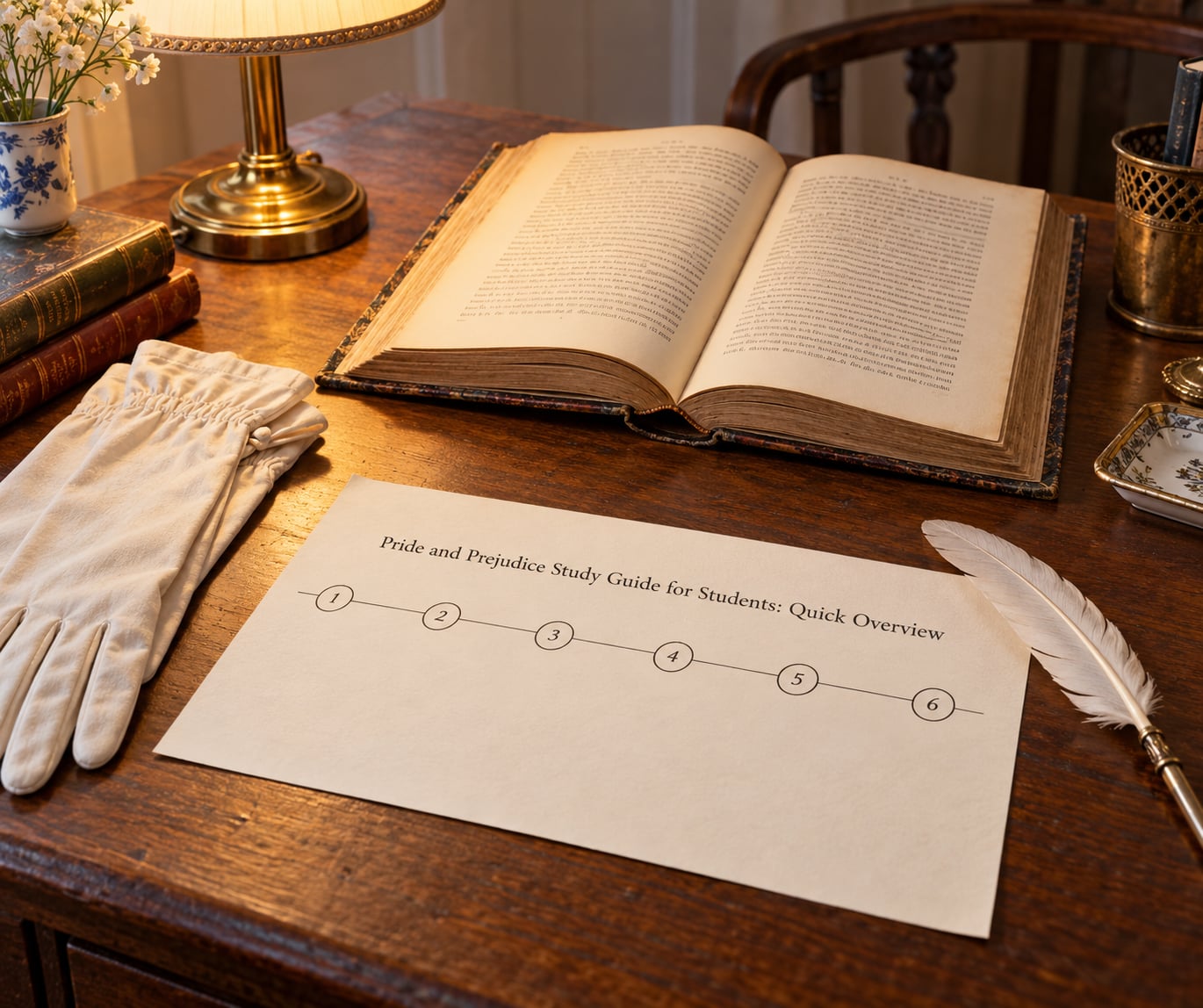
Pride and Prejudice Study Guide for Students: Quick Overview
Pride and Prejudice is Jane Austen’s second published novel, released in 1813 in three volumes under the title First Impressions. It is a novel of manners: a comedy of manners, really, where the main action is conversation, courtship and reputation, and the biggest threat to a character is what people say about them. The narrator is an unnamed third-person voice who is often close enough to Elizabeth Bennet to slide into her opinions without announcing it.
| Author | Jane Austen (1775-1817) |
|---|---|
| First published | 1813, in three volumes |
| Chapters | 61, unevenly divided across the three original volumes |
| Length | About 336 pages in a standard modern edition |
| Reading level | Around Lexile 1190, commonly assigned to grades 9-12 |
| Setting | Regency England, roughly 1790s-1810s, mostly Hertfordshire and Derbyshire |
| Places | Longbourn, Meryton, Netherfield, Lucas Lodge, Rosings Park, Pemberley, Lambton |
| Genre | Novel of manners, romantic comedy, social satire |
| Narrator | Third person, closely aligned with Elizabeth, with free indirect discourse |
| Central conflict | Elizabeth’s prejudice against Darcy collides with Darcy’s pride until both are forced to revise their judgement |
The opening sentence is the most quoted line in English literature, and it is also a piece of satire aimed at the reader. “It is a truth universally acknowledged, that a single man in possession of a good fortune, must be in want of a wife.” The joke is that this is not a truth at all. It is what people say at a ball, and Austen opens the novel by announcing that the marriage market runs on gossip and cliché.
What Is the Plot of Pride and Prejudice?
The plot moves through six stages, and once you can place a chapter in one of them, the pacing problem mostly disappears.
The Bennet household under financial threat
The story opens with Mr. Bennet, an idle country gentleman with a wife he finds tiresome and five unmarried daughters. Longbourn is entailed away from the female line, so when Mr. Bennet dies the house and income pass to his nephew, Mr. Collins, and the four younger Bennet sisters are left with nothing. That single legal fact is the engine of the whole first act: every conversation about marriage is really a conversation about survival.
Netherfield and the arrival of the Bingleys
Caroline Bingley rents Netherfield, brings her brother Charles and his friend Fitzwilliam Darcy, and the Bennets are thrown together with them at assemblies, dinners and a dance. Elizabeth watches Darcy’s behaviour and draws the wrong conclusion, aided by Wickham, an acquaintance who tells her a flattering story about Darcy the moment she asks.
Collins, Charlotte and the refusal
Mr. Collins offers Elizabeth a marriage of convenience: he has a living and a house, and he wants a wife who will run it. She refuses him, which she later describes as her first act of independence and which readers often see as the moment her family loses its best chance. Her friend Charlotte accepts the same offer days later, and the contrast between the two women becomes a theme of its own.
Hunsford, the letter and the elopement
Elizabeth visits her newly married friend at the parsonage near Rosings, Darcy’s estate. He proposes; she refuses, and she refuses badly, insulting his family and declaring that she would sooner die than marry him. He writes a letter explaining his history with Wickham, and she reads it while on a trip with the Lucases. Lydia then elopes with Wickham, the scandal is discovered, and Darcy intervenes to pay for the arrangement and to buy an officer’s commission for Wickham.
The reappraisal
Alone in her room, Elizabeth works backwards through every conversation she has had with Darcy and realises how much of her certainty was laziness rather than judgement. She re-reads his letter, finds it fully consistent, and concludes that she was wrong about everything except her own self-knowledge.
The second proposal and the ending
Lady Catherine de Bourgh arrives at Longbourn to pressure Elizabeth into refusing Darcy, reveals that Darcy has been in love with her since the Netherfield ball, and is astonished by the answer. Elizabeth agrees to marry Darcy. The closing chapters settle the rest: Jane marries Bingley, Lydia’s scandal is smoothed over, Mary and Kitty are married off, and the narrator delivers one of the best last lines in fiction about how much happiness a well-matched marriage actually costs the people around it.
Who Are the Main Characters in Pride and Prejudice?
There are a lot of Bennets, Bingleys and Lucases, and the cast blurs if nobody sorts them. Group them by function instead: the Bennet family, their friends and rivals, the landed gentry, and the professional classes.
Elizabeth Bennet
The second of the five sisters and the narrator’s centre of gravity. She is quick, well-read, funny and proud of her own independence, which in her world means being the only one in the family who argues back. Her flaw is that she is sure she is a good judge of people, and she treats first impressions as finished verdicts.
Fitzwilliam Darcy
A wealthy landowner who owns half of Derbyshire and spends far too little of it. He is proud, awkward in society, honest to the point of bluntness, and slow to speak. His big mistake is assuming that doing right by his own account is enough, and that other people will be able to see it.
Jane Bennet
The eldest sister, described by Elizabeth as “tolerable, and handsome enough to tempt me.” Jane sees the best in everyone, which makes her gentle and also blind. She loves Bingley from the moment they meet, but the marriage stalls because of Pride and Prejudice, not want.
Charles Bingley
Darcy’s friend, immediately and constantly in love with Jane, but easily talked out of it by Darcy’s objections to the Bennets. He is warm, agreeable and passive, which makes him a good contrast to Darcy in a comparison question.
Mr. and Mrs. Bennet
They are opposites and it matters. Mr. Bennet is a satirist who has retreated from society because he finds it boring, and he retreats further into books. Mrs. Bennet is a social animal obsessed with marrying her daughters off and says so, out loud, in front of strangers. Elizabeth’s defensiveness and her razor wit both come from this household.
Charlotte Lucas and Mr. Collins
Charlotte is Elizabeth’s oldest friend and the novel’s quiet counterexample to her. She loves security more than passion, so she accepts Collins knowing exactly what she is getting. Collins is a clergyman with a patron, a fortune, a good house, no conversational skill, and a startlingly accurate understanding of his own social rank. He reads to learn which of his neighbours are unmarried women, and he proposes to the wrong Bennet sister before he ever speaks to Elizabeth.
Lydia and Mary Bennet
Lydia is fifteen when the novel opens and has no interest in reading. She is the family’s disgrace-in-waiting, and her elopement with Wickham after Darcy pays for it is the moment the family’s finances are actually solved. Mary is the sister who wants to be a writer and produces a very bad composition about melancholy, which Austen prints so readers can laugh at her.
George Wickham
Charming, broke, and the source of most of the novel’s plot damage. He was Darcy’s steward son, was favoured by old Mr. Darcy, and was protected from the consequences of his own conduct by young Fitzwilliam’s intervention. He lies to Elizabeth about both this and his debts, and readers who trust him in the first twenty chapters usually regret it.
Lady Catherine de Bourgh and Georgiana Darcy
Lady Catherine is Darcy’s aunt, rich, rude, and entirely certain that family rank is the proper basis for a decision. She is the comic engine of the second half and the one who accidentally makes Elizabeth admit her feelings. Georgiana is the quiet, restrained sister whom Elizabeth’s prejudice about women like her gets wrong, and who is quietly one of the novel’s most sympathetic figures.
Caroline Bingley
Darcy’s manipulative friend and Elizabeth’s temporary ally at Netherfield. She flatters Elizabeth until she gets information, then reveals that she has been engineering a marriage between Darcy and Georgiana all along. The partnership with Darcy is instructive: the two people Elizabeth trusts most are the two with the least honest motives.
How Does Elizabeth Bennet Change?
Elizabeth does not change her tastes, her opinions of marriage, or her behaviour in society. She changes in one specific way: she stops believing that her own first impression is a finished judgement, and she discovers how expensive that error was.
The turning point comes at Hunsford, not in the letter. When Darcy says he admired her for lively intelligence but saw no reason to be attached to her, Elizabeth gives a speech defending her own right to decide, and adds that she has always found him disagreeable. Austen follows her speech with one of the great narrative reversals in fiction: “She never had so much of the power of arising without a feeling of shame before it.” She has won the argument and lost.
Darcy’s letter does the factual work. It shows that Darcy had nothing to hide, that Wickham was the liar, and that Elizabeth’s neat little story about the proud rich man and the charming poor one was fiction. The elopement does the emotional work, because she watches Darcy spend money and status to repair a family mistake that was not his.
Her self-reading, when she is alone, is the important passage for essays. She does not apologise to Darcy. She turns inward and concludes that her own cleverness has been the real defect, because it let her believe she knew people without testing anything. Austen makes the growth moral rather than romantic: nothing about Darcy has changed except what she now knows about him.
Why Is Pride Important in Pride and Prejudice?
Pride is what stops the two main characters from simply talking to each other, and the novel is built so that both of them are guilty of it in slightly different ways.
Darcy’s pride is about rank and about himself. He assumes his class position and his good intentions are self-evident, so he never has to explain, admit, or apologise. When his pride collides with Wickham’s lies, he says nothing, which leaves Elizabeth with a silence she fills with her own assumptions. His pride is the reason the plot takes six weeks longer than it should.
Elizabeth’s prejudice is cheaper and faster. She decides who people are in the first half hour of meeting them and then defends the decision as intelligence. The word does double duty, since the novel’s title names her position, Darcy’s position, and the whole society’s position at the same time.
Austen is careful not to make either of them entirely right. Darcy corrects his pride and never says so; Elizabeth corrects her prejudice out loud, in a speech to Lady Catherine, which is hardly humility. The novel’s argument is not that one of them was sincere and the other fraudulent. It is that both treated their own certainty as evidence, and both had to pay for it.
How Does Austen Explore Class and Marriage?
Class in this novel is not a mood. It is a system that decides who can marry whom, how much money moves with a wedding, and whether a woman has any choice at all, and Austen shows it by tracking income and property through every family.
What the Longbourn entail actually means
An entail is a legal arrangement that ties property to a line of heirs, usually male and usually the nearest male relative. Longbourn is entailed in the male line. Mr. Bennet’s sisters’ son, Collins, is the heir. When Mr. Bennet dies, Longbourn goes to Collins, Mrs. Bennet is turned out of the house, and Elizabeth and her sisters are left without income. Austen introduces it immediately, in Mr. Bennet’s joking conversation with Collins, so that the reader understands the stakes before the plot does.
The law also blocks inheritance in a way students often miss: because the sisters cannot inherit, the Bennet daughters’ own future children will have no claim either. That is why marriage is not romance to them, it is a financial decision with a body attached.
Class differences between the families
Darcy’s wealth comes from the Pemberley estate, which is roughly half of Derbyshire and generates about ten thousand a year, enough that he has no need of any particular post. Collins’s income comes from a clerical living and a patron, and he knows exactly how small it is. Bingley inherits money but no land, which is the practical difference between the two men and the reason the marriage question for Jane is complicated rather than obvious. Wickham has no income and no estate at all, which is why Darcy can end him with money.
Lady Catherine and Mrs. Bennet are the two ends of the same problem. One believes her rank entitles her to decide other people’s lives; the other believes her rank obliges her to secure her daughters. Neither has any legal power over Elizabeth, and the novel’s funniest observation is that they are both wrong.
Charlotte’s marriage is where Austen is most honest. She has no money, no lover, and a family with four daughters to marry off. Her decision to accept Collins is not a failure of imagination; it is a rational response to a system in which an unmarried woman with no income has almost nothing to spend the rest of her life on. Elizabeth calls it “the wisdom of good sense,” and the reader is left deciding whether that is a compliment.
What Are the Main Themes in Pride and Prejudice?
Pride and prejudice
Darcy’s pride and Elizabeth’s prejudice are presented as equal errors rather than opposite ones. Each thinks that seeing the other clearly is the same as knowing the other, and each has to give up that shortcut. The theme is not simply “don’t judge a book by its cover”; it is that a first impression is a hypothesis, and treating it as a conclusion is the actual mistake.
First impressions
The first half of the novel is a demonstration of how the mind fills in gaps. Elizabeth believes Darcy is arrogant because he says little and stands apart; he believes she is superficial because she flirts. Wickham, who says exactly what each listener wants, produces the most confident and most false impressions of all. The novel is also built on dramatic irony, since the reader is usually told early that somebody is lying and has to wait for the characters to catch up.
Love versus marriage
Austen takes the arranged-marriage question seriously rather than treating it as a romantic convention. Elizabeth and Darcy fall in love while neither is ready to admit it, and the novel never claims that love is a sufficient basis for marriage. It argues instead for the thing Austen valued, a clear understanding between two people who have enough sense to know each other properly.
Money and social status
Money is in almost every significant scene. The Bennets’ need, the Bingley inheritance, the Bennet sisters’ portion of four thousand pounds, Wickham’s debts, and the ten thousand a year from Pemberley all land in the reader’s head and affect who marries whom. Status is treated more coldly than money: Darcy’s rank protects him from consequences that destroy Wickham, and Collins’s rank is small enough that he is not safe from ridicule.
Women, marriage and independence
Elizabeth is the closest thing the novel has to a modern woman, and Austen is honest about the limits. She can refuse a suitor, refuse a visitor, and refuse to be bored, and she cannot keep an income, inherit a house, or run a business. Her independence is real in attitude and completely bounded by law and money. The courtship of her sisters, especially Mary’s need for a respectable match, shows the alternative she avoided rather than a fate she disproved.
Appearance versus reality
Wickham looks like a gentleman and behaves like a swindler. Darcy looks cold and behaves generously. Caroline flatters Elizabeth and works against her. Mrs. Bennet’s fussing looks ridiculous and is financially rational. The theme is not that appearances always lie, since some of them do reveal character. It is that they are cheap evidence, and that the novel’s method is dialogue and behaviour over time rather than first impressions.
Personal growth and self-knowledge
Both leads end the novel more accurate and less confident. Elizabeth loses her certainty about reading people, and Darcy learns that being right is not the same as being effective. Austen treats self-correction as a skill that takes about a novel to acquire, and she makes sure the reader watches both of them pay for their mistakes in public first.
Which Scenes and Quotes Should Students Analyze?
These are the quotations that do the most work, with what each one is doing and where it sits. Learn eight well-explained pieces of evidence rather than twenty you cannot use.
- “It is a truth universally acknowledged…” (Chapter 1). The most quoted line in the novel is also its thesis statement. It is not a truth, it is a social formula, and it tells the reader the book is about how marriage talk circulates without evidence.
- “tolerable but not handsome enough to tempt me” (Chapter 3). Elizabeth’s free indirect voice introducing Jane. Free indirect discourse lets Austen narrate in Elizabeth’s idiom without quoting her, which is how the reader stays inside her confidence.
- “I have every intention in the world to tremble before his authority. You will, I am sure, hear me with a little surprise… So many of your good lady-friends gone mad, cannot forgive me?” (Chapter 15). Darcy’s “declaration of feelings” refuses to be romantic on purpose, and the apology to the Bennets is his first act of self-criticism.
- “I never saw a more elegant person than you are” / the refusal speech (Chapter 34). Elizabeth’s answer that he should have behaved better and that she will not be a wife who “be on the side of charity to the world.” Her anger is class pride, and the sentence above it, about having no reason to be attached to her, is what finally lands.
- “You are determined to ruin him in the opinion of all his friends” and Darcy’s “Be of better cheer” reply (Chapter 34). The give-and-take in one exchange. He admits the impropriety and asks for a chance to be known, which is a real emotional move disguised as coldness.
- Wickham’s account of his wrongs (Chapters 16 and 25). Two versions of the same story, told a month apart to different audiences, and the second is a completely different story. Pairing them is the fastest way to show a teacher that you understand evidence versus persuasion.
- Darcy’s letter (Chapter 35). The novel’s most quoted document, but analyse the structure rather than the emotion: it explains the benefactor, corrects the record, and closes with a direct request that Elizabeth do something she might be able to do. It is an argument, written by someone who knows he is being judged.
- Elizabeth’s self-examination and Lady Catherine’s visit (Chapters 36 and 43). The reappraisal that produces the novel’s argument, followed by the comic engine that lets Elizabeth say yes out loud. Together they show growth followed by speech.
One more pair is worth knowing: Mrs. Bennet’s opening “it is a very long time since you were last seen” and her “single women of no fortune” speech in the same scene. Read the Bennets’ dialogue aloud, as readers on forums recommend, because the comedy depends on rhythm that a silent page does not give you.
How Do You Write a Strong Analysis Essay?
A good essay makes one arguable claim, defends it with a small amount of well-explained evidence, and connects that evidence to a pattern in the novel rather than to a single scene. Most marks are lost in the second sentence of the paragraph, not the evidence selection.
Build a thesis you can argue against
“Pride and Prejudice is a novel about love” cannot be argued with, so it earns nothing. Try the shape of the claim: in this novel, this character’s action or quality does this specific thing, as shown by this scene and that scene. A worked example: Austen’s pairing of Elizabeth’s quick speech at the Netherfield ball with Darcy’s silence shows that the novel treats fluency as a form of prejudice, because the reader learns to distrust the person who speaks first.
Choose evidence that builds an argument
Three quotations, explained and connected, beat twelve dropped in. A good set includes at least one scene and one moment of narration, and it should include something that complicates your claim. Teachers reward the paragraph that says the evidence partly cuts the other way.
Explain the quotation, do not just cite it
Use this four-step order: quote a short phrase, name the technique, explain what it does in the scene, and connect it to the claim. For example: Darcy’s phrase about being “dearer to me than life itself” is hyperbole, and it arrives immediately after Elizabeth’s refusal, so the excess is doing the work of a man who has no practice at stating his feelings and overcorrects into them. The structure is quotation, technique, function, claim, and the claim is what your last sentence should restate.
Compare two characters, not two summaries
A comparison essay needs a controlling question, not two set summaries. Darcy versus Wickham works well: both are charming, both are poor at first impressions of others, and both know exactly how much money controls their options, but one conceals a selfless history and the other invents a false one. Sense and Sensibility works as a comparison for an opening about different judgements of marriage, since Elinor and Elizabeth both refuse a convenient match but for opposite reasons.
What Is a Simple Study Plan for Pride and Prejudice?
Four steps, in order, will carry you through the novel and through the essay without rereading the whole thing twice.
Step one: get the map before the detail
Read this guide’s plot stages and the Key Facts table first, then read the novel in order without stopping to annotate. The first twenty chapters do feel slow, and readers consistently say the payoff is worth it. Knowing the six stages in advance means you are never lost, even in a chapter of ball logistics.
Step two: read for people, not for plot
On the second pass, keep one page per character. Track who wants what and who is being lied to. This solves the biggest practical problem with the book, which is that there are five Bennets, three Bingleys, three Lucases and several Lucys, and readers routinely mix them up. Reading the dialogue aloud also solves it faster than anything else, because the voices are genuinely different.
Step three: pace it by week
A four-week plan divides the 61 chapters into roughly fifteen chapters a week and assigns one job to each week: plot in week one, characters in week two, themes and one essay prompt in week three, evidence and a draft in week four. A six-week plan splits it into about ten chapters a week and uses the spare weeks for group discussion and a comparison with another Austen novel. Whichever you use, put a checkpoint at the end of each week: a single page of notes, not a full summary.
Step four: gather evidence last
Copy your eight quotations into a separate document with chapter references and one line on why each matters. Then practise using them in a fifty-word answer and a four-paragraph essay. A study guide is a legitimate tool, and using one alongside the novel rather than instead of it is the difference between understanding the book and recognising its plot points.
Frequently Asked Questions
Why does Elizabeth reject Darcy’s first proposal?
Elizabeth believes Darcy has interfered with Wickham’s career, and she treats that as proof of a cruel and conceited man. She also hears his admission that he thought her attractive but not enough to be attached to her as a reason to insult his rank rather than argue her case. The rejection is a defence of her own pride, which is why the narrator immediately notes that she had the argument and the shame at the same time.
Why does Wickham lie to Elizabeth?
Wickham lies because Elizabeth is a useful source of status and information. He expects her to pass his version of the Darcy story to the Bingleys and onward, which is exactly what happens, and it feeds his plan to marry into a wealthy family. He also owes debts he cannot pay and wants a position he has been promised twice and has not received. In short, he is a social climber with no income and no reputation left.
What is entailment and why does it matter?
An entail ties property to a line of heirs, usually male and usually the nearest relative. Longbourn is entailed in the male line, so it passes to Mr. Collins when Mr. Bennet dies, and the four younger Bennet sisters get nothing. It explains the parents’ obsession with marriage, Charlotte’s decision to accept Collins, and why the whole novel is really about a family trying to stay housed. Students who do not understand it tend to miss the motive underneath most conversations.
Is Pride and Prejudice hard to read?
Only for the first twenty chapters, and mostly because of the prose rather than the plot. The difficulty is nineteenth-century sentence length, inverted word order, and a cast of names that look identical on the page. Audiobooks, reading the dialogue aloud, and having a six-stage plot map in your head solve most of it. Readers who come back to the book as adults usually say the satire gets sharper, not the writing easier.
How do I understand the language in Pride and Prejudice?
Read sentences in clauses rather than all at once, and pay attention to who is speaking, because most archaic difficulty is really characterisation in disguise. Useful substitutions: consequence means punishment, propriety means correct behaviour, condescension means talking down to someone, and tolerable means barely good enough. Austen’s narration also borrows Elizabeth’s vocabulary, so if a sentence sounds smug, it is probably her view rather than the narrator’s.
Why is Lizzy Mr. Bennet’s favorite daughter?
Elizabeth is the only one of the five who argues back. Mr. Bennet enjoys irony, and Elizabeth is the only family member who can meet him in that register, so their affection is really mutual recognition. She also refuses the suitor he could not bear to push on her, which is why the book names them together. He thinks she will marry well; he is wrong about almost every other thing.
Conclusion
Start with the plot in six stages, then learn who is lying to whom, because that single question accounts for most of the novel’s plot. Once the entail makes sense, the Bennets’ urgency stops being background noise, and once you can see that Darcy’s pride and Elizabeth’s prejudice are the same mistake in different clothes, the character analysis writes itself. Gather your evidence last, with chapter references attached, and use this guide for the parts you are asked to explain rather than the parts you are asked to recite.