
Othello is a tragedy because a man of genuine virtue and high rank destroys himself through a single unchecked weakness. Othello has a reputation for courage, a career built on real service to the state and a marriage he genuinely values. Jealousy, fanned by Iago’s lies, turns him into a murderer of his innocent wife, and he kills himself to answer for it. This Othello study guide for students walks through the plot act by act, the characters and their motives, the themes, the symbols and the scenes worth quoting in an essay.
The play runs to five acts and fifteen scenes, and the language is deliberately hard to read at the start. The approach here is simple: learn the plot spine first, then attach a quotation to each turning point, because most exam questions come back to four things — jealousy, race, deception and the difference between what characters seem to be and what they are.
Content note: the play contains racial stereotypes, domestic violence, a murder and a suicide. Some scenes are hard to sit through, and teachers often flag them in advance.
Table of Contents
- Othello Study Guide for Students at a Glance
- What Othello Is About
- Plot Summary by Act
- Act 1: The marriage and the warning (Venice)
- Act 2: Cyprus, and the first suspicions
- Act 3: The handkerchief and the trial
- Act 4: The murder of Cassio and Roderigo
- Act 5: The final scene
- Key Characters and Motivations
- Othello Character Relationships at a Glance
- Major Themes and How to Analyze Them
- Jealousy: the green-eyed monster
- Racial prejudice and otherness
- Appearance versus reality
- Deception and manipulation
- Gender and the position of women
- Trust, betrayal and loyalty
- Revenge and honour
- Love and its limits
- Important Symbols, Motifs, and Imagery
- Key Scenes to Know for Essays and Exams
- Famous Quotes and What They Mean
- How to Write an Othello Analysis Essay
- Step 1: write a thesis that answers the actual question
- Step 2: choose evidence that does a job
- Step 3: embed short quotations and analyse the words
- Step 4: link every quotation to the point
- Questions to Put in an Othello Study Guide for Students
- Othello Act-by-Act Reading Roadmap
- Common Mistakes Students Make
- How to Study Othello Effectively
- Frequently Asked Questions
- How long should I study Othello before an exam?
- What is the hardest part of Othello study and analysis?
- Is Othello considered a racist play, and how should I write about that?
- What is the central message of Othello without simplifying it?
- Should I memorize famous quotations for an Othello exam?
- How can I compare Othello and Iago when writing an essay?
- Conclusion: What to Review First
Othello Study Guide for Students at a Glance
The fastest way into this play is to fix the facts first: who wrote it, where it happens, who drives the plot, and what kind of shape the story takes. Everything else hangs off that table.
| Element | Detail |
|---|---|
| Author | William Shakespeare, written 1603-04 and first performed by the Chamberlain’s Men in 1604 |
| Full title | The Tragedy of Othello, the Moor of Venice |
| Genre and type | Tragedy; a verse play in blank verse, with prose for asides and informal scenes |
| Setting | Venice in Acts 1 and 2, then the island of Cyprus for the rest |
| Central conflict | Iago’s manufactured belief that Desdemona is unfaithful, against Othello’s trust in her |
| Main characters | Othello, Desdemona, Iago, Emilia, Cassio, Roderigo, Brabantio, Montano, Lodovico |
| Governing themes | Jealousy, racial otherness, appearance versus reality, deception, gender, trust and betrayal, revenge |
| Tragic structure | Othello has stature and a tragic flaw (hamartia); the reversal (peripeteia) comes when he believes the handkerchief is proof; recognition (anagnorisis) comes as Emilia explains the truth |
| Best way to study | Read the plot spine of all fifteen scenes, then learn one quotation per turning point rather than every scene |
What Othello Is About
Othello is about a Moorish general in Venetian service whose ensign destroys him by convincing him his wife is unfaithful. Othello was born a slave and sold into service as a boy, and he has risen through the army to become a general and a senator of Venice. He has secretly married Desdemona, a Venetian nobleman’s daughter, and the Senate approves the match, but her father Brabantio is furious at being left out.
The trouble starts in Cyprus, where Othello is posted with a small force to hold the island against the Ottoman Turks. Iago, his ensign, has been passed over for promotion and decides to destroy Othello in revenge. Working from assumption rather than evidence, Iago insinuates that Desdemona and Cassio, Othello’s lieutenant, are lovers.
Iago manufactures proof in stages: a bloodstained handkerchief, a staged conversation between Cassio and Bianca, and invented detail about Desdemona’s behaviour. Othello moves from disbelief to obsession and then to violence, and the chain runs jealousy, deception, self-doubt, murder and finally the deaths of Desdemona, Emilia, Roderigo, Montano, Iago and Othello himself.
One thing is worth holding on to throughout: nothing Iago says is ever checked against anything else. Othello does not put a single direct question to Desdemona about Cassio, and that silence is the engine of the whole play.
Plot Summary by Act
Act 1: The marriage and the warning (Venice)
Act 1 Scene 1 opens on a street in Venice at night. Iago tells Roderigo he is unhappy serving Othello, and the two men trade insults. Othello enters, and Iago’s asides tell the audience plainly that he means to be revenged on Othello for being overlooked, so we know the shape of the plot from the first minute.
In Scene 2, three Venetian senators discuss a Turkish fleet moving toward Cyprus. Brabantio enters announcing that a senator has an important piece of news. Othello appears with Desdemona and his ensign, and explains that he has never told her the story of his life: the fights, the captivity, the near-death escape from drowning in a prison. Desdemona says she loved him for that story, and her father reacts to what he calls witchcraft.
Scene 3 is the longest scene of the act. The Duke and Senate approve the marriage, then summon Othello to explain how he won Desdemona. Othello tells his story again, and Iago answers him in asides that tell the audience what is really going on. Desdemona is then called in to attend on the Senate and teases Othello with a joke about the handkerchief on her head, and he laughs. It is the warmest moment in the play, and it happens while Iago is already planning.
Turn to note: Iago has not started his plot yet, but his asides show him already committed to it.
Act 2: Cyprus, and the first suspicions
In Cyprus the Venetian governor Montano and Cassio discuss their welcome. Cassio is gracious and well liked, which Iago privately resents. He also reports that three local gentlemen would not accept him, and Iago tells him to watch Desdemona’s contacts with Cassio and report what he sees.
Desdemona is a direct, affectionate woman who puzzles Emilia by talking about her husband’s sheets and other domestic details. In her great Act 2 Scene 1 speech she defends her marriage by arguing that women who marry for their wits may be wise, but women who marry for their husbands are wise in other ways too.
Scene 3 is Iago’s workshop scene with Roderigo. Roderigo tells Iago he has seen Desdemona, and Iago discards the clumsy suggestion of an obvious meeting in favour of a subtler claim: that Desdemona is having an affair with Cassio, and that Cassio is in love with her.
The scene ends with Desdemona and Othello parting warmly. She calls him her “dear warrior” and wishes him good night; he sends her to bed and stands for a moment alone in the dark, already the picture of a man whose instincts are sharper than his trust.
Act 3: The handkerchief and the trial
Act 3 Scene 3 is the pivot of the play. Emilia picks up a bloody handkerchief in Cassio’s room while tidying after his party and later hands it to Iago, who takes it and immediately turns it into a weapon. He tells Othello that Desdemona has learned to make a sport of the handkerchief, and that she has met Cassio in every room on the island.
Iago then takes Othello to a window where they watch Cassio talking to Bianca, and Othello reads sexual meaning into every word. Othello’s response is to choke and drop to the floor, and when Emilia is called in he cannot bring himself to explain why.
Desdemona’s appeal goes nowhere. Othello demands the handkerchief, she cannot produce it, and he storms out before any explanation is possible. Scene 4 brings Emilia telling Iago that Othello has changed, then the Duke and senators examining Othello’s conduct over the Turkish campaign. Cassio’s demotion is referred to Venice, and Othello’s career stalls.
Turning point: Othello believes the handkerchief is “ocular proof” that Desdemona is false, and after that no evidence can reach him.
Act 4: The murder of Cassio and Roderigo
Othello visits Desdemona at her lodging and interrogates her like a suspect in a trial, question after question. She admits nothing because there is nothing to admit. Lodovico arrives to bring her to Cyprus, and Othello shuts Desdemona’s maid in his room, tells Cassio that a case in court requires his presence, and then murders Desdemona in her bed.
Iago first gets Cassio drunk and arranges a brawl that ends in his demotion, then draws him into a street ambush, stabs him and leaves a cap belonging to a slave on the body so the wrong man is blamed. Othello arrives and helps finish Cassio. Iago’s aside about “the cat’s in the play” is his signal that the ambush has worked.
Emilia knocks at the door of the brothel where Bianca has been drawing Cassio away from Desdemona, and Iago sends her to find her husband. Emilia tells Othello that the maid is in the room behind her. Emilia is crushed to death by Othello for telling him the truth, and Iago kills Roderigo offstage before he can be questioned.
Act 5: The final scene
Act 5 Scene 1 opens with Othello alone in the dark, about to kill Desdemona. His speech moves wildly between a song about a maid betrayed by her lover, a picture of the Virgin Mary, and a soldier who runs upon a wounded soldier and finds a whole chapter of hurt under the wound. He has run out of language for what he is doing and borrows other people’s.
In Scene 2 he has smothered Desdemona in bed and she wakes. She protests her innocence, then grows tired, asks for her wedding ring and asks Emilia to commend her to her husband. Emilia knocks and calls for help. Othello tries to explain the murder, and when Desdemona speaks again from her bed it is to say that she is innocent and that she is dying, not confessing to anything.
Emilia comes in, then discovers Desdemona’s body and screams. In the struggle she explains that she found the handkerchief, that she gave it to her husband Iago, and that she refused to believe his story that it proved Desdemona’s guilt. Emilia’s words are the recognition that opens Othello’s eyes: Desdemona was true, and Iago lied. Iago kills Emilia as she tries to leave.
Montano and Gratiano arrive to find Emilia dead, and Iago kills them in the corridor. Only then does Othello learn that Roderigo is also dead. He stabs Iago, is arrested, and is loaded with curses by the wounded soldiers of the night before, who still love the general who led them.
Desdemona’s body is carried in and laid on the bed, and Lodovico and Gratiano look at it in silence. Othello pleads that he kissed her and asks whether it was not a sin to love her too well. Othello takes a pipe and a pot of tobacco, and the last lines are an argument between Lodovico and Gratiano about how the city will remember him.
Key Characters and Motivations
Tracking characters is a real difficulty for students, especially after Bianca appears in Act 4. Use this table as your spine and note how each person’s motive changes.
| Character | Role and motivation | Key relationship | Fate |
|---|---|---|---|
| Othello | Moorish general, commander in Cyprus; wants to be a valued and beloved husband, is destroyed by jealousy and a sense of his own difference | Husband of Desdemona, master of Iago | Kills Desdemona, stabs Iago, dies by suicide |
| Desdemona | Venetian noblewoman who chose her husband freely and defends her marriage in words and in public | Daughter of Brabantio, wife of Othello, friend of Emilia | Smothered by Othello, falsely declared a murderer |
| Iago | Othello’s ensign; passed over for promotion, builds the whole plot to destroy Othello from envy and resentment | Manipulates Othello, Roderigo, Cassio, Emilia | Stabbed by Othello, killed in prison |
| Emilia | Desdemona’s aunt and Iago’s wife; loyal to Desdemona, and the one character who refuses to believe her husband about the handkerchief | Wife of Iago, aunt and confidante of Desdemona | Crushed to death by Othello |
| Cassio | Othello’s lieutenant; promoted, then demoted after a drunken incident involving Bianca’s brother | Trusted by Othello and Desdemona, used by Iago | Murdered by Iago and Othello in Act 4 |
| Roderigo | Venetian gentleman infatuated with Desdemona, paying Iago to court her | Pupil then dupe of Iago | Killed by Iago in the street in Act 5 |
| Brabantio | Desdemona’s father, a Venetian senator; protests the secret marriage | Father of Desdemona | Doesn’t appear again after Act 1 |
| Montano | Governor of Cyprus, replaced by Othello | Rejects Iago’s account of Cassio | Killed by Iago in the street in Act 5 |
| Lodovico | A Venetian nobleman, cousin to Brabantio, who carries Desdemona to Cyprus and reports Othello’s conduct to the Duke | Messenger and commentator on the tragedy | Delivers the final lines |
Read Othello against himself. He tells his story twice in Act 1 and is proud of it, yet by Act 3 he cannot bring himself to state the suspicion aloud to Emilia. That withdrawal is worth a paragraph in any essay.
Read Emilia as the play’s conscience. Her exchanges with Desdemona in Act 2 Scene 1, her refusal to accept the handkerchief’s meaning, and her last speech carry the play’s clearest moral weight. She is the only character who insists on evidence rather than rumour, and the play kills her for insisting.
Othello Character Relationships at a Glance
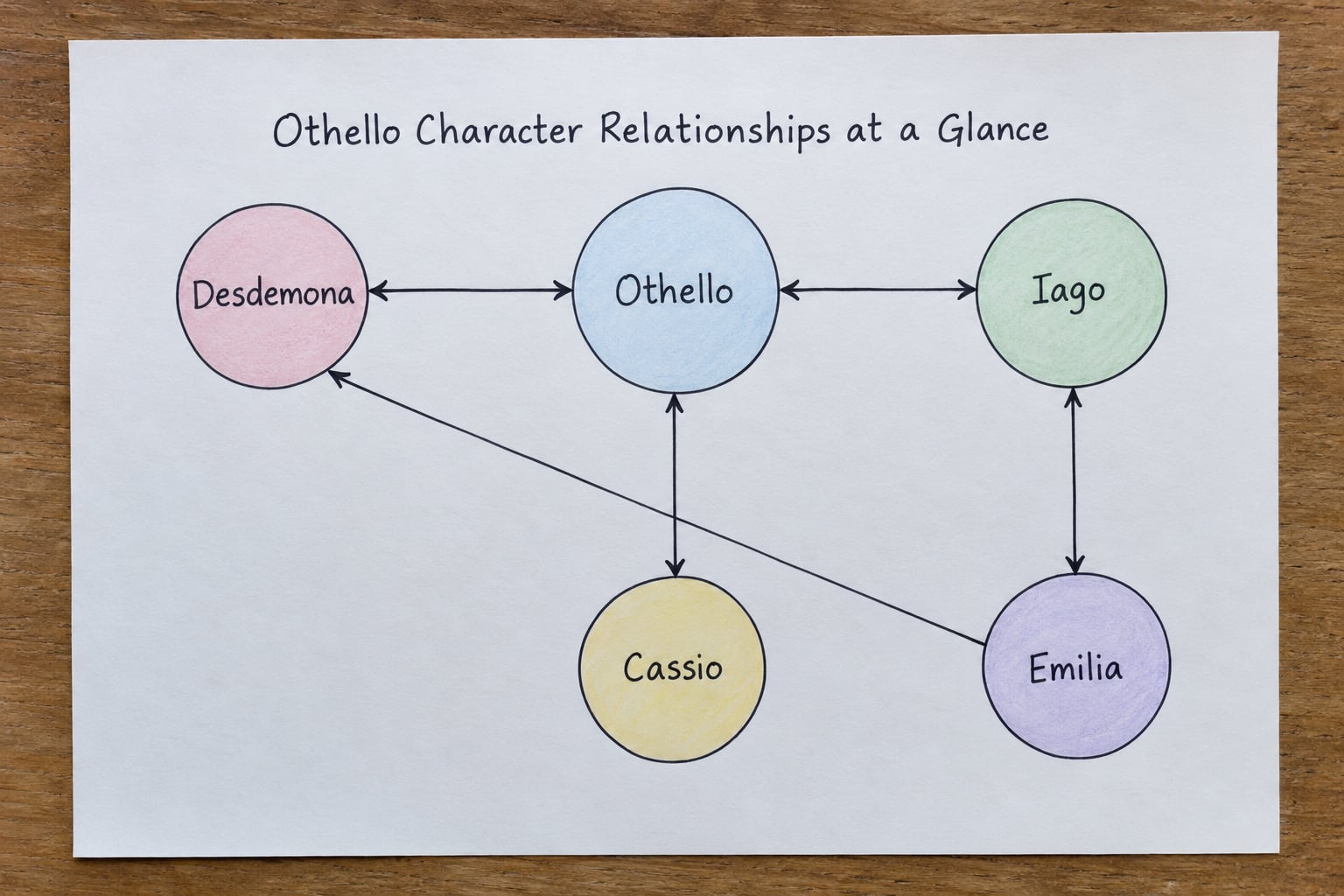
The plot turns on a small number of relationships, and each one is altered by Iago’s lies. This map shows who is allied, who is used and who is betrayed.
| Pair | Nature of the relationship | How it changes |
|---|---|---|
| Othello and Desdemona | Marriage based on admiration and affection, not on Venetian custom | Built on trust, then destroyed by suspicion; neither of them ever has a real conversation |
| Othello and Iago | Master and ensign who have served together on campaign; Iago calls him honest and claims credit for their shared past | Becomes a duel of appearances, ending in Othello’s murder of Iago |
| Iago and Emilia | Marriage in name; Iago ignores Emilia’s requests for a position and uses the handkerchief | Emilia stops believing Iago in Act 5 and Iago kills her to keep the secret |
| Desdemona and Emilia | Aunt and confidante; Desdemona talks freely to her | Their closeness is what gives Iago access to the handkerchief |
| Iago and Cassio | Colleagues; Iago was passed over when Cassio was promoted | Cassio’s demotion is Iago’s work, used to attack Othello |
| Iago and Roderigo | Roderigo pays Iago to court Desdemona | Iago takes Roderigo’s money, uses him, then kills him |
| Cassio and Bianca | A liaison, and a trap Iago builds using it | Cassio’s love for Bianca is genuine; Iago uses it as “proof” |
| Othello and the Venetian state | Ally and outsider; a Moor serving a state that depends on him and does not accept him | His position weakens when jealousy becomes a public matter in the Senate in Act 4 |
Two of these relationships carry more analytical weight than the rest. Desdemona and Emilia model two futures for women in the play: Emilia, who doubts her husband’s story but stays; Desdemona, who speaks freely and pays for it. Othello and Iago are also mirrors — both are outsiders who build their identity on how others see them, and Iago is what Othello might have become had anyone spoken to him honestly in Act 3.
Major Themes and How to Analyze Them
Jealousy is the play’s main theme, and every other theme runs alongside it. It is the engine of the plot, the cause of the deaths and the thing that turns a respected general into a murderer.
Jealousy: the green-eyed monster
Jealousy in Othello is presented as a force that corrodes the mind before it touches the body. Iago’s phrase “the green-eyed monster which doth mock the meat it feeds on” (Act 3, Scene 3) names it, and the play’s structure then shows Othello feeding it. Othello’s jealousy is not sudden: he is already insecure about his age, his rank, his race and his unfamiliarity with Venetian marriage customs, and Iago finds every one of those cracks.
How to analyse it: contrast Othello’s two great speeches, the Act 3 Scene 3 soliloquy beginning “It is not well I am found” and the Act 5 Scene 2 speech beginning “Speak of me as I am”, and show the change from a man reasoning towards a decision to a man describing a ruin.
Racial prejudice and otherness
Othello is repeatedly described through his colour, and Venice depends on him without fully accepting him. Brabantio calls the marriage a “witchcraft” in Act 1, Scene 1 and treats a Black husband as an explanation his daughter cannot possibly have reached for herself, and the Senate’s curiosity is about Othello’s origins rather than Desdemona’s choice. In Act 1, Scene 3 Desdemona’s own joking about the turban shows she is used to being the surprising thing in the room, and in Act 5, Scene 3 Lodovico is the one who notices how differently Othello behaves in front of a Venetian gentleman.
How to analyse it: argue that the play criticises Venice rather than Othello. Show how the same stereotypes turn out to apply to Iago, the trusted ensign of a Venetian family who plans to kill his own commander, so that the play’s final judgement falls on the society rather than the outsider. The early reading that Othello is a “noble Moor” whose tragedy is a failure of judgement works alongside a postcolonial reading that sees him as a man destroyed by how the state treats him, and both reward careful use of Lodovico’s Act 5 speech and Emilia’s Act 2 questioning of what men are worth.
Appearance versus reality
Nearly every main character is mistaken for something they are not. Iago presents himself as reliable and everyone accepts it, including Emilia; Roderigo is treated as a fool; Bianca is assumed to be a woman who costs Cassio nothing; and Othello is regarded as self-controlled until Desdemona’s handkerchief proves otherwise. The play’s title is part of the same pattern, since a Moor is an outsider’s label rather than a description of anything Othello does.
How to analyse it: use the play’s title. Othello is named for his race, and “Moor” is an outsider’s label rather than a description of what he does. Iago’s asides make the audience the only group with the full picture, which is also the engine of dramatic irony.
Deception and manipulation
Iago’s plot is the play’s real plot, and it is worth learning it as a sequence rather than a story. Step by step: he resents Cassio for being promoted over him and resents Othello for passing him over; he keeps Roderigo paying without telling him Desdemona is unavailable; he tells Roderigo that Desdemona is unfaithful; he tells Othello to make Cassio’s rank depend on Desdemona’s liking; he gets Emilia to hand over the handkerchief; he drops it where Desdemona will lose it and then “accidentally” picks it up; he makes Othello watch Cassio with Bianca; he describes Bianca as a whore who is robbing Cassio of his soul; he tells Othello that Desdemona’s bare admission of the loss of the handkerchief is proof; he urges Othello to work out a “valid” justification; and he concludes the plot by killing Roderigo, Montano and his own wife to cover his tracks.
How to analyse it: note that Iago never invents the handkerchief itself — he only supplies an interpretation. Every lie works because Othello wants it to be true.
Gender and the position of women
Desdemona is allowed to speak in public, to defend her marriage in a speech to the Senate about her reason for choosing Othello, and to talk freely with Emilia about her husband. What she cannot do is be believed once jealousy is in play. Emilia, who speaks bluntly and refuses to accept Iago’s story about the handkerchief, is killed. Bianca survives only because Iago needs her alive as cover for his own story about Cassio.
How to analyse it: a good short paragraph compares the Act 2 Scene 1 exchanges. Desdemona argues that women who marry for love of a man are wise in a different way from women who marry for a man’s wits, and Emilia complains that women are left to carry the shame of what their husbands do. Both women talk about their situation with complete clarity, and only one of them is heard.
Trust, betrayal and loyalty
The play tests whether trust can survive knowledge. Othello’s trust in Desdemona is destroyed by a story told by someone who has never checked it; Emilia’s trust in Iago survives until the moment she has proof; Roderigo’s loyalty pays for Iago’s silence with his life; and Montano’s trust is misplaced when Iago claims he speaks with no right.
How to analyse it: argue that the play defines trust as verified rather than felt. Every claim about Desdemona in the play is second-hand, and Emilia is the only person who ever tries to verify one, which is why her death is the pivot of the ending. Emilia’s insistence that her husband cannot be trusted once the evidence contradicts him shows Shakespeare testing honesty against familiarity.
Revenge and honour
Iago’s motives. He offers two explanations in Act 1, Scene 1 and neither convinces anyone, including himself: that Othello passed him over for Cassio, and that a man once gave him a slight he has never been able to put down. By Act 5 he cannot produce a reason at all, which makes him the play’s most frightening figure. His envy did not need a cause, only somewhere to land.
How to analyse it: compare Othello’s stated reason for going to Cyprus, which is military service, with Iago’s motive, which is revenge with no stated end. Revenge stops only when its target is dead; jealousy works from the inside and Othello is the one who dies of it. Ask whether Othello is more to blame for his jealousy or Iago for supplying it, and the answer is usually that the play needs both.
Love and its limits
Othello and Desdemona genuinely love each other, and the play never lets them say so at the moment it would matter. Othello’s love is founded on Desdemona’s response to the story of his life and on her boldness in choosing him; Desdemona’s is founded on admiration and on being an outsider alongside him. The tragedy is not that they stop loving each other, but that neither of them speaks to the other once talking is all that is left.
Important Symbols, Motifs, and Imagery
The play runs on repeated images, and identifying them quickly is one of the highest-yield things you can do in an extract question.
- The handkerchief. Desdemona loses it and Emilia picks it up, then hands it to her husband Iago without knowing what he will do with it. In Act 3, Scene 3 Othello tells Emilia that the cloth came from his father, who pressed it to his own lips and gave it to her as a keepsake. Iago turns that family object into the single proof of adultery, and the play’s central illusion depends on nobody else ever examining it.
- Eyes and sight. “Ocular proof” (Act 3, Scene 3) is the phrase Othello borrows, and Iago supplies it. It works because Othello’s sight is unreliable: in Act 1, Scene 3 he admits he could not read Desdemona’s face when she told him her father had died and he called her a dissembler. He trusts what he is shown rather than what he hears, which is exactly the weakness Iago is selling.
- The willow tree. Desdemona sings of willows in Act 4, Scene 3 as she prepares for death: “Make your bed in my rocky grave… My soul hath her content so shall the world.” Willows grow by water and are associated with forsaken women, and the song is the one moment in the play where she states her situation with complete clarity and no one believes her.
- Chains and yokes. Othello tells Iago in Act 1, Scene 1 that marriage makes a man a “yoke”, and the whole play shows him learning what that yoke costs. The bonds that matter are the ones nobody chooses: the marriage of Desdemona to a man Venice cannot quite accept, and the private oath Othello swears in Act 3, Scene 3 to act on evidence he has not checked.
- Animals. Emilia in Act 2, Scene 1 calls the men around her wolves, and Desdemona teases Othello in Act 1, Scene 3 with the ram, which she explains as a man who is ruled by instinct. By Act 5 Iago calls Desdemona “a baggage of venery” as he drowns her. Shakespeare keeps returning to animals to remind us that the characters’ reasoning is thinner than their self-image, and Iago, who calls himself the sensible one, uses animal language constantly.
- The turban. Desdemona arrives in the Senate in Act 1, Scene 3 with a handkerchief on her head and teases Othello about it, and he laughs warmly and tells her not to deceive him because he is not the sort of man who can be led by such a thing. The line plays as affection on stage and turns into the play’s worst omen, because Othello will be led by exactly that kind of thing.
- Red and blood. Othello’s account of the handkerchief in Act 3, Scene 3 involves his father pressing a bloodied cloth to his lips. From that point blood runs through the play: it marks the cloth as proof, it stains everything it is used to justify, and the last two acts are full of people dying while the characters keep calling it something other than murder.
What dropping the handkerchief means. It means Iago has engineered the play’s central illusion. The cloth is proof of nothing until Othello decides it is proof, and that decision converts a piece of cloth into the entire case against Desdemona.
Key Scenes to Know for Essays and Exams
You cannot annotate fifteen scenes, so learn six properly. These are the ones that come up in every question type, from theme to language to structure.
| Scene | What it reveals | Likely question |
|---|---|---|
| 1.3 (Othello’s backstory) | Othello’s eloquence and outsider status, Desdemona’s choice, Iago’s asides | How does Shakespeare present marriage and reputation? |
| 2.1 (the women on Cyprus) | The friendship between Desdemona and Emilia and their sharpest exchanges | How does Shakespeare present the position of women? |
| 3.3 (the handkerchief) | Iago’s manipulation, Othello’s jealousy, dramatic irony | How does Iago manipulate Othello? What is the significance of the handkerchief? |
| 4.3 (the willow song and the killing) | Desdemona’s clarity, Othello’s cruelty, Emilia’s arrival at the door | How does Shakespeare present love and violence? |
| 5.1 (Othello alone with his guilty purpose) | Othello’s borrowed language and the tragic rhythm of the final act | How does Shakespeare use language to show Othello’s character changing? |
| 5.2 (the bedroom, Emilia’s death and Othello’s speech) | Desdemona’s dignity, Othello’s self-justification, Iago’s motive | Why is Othello a tragic hero? How does Shakespeare explore race and otherness? |
Learn two quotations from each of those scenes. Six scenes and twelve quotations is a complete exam kit, and it is far better than thirty half-remembered lines from Act 2.
Famous Quotes and What They Mean
These are the lines that appear in revision sheets and model answers. Learn the short version of each one, and always be ready to explain what the word choice is doing.
“O, beware, my lord, of jealousy; It is the green-eyed monster which doth mock the meat it feeds on.”
Iago, Act 3, Scene 3. On the surface a warning, but Iago is talking Othello into his illness. He dresses the accusation as friendly advice, which is why examiners use this line to show manipulation working as apparent honesty.
“She loved me for my dangers, That my eyes had seen.”
Othello, Act 1, Scene 3. He explains his own marriage: Desdemona loved him for his hard life, not for his rank. It shows that the play’s central relationship begins as free choice, which makes its destruction more painful.
“If she be false, O, then heaven mocks itself! I’ll not believe’t.”
Othello, Act 3, Scene 3. He wants Desdemona innocent so that his own judgement of her is not absurd. This is the moment he chooses to believe, before the handkerchief makes the choice for him.
“She must die, else she will betray more men.”
Iago, Act 3, Scene 3, aside. The audience hears the decision to murder before Othello has made it. The only thing that changes after this point is who pulls the trigger, which is the point of the asides.
“Good night, good night, parting is such sweet sorrow, I shall say good night to it.”
Desdemona, Act 4, Scene 3. A courtly song turned into a farewell, sung by a woman who already suspects she will not see the morning. Her calm is the clearest evidence in the play that she is innocent, and it makes Othello’s long self-explanation in Act 5 almost unbearable to read.
“O thou dull Moor! that handkerchief thou speak’st of I found by fortune and did give my husband.”
Emilia, Act 5, Scene 2. Her last speech is the play’s truth-telling, and Iago kills her moments later. Use it in essays on integrity, on Emilia’s character, or as proof that the handkerchief never carried any meaning but the one Iago gave it.
“Speak of me as I am: nothing extenuate, Nor set down aught in malice: then must you speak Of one that loved not wisely but too well.”
Othello, Act 5, Scene 2. He asks to be judged honestly rather than generously, which is the last time he controls how he is seen. Shakespeare gives the tragic hero his own defence and makes it an admission: the “too well” is where the flaw lived.
How to Write an Othello Analysis Essay
A good Othello essay is built from four links: a quotation, what the words do, how they connect to the theme, and a link back to the question. Students lose marks at the third and fourth link, not the first.
Step 1: write a thesis that answers the actual question
If the question is about “the consequences of jealousy”, your thesis needs to say what jealousy causes in this play and how Shakespeare shows it. “Jealousy is an important theme in Othello” is a topic sentence, not a thesis. Try: “Shakespeare presents jealousy not as a sudden passion but as a series of choices, and Iago’s manipulation matters because Othello is willing to believe him at every stage.”
Step 2: choose evidence that does a job
Pick two or three scenes, not six. Use one quotation to establish the theme, one to show it developing, and one to show its consequence. If you cannot say in a sentence what a quotation proves, drop it.
Step 3: embed short quotations and analyse the words
Quote five to eight words and give the reference in brackets (3.3.365). Then write about the language, not the paraphrase. “Othello describes the handkerchief as ‘ocular proof’ — the word is visual, and he is a man who cannot see clearly.” The verb and the noun are doing work here; name them.
Step 4: link every quotation to the point
End each sentence of analysis with “this shows”, “which suggests”, or “therefore”. That is not padding; it is the sentence that turns description into analysis and earns the marks.
Questions to Put in an Othello Study Guide for Students
Use these for revision, class discussion or a self-test, and try to answer them without looking at your notes first.
- Why is Othello considered a tragedy? What is his tragic flaw?
- How does Shakespeare use Othello’s backstory in Act 1, Scene 3 to set up the ending?
- Why does Othello never ask Desdemona a direct question about her handkerchief?
- How does Iago manipulate Othello? Identify each step and its evidence.
- What is the significance of the handkerchief in Othello?
- How does Shakespeare present race and otherness in the play?
- Compare Desdemona and Emilia. How are they treated by the men around them?
- How does Shakespeare use the willow tree and the animal imagery in Act 4?
- Why is Act 3, Scene 3 the turning point of the play?
- Who is responsible for Othello’s tragedy, and how would you argue that in an essay?
- How does Iago’s motivation change or stay the same between Act 1 and Act 5?
- How does Shakespeare use dramatic irony in the asides?
- What does Othello’s final speech, “Speak of me as I am”, reveal about how he understands himself?
- How does Shakespeare use soliloquy to let us watch Othello lose control?
- Which scene would you choose to perform, and why would you cut the rest?
Othello Act-by-Act Reading Roadmap

Five acts and fifteen scenes, which is a long evening’s reading. Pace it this way and the play stops feeling like a wall of text.
| Act | Location | Turning point | Dramatic function |
|---|---|---|---|
| Act 1 | Venice | Othello and Desdemona appear before the Senate | Exposition: the marriage is approved and Iago declares his intent |
| Act 2 | Cyprus | Iago proposes the affair story to Roderigo | Rising action: the audience learns the plan before Othello does |
| Act 3 | Cyprus | The handkerchief, and Othello’s “It is not well I am found” | Climax: jealousy becomes a decision, and the trap closes on Desdemona |
| Act 4 | Cyprus | Roderigo’s murder and the killing of Cassio | Falling action: Iago achieves his ends and Desdemona is doomed |
| Act 5 | Cyprus | Emilia’s last speech reveals the truth | Resolution: recognition, deaths, and the closing debate over the general’s reputation |
Read Act 1 and Act 2 in one sitting and only note the main events; do not annotate. Read Act 3, Scene 3 properly with a pencil. Then read Act 5, Scene 2 properly, because it contains the answer to nearly every theme question in the play.
Common Mistakes Students Make
Most lost marks come from six habits, and none of them are about understanding the plot.
- Calling Othello simply a jealous man. He is a commander with real self-control who is steadily told that his wife chose him against her better judgement and that his life is worthless. Ask what Iago exploits, not just what Othello feels.
- Treating Iago as honest. The play’s asides make him the most reliable narrator and the least reliable man. Say “Iago claims to be honest” and the analysis gets sharper immediately.
- Saying Desdemona lied. She says in Act 5 that she lost the handkerchief, which is true, and Emilia confirms it in her last speech. Desdemona’s whole aim in that scene is to protect Othello’s reputation, and Emilia says so before Iago kills her.
- Summarising instead of analysing. “Iago makes Othello jealous” is the plot. “Iago’s asides tell us his plan before Othello has any suspicion, so we watch the audience become complicit in it” is analysis.
- Dropping the context. One sentence on Venice, the Ottoman threat and how a Moor was regarded in Elizabethan England will lift an essay from generic to specific.
- Quoting and moving on. A quotation with no comment is a decoration. If you cannot spend two sentences on a line’s word choice, cut the quotation and use your space.
How to Study Othello Effectively
Most students revise Othello by re-reading, which is the slowest possible way in. This plan takes about two weeks and covers the whole play.
- Day 1-2: the spine. Read the plot summary above and then Act 1 and Act 2 straight through. Write the fifteen scene headings in order with one line under each.
- Day 3-4: characters. Fill in the character table by hand. For each person, write one thing they want and one thing that stops them. This single exercise solves the “who is who” problem.
- Day 5-6: annotate three scenes. Mark Act 3 Scene 3, Act 4 Scene 3 and Act 5 Scene 2. Highlight repeated images, note every aside by Iago, and mark each reversal.
- Day 7-8: theme grouping. Sort your quotations into piles: jealousy, race, appearance versus reality, gender, deception. Notice that most quotes fit more than one pile.
- Day 9-10: write two paragraphs. One close reading of a six-line speech, one comparison of Othello in Acts 3 and 5. Time them.
- Day 11-12: retrieval questions. Answer the question set above with the book closed, then check what you missed.
- Final two days: past papers. Do one full essay under timed conditions, mark it against the mark scheme, and revise only the paragraphs that lost marks.
Glossary, because the language is the barrier for most students: nay means no or, more often, a mild refusal; tush means silence; anecdote means a story or an amusing tale; ague is a fever or a chill; hallowed means holy or consecrated; venery means hunting, and in this play it also means sex; bespeak means to speak for or arrange; discreet means careful and aware of what others can see. If a line stops you, read the next line first; Shakespeare frequently delays the verb.
For visual learners, watch one production and one filmed version. Laurence Olivier’s 1965 film and the 1995 film starring Lawrence Fishburne are the two most studied, and comparing them with the text shows you which lines directors cut and why.
Frequently Asked Questions
How long should I study Othello before an exam?
About two weeks of focused revision is enough for most A Level and IB papers, provided you start early. Spend the first week learning the plot spine and the characters, the second on annotating the six key scenes and writing timed paragraphs. If you have only four days, learn Act 3 Scene 3 and Act 5 Scene 2 properly and skim everything else for plot only.
What is the hardest part of Othello study and analysis?
The language is usually the first barrier, followed by losing track of who is loyal to whom once Bianca and Roderigo appear. Solve both by reading with a character sheet beside you, marking every aside, and writing one line per scene. The analytical barrier comes later, when students describe instead of explaining what a quotation proves.
Is Othello considered a racist play, and how should I write about that?
Othello contains overt racial stereotypes, and the play presents them as Venetian prejudice rather than Shakespeare’s own view. Brabantio’s insistence that his daughter could not have chosen a Black husband willingly, and Lodovico’s noticing that Othello changes his manner between one Venetian and another, both come early. Write that the play criticises the society, then show that Iago, the trusted Venetian, is its most violent bigot.
What is the central message of Othello without simplifying it?
Othello argues that jealousy unchecked destroys the person who feels it as surely as the person it is aimed at, and that a society which treats people as outsiders creates the conditions for it. Iago’s envy, Venetian prejudice against a Moor and Desdemona’s powerlessness all feed the same outcome, so the play’s message is about how people fail to verify what they are told.
Should I memorize famous quotations for an Othello exam?
Memorise twelve quotations, not thirty. Choose two each from Act 1 Scene 3, Act 2 Scene 1, Act 3 Scene 3, Act 4 Scene 3 and Act 5 Scene 2, and know what each one is doing rather than only the words. If you can explain a line’s word choice from memory, you can adapt it to almost any prompt on jealousy, race or deception.
How can I compare Othello and Iago when writing an essay?
Compare them as mirrors first: both are outsiders who build their identity on how others see them, and Iago is the Othello who never trusted anyone. Then compare their methods, since Iago works indirectly with rumour while Othello acts directly on belief. A third point is motive, where Iago’s revenge has no stated end and Othello’s jealousy has no cause he can name.
Conclusion: What to Review First
If you are short on time, review in this order. First, get the fifteen scenes in order with the turning points marked, because every question assumes you know the plot. Second, learn the characters’ motives rather than their adjectives: what Othello wants, what Iago wants, what Emilia refuses to do.
Third, work through the six key scenes with two quotations each, and be able to say what the word choice is doing. Finally, write one timed paragraph on a theme question, since that is the difference between knowing the play and being able to answer for it.
This Othello study guide for students is built as a revision sequence: the tables, the character map and the question bank are all meant to be used in order. Do the plot, then the characters, then the quotations, and the play stops feeling like a memory test and starts reading like a story about a man who trusted the wrong voice.