
The Harlem Renaissance ran roughly 1918 to 1937, centered on Harlem, New York, and the novels set during it follow Black migrants, artists and hustlers trying to build lives in a city that had never planned to hold them. If you want novels set during the Harlem Renaissance, start with Claude McKay’s Home to Harlem (1928), Wallace Thurman’s Canewell (1923) and George S. Schuyler’s Black No More (1931) — a tailor’s shop, a boardinghouse and a satire of racial passing, all within about a decade of each other.
This list of 10 is deliberately mixed about one thing. Five books put you physically in Harlem or in Black America during those years. The other five were written decades later by authors whose characters carry the era’s arguments into the present, and they are included because they are where most readers actually meet this literature. I’ve flagged which is which in every section, so you don’t pick up Go Tell It on the Mountain expecting a 1920s street scene and get a 1950s Harlem church instead.
Five to read first, if that’s all you have time for:
- Home to Harlem — Claude McKay (1928) — a working tailor’s marriage, told in plain, sturdy prose.
- Canewell — Wallace Thurman (1923) — a Harlem boardinghouse where the residents argue about politics, art and rent.
- Black No More — George S. Schuyler (1931) — a sharp comic novel about a man who literally turns white and discovers he has joined the wrong club.
- Mumbo Jumbo — Zora Neale Hurston (1938) — a satire of a new Black religion colliding with white money, set in a fictional Southern town.
- Song of Solomon — Toni Morrison (1977) — the search for a father and a name, moving between the 1920s and the 1950s.
Table of Contents
- Novels Set During the Harlem Renaissance at a Glance
- 1. Home to Harlem by Claude McKay (1928)
- 2. Canewell by Wallace Thurman (1923)
- 3. Jazz by Langston Hughes, Written 1927–28 and Published 2022
- 4. Strong Men by Wallace Thurman (1936)
- 5. Black No More by George S. Schuyler (1931)
- 6. Mumbo Jumbo by Zora Neale Hurston (1938)
- 7. One Left-Handed Black by William Henry Smith (1929)
- 8. Go Tell It on the Mountain by James Baldwin (1953)
- 9. Invisible Man by Ralph Ellison (1952)
- 10. Song of Solomon by Toni Morrison (1977)
- Reading Home to Harlem Among Novels Set During the Harlem Renaissance
- Frequently Asked Questions
- What years are considered the Harlem Renaissance?
- Which books on this list are actually set in Harlem?
- What is the best novel to read first for a student new to the Harlem Renaissance?
- How can a teacher introduce these novels without making the lesson only about racism?
- How do Home to Harlem, Canewell and Jazz differ in style and subject?
- Are Harlem Renaissance novels appropriate for older middle-school readers?
- Where to Begin: Read Home to Harlem First
Novels Set During the Harlem Renaissance at a Glance
| Novel | Author | Published | Setting | Central context | Why read it |
|---|---|---|---|---|---|
| Canewell | Wallace Thurman | 1923 | Harlem boardinghouse | Artists vs. political organizers in the early 1920s | The shortest and funniest entry point |
| Home to Harlem | Claude McKay | 1928 | Harlem, 133rd Street | Great Migration, working-class neighborhood life | Plain prose, real place, real stakes |
| One Left-Handed Black | William Henry Smith | 1929 | Harlem | Intellectual ambition and social climbing | Rare find; rewards the curious reader |
| Jazz | Langston Hughes | Written 1927–28, published 2022 | Harlem | Jazz Age nightlife and fractured family | The experimental one; prose that moves like music |
| Black No More | George S. Schuyler | 1931 | American South | Race as a costume industry | The funniest and meanest satire on the list |
| Strong Men | Wallace Thurman | 1936 | Harlem | Depression-era politics vs. money | The late-career, harder-edged Thurman |
| Mumbo Jumbo | Zora Neale Hurston | 1938 | Fictional town of Orchard | Black spiritualism vs. commercial exploitation | Genre-bending; not Harlem, still essential |
| Go Tell It on the Mountain | James Baldwin | 1953 | Harlem and the rural South | The era’s afterlife in a preacher’s son | Short, furious, the best on religion and inheritance |
| Invisible Man | Ralph Ellison | 1952 | Harlem, then the American South | Communism, race organizations, visibility | Big, ambitious, genuinely about 1930s Harlem |
| Song of Solomon | Toni Morrison | 1977 | Several cities, 1920s to 1960s | Migration, legacy, the Black family archive | The fullest account of what the 1920s handed on |
1. Home to Harlem by Claude McKay (1928)
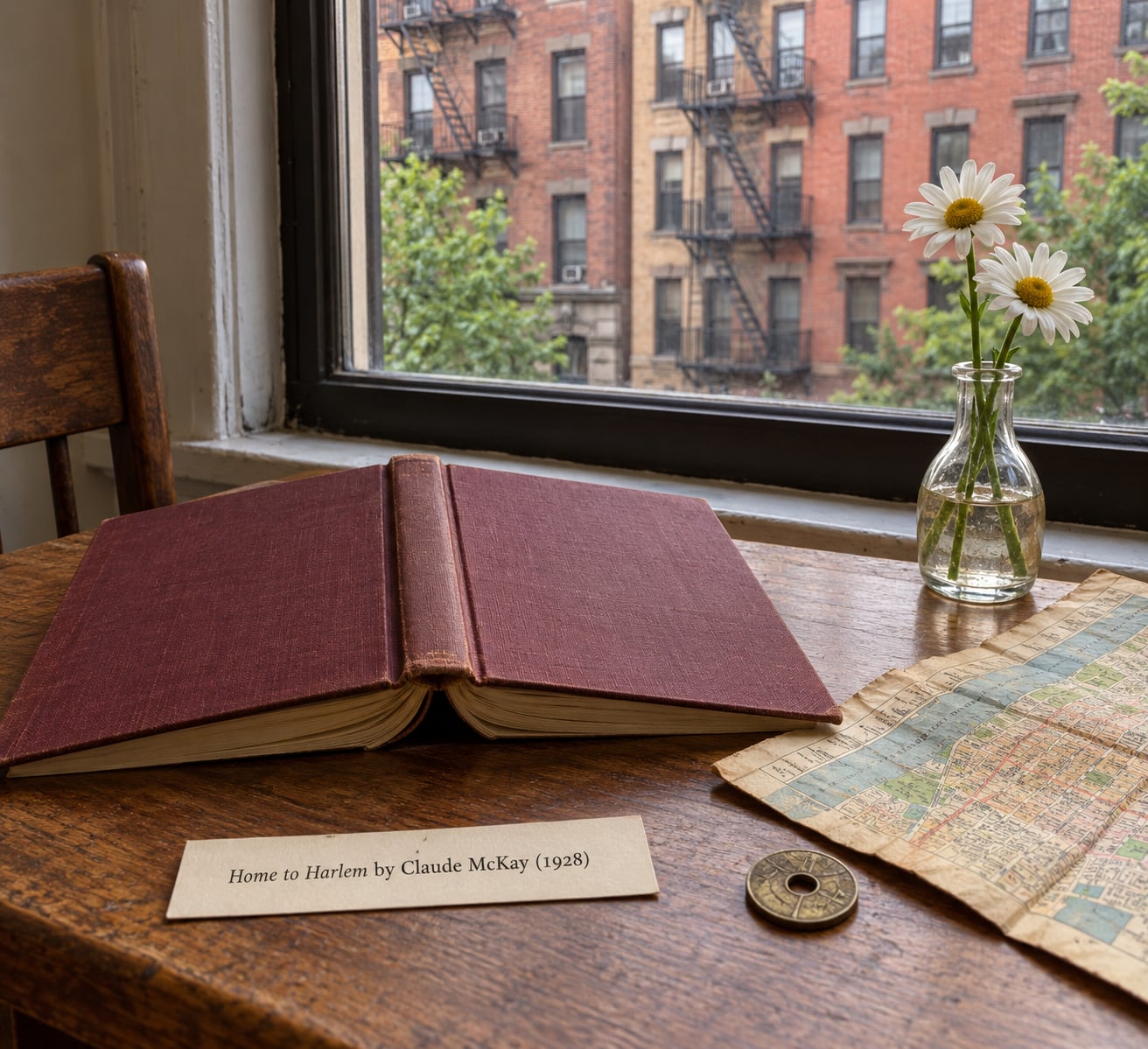
Home to Harlem is the book most people should open first, and the title is sometimes misattributed to Langston Hughes, who had no hand in it. Claude McKay wrote it in 1928, and it concerns Dane Carpenter, a Harlem tailor of partly West Indian background whose marriage to Velma comes apart while he is at work in the neighborhood.
What makes it work is that McKay is not writing about a movement. He is writing about rent, work, and what a man’s pride costs him when he leaves one life for another in the same four square blocks. Velma is not a villain; she is a person with her own reasons, and the novel refuses to make the marriage simple.
The backdrop is the Great Migration — the movement of Black families out of the South into northern cities — and the New Negro readership McKay wrote for. Read it for the streets, then read it again for how carefully he keeps the political conversations of Harlem just offstage, audible in the background.
2. Canewell by Wallace Thurman (1923)
Canewell is the first novel on this list and the least known, which is a shame. Wallace Thurman wrote it while he was very young and very broke, and it takes place almost entirely inside a Harlem boardinghouse where the residents cannot agree on anything.
The residents include Redstone, a doctor with strong political convictions, and Tchemist, who is equally certain and equally certain he’s right. Thurman’s real target is the reformers who arrived expecting young Black artists to be grateful and politically obedient in return for publicity. Guy Haplin, the artist in the middle, would rather paint than attend meetings about the race.
It is short, it is funny, and it does to the New Negro movement what Black No More does to white supremacy, eight years earlier and with better jokes. For a first Harlem Renaissance novel, it is hard to beat.
3. Jazz by Langston Hughes, Written 1927–28 and Published 2022
A note before you start: this is not a 1928 novel. Hughes drafted it in the late 1920s and set it aside, and it was not published until 2022. So you are reading a period manuscript at a remove, not a book that circulated in the 1920s.
The story follows Trueby Hawkins, a young man who arrives in Harlem looking for his biological father and finds a city full of people who were shaped by the same absences he is. The women of the book — including Rose, who moves through Harlem’s nightlife with real authority — are more sharply drawn than most male characters in period fiction of this kind.
The prose is the real event. It is fragmentary, rhythmic, and deliberately hard to follow, closer to a long poem than a novel. If you have been intimidated by Cane or by Wallace Thurman’s prose, start with this instead and work up.
4. Strong Men by Wallace Thurman (1936)
Strong Men is Thurman eight years past Canewell, with the jokes turned down and the ambition turned up. It follows two friends in Harlem: Webb, who is politically active and convinced that organizing is the answer, and Stokes, who wants to make money and considers the movement largely a way to meet the right people.
That contrast is the whole book. Webb’s sincerity is real and so is his blindness; Stokes’s pragmatism is realistic and so is his moral cowardice. Thurman refuses to let either one be the novel’s verdict on Black ambition in the 1930s.
The Depression has changed Harlem by the time this novel opens — rent is up, work is scarce, and the nightclub scene has a harder edge. For readers moving from Canewell to Strong Men, the difference in tone is the reward: same city, ten years older, much less optimistic.
5. Black No More by George S. Schuyler (1931)
Black No More begins with a crooked chemist and an even more crooked invention: a treatment that turns any Black person white, permanently, for a fee. Julian Effingham, an angry young man in the American South, is the first volunteer.
What follows is genuinely a comedy, and the jokes land because Schuyler wrote them at the top of his game. White Julian is received, celebrated, adopted by men who thought a Black man like him was a tool. He ends up inside the Ku Klux Klan under a false identity and discovers that the organization he joined to fight works perfectly fine without him.
Two cautions. First, it is not set in Harlem — it happens mainly in and around Atlanta. Second, Schuyler uses the era’s slang and racial caricature heavily, which modern readers can find wearying. Read it as a weapon aimed at white supremacy rather than a documentary of Black speech.
6. Mumbo Jumbo by Zora Neale Hurston (1938)
Mumbo Jumbo is set in a fictional town called Orchard and has almost nothing to do with Harlem, which is why so many readers skip it. It is still worth the detour. Hurston’s premise is that a Black tailor, John Henry, invents a spiritual movement in his shop; white interests immediately recognize a saleable product and begin packaging it, hiring performers and staging the rituals for paying crowds.
The satire lands on the commodification of Black culture before anyone had the language for it. Hurston wrote the book after returning from fieldwork in the Caribbean and it shows, in her ear for vernacular speech and in the confidence that lets her let characters talk past each other.
Readers usually pick it up next to Harlem Renaissance fiction because it is from the same conversation, not the same neighborhood. If you read it that way, you will notice something useful: the movement was already being packaged while its members were still living it.
7. One Left-Handed Black by William Henry Smith (1929)
This is the hardest book on the list to get hold of, and that is a large part of its appeal. William Henry Smith’s 1929 novel follows a Black man in Harlem whose intellectual ambitions and private resentments pull in opposite directions as the neighborhood changes around him and the wider world starts paying attention to people like him.
The title points at the era’s habit of marking Blackness as a physical fact — the hand, the profile, the skin — and the novel is interested in what happens when a man tries to convert that mark into status instead of hiding it.
If you have read the six or seven famous titles and feel you have exhausted the canon, this is where the reading gets interesting again. Expect thin character development by modern standards and a dated feel in the prose; expect also a novel that was doing something specific with Harlem ambition that the better-known books do not.
8. Go Tell It on the Mountain by James Baldwin (1953)
Go Tell It on the Mountain is not set during the Harlem Renaissance. It was published more than fifteen years after the era’s end, and it matters here for a different reason: it is the clearest account of what those years handed to the next generation.
The structure is a frame and a flashback. You meet John as a young preacher in Harlem, sick, broke and certain he has failed, and then the book drops back to his seventeenth birthday in 1920s Harlem and then further to a childhood in the rural South.
The people he is caught between are Deborah, his frightened and brutal stepmother, Liz, his mother who wants more for him, and John, his stepfather, a man who buys a church and a dignity neither of them was given. Baldwin uses the mountain and the river in the title as a plain metaphor and still refuses to make it simple. If your interest is Harlem in the 1920s, read Home to Harlem first and this second.
9. Invisible Man by Ralph Ellison (1952)
Invisible Man is a 1952 novel that spends real time in 1930s Harlem, and readers looking for novels set during the Harlem Renaissance sometimes skip it for that reason. It deserves better than a skip.
The narrator arrives in Harlem with a college degree and a naive plan: he will become a teacher, then a writer, then somehow visible. Instead he works a job sacking tobacco for Mr. Emerson, an old man who believes in him, and then gets absorbed into the Brotherhood, a Communist organization that offers him exactly the visibility he wanted and drains it out of him in the process.
Ellison’s Harlem is crowded, argumentative and full of competing theories about what Black people should do. The novel’s central question — whether political visibility can coexist with intellectual credibility and a private self — is exactly the argument running through Thurman’s Strong Men and Hughes’s Jazz. It is a hard book, and the famous ending will frustrate some readers on a first pass. Give it a second one.
10. Song of Solomon by Toni Morrison (1977)
Macon Dead, called Milkman, grows up in a Northern Black community that has money, migration and a set of private rules nobody can explain to him. What he has never been told is who his father was, and finding out takes him backwards through Black communities shaped by the 1920s and 1930s and forward again to a present he is not sure he wants.
The book moves nonlinearly, and Morrison is at her most characteristic when doing it: a childhood memory, a fragment of old song, a name overheard on a street, then a hard cut to a different city and a different decade. The pieces assemble into an account of how a family inherits and misinforms itself.
For anyone studying the long afterlife of the Harlem Renaissance, this is the fullest version available. It asks what the twenties actually left behind, not in speeches but in habits of secrecy, naming and self-invention that run for three generations.
Reading Home to Harlem Among Novels Set During the Harlem Renaissance
If you only read one book here, read Home to Harlem. It is under two hundred pages, the language gives you no trouble at all, and it puts Harlem on a specific street with working people in it rather than at a cotillion or a nightclub door.
From there, the practical split is simple. Books set in Harlem or in Black America during the era are Canewell, Home to Harlem, One Left-Handed Black, Jazz, Strong Men and the southern portions of Black No More. Books written later about that world are Go Tell It on the Mountain, Invisible Man, Mumbo Jumbo (which is neither, strictly) and Song of Solomon.
Once you have finished McKay, the most useful second read is Canewell — Thurman in 1923 is funny where McKay is steady. Save Strong Men and Black No More for when you want an argument with the first book instead of a companion to it.
Frequently Asked Questions
What years are considered the Harlem Renaissance?
Historians usually place the Harlem Renaissance between about 1918 and 1937, though some stretch the end into the mid-1930s when the Depression cooled the movement’s optimism. It is a label for a cultural moment rather than a single event. The term its own participants preferred was the New Negro movement, coined by Alain Locke.
Which books on this list are actually set in Harlem?
Canewell, Home to Harlem, One Left-Handed Black, Jazz and Strong Men are set in Harlem. Black No More happens mainly in and around Atlanta, and Mumbo Jumbo is set in a fictional Southern town called Orchard. Go Tell It on the Mountain, Invisible Man and Song of Solomon were all written decades later and look back at the world those books created.
What is the best novel to read first for a student new to the Harlem Renaissance?
Start with Home to Harlem by Claude McKay. It is short, the prose is plain, and Dane Carpenter’s tailoring shop gives you Harlem as a working neighborhood instead of a tourist image. Pair it with Canewell next, which is also short and shows the political arguments running through the artists of the period.
How can a teacher introduce these novels without making the lesson only about racism?
Open with a scene rather than a lecture. Read an opening chapter aloud, ask what the street, the job and the rent tell students about a character’s options, then supply the Great Migration as background. Put Hurston’s Mumbo Jumbo or a Thurman novel beside it so the unit also covers art, money, friendship and ambition.
How do Home to Harlem, Canewell and Jazz differ in style and subject?
Home to Harlem is a realistic novel about one man’s marriage and ambitions on a Harlem street. Canewell is a boardinghouse satire built on residents arguing with each other. Jazz, which Langston Hughes drafted in the late 1920s but left unpublished until 2022, is the experimental one: fragmentary, jazz-inflected prose and a narrator searching for his father.
Are Harlem Renaissance novels appropriate for older middle-school readers?
For most teen readers, Home to Harlem, Canewell and Strong Men work without warning. Give a heads-up for Black No More, which uses period slang and heavy racial caricature, and for Invisible Man, which includes a sexual assault scene that unsettles some classrooms. Check Mumbo Jumbo’s satire of religion against your group’s comfort level before assigning it.
Where to Begin: Read Home to Harlem First
Open with Home to Harlem. Claude McKay’s 1928 novel is short, readable, and takes place on an actual street with working people in it, which makes every historical question you have later easier to answer.
Move from there to Canewell or Jazz depending on whether you want argument or music. Once you have those three, pick up Strong Men, Black No More and Mumbo Jumbo to see three sharply different answers to the same question about what Black ambition costs. Then move forward to Baldwin, Ellison and Morrison, who take that cost and carry it into the next fifty years.
If you are still deciding, the simplest way into novels set during the Harlem Renaissance is to read one book set on a Harlem street and one book that argues with it. The two together teach you more than a full syllabus, and you will finish the 2026 guide with a sense of which period each author is actually writing from.