
The mistakes to avoid when writing a college application essay are mostly about restraint: answer the prompt you were given, stay in your own voice, show one specific moment instead of listing credentials, and cut every sentence that exists only to sound impressive. Most applicants lose their file in the first two paragraphs, before a reader ever gets to the good part.
That matters because of how the essay is actually read. Officers are working through files at speed, in the order they arrive, and the opening lines decide whether the rest gets attention. A wrong school name, a repeated prompt, a paragraph of familiar phrasing, or an unproofed typo can each turn a strong file into a skimmed one, and a skimmed essay is not neutral. It reads as an application from someone who did not care enough to try.
Our advice below pairs every mistake with the fastest concrete fix, and most of them take less than an hour if you catch them early. The order also works as a revision schedule, so you can run it top to bottom on a draft that already exists.
Table of Contents
- 12 Mistakes to Avoid When Writing a College Application Essay at a Glance
- 1. Writing About a Generic Personal Trait
- Turning a trait into a scene
- 2. Retelling a Life Story Without Reflection
- 3. Trying to Sound Perfectly Adult
- 4. Using Cliches and Famous Quotes
- 5. Listing Achievements Instead of Showing Character
- 6. Choosing a Topic That Cannot Support a Full Essay
- 7. Writing the Introduction and Conclusion Before the Story
- 8. Making the Entire Essay About One Perfect Moment
- 9. Ignoring the Prompt
- 10. Submitting a Draft That Has Not Been Revised
- 11. Overexplaining What the Admissions Reader Should Feel
- 12. Ending With a Generic-sounding Summary
- Frequently Asked Questions
- What not to start your college essay with?
- Can I write a 3000 word essay in one day?
- Can a bad college essay negatively affect my application?
- What should I avoid in my Common App personal statement?
- What do admissions officers look for in a Common App essay?
- Conclusion
12 Mistakes to Avoid When Writing a College Application Essay at a Glance
| Mistake | What it looks like | Why it weakens the application | Fastest fix |
|---|---|---|---|
| Generic personal trait | “I am a curious and resilient person” | Interchangeable with thousands of other applicants | Replace the claim with one scene that proves it |
| Story with no reflection | A chronological account that ends where it started | Reads as narration, not thought | Add the moment something changed and why |
| Overly adult tone | Inflated vocabulary, stiff sentence structure | Hides the person actually writing | Write it aloud and use the words you would say |
| Cliches and famous quotes | “Define yourself,” “follow your dreams” | Anyone could have written it | Swap the quote for a detail only you would notice |
| Achievement list | A resume paragraph in prose form | Duplicates information already in the application | Keep one accomplishment and explore why it mattered |
| Topic too thin for the word limit | Padded to reach 650 words | Filler is visible to a professional reader | Test for conflict before you commit to it |
| Intro and conclusion first | Five drafts of an opening line, no story | Produces suspense-manipulating, generic openings | Draft the middle, then write the edges |
| One perfect moment, no context | 600 words about a single afternoon | Feels narrow or self-congratulatory | Widen to what came before and after |
| Prompt ignored | A prewritten personal statement pasted in unchanged | The one piece of evidence about your fit is missing | Underline every requirement in the prompt first |
| No real revision | One proof pass checking spelling only | Structure and voice problems survive to submission | Run four separate passes, in order |
| Overexplaining the lesson | “This experience taught me the value of perseverance” | Tells the reader what to feel | Cut the explanation and let the detail carry it |
| Generic conclusion | A restated theme, or “I will bring this energy” | Ends on abstraction instead of insight | Return to the specific image or idea |
1. Writing About a Generic Personal Trait
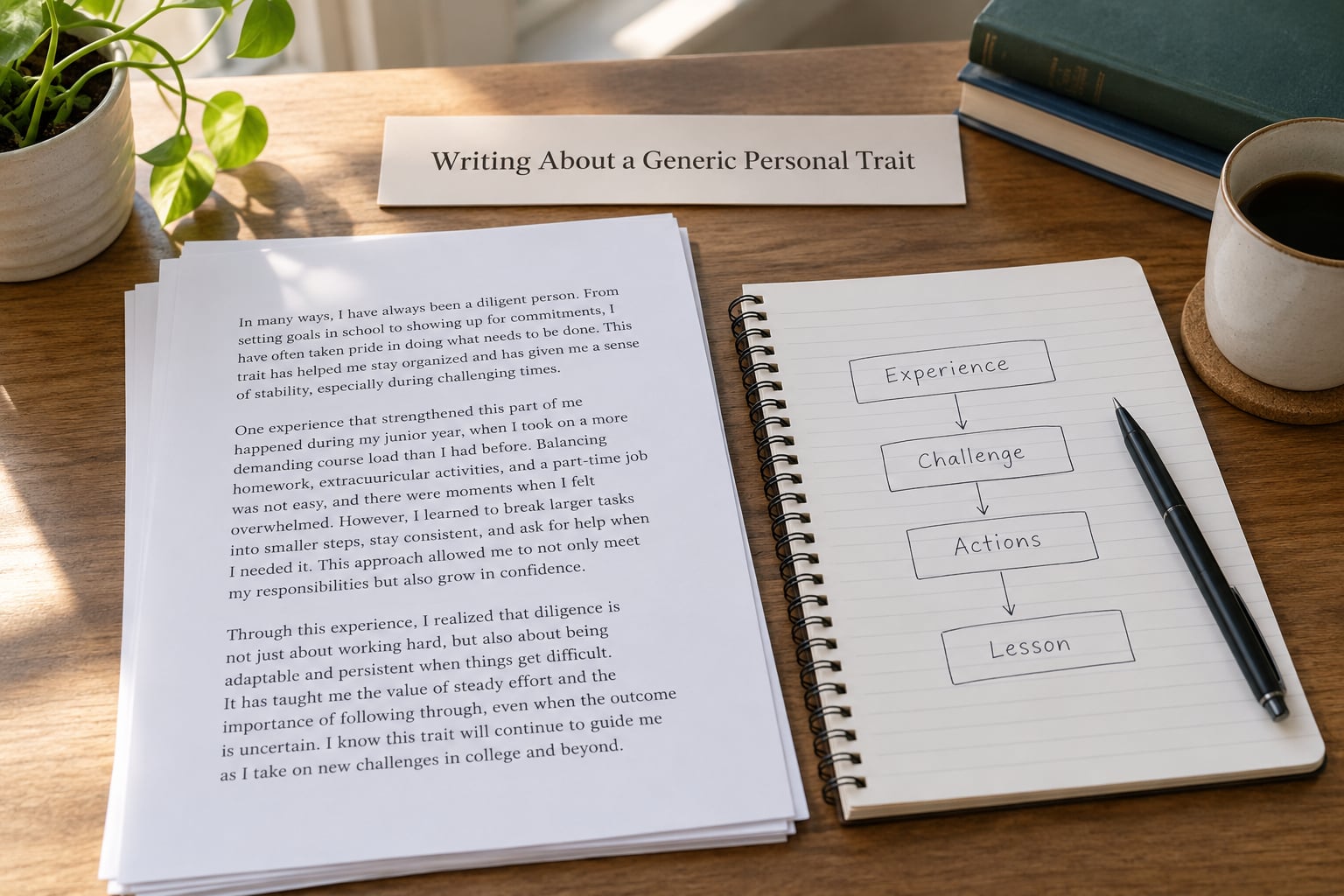
Traits like curiosity, resilience, hard work, and kindness are not interesting subjects. They are conclusions, and admissions readers have already reached them about most of the applicants in front of them. A draft that opens by naming one of them has spent its best lines on an assertion it cannot prove.
Turning a trait into a scene
Keep the trait, but push it down into a specific moment. Weak: “My love of learning has always driven me.” Stronger: “My grandmother let me help her grade the Sunday quizzes, and I got every one wrong for a month because I kept arguing with the answer key.”
The second version still shows curiosity, but now you can see it happening instead of taking a claim on trust. That is the whole move.
2. Retelling a Life Story Without Reflection
Most drafts are a camera pointed at an event, running forward until the word limit. Nothing in the telling shows the writer thinking, so the reader finishes the essay knowing what happened to you and nothing about what you made of it.
Three questions fix this. What did you expect to happen? What actually happened? What do you understand now that you did not understand at the time? Those answers are the essay. The event is only the container that makes them credible.
Applicants in admissions forums say this is the shift they wish they had made earlier: the moment the writing started sounding like an argument rather than a report.
3. Trying to Sound Perfectly Adult
Eighteen-year-olds are told that maturity means writing like a brochure, so drafts arrive stuffed with words like “endeavor,” “facilitate,” and “individual,” joined by sentences with three subordinate clauses and no landing.
Formal language is not the same as polished language. Clear is polished. Write the first draft the way you would explain it out loud to a friend, then fix the actual errors rather than the vocabulary. Contractions are fine, most readers expect them, and a simple sentence that lands hard beats a fancy one that drifts.
4. Using Cliches and Famous Quotes
“Chasing my dreams,” “the definition of crazy,” “life is a journey,” and the unattributed line about stars from a Dylan Thomas poem have all appeared in more applications than anyone should have to read. They signal that the writer reached for something borrowed because the real material felt too small.
A specific detail is always stronger than a famous line. “I ran the same four-minute mile in junior year and hated every step” carries more than any quotation about perseverance, because nobody else could have written it and you can picture it.
Search your draft for the phrase that would work in any essay, on any topic, for any applicant. Each one is a hole you can fill with something true.
5. Listing Achievements Instead of Showing Character
The activities section already lists your clubs, awards, hours, and jobs. Repeating that list in prose wastes the only space where an officer can see how you think, and it makes the essay read as an extension of a form.
Pick one accomplishment, even a minor one, and dig into the parts a resume cannot hold. What did you decide that nobody asked you to decide? Who else was affected? What would you do differently? One hour of volunteer work explored honestly is worth more than a paragraph of everything you have ever done.
6. Choosing a Topic That Cannot Support a Full Essay
A dramatic-sounding subject is not the same as a good one. Some prompts are 100 words, not 650, and a subject with no real tension forces you to write around the edges for pages.
Before committing, run a quick test. Is there a moment of conflict, a decision you made, or a belief you had to revise? Will the story hold your voice in past tense? Can you describe it without explaining what it means? If the honest answer is that the topic was just impressive-sounding, pick again now rather than three drafts later.
Word limit discipline matters here. Padding is the fastest way to make a thin essay obvious, and readers can tell the difference between an essay that needed more room and one that ran long.
7. Writing the Introduction and Conclusion Before the Story
Starting at the top is the standard habit and it produces the weakest part of the essay first. With no story drafted, an introduction has nothing to point at, so it turns into throat-clearing: “In a world where,” “Throughout my life,” “It is often said.”
Draft the middle instead. Get the scene on the page, rough and unpolished, and only then decide how to open and where to land. Many writers find the opening simply writes itself once they know what the essay is actually about, and they usually delete the first three lines they drafted.
8. Making the Entire Essay About One Perfect Moment
A single afternoon can carry a short personal statement, but stretching a narrow moment across 650 words usually means repeating it from new angles. The result reads as a spotlight with no dimmer switch, and often turns self-congratulatory.
Widen the lens. Include what came before, what you thought at the time, and what happened in the following weeks. The moment should sit inside a larger arc of change, and the arc is what other applicants cannot replicate.
9. Ignoring the Prompt
Some students paste a personal statement they have polished for months into a prompt that asks something else entirely. The result is a beautiful essay that answers zero of the questions the committee is holding.
Read the prompt the way you would read an exam question. Underline every noun in the first sentence, then check each requirement against your draft one at a time. A prompt asking what you hope to study needs a different essay from one asking about an influence, a community, or a loss, even if the same experience underlies both.
The near-symmetry mistake is worth naming separately: restating the prompt back in the opening as proof you read it. Repeating the question is not answering it.
10. Submitting a Draft That Has Not Been Revised
Proofreading for spelling is not revision. Spellcheck will not tell you that your second paragraph repeats your first, that a scene is missing a point of view, or that the last line cancels out everything before it.
Run four passes, one at a time, with a break in between.
- Structure: Does each paragraph do a distinct job? Cut anything that repeats.
- Voice: Read it aloud. Anything you stumble over is too long or too fancy.
- Grammar: Then handle run-ons, fragments, verb tense, its versus it’s, and comma splices.
- Fit: Re-read the prompt and the school’s own words. Confirm the essay still answers what was asked.
Set a real deadline for each pass. A 650-word personal statement with genuine revision takes several days, and applicants who try to write and polish in a single overnight session end up submitting sentences they have never read carefully.
11. Overexplaining What the Admissions Reader Should Feel
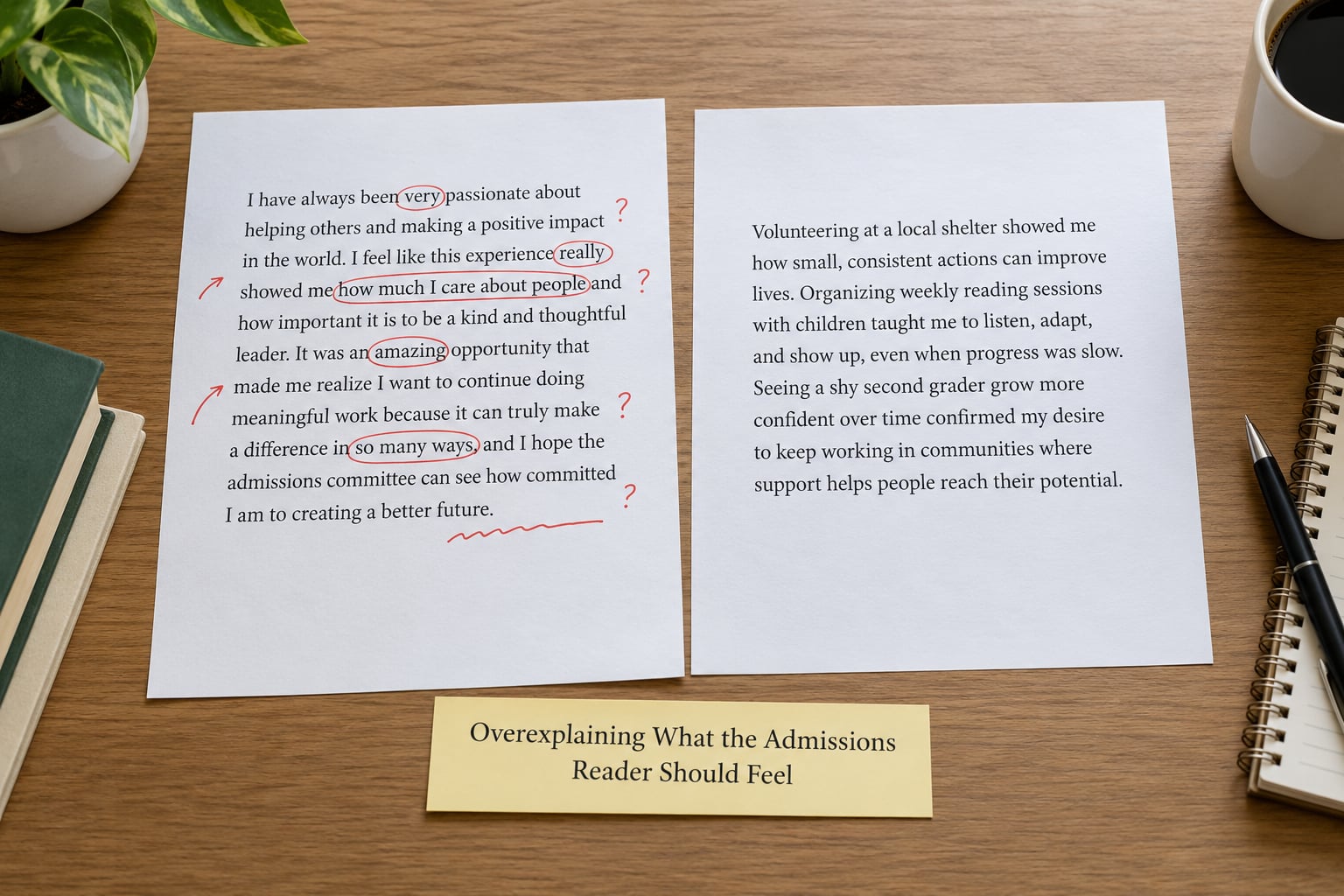
Spending three sentences on what your experience taught you about perseverance is a waste of three sentences. The reader drew the conclusion two paragraphs ago and is now being asked to admire the explanation.
Show the change instead of naming it. Instead of “this taught me humility,” describe the specific thing you no longer assume, the person you now ask for help, the smaller decision you would make this time. Precise reflection is more convincing than a stated moral because the reader gets to reach it themselves.
The same rule applies to hardship. Vulnerability works when it comes with your own interpretation of it, not when the reader is asked to feel sorry for you.
12. Ending With a Generic-sounding Summary
Many drafts end by restating a theme, or with a line about bringing energy and enthusiasm to campus. It is the least specific paragraph in an otherwise specific essay, and it is the last thing a tired reader sees.
Land on the insight instead of the summary. Return to a concrete image, a repeated word, or the question you were asking at the start, and close on something that shows where you are now rather than what you learned. If your last paragraph could be pasted onto another applicant’s essay, it needs another pass.
Frequently Asked Questions
What not to start your college essay with?
Skip openings like In a world where, Throughout my life, and It is often said that, plus any famous quotation. They are slow, and they say nothing specific about you. Start with a concrete moment, a surprising line of dialogue, or a detail from a place, then let the reader learn what the essay is about from what happens next.
Can I write a 3000 word essay in one day?
You can type 3000 words in a day, but you cannot revise them well in one. A long draft written in a single sitting usually arrives full of filler, repeated ideas, and errors you stop seeing after hour six. Budget several days for a 650-word personal statement: one day to draft, one to revise structure, one to proofread, and one buffer.
Can a bad college essay negatively affect my application?
Yes, but usually through skimming rather than rejection. If the opening does not grab a reader working quickly through files, the essay gets read in fragments, and a skimmed essay looks like an application from someone who did not try. One typo is embarrassing; a weak, generic essay across the board reads as carelessness.
What should I avoid in my Common App personal statement?
Avoid retelling your activities list, writing for an imagined admissions office, ignoring the prompt, borrowing famous lines, taking all the credit for a group’s work, and explaining your own lesson at length. Also avoid the symmetry trick of repeating the prompt back as your introduction, and avoid pasting one essay unchanged into every school’s supplemental slot.
What do admissions officers look for in a Common App essay?
They look for a clear voice, specificity, and reflection rather than a highlight reel. In practice the opening paragraph tells them whether the essay answers the prompt and whether the writer sounds engaged, and the middle shows how they think about something that happened to them. Self-awareness and honest credit to others tend to read as stronger than polished achievement.
Conclusion
The mistakes to avoid when writing a college application essay all resolve the same way: cut the claim, keep the detail. Most of these errors are not visible while you are drafting them, so work through the list in order once your first draft is finished.
Start with the cheapest fix, which is running the checklist above against a fresh printout, then get a second reader who has not seen the topic. And begin the next draft by choosing one specific experience and writing down, in a sentence, what you want the reader to understand afterward. Everything that does not serve that sentence goes.