
A personal narrative essay is a short, first-person piece of writing that tells one real experience from your own life, arranged like a story with a beginning, a turning point, and a reflection on what the moment taught you. Learning how to write a personal narrative essay for school comes down to narrowing one experience down to a single scene and building an arc around it. Most students have plenty of material. The trouble is deciding what to leave out.
What follows covers the whole process: how to choose a topic, how to find the lesson underneath it, how to outline the arc, how to write with detail and dialogue, and what teachers actually mark when they grade. It also includes a word-count table by grade level, a copy-ready outline you can fill in, a revision checklist, and answers to the questions students ask most.
What you will learn:
- How to pick one experience out of everything that has happened to you
- A fill-in outline for the beginning, conflict, turning point, outcome, and reflection
- Five types of opening hook that beat It was a sunny day
- How much reflection to use and how to keep it from turning into a moral
- What sits on a narrative essay rubric, and a checklist to run before you hand it in
Table of Contents
- What You Need to Write a Personal Narrative Essay
- How long should it be?
- Step-by-Step: How to Develop Your Narrative
- 1. Choose a Focused Personal Experience
- 2. Identify the Story’s Central Message
- 3. Outline the Beginning, Conflict, and Resolution
- 4. Write with Sensory Details and Strong Narrative Flow
- Five hooks that work
- Dialogue
- First person without sounding self-centred
- Tense
- 5. Revise, Edit, and Proofread Your Essay
- Common Mistakes and How to Fix Them
- Frequently Asked Questions
- How long should a personal narrative essay be?
- Do personal narrative essays use first person?
- What if I don’t have anything interesting to write about?
- Is a school narrative essay the same as my college application essay?
- Can I write about a sad or difficult experience?
- How do I end without sounding preachy?
- Conclusion: Start With the Moment That Matters
What You Need to Write a Personal Narrative Essay
You need five things, and none of them are expensive. Most students already have four of them.
The assignment sheet. Photograph it. It tells you the word count, the formatting rules, whether you may use dialogue, whether sources are required, and whether the teacher wants a specific prompt followed. Ask about anything it leaves unclear before you choose a topic, because the wrong topic wastes a whole draft.
One experience with a turn in it. A good personal narrative has a moment where something shifts — what you believed before is not what you believe after. If you cannot point to that moment, the story will read flat, no matter how well you write it.
A place to work. A notebook for scribbling and a document for the real draft. Most students lose their best material in the gap between the two, because the interesting line gets written on a bus and never typed up.
An outline. Even a rough one. Outlining is not a form to fill in for the teacher’s sake; it is how you find out what you actually think happened.
Two separate blocks of time. One to draft badly and quickly, one to fix it. Students who try to write and revise in the same sitting usually protect the sentences they are most attached to.
How long should it be?
Ask your teacher, because the number on the rubric is the only one that counts. If nobody gave you one, use the ranges below as a starting point rather than a target.
| Level | Typical length | Double-spaced, 12pt |
|---|---|---|
| Middle school, grades 6-8 | 300-500 words | About 1.5 to 2 pages |
| High school, grades 9-10 | 500-750 words | About 2.5 to 3 pages |
| High school, honours or AP | 750-1,000 words | About 3.5 to 4 pages |
| College composition | 1,000-1,500 words | About 4.5 to 6 pages |
These are typical US ranges for school assignments. Nothing here overrides your teacher’s instructions.
Step-by-Step: How to Develop Your Narrative
The process breaks into five moves. Topic first, because everything downstream depends on it, then meaning, then structure, then craft, then revision.
- Choose one focused experience you can locate in a specific minute, not a season of your life.
- Name the central message the moment taught you, in one plain sentence.
- Outline the arc: setup, conflict, turning point, outcome, reflection.
- Draft with sensory detail, dialogue, and a hook that drops the reader into the scene mid-action.
- Revise for structure, then edit for grammar, in two separate passes.
1. Choose a Focused Personal Experience
Use the minute test: can you point to the specific minute the story turns on? I was nervous about the meet all season is a season. The knot in my stomach when the announcer said my name, at 4:12 on the last call, is a minute. Second one wins.
If you think you have nothing to write about, run a ten-minute freewrite. Set a timer, do not stop, do not edit, and write whatever arrives in order of occurrence. The moment with the most heat in it is your essay. Almost always it is somewhere you would not have chosen deliberately.
If freewriting leaves you blank, borrow from these categories:
- Small ordinary moments — a lost watch you never replaced, the long walk home from practice, a routine you refused to give up when everyone expected you to.
- Challenges — a first shift at a job, a move that cost you a friendship, learning something hard at an age when it was supposed to be easy.
- Relationships — one conversation that changed how you speak to a parent, a grandparent, or a friend. One is enough; a friendship that ended usually works.
- Places — a kitchen table, a market stall, a stadium seat, a neighbourhood that changed after you moved away.
- Achievements — a first serve, a completed 5K, an audition. These need friction, or they read as a résumé entry. Ask what nearly went wrong.
Students tell me the small ones land better, and the reason is mechanical rather than sentimental. You remember the exact sound of the clock, so you can write it. You do not remember every detail of the year everything changed.
Two narrowing questions help after you have a brainstormed list: which of these has a specific scene I can picture, and which one would I still want to read about two years from now?
One more thing about sensitive subjects. Grief, illness, a divorce, mental health, a family conflict — these can make an excellent narrative, and you are not obliged to write about any of them. Talk to your teacher before you commit to one, because they know the context and can tell you how much detail this particular classroom can hold. Focus on what changed in you rather than on the injury itself.
2. Identify the Story’s Central Message
Before outlining, say in one sentence what the experience taught you. The formula is unglamorous and it works: Until [the moment], I believed [the old belief]. It turned out to be [what you now know].
This is not an argumentative thesis. Nobody needs to be persuaded, and you are not claiming something contested. It is a lens, and it decides what you leave in the essay.
Keep it in your notebook, not in your first paragraph. Readers of narrative writing do not need the point announced on page one; they need it earned by the end. Most strong narrative essays state the lesson somewhere in the final quarter, after the reader has seen the evidence.
The distinction students get wrong most: reflection is not a moral. Reflection looks back at the moment and describes what it changed in you, in specific terms. A moral tells the reader how to live. I learned that you should never give up is a moral. Three years later I still take the stairs instead of the lift, and I know exactly which flight that started on is reflection. Same story, completely different ending, and the second one is not preachy.
3. Outline the Beginning, Conflict, and Resolution
Fill this in before you write a paragraph of prose. Ten minutes here saves an hour of flailing later.
- Hook and setting (2-3 sentences): where we are, what is happening, the detail we are standing on.
- The want (1 sentence): what you wanted that day, in plain terms.
- Obstacle or conflict (2-3 sentences): what stood in the way. Friction can be a person, yourself, the weather, or the situation.
- Rising action (2-4 sentences): the two or three things that went wrong or escalated.
- Turning point (1-2 sentences): the minute things changed. This is the heart.
- Outcome (2-3 sentences): what actually happened by the end of the day or the event.
- Reflection (3-4 sentences): what you noticed afterwards, in concrete terms. No advice to the reader.
Map that to the five elements of narrative, because teachers grade them in this order:
| Element | What it is | Where it sits |
|---|---|---|
| Characters | You plus anyone who acts on you or with you | Introduced in the first paragraph |
| Setting | Place, time, weather, and the mood they create | Opening paragraph, one or two sentences of texture |
| Conflict | What resists the main character | Early, once the want is clear |
| Climax | The highest-pressure moment, the turning point | Roughly two thirds of the way in |
| Resolution | What happens after, and what you take from it | Final two paragraphs |
Conflict has four flavours, and you only need one:
- Person against person — an argument with a sibling you eventually understood.
- Person against self — nerves before a performance you actually wanted.
- Person against environment — a storm, a deadline, a broken-down bus.
- Person against society — a family expectation, a team culture, a group you did not fit.
If your outline has no conflict, you have a description of a day, not a narrative. Add something that gets in the way, and the essay starts moving on its own.
4. Write with Sensory Details and Strong Narrative Flow
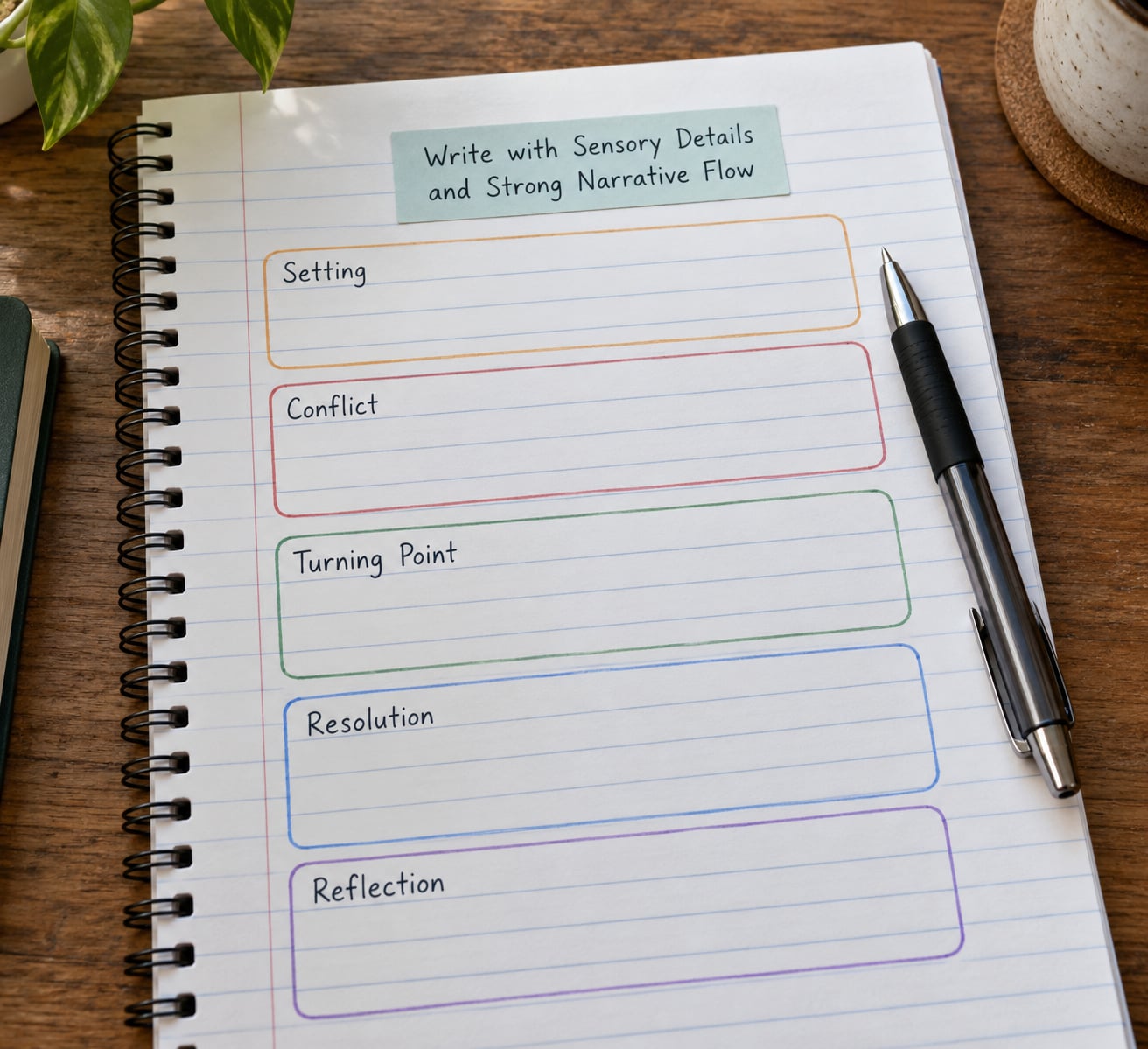
Draft with the rule of showing one and telling zero, then fix the rest in revision. Telling is a summary line. Showing is the evidence for it.
Telling: I was nervous before the race.
Showing: I laced my shoes twice. The first knot came undone, and my hands were not doing what I told them to do.
Work through all five senses, though sight and sound usually carry the most. What did the air smell like, what was the floor doing under your feet, what were you hearing that you did not want to hear?
Five hooks that work
- Drop into the middle of action: the announcer said my name and I was not ready yet.
- Start with the line of dialogue the whole essay is secretly about.
- Start with the sensory detail: the pool smelled of chlorine and wet concrete, and it was 5:40 in the morning.
- Start with the contradiction: everyone told me the season would be fun. It was the longest four months of my life.
- Start at the turning point and explain the earlier part afterwards, provided your teacher has not required chronological order.
Skip It was a bright cold day in April and anything that starts with My name is. Those openings have been used by every student in the class since September.
Dialogue
Two to five lines, maximum. Let dialogue carry conflict and cut everything after the point where the argument lands. Tag it with action rather than he said every time: My mother set the envelope down without opening it. If you cannot hear the difference between two voices, describe the body instead of the speech.
First person without sounding self-centred
Yes, you use I. The trick is to keep I pointed at your perception rather than at your goodness. I ran three times that week reports an action. I had never worked harder in my life asks the reader to admire you. Keep the reporting, cut the admiration.
Tense
Write the story in past tense, and keep it there. One or two sentences of present tense for the moment of impact works as a deliberate shift, provided it does not drift back and forth. Mixing tense mid-paragraph reads as a mistake even when the reader cannot name what is wrong.
Aim for paragraphs of four to seven sentences, and vary them. If every paragraph is the same length, the essay reads like a list with extra steps. A figurative image or two helps — a simile doing real work beats three where the comparison is doing nothing.
5. Revise, Edit, and Proofread Your Essay
Here is what sits on a typical narrative essay rubric, in the order teachers tend to mark it:
- Purpose and point — is there one clear experience and one clear thing it taught you?
- Structure — does the story have a beginning, a rising middle, a turning point, and an ending that resolves it?
- Detail and description — sensory language, specific names, numbers, and places instead of general statements.
- Voice — does it sound like a person rather than a template?
- Reflection — is the ending earned by the story, and specific rather than preachy?
- Conventions — grammar, spelling, punctuation, and the format your teacher asked for.
Teachers are explicit about this: the story is not the point. The point is how it is told and what you take from it. A small moment rendered with precision beats a dramatic event described in broad strokes every time.
Revision checklist before you hand it in:
- Read only the first sentence of each paragraph. Does the order tell the story without the middle sentences?
- Cut every sentence that only repeats what the paragraph before it already showed.
- Check that the turning point is on the page, not implied.
- Read the ending aloud. If it sounds like advice, rewrite it as something you noticed.
- Check tense consistency, then paragraph length, then spelling. That order catches the most.
- Confirm word count, formatting, file name, and the submission method before you upload.
For peer review, separate the passes. Round one is structure only: does the turning point work, does the ending follow. Round two is content: is anything missing, anything padded. Round three is grammar. Students who do all three at once get grammar corrections and no structural help, which is the least useful outcome available.
Common Mistakes and How to Fix Them
Writing your whole life so far. An autobiography covers years and no single arc. Fix: pick the one moment where something changed and let the rest go.
Summarising instead of showing. We argued and then we made up is a report of a story, not a story. Fix: pick the single line you remember saying and write the minute around it.
Opening with a broad lesson. Everyone has struggles tells the reader nothing they did not know. Fix: open inside the scene, mid-action, and let the meaning arrive later.
Ending with a moral. This experience taught me never to judge others. Readers can reach that themselves, and the telling sounds smug. Fix: describe the change in your habits or your thinking instead of instructing anybody.
Too much dialogue. Scripts read like a play, and stage directions slow the pace. Fix: keep the two or three lines that turn the scene and cut the rest.
No conflict at all. Everything went fine, so nothing happens on the page. Fix: name what got in the way — even if it was your own hesitation or the weather — and put it near the front.
Hiding the moment you are actually proud of because it felt too small. It is usually the strongest material available. Fix: keep it, and cut the paragraph of context you added to justify it.
Frequently Asked Questions
How long should a personal narrative essay be?
Ask your teacher first, because the number on the rubric is the only one that counts. If nobody gave you one, middle school assignments land around 300 to 500 words, high school around 500 to 1,000, and college composition around 1,000 to 1,500. Roughly two double-spaced pages per 500 words.
Do personal narrative essays use first person?
Almost always. A personal narrative is written in first person, which means I, me, and my, because the point of view belongs to you. A few teachers allow a reflective opening in third person, but the story itself returns to first person. The mistake to avoid is drifting between tenses partway through a paragraph.
What if I don’t have anything interesting to write about?
You have enough material; the problem is usually scope. Most students say they have nothing to say because they have ten years of nothing to say. Choose a five-minute moment instead of a five-year period — a walk home, a lost item, an argument at dinner — and go deep on it. Small everyday moments often read better because the detail is real.
Is a school narrative essay the same as my college application essay?
The form is similar but the purpose is not. A school narrative essay is assessed for craft: structure, detail, voice, reflection. A college application essay is assessed for fit, originality, and what you would contribute to a campus. Writing college-application tone into a graded assignment usually costs points. Always read the prompt before reusing anything.
Can I write about a sad or difficult experience?
Sometimes, and you never owe your teacher the hardest thing in your life. Grief, illness, mental health, and family conflict all work well, but talk to your teacher first — they know the context and can tell you how much detail the classroom can hold. Focus on what changed in you rather than the injury, and skip anything you would not want read aloud.
How do I end without sounding preachy?
Stop telling the reader what the story means and start describing what you noticed afterwards. Instead of writing that hard work pays off, describe the specific thing that changed: the habit you kept, the conversation you had afterwards, the choice you made differently the next Monday. Show the change and leave the verdict to the reader.
Conclusion: Start With the Moment That Matters
Knowing how to write a personal narrative essay for school comes down to three decisions made before you draft anything: which minute you are writing about, what that minute changed, and where it sits in the arc. Get those right and the writing is craft, not panic.
So open a blank page, set a timer for ten minutes, and freewrite until something has heat in it. That is where you begin.