
An outline for a research paper is a plan of every section you intend to write, listed in the order you will write them, with the arguments and sources supporting your thesis noted underneath. Knowing how to create an outline for a research paper takes roughly 30 minutes once your sources are in hand, and it saves hours later because gaps and repetition surface now rather than the night before the deadline.
Students often treat outlining as busywork to rush through. It works better as a diagnostic. If you cannot sequence your own arguments on a single page, the research is not finished, and no amount of drafting will fix that.
Table of Contents
- What You Need
- Step-by-Step: How to Create an Outline for a Research Paper
- 1. Read the Assignment and Identify the Requirements
- 2. Narrow the Topic and Write a Research Question
- 3. Gather and Evaluate Sources
- 4. Choose a Thesis or Main Idea
- 5. Group Main Ideas and Evidence
- 6. Build the Paper’s Main Sections
- 7. Check the Outline Before Writing
- Common Mistakes
- Frequently Asked Questions
- How long should a research-paper outline be?
- Should a research-paper outline include full sentences?
- How do I turn my research question into a thesis statement?
- How many sources should I include in a research-paper outline?
- Can I use the same outline format for different subjects?
- When should I revise my research-paper outline?
- Conclusion
What You Need
Everything you need to begin is probably already on your desk. Gathering these five items takes about 20 minutes, and doing it first keeps the outline from turning into a guessing game.
- The assignment prompt. Photograph it or highlight it. Required sections, source count, page count, citation style, deadline, and audience all shape the outline, and each one is easy to skim past.
- A research question. One sentence, answerable with the sources you can actually find. If you cannot phrase the question yet, that is the first task, not the last.
- Credible sources. Library databases, peer-reviewed journals, government or institutional reports, and reputable books. Aim for one more source than the assignment requires so you have a spare.
- Your notes. Annotated articles, quoted passages, and a running reference list. Capture the full citation the moment you find a source, not later.
- An outline format. Roman numeral, alphanumeric, or decimal. Pick one now and stay with it, because switching mid-draft is how formatting spirals out of control.
One thing you do not need at this stage: finished paragraphs. Writing full sentences in an outline blurs the line between planning and drafting, and you end up rewriting sentences you already spent an hour on. Fragments are fine. A bullet that says “Smith 2019: no correlation between X and Y” is doing its job.
Step-by-Step: How to Create an Outline for a Research Paper
To outline a paper, mark the prompt’s requirements, narrow your topic into a research question, choose a working thesis, break that thesis into main sections, attach evidence to each section, then check the whole thing for logic and balance. Seven steps, and the first three take care of themselves once you slow down enough to do them properly.
1. Read the Assignment and Identify the Requirements
Most weak outlines fail here, before any thinking happens. A prompt that says “6-8 pages, minimum four scholarly sources, APA format, discuss two counterarguments” is a set of instructions, and each clause narrows what your outline can contain.
Turn the prompt into a checklist you can tick off later: required sections, source minimum, page or word count, citation style, whether an abstract or title page is needed, and who will read it. If the prompt names required headings, use those exact headings in your outline. Renaming them to your own wording is a small risk that costs points for no reason.
2. Narrow the Topic and Write a Research Question
Broad topics produce broad, useless outlines. “Social media and mental health” is too wide for eight pages because you could write a book on it and still feel like you covered nothing.
Push narrower until the question is arguable and answerable. “How does Instagram use recommendation algorithms to shape teenage body image?” works for a term paper. “What factors affect adolescent mental health?” does not, because the honest answer is “many things” and you cannot prove much with it.
A research question is the lens for everything that follows. Every source you keep should help you answer it, and anything that does not is a distraction you can drop without regret. If a source makes you want to widen the question, that is usually a sign to find a second source, not a second topic.
3. Gather and Evaluate Sources
Evaluate as you read, not after. Four quick questions cover most of it: who wrote this and what do they know, where was it published, when was it published, and what evidence is offered for the claim.
Peer-reviewed journal articles are the safest core for most college papers. Books work well for background and theory. Institutional sites such as government agencies and universities are useful for statistics and definitions. Trade magazines, blogs, and content farms are fine for finding leads but should not be your evidence.
When you take notes, capture three things per source: the citation in the format your style requires, the claim you might use it to support, and a one-line note on why it matters. Writing the citation immediately removes the most common source of last-night panic, which is hunting for a publication date you never recorded.
4. Choose a Thesis or Main Idea
A thesis statement is one or two sentences that make a claim someone could reasonably disagree with. That last test is the useful one. “Social media affects teenagers” is a topic, and nobody argues with it, so it cannot direct your paper. “Instagram’s recommendation system intensifies appearance comparison among teenage girls, which predicts worse body satisfaction” is a claim, and you now know exactly which evidence you need.
Students on academic forums describe the same pattern: the outline gets easier once the thesis is fixed, and nearly impossible while the topic is still broad. Many also write the introduction and thesis first, then outline the body to match. Either order works as long as you have a thesis before you build sections.
If you cannot write a strong thesis yet, keep going. A working thesis you can revise is better than a polished one that has nothing behind it, and a research question honestly admits more uncertainty than a thesis statement does.
5. Group Main Ideas and Evidence

This is where students go wrong most often. They list their sources in the order they found them. That produces an outline organized around reading history instead of argument, and it is why so many drafts feel like disconnected summaries.
Organize by idea, not by source. Start from the claims your thesis requires you to prove, group your evidence under each claim, and order the groups so the strongest and most direct evidence comes first. Then attach every bullet to a specific purpose: does this evidence prove the point, qualify it, or explain it?
Keep the three rules of outlining in your head while you do this. If you have a I, you need a II. If you have a A, you need a B. And items at the same level should read in parallel grammatical form, so either all start with verbs or all start with nouns. These rules catch most structural problems before they become paragraphs.
Where a claim is contestable, plan a counterargument. A counterargument is the strongest objection to your position, not a weak one, and addressing it directly is usually what separates a B paper from an A paper.
6. Build the Paper’s Main Sections
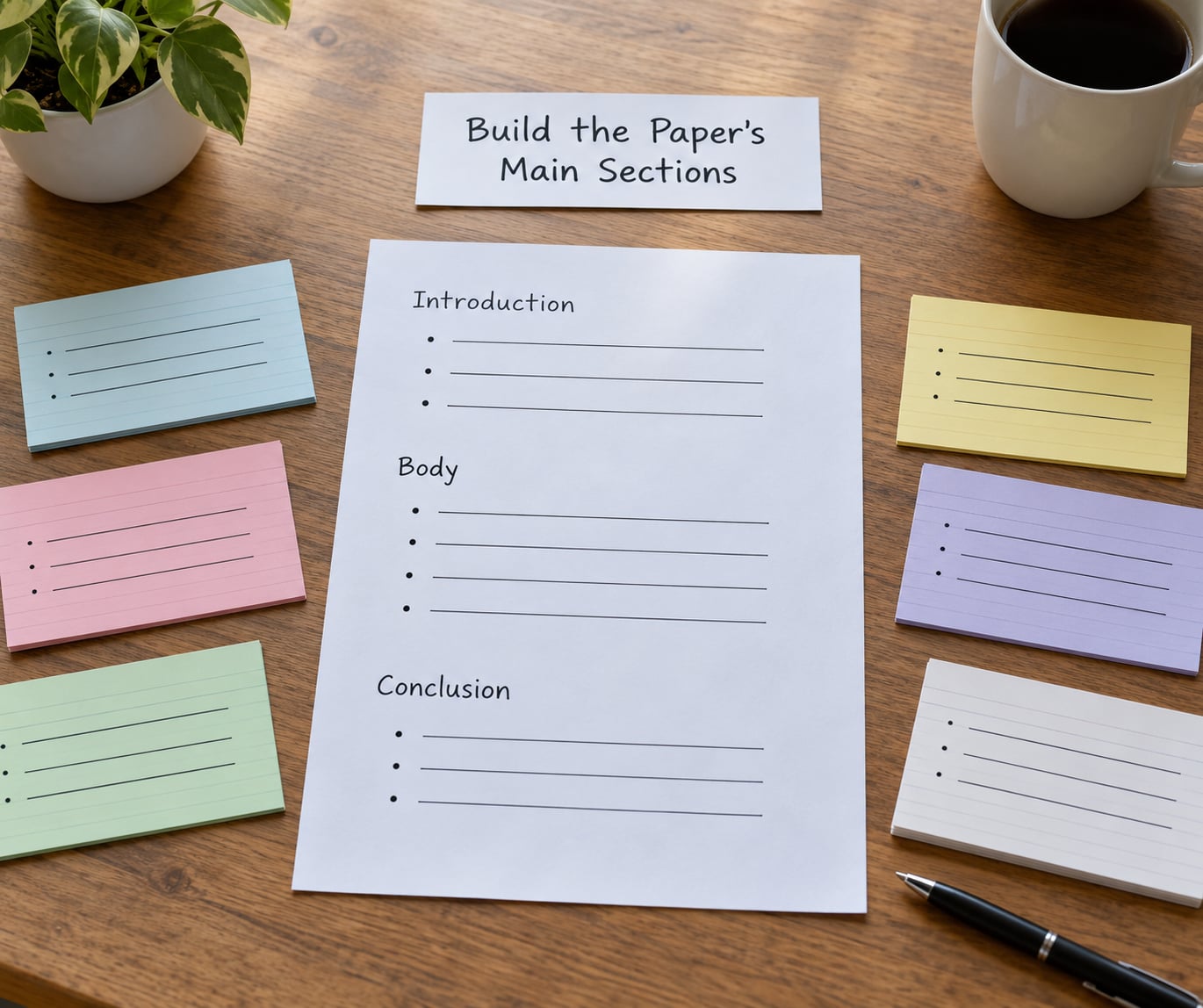
Most research papers have three large parts: an introduction, a body, and a conclusion. The introduction takes roughly 10 percent of your word count and should hold your topic, your thesis, your approach, and why the question matters. The body takes roughly 80 percent and holds one section per main claim. The conclusion takes the last 10 percent and should restate the thesis in new words, weigh the counterargument, and leave the reader with the implication.
Under each body section, add subheadings in level two, then supporting points in level three. Three or four body sections is the usual sweet spot for an 8 to 12 page paper: enough to develop each claim properly, few enough that each one gets real analysis. Aim for each section to hold roughly the same amount of material. When one section has five sub-points and another has one, the paper will feel lopsided even if every word is accurate.
For each body section, list the evidence that belongs there with its citation attached. Use a placeholder for evidence you still need, such as “statistic on daily use here,” so you can see the hole rather than forget it.
Discipline changes the shape but not the logic. A lab or social science paper often runs Introduction, Literature Review, Methodology, Results, Discussion, Conclusion. A humanities paper is usually all thesis and textual evidence. A literature review paper leads with the field’s central debates rather than a hypothesis.
7. Check the Outline Before Writing
Run a final pass with these questions: does it answer the prompt exactly, does every section support the thesis, does the order make sense, do I have enough credible evidence, and is each section roughly the same size?
Then read only the sub-headings and bullets aloud, without writing sentences. If the argument still makes sense as a list, the structure is sound. If it makes no sense aloud, the problem is ordering or scope, and both are far cheaper to fix now than after 3,000 words.
Common Mistakes
Nearly every outlining problem comes from one of these. Each one has a quick fix.
- Starting too broad. Fix: force a narrower question by adding a population, a time period, or a specific mechanism. “Teenagers and social media” becomes “teen girls aged 13-16 and Instagram’s recommendation feed.”
- Writing sentences instead of notes. Fix: strip every bullet to a fragment. If a bullet needs to be a full paragraph, it belongs in the draft, not the outline.
- Organizing sources rather than ideas. Fix: start from your thesis claims and place sources underneath. If a source fits nowhere, leave it out.
- Relying on weak sources. Fix: check who published it and what evidence sits behind the claim. One solid journal article beats five blog posts.
- Too many or too few sections. Fix: three or four body sections for a standard paper. Ten sections in 8 pages means ten shallow paragraphs.
- Evidence never tied back to the thesis. Fix: add one line under each bullet explaining how it supports the point above it. If you cannot, that evidence may not belong there.
- Skipping the counterargument. Fix: add one section or one paragraph reserved for the best objection to your position.
Two habits help more than any of these fixes. Write the outline the night your research is done, not the night it is due, and give it to a classmate or your instructor while it is still cheap to change. Students who describe outlining as painless usually did it before they felt ready.
Frequently Asked Questions
How long should a research-paper outline be?
Roughly one page for a 5 to 7 page paper, and one to two pages for an 8 to 12 page paper. The outline should be detailed enough that a reader could reconstruct your argument without your notes, but not so long it becomes a draft in outline form. If your outline runs longer than a third of your paper will be, you have started writing it.
Should a research-paper outline include full sentences?
No, not at first. Use fragments, and write a full sentence only where a claim genuinely needs precision, such as your thesis or a research question. Full sentences in an outline slow you down and tempt you to polish paragraphs before your structure is settled. Save the sentences for the draft.
How do I turn my research question into a thesis statement?
Answer the question in one sentence, then add the reasoning that makes your answer arguable. If your question is how something works or what causes what, your answer becomes the claim and the reasoning becomes your supporting argument. If your question asks whether something is true, state your position plainly and add the strongest evidence you can find.
How many sources should I include in a research-paper outline?
Use whatever minimum your assignment states, then add one or two more so you have options. For a standard 8 to 12 page paper, six to ten solid sources is usually enough. Every source listed should connect to a specific claim; padding an outline with citations you never use costs you credibility without adding evidence.
Can I use the same outline format for different subjects?
The format can stay the same, but the internal structure should follow your discipline. Roman numeral or alphanumeric outlines work across most humanities and social science papers. Empirical science papers follow Introduction, Literature Review, Methodology, Results, and Discussion. Literature reviews lead with the field’s debates instead of a hypothesis.
When should I revise my research-paper outline?
Revise it whenever your thesis changes, and once more after you begin drafting, because writing exposes gaps that planning cannot. A quick check partway through the draft usually catches at least one section that is too thin or one claim with no evidence behind it. Revising an outline takes ten minutes; fixing the same problem in the finished paper takes hours.
Conclusion
Start with the assignment prompt, not the introduction. Turn your topic into a research question, commit to a working thesis, group your evidence under the claims that thesis requires, and lay the sections out as introduction, body, and conclusion. Then read the headings aloud. If the argument survives without any sentences, you are ready to draft, and every paragraph you write later already knows what it has to do.