An annotated bibliography is a list of correctly cited sources where every citation is followed by a short indented paragraph, usually 100 to 250 words, that summarizes the source, judges how credible and useful it is, and connects it to your research question. Knowing how to write an annotated bibliography comes down to two skills done well: getting the citation exactly right, and saying something specific about the source rather than repeating its abstract.
Start with the assignment sheet. Almost everything that trips people up — style, length, number of sources, what kind of sources are allowed — is written on it, and instructors vary far more than students expect.
Table of Contents
- What You Need
- How to Write an Annotated Bibliography Step by Step
- 1. Read the Assignment and Set Requirements
- 2. Find Reliable Sources
- 3. Read Sources and Take Notes
- 4. Create the Citation
- 5. Write the Annotation
- 6. Assemble, Edit, and Format the Final List
- Common Mistakes
- Frequently Asked Questions
- How long should each annotation be?
- Should my annotations be summary style or critical style?
- What makes a good annotation?
- Can ChatGPT write an annotated bibliography for me?
- Do I need a separate reference page with an annotated bibliography?
- How long does it take to finish an annotated bibliography?
- Conclusion: Start With One Strong Source
What You Need
Five things make the work faster. Gathering them first means you are not rebuilding a citation by hand at midnight.
- The assignment sheet. Source count, required style, annotation length, permitted source types, topic scope, and whether a title page and introduction paragraph are needed.
- The right style manual. APA 7th edition, MLA 9th edition, Chicago 17th edition, CSE, or AMA 11th edition. Check which edition your course uses, because indentation and title-page rules changed between editions.
- A reference manager. Zotero or Mendeley exports clean citations and keeps them consistent once you retype a handful of fields.
- A note template. Five fixed slots per source make the writing stage mechanical instead of stressful.
- Library access. Most academic sources live behind a database login, so sign in before you start hunting.
If you have ever built a reading list for a literature review, you already have the source-finding half of this. What changes is the paragraph under each entry.
How to Write an Annotated Bibliography Step by Step
Every entry has exactly two parts: the citation in your required style, and the annotation on the next line. Some instructors also want a title page and a short introduction explaining your topic and approach. Get those two parts right and the assignment is largely done.
1. Read the Assignment and Set Requirements
Pull six numbers or decisions out of the sheet before you open a single source: how many entries, which citation style, how many words per annotation, which source types count, how narrow the topic must be, and how it gets submitted.
Write them at the top of your document. When you are forty sources deep, you will not remember whether the limit was 150 or 250 words.
Also note the annotation type. A summary annotation describes the source. A critical or evaluative annotation judges it. Many assignments want both, and some students lose marks simply for delivering pure summary when the rubric asked for evaluation. If the sheet is vague, ask your instructor in one short email what they want rather than guessing.
2. Find Reliable Sources
Search library databases rather than general web search. Searching a database tells you the source exists in the scholarly record, which matters more than it sounds.
Then run a fast four-part screen on each candidate:
- Authority. Who wrote it, and what do they actually know about this? Credentials beat a prestigious-looking publisher every time.
- Accuracy. Are the claims sourced? Are the numbers traceable?
- Relevance. Does it speak to your question, or merely share a keyword?
- Usefulness. Will you quote it, argue against it, or use it for background? A source you will never cite does not belong on the list.
Balance matters too. Five sources that all agree make for a weak literature review. Look for at least one credible source that complicates your view, and annotate that one carefully.
For students working on a deadline, the Mendeley and Zotero workflows save real time. Export the citations from the tool, paste them into your document, then set a hanging indent and type the annotation by hand under each one. The tool handles the citation; the annotation is the part only you can write.
3. Read Sources and Take Notes
Most students lose marks here, and it is not a writing problem. They read enough to summarize but never collect what they need to evaluate.
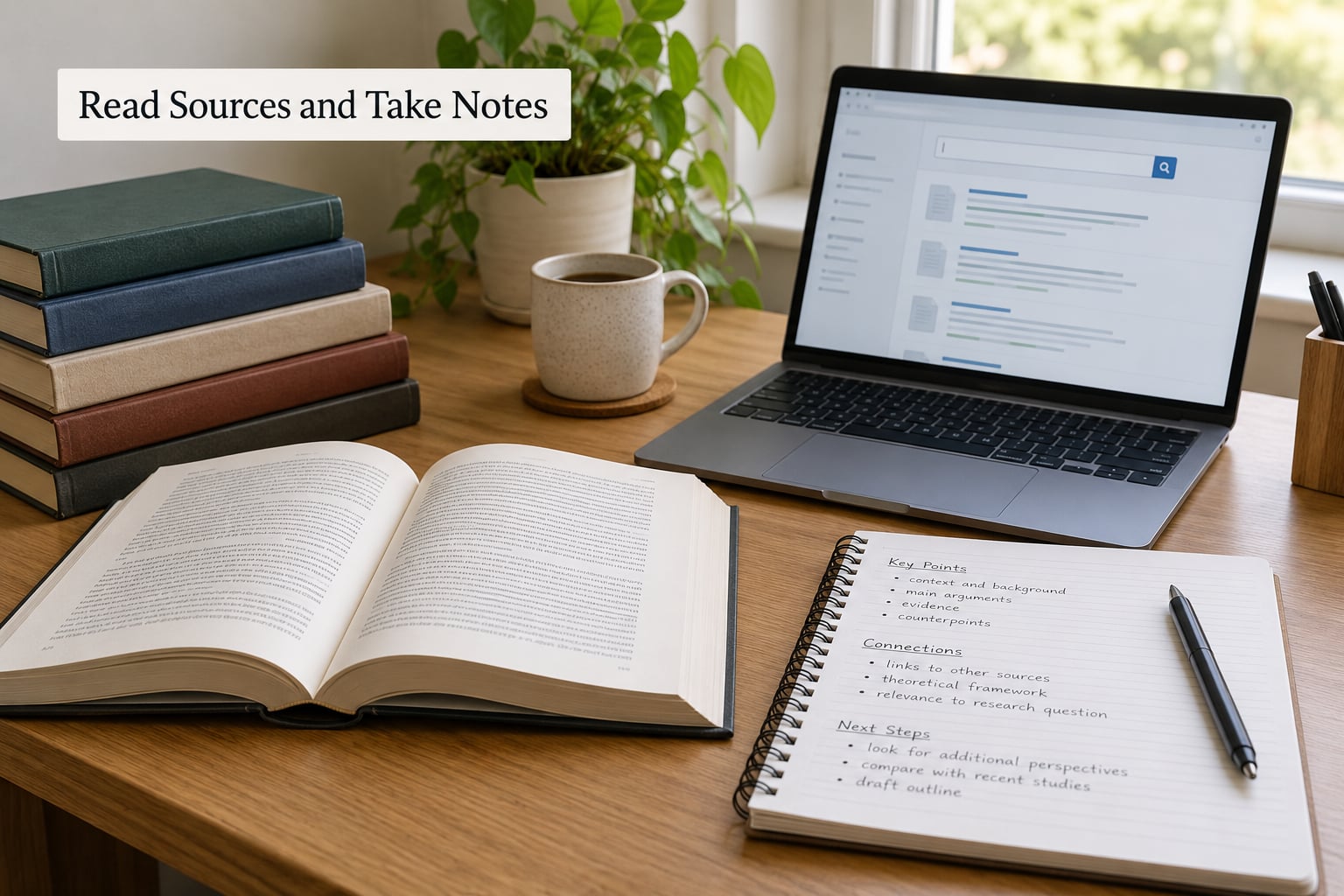
Use the same five slots for every source so you can write from notes later without reopening the PDF:
- Main argument. One sentence, in your own words, of what the author claims.
- Key evidence. The two or three pieces of support that carry the argument.
- Structure. Is it a research article, a review, an essay, a report? Descriptive or analytical?
- Limits. For empirical work, note the method, the number of participants, the setting, and what the design cannot prove.
- Your use. How it supports, extends, or challenges your research question.
Slot four is where critical annotations get their substance. If a study surveyed 300 undergraduates at one university, your annotation can say so. Specifics are what separate an evaluation from an opinion.
4. Create the Citation
Build each citation in the required style, including the elements that style actually asks for: author or creator, title, publication or container details, date, and a DOI or URL where one exists. Include an access date when the style requires one for online sources.
In APA, for example, a journal article needs the journal name and volume in italics, issue in parentheses, page range, and a DOI as a live link. In MLA, the core elements shift to author, title of the article, title of the container, publisher, date, and location. Same source, different skeleton, so do not carry habits between styles.
Set a hanging indent on every citation so the second and following lines sit half an inch in from the left margin. Most editors and word processors apply this automatically once the style is selected.
5. Write the Annotation
An annotation that works runs on four moves, usually in this order: what the source says, how it says it, whether it is convincing, and what it does for your project.
Budget the words. At 150 to 250 words, roughly a third goes to summary, a third to evaluation, and the rest to relevance. That split stops the most common failure, which is a paragraph of summary and one trailing sentence of vague praise.
Here is a filled-in example for a journal article, shown as plain text:
Chen (2026) examines whether four-day workweek pilots in manufacturing retain productivity after the trial ends. Her study tracks output data from 340 workers across six plants over eighteen months, which makes it one of the longer follow-up records available. Chen argues that early gains come from scheduling rather than hours and dissipate once firms reinstate full shifts. The methodology is unusually transparent for this literature, with the sampling criteria and attrition rates published alongside the findings. One weakness: every participating plant shares the same regional labor market, so the results may not transfer to other contexts. I will use this source to support the claim that early productivity gains are largely logistical, and pair it with an industry-level study to test how far that finding generalizes.
Notice what that paragraph does not do. It never restates the author name, journal, or year, because the citation above already says all of that. It also avoids the abstract’s own language.
For empirical sources, name the method and sample size. For a book, cover the author’s expertise and any bias a scholar in the field would flag. For a website or news source, ask who published it and what they stand to gain.
6. Assemble, Edit, and Format the Final List
Order entries alphabetically by the author’s last name in every major style. Then set the layout so each entry looks like this:
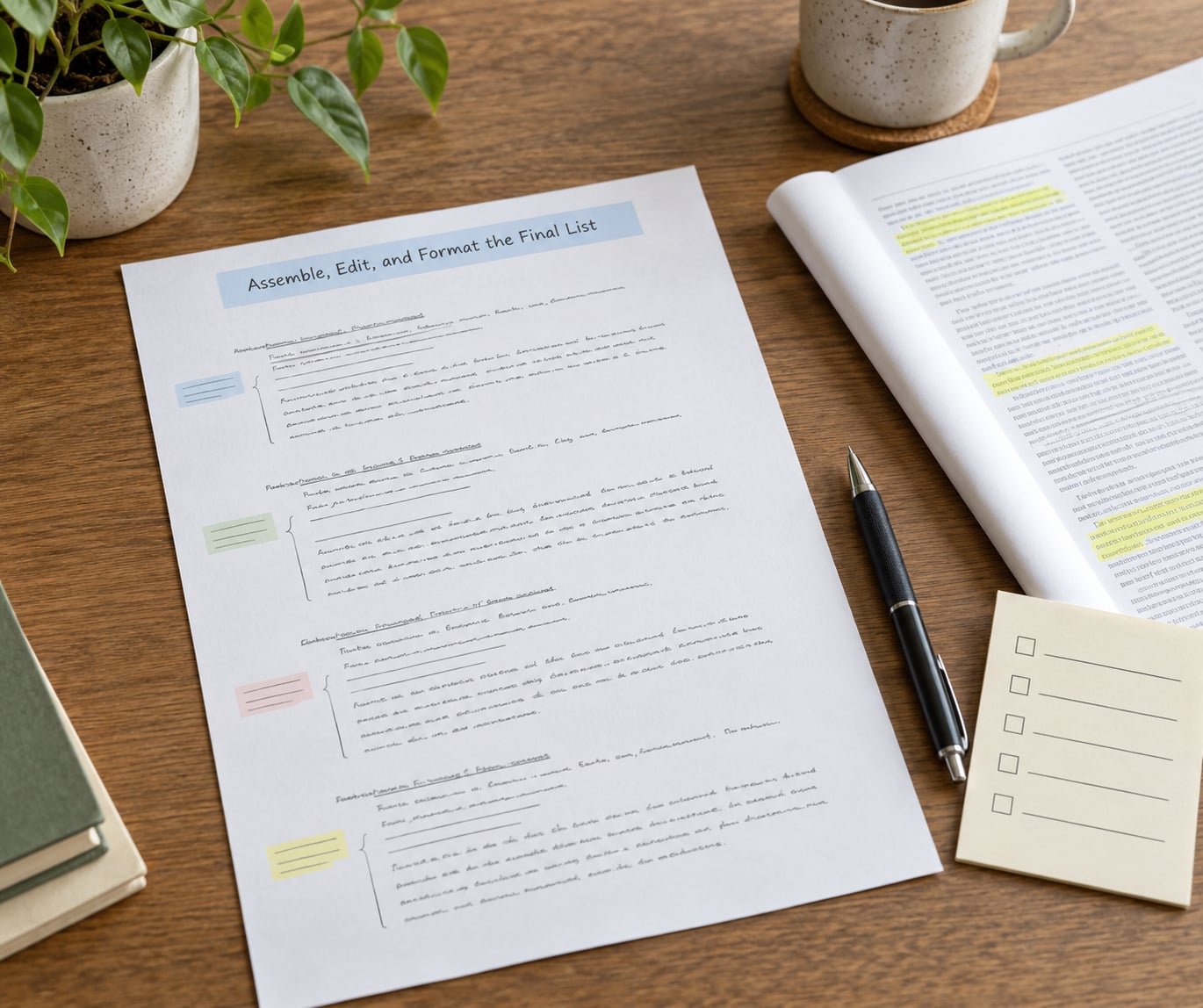
Chen, M. (2026). Four-day workweeks and manufacturing output. Journal of Applied Organizational Psychology, 41(3), 218-237. https://doi.org/10.1000/jaop.2024.3182
Chen (2026) examines whether four-day workweek pilots in manufacturing retain productivity after the trial ends. Her study tracks output data from 340 workers across six plants over eighteen months…
The citation gets the hanging indent. The annotation starts on a new line and is block indented half an inch so it lines up with the hanging indent, not with the text above it. Double-space everything, including between entries, unless the assignment sheet says otherwise.
Then edit in this order: citations first, then annotations, then formatting last. Verify that every in-text mention in an annotation matches a citation entry, that no entry is missing a required field, and that the length sits inside the range your instructor set.
Common Mistakes
These six patterns account for most lost marks. Each has a quick fix.
- Repeating the citation inside the annotation. Restating the author, year, and journal wastes words. Fix: start with what the source argues, never who published it.
- Pure summary with no judgment. The single most common grade-loss pattern, because it misses the point of the assignment. Fix: reserve at least a third of the words for credibility, evidence, and usefulness.
- Vague praise. “This is a very useful and credible source” says nothing testable. Fix: name the specific reason, such as the transparency of the method or the length of the follow-up period.
- Mixing citation styles. Two styles in one list is an automatic format penalty. Fix: pick the required style before the first entry and never switch mid-list.
- Weak or off-topic sources. A blog post or a hit on a keyword does not equal a scholarly source. Fix: apply the authority screen and replace anything that cannot clear it.
- Copying the abstract. Annotations written in the author’s own sentences read as filler. Fix: close the abstract, write the summary from your notes, then check your word count.
One more worth naming: over-writing. Several students panic and produce 500 words per entry. That is not thorough, it is padded, and instructors read it as padding.
Frequently Asked Questions
How long should each annotation be?
Most instructors expect 100 to 250 words, with 150 a common set point. Students on academic forums often describe the target as five to seven lines of double-spaced text, which lands in the same range. If your assignment sheet gives a number, that number wins. For empirical sources, use the longer end so you have room to mention the method and sample size.
Should my annotations be summary style or critical style?
Check the assignment sheet or your rubric. Summary annotations describe what the source says and how it supports its claim. Critical or evaluative annotations judge the evidence, the author’s credibility, any bias, and the limits of the method. Many assignments want both, roughly two-thirds summary and one-third evaluation. When the sheet is unclear, ask your instructor in one sentence rather than guessing.
What makes a good annotation?
Three things: an accurate summary in your own words, a specific judgment grounded in something you actually observed such as the method or the sample, and a clear link to your research question. Strong annotations use concrete details rather than adjectives. Avoid anything that only restates the citation or quotes the abstract, since both add nothing the reader cannot already see.
Can ChatGPT write an annotated bibliography for me?
It can generate citations and show you the structural shape of an annotation, which is useful as a scaffold. It cannot produce your annotation, because an annotation is supposed to reflect your reading and your judgment about credibility and usefulness. Submitted machine-written annotations fail the point of the assignment and may count as academic misconduct under your course policy. Use a tool for formatting questions only, then write every annotation from your own notes.
Do I need a separate reference page with an annotated bibliography?
Usually not. In most courses the annotated list is itself the reference list, since every citation appears in it with full publication details. Some instructors ask for both, particularly when the annotated list feeds a later research paper. Read the assignment sheet carefully; if it is silent, ask before you add a duplicate page.
How long does it take to finish an annotated bibliography?
Budget roughly 45 to 90 minutes per source once your citation system is set up. Most of that time is reading and deciding what the source actually contributes, not formatting. Finding suitable sources and setting up your reference manager will take longer for the first entry, so start there early rather than leaving it for the night before the deadline.
Conclusion: Start With One Strong Source
The whole assignment collapses into one repeatable move: check the sheet, find one source worth defending, record its citation in the required style, then write 100 to 250 words that say what it argues, whether you find it convincing, and what it does for your research question.
Do that once, carefully, before you have twenty entries hanging over you. Once you have finished a single annotation you trust, the remaining ones are the same work with different sources, and the formatting will follow the pattern you already set up.