
Shakespeare is still taught in schools because his plays train students to read closely, argue with evidence, and talk about hard human questions in language that still shapes English. He is kept on the syllabus not as a museum piece but as a training text: the difficulty of his language, the moral messiness of his characters, and the fact that his work is still performed, quoted and adapted everywhere make him useful long after his era.
That answer sounds tidy. In practice, teachers argue about it constantly, and parents ask whether weeks spent on a play they cannot follow would be better spent on something practical. This guide takes the case seriously, including the objections that deserve a straight answer.
Table of Contents
- Why Shakespeare Is Still Taught in Schools Today
- What Makes Shakespeare Relevant Across Centuries?
- How Does Shakespeare Develop Critical Thinking?
- Why Shakespeare Is Still Taught in Schools: The Educational Case
- How Do His Plays Improve Reading and Communication Skills?
- What Do Students Learn from Difficult Language?
- Why Are Shakespeare’s Histories Still Worth Studying?
- Does Shakespeare Still Belong in a Diverse Curriculum?
- How Can Teachers Make Shakespeare Accessible?
- Frequently Asked Questions
- Is Shakespeare too difficult for younger students?
- Do schools still need to teach Shakespeare, or can they use adaptations?
- Why do schools teach Shakespeare if students do not live in his time?
- Should students have to memorize Shakespearean lines?
- How can teachers make Shakespeare more inclusive and accessible?
- Conclusion
Why Shakespeare Is Still Taught in Schools Today
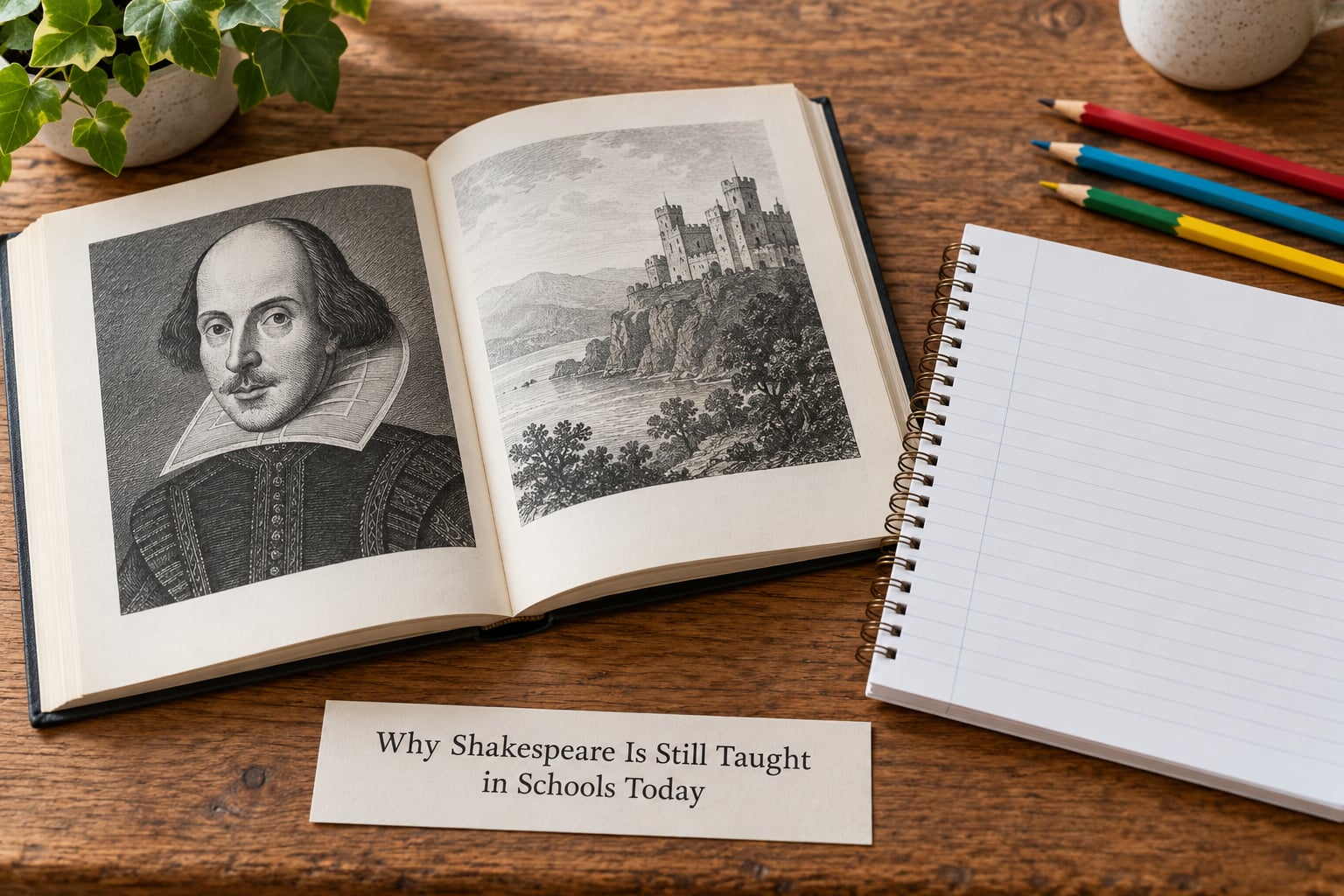
Seven reasons do most of the work, and they are worth stating plainly before the detail:
- The language is genuinely difficult, and reading past difficulty is the skill being taught.
- The conflicts have not changed: ambition, revenge, prejudice, love, inheritance, loyalty.
- He shaped ordinary English, so his words are already part of how students talk.
- Nothing in his plots is easy to summarise, which trains argument and close reading.
- The plays were written to be watched and heard, not read silently.
- He is a shared reference point, the way a shared language is a shared reference point.
- Curriculum standards, exams and university departments keep naming him, so schools keep teaching him.
None of these reasons says Shakespeare is flawless or that every way of teaching him works. Several argue for a different method rather than for dropping the plays, which is the point I come back to below.
What Makes Shakespeare Relevant Across Centuries?
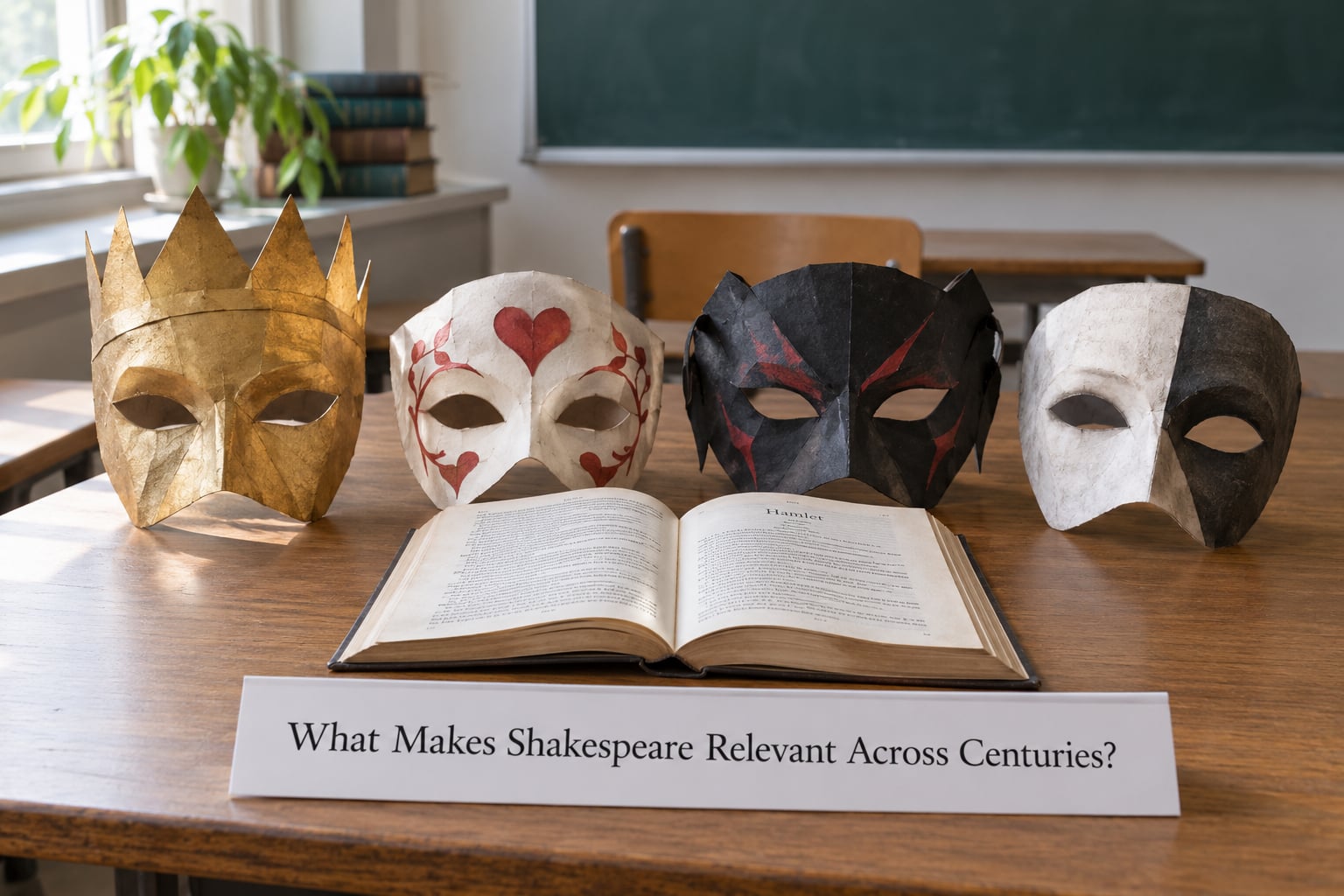
Ask a class why Macbeth kills Duncan and you will collect the same answers today as in 1606: ambition, fear of losing position, a spouse pushing him onward, a sense that the universe will not stop him. That is not a coincidence. People have not changed their reasons for wanting power or their willingness to destroy something to get it.
Shakespeare’s advantage over most canonical writers is that he wrote conflicts rather than conclusions. Hamlet hesitates in a way that still splits readers. Othello’s jealousy is understandable and catastrophic at the same time. TheMerchant of Venice lets Shylock argue a case that sounds uncomfortably persuasive until you hear who is speaking. Nobody walks out of these plays with a tidy moral to repeat back; they walk out with a position to defend.
That is also why the plays age better than most required reading. Contemporary fiction often arrives with its social context already inside the text. Shakespeare arrived with almost none, which is precisely what leaves room for a reader standing at year fifteen to project a modern classroom, a modern family, a modern school onto Verona or Elsinore.
Baz Luhrmann’s 1996 film Romeo + Juliet took the play out of its own century and it still worked, with Leonardo DiCaprio and Claire Danes speaking the original lines. Later film and television versions have moved Macbeth into modern corporate spaces, and Othello into a police or military present. The plots survive the relocation because the pressures in them are structural, not period-specific.
One practical note on where this usually shows up: Romeo and Juliet appears in roughly 93 percent of ninth-grade American classes, and the tragedies dominate most Shakespeare units. If you are a parent trying to work out why your child is reading a 400-year-old play with original spelling, that frequency is the answer.
How Does Shakespeare Develop Critical Thinking?
Critical thinking is a vague phrase in school documents, so it helps to be concrete about what a Shakespeare unit actually asks a student to do. It asks them to hold two incompatible readings at once, find the words in the text that support one over the other, and change their mind when a fourth piece of evidence arrives.
Consider Macbeth’s line about life, “a walking shadow, a poor player / That struts and frets his hour upon the stage.” Read one way it is nihilism, a man who has decided nothing matters. Read another way it is despair produced by guilt, a man who has done something and cannot undo it. The same fourteen words carry both meanings, and no amount of plot summary settles it.
Unreliable narrators do the same job more bluntly. In Richard III, the title character announces his own wickedness in the opening scene, so every later claim he makes has to be measured against it. That is a reading exercise disguised as a history play.
Difficult language forces the same discipline. When a student cannot immediately parse “unkindness” in a sonnet’s sequence, they have to slow down, notice where it sits between the lines around it, and infer. That is inference from context, which is a transferable reading move and also a life skill for reading anything written in a register you did not grow up with.
Why Shakespeare Is Still Taught in Schools: The Educational Case
Here is the case in its most compact form, and it is less about Shakespeare than about what survives a student leaving the unit.
Each reason maps to a skill that keeps working after the bell rings:
- Hard language builds close reading, which then transfers to any dense or unfamiliar text.
- Moral ambiguity builds argument with evidence, because no one can win by summarising.
- Performance and staging build listening, interpretation and public speaking.
- Verse and prose structure build sensitivity to rhythm, compression and deliberate choice.
- Unreliable voices build scepticism about who is telling a story and why.
- History plays build reading for causation, motive and consequence rather than dates.
The best evidence for the performance point comes from teachers themselves. English teachers posting in r/ELATeachers describe a consistent pattern: when students watch a filmed or staged version before they open the text, they arrive at the language already knowing who wants what. The play stops feeling like a wall of archaic syntax and starts behaving like a story with people in it.
The Folger Shakespeare Library built its National Teacher Corps partly around this. Teachers set students the task of arguing why Shakespeare should not be studied, and the objections that come back are sharp: misogyny, racism, religious content, plagiarism debates, the authorship question, the language barrier. Students then research those positions properly and tend to arrive somewhere more considered than the slogan they started with. A unit that produces that is doing something no worksheet does.
How Do His Plays Improve Reading and Communication Skills?
Close reading is usually described as reading carefully. In a Shakespeare unit it means doing four things at once: parsing the sentence, tracking who is speaking and why, hearing the line’s rhythm, and inferring what is unsaid.
The parsing is the entry fee. Early Modern English drops inflections and changes word order under metrical pressure, so “What seeks he in that country” is not bad grammar, it is a man scanning for rhyme while hiding. Once students see that, the strangeness of the language stops being a defect and starts being a set of choices.
Rhythm does the rest. Iambic pentameter is not decoration; it is how the play signals gravity or hurry. A line that breaks its own rhythm tells you something happened. Learning to hear that is close listening, and it feeds directly into how a student writes and speaks.
Then there is the part nobody expects: dramatic irony. In Julius Caesar, the audience knows Brutus is about to speak before Brutus does. Students learn to track where a text places them and what effect that positioning has, which is a skill that carries into film, news, advertising and fiction.
Communication-wise, the discussion format is unusually demanding. There is no correct answer to hold onto, so a student who claims Hamlet is indecisive has to say which lines support it, and a student who claims he is stalling has to say the same. That is a discussion where agreement requires evidence rather than confidence. Teachers also report that students who rehearse a scene out loud write better essays, because performing the line exposes the punctuation problem and the pacing problem at the same time.
What Do Students Learn from Difficult Language?
The most common objection from students is not that Shakespeare is old. It is that they cannot understand him, and they assume that means they are not clever enough. That misdiagnosis is the real harm, because the correct response is a method, not an ability.
Look at what a struggling reader actually faces. Pronouns in Early Modern English refer across long stretches. Sentence boundaries do not fall where modern punctuation puts them. Common words have drifted in meaning: “quaint,” “nice,” “fool,” and “budget” all shifted after Shakespeare used them. None of this is hidden; it is regular, and once you know the patterns, the text opens.
Teachers who succeed tend to give students three supports rather than one. They supply a plot scaffold, because knowing that the play is a revenge story told through flashbacks changes how you read the first scene. They put the original and a modern translation side by side, so the argument is about what Shakespeare chose rather than what he meant at all. And they let students hear it first, so the sound and the story register before the syntax does.
What survives is a habit most students never practise elsewhere: stay with an unclear sentence long enough to work out its structure from context. Multilingual learners often pick this up fastest, since translating an unfamiliar phrase is already the exercise.
There is a defensible position that younger students should meet Shakespeare late. A fourteen-year-old reading King Lear cold will be overwhelmed and will learn little. The same fourteen-year-old meeting Romeo and Juliet in a modern translation, then reading key speeches in the original, gets both the story and the strangeness of the phrasing. That is a sequencing argument, and it is a better one than an argument for dropping the plays.
Why Are Shakespeare’s Histories Still Worth Studying?
The history plays are the part of the canon students skip, because a chronicle with seventeen named nobles and two wars is hard work. They are also the part that maps most directly onto how power actually behaves.
Henry V is a study in leadership under pressure, including the calculated choice to abandon a French princess after she has made her own marriage conditional on the match. Henry IV and Hal across Henry IV Parts 1 and 2 deal with succession and a heir who must decide what kind of king to be. Richard III is a study in political manipulation told by the man doing the manipulating. Shakespeare’s later histories, written with co-authors, are looser and darker.
The value is not historical accuracy. Shakespeare compressed timelines, invented conversations and rearranged events for dramatic weight, so he is a poor source for dates. The value is analytical. These plays show what happens when legitimacy is questioned, when rebellion succeeds, when a ruler’s public reputation and private conduct pull apart. Students meet those pressures in the news constantly; the histories let them examine them in a form where motive is stated rather than implied.
For teachers, they are also a relief. A plot with a clear shape and lots of political friction supports lively debate more easily than Hamlet does with a younger group.
Does Shakespeare Still Belong in a Diverse Curriculum?
The honest answer is that he belongs there alongside a great deal of other writing, and that a curriculum made only of him is a weak curriculum. The strongest objection on cultural grounds is not decorative. It points out real things: a canon built largely by men writing in one country, centuries of misogyny in the plots, an authorship debate that Shakespeare helped generate by keeping his name off his own work, and a body of drama shaped in an empire with colonial interests and commerce with the East.
Those points deserve a place in the unit rather than a dismissal. A class that reads Hamlet and then reads contemporary Indigenous, Black and Asian writers addressing power and grief can hold the comparison honestly. The point is not to catch the canon out. It is to show that literary value is a claim that gets made and examined, not a fact that gets inherited.
Shakespeare also does not have to be the sole test of rigour. Pairing him with a difficult modern poem or a novel with the same moral problem and none of the centuries between them shows which techniques belong to the text and which belong to the author. Those transferable techniques are what the unit is really for.
Meanwhile, plenty of students have never been asked what they think Shakespeare is worth, only whether they can decode him. That is a missed opportunity in both directions. The teacher who hears the critique seriously, who lets a student make the case for dropping him and then asks what the curriculum gains by dropping him, gets better discussion from the whole room.
How Can Teachers Make Shakespeare Accessible?
If the objection to teaching Shakespeare is usually about method rather than about the plays, these are the methods that work. Every one of them is reported by teachers as changing how the room responds.
- Show it first. A film, a stage recording or a scene read aloud before any close reading gives students the story and the voice in one sitting.
- Put the original and a modern translation on facing pages. Students then argue with the text rather than getting stranded by it.
- Hand out a one-page plot scaffold with the timeline and the family relationships before the first act.
- Teach the words, do not assume them. Twenty minutes on pronouns, word order and shifted meanings beats an hour of silent confusion.
- Cast the play in a modern setting and ask students to recast a scene. This is what the film adaptations do, and students understand the exercise before they can analyse it.
- Move students into performance early, even a five-minute reading with parts assigned, so the text stops being a printed object.
- Build discussion questions that require evidence from two different scenes rather than asking whether a character was right.
- Use accessible editions with facing-page support, glossaries and clear type, so difficulty is the language and not the print.
Two cautions. Online summaries will bypass the whole unit if you assign a play without in-class checkpoints on interpretation; students who never struggle with the text never practise recovering meaning from it. And a unit built on silent reading alone underuses the material, which is a fair criticism that teachers have levelled at themselves for years.
If you are building this unit now, start smaller than you think. One act, one scene, seen first and then read, produces more thinking than a rushed full-play unit that gets abandoned in week three.
Frequently Asked Questions
Is Shakespeare too difficult for younger students?
Not if the difficulty is handled as a method rather than left as a test of intelligence. Younger students usually need a plot scaffold, a modern translation alongside the original, and to hear the play before reading it. That gives them the story first and lets them meet the strange phrasing inside a plot they already follow. The problem is rarely the age; it is starting students on a cold page with no context and asking them to decode and analyse in the same breath.
Do schools still need to teach Shakespeare, or can they use adaptations?
Adaptations work well as the front door, not as a replacement. A film or modern retelling gives students the shape of the plot and the emotional stakes quickly, and they can then read key scenes in the original with something to compare. Teachers commonly report that students engage with the language far more after watching a staged or filmed version. Whether Shakespeare must appear at all is a curriculum decision, but the versions schools use as a bridge are the ones that end up making the original text readable.
Why do schools teach Shakespeare if students do not live in his time?
Because the plays are read for their arguments rather than their facts. Ambition, revenge, prejudice, loyalty, inheritance and grief are the same pressures students meet at school and at home, and Shakespeare puts them into speech rather than describing them. He is also still performed, quoted and adapted constantly, so he works as a shared reference point. What matters for teaching is that students read the original for part of the unit rather than only through a summary.
Should students have to memorize Shakespearean lines?
For most students, no. A short passage learned by heart is worthwhile when it lets a student speak a line with weight, but extended memorization of whole scenes tends to consume lesson time and reward the confident readers over everyone else. The skill schools actually want is reading: noticing how a line is built and why a word was chosen. If memorization is set, keep it short, let students pick the passage, and give them time to understand it rather than recite it.
How can teachers make Shakespeare more inclusive and accessible?
Start with format, not theme. Provide facing-page original and modern translations, plot scaffolds, glossaries and accessible type so the barrier is the language rather than the page design. Then make room for the cultural critique: pair the play with contemporary writers from a range of traditions and let students argue both sides of the canon question out loud. Students who feel the text is not addressed to them disengage fast, and those conversations keep them in the discussion.
Conclusion
Shakespeare stays in schools because he is still useful, not because he is untouchable. He gives students hard language to read closely, conflicts with no clean answer, and a shared cultural reference that costs nothing to bring into a classroom.
Here is where to start: pick one short passage, watch or listen to a performance of it first, then read it with a modern translation in hand and ask students which word Shakespeare chose and why. Ten minutes of that is worth more than a term of silent reading.