To summarize a chapter without plagiarizing, find the one claim the chapter argues, decide which points actually support it, and restate those points in your own words with a citation at the end. Ignore the quotations, the statistics, and the interesting asides, even when they are the best writing in the chapter. It takes about 40 minutes for a typical textbook chapter once you have read it properly, and the skill gets faster each time you use it.
Most summaries get flagged for one reason: the writer copied sentences and swapped a few words around. That kind of surface rewording is still copying, and similarity checkers catch it reliably. The fix is not fancier word substitution, it is a different order of operations, which is what the steps below set up.
Table of Contents
- What You Need
- Step-by-Step: How to Summarize a Chapter Without Plagiarizing
- Read the Chapter for Its Central Idea
- Separate the Main Ideas From Supporting Details
- Write Each Key Idea in Your Own Words Without Plagiarizing
- Use Evidence Without Copying the Chapter
- Build a Coherent Summary Paragraph
- Revise for Accuracy, Concision, and Originality
- A Note on Fiction and Nonfiction Chapters
- Using AI Tools Without Getting Into Trouble
- Common Mistakes
- Frequently Asked Questions
- What are the five basic rules of summarizing?
- How long should a chapter summary be?
- Is it legal to use AI to summarize a book chapter?
- Is quoting a chapter plagiarism if I cite it?
- How do you summarize a difficult or confusing chapter?
- How do you summarize a fiction chapter without copying the language?
- Conclusion: Start With the Chapter’s Main Idea
What You Need
Five things, and none of them expensive. You need the chapter itself, the assignment instructions, a notebook or a blank document, a way to mark up the text, and the citation guide your course uses.
Read the assignment instructions first, before the chapter. Length limits, required format, and citation style all change what you write later, and going back to fix citations at midnight is a waste of a night.
For the marking tool, highlighter and margin notes work fine for most people. Some readers do better with a structured template like the Cornell method, where notes sit beside questions and a short recap of the whole section. Pick whatever you will actually keep using.
The citation guide matters more than students expect. MLA, APA, and Chicago each want a book chapter cited differently, and guessing produces references your instructor marks as missing. If nobody gave you one, search your school’s writing center for the style sheet.
One habit to set up front: your summary should track the chapter’s argument, its structure, and where it ends up. It should not track every notable quotation. A summary that preserves the author’s best lines instead of their main points is the most common reason a summary reads like a rewritten chapter.
Step-by-Step: How to Summarize a Chapter Without Plagiarizing
Read the Chapter for Its Central Idea
The central idea is the single sentence the chapter exists to prove. You can find it in the introduction, in the last two paragraphs, in the section headings, and in the topic sentences that open each paragraph. Writers state their claim more than once, usually without realizing it.
Try this: close the book and say the chapter’s argument out loud in one sentence, in the plainest language you have. If you need the author’s phrasing to get through it, you have not found the claim yet, you have found a sentence.
A working test is the first-and-last-two-sentences method. Read the opening two and closing two sentences of the chapter, plus the first sentence of every section. Write down what each one says the chapter is doing. Where they agree is your central idea.
You will know this step worked when you can write that one sentence on a blank page without notes, and it explains why the chapter has three sections instead of five.
Separate the Main Ideas From Supporting Details
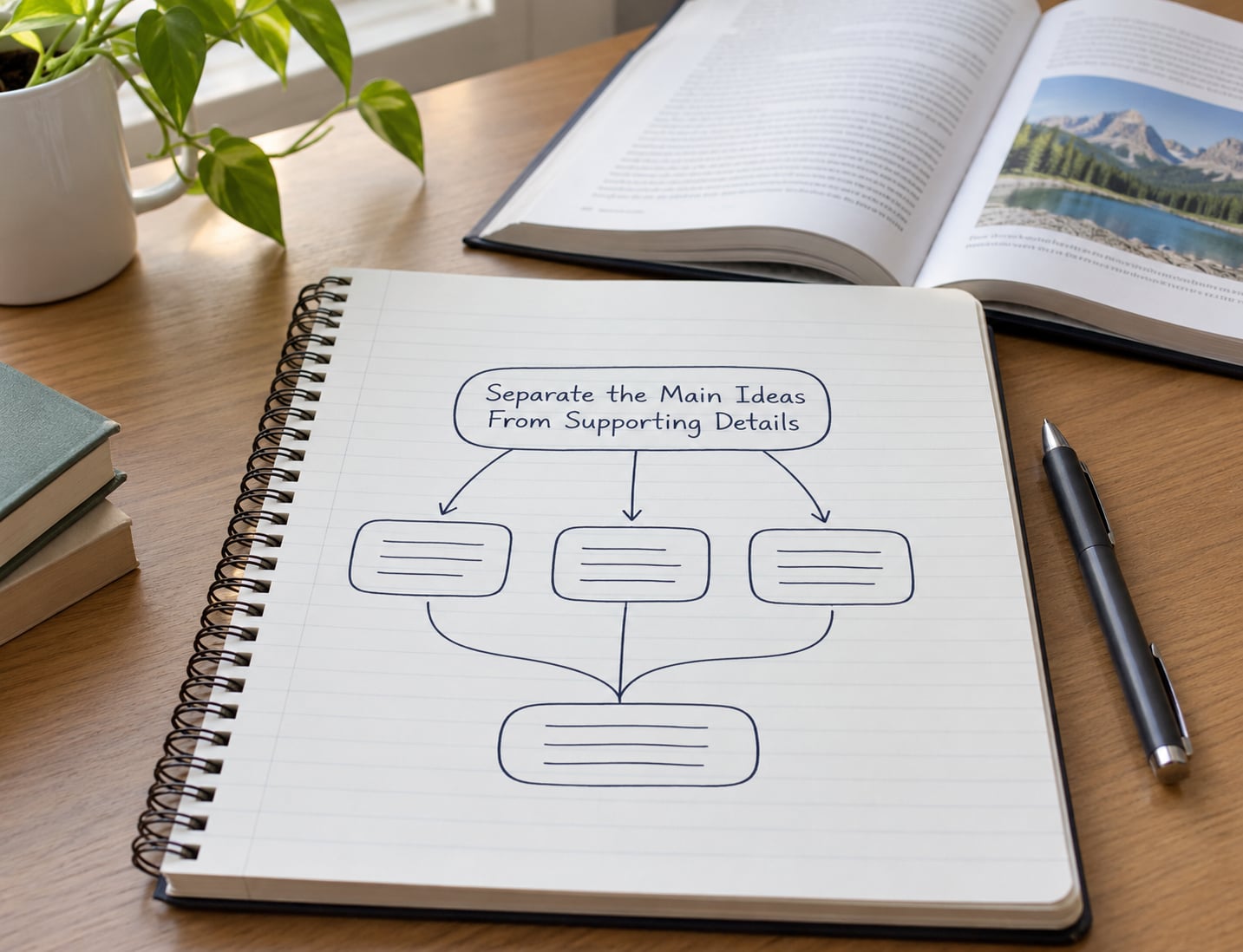
Now split what you noted into two piles: points the chapter needs, and points that illustrate those points. Statistics, worked examples, long quotations, historical background, and asides go in the second pile. They can be interesting and you can still leave them out.
Map it. Write the central idea in the middle of a page, then branch out to the three or four supporting points that carry the weight, then add a box for the conclusion. Anything that does not connect to the center by a clear line gets cut.
A useful question for each candidate point: if I dropped this sentence, would the central idea still hold up? If yes, it is decoration. If no, it earns a place in the summary.
This step worked if your map has three to five branches, not twelve. A summary with a dozen key points is an outline, and an outline is not a summary.
Write Each Key Idea in Your Own Words Without Plagiarizing
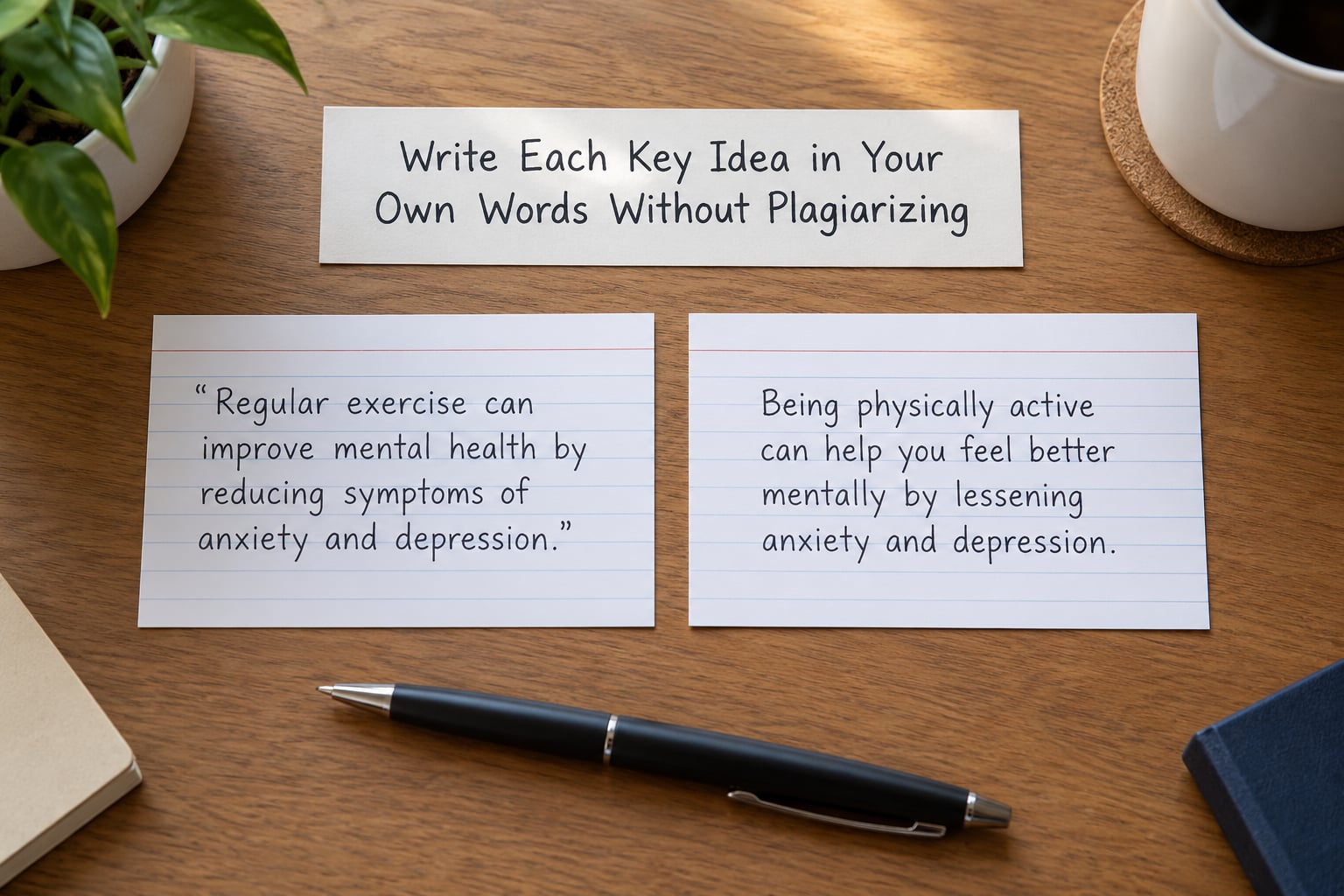
Put the chapter aside and write each point from memory. Blanking the page first is what makes the sentences yours, because once the original wording is in front of you, matching it is close to unavoidable.
Three moves help when memory runs thin. Close the source and describe the idea in your own words, then check. Change the sentence structure, turning a passive claim into an active one or splitting one long sentence into two short ones while keeping the meaning. Then explain the reasoning, replacing jargon the author used with ordinary words you would say out loud.
Before: “The author contends that early literacy programs produce lasting gains because instruction begins before kindergarten and is reinforced through third grade.”
After: “The chapter credits early literacy programs with lasting gains, and points to timing and repetition as the reason: instruction starts before kindergarten and keeps going through third grade.”
The second version is shorter, uses a different structure, and says what the first one meant without reusing its phrasing. That is paraphrasing. Check that you did not drift, since a paraphrase that changes the meaning is its own kind of error.
If you cannot write a point without the book open, you did not understand it yet. Explain it to a friend, out loud, and try again.
Use Evidence Without Copying the Chapter
A short quotation is fine when the author’s exact words carry something a paraphrase would flatten, a defined term, a striking phrase, or a claim you intend to argue with. Everything else belongs in your own words.
Keep quotations short, wrap them in quotation marks, and give the page number. Many instructors cap how much of a summary can be quoted; one or two short quotations in a page of prose is a reasonable expectation, but check your own rubric rather than trusting that rule.
Three terms get confused here, so it is worth separating them. Paraphrase restates one idea in new words at roughly the same length. Summarizing compresses a whole chapter into the points that matter. Direct quotation reproduces the author’s exact words and marks them as such.
You will know this step worked when every sentence in your draft is either your own phrasing or a marked quotation with a page number attached.
Build a Coherent Summary Paragraph
A summary paragraph has a fixed order: central idea first, then the strongest supporting points, then where the chapter leaves you. For fiction, keep chronological order for the plot beats but open with the chapter’s effect rather than its first scene.
Use this fill-in-the-blank outline. This chapter argues that [central idea]. First, it explains [supporting point one]. It then shows [supporting point two], using [supporting point three] as evidence. The chapter concludes that [conclusion or implication].
A finished example, on a chapter about habit formation in daily routines: this chapter argues that habits stick when the behavior is tied to an existing cue rather than to willpower alone. It first describes the cue-response loop that underlies automatic behavior, then shows how attaching a new routine to a fixed morning habit shortens the decision step. Its evidence comes from a workplace study where small teams restructured their shift handovers and cut missed handovers by a third. The chapter concludes that environment design beats motivation for anything repeated daily.
That paragraph runs about 110 words, covers the whole chapter, and contains no sentence lifted from the source. Length varies, the shape does not.
Revise for Accuracy, Concision, and Originality
Set the chapter and your draft side by side and work through a short checklist. Cut every detail that does not support the central idea, and cut any sentence that only restates the one before it.
Then check each remaining sentence against the source for accuracy. Confirm that you kept the author’s actual position, since softening or sharpening a claim is a common revision error. Replace any phrase that came out word-for-word with the original.
Search the draft for stretches of four or more matching words with the source. That is the range similarity tools flag most often, so those are the phrases worth rewriting yourself. Finally, confirm your in-text citation and reference entry are present and formatted per your style guide.
One habit worth keeping: run a free plagiarism checker on the draft before you submit it. Not because a green score means you are clear, since those tools miss plenty, but because a flagged passage tells you exactly where to go fix something.
A Note on Fiction and Nonfiction Chapters
Nonfiction chapters argue, so the summary reports the argument. Fiction chapters show, so the summary reports what changes. For fiction, track the chapter’s turn, the decision a character makes, and what it costs them, and leave out descriptive detail that does not move that turn forward.
For self-studying readers without a classroom or a rubric, set your own limits instead: one page of notes per chapter, and one paragraph of summary written from memory afterward. Nobody asks you comprehension questions while you study alone, so the written summary becomes the check.
Using AI Tools Without Getting Into Trouble
Using a chatbot to summarize a book chapter you have not read is not summarizing, and in most academic settings it counts as a form of cheating even when nothing is copied verbatim. Many courses treat submitted AI work as uncredited work, and instructors can usually tell.
There is a legitimate middle path. Use AI to quiz you on the chapter, to check whether your central idea sentence captures what the author actually argued, or to compare your draft against the original for wording overlap. You are using it as a sparring partner on work you did, not as a replacement for reading it.
Disclosure matters too. If your course allows AI assistance at all, say what you used it for. Keeping it quiet risks more than the writing itself.
Common Mistakes
Copying sentences and swapping synonyms. Changing three words in a twenty-word sentence leaves a match. Fix: write from memory with the book closed, then compare.
Summarizing scene by scene. You end up with a condensed retelling, which is a different assignment. Fix: organize around the argument, or around the changes a chapter produces.
Quoting too much. Six quotations in a paragraph means you summarized nothing. Fix: keep one or two short lines and paraphrase the rest.
Mixing in your own opinions. A summary reports what the author said. Fix: save your evaluation for a separate section, clearly marked as yours.
Forgetting the citation. Original wording does not remove the obligation to credit the source. Fix: add the in-text citation and full reference as you write, not at midnight.
Skipping the conclusion. A summary that stops mid-argument misrepresents the chapter. Fix: end with what the chapter concludes or leaves open.
One tip covers most of these. Read your draft aloud. Sentences that came from the source tend to sound stiff when spoken, because nobody talks like a textbook.
Frequently Asked Questions
What are the five basic rules of summarizing?
First, state the main idea and leave out the details. Second, keep the author’s meaning intact rather than adding your own view. Third, use your own words and sentence structure for almost everything. Fourth, quote only when exact wording matters, and mark it with quotation marks and a page number. Fifth, cite the source with an in-text citation and a full reference entry.
How long should a chapter summary be?
Most instructors expect somewhere between 10 and 25 percent of the original length, so a 4000-word chapter usually means a 400 to 1000 word summary. When the assignment does not specify a length, aim for one dense paragraph or three short ones that cover the argument, the main supporting points, and the conclusion. Depth matters more than hitting a number.
Is it legal to use AI to summarize a book chapter?
It depends on your course and institution, and the rules changed quickly. Using AI to produce a summary you submit as your own is widely treated as academic misconduct, even with no direct copying. Using it to quiz you or check your draft after you have read the chapter is usually fine. Read your course’s policy and disclose any AI use rather than guessing.
Is quoting a chapter plagiarism if I cite it?
No. A direct quotation with quotation marks, an in-text citation, and a full reference is legitimate academic practice, not plagiarism. Problems appear when quotations are so long that they replace your own summary, when quotation marks are missing, or when the citation points to a different source than the words you used. Keep quotations brief and keep the citation attached.
How do you summarize a difficult or confusing chapter?
Go back to the structure rather than pushing through the prose. Reread the introduction, the section headings, and the conclusion, then write one sentence on what the chapter claims. Next, diagram how each section connects to that claim. If you still cannot summarize it, you have found the part you do not understand, which is the part worth asking about.
How do you summarize a fiction chapter without copying the language?
Avoid adjectives, imagery, and dialogue entirely, since that is where a chapter’s distinctive language lives and where copied phrasing shows up most. Track plot and change instead: what the character wanted at the start, what shifted, what they decided, and what it cost. Summarizing a scene in plain language like the character set down a glass or left the room is paraphrasing, not retelling.
Conclusion: Start With the Chapter’s Main Idea
Knowing how to summarize a chapter without plagiarizing comes down to three habits: find the claim, write the supporting points from memory in your own words, then credit the source and cut everything that did not serve the claim.
Start with one action today. Close the book you are reading and write, on a single line, the sentence that says what this chapter argues. If you can do that without notes, the rest of the summary is a short job. If you cannot, that gap is the actual work, and it is worth finding before you write a single sentence of summary.