A compare and contrast essay about two books is an analytical paper that examines two novels, plays, or nonfiction works by organizing evidence around shared criteria, showing where they resemble each other, where they diverge, and what that comparison reveals about both.
Students get stuck on one mechanical question: how do you keep two whole books inside the same essay instead of writing two book reports taped together? The answer is boring and reliable. Every body paragraph takes one literary criterion, brings evidence from both books into the same paragraph, and explains what the gap between them means.
Budget roughly a week for the whole thing, less if you already have notes. Two hours on planning saves you four hours of rewriting.
Table of Contents
- What You Need
- Step-by-Step
- Step 1: Read and Annotate Both Books
- Step 2: Choose Meaningful Comparison Criteria
- Step 3: Develop a Focused Thesis
- Step 4: Create an Outline
- Step 5: Draft Evidence-Based Body Paragraphs
- Step 6: Write the Introduction and Conclusion
- Step 7: Revise and Proofread
- Common Mistakes
- Frequently Asked Questions
- Do the two books have to be by the same author?
- How many paragraphs should a compare and contrast essay about two books have?
- How long should the evidence from each book be?
- Should I write about similarities or differences?
- Can I write a 3,000 word essay in one day?
- Start With a Strong Comparison Plan
What You Need
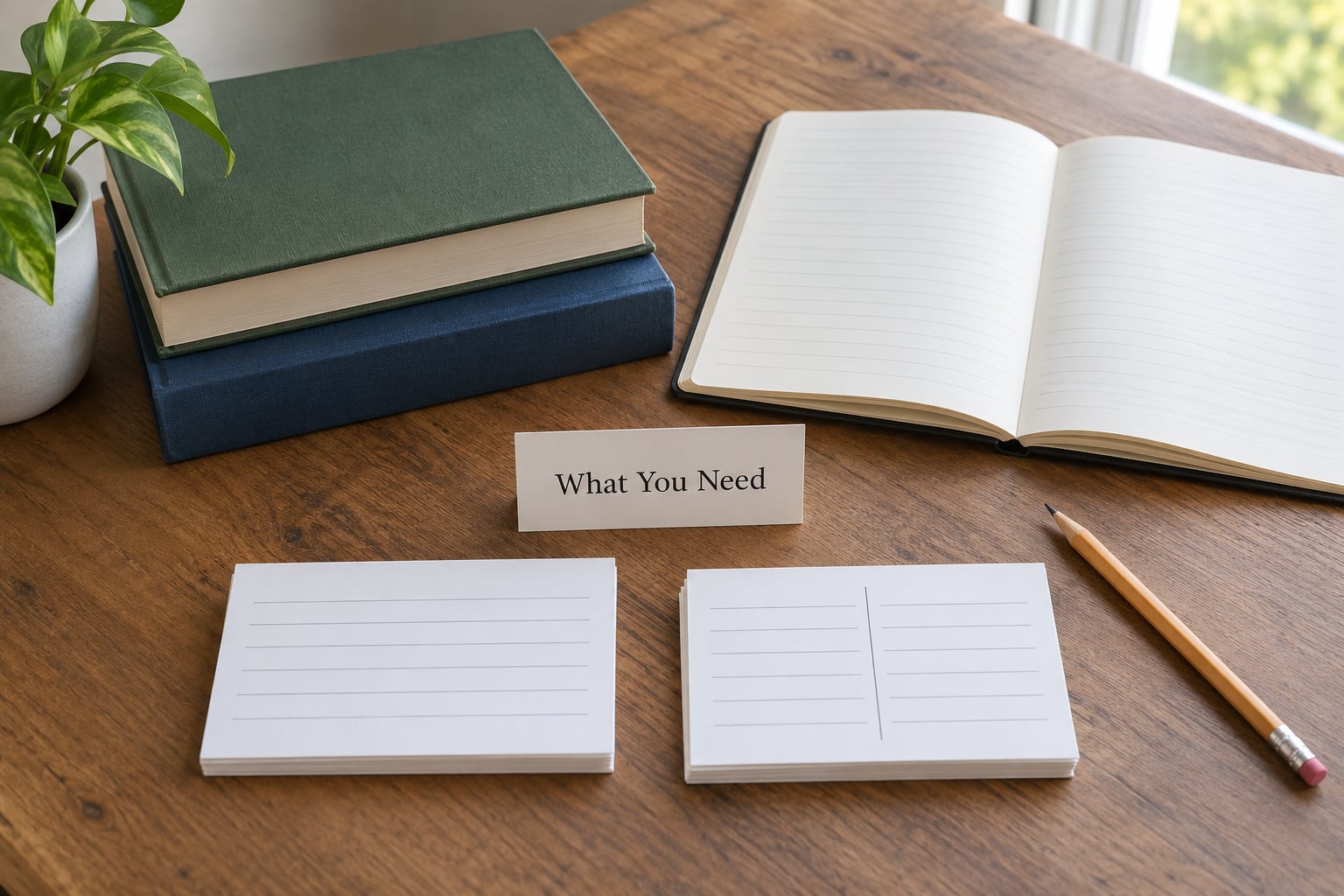
Gather five things before you write a single sentence. You can plan the entire essay with these in front of you and nothing else.
- Both books, in the exact edition your teacher assigned. Use a library copy or the class edition so your page numbers match the ones your teacher checks.
- The assignment sheet. Rubrics name the criteria they grade. A prompt asking you to compare how each novel handles loneliness is not the same prompt as one asking which novel is better, and the evidence you collect differs.
- Reading notes with page numbers. If you underlined nothing, go back and mark at least six passages per book now. Write the page number next to each mark while you are still looking at it.
- Your comparison criteria. Two or three lenses, decided before you read deeply, so you are not just collecting whatever interesting things you noticed.
- An evidence bank. One page per book listing passages, what each passage shows, and how it connects to each criterion.
One caution on editions. Translations, abridgements, and modern retellings have different chapter breaks and different pagination, and a citation from the wrong edition reads like you borrowed your evidence from somewhere else. If a teacher hands out a text with numbered chapters, cite by chapter rather than page and the problem disappears.
Step-by-Step
Step 1: Read and Annotate Both Books
Annotate each book for six things: central topic, characters, theme, setting, conflict, and the author’s message, plus the narrative technique that carries it.
Write evidence in your own words first and quote second. A note that reads Tom grows more isolated as the summer goes on, refuses help twice, and nobody notices is worth more at revision time than a page of highlighted text, because a note with a claim attached can become a topic sentence later. Raw highlights only tell you where to look.
Not finished one book? Read it for the criteria you already chose rather than for the plot. You can compare characterization without knowing the ending of every subplot, and for most essays the first and last thirds carry most of the quotable material.
Dislike one of them? That is workable. Write about a moment where the book earns your dislike, or where a character does something you think is wrong, and use that friction as evidence. Honest friction reads better than polite nothing.
You know the step worked when you can name each book’s argument in one sentence without describing any events.
Step 2: Choose Meaningful Comparison Criteria
Two or three criteria beat six, because each one needs a full paragraph of evidence from both texts and deep criteria produce analysis rather than summary.
| Criterion | Question to ask of both books | Evidence type to collect |
|---|---|---|
| Theme | What central idea does each book treat, and how seriously? | Two or three passages where the theme surfaces in action, not dialogue |
| Character development | How does each protagonist change, and what causes the change? | Scene showing the moment before and the moment after |
| Setting | How does time and place shape what the characters can do? | Description passages plus one plot event the setting forces |
| Plot structure | How does each book order events and build toward its ending? | Chapter or part transitions, framing devices, structure shifts |
| Symbolism and motifs | Which recurring object carries weight in each text? | Two appearances of the same object per book |
| Narrative point of view | Who tells the story, and how does that distance shape judgment? | Moments where the narrator comments or withholds |
Test each criterion with a simple filter: do you have at least two pieces of evidence from each book? If one side has none, drop it. A criterion that fits only one novel forces you to write two separate essays stapled together, which is the exact failure this assignment is designed to catch.
Step 3: Develop a Focused Thesis
A strong thesis names both books, states their relationship, and makes a claim a reasonable person could disagree with.
| Weak | Why it fails | Strong |
|---|---|---|
| This essay will compare The Great Gatsby and The Catcher in the Rye. | Announces the topic, claims nothing. | Both novels treat the longing for a greener, kinder past as a trap, but Gatsby turns that longing into ambition while Holden turns it into refusal, and that difference explains why neither narrator gets what he wants. |
| The two novels have many interesting similarities and differences. | No focus, no argument. | Fitzgerald and Golding both isolate a boy on an island, yet The Great Gatsby blames society for his failure while Lord of the Flies blames the boy, which shifts the burden a reader feels for the ending. |
| Animal Farm is a better book than Brave New World. | Opinion without evidence structure. | Animal Farm is the more useful book because Orwell writes satire that survives rereading, while Brave New World depends on a reader who already knows the history it is mocking. |
Notice the pattern in every strong example: it tells you what the comparison proves, not just what it covers. That is the whole difference between a 1 and a 4.
If the prompt asks which book is better, that is an argumentative thesis, and it needs one honest concession. Acknowledging the strongest case for the book you are not choosing is what separates a persuasive argument from a complaint.
You know the step worked when you could argue the opposite sentence out loud and it would be a real argument rather than a joke.
Step 4: Create an Outline
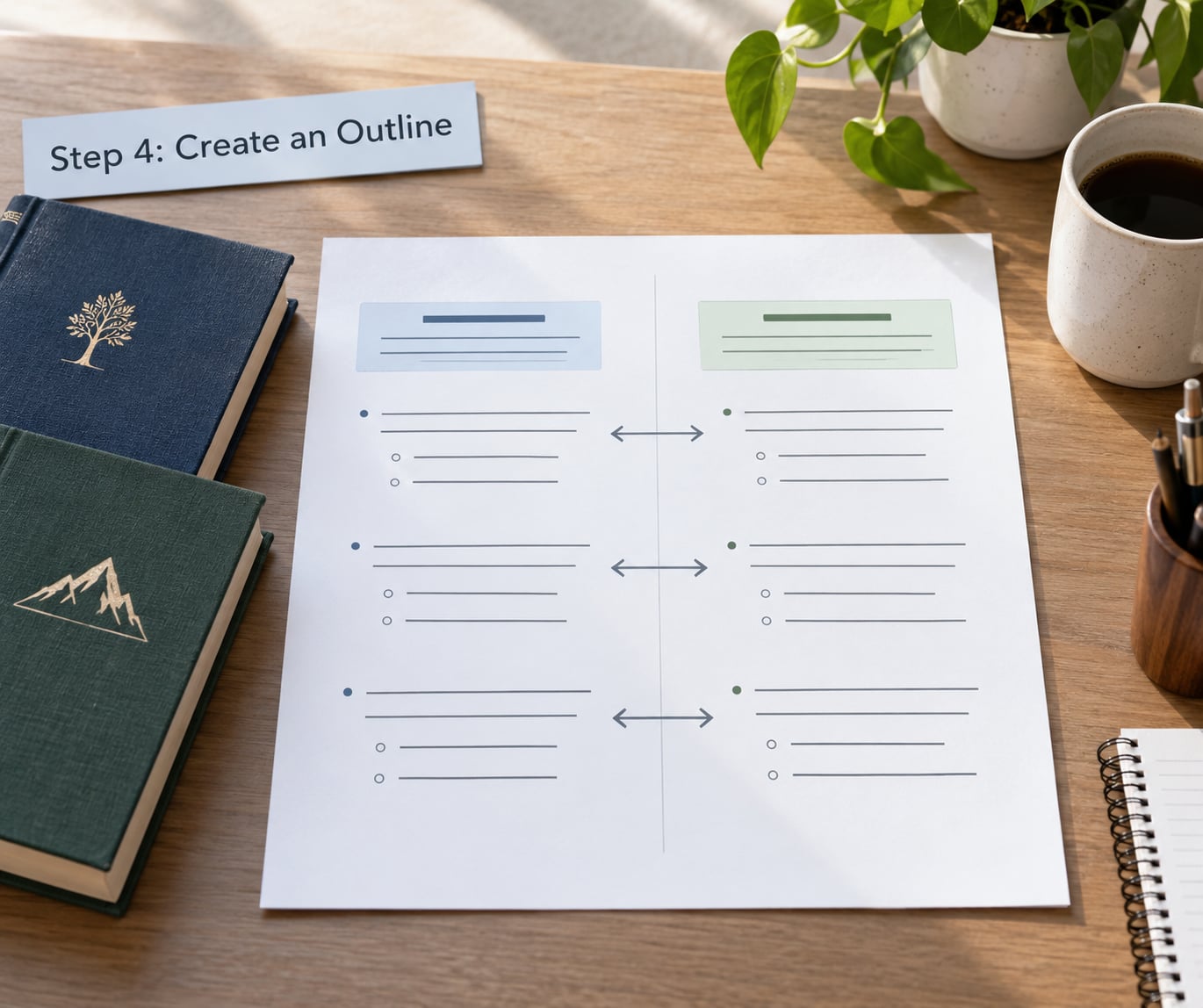
Choose one of two organizational methods and stay in it, because mixing them is the most common structural mistake students make.
| Method | Shape | Choose this if |
|---|---|---|
| Block (subject by subject) | All of Book A in one section, then all of Book B | The essay is short, under about 1,000 words, or the two books are radically different and forcing them into the same paragraph would be awkward |
| Point-by-point (criterion by criterion) | Each paragraph takes one criterion and covers both books in it | The books are genuinely comparable, or the assignment runs 1,000 words and up, or your thesis makes a claim about the relationship between them |
Put the similarities paragraph first. Before you can argue two books differ in some meaningful way, you have to show they belong in the same conversation, and a reader who does not yet know why these two are worth comparing will not care about the differences you find later.
A point-by-point outline in point-by-point form looks like this: a one-sentence introduction of each book, a similarities paragraph, then one paragraph per criterion covering both books, then a conclusion that synthesizes. Give every paragraph a label and a topic sentence before you draft, and put the evidence under the topic sentence so you can see whether the paragraph actually has enough to work with.
Use transitional language that signals the move. For similarity: similarly, both novels, alike, likewise, in the same way. For difference: however, by contrast, while, whereas, unlike. For addition: moreover, further, a second difference appears. For emphasis: crucially, most importantly, above all. For conclusion: ultimately the pattern across both books suggests.
You know the step worked when every paragraph has a job and one criterion, and no paragraph could be deleted without leaving a hole.
Step 5: Draft Evidence-Based Body Paragraphs
Build each body paragraph in four moves: point, evidence, explanation, link.
- Point. A topic sentence that names the criterion and makes a claim about both books. Not Gatsby and Holden are both lonely, which says nothing, but Both narrators treat loneliness as a private failure rather than a social one, which gives you a paragraph.
- Evidence. A short quotation or a specific paraphrase from each book, with an in-text citation. Two short quotations usually beat one long block quote, because the point is the comparison, not the quote.
- Explanation. Several sentences analyzing what each passage actually does. This is the part students skip and the part that carries the grade.
- Link. A sentence tying the analysis back to the criterion and toward the thesis.
Evidence from both books belongs in the same paragraph. That single habit is what makes the essay a comparison instead of a summary, and it is the hardest operational skill in the assignment.
Quote accurately and briefly, then explain. If the quotation makes your point for you, it is too long. For novels organized by chapter, cite the chapter: (Great Gatsby 8). For plays, cite act, scene, and line: (Romeo and Juliet 2.2.35). Follow whatever style the assignment specifies, and check it before you cite rather than after.
You know the step worked when you read only the topic sentences in order and get a complete argument without reading the evidence underneath them.
Step 6: Write the Introduction and Conclusion
The introduction moves in five beats: hook, contextualize both books, state the criteria, name the argument, deliver the thesis in the last one or two sentences.
Four hook types work reliably. A short quotation that names the shared problem, a concrete image from one of the books, a one-sentence summary of a common historical moment, or a question you answer by the thesis. Skip the dictionary definition of compare and contrast; it reads like filler and buys you nothing.
The conclusion makes four moves: restate the argument in new words, widen it to a larger observation about the two books together, note the significance, and stop. Do not introduce a new quotation or a new idea, and do not simply re-list each book. Synthesis answers what the two books together show; summary answers what each book was about.
You know both parts worked when your last sentence could not be swapped into any other essay on your desk.
Step 7: Revise and Proofread
Revise in separate passes, because one pass cannot do everything at once and you stop seeing your own sentences.
- Argument pass. Does the thesis answer the prompt? Does every paragraph support it? Is there any paragraph you cannot connect to it?
- Balance pass. Count the paragraphs and the quoted words devoted to each book. If one book has three paragraphs and the other has one, or if one book supplies 80 percent of your evidence, the comparison is lopsided and readers notice before they can say why.
- Evidence pass. Check every quotation against the original, add citations, confirm the analysis after each quote explains rather than repeats.
- Organization pass. Confirm you used one method only, that transitions signal the move, and that the similarities paragraph earned the differences.
- Sentence and formatting pass. Cut filler, vary rhythm, check subject-verb agreement and citation format, then format the works cited page in the required style.
A long assignment, say 3,000 to 5,000 words, is not more work than a short one; it is more criteria. Assign one criterion per body paragraph and the length takes care of itself, which is also the cleanest answer to anyone wondering how to fill that many pages.
Common Mistakes
Six failures account for most of the lost points, and each has a mechanical fix.
Two summaries taped together. Symptom: a block of paragraphs about Book A, then a matching block about Book B, with the word comparison appearing only in the introduction. Fix: reorganize to point-by-point so each criterion paragraph holds evidence from both books.
Plot retelling dressed as analysis. Symptom: a long scene-by-scene walkthrough with no claim attached. Fix: cut every sentence that only tells you what happened and keep only the ones that argue for something.
One-sided coverage. Symptom: the book you enjoyed gets four paragraphs and the other one gets a single token section. Fix: run the balance pass and redistribute evidence until the two sides are close to even.
An announcement thesis. Symptom: a thesis that names the books and says you will compare them. Fix: rewrite it to claim what the comparison shows, using the formula in Step 3.
Criteria that only fit one book. Symptom: a paragraph on setting in one novel while the other gets forced into a setting paragraph it does not need. Fix: drop the criterion and pick one that both books genuinely share.
A conclusion that summarizes. Symptom: the last paragraph restates each plot in two sentences. Fix: delete it and write the four synthesis moves instead, starting from the pattern you found across both books.
Frequently Asked Questions
Do the two books have to be by the same author?
Usually no. Most assignments want two books from the same category, and that category is usually genre or period, such as two dystopian novels or two coming-of-age novels. A same-author pair is a specific and interesting variant because you can compare how a writer’s concerns change across one book and another. Whatever the pairing, the books need enough shared ground on at least two literary criteria for the comparison to produce evidence rather than summary.
How many paragraphs should a compare and contrast essay about two books have?
Follow the assignment. A 750-word paper usually needs five body paragraphs: one establishing similarities, three comparing criteria, and one that handles the argument or implication. At 1,500 words, use six or seven criteria paragraphs. At 3,000 words and beyond, give each criterion its own paragraph and add a section on one book’s treatment of the other’s central concern. Length is best absorbed by adding criteria, never by adding plot summary.
How long should the evidence from each book be?
Short quotations with substantial explanation beat long quotations with none. In a 750 to 1,000 word essay, two quotations of a sentence or two per book is plenty for most paragraphs. If your teacher permits block quotation, format it according to the required style and follow it with at least as many words of analysis as the length of the quote. The test is whether you are arguing about the passage or merely displaying it.
Should I write about similarities or differences?
Both, in a specific order. Open with similarities to justify why the two books belong in the same conversation, then move to differences, which carry most of the analytical weight. Equal amounts of each gets you a safe, competent essay. Weighting the body toward differences and ending on a pattern across both books is what turns the comparison into an argument a teacher can score at the top of the range.
Can I write a 3,000 word essay in one day?
You can draft one, but the quality will show. A full day works if the planning is already done: you have criteria chosen, an outline with one topic sentence per paragraph, and your evidence bank filled. If planning is not done, a single day produces an essay built on two books you have not read closely, which is exactly what the assignment is testing. Two days of two hours each usually beats one day of twelve.
Start With a Strong Comparison Plan
Six moves, in this order, and the essay mostly writes itself.
- Pick two books with real shared ground on at least two literary criteria.
- Choose two or three criteria and collect evidence for each from both texts, with page or chapter references.
- Write a thesis that claims what the comparison shows, not what you will compare.
- Pick block or point-by-point based on length, and commit to it.
- Draft every body paragraph with evidence from both books inside it, in the order point, evidence, explanation, link.
- Revise in passes, starting with argument and balance, and finish with a conclusion that synthesizes.
The method carries the grade, not the reading volume. Do the planning on paper and the writing gets almost boring, which is exactly the point.