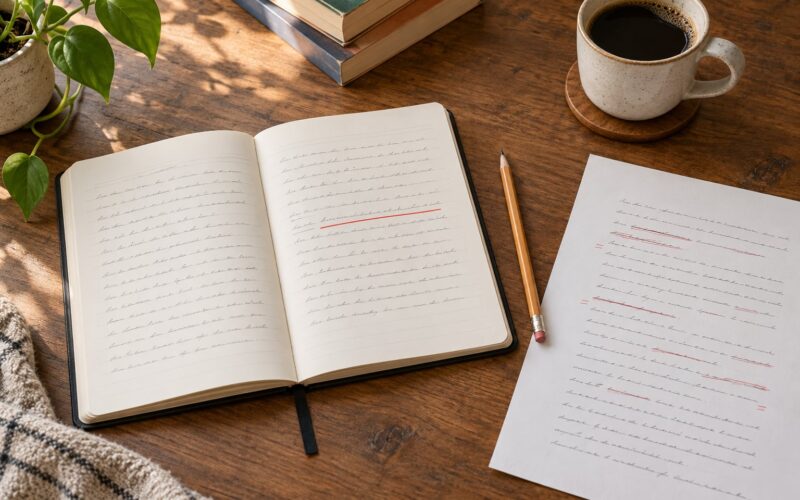
To take notes while reading a novel, set one purpose before you start, mark only the moments where a character changes or the plot turns, keep a cast list with page numbers as you go, and write three to five lines of your own reaction at the end of each chapter. The whole system takes about five extra minutes per sitting. That is the entire method — everything else is detail.
I have kept reading notes for years, mostly for novels I had to teach or write about, and the system that survived is a boring one. A pencil, three symbols, a cast list, and a notebook page per chapter. The elaborate color-coded schemes I tried at twenty-two lasted three books.
Before the method, the honest bit. There is a persistent complaint in reading communities that note-taking turns novels into homework, and it is a fair one. If a book is doing its job, you are inside the story, not beside it with a clipboard. So the version below is built to stay out of the way: light marks while you read, a short written reaction afterwards. If a given book does not deserve notes, that is a perfectly good outcome.
Table of Contents
- What You Need
- Step-by-Step: How to Take Notes While Reading a Novel
- Set a Purpose Before Reading
- Record the Plot and Key Events
- How to Take Notes on Characters and Relationships
- Capture Themes, Symbols, and Evidence
- Write Questions and Interpretations
- Review and Organize Your Notes
- Common Mistakes
- Frequently Asked Questions
- Should you take notes while reading a novel?
- What should I write down while reading fiction?
- How do I keep track of characters in a novel with a big cast?
- Should I use paper or digital notes for novels?
- How do I take notes on a book I cannot write in?
- How do I turn reading notes into study material?
- Conclusion
What You Need

Four things, and only one of them is the novel itself.
The novel and a way to mark it. A book you own and can write in is the easiest case. A library book, a borrowed paperback, or a tight-margin edition needs a workaround, which I cover in the step section and in the FAQ.
A pen or pencil. Pencil first. Ink on a page you may want to erase is a permanent regret, and erasable ink smudges onto the next page when the book is stacked.
A highlighter, used sparingly. Highlighter marks are for things you will point at again. If you are highlighting more than about one page in ten, you are highlighter-hunting.
A separate place for longer notes. A notebook, an index card, or one document. Margins hold four words; they do not hold a paragraph of analysis. Keeping the reaction somewhere else is what makes margin notes survivable.
Optionally, a reading log. A single line per book — title, author, start date, finish date, one sentence — is enough. It is genuinely useful when you want to reread something five years later and cannot remember whether you did.
Here is the template most of my notes follow. Every row is optional, and most chapters only need three of them.
- Cast list. Name, who they are to the narrator, and the first page they appear on. One line per character, kept in one place for the whole book.
- Chapter note. What changed, in your own words. Three to five lines.
- Craft note. Word choice, structure, or point of view doing something unusual. One line, with the page number.
- Question. Anything you did not understand or want to argue with. One line.
- Reaction. What the chapter felt like, and whether you want to keep going. One sentence.
Paper or digital depends less on preference than on what you will do with the notes afterwards. Paper wins on recall: a page you wrote in has handwriting, position, and texture, and you find it faster than you find a search result. Digital wins on search, on the sheer volume of text you can hold, and on anything you need to quote in an essay with a clean citation.
The compromise most readers land on, and the one I use, is light marks in the book plus longer notes in a separate notebook or document. Marks for finding, notes for thinking.
Step-by-Step: How to Take Notes While Reading a Novel
Six steps, in order, repeated per chapter. Steps one to three happen as you read. Steps four to six happen at chapter breaks. If you only have fifteen minutes and a chapter, do step six properly and let the rest be light.
Set a Purpose Before Reading
Write one sentence at the front of your notes describing why you are annotating this particular book. That sentence decides everything else, because a book read for a literature class and a book read for pleasure need completely different notes.
Some purposes and what each one demands:
- Essay or close reading: mark craft. Word choice, sentence structure, imagery, point of view shifts, and anything you could quote. Record page numbers for every mark.
- Book club: mark moments that start a conversation. Arguments between characters, revelations, and lines worth reading aloud.
- Remembering the story: mark only turning points. Most of the middle of a novel can be dropped without the plot breaking.
- Long series or epic fantasy: the cast list is the note. Names, allegiances, who died.
- Pleasure: keep the reaction line and stop there. Genuinely.
You will know this step worked when a chapter goes by and every mark you made fits one of your stated purposes. Anything that does not fit is a note to skip.
Record the Plot and Key Events
Summarize in your own words, never by copying. Copying a plot is slow, produces nothing you can use, and usually breaks copyright expectations depending on how much you take; paraphrasing takes thirty seconds and works better.
Focus the summary on cause and effect, not sequence. A list of events in order is a plot summary. A sentence that says why the next thing happened is comprehension. “She burns the letter because he has already left” beats “She burned the letter. Then she went to the window.”
Mark the turning points separately. A turning point is the moment after which the book is not the book you started. Most novels have three to six. Those are the marks you will want a decade later.
Keep this to the chapter, not the whole book. A one-line summary at the top of each chapter is enough context to reconstruct the story later, and one line per chapter stays manageable even at 700 pages.
How to Take Notes on Characters and Relationships
Start a cast list on the first page of your notes and add to it as new people appear. Four fields: name, who they are to the narrator, the page where they first show up, and one word for what they want.
That last field is the useful one. Almost every character in a novel is doing something on purpose, and “wants” captures it in one line. Readers in the forums say the same thing about ensemble casts: nobody remembers forty names, but everyone remembers forty wants. “Wants to be forgiven,” “wants the money,” “wants to be told the truth.”
Skip minor characters until they do something. A servant who appears once and never again does not need a line. A servant who appears once and then reappears at the end absolutely does, and the page number is what lets you find that scene later.
Track change rather than traits. Instead of “brave,” write what the character does when frightened, then compare it to what they did at the start. A character arc is a change you can point at on two pages, and it gives you the raw material for an essay paragraph in about two minutes.
Capture Themes, Symbols, and Evidence
Watch for repetition. An image, an object, a phrase, a setting that comes back three or more times is doing work on purpose, and collecting those instances is one of the highest-value things you can annotate in fiction.
Write down the repeated item, each location with a page number, and one note on what changed each time it appeared. Windows in a novel might start as a way out, become a way of watching, and end as a wall. Three occurrences, one line each, and you have written a paragraph of literary analysis without noticing you were doing it.
Separate evidence from interpretation, in writing, every time. Use two labels: text for what is literally on the page and read for what you think it means. Keeping them visually distinct stops you from presenting an opinion as a fact in an essay, which is the most common and most expensive note-taking mistake.
Write Questions and Interpretations
Keep one question line in your notes and use a question mark in the margin. Confusing things, unexplained motivations, a narrator you do not trust, a line that does not sit right — all of it goes there.
Some questions are dead ends and that is fine. A question that never resolves in a 300-page novel often means the author set up something they did not pay off, and noticing that is a legitimate observation. Others resolve on page 240 and your earlier note becomes the payoff.
Write interpretations as claims you could argue. “The narrator is unreliable” is a claim. “The narrator describes his mother’s room in six pages and never describes his father” is evidence for it. Keep both, and your discussion notes and essay paragraphs build themselves later.
Review and Organize Your Notes
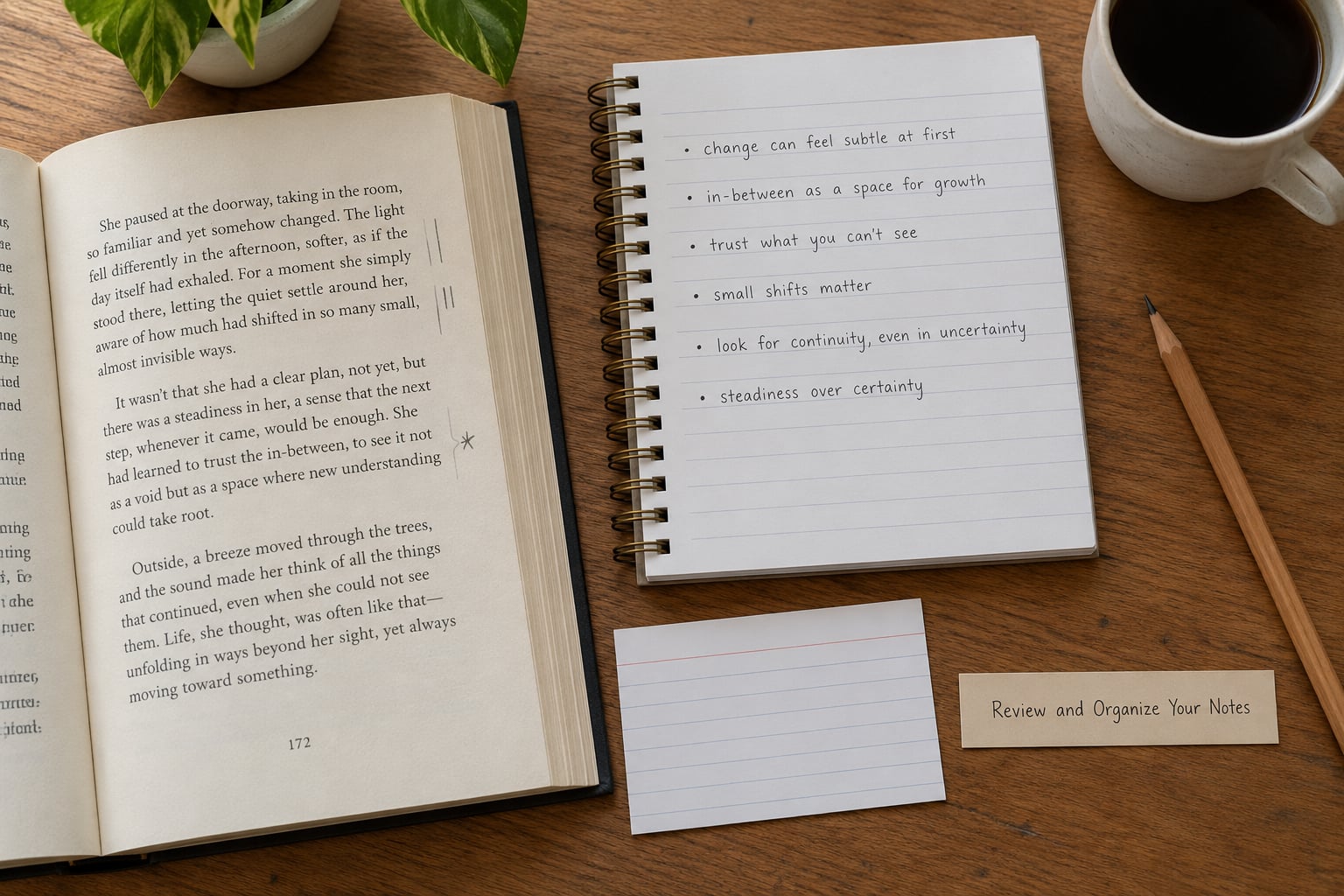
Spend five minutes at the end of each session. This is the step that separates notes that get used from notes that become a graveyard, and it is the step almost everyone skips.
Reread what you wrote. Cut anything that does not match your stated purpose. Fill in the cast list with anyone you left out. Turn your one-line chapter summaries into a running plot summary as you go, so you can reconstruct the whole book from a single page if you need to.
At the end of the book, do three specific things. Write a one-page summary in your own words, before rereading any of your notes, because that is the version you actually retained. Then read your notes against the book and mark the three moments that mattered most. Then pull everything for one character or one theme into a single list, which is your essay evidence and your book club contribution at the same time.
Readers report this combination — marks while reading, one page of summary afterwards — as the most reliable habit they actually keep, and the reason it works is that the summary has to be written from memory. That is the whole retention trick.
You will know the review worked if you can look at your notes and tell someone what the book was about without opening either one.
Common Mistakes
Five problems come up repeatedly, and each one has a fix you can apply mid-book without starting over.
1. Highlighting everything that feels important. A page where everything is marked has nothing marked. Fix: no more than one mark per page, and if a page has two, one of them is wrong. Highlights mark things you will point at again, which is a much smaller set than things that felt good.
2. Copying long passages. It feels efficient and it is not. Transcribing text teaches you almost nothing, because the effort goes into the fingers instead of the meaning, and it slows you enough that you abandon the habit within a week. Fix: a short quote in your own notebook, then one sentence explaining why it mattered.
3. Recording every detail, including plot summary. Page-by-page notes become thousands of words you will never reread. Fix: chapter summaries of three to five lines, cast list entries with page numbers, and turning points only. Everything else can be recovered from the book itself if you need it later.
4. Forcing a theme too early. You spot a motif in chapter three, decide what the book is about, and then read the rest looking for proof. Fix: hold interpretations in the read column, separate from evidence, and only promote one to a theme once you have three instances with page numbers.
5. Never looking at the notes again. Capturing is not learning, and a notebook you never reopen is a diary. Fix: the five-minute end-of-session review. If you skip it, cut the volume of notes instead, so the little you keep is worth keeping.
One last thing. If annotating is slowing you to the point where you dread picking the book up, stop annotating. Reading for pleasure is the base activity, and everything in this guide is an add-on to it, not a replacement for it.
Frequently Asked Questions
Should you take notes while reading a novel?
Take notes when the reading has a job attached to it: a class, an essay, a book club, or a book you know you will want to remember. Skip it when you are reading purely for pleasure, where marking the page often pulls you out of the story. A good middle position is light marks while reading and a written summary afterwards. Readers who plan to write about or teach a book usually report that the notes stop feeling like a chore.
What should I write down while reading fiction?
Five things earn their place: character changes, turning points, repeated images or symbols with page numbers, craft choices worth quoting, and your own questions and reactions. Skip anything that only restates what happened on the page, and skip copying long passages. Write summaries in your own words and label interpretation separately from evidence so you can tell later which is which.
How do I keep track of characters in a novel with a big cast?
Keep one cast list in a single place for the whole book, with four fields per character: name, who they are to the narrator, the page they first appear on, and one word for what they want. Add only the characters who do something, and let the page numbers do the tracking for you. Most readers find they remember forty wants far better than forty names, and the list makes a re-read dramatically easier.
Should I use paper or digital notes for novels?
Paper is easier to recall from, because handwriting and page position act as memory cues, and it never needs charging or syncing. Digital notes are searchable, hold more text, and quote cleanly into an essay with a citation. Most readers end up mixing: light marks on the page for finding things later, and longer notes in a notebook or document for thinking. Pick the one that works on a commute and keep it.
How do I take notes on a book I cannot write in?
Check first whether your library permits it, since many explicitly allow pencil and sticky notes but not ink. For books you do not own, use removable sticky notes rather than writing on the page, photograph the pages with your phone and annotate the images, slip index cards into the chapter openings, or print long texts two-up to create margin space. Notes also belong outside the book entirely in a notebook.
How do I turn reading notes into study material?
Write a one-page summary from memory before you reread any of your notes, since that version is what you actually retained. Then sort your notes into character, theme, and craft piles, each with page numbers. Everything in one pile becomes a paragraph or a discussion point. Revisit the pile a week later and again before an exam, spaced a little each time, rather than rereading everything once.
Conclusion
Start with three things and nothing else: a one-sentence reason for reading this particular book with notes, a cast list, and a notebook page per chapter. Pick a pencil, decide on three symbols, and mark only what changes or resonates. Then spend five minutes at the end of each session turning those marks into three lines and a question.
That is the whole system. Keep it for one book, and if it still feels like work when you reach the last chapter, you have learned what you needed, which is that this particular book was better read straight through.