
Good book club discussion questions anchor the group to a specific moment in the text, then ask readers to compare, judge, or apply it. That combination forces an opinion instead of a fact, which is the whole difference between a lively table and twenty minutes of plot recap. Writing them takes about 30 minutes once you know the method, and no special background beyond having read the book yourself.
The trouble is that most question sets are built backwards. Someone remembers a moment they liked, dresses it up as a question, and hands the group something with only one possible answer. Fix that and everything else gets easier, and learning how to write book club discussion questions stops being guesswork.
Table of Contents
- What You Need
- Step-by-Step: How to Write Book Club Discussion Questions in 7 Steps
- 1. Read the Book Closely and Mark Important Passages
- 2. Decide What the Discussion Should Explore
- 3. Collect Details the Group Can Discuss
- 4. Write Open-Ended Questions
- 5. Include Several Kinds of Questions
- 6. Test Each Question for Discussion Value
- 7. Assemble and Format the Final Question Set
- Common Mistakes That Kill a Discussion
- Frequently Asked Questions
- How many book club discussion questions should I prepare?
- How long should each book club discussion question be?
- How do I write book club questions that do not have one right answer?
- How can I prevent spoilers when preparing discussion questions?
- How do I create questions that work for a difficult or controversial book?
- Conclusion: Start With Three Questions Tonight
What You Need
Four things, and three of them you already have. The finished book, a notebook or a document to type into, and a clear sense of who is coming. That last part matters more than people expect, because a set built for four close friends will feel like a seminar to twelve strangers, and a set built for a classroom will bore a two-person club to death.
Optional but useful: quick notes on the characters who carry the most weight, the themes you suspect the book is about, and any passages you know will start an argument. If the club has already met before, add two things that landed well last time and two that visibly flopped. That record is worth more than any generic advice you’ll find online.
One last item, if the group is large or new: decide now how the questions will be used. Six questions read aloud to fifty people is a very different artifact from ten questions printed on a sheet for a table of eight to work through together.
Step-by-Step: How to Write Book Club Discussion Questions in 7 Steps
Read closely, choose a focus, gather details, draft in open-ended form, balance the types, test them, then format. Each step below tells you what to do and how to tell it worked.
1. Read the Book Closely and Mark Important Passages
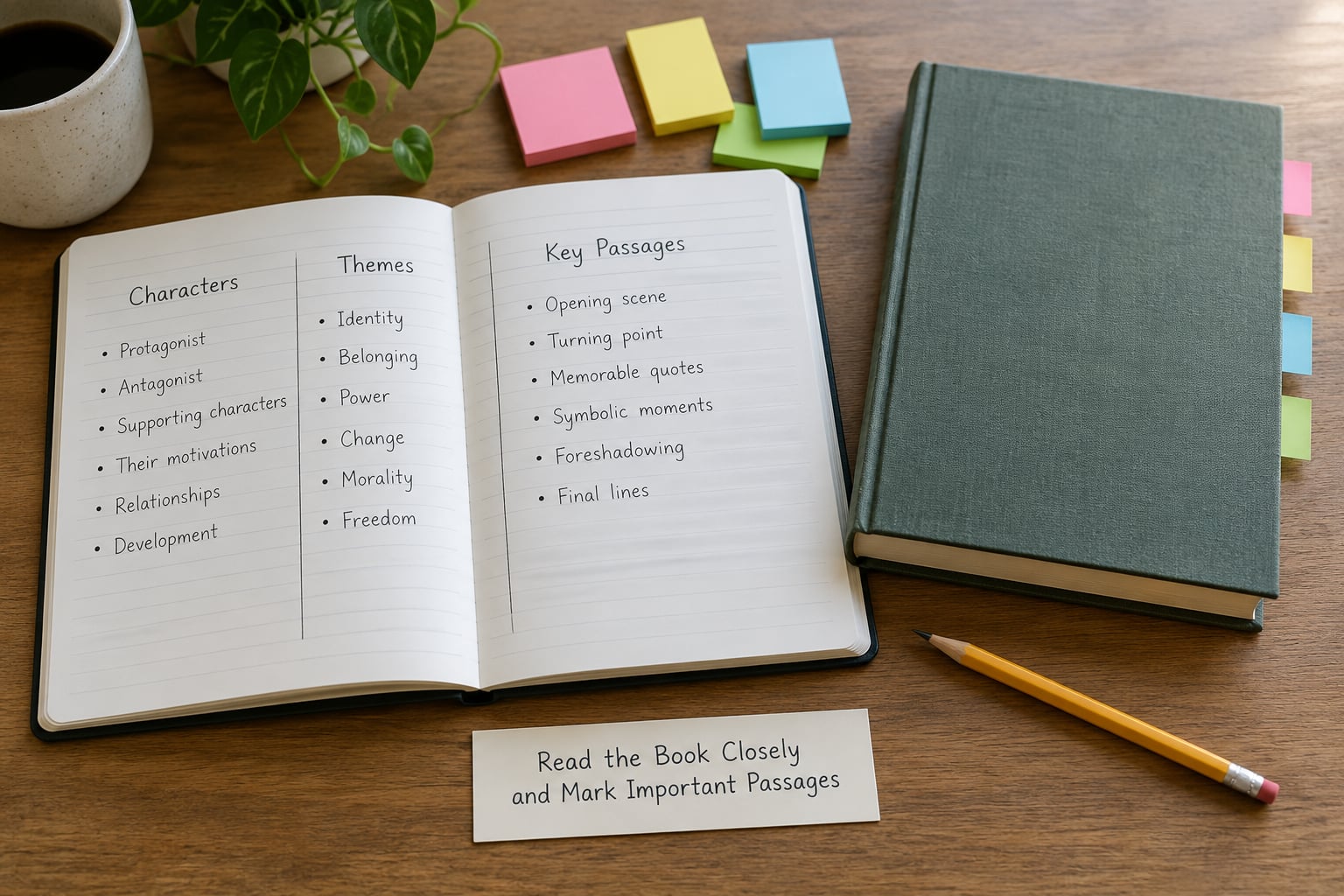
You are hunting for moments that can carry an argument, not moments that are interesting. Six categories do most of the work: a conflict that changes something, a character who behaves differently than they did at the start, a recurring image or object, a setting that shapes behaviour, a piece of history or context the book leans on, and the theme the book keeps circling without stating outright.
Tab or flag those pages as you read rather than writing questions on the spot. You don’t yet know what the group can carry, and a half-formed question written in a hurry tends to survive all the way to the meeting.
You know step one worked when you have six to ten flagged pages and at least one of them is a page you would happily argue about yourself. If your flags are all plot mechanics, keep reading.
2. Decide What the Discussion Should Explore
Pick one focus and write it at the top of your notes. Character motivation, craft choices, social or historical context, competing interpretations, or the ending. A set with a stated focus reads coherently. A set built from whatever you noticed reads like a pile.
3. Collect Details the Group Can Discuss
For each flagged page, write down four things: what happened, who was involved, what changed afterwards, and what the author might have been trying to do. That last column is where the good questions live, because it hands the group something to push back on.
If you can’t fill all four lines for a passage, it probably isn’t worth a question. Flag it as context instead.
4. Write Open-Ended Questions
Open-ended questions start with why, how, what, and which, and they cannot be finished in one word. Closed questions end in a yes or a no, or ask the group to recite something printed on the page.
Here is the contrast in practice. “Did you like the ending?” closes the door: yes or no, done. “What did you make of the ending, given how the last chapter set it up?” asks for evidence and invites disagreement.
Two more traps to avoid. Questions answerable directly from the text (“What happens in chapter 7?”) turn the group into a quiz team. And vague prompts (“What did you think of the book?”) produce shrugs, because nobody knows which of 400 pages you mean.
A useful test: read the question aloud and ask whether two people could give opposite answers and both be right. If not, rewrite it. Most drafts of how to write book club discussion questions fail here, where the wording quietly collapses into something the group can finish in a single word.
5. Include Several Kinds of Questions
A balanced set covers character, theme, plot, setting, context, symbolism, and craft, in roughly that proportion of attention. Start with observation, because it gives quieter members an easy entry, then move to interpretation, then close with something playful.
Concretely: two character questions about what a person wanted and what stopped them, two theme questions about what the book keeps returning to, two plot or structure questions about why the author arranged things this way, one context question, and two craft or hypothetical questions. If every question is about character, the group will exhaust itself by question four.
6. Test Each Question for Discussion Value
Run each draft through five checks. Does it ask for exactly one idea? Can you point to the passage that supports it? Could a thoughtful reader disagree? Is there no single obvious answer the group will converge on in five seconds? And can it be answered using only the book, with no research the group hasn’t done?
Fail two or more checks and the question goes back to step three. That failure is normal; most first drafts fail on the “one obvious answer” test.
7. Assemble and Format the Final Question Set
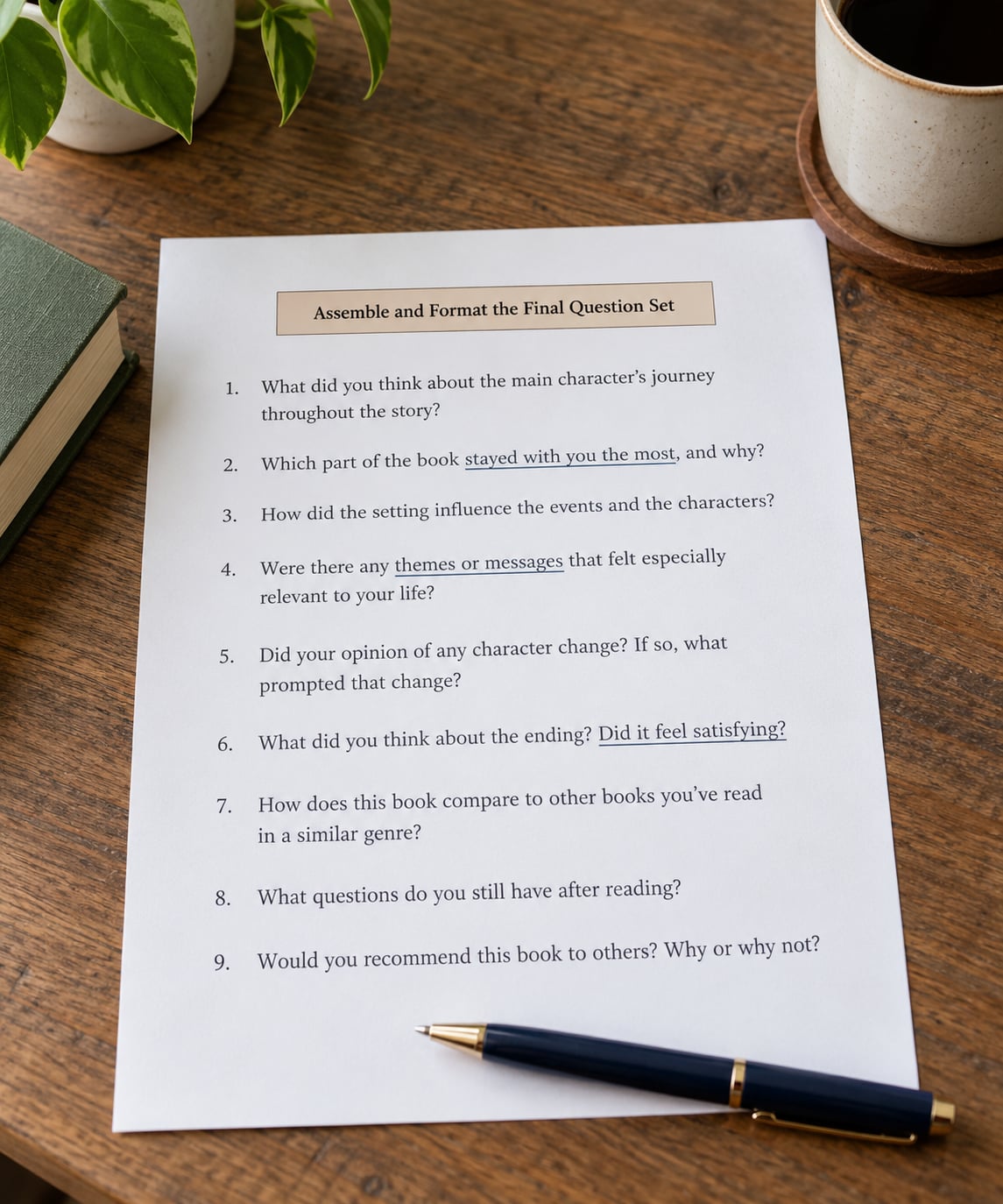
Cut duplicates, delete filler words, and add a passage reference where the group might remember the moment differently than you do. Then land on eight to twelve questions for a 60-minute meeting. Fewer than six and you will be improvising by the halfway mark; more than twelve and nobody gets past question four.
Put your strongest question third and your most divisive one near the end. Number the list, leave a blank line between questions, and write the passage references in parentheses so a host can skip them if the group has the book open. Knowing how to write book club discussion questions is more editing than drafting, and this is where the editing happens.
A quick fill-in formula helps when you are writing under time pressure: [a specific detail from the book] + [a comparison or choice] + why or how. “The letter Elena burns in chapter 4, compared with the one she keeps, raises what question about what she is willing to lose?” That pattern produces a usable question from almost any passage.
Common Mistakes That Kill a Discussion
Here are the failures I see most, and the fix for each.
Questions that are yes-or-no in disguise. “Was the ending satisfying?” has no room in it. Rewrite so that two reasonable readers could answer differently, then ask for the reason.
Plot recall dressed up as analysis. “How did the war affect the family?” collapses into a summary. Ask what the author does with the war instead of what happened during it.
Academic wording that frightens people. “Discuss the subversion of the Bildungsroman tradition” is a classroom prompt. Say what you mean in plain words; you can keep the academic version for a school setting where it’s expected.
Questions unrelated to the book’s actual content. Generic sets written for “any book” are filler. Use a generic set only as a backup for a book nobody has prepared for.
Leading questions with a built-in verdict. “How tragic was the ending?” announces the answer. Ask “what happened in the final chapter, and how did you react?” and let the room decide.
Too many questions at once. Twelve is already the ceiling for an hour. Aim for eight good ones.
Every question landing at once. If you hand out the full list, the meeting becomes a worksheet. Hold back two or three and use them when the group runs dry or the conversation is circling.
No closing question. End with something light, like a best line, worst line, or a casting choice. Hosts report the playful questions land best when they run after the heavier material, not before it.
Two facilitation habits go a long way. Ask each question, then wait five seconds before speaking, because the pause is where answers come from. And when one member takes every turn, hand the floor to someone by name with a question they can answer, rather than trying to balance the air.
Frequently Asked Questions
How many book club discussion questions should I prepare?
Prepare eight to twelve for a standard 60-minute meeting, and hold three back as reserves. That gives roughly five minutes per question with room for the conversation to run long on a good one. For a 30-minute meeting, five questions is plenty. For a large group split into small tables, give each table four and keep the rest for a whole-room round.
How long should each book club discussion question be?
One sentence, about fifteen to twenty-five words. Long questions give people three things to track at once, and the group ends up answering the easiest part. A short question with a passage reference underneath is easier to answer and easier to discuss for another ten minutes.
How do I write book club questions that do not have one right answer?
Anchor the question in a specific detail, then ask for judgment, comparison, or reasoning rather than recall. Ask why the author made a choice, or what two characters would each say about it, rather than what happened. If two readers can disagree and both be right, the question works.
How can I prevent spoilers when preparing discussion questions?
Stick to the first two-thirds of the book and flag the ending separately as an optional final question. Write ending questions on a second page a host can choose to skip. Also state the rule out loud at the start, since most spoiler complaints come from someone who read ahead rather than from a badly written question.
How do I create questions that work for a difficult or controversial book?
Start from a character’s choice rather than a position on the issue, so members are analyzing a decision rather than defending an identity. Pair each heavy question with one lighter or craft-focused question to let the room breathe. And keep the ground rules set before the book is opened, not after the first disagreement.
Conclusion: Start With Three Questions Tonight
The method in short: read for moments worth arguing about, pick one focus, gather details, phrase everything as open-ended, balance the types, test them, and cut down to what fits the hour.
Don’t try to write the full set yet. Write one question about a turning point, one about a theme the book keeps returning to, and one about a choice the author made with the writing itself. If those three produce ten minutes of real talk between you and the page, the rest of the set will hold up. That is the whole of how to write book club discussion questions worth an evening, and it gets easier every time you run it on a real book.