
How to narrow a research topic for a paper comes down to one move: cutting a wide subject down to a single facet you can actually argue about inside your word limit. The method is simple: read the assignment, name the subject in a sentence, pick one angle, add boundaries for time, place, or theme, test it against real sources, and draft a working thesis. Thirty focused minutes is usually enough if you resist browsing.
Students stall here because narrowing feels like losing interest. It is the opposite. A broad subject produces the shallow summary an encyclopedia already gives you for free; a narrowed one lets you say something your sources have not quite said yet. The whole process fits into a short sprint, and the checkpoints below tell you when a topic is ready.
The short version, in seven moves:
- Read the prompt and pull out length, scope, evidence type, and audience.
- Write the broad subject as one plain sentence with no details.
- Pick one main idea worth investigating, judged by relevance, evidence, and interest.
- Interrogate it with who, what, when, where, why, and how questions.
- Draw hard boundaries around period, geography, text, or theme.
- Run a five-minute database search and count the credible sources.
- Convert the narrowed topic into a research question and a working thesis.
One warning before you start. Roughly half the students who panic about a broad topic end up with the opposite problem, a corner so small that three sources exist and none of them argue against each other. Steps 5 and 6 exist to catch that.
Table of Contents
- What You Need to Narrow a Research Topic
- Step-by-Step: Seven Steps From Broad to Focused
- Step 1: Start With the Assignment Requirements
- Step 2: Write a One-Sentence Broad Description
- Step 3: Choose One Main Idea to Investigate
- Step 4: Ask Questions That Get More Specific
- Step 5: Set Boundaries for Time, Place, and Theme
- Step 6: Test the Topic With a Quick Search
- Step 7: Turn the Topic Into a Working Thesis
- Common Mistakes and How to Fix Them
- Frequently Asked Questions
- How do I know if my research topic is narrow enough for a paper?
- Is it better to write a research paper topic as a question or a statement?
- How can I narrow a topic that is already very specific?
- What if I cannot find enough sources on my narrowed topic?
- Should I choose a topic based on my opinion or the available evidence?
- How do I narrow a literature topic without reducing it too much?
- Conclusion
What You Need to Narrow a Research Topic

Gather five things before you touch a database. Missing any one of them turns narrowing into guesswork.
- The assignment prompt. Read it twice and underline every constraint. The page or word count is the single most useful number on the sheet.
- Preliminary notes. Lecture notes, textbook margins, anything your instructor said out loud that felt specific.
- A working research question. A rough draft is fine. You are testing it, not defending it.
- Reliable source options. Know which database, archive, or collection you can reach from your account before you promise yourself a topic that lives in a paywalled archive.
- A one-page scope statement. One page of prose stating what the paper will cover and, just as importantly, what it will not.
The scope statement is the item people skip and later regret. Writing half a page about what your paper deliberately ignores forces you to make a choice, and choices are the whole exercise.
Step-by-Step: Seven Steps From Broad to Focused
Step 1: Start With the Assignment Requirements
Four details tell you how narrow to go: required length, assigned scope, the kind of evidence your instructor expects, and the audience. A 2,500-word paper on nineteenth-century American literature cannot hold the Civil War, abolition, westward expansion, and Reconstruction. Your instructor already knows this, which is why the prompt usually names a stretch of time or a handful of texts.
An assignment that reads “argue a position about The Great Gatsby and the American Dream” has done half your narrowing. Note the assigned scope first, then decide where inside it you want to dig.
Step 2: Write a One-Sentence Broad Description
Say your subject plainly, without adding anything. “Climate change” is a subject. “Climate change” with a place, a decade, and a mechanism attached is already a paper. Write the plain version first so you can see how much room you have left to cut.
Try it. Most students cannot get a broad description under fifteen words without sneaking in a detail. That difficulty is the signal.
Step 3: Choose One Main Idea to Investigate
A broad subject splits into three or four legitimate angles, and picking between them feels arbitrary. Four tests help: relevance to the prompt, whether evidence exists, whether you actually care, and whether the assignment permits it.
Write each candidate on its own line with one supporting reason. The angle that survives all four filters is your main idea. Choose the facet you could spend a whole semester on rather than the one that sounds most impressive to your classmates.
Step 4: Ask Questions That Get More Specific
This is where narrowing actually happens. Take your main idea and interrogate it.
- Who is affected, deciding, or arguing? A group, an institution, a demographic, an author.
- What specifically is changing, disputed, or unproven? Name the variable, not the field.
- When does it happen, and what marks the start and end of your window?
- Where does it happen, down to a city, a region, or a single site?
- Why does it matter, and to whom?
- How did it happen, and through what mechanism?
Pick two and combine them. What plus where, what plus how, when plus who. History of the American Civil War becomes federal policy toward Black military veterans between 1865 and 1870, which is a researchable subject with a real archive behind it.
Step 5: Set Boundaries for Time, Place, and Theme
Boundaries are how to narrow a research topic for a paper without shrinking it into nothing. Four levers work almost every time: a historical period, a geographic area, a single text or body of work, or one theme. Add two of them and your paper stops being a survey.
Literature topics need special care, because you can cut a text down to one image and lose the argument with it. Narrow by interpretive question rather than by object: not “symbolism in Fitzgerald” but how Fitzgerald uses a single object to track the narrator’s drift between the novel’s 1925 setting and its present-day frame.
Step 6: Test the Topic With a Quick Search
Spend five minutes in a library database, not Google. Type your narrowed topic, apply a date filter and a subject-index filter, then count the credible results.
- Too little means zero to four usable sources. Broaden one boundary, usually the time period.
- Working range is roughly five to fifteen sources for an undergraduate paper. Enough to compare, few enough to read.
- Too much means forty-plus hits with no arguing between them. Add a boundary.
Then read the titles and abstracts only, about three minutes. You are not researching yet. You are checking that the sources talk to each other rather than repeating the same fact. The practical rule that circulates on r/AskAcademia is simple: if you cannot find five credible sources, you have probably gone too narrow.
Step 7: Turn the Topic Into a Working Thesis
A narrowed topic is still a subject. A research question asks something answerable; a working thesis answers it provisionally so you have something to argue against while you read.
Take your narrowed topic, federal policy toward Black military veterans, 1865 to 1870, and push it into a question: to what extent did federal policy meet the needs of Black veterans after the Civil War? Then a provisional answer: it addressed pensions reliably but failed on land and education because funding fragmented across agencies.
Hold that thesis loosely. Narrowing is a loop, not a single decision, and your thesis will likely shift once you have six sources in hand.
Common Mistakes and How to Fix Them
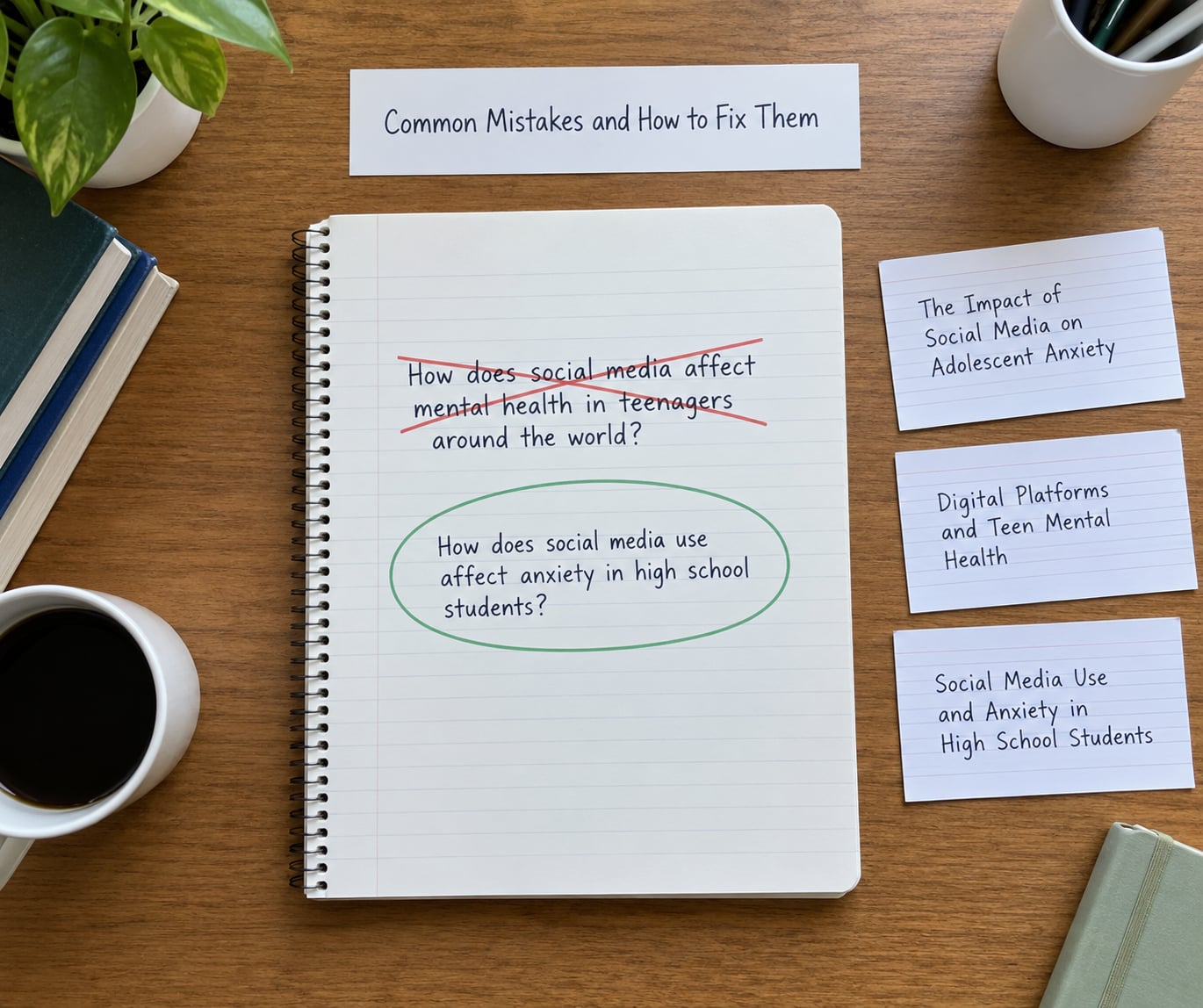
The topic is far too broad. You cannot write three or four sources on it, only summarize an encyclopedia. Fix: add a time boundary and a population, then retest. “Book banning” becomes school district responses to challenged novels across a defined five-year window.
The topic is too narrow. Three sources exist and they all agree, so there is nothing to argue. Fix: widen one boundary rather than abandoning the idea. Move the geography out one level, or extend the period by a decade.
The topic is too familiar. Everyone in the class wrote on it and you can predict the sources from the textbook index. Fix: take the same subject and attach a case nobody in the course has used, or shift from what happened to why it happened.
You picked the argument first. You started from a position you hold and then went looking for a topic to justify it. Fix: keep the position, but swap in evidence that could genuinely disconfirm it. If no source could ever disagree with you, your paper has no work to do.
The topic ignores the prompt. You fell in love with a subject outside the assigned scope. Fix: write down what the prompt requires in one line and check your topic against it before anything else.
You are stuck in reading. Topic search has turned into a slow literature review with no decision at the end of it. Fix: set a timer, stop at the titles-and-abstracts stage, and force a decision. A topic you can revise beats a topic you never choose. Talking to your instructor or a librarian early is normal practice, not an admission that you failed.
One more habit worth copying from grad students who finish on time: run the narrowing sprint twice. Once now, and again after your first six sources, when your evidence tells you which facet deserves the space.
Frequently Asked Questions
How do I know if my research topic is narrow enough for a paper?
Run a five-minute library database search and count credible results. For an undergraduate paper, roughly five to fifteen usable sources means you are in the right range. Fewer than five and you should widen one boundary, usually the time period. Forty or more with no sources disagreeing means your topic is still broad. You also want enough material to make an argument, not just describe a fact.
Is it better to write a research paper topic as a question or a statement?
Write the topic as a question and the thesis as a statement. A question signals what you intend to investigate and keeps you open to an answer that surprises you. A statement offered too early is usually a position you adopted before reading anything. Once you have six or seven sources, convert your question into a working thesis you can revise.
How can I narrow a topic that is already very specific?
Widen along one axis only. Move the geography out a level, extend the period by a decade, or shift the focus from a single person to that person’s institution or network. Do not widen everything at once, or you are back where you started. If a topic came from an assignment sheet, re-read it before widening, since the prompt may be the thing forcing the specificity.
What if I cannot find enough sources on my narrowed topic?
Loosen the least important boundary first, not the one your argument depends on. Change the place, then the period, then the sub-theme. If the topic came from a required reading list, your instructor expected sources to exist, so check the course library databases rather than a general search engine. If you still find nothing, bring the topic to your instructor with two or three candidate widenings already drafted.
Should I choose a topic based on my opinion or the available evidence?
Let the evidence decide and keep your opinion for the argument stage. Searching first tells you whether sources disagree with each other, and a paper on a settled question has nothing to contribute. Pick a topic where credible sources genuinely conflict. Your own position still matters, but it should emerge from the reading rather than lead you away from it before you start.
How do I narrow a literature topic without reducing it too much?
Narrow by question rather than by object. Instead of picking one image or one chapter, choose an interpretive problem that runs across the whole work or across two texts. Ask how a text handles a specific idea, then bound it with a period or a comparison. That keeps the full argument in play while still giving you a claim you can defend in a short paper.
Conclusion
How to narrow a research topic for a paper comes down to shrinking your subject until it fits the assignment, then testing that it still has something to say. Read the prompt, name the subject in one sentence, cut to one angle, add two boundaries, and check the source count before you commit.
Do the first piece today. Write your broad subject on one line, list three angles underneath it, and run a five-minute search on the smallest one. A topic you can revise later beats a perfect topic you never settle on.