To take research notes on index cards, write the citation and page number on the first line of the card, put exactly one idea underneath it in your own words, and file the card under that idea rather than under the book. Repeat that for every idea worth keeping.
That single rule does most of the work. One idea per card forces you to summarize instead of transcribe, and a citation on the top line means you never have to hunt for where a claim came from six weeks later.
I keep a box of 4×6 cards by the desk for exactly this. Somebody in r/Studium put it plainly: after trying every digital option, what actually worked was index cards and a few colored fineliners. Others in r/GradSchool flatly refuse electronics for this. Nothing below requires a device.
Table of Contents
- What You Need
- Step-by-Step: How to Take Research Notes on Index Cards
- 1. Set Up a Reference Card for Each Source
- 2. Read with a Specific Purpose
- 3. Put One Main Idea on Each Card
- 4. Record the Page Number and Citation Key
- 5. Add Your Own Interpretation
- 6. Sort, Review, and Connect the Cards
- A Strong Index Card Note Example
- Common Mistakes and Quick Fixes
- Useful Tips for Researching with Index Cards
- Frequently Asked Questions
- How many index cards should I buy for research?
- Should I write direct quotes or my own words on research cards?
- Should I organize index cards by source or by idea?
- How do I organize index cards by topic?
- Should I use index cards or a note-taking app for research?
- Conclusion
What You Need

The whole setup is small: a source worth reading, index cards, one citation format, and somewhere to file them. That is genuinely the list.
- A source to read. A book chapter, an article, a primary document. The card method only works if you are working from something specific rather than a vague topic.
- Index cards. One pack of 4×6 is plenty to start. Buy the second pack before you think you need it.
- A reference card for each source. One card per book or article, filed separately from everything else.
- Note cards. These hold one idea each and multiply fast.
- One citation format. Pick MLA, APA, Chicago or your own short key. Consistency matters more than which one.
- A box, envelope or folder. A shoebox works. So does a single-cabinet card index if you are past a few hundred cards.
On pens: ink, not pencil. Pencil smudges, fades in sunlight and can be erased by a careless sleeve, and a research file that fades is a research file you cannot trust. Water is the other quiet threat, along with static, which lifts toner off cards stacked in a humid room.
Card size is a real choice, not a preference. Ruled cards with a margin help when you are transcribing passages; blank cards suit paraphrasing. I use 4×6 for anything literary and 3×5 for short definitional facts.
Step-by-Step: How to Take Research Notes on Index Cards
The system has six moves. The first is administrative, the rest are habits you repeat for every source.
1. Set Up a Reference Card for Each Source
Write one master card per source before you read a word of it: author, title, publication or website, date, and the page range you expect to use.
Give that card a short identifier, something like R-142, and write the same identifier on every note card you create from that source. Umberto Eco’s version of this method works the same way, with one bibliographic card per book kept apart from the reading notes. It takes about two minutes and it means you never retype a citation.
2. Read with a Specific Purpose
Turn the assignment prompt into a research question, then preview the headings and summary before reading. Decide what kind of evidence would answer it.
Reading without a question produces cards full of interesting facts you will never use. Reading with one produces a small number of cards you will use immediately. You can tell step two worked if you can say, in one sentence, why you are holding the book open.
3. Put One Main Idea on Each Card
One card carries one definition, one claim, one example or one event. If you need two cards, write two cards.
This is the whole method in one instruction, and it is the rule researchers keep breaking. A card that holds a definition plus an example plus a quote cannot be sorted, cannot be cited cleanly and cannot be moved into an outline later. The practical test: can you label the card in four or five words? If not, the card holds more than one idea.
Niklas Luhmann’s slip-box, the system Sönke Ahrens later wrote about in How to Take Smart Notes, runs on this same atomicity. The physical constraint is the point. A card that cannot hold more forces the thinking that would otherwise happen later, while you are tired.
4. Record the Page Number and Citation Key
Write the exact page beside the idea, and include the citation key from step one so evidence can be found and cited without a hunt.
For print, page numbers are enough. For a webpage, capture the section heading or paragraph number, because URLs shift. For anything without stable pagination, screenshot it and write the date you accessed it. A quotation without a location is a quotation you cannot use, and instructors know it.
5. Add Your Own Interpretation
Add a short reaction or connection explaining why the evidence matters, and separate it visibly from what the source says.
A bracketed line reading [my note: this contradicts the Jones reading, p. 112] takes five seconds and turns a transcription into an argument. This is the step most people skip, and it is the reason notes collected by somebody else never feel like yours. Keep the bracket and the boundary stays clean.
6. Sort, Review, and Connect the Cards
File cards under meaningful topic headings, pull cards from different sources side by side, drop duplicates, and test whether the set holds up.
The test is simple: read only the topic labels. Do the labels tell a coherent story? If they do, you have an outline forming itself. If they do not, the problem is usually the labels, not the reading.
A Strong Index Card Note Example
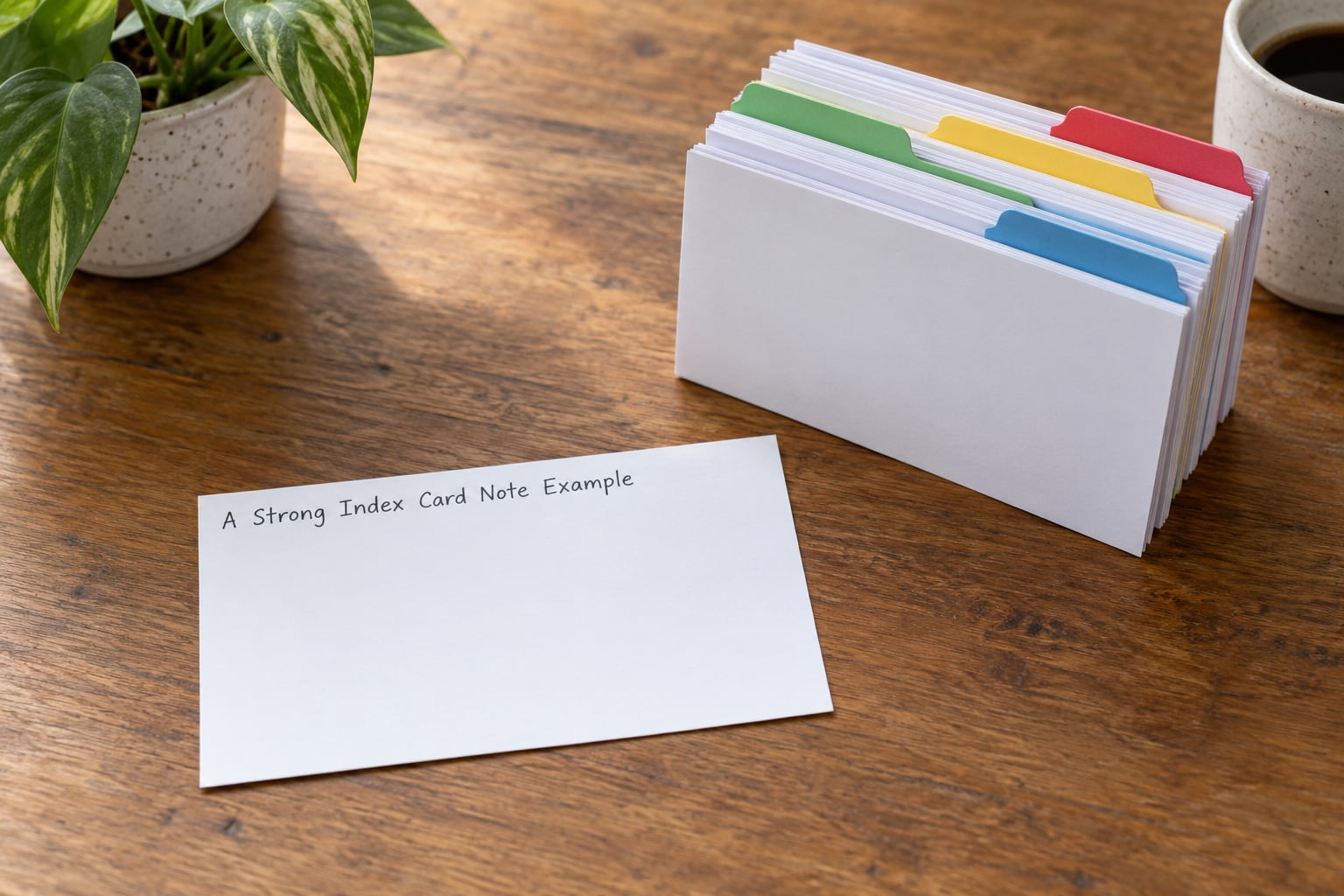
A finished card looks like this. The top line carries the citation and location, the body carries one idea in your own words, and your reaction sits apart from both.
FRONT  (a worked example, source details invented)
------------------------------------
TRAINING AND DISCIPLINE - Reyes p.34
------------------------------------
Labour discipline is maintained
mainly through control of workers'
time on the job, not through
physical supervision or wage
incentives. Timekeeping replaced
direct oversight as factories grew.

-> R-089, R-201
[my note: read against Okonjo p.9]

------------------------------------
BACK
------------------------------------
"discipline becomes a matter of
the correct use of time" (p. 34)
Compare R-089 on the clock vs the
supervisor - same mechanism, no
overseer present.
Three things make that card work. The citation and page are above the idea, so they never get separated from it. The body is paraphrased, so the risk of accidental plagiarism sits close to zero. And the reaction is bracketed, so when you draft from this card in March you can tell your thinking apart from someone else’s.
Keep verbatim quotations on the reverse, in quotation marks, with their page numbers, and only when you genuinely plan to quote. A reader on forum.zettelkasten.de raised the standard objection: putting exact quotes in your notes seems to violate the spirit of a system built on your own ideas. The resolution is simple. Quotation is not the opposite of note-taking. It is the record of the exact words that produced your paraphrase.
Common Mistakes and Quick Fixes
Six failures break most paper research files, and each has a short correction.
- Copying whole passages. Fix: cover the source and write the idea from memory, then reopen and check your summary.
- Cramming several ideas onto one card. Fix: split it. One card per idea, every time.
- Missing the location. Fix: if the page number is not on the card, the idea is not finished.
- Vague labels. Fix: use four or five specific words, like “training and discipline,” not “chapter 3.”
- Inconsistent abbreviations. Fix: pick one scheme and write it on the reference card, so page 34 and pp. 34-38 never mean different things.
- Never testing the set. Fix: read the labels alone. If the story is not there, the cards are not ready.
Two more worth naming: using pencil, which fades; and writing across the whole card with no margin, so the reverse becomes invisible. Write on one side. It sounds fussy, and it is the reason people flip a card by mistake and lose the note they needed.
Useful Tips for Researching with Index Cards
Color coding works best with four colors and a fixed rule. Blue for definitions, green for examples, yellow for open questions, red for tasks. Any more than four and you are making a code you will not remember in March.
Numbering beats color for retrieval, because you can sort a number and you cannot sort a color. Give each card an ID and use prefixes for the type: L- for a literature note, Z- for an idea of your own, Q- for a question you still need answered. Sönke Ahrens makes a related point about situational versus categorical filing, which is worth stealing: file a card by the situation where you will want it, not only by its subject.
Set a review rhythm. Five minutes daily to file loose cards. Once a week, re-read the labels and pull clusters onto a stand. Once a month, cull anything you have not touched. Research files die of neglect, not of disorder.
Plan for scale honestly. A few hundred cards is comfortable. A thousand is workable with an ID system and dividers. Several thousand is where paper stops being fun, and forum threads on graduate study describe exactly that wall: thousands of keywords, thousands of boxes. When you get there, archive by ID and pull a subset onto a stand when drafting, rather than trying to hold the whole system in your head.
You can move the whole thing into Zotero or Obsidian later without starting over. Type each card in with its ID as the key, and you get a digital file that keeps the retrieval logic you already built. If you would rather never touch a device, skip that step. The paper system stands on its own.
Frequently Asked Questions
How many index cards should I buy for research?
Start with one pack of 4×6 cards and a second pack of 3×5. A single source commonly fills fifteen to thirty cards once you capture a citation card, one idea per note, and quotations on the reverse. A literature review of twenty sources can pass five hundred cards, so buy more than feels generous; unused cards cost nothing compared with a missing citation you cannot recover.
Should I write direct quotes or my own words on research cards?
Put the idea in your own words on the front, and keep any exact quotation on the reverse in quotation marks with its page number. This keeps your paraphrase as the working note and preserves the source’s wording as evidence. Record the quotation only if you genuinely expect to quote it, since an unattributed phrase on a card can migrate into a draft by accident.
Should I organize index cards by source or by idea?
File by idea, and keep one separate reference card per source. Filing by source means reading a whole book in one sitting and finding nothing at drafting time, because every relevant card is scattered across dozens of files. Filing by idea lets you pull three cards from three books on the same question and see the argument, which is the only reason to keep notes at all.
How do I organize index cards by topic?
Write a specific topic label of four or five words at the top of every card, then sort by label rather than by source. A card index or a set of labeled divider tabs in one box works well. Keep the active cards on your desk and archive the rest by ID, and set aside ten minutes each month to cull anything you have not used.
Should I use index cards or a note-taking app for research?
There is no universal winner. Cards force one idea per card, work without a device and stay legible years later, but they do not search, sync or share. Apps search instantly and back up themselves, but they let you keep taking notes without ever deciding what a note is for. Many researchers use both, keying digital notes to the same IDs they used on paper.
Conclusion
Start with one source and one reference card. Write your research question on the top of that card, read with it in sight, and put only one usable piece of evidence on each note card. Everything else in this method is a habit built on top of those three moves.