American realism replaced romanticism because the country that romanticism had celebrated no longer existed by the 1870s. The Civil War and Reconstruction broke faith in national progress, while railroads, mills and crowded cities created problems that heroic fiction could not explain. Writers answered with ordinary people, verifiable detail and an objective narrator. Why American realism replaced romanticism is therefore less a style choice than a change in what readers expected a novel to prove.
This guide walks through the causes, the techniques, the authors and the timeline, so you can write a thesis that holds up in a seminar rather than a one-line homework answer.
Table of Contents
- Why Did American Realism Replace Romanticism?
- How Did American Romanticism and Realism Differ?
- What Social and Historical Changes Made Realism Attractive?
- How Did the Civil War Encourage a More Realist Literature?
- Which Authors Led the Shift Toward American Realism?
- Mark Twain: the comic realist
- William Dean Howells: the social realist
- Henry James: the psychological realist
- The Bridge: Local Color and Regionalism
- Beyond the Great Three: Naturalism and the writers often missed
- Transcendentalism and the writers who straddled both eras
- Why Do Some Scholars Say Romanticism Was Not Really Replaced?
- What Is the Timeline of the Change From Romanticism to Realism?
- How Can You Recognize Realism in an American Novel?
- Frequently Asked Questions
- When did American realism replace romanticism?
- Did American realism completely replace romanticism?
- Why did the Civil War influence American realism?
- Who are the major writers of American realism?
- How is American realism different from naturalism?
- Conclusion: What Should You Study First?
Why Did American Realism Replace Romanticism?
Five pressures did most of the work. Each one weakened a promise romanticism depended on.
- The Civil War and Reconstruction. Four years of slaughter followed by a decade of contested emancipation made ideals of innocent optimism and inevitable progress hard to defend.
- Industrialization and urbanization. Factories, railroads, tenements and new immigrant workers created subject matter that heroic pastoral fiction had no vocabulary for.
- Hunger for an American voice. Writers tired of importing British polish and built a native tradition out of frontier vernacular, local color and regional speech.
- Science and Darwinism. Evolution and determinism made plausible causation more persuasive than Providence, and readers wanted characters shaped by forces they could name.
- Inequality and muckraking. Concentrated wealth, wage slavery, railroad corruption and city political machines made readers demand testimony about how things actually worked.
That is the short answer. Everything below unpacks those five, plus the honest complication: the change was gradual, uneven, and never finished.
How Did American Romanticism and Realism Differ?
The differences show up in craft, not just subject. Here is the side-by-side version most classes want.
| Element | Romanticism | American Realism |
|---|---|---|
| Core belief | Imagination and the individual’s inner vision | Evidence, plausibility and social context |
| Typical hero | Exceptional, isolated, morally pure | Ordinary, flawed, socially embedded |
| Setting | Wild or idealized landscape, the frontier as promise | Specific cities, streets, offices, farms with names |
| Language | Euphuistic, elevated, musical | Plain, colloquial, accurate to speech |
| Plot | Conflict of ideals, often prophetic or mythic | Character-driven, causally plausible, often unresolved |
| Narrator | Authorial presence, morally involved | Objective or limited, restrained, rarely sermonizing |
| Ending | Transcendence, revelation, death transfigured | Compromise, exhaustion, an open or ironic close |
Two habits make the difference visible in a single paragraph. Realists show rather than tell and refuse sentimentality: they let a boarding house landlady say something cutting instead of describing her moral failing. Romanticists reach for the exceptional figure whose life is shaped by destiny rather than by rent money.
If you are building a study set, our guides on American literary movements and close reading cover the other periods on the same scale.
What Social and Historical Changes Made Realism Attractive?
Between 1860 and 1910 the United States went from about 31 million people to about 76 million, and a large share of the arrivals came from abroad. Someone writing about “America” in 1875 could no longer assume a homogeneous republic of farmers.
Four changes mattered most for literature:
- Factories and railroads. The transcontinental railroad finished in 1869, and the telegraph let news and goods move faster than anyone had planned for. Movement became ordinary, and so did disruption.
- Cities. Urban populations surged. Tenements, streetcars, offices and saloons gave realists their rooms, their traffic and their recurring locations.
- Immigration. Tens of millions of immigrants arrived in the half century after the war. Novelists wrote about boarding houses, ethnic neighborhoods, the pressure of assimilation and the wage economy.
- A mass reading public. Public schools and cheap periodicals created readers who wanted stories about people they recognized. Cheap monthly magazines and the new pulp novel meant fiction had to hold a paying audience, which favors plots with consequences over poetry in prose.
Money concentrated at the same time. A handful of fortunes existed before the war; by the close of the century industrialists had built fortunes on a scale the older republic had never seen. Novelists wanted to describe both sides of that ledger.
How Did the Civil War Encourage a More Realist Literature?
The war made romantic claims about American destiny hard to hold. Between 600,000 and 750,000 soldiers died, Lincoln was assassinated within days of Lee’s surrender, and Reconstruction produced fraud, violence and a constitutional crisis over citizenship that was still unresolved when realism reached its peak.
The wartime and postwar publishing record shows what readers wanted next. Northern writers who had filed glowing reports from army camps wrote disillusioned accounts of cowardice and waste. The New England magazine The Atlantic Monthly published poems on civic hypocrisy within a year of the armistice, and readers responded to them.
Politics supplied the second lesson. The Grant era’s Credit Mobilier scandal, the Whiskey Ring and the Tweed Ring made corruption a national talking point. Lincoln Steffens’s The Shame of the Cities later packaged the same exposure for a mass audience. The message repeated across the century: institutions deserved watching, and fiction had an obligation to watch them.
Race made the demand sharper still. Emancipation raised a question American literature could no longer evade, and Black writers such as Booker T. Washington, W.E.B. Du Bois and Charles Chesnutt answered it from inside the same decades that produced the canon realist novel.
Which Authors Led the Shift Toward American Realism?
Three writers functioned almost as theorists of the new method, each taking a different version of it.
Mark Twain: the comic realist
Adventures of Huckleberry Finn (1884) hands the narration to a fourteen-year-old outsider who observes a runaway slave and a riverboat criminal without fully understanding what he sees. That is an objective narrator doing work no romantic narrator would have allowed: the moral weight sits in the episode, not in a closing lecture.
William Dean Howells: the social realist
Howells edited The Atlantic Monthly and The Nation, and he argued openly that American writers should stop imitating European polish. In The Rise of Silas Lapham (1885) he traced a family’s decline through land prices, class resentment and business ethics, refusing to reward his characters with moral clarity.
Henry James: the psychological realist
James cared less about social statistics than about how people deceive themselves. The Portrait of a Lady (1881) and The Bostonians (1886) turn on perception, and his narrators stay carefully outside the action, reporting what they can see without verdict.
The Bridge: Local Color and Regionalism
Neither local color (1865–1885) nor regionalism (1875–1895) is realism, but both carried readers across the gap. Local colorists such as Bret Harte, Hamlin Garland and Sarah Orne Jewett recorded speech, weather and local habit with an ear borrowed from the tall tale. Regionalists treated place as a social fact: Willa Cather’s Red River farms and Kate Chopin’s Louisiana are as economically and politically specific as Howells’s Boston.
Beyond the Great Three: Naturalism and the writers often missed
Naturalism pushed realism’s logic further, arguing that heredity and environment determine a character almost completely. Stephen Crane’s Maggie: A Girl of the Streets (1896), Jack London’s Martin Eden and Theodore Dreiser’s An American Tragedy belong to that phase.
Women writers deserve separate credit. Charlotte Perkins Gilman’s The Yellow Wallpaper treats a medical diagnosis as social violence. Sarah Orne Jewett’s “A White Heron” refuses the sentimental heroine. Labeling these writers “regionalist women” narrowed work that was formally ambitious, and historians like Mary Lou Aswell push back on the label.
Transcendentalism and the writers who straddled both eras
Transcendentalism, with Emerson and Thoreau, is usually taught separately, but it overlaps the shift. Emerson died in 1882, and his essays kept the Romantic conviction that individuals could access truth directly. Melville’s Moby-Dick (1851) mixes sublime nature with a narrator who reports what he cannot explain. Dickinson published compressed, epigrammatic poems that read as private Romantic utterance and clipped Realist observation at once, which is why assignments keep arguing about where she belongs.
Why Do Some Scholars Say Romanticism Was Not Really Replaced?
Because “replaced” is too clean a word. Realism became dominant in the novel and in elite criticism; romanticism kept the lyric poem, the nature lyric, the spiritual essay and much of the reading audience. Realism never touched the popularity that dime novels and the sentimental domestic romance held.
Some scholars go further and question the periodization itself. A widely discussed argument holds that American Romanticism was never a single, coherent movement, which makes “replacement” describe a change of market power rather than a change of belief.
The honest version for your essay: realism won the argument about what a serious American novel had to do, and romanticism kept winning readers who wanted music, memory and the sublime. The historiographic case, in both directions, is worth reading before you settle on a single word like “replaced.”
What Is the Timeline of the Change From Romanticism to Realism?
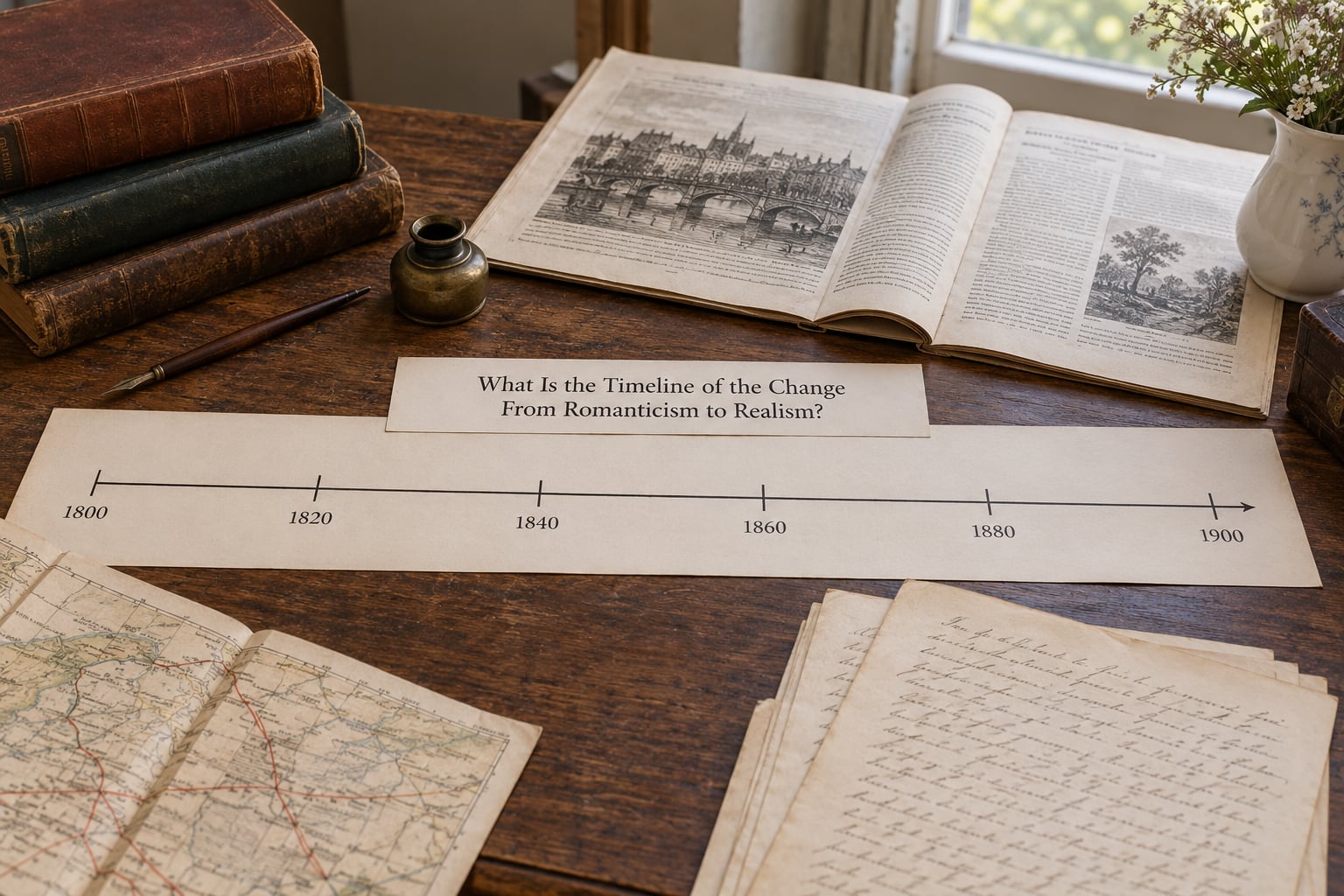
Dates matter here because the change runs in overlapping bands rather than in a single break.
| Period | What was happening in American literature |
|---|---|
| 1820–1860 | Romanticism at its height: nature lyric, the transcendental essay, Cooper’s frontier myth, Poe’s Gothic fiction |
| 1861–1865 | The Civil War interrupts publishing; war memoirs and poetry displace pastoral confidence |
| 1866–1875 | Reconstruction disillusionment, Grant-era scandals, muckraking begins, local color appears |
| 1870–1885 | Realism consolidates; Howells edits the Atlantic; Jewett, Crawford and regional fiction flourish |
| 1880–1890 | Peak realist novel: Twain’s Huckleberry Finn (1884), James, Howells, regionalism |
| 1880–1900 | Naturalism rises: Crane, London, Norris; census declares the frontier closed in 1890 |
| 1890–1914 | Realism hardens into Naturalism and then is challenged by modernism |
How Can You Recognize Realism in an American Novel?
Run this checklist against any passage you are assigned. If five or more answers are yes, you are looking at realism.
- The place is specific. A named street, river or factory town, not a vague wilderness. Romanticism gives you untamed nature; realism gives you a corner of Fourth Street.
- The protagonist is ordinary. A clerk, a widow, a farmhand. Nobody’s destiny is the point.
- Detail is verifiable. Prices, wages, meals and machinery appear with documentary precision.
- Social context is visible. Money, class and labor explain the conflicts characters cannot resolve alone.
- The narrator does not sermonize. No closing lesson about virtue, unlike the nineteenth-century sentimental novel.
- Behavior stays plausible. Nobody declares a feeling the situation has not earned.
- Plot is causal, not mythic. Things happen because of what happened before, not because fate decides.
- The ending resists comfort. Compromise, exhaustion or silence rather than transcendence. Adventures of Huckleberry Finn withholds moral resolution rather than delivering one.
Frequently Asked Questions
When did American realism replace romanticism?
Realism became dominant between 1870 and 1890, though the transition started during and after the Civil War. Romanticism peaked from about 1820 to 1860, and naturalism followed realism from roughly 1880 to 1900. Most teachers date the shift to the years after 1865, when new writers such as Twain, Howells and James started winning readers and critics.
Did American realism completely replace romanticism?
No. Realism took over the serious novel and literary criticism, while romanticism kept the lyric poem, the nature lyric and a large popular readership. Hawthorne, Poe, Melville and Dickinson straddle both periods, and sentimental romance kept selling throughout the century. Dominance in one genre is not the same as disappearance.
Why did the Civil War influence American realism?
The war killed hundreds of thousands of people, killed Lincoln within days of Lee’s surrender and left Reconstruction unresolved, which made claims about innocent optimism and inevitable national progress difficult to defend. Writers who had reported heroically from army camps turned to exposing waste and cowardice. The postwar appetite for verifiable truth gave realism its opening.
Who are the major writers of American realism?
Mark Twain, William Dean Howells and Henry James are the three most often taught, representing comic, social and psychological realism. Around them sit local colorists Sarah Orne Jewett and Bret Harte, regionalists Willa Cather and Kate Chopin, naturalists Stephen Crane and Theodore Dreiser, and Black writers including W.E.B. Du Bois, Booker T. Washington and Charles Chesnutt.
How is American realism different from naturalism?
Realism asks readers to accept that life is plausibly caused by character, circumstance and social pressure, and it leaves moral questions open. Naturalism argues something colder: heredity and environment determine a person almost fully, so characters are often shown as products of forces beyond their control. Naturalism runs from about 1880 to 1900 and leads into modernism.
Conclusion: What Should You Study First?
Start with two passages, one page each: the opening of a chapter from Moby-Dick or “The Custom-House,” and the opening chapter of Huckleberry Finn or The Rise of Silas Lapham. Mark every place the first passage reaches upward and the second reaches down, and the difference becomes visible in your own handwriting.
Then write the causal chain in one sentence: a civil war broke the national myth, an industrializing country created new problems, science replaced Providence as an explanation, and readers demanded evidence. That chain, plus the honesty that realism won the novel without erasing romanticism, is what makes the argument that American realism replaced romanticism worth making rather than repeating.