To ask why dystopian novels are popular with teens is to ask about a genre that puts their own questions — who decides what happens to me, what happens if I refuse, who am I underneath the rules — into a world with real stakes and none of the real-world risk. It is a thrill ride and a rehearsal space at once, and very few other genres manage both.
Table of Contents
- What Is a Dystopian Novel?
- Why Dystopian Novels Are Popular With Teens
- Why Dystopian Novels Are Popular With Teens
- They Let Readers Question Identity and Independence
- They Turn Anxiety Into Compelling Stories
- They Make Social Issues Feel Immediate
- They Offer Adventure and Meaningful Choices
- They Explore Belonging and Relationships
- They Resonate With Digital Culture
- How Dystopian and Post-Apocalyptic Books Differ
- Which Dystopian Themes Often Appeal Most to Teen Readers?
- How Can Parents and Teachers Choose an Appropriate Book?
- How Do You Discuss a Dystopian Novel With Teens?
- Frequently Asked Questions
- Why are dystopian novels especially popular among teenagers?
- What age group is considered appropriate for reading dystopian fiction?
- Are dystopian novels always considered young-adult books?
- What themes do teenage readers commonly notice in dystopian stories?
- How do I start a teenager who says they do not like reading?
- What is the difference between dystopian and post-apocalyptic fiction?
- Conclusion
What Is a Dystopian Novel?
A dystopian novel imagines a society that has gone wrong in a specific, traceable way. Something that was supposed to protect people — a government, a technology, a corporation, a system of belief — ends up controlling them instead. Freedom narrows, choices get made for you, and the reader can see exactly how the machinery got there.
The word pairs with utopia, which is an imagined perfect society. A dystopia is that same idea run backwards, usually with a trace of the original utopia still visible: the propaganda is still posted, the ceremony still happens, the officials still claim they are protecting you. That residue is what makes the genre unsettling rather than merely bleak.
Four shapes cover most of what gets sold as dystopian fiction:
- Utopian inversion — a comfortable, controlled society whose cost is freedom. The Giver and The Handmaid’s Tale work this way.
- Surveillance state — a population watched, rated, or scored by an authority that claims the watching is protective.
- Post-apocalyptic society — a world remade after collapse, where the new order is the only order left.
- Hybrid dystopia — a bad world that still offers a genuine good, so the reader has to weigh trade-offs instead of simply rooting for escape.
Dystopian fiction is a branch of speculative fiction, the wider family that includes science fiction and fantasy. What separates it is the question it asks. Science fiction usually asks what a technology will do; fantasy asks what a different world would feel like; dystopia asks what we have already chosen.
Why Dystopian Novels Are Popular With Teens
Short version, the whole appeal in one line: dystopian novels give teenagers problems that feel enormous, worlds that feel unstable, and characters their own age who get to do something about both — without any of the risk.
The reasons, in the order they tend to matter to readers:
- Identity and independence are on the page, not just in the subtext.
- Real anxiety becomes story instead of worry.
- Big social debates shrink to something a reader can actually hold.
- The plot engine is fast, and the stakes are life and death.
- Every choice costs something, which makes values worth thinking about.
- Friendship and family loyalty are tested under pressure.
- Familiar anxieties about technology and attention are taken seriously.
Why Dystopian Novels Are Popular With Teens
Because the genre combines concerns teenagers already have with a world that refuses to stay stable. School, friendship, identity, and the slow build of adulthood are the raw material, and the setting supplies suspense, moral decisions, and the possibility of resistance. A reader who has never thought about governance finishes a chapter thinking about it anyway, and thinking about it safely.
They Let Readers Question Identity and Independence
Adolescence is the period when a person is old enough to argue with institutions and still deciding who they are. Dystopian protagonists sit exactly there. A seventeen-year-old assigned a role, a faction, a uniform, a curriculum, or a future is a character whose identity is being decided for them on the page.
When that character refuses the assignment, the reader gets to test what independence would actually cost. Divergent is the clearest case: choosing a faction means choosing a version of yourself, and the book treats that as a serious act rather than a costume change. Matched works the same pressure more slowly, through a protagonist whose family, romance, and future have all been pre-selected for her.
They Turn Anxiety Into Compelling Stories
Fear sells better than despair. A book that simply confirms that everything is doomed gets closed halfway through. A book that puts a name, a face, and a problem on the fear keeps being read.
School pressure, uncertain futures, online exposure, climate worry, and the general sense that adults are managing a world badly all arrive in the same package, and the genre gives each one a plot. On Reddit’s r/AskReddit, the question of why dystopian novels are so popular usually comes back to this: teens read them because they are genuinely worried, and the books are a way to be worried productively.
They Make Social Issues Feel Immediate
Censorship, inequality, propaganda, surveillance, and ecological damage are usually discussed as abstractions. A dystopia attaches each one to a person. Inequality becomes a ration system or a sorting ceremony. Propaganda becomes a public ritual performed on schedule. Surveillance becomes a neighbour who reports what he hears through the wall.
That compression is why the genre works so well in a classroom, and why books in it end up on challenge lists. The American Library Association tracks the titles most often challenged in schools and libraries every year, and dystopian novels appear on that list repeatedly, usually for their treatment of sexuality, violence, or political criticism. The practical effect is the opposite of suppression: a book under debate tends to get read by more teenagers, not fewer, because a fight over a book is a reason to find out what it says.
They Offer Adventure and Meaningful Choices
The plot engine is part of the appeal. Faction tests, televised games, maze runs, and survival scenarios are not decoration; they are the reason a reluctant reader turns the page at speed. Readers on r/writing frequently trace the appeal back to the rebel-protagonist structure, where an ordinary person is placed against a system too large to fight directly.
What keeps that structure from being shallow is the cost. The genre is unusually good at choices where every option costs something real: inform on your family or watch them suffer, obey and stay safe or refuse and lose everything, lead a movement and become the thing you opposed. The reader is not asked what the protagonist would do, but what they themselves would do, which is a different question and a more interesting one.
They Explore Belonging and Relationships
Almost every dystopia is really a story about who counts as one of us. The Giver is built on it: a community that achieves peace by narrowing the definition of a person, and a boy who discovers the cost. The Hunger Games divides its world into the watched and the watching, and puts two people on opposite sides of that line.
For teenagers, that is a live question with an obvious emotional register. Fitting in and standing up for something pull against each other constantly, and the genre stages that conflict in groups — friends, siblings, a resistance cell, a crew — where being right and being loyal rarely coincide.
They Resonate With Digital Culture
Being watched, rated, and interpreted by systems you did not design is now ordinary life, and the genre treats it as ordinary. Legend and its sequels build a world around ranking and reputation. Matched builds one around compatibility scoring. Ready Player One puts a whole society inside a mediated space with its own rules and its own gatekeepers.
None of that requires believing technology is inherently evil. The genre’s better books are subtler: they ask what happens when a system designed to help one thing ends up optimising for something else entirely, and what a person can still choose when every choice is being scored.
How Dystopian and Post-Apocalyptic Books Differ
Post-apocalyptic fiction starts with damage: a catastrophe, a collapse, a ruin, and a world afterward. Dystopian fiction starts with a system: a social arrangement that produces harm by functioning as designed. The two overlap constantly, which is why book lists mix them.
The Hunger Games is usually shelved as dystopian, and that fits — the Capitol runs a permanent oppressive system on purpose. Mad Max is post-apocalyptic; the authority in it is whatever remains after the political structure dissolved. The Road is almost pure post-apocalyptic, with no society left to criticise.
For teaching purposes the difference is useful. A post-apocalyptic book asks how people behave when institutions fail. A dystopian book asks what happens when an institution succeeds at controlling people perfectly. Both are relevant to teenagers, but they produce different questions for a book club.
Which Dystopian Themes Often Appeal Most to Teen Readers?
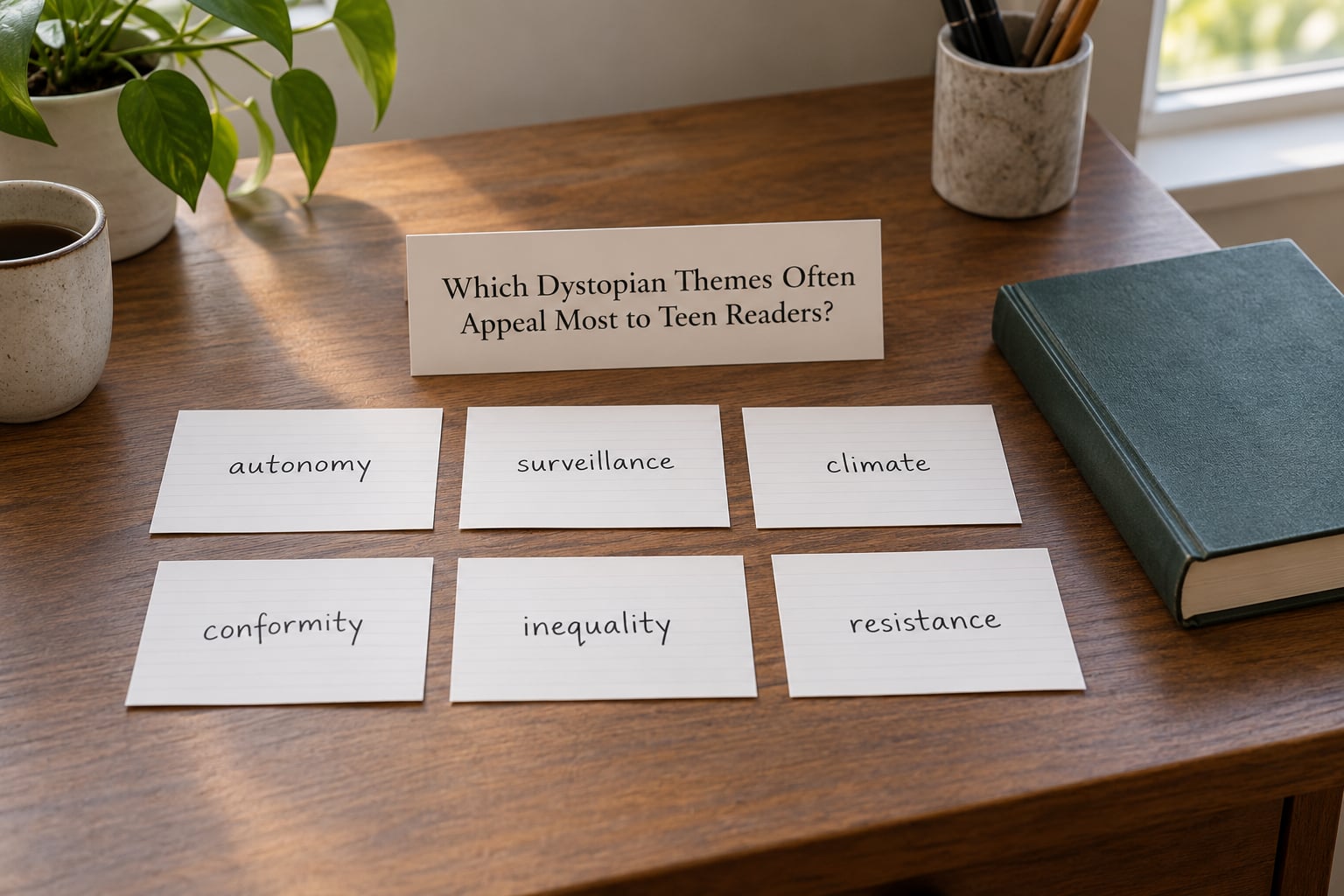
The table below maps the recurring themes to the feeling underneath them and to a book that handles each one well. It is a starting point, not a ranking — readers tend to pick by mood, not by importance.
| Theme | What it gives the reader | Example titles |
|---|---|---|
| Control and surveillance | Recognition, and something to push against | The Giver, Legend |
| Preassigned identity | Language for the pressure to conform | Divergent, Matched, Uglies |
| Climate and ecological damage | A future-shaped fear with stakes attached | The Water Knife, Red Queen |
| Inequality and rationing | Class and access made visible | The Hunger Games, Legend |
| Manipulated media | Real unease about attention and truth | The Handmaid’s Tale, Ready Player One |
| Resistance and cost | Agency, plus the price attached to it | Scythe, The Darkest Minds, The Maze Runner |
It is worth being honest about the criticism, because readers raise it themselves. Recurring requests on r/YAlit and r/dystopianbooks usually ask for something that is not a Divergent variation: a different structure, a different pace, a narrator who is not a chosen one. The formula really does get copied. So do readers who aged out of the genre entirely and now read romantasy or literary fiction, and who describe their old dystopian shelf as nostalgic comfort rather than a current preference.
That is a real limitation, and it does not cancel the appeal. A familiar structure is part of why a reluctant reader opens a book in the first place, the same way a comfort read is comfortable. The better titles keep the structure and change the world inside it.
How Can Parents and Teachers Choose an Appropriate Book?
Start with the reader’s age, then check the actual content rather than the cover. Dystopian fiction spans a wide range: The Giver is spare and gentle on the surface with a devastating final third, while Red Queen runs with explicit content and steady violence. Age bands on the cover are a rough filter, not a description.
Ask about four things directly: how much violence, whether sexual content appears and in what context, how dark the ending gets, and whether the book treats a real group or identity as the target of its critique. That last one is a genuine discussion point with older teens and worth raising rather than dodging.
For younger or sensitive readers, an easy re-order works. The Giver, The Maze Runner, and Matched sit lower on violence and sexual content than the current market average. Where a book does get dark, finish it — the reason most readers fell for the genre is that the world keeps going, and a book abandoned at the worst moment is exactly the one that makes the genre look pointless.
Then let the reader choose the next one. Reading a series start to finish without an adult picking the sequel is where the habit forms.
How Do You Discuss a Dystopian Novel With Teens?
Plot questions get “yes” answers, which is why they stall. Questions about a decision, a comparison, or an author move keep everyone talking. A few that work with almost any title in the genre:
- Which choice in this book would you have made differently, and what did it cost the person who made it?
- What does this society tell people about itself that is not true?
- Is this world worse than the one we live in, or a different kind of bad?
- What is the author warning about, and how would you know if the warning was working?
- Who benefits from the system, and do they know what it costs the rest?
- At what point would refusing no longer be the right call?
The fourth question tends to produce the best discussion, because it asks the group to argue about craft rather than preference. A comparison between the novel and its film adaptation works well too, if there is one: adaptations usually cut the interior thinking that makes a dystopia feel real, and noticing exactly what was removed shows how the book builds pressure.
Frequently Asked Questions
Why are dystopian novels especially popular among teenagers?
Dystopian novels take pressures teenagers already feel and give them a shape: a society that controls them, a future that feels unstable, and characters their own age deciding whether to comply. The genre offers suspense, moral choices with real costs, and a safe way to argue with authority. Because the danger is fictional, readers can rehearse independence, test values, and think about identity without facing any of the risk.
What age group is considered appropriate for reading dystopian fiction?
There is no single age. The category spans middle grade through adult, from Lois Lowry’s The Giver to Margaret Atwood’s The Handmaid’s Tale. Choose by content rather than label: check violence, sexual content, how dark the ending is, and how directly the book treats real groups. Younger or sensitive readers usually do better with The Giver, The Maze Runner, or Matched than with the current market average.
Are dystopian novels always considered young-adult books?
No. Dystopia and young adult fiction are separate categories that overlap heavily. Nineteen Eighty-Four and The Handmaid’s Tale are adult novels, and the Harry Potter series is usually read as fantasy rather than dystopia, though readers often argue it fits. The genre asks adult readers the same questions, so age label tells you about the intended audience, not the themes.
What themes do teenage readers commonly notice in dystopian stories?
Surveillance, conformity, inequality, propaganda, environmental damage, and the loss of individual choice come up most often. Teenagers also pick up the social layer adults assume is hidden: who benefits from a system, and how information is controlled. Because the settings are unfamiliar, readers often infer meaning from context, which is one reason the genre builds strong comprehension skills as a side effect.
How do I start a teenager who says they do not like reading?
Do not lead with the best book on the shelf. Lead with the one that moves fastest: The Hunger Games, Red Queen, or The Maze Runner open with immediate stakes and short chapters. Let them pick between three covers and set a stopping point they choose, so the book ends on their terms rather than on a cliffhanger you chose. Finishing one book is the whole goal; the sequence comes later.
What is the difference between dystopian and post-apocalyptic fiction?
Post-apocalyptic fiction begins with a catastrophe and explores what people build afterward, when old institutions are gone. Dystopian fiction begins with a working system that harms people by operating as designed, such as a surveillance state or a controlled economy. The books overlap often, but the question differs: one asks how people behave after failure, the other asks what happens when control succeeds.
Conclusion
Dystopian novels stay popular with teens because they do two jobs at once. They deliver a fast, high-stakes story, and they let a young reader argue with the world inside it — about identity, authority, fairness, and what they would actually do — with no danger attached.
Start with the theme rather than the series. Pick a book about the pressure the reader feels most, at a level of darkness they can finish, and let them choose what comes next. The Hunger Games remains the widest doorway into the genre, and The Giver is the shortest, but the books worth their time are the ones that keep asking questions after the ending.