Abigail Smith Adams (1744-1818) wrote more than 1,100 surviving letters between 1762 and the end of her life, mostly to her husband John Adams during his political career. They survive in the Adams Family Papers at the Massachusetts Historical Society and are readable free online. Their legacy rests on two things: a rare record of a woman’s political reasoning in the founding era, and one famous sentence that has been quoted for 250 years with the context changed.
That combination makes these letters unusually good study material and unusually easy to misread. This guide gives you the short list of documents, the themes that run through them, a method for reading any single letter, and a plain account of what historians argue about when they disagree.
Table of Contents
- What Are the Most Important Abigail Adams Letters?
- Abigail Adams Letters and Legacy: How the Two Connect
- What Do Abigail Adams’s Letters Reveal About Her Marriage?
- How Did Abigail Adams Express Ideas About Women and Equality?
- What Concerns About Slavery Appear in Her Letters?
- How Do the Letters Reflect the American Revolution?
- How Do You Read a Historical Letter Without Losing Its Context?
- What Legacy Did Abigail Adams Leave?
- How Do Historians Interpret Abigail Adams’s Letters and Legacy?
- What Are the Best Primary and Secondary Sources for Further Study?
- Frequently Asked Questions
- Where can I read Abigail Adams’s letters online?
- What is Abigail Adams best known for writing?
- Did Abigail Adams influence her husband’s political decisions?
- What did Abigail Adams mean by remember the ladies?
- How did Abigail Adams’s views on slavery compare with those of other founding-era women?
- Conclusion: Where to Begin
What Are the Most Important Abigail Adams Letters?
If you only have time for a handful, start here. Each entry below is a real letter from the surviving correspondence, with its date, recipient and reason it still matters to historians.
| Date | Recipient | Subject | Why it matters |
|---|---|---|---|
| April-May 1762 | John Adams | Courtship, written while he was undergoing a smallpox inoculation | Shows the pair’s intellectual partnership forming before either had a career, and includes her line about her pen being freer than her tongue |
| 27 April 1776 | Mercy Otis Warren | Revolutionary politics, Dunmore’s proclamation | A second political voice aimed at another woman, and a useful comparison with the letter to her husband |
| 31 March 1776 | John Adams | Independence, a new code of laws, and the rights of women | The most quoted and most mangled letter in American history, including “Remember the Ladies” |
| 20 September 1776 | John Adams | The “Race of Amazons” passage on women who defend their country | Complicates the feminist myth; she praises female patriotism while also accepting women’s exclusion from power |
| 24 July 1775 | John Adams | A private warning, intercepted by the British | The letter that hung the Adamses’ home with the phrase “star-spangled banner” in a hostile newspaper report |
| 29 January 1783 | Thomas Jefferson | Women’s education | Continues the argument for female education after independence, decades after the famous sentence |
| 8 January 1791 | Abigail Adams Smith | Family, daughters, and obligations among women | Shows the everyday network of female correspondence that the John letters sit inside |
| 5 June 1809 | Elizabeth Peabody | Women writers, education and intellectual companionship | Written near the end of her life; ties her own reading to the next generation of women |
| 2 November 1800 | John Adams | Friendship, memory and honest government | Contains his closing line, “May none but honest and wise Men rule under this roof,” and effectively ends the correspondence |
| Across the corpus | John Thaxter and others | War news, illness, harvests, prices, children | The unglamorous majority of the letters, and the reason historians call the archive a social document |
One practical note before you start. John and Abigail Adams exchanged over 1,100 letters, and the Massachusetts Historical Society holds about 1,160 manuscript pieces in the collection. Not every letter survives in the same form: some are recipient’s copies made by a clerk, some are letterbook copies kept in a bound volume, a few are drafts, and one famous item survives only through a newspaper transcription.
Abigail Adams Letters and Legacy: How the Two Connect
The letters and the legacy are the same body of work seen from two sides. Read them as documents and you get courtship, grief, harvests, a difficult marriage, war news and sustained argument. Read them as a legacy and you get a founding-era woman’s political voice, preserved at length, at the exact moment the new republic was writing its laws.
Five concerns recur often enough to trace across four decades: women’s political influence and education, the management of a farm and household through war, motherhood and repeated loss of children, the ethics of slavery in a slaveholding society, and what public duty owes to a family. Each one leaves a trace in the legacy, and each legacy claim can be checked against a dated letter.
What Do Abigail Adams’s Letters Reveal About Her Marriage?
They reveal a working partnership that included real argument. The two corresponded almost daily through courtship, through John’s years at the Continental Congress, through the diplomatic missions to France and the Netherlands, and through his vice presidency and presidency.
The courtship letters of 1762 set the tone early. John was recovering from a smallpox inoculation and worried about how his appearance and prospects would affect his prospects of marriage; Abigail answered with wit, literary reference and pointed questions about his plans. She also described her own situation plainly, including the limits she faced as an unmarried woman with no formal education and limited control over her own time.
Across the political letters, the pattern is different. Abigail read newspapers closely, followed debates in Congress, and gave John assessments of men and arguments he then carried into the room. Historians generally read the correspondence as genuinely collaborative rather than merely deferential, and readers on history forums often note that her letters are frequently more analytically sharp than his replies.
There were limits. Abigail supported John but did not always share his positions, and their letters show friction over his public life, their finances and their children. The famous 1776 sentence is usually read as a demand he refused; the surrounding correspondence suggests something messier, because John himself disliked the new state constitutions’ treatment of some liberties and remained a critic of unchecked popular power for the rest of his career.
Separation was constant. John was away for years at a stretch during the war and again during the European missions, and the letters from those years carry a repetitive rhythm: news requests, reassurance, illness reports and an ongoing negotiation about the farm in Braintree and the education of the children.
How Did Abigail Adams Express Ideas About Women and Equality?
She made two arguments repeatedly: that women needed real education rather than ornamental accomplishments, and that women had a political interest in how law was written even though they had no vote. The 31 March 1776 letter to John Adams is the compressed version of both, written while he was serving in the Continental Congress and while she was managing the farm and children in Braintree.
“I long to hear that you have declared an independancy – and by the way in the new Code of Laws which I suppose it will be necessary for you to make I desire you considerably to remember the Ladies, and to be particularly attentive to any and all new Laws respecting them, more especially to such as make an abridgement of their Rights, or in any way increase their disadvantages. what do you think will become of us? By the next New Years we shall have a new Set of Representatives if that is possible, I wish the Gentlemen would remember the Limitation of their Power. that unlimited power of the Husbands is a subject to me of continual disquiet. I have sometimes thought it would be a good thing if the Men would remember that the Women are their Country. I desire you would consider the Effects of a total change of the Constitution. which now stands on the footing of your assuming every thing as granted. … all Men would be Tyrants if they could. I am not sorry to transgress this rule, on such a subject, because I have long thought it an injustice to the female Sex. Remember the Laidies, and of those Sexes whose virtues are so well known, that you cannot read them without feeling as well as I do upon the subject. I have not heard of any amendment that may be favourable to it yet. dont you think we shall appear rather monstrous in the new Constitution? … I am willing to submit to every restriction that shall be favourable to the females, and I am happy to submit to those which are superfluous, provided they are worth it.”
The manuscript is four pages, dated 31 March to 5 April 1776, and it survives in the Adams Family Papers at the Massachusetts Historical Society. A second version is associated with the Emmet Collection at the New York Public Library.
Here is where the common retelling goes wrong, and it matters for essays and exams.
| What she actually wrote | How it is usually quoted | Why the difference matters |
|---|---|---|
| “Remember the Laidies” | “Remember the Ladies” | Original orthography tells you this is a manuscript, and that the modern slogan is a later smoothing |
| “limited power of the Husbands” | “the unlimited power of husbands” as her general grievance | She names a specific concern about the new constitutional arrangements, not a timeless complaint about marriage |
| “foment a Rebelion” appears in the letter as a hypothetical | Quoted as “foment a rebellion” as a statement of intent | The phrase is a warning about what unrestricted power invites, not a call to action |
| “all Men would be Tyrants if they could” | Presented as a slogan she invented | The line echoes an inherited rhetorical commonplace; historians trace similar formulations to earlier writers |
| Addressed privately to her husband, never published in her lifetime | Recast as a movement slogan | She was making a private argument to a man who could act on it, not addressing a public |
On the substance, her target was law. Women in the colonies were under coverture, which meant a married woman’s property and legal identity passed to her husband under English common law. Asking a lawmaker to “remember the ladies” in a new code of laws was, in that setting, a request about property and legal standing rather than a rhetorical flourish.
Her later letter to Thomas Jefferson on 29 January 1783 continues the education argument and shows she did not treat 1776 as the end of the conversation. What she did not do is argue for suffrage, a public role for women, or equal political rights in the modern sense. The Revolution ended restrictions on some men and left coverture and property law largely intact for women, and her correspondence reflects that limit rather than transcending it.
What Concerns About Slavery Appear in Her Letters?
Slavery appears in the correspondence more often than the famous gender letter suggests, and it appears with discomfort. Abigail grew up in a slaveholding Massachusetts household, and the family’s farm economy, household labor and social position all rested on enslaved labor. That tension runs through letters about household management, servants, illness and the Braintree farm.
Her stated positions were conventional for a Quaker-educated woman of her circle but sharper than her husband’s public record. She is on record in private correspondence as regarding slavery as contrary to the principles she claimed to hold, and she wrote critically of the violence and moral carelessness it produced. John Adams himself opposed slavery in principle while doing nothing to dismantle it and, as president, accepting the constitutional protections for it without significant challenge.
Historians are careful about how far to push this. Abigail’s antislavery statements appear largely in private letters, not in public advocacy. She held no office, ran no organization, and does not appear in the correspondence as a campaigner alongside women such as Phillis Wheatley or the Quaker schoolteacher Anthony Benezet, whose abolitionist work was public and printed. Her commitment is visible; its consequences are not.
That gap is one reason historians now read the whole archive together rather than extracting the 1776 letter. Read whole, it is the record of a thoughtful, well-read woman who could name injustice clearly in the abstract and still lived inside a system that made her comfortable. That is not a contradiction unique to her. It is the ordinary shape of the founding generation.
How Do the Letters Reflect the American Revolution?
They show what the Revolution felt like from inside a house with no vote in it: news arriving late, letters opened by enemies, harvests going unplanted, children sent away, and a constant calculation about which political decision would make the family safer. Six eras organize the whole correspondence, and the archive itself is organized the same way.
1762-1764, courtship and early legal career. Two hundred letters or more, much of it about money, debt and whether the courtship would survive John’s uncertain law career. Abigail’s self-education in political and classical history is visible in these pages.
1774-1777, Continental Congress and independence. The densest political stretch, including the letter about the new code of laws, the “Race of Amazons” passage, and the intercepted letter of 24 July 1775 whose paraphrase appeared in a hostile newspaper and put the Adams house under suspicion.
1778-1779, the mission to France. Abigail urged John to remember his family when negotiating with a court he found disagreeable, and she managed a farm and a household through his long absence.
1779-1789, Europe and the Treaty of Paris. Years abroad, illness, money worries, news of the Constitutional Convention, and Abigail’s reaction to the new federal government forming without her.
1789-1796, the vice presidency. The couple divided between Braintree and Philadelphia. Abigail’s letters about distance, family and the cost of public life show strain as clearly as any document of the period.
1796-1801, the presidency and the election of 1800. Abigail was the first wife of a sitting president to live in the White House, though the correspondence barely registers it; she wanted the rooms heated and complained about the kitchen. The era closes with 2 November 1800 and the line about honest and wise men ruling under that roof.
Her mechanism for influencing revolutionary debate was not office. It was family, reputation and argument: she read the same newspapers, understood the same factional fights, had access to other educated women through her own network, and wrote to a man with real authority. AskHistorians threads frequently make that point, and it remains the reason the archive matters for political historians as well as for students of letters.
How Do You Read a Historical Letter Without Losing Its Context?
Read the letter once for the facts of its making, then again for the argument. Eight questions cover almost everything, and they take about ten minutes per letter.
Who wrote it, and to whom? Abigail’s letters to John are intimate and politically direct. Her letters to Mercy Otis Warren are collegial. Her letters to Elizabeth Peabody near the end of her life read like a teacher passing on a reading list. The recipient changes what she assumed the reader already knew.
What date, and what was happening that week? A letter written on 31 March 1776 sits between the Battle of Lexington and the Declaration. Almost nothing in it makes sense without knowing Congress was about to write a new constitution.
What kind of document is it? A retained copy, a letterbook copy, a draft or a clerk’s fair copy are not the same object. The Massachusetts Historical Society archive distinguishes them, and it explains the one nineteenth-century newspaper transcription separately because it is a later document about a letter rather than the letter itself.
What are the exact words? Use the transcription, and keep the spelling. “Laidies” and “foment a Rebelion” are not errors to clean up. They are evidence that you are reading an eighteenth-century hand rather than a modern slogan.
What did she assume? Abigail wrote to a man who had read the same debates she had. She did not define terms like tyranny or representation because she assumed a shared political vocabulary, which also means an unfamiliar reader needs that context supplied from elsewhere.
Who was meant to see it? None of it was published in her lifetime. That is what makes the archive candid and also what limits it: private letters record worry, not platform.
What was the intended effect? Ask what she wanted John to do. Advice about a vote, a treaty, a harvest or a child’s schooling tells you far more about her priorities than a summary of her views does.
How did later generations change the meaning? Finally, check the reception. A line that became a slogan in the twentieth century may have been a private aside in 1776, and the difference is the whole argument of the next section.
What Legacy Did Abigail Adams Leave?
The documented influence is real but specific. Abigail’s letters show John Adams consulting her judgment on political and family questions, and historians read the correspondence as a working partnership rather than a decorative one. The influence is harder to measure than the word suggests, because he rarely attributed her advice in public and the record gives us her side far more fully than his.
The influence on their son John Quincy Adams is more visible, partly because he later wrote openly about his parents and partly because he inherited the habit. Abigail’s letters to her children about education and public duty read as an early version of the argument she made to her husband, and the son carried a version of it into his own political life.
The larger legacy sits in the debate over republican motherhood, the idea that women would shape the republic indirectly, through the character of the next generation and the moral pressure of their opinion. Abigail’s letters both fit that framework and complicate it, because her interest in politics was direct and practical rather than purely maternal. She wanted a say in the laws.
Set against that is the commemoration story, and the two should not be blended. Abigail Adams entered popular culture largely through the twentieth-century revival of the “Founding Mothers” as a corrective to a Founders-only story. That recovery was valuable and it made her letters widely read. It also contributed to the distortions examined next, by treating her as the representative of a cause she described in far narrower terms.
Her final years are worth a note. She was largely bedridden and blind in her last years, surrounded by her daughter and grandchildren, and she kept reading and dictating until close to her death in 1818. She died three years before her husband. Whatever is claimed for her legacy, it rests on her own hand rather than on later hands writing about her.
How Do Historians Interpret Abigail Adams’s Letters and Legacy?
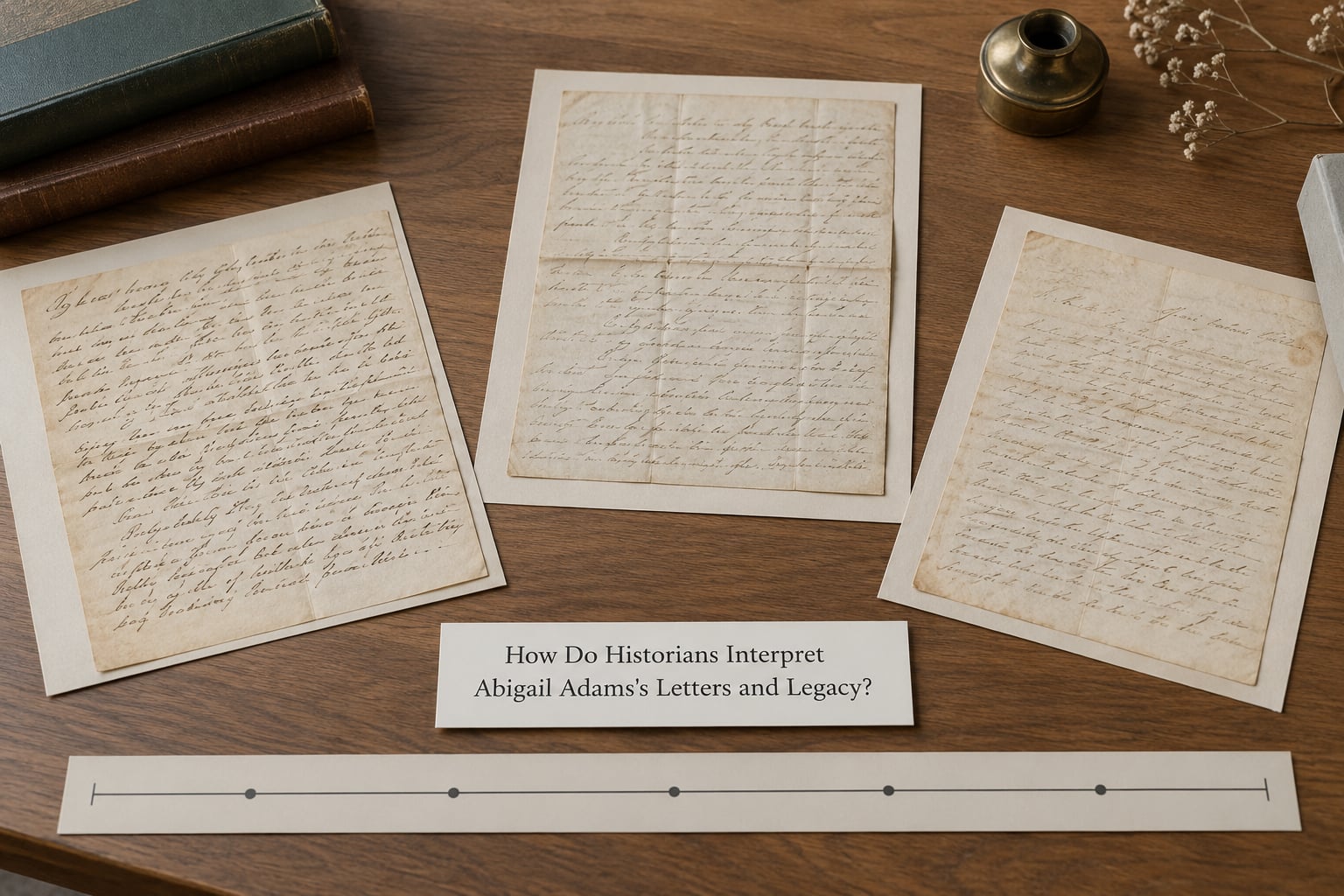
Four interpretive positions dominate, and none of them cancels the others.
Abigail as a political writer. This reading treats the letters as political reasoning in its own right, not as a woman’s commentary on a man’s career. On this view, her assessments of political actors are consistent, specific and often more analytically precise than her husband’s replies, and her interest in legislation is a natural extension of a household manager tracking property, credit and law.
The feminist myth debate. This is the most contested question, and it deserves a careful answer rather than a slogan. Scholars including Lori Udell and Elizabeth Dexter have argued that Abigail has been made to stand in for a women’s rights movement she did not organize and did not describe in modern terms. The evidence cuts both ways: she argued explicitly and repeatedly that women were being denied rights, which is a serious claim about equality, and she did so within a framework where she accepted coverture and declined to demand suffrage. Historians who wrote the “Abigail Adams, the Feminist Myth” critique argue that her significance was largely assigned retroactively, especially once the 1776 letter was excerpted and reprinted without its context.
The antislavery question. Reading the letters whole complicates both the celebratory and the dismissive accounts. Abigail named slavery as an injustice and lived inside it comfortably. Scholars who study the founding generation’s racial bargain tend to treat her as a useful case because the letters show the limit of reformist thinking in a period when few of her contemporaries moved from principle to action on race.
The marriage as historical evidence. A large body of scholarship uses the Adams correspondence to study eighteenth-century marriage as a partnership rather than a sentimental romance, and to study letter-writing as a form of political labor. Abigail’s education of her children by mail, her management of the farm, and her candid complaints about her husband’s public ambitions are the standard evidence.
Where most historians now agree is on method: quote the letter with its date, recipient and surrounding paragraph. The forum consensus on r/AskHistorians is close to unanimous that the letter is remarkable without being the founding document of a modern movement, and that the two claims are not actually in conflict.
What Are the Best Primary and Secondary Sources for Further Study?
The good news is that nearly all of this is free online and often includes full-color manuscript images. Start with the Adams Electronic Archive at masshist.org/digitaladams, which pairs the digitized Adams Family Papers with transcriptions and a chronological index of the correspondence. Founders Online at founders.archives.gov carries the National Archives’ annotated transcriptions of the Adams papers, useful when you want editorial notes on people and events. The National Constitution Center’s historic document library holds a clean document record for the 31 March 1776 letter.
For the archives themselves, the Massachusetts Historical Society holds the Adams Family Papers and publishes a description of what survives: recipient’s copies, letterbook copies and drafts, plus notes on the exceptions, including one letter kept in the Warren-Adams Collection and a set of uncatalogued letterbook copies.
On biography, two titles anchor the field. The best starting point for the letters in context is the standard edition of the correspondence, which preserves dates, recipients and editorial annotation across the whole run. Beyond that, modern biographies built on the papers give you the political and domestic context that a single letter cannot supply. For the debate about her reputation, the feminist-myth scholarship is the essential corrective, and it is worth reading alongside any celebratory treatment so you can see exactly where the two accounts part company.
For women’s-history resources, look for material that places the Adams correspondence beside Mercy Otis Warren’s political writing, Elizabeth Peabody’s, and the published arguments of women who, unlike Abigail, wrote for print and for a public audience. The contrast is instructive and it is the fastest way past the myth in either direction.
For citation, students should give the date, recipient and repository, and should note whether they read a manuscript image or a modern transcription. Something like Abigail Adams to John Adams, 31 March 1776, Adams Family Papers, Massachusetts Historical Society, Adams Electronic Archive, is enough and it is verifiable.
Frequently Asked Questions
Where can I read Abigail Adams’s letters online?
You can read them free at the Massachusetts Historical Society’s Adams Electronic Archive, which includes full-color manuscript images and transcriptions, with a chronological index covering 1762 to 1801. Founders Online at the National Archives offers annotated transcriptions, and the National Constitution Center’s historic document library has a clean record of the 1776 letter. All of these are usable for citation.
What is Abigail Adams best known for writing?
She is best known for the letter of 31 March 1776 asking John Adams to remember the ladies in any new code of laws. Her surviving output is much larger than that one document: more than 1,100 letters covering courtship, war, farm management, childrearing, health, money and repeated arguments about women’s education and legal standing, written between 1762 and 1818.
Did Abigail Adams influence her husband’s political decisions?
The letters show a genuine intellectual partnership. Abigail read the same debates, judged politicians and arguments, and pressed John on family and policy questions across four decades of his public life. Historians treat the correspondence as collaborative rather than decorative. Measuring the effect is harder, since John rarely credited her advice in public and her side of the exchange survives far more fully than his.
What did Abigail Adams mean by remember the ladies?
She meant that any new legal code should account for women. Her request targeted coverture, the common-law rule that folded a married woman’s property and legal identity into her husband’s. She asked lawmakers not to write new disadvantages for women and doubted they would, since they did not represent the sex. She was making a private argument to a legislator, not addressing a public movement.
How did Abigail Adams’s views on slavery compare with those of other founding-era women?
Her private letters record a clear discomfort with slavery and its moral costs, which fits the Quaker-influenced antislavery sentiment of her circle. Where she differed from figures like Anthony Benezet or the poet Phillis Wheatley was in public action: she never organized, printed or petitioned. She named the injustice from inside a comfortable slaveholding household, which is why historians read her as a case study in the gap between founding principles and founding practice.
Conclusion: Where to Begin
Pick one letter and read it end to end, including the paragraphs before the sentence everyone quotes. Note the date, the recipient and what Abigail wanted John to do. Then take one of the five recurring concerns and follow it across a decade of correspondence, and you will have both the evidence and the argument that a summary of the famous line cannot give you.
If you want the full scholarly framing before you start, the historiographical section above is the one to return to after a few letters, because the myth is easier to see once you have the real thing in front of you.