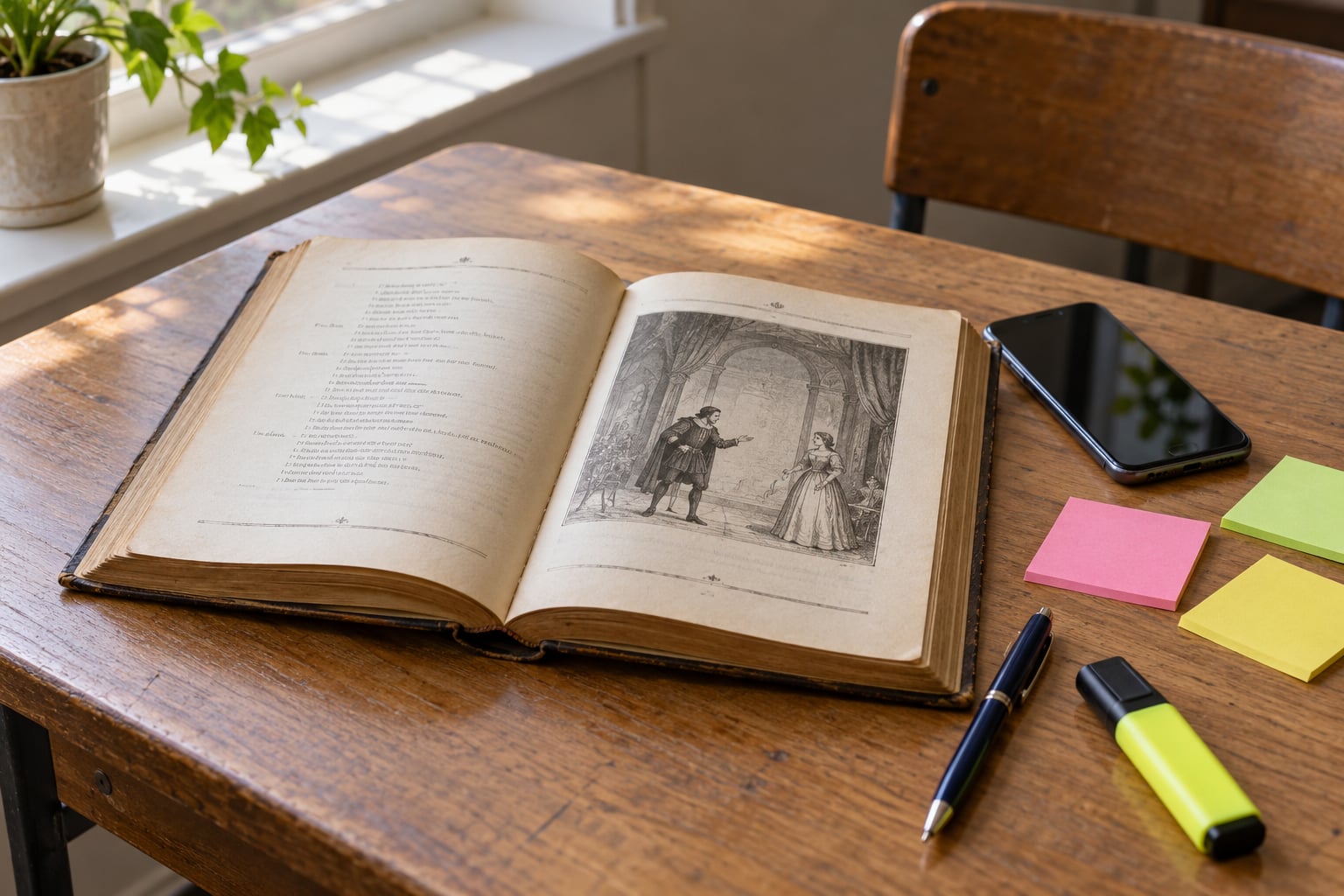
The best way to teach Shakespeare to reluctant students is to stop asking them to sit through a full play in silence and start putting short extracts in their mouths, hands and arguments from day one. Performance, side-by-side translations and low-stakes writing tasks do more for engagement than any amount of background lecture.
Here is the short version I hand to colleagues before a unit starts: pick one clear conflict, rehearse it aloud, give students a way to be wrong without penalty, and assess what they understood rather than what they could decode. That approach takes about ten minutes of prep per activity and works in a single period. It is not fancy, and it does not require a drama specialist or a stage.
This guide is for secondary and middle school English teachers, teaching assistants and homeschool parents running a unit in a mixed-ability room. The nine steps below run in order, but most classes end up borrowing two or three and skipping the rest. That is fine.
Table of Contents
- What You Need
- Step-by-Step: How to Teach Shakespeare to Reluctant Students
- Start With a Low-Stakes Choice
- Connect the Story to Students’ Lives
- Choose an Accessible Starting Point
- Build Vocabulary in Context
- Use Guided Close Reading Together
- Turn the Text Into a Collaborative Activity
- Discuss the Film or Performance Choice
- End With a Small Creative Product
- Replace Cold-Reading Quizzes With Low-Stakes Checks
- Common Mistakes
- Frequently Asked Questions
- Which Shakespeare play is best for reluctant students?
- How can I teach Shakespeare without making students perform?
- Should reluctant students read a modernized edition of Shakespeare?
- How much vocabulary should I preteach before reading Shakespeare?
- What if students refuse to participate in discussion?
- How long should a Shakespeare lesson be for students who are struggling?
What You Need
None of this needs a budget. It needs a small set of prepared materials that you build once and reuse across periods.
- An accessible text or performance. One public domain edition you can project, plus a modern-spelling version for students who stall on the original. Folger Shakespeare Library and the Royal Shakespeare Company both publish free resources, and No Fear Shakespeare gives a plain-English side-by-side that works well for a first read.
- Short scene selections. Three or four extracts of 60 to 150 lines, not whole acts. Print them double-sided with line numbers in the margin.
- A plain-language context sheet. One page. When Shakespeare wrote, who was on stage, what a soliloquy actually is, why nobody explains anything in a play.
- Annotation tools. Coloured pens or highlighters, sticky notes for wall work, and a one-page annotation key so students mark the same things.
- Optional bridges. A film or stage clip, a graphic-novel adaptation, or a three-minute audio scene. Use them as a way in, never as a replacement for the text.
- Cue cards and a short cast list. If any scene gets staged, decide the casting before the lesson and hand out two or three roles that require no reading at all.
Set your prep time expectations honestly. The circle opening and the collaborative activity each take under ten minutes to build. The close reading takes longer, because you have to pick the passage.
Step-by-Step: How to Teach Shakespeare to Reluctant Students
Start With a Low-Stakes Choice
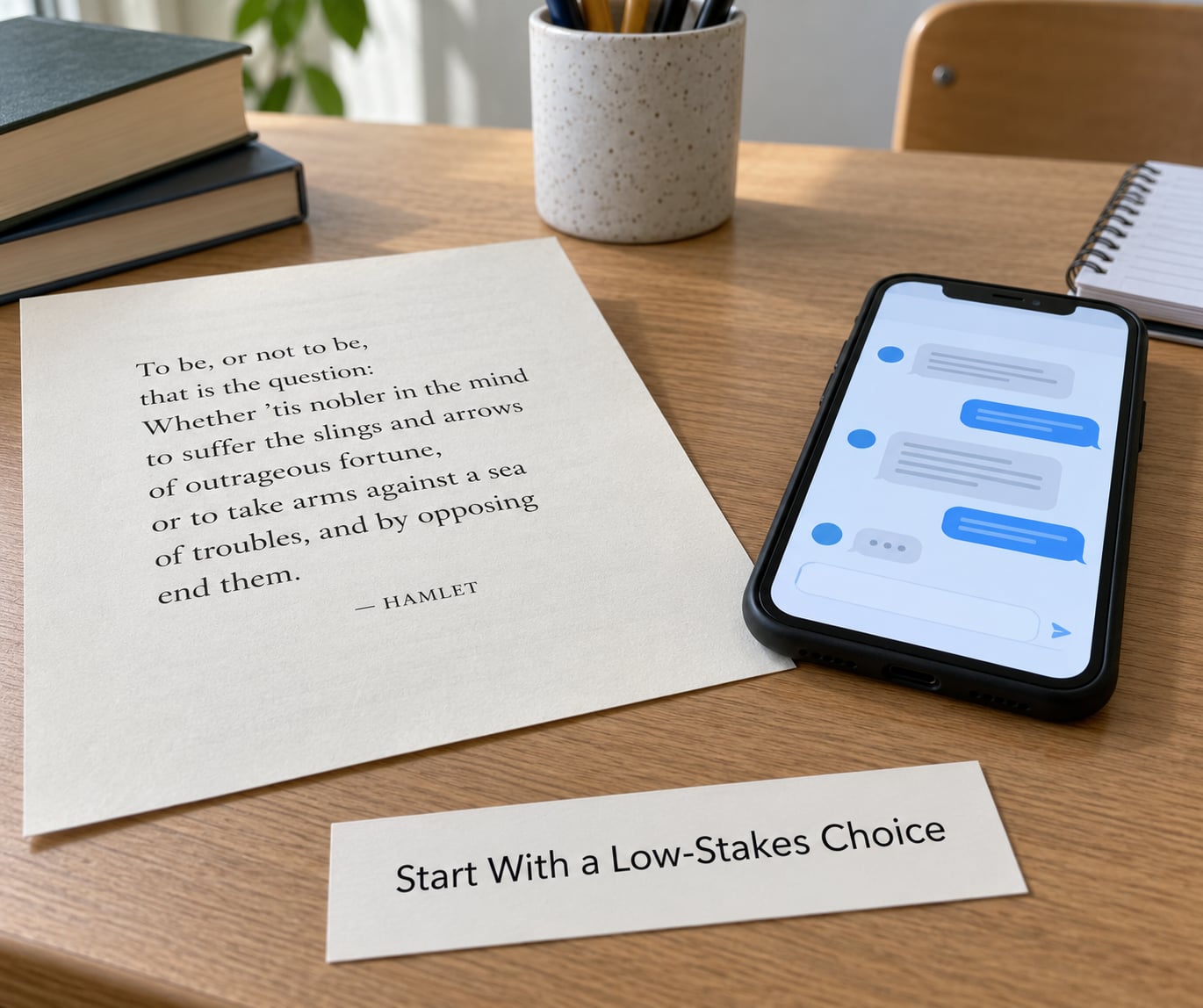
Open with a question anyone can answer, before a single line of Shakespeare appears on the board. I use a round-the-room “Shakespeare is…” circle: students complete the phrase out loud, and that is the entire demand. Unforgettable, boring, old, worth studying, violent, confusing. You get eye rolls and snorts in the first ninety seconds, and now the room has energy.
Then the question that does the real work. Put one short quotation on the board — something from a Juliet balcony scene or an Antony Cleopatra speech — and ask students to write a sticky note answering one thing: what does this person want, and what is stopping them? No reading of the full play. No analysis vocabulary.
You will know it worked when the notes on the wall disagree with each other. Disagreement means students made an interpretation, which is the whole goal for the first ten minutes. If every note says the same thing, ask for the evidence behind one claim and watch the room get quiet.
Connect the Story to Students’ Lives
Reluctance usually comes from a story the student cannot locate. Before asking anyone to struggle with early modern English, give them the plot in their own words, then anchor it to conflicts they already recognise: a friend who betrays you for status, a family that expects you to be loyal against your own preference, someone who does something clever and ends up humiliated.
A ten-minute retelling is worth it. Tell it badly, with interruptions and a joke, the way you would tell a friend a film you watched. A character map on the board beats a printed timeline every time, because students can add to it while you talk. Macbeth wanting the crown, a wife pushing him, a friend who cannot stop bragging — that triangle lands with a fifteen-year-old in about ninety seconds.
Pop culture is already in the room. If a student walked in knowing Romeo and Juliet through a film, a teen series or a meme about balcony scenes, use it rather than pretending it does not exist. Show one clip, ask what the director chose to keep and what they cut, and let the original text arrive as a second version of something they half-know.
Somewhere here, someone will ask why you are teaching this at all. The honest answer beats the standard one. Say that Shakespeare wrote lines people still steal four hundred years later, that the plots supply most of the world’s popular story shapes, and that reading difficult language on purpose is a skill adults pay for in job interviews. If the room wants more argument, give it; teachers describe this objection as the one that most needs a rehearsed response rather than a slogan.
The weakest version of the answer is that Shakespeare is timeless because his themes are universal. Students have heard universal often enough to hear it as a brush-off. The version that survives contact with a teenager is smaller and more specific: here is a line written four hundred years ago that is still the exact phrase you would use today, and here is the technique behind it. Let the craft be the argument rather than the moral.
Choose an Accessible Starting Point
Teach a scene, a sonnet or a speech rather than a whole play. The extract should have one clear conflict, two voices that sound different, and enough pressure that reading it aloud is interesting on its own. If you cannot name the conflict in a sentence, it is the wrong extract.
Some entry points suit a reluctant room better than others.
- Romeo and Juliet. Fixes perceived irrelevance and vocabulary load. Start with the balcony scene and the tomb scene, read in sequence so the escalation is obvious.
- Much Ado About Nothing. Fixes the fear of looking foolish, because the insults are the lesson. Open on Beatrice and Benedick’s first exchange.
- The Tempest. Fixes cultural distance. Pair Prospero and Ariel and hand out a short cast list before you start.
- Twelfth Night. Fixes reluctance to perform and low confidence. The opening shipwreck plus Viola’s first speech gives you two clean entry scenes.
- Macbeth. Fixes short attention spans. The banquet scene is short, physical, and easy to stage in ten minutes.
- The Sonnets. Fixes an overwhelming sense of length. Read Sonnets 18, 29 and 116, one line deep in each.
For a middle school or ESL/ELL class, drop the reading load further. Read the scene aloud twice while students follow on a modern-spelling printout, and ask them to mark only the lines that confuse them. Those marked lines become the vocabulary list in the next step, which means the preteaching is targeted instead of generic.
You will know the extract is right when a reluctant student asks a question about a character’s motive before you have prompted one.
Build Vocabulary in Context
Preteaching a word list of archaic diction in the old-fashioned way creates a wall. Students memorise eight terms, forget them, and still cannot read the scene. Instead, teach six to eight words that your marked lines actually require, and show students how to get the rest from context.
The three moves worth modelling: look at the syntax, notice repetition and contrast, and check the words on either side. A line such as “she doth teach the torches to burn bright” gives you structure, not a dictionary. Show that the meaning sits in the relationships between words, and that guessing wrong in front of the class is normal.
Use a glossary sheet rather than a lecture. Six common ones that trip up most classes: thou, thee, thy for the pronoun set, betimes for early, blench for flinch, fardel for a small parcel, bodkin for a dagger, and wherefore for why, which has nothing to do with location.
The quick check is whether students use the words themselves. Give them two sentences to fix using two of the new words, or ask them to rewrite one line in modern English and name the archaic phrase they replaced. If they can do that in a sentence each, the vocabulary is doing its job.
Use Guided Close Reading Together
Close reading works with reluctant students when the teacher goes first and the room goes second. Model one short passage yourself, out loud, thinking through what you notice: the word that stands out, the shift in tone, the thing the character does not say. Then hand over the annotation key and let them do the next passage with a partner.
Keep the questions moving from what to why. What does the character say? Which two words carry the weight? Why did the writer choose that word instead of an obvious one? Why does the line come here and not earlier? That last question is where reluctant students start to sound like readers, because it makes them directors rather than decoders.
Avoid two failure modes. Do not turn the lesson into a line-by-line interrogation of thirty lines, and do not perform the whole analysis yourself while students copy it. One modelled passage, one paired passage, one short share-out is a full forty minutes done well.
Watch for the student who annotates nothing. Give that student a different job on the page, such as marking every question mark Shakespeare leaves hanging, and let them contribute through that lens. Teachers running mixed-ability classes describe this as the difference between participation and blank-page panic.
If the share-out stalls, stop waiting for volunteers. Read one student’s note aloud yourself and ask the room whether the evidence holds, which turns a cold question into a warm debate about somebody else’s idea. Close reading only feels intimidating when the first voice in it is the weakest reader’s.
Turn the Text Into a Collaborative Activity

This is where a reluctant class usually turns around, and where teacher planning matters most. Prepare the options in advance so that participation never depends on a student volunteering on the spot.
Options that work: freeze-frame interpretation, where students build the tableau and the class asks questions about it; hot seating, where one student plays a character for three minutes while others ask questions; staged dialogue with modern phrasing and no memorisation; a courtroom scene for a trial of a major character; and character journals written in first person, which is the lowest-stakes option of all.
Cast ahead of time and never cast by reading ability. Choose roles on the strength of who has something to say, then tell shy students their part in a private word before the lesson. If someone is going to be on stage, they need to know what their lines are by the end of the previous class, not at the top of this one.
One reliable warm-up takes four minutes and needs no scene knowledge. Pair students back to back for Back to Back, face to face and far apart for Far Apart, chest to chest for Over the Top, then a chat about how the same words landed differently. It teaches the physical register of early modern English before anyone has to perform it, and students remember it for weeks.
You will know it worked when quiet students start quoting the scene at each other later in the week. That is the signal that the text has moved from the page into their speech.
Pacing matters more than people expect. Two activities per lesson, forty-five minutes, always finishing with the text in someone’s mouth rather than on a worksheet. Once a class has rehearsed a scene, the next lesson opens on their own lines instead of a cold start, and that continuity is most of what turns a unit around.
Discuss the Film or Performance Choice
Watching an adaptation is the most common shortcut, and on its own it is the one that teaches least. Teachers consistently warn that students walk away remembering the actor’s face and nothing about the language. Used properly, though, a performance is a lens that makes choices visible.
Watch one short scene with the text in front of students, then ask what the performance clarified and what it hid. Did the actor find the joke in a line that reads flat on the page? Where did the film cut ten minutes that changed who the audience blames? What did a director do with a speech that only works when you hear the rhythm of it?
Then the productive question: which reading of the character did this performance commit to, and what in the text supports that reading? Students get to hold an opinion and check it against evidence, which is the skill the unit is really for. Different film versions of the same scene, played back to back, do more for close reading than a lecture on interpretation.
When the class asks whether they can just watch the film version, the answer is that they can, and then the extract still gets read. The performance makes them want to read; it does not replace the reading.
End With a Small Creative Product
Give students a choice of formats and a short checklist of what the evidence must contain. Choice is the scaffolding here; without it, a creative task is just an extra hoop.
Formats that produce usable evidence: an exit ticket of three sentences with one quotation attached, a social media post from a character’s point of view, a sixty-second voice memo explaining one motive, an alternative ending of ten lines, or a standard analytical paragraph with a topic sentence and two quotations. Some students hand in paper; recording the voice memo on a phone is usually the single best inclusion for a reluctant reader, because it removes handwriting from the equation.
Put the requirements on the board in this form: one quotation, one piece of language detail you noticed, one thing the character wants. That is a floor, not a ceiling, and it stops the task collapsing into vague opinion.
Collect them as you go rather than at the end of the unit. A stack of exit tickets from week one tells you which scenes to spend time on in week three.
Replace Cold-Reading Quizzes With Low-Stakes Checks
Assessment decides who survives a Shakespeare unit, and the standard cold-reading quiz is why reluctant students decide early that they have lost. A student two reading levels behind in early modern English is being graded on a skill the assessment never taught. No amount of good activity undoes that.
English teachers report the most reliable version of this: storyboard each scene, then attach a close reading of one key passage to the board. It checks comprehension, sequencing and language analysis in one artefact, and it does not ask a weak reader to decode forty pages in silence. Pair it with the annotation work from step five and you have a summative task that most reluctant students can actually complete.
Other options worth knowing: short performance tasks with a written reflection afterwards, a choice of two extract analysis questions rather than one, oral delivery credit for students whose written work understates their understanding, and vocabulary checks that test the six words you taught rather than forty from a list nobody saw.
If the school scheme still requires a cold-reading assessment, keep it and add these alongside it. A student who sees two different ways to be assessed stops reading the room for signs of which one counts.
Common Mistakes
Overloading the opening with context. Forty minutes on Elizabethan theatre, the Globe and the religious settlement produces a class that knows more about the period and less about the play. Teach one page of context and get to the extract. You can add history later, when a question demands it.
Treating reluctance as disrespect. The groan arrives before you have taught anything, and it is usually a social performance rather than a considered objection. Answering it with sarcasm confirms the stereotype. Name it instead: tell the class that everyone finds this language hard at first, including you, and that the plan this week is to read it out loud until it stops sounding foreign.
Making performance mandatory. Forcing a reluctant or anxious student onto the floor in week one can cost you the whole term. Offer the freeze-frame, the written hot-seat answers or the audio recording instead, and keep live staging for students who opt in. Readiness varies more than ability.
Asking vague questions. What do you think about this scene? produces silence every time. Ask what a character wants in that moment, or which of two readings the evidence supports, and give students thirty seconds of silent write time first. Silent thinking is not reluctance; it is processing.
Correcting every interpretation. If you take the floor away from students who misread, they will learn to stay quiet rather than risk being wrong. Accept the reading, ask which two words support it, and let the evidence do the arguing. Save your correction for the factual errors that matter.
Assigning long, intimidating passages. A whole act for homework is the fastest way to produce a class that has all decided the text is unreadable. Set line ranges instead, around eight to twelve lines, and tell students which question to answer while they read.
A few habits that keep momentum when the class sags. Vary the mode every lesson: one day oral, one day written, one day visual. Cast ahead of time, always. Give warnings before transitions, because the students who dread Shakespeare also dread being surprised. And take your own dread seriously; teachers who admit the text is hard get more cooperation than teachers who perform effortless command of it.
Track the room honestly rather than by assumption. Count how many students spoke in the last ten minutes, how many exit tickets came back, and how many finished the extract. Those three numbers tell you more about engagement than any impression you form from across the room.
And if a unit has already gone quiet, do not restart it. Drop the play for a week and run a single scene well, even if that breaks the scheme’s order. Teachers describe the recovery unit as a deliberate retreat rather than failure: one extract, one performance, one finished piece of writing, then the full text returns to a room that has had one success with it.
Frequently Asked Questions
Which Shakespeare play is best for reluctant students?
Much Ado About Nothing usually works best for a hesitant class, because the comedy carries the meaning and the insults give students something to argue about. Romeo and Juliet is the safest alternative when you need a familiar plot. Avoid Hamlet and Macbeth early in a unit; the density adds to the reading load rather than reducing it.
How can I teach Shakespeare without making students perform?
You can teach the whole unit without a single staged scene. Use freeze-frames, written hot-seat responses, character journals, audio recordings and storyboard work instead, all of which ask for interpretation without an audience. Many teachers run the performance version in one period and the written version for anyone who opts out.
Should reluctant students read a modernized edition of Shakespeare?
Yes, as a bridge, not a replacement. Reading a modern-spelling side-by-side version first lets low readers get the plot and the motive, and they return to the original with a hypothesis about what the old wording is doing. Keep both open during close reading so the translation never becomes a substitute for the text.
How much vocabulary should I preteach before reading Shakespeare?
Six to eight words, chosen from the passage rather than from a list. Teach them through syntax, repetition and contrast instead of definitions, then check understanding by having students use each word in a rewritten line. Students working alone can infer the remaining words, and inferring is the skill you actually want.
What if students refuse to participate in discussion?
Lower the stakes before you push harder. Start with anonymous sticky notes on the wall, then thirty seconds of silent write time before any spoken answer, then pair talk before whole-class talk. If discussion still stalls, run a text-based seminar where students respond in writing and the room reads responses aloud instead of speaking cold.
How long should a Shakespeare lesson be for students who are struggling?
Keep it to one extract and one clear task, which usually fits a forty-minute period with room to spare. Two extracts in one lesson reliably exceeds what a struggling reader can hold. If your scheme gives you a double period, use the first half for reading and rehearsal and the second for the written or performance task.
Do one thing first: pick your extract, cut it to about a hundred lines, and rehearse it aloud in your own room before you teach it. Everything else in this guide works better once you have heard the scene breathe, and a teacher who has enjoyed saying the lines aloud tends to build a room that enjoys hearing them too. When you plan how to teach Shakespeare to reluctant students next term, the first cohort will tell you within two weeks whether the sequence is working.